
Threat Hunting Market Growth, Trends & Forecast by 2034
Threat Hunting Market Size and Forecasts (2021–2034), Global and Regional Share, Trends, and Growth Opportunity Analysis Report Coverage : By Component (Solution, Services); Organization Size (Large Enterprises, SMEs); Threat Type (Advanced Persistent Threats (APTs), Malware and Ransomware, Insider Threats, Phishing and Social Engineering, Others); End Users (BFSI, IT and Telecom, Healthcare, Retail & Ecommerce, Manufacturing, Others)
- Status : Data Released
- Report Code : TIPRE00039653
- Category : Electronics and Semiconductor
- No. of Pages : 150
- Available Report Formats :


- Last update date : July 21, 2026


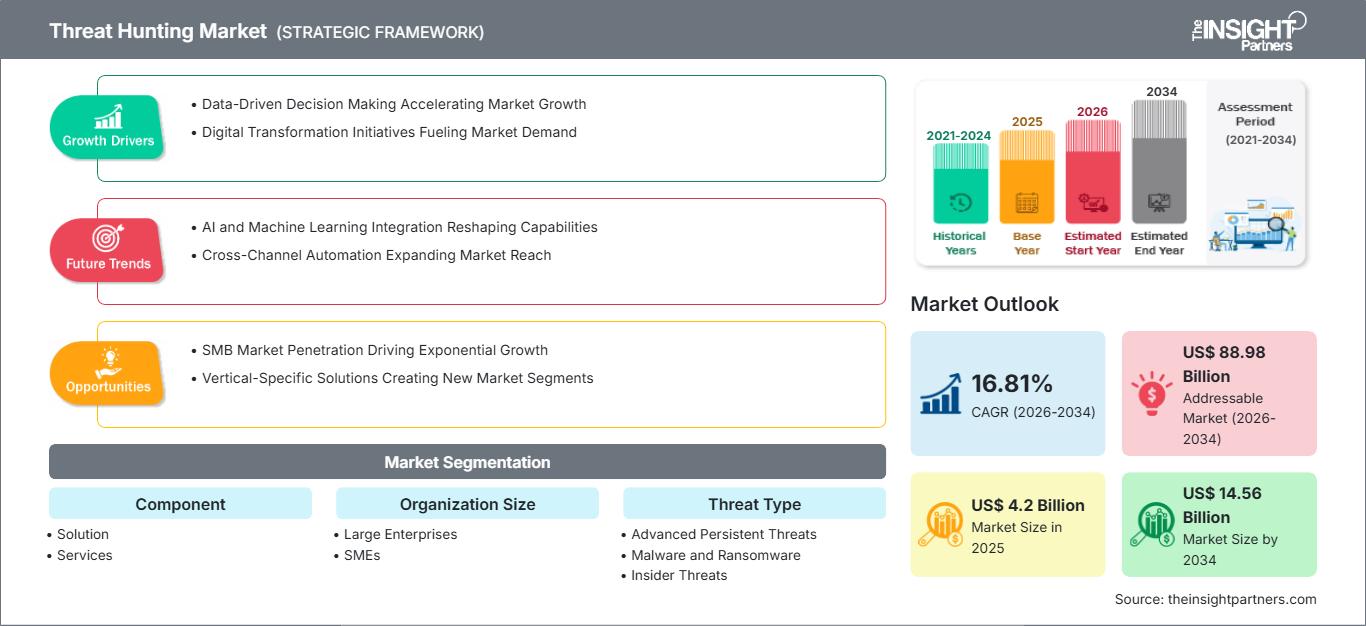
2025 Market Size
US$ 4.2 Bn
Base year value
2034 Forecast
US$ 14.56 Bn
Projected by 2034
CAGR 2026-2034
16.81 %
Growth rate
Addressable Market
US$ 88.98 Bn
(2026-2034)
The Threat Hunting Market size is projected to expand from US$ 4.2 Billion in 2025 to US$ 14.56 Billion by 2034, registering a CAGR of 16.81% during 2026–2034. As the number of advanced persistent threats, ransomware attacks, insider threats, and social engineering attacks rises, the market transitions from periodic analysis to constant and intelligence-driven discoveries on endpoints, cloud workloads, identities, and enterprise networks.
In North America, Threat Hunting Market Size is bolstered by substantial enterprise-level security expenditure, advanced managed detection and response, and regulations within BFSI, healthcare, telecommunications, and critical infrastructure. This region will experience a CAGR of 15.8-16.5% from 2026-2034 due to investigations using identities, cloud native telemetry, and skilled analysts.
Threat Hunting Market Assessment and Insights
- North America held 39–42% share in 2025 and is growing at a CAGR range of 15.8–16.5% during 2026–2034, supported by mature SOC modernization, cloud migration, and critical infrastructure defense programs.
- US accounted for 82–86% of North America in 2025 and is growing at 15.9–16.6% CAGR, driven by federal cyber mandates and enterprise platform consolidation.
- Europe represented 24–27% share in 2025 and is growing at 15.2–16.0% CAGR, with the UK, Germany, France, Italy, and Spain leading demand under operational resilience requirements.
- Asia Pacific captured 21–24% share in 2025 and is growing at 18.0–19.2% CAGR, led by China, Japan, India, South Korea, and Australia as digital infrastructure expands.
- Largest Segment Solutions held 66–70% market share in 2025 and is growing at 15.6–16.4% CAGR as enterprises prioritize integrated analytics, endpoint telemetry, and threat intelligence platforms.
- High Growth Segment SMEs held 28–32% market share in 2025 and is growing at 18.4–19.6% CAGR through managed services and affordable cloud-based detection models.
- Key companies analyzed in detail: International Business Machines Corporation, AO Kaspersky Lab, Capgemini SE, CrowdStrike Holdings, Inc., Trustwave Holdings, Inc., Verizon Communications Inc., SecureWorks Corp., Rapid7, Inc., Trend Micro Incorporated, Palo Alto Networks, Inc.
Source: The Insight Partners' analysis based on proprietary research, government publications, company annual reports, investor presentations, industry databases, and expert interviews.
Security operations have evolved from alert triaging to hypothesis-based investigation owing to an increasing use of identity, SaaS entitlements, cloud misconfigurations, and living-off-the-land tactics by attackers. Threat Hunting Market relies on telemetry normalization, behavioral analysis, analyst workbenches, and intelligence feeds as opposed to endpoint alerts alone. The production landscape is evolving to include vendors' integration of AI-powered investigation, managed detection and response, and threat intelligence capabilities into unified SOC solutions for overcoming tool sprawl and speeding up investigations.
Adoption is likely to expand across regulated mid-market firms, digital economies of Asia Pacific, and energy-rich infrastructure projects in the Middle East over the forecast period. Funding is expected to go into managed hunting, cloud detection engineering, and identity threat analysis as organizations deal with talent gaps. Regulatory headwinds due to financial resiliency laws, privacy regulations in healthcare, and national cyber security frameworks will drive continuous monitoring as a risk management process for the board.
Threat Hunting Market Report Scope
| Report Attribute | Details |
|---|---|
| Market size in 2025 | US$ 4.2 Billion |
| Market Size by 2034 | US$ 14.56 Billion |
| Global CAGR (2026 - 2034) | 16.81% |
| Historical Data | 2021-2024 |
| Forecast period | 2026-2034 |
Threat Hunting Market Analysis
Threat hunting requires development due to the necessity to detect attacks which do not involve malicious signatures and move under the cover of valid identity, remote access tools, and cloud control plane. The highest demand in the market is observed in case if there is any financial impact of business disruption, risk of fraud, or any data breach. The threat hunting market environment comprises providers of telemetry, SIEMs, XDRs, MDRs, incident response providers, and intelligence providers turning raw telemetry into investigation leads. On the supply side, one can observe vendors that provide not only telemetry but also analysis, automation and services of threat hunters. What customers look for is getting some particular results such as reduction of dwell time, ransomware protection or compliance for audit readiness.
Threat Hunting Market Report reveals a competitive industry with vendors of platforms competing against those who focus on services. International Business Machines Corporation, Palo Alto Networks, Inc., CrowdStrike Holdings, Inc., Rapid7, Inc., and Trend Micro Incorporated put an emphasis on the capabilities of their platforms, whereas Capgemini SE, Trustwave Holdings, Inc., Verizon Communications Inc., SecureWorks Corp., and AO Kaspersky Lab rely on their managed expertise, intelligence, and incident response offerings. The trend in positioning lies in the convergence towards SOCs with integration of threat intelligence, endpoint data, cloud logs, and identity data. The investments are being made into AI-based triage, automation of the evidence gathering process, and managed detection capabilities.
● REPORT CUSTOMIZATION
Tailor This Report To Align With Your Specific Business Requirements
This report can be customized to align precisely with your business objectives, scope, and target markets. Customization options include tailored segmentation, geography, competitive analysis, and strategic insights to support informed decision-making.
Customize This Report →WHAT YOU CAN ADJUST
- ● Segmentations
- ● Geography
- ● Competitive Analysis
- ● Language Preferences
Threat Hunting Market: Strategic Insights
Regional Insights
North America Threat Hunting Market
North America held 39–42% Threat Hunting share in 2025 and is forecast to grow at a 15.8–16.5% CAGR. Demand is built around finance services, healthcare systems, military contractors, telecom providers, and cloud-first organizations that need to perform constant analysis on their endpoints, identities, SaaS, and infrastructure.
The region enjoys a high pressure of breach disclosure, cyber modernization within federal government, and wide adoption of MDR services. Buyers move from single tools to security operations platforms and demand automation of evidence gathering, threat intelligence, and analyst validation. The US remains an anchor market, and Canada adds demand via financial, energy, and public sectors.
U.S. Threat Hunting Market
The U.S. accounted for 82–86% of North America in 2025 and is projected to grow at a 15.9–16.6% CAGR. Enterprise demand is concentrated in banking, insurance, cloud services, healthcare providers, federal agencies, and managed security providers serving complex hybrid infrastructures.
Company presence is extensive, with CrowdStrike Holdings, Inc., Palo Alto Networks, Inc., International Business Machines Corporation, Rapid7, Inc., SecureWorks Corp., Trustwave Holdings, Inc., and Verizon Communications Inc. supporting platform and managed-service adoption. Application trends include identity investigation, cloud workload hunting, ransomware readiness, and evidence-driven incident response for regulated enterprises.
Europe Threat Hunting Market
Europe represented 24–27% share in 2025 and is expected to grow at a 15.2–16.0% CAGR. The UK leads regional adoption through financial services, telecom, retail, and government programs, where resilience, breach reporting, and third-party risk controls are strengthening demand for continuous investigation.
Germany follows with manufacturing, automotive, industrial technology, and critical infrastructure use cases that require OT-aware visibility. France, Italy, and Spain are scaling adoption through healthcare digitization, payment security, and national cyber initiatives. Regional buyers often prefer service partnerships that provide multilingual support, data residency alignment, and measurable investigation outcomes.
APAC Threat Hunting Market
APAC held 21–24% share in 2025 and is forecast to expand at an 18.0–19.2% CAGR, the fastest regional pace. China is the leading country by scale, while Japan, South Korea, India, and Australia show strong enterprise and public-sector demand.
Industrial digitization, 5G networks, payment modernization, and government cyber programs are expanding the addressable base. Local demand is particularly strong for managed hunting, cloud detection engineering, and multilingual threat intelligence that can support distributed operations, regional compliance, and sector-specific risk across manufacturing, telecom, banking, and ecommerce.
Middle East & Africa Threat Hunting Market
Middle East & Africa is projected to grow at a 16.8–17.8% CAGR, with Saudi Arabia leading regional demand. The UAE, South Africa, and Rest of MEA are adopting services around energy, public infrastructure, finance, and smart-city environments.
Energy security, sovereign cloud programs, and national digital transformation are creating demand for proactive investigation capabilities. Buyers often require managed services because skilled analyst supply remains constrained. Infrastructure operators are prioritizing ransomware preparedness, identity monitoring, and OT-adjacent visibility to reduce business interruption risk.
Segmentation Analysis
Component
The Component segment is expected to grow at a 16.0–17.0% CAGR during 2026–2034. Threat Hunting Market scope across this segment is shaped by the balance between technology platforms and expert-led services, as enterprises need both scalable telemetry analytics and skilled interpretation to convert suspicious patterns into validated investigations.
- Solution remains the largest sub-segment as organizations invest in analytics engines, XDR, SIEM integrations, intelligence platforms, and workflow tools that operationalize proactive detection across distributed environments.
- Services are gaining strategic importance because many enterprises lack hunting expertise, detection engineering capacity, and round-the-clock analyst coverage required to investigate stealthy or identity-led intrusions.
Organization Size
The Organization Size segment is projected to grow at a 16.5–17.5% CAGR during 2026–2034. Large enterprises maintain higher spending because they manage wider attack surfaces, while SMEs are adopting managed models that reduce staffing burden and provide enterprise-grade visibility without heavy internal infrastructure investment.
- Large Enterprises lead adoption due to complex hybrid networks, compliance obligations, global user bases, and the need to identify sophisticated intrusions across multiple security domains.
- SMEs are expanding rapidly through managed detection, subscription-based platforms, and cloud-native security bundles that lower entry barriers while improving visibility into ransomware and phishing risks.
Threat Type
The Threat Type segment is expected to grow at a 16.2–17.2% CAGR during 2026–2034. Demand is increasingly aligned to adversary behavior rather than isolated malware events, as organizations investigate persistence, credential misuse, privilege escalation, phishing chains, insider misuse, and ransomware staging before business disruption occurs.
- Advanced Persistent Threats require deep intelligence, long-term behavioral baselining, and cross-domain investigation because actors often maintain stealthy access for espionage or strategic disruption.
- Malware and Ransomware remain high-priority use cases as hunters identify lateral movement, credential theft, backup targeting, and encryption staging before attackers execute destructive payloads.
- Insider Threats are gaining attention as privileged users, contractors, and compromised accounts create subtle anomalies that require behavioral analytics and contextual investigation.
- Phishing and Social Engineering support demand for identity-centric hunting because credential capture, MFA fatigue, and help-desk impersonation frequently precede broader enterprise compromise.
End Users
The End Users segment is projected to grow at a 16.4–17.4% CAGR during 2026–2034. Adoption is strongest where operational continuity, customer trust, regulated data, and supply chain exposure converge. BFSI leads maturity, while healthcare, retail, telecom, and manufacturing are expanding managed and platform-based hunting programs.
- BFSI remains the highest-value end user because fraud, payment disruption, regulatory exposure, and customer data sensitivity demand continuous monitoring and fast investigative validation.
- IT and Telecom adoption is driven by cloud services, network complexity, subscriber data risk, and the need to identify identity compromise across distributed infrastructure.
- Healthcare demand is rising as hospitals, insurers, and digital health platforms protect patient data, medical devices, and clinical continuity from ransomware and credential attacks.
- Retail & Ecommerce prioritize hunting for payment fraud, account takeover, phishing, and supply chain compromise across high-volume digital channels and seasonal traffic spikes.
- Manufacturing is strengthening adoption as IT and OT convergence, supplier networks, and ransomware exposure increase the need for early-stage intrusion detection.
Opportunity Snapshot
| End Users | Revenue Contribution | Trend Tag | Adoption Stage |
| BFSI | High | Fraud Defense | Mature |
| IT and Telecom | High | Identity Signals | Scaling |
| Healthcare | Medium | Ransomware Readiness | Scaling |
| Retail & Ecommerce | Medium | Account Takeover | Scaling |
| Manufacturing | Medium | OT Visibility | Emerging |
Threat Hunting Market Growth Drivers and Impact Analysis
Identity-Led Intrusions Compress Response Windows
Hackers employ valid credentials, session IDs, and social engineering attacks to overcome perimeter defenses, rendering alerting less effective. Threat Hunting Market helps in detecting irregular authentication behaviors, impossible travel, privilege abuse, and SaaS access anomalies before the attack becomes a full-scale incident. The business impact will be greatest for BFSI, telecommunication, and technology firms due to the potential consequences of compromised identities – namely, fraud, data theft, and lateral movement.
Cloud Complexity Expands Hidden Attack Surfaces
The hybrid/multi-cloud environment leads to gaps in visibility of workloads, containers, APIs, SaaS apps, and privileged access layer. Proactive investigation techniques have been used by security teams to build a narrative on how different log files from clouds, endpoints, identity providers, and network devices tell the story of attacks. It is reflected in growing interest in cloud detection engineering services and cloud-native integrations aimed at lowering the gaps in coverage. There is a need for hunting playbooks to cover misconfiguration, exposure of secrets, lateral movement, and exfiltration.
Ransomware Preparedness Becomes a Board Priority
Risk associated with ransomware is now moving from being technical to affecting the business in terms of revenue generation, reputation, insurance, and regulation. Hunting solutions allow companies to identify any early indicators such as credential dumping, suspicious administrative actions, backup connections, unauthorized use of remote management tools, and lateral movement. This driver is driving investment by healthcare organizations, manufacturers, retailers, and public infrastructure providers. Providers are being asked to deliver results by buyers in terms of reducing the dwell time, containment plans, and package of evidence.
Threat Hunting Market Future Trends
AI-Assisted Investigation Workbenches
Threat Hunting Market trends indicate that AI will increasingly support evidence correlation, query generation, case summarization, and analyst prioritization rather than replace human judgment. Platforms of the future would turn natural language hypotheses into searches based on endpoint, identity, cloud, and network data, thus accelerating junior analysts. More advanced clients would consider aspects like transparency, auditability, and control of false positives before automating the processes. Machine-level triage along with expert validation capabilities would provide vendors with an advantage since their opponents would also use similar methods.
Convergence of MDR, XDR, and Threat Intelligence
This stage will see a melding of managed detection, extended detection, and intelligence-led investigation. The customer will be looking for a provider that can offer curated adversary intelligence, detection information, advice on what to do, and reporting all through one operating model. This approach should lessen tool fatigue and accountability issues, but at the same time, increase competitive pressures related to the quality of the services offered. Providers that have global telemetry, regional analysts, and methodologies will be preferred by multinational clients.
Threat Hunting Market Opportunities
Managed Hunting for Mid-Market Enterprises
Mid-market organizations face ransomware, phishing, and cloud risks similar to large enterprises but lack mature SOC staffing and detection engineering capacity. They can construct scaleable services which include onboarding, tuning of telemetry, monthly hunting of hypotheses, and executive reporting. Threat Hunting Market Forecasts indicate significant growth potential for areas where there is demand for price predictability, quick implementation, and industry-specific playbooks. Insurer channels, cloud provider channels, and compliance advisor channels may help drive adoption due to its risk mitigation benefits.
Sector-Specific Detection Content and Playbooks
Vendor differentiation can be achieved by providing hunting services that address banking fraud, telecom identity theft, healthcare ransomware campaigns, retail account takeovers, and OT-adjacent risks in manufacturing. Industry context is frequently overlooked by generic rules, whereas customized plays increase signal fidelity and make analysts more productive. Investments must be made in detection technology, threat intelligence integration, and quantifiable service results. Cooperation with industry organizations and incident response groups is key to enhancing credibility and renewals.
Recent Developments
- June 2026: Cyware, the leader in agentic AI-powered operational threat intelligence and collective defense, today announced a significant evolution of the Cyware Intelligence Suite. Through a new strategic partnership with SOCRadar, Cyware is integrating sophisticated external Digital Risk Protection (DRP) into its platform. By operationalizing SOCRadar's external visibility within Cyware's intelligence backbone, Cyware transforms standalone DRP signals into automated, intelligence-driven defense — proactively acting on threats across the dark web, domain registries, and social media ecosystems.
- January 2026: Kaspersky has announced a major update to its Threat Intelligence Portal (TIP), introducing a new Hunt Hub section alongside an enhanced MITRE ATT&CK coverage map and a significantly expanded vulnerabilities database. The update strengthens organizations’ ability to investigate threats, understand adversary behavior, and proactively monitor the most relevant risks across their environments.
Frequently Asked Questions

- Comprehensive Market Sizing and Forecast Analysis
- Detailed Segmentation Analysis
- In-Depth Market Dynamics Assessment
- Regional and Country-Level Insights
- Competitive Landscape and Company Benchmarking
- Strategic Business Intelligence
Recent Reports
Testimonials

The Insight Partners' SCADA System Market report is comprehensive, with valuable insights on current trends and future forecasts. The team was highly professional, responsive, and supportive throughout. We are very satisfied and highly recommend their services.
RAN KEDEM Partner, Reali Technologies LTDs
I requested a report on a very specific software market and the team produced the report in a few days. The information was very relevant and well presented. I then requested some changes and additions to the report. The team was again very responsive and I got the final report in less than a week.
JEAN-HERVE JENN Chairman, Future Analytica
We worked with The Insight Partners for an important market study and forecast. They gave us clear insights into opportunities and risks, which helped shape our plans. Their research was easy to use and based on solid data. It helped us make smart, confident decisions. We highly recommend them.
PIYUSH NAGPAL Sr. Vice President, High Beam Global
The Insight Partners delivered insightful, well-structured market research with strong domain expertise. Their team was professional and responsive throughout. The user-friendly website made accessing industry reports seamless. We highly recommend them for reliable, high-quality research services
YUKIHIKO ADACHI CEO, Deep Blue, LLC.
This is the first time I have purchased a market report from The Insight Partners.While I was unsure at first, I visited their web site and felt more comfortable to take the risk and purchase a market report.I am completely satisfied with the quality of the report and customer service. I had several questions and comments with the initial report, but after a couple of dialogs over email with their analyst I believe I have a report that I can use as input to our strategic planning process.Thank you so much for taking the extra time and making this a positive experience.I will definitely recommend your service to others and you will be my first call when we need further market data.
JOHN SUZUKI President and Chief Executive Officer, Board Director, BK Technologies
I wish to appreciate your support and the professionalism you displayed in the course of attending to my request for information regarding to infectious disease IVD market in Nigeria. I appreciate your patience, your guidance, and the fact that you were willing to offer a discount, which eventually made it possible for us to close a deal. I look forward to engaging The Insight Partners in the future, all thanks to the impression you have created in me as a result of this first encounter.
DR CHIJIOKE ONYIA MANAGING DIRECTOR, PineCrest Healthcare Ltd.Reason to Buy
- Informed Decision-Making
- Understanding Market Dynamics
- Competitive Analysis
- Identifying Emerging Markets
- Customer Insights
- Market Forecasts
- Risk Mitigation
- Boosting Operational Efficiency
- Strategic Planning
- Investment Justification
- Tracking Industry Innovations
- Aligning with Regulatory Trends





 Get Free Sample for