
Vehicle Toll Collection and Access Systems Market Growth, Demand & Size by 2034
Coverage: by Type (Barrier Toll Collection, Entry/Exit Toll Collection, Electronic Toll Collection); Application (Bridges, Roads, Tunnels), and Geography (North America, Europe, Asia Pacific, and South and Central America)
- Status : Data Released
- Report Code : TIPRE00013551
- Category : Electronics and Semiconductor
- No. of Pages : 150
- Available Report Formats :


- Last update date : September 07, 2026


2025 Market Size
US$ 6 Bn
Base year value
2034 Forecast
US$ 11.07 Bn
Projected by 2034
CAGR 2026-2034
7.04 %
Growth rate
Addressable Market
US$ 77.06 Bn
(2026-2034)
The vehicle toll collection and access systems market is valued at US$ 6 Billion in 2025 and is projected to reach US$ 11.07 Billion by 2034, expanding at a CAGR of 7.04% during 2026–2034. The market encompasses barrier toll collection, entry/exit toll collection, and electronic toll collection technologies deployed across bridges, roads, and tunnels to automate charging, improve traffic throughput, and strengthen revenue administration.
North America is expected to maintain a structurally important position, with the vehicle toll collection and access systems market size supported by modernization of aging toll infrastructure, open-road tolling conversions, and congestion-management programs. The regional market is estimated to expand at approximately 6.2–6.8% CAGR between 2026 and 2034, supported by cashless collection adoption, interoperability requirements, and investment in intelligent transportation infrastructure.
Vehicle Toll Collection and Access Systems Market Assessment and Insights
- North America: North America is estimated to account for 31–34% share in 2025 and is projected to grow at a CAGR of 6.2–6.8% between 2026–2034, supported by open-road tolling and infrastructure modernization.
- US: The US represents approximately 65–69% of North America's 2025 market and is expected to grow at a CAGR of 6.0–6.6% during 2026–2034, driven by cashless tolling conversions.
- Europe: Europe is estimated at 26–29% share in 2025 and is projected to grow at a CAGR of 6.4–7.0% during 2026–2034, led by Germany, the UK, France, Italy, and Spain.
- Asia Pacific: Asia Pacific is estimated at 27–30% share in 2025 and is expected to expand at a CAGR of 8.0–8.6% during 2026–2034, led by China, Japan, India, and South Korea.
- Largest Segment: Electronic Toll Collection is estimated to hold a 56–60% market share in 2025 and grow at a CAGR of 7.5–8.0% during 2026–2034, reflecting accelerating cashless adoption.
- High Growth Segment: Entry/Exit Toll Collection is estimated at a 20–24% market share in 2025 and is expected to grow at a CAGR of 8.2–8.8% during 2026–2034, supported by automated access control.
- Key companies analyzed in detail: 3M; FEIG ELECTRONIC; Hitachi, Ltd.; Magnetic Autocontrol GmbH; MITSUBISHI HEAVY INDUSTRIES MACHINERY SYSTEMS, LTD.; Nedap N.V.; Siemens AG; TransCore; TRMI Systems Integration, Inc.; VITRONIC; Kapsch TrafficCom AG; Conduent, Inc.
Source: The Insight Partners' analysis based on proprietary research, government publications, company annual reports, investor presentations, industry databases, and expert interviews.
The vehicle toll collection and access systems market has evolved from manually operated toll plazas toward integrated electronic environments combining RFID, automatic number plate recognition, vehicle classification, digital payment processing, and centralized back-office platforms. Operators increasingly connect roadside equipment with cloud-enabled monitoring and analytics, while barrier hardware is being optimized for higher throughput, reliability, and lower maintenance. These shifts are changing procurement from isolated equipment purchases toward integrated lifecycle solutions.
According to the Vehicle Toll Collection and Access Systems Market Report, looking forward, investment is moving toward multi-lane free-flow environments, interoperable payment credentials, and infrastructure capable of supporting congestion pricing and road-user charging. Emerging deployments in India, Southeast Asia, the Middle East, and selected Latin American corridors are creating additional opportunities as governments seek predictable infrastructure revenues without increasing physical bottlenecks. Regulatory emphasis on digital transactions, road safety, emissions reduction, and transparent revenue accounting should reinforce technology replacement cycles through 2034.
Vehicle Toll Collection and Access Systems Market Report Scope
| Report Attribute | Details |
|---|---|
| Market size in 2025 | US$ 6 Billion |
| Market Size by 2034 | US$ 11.07 Billion |
| Global CAGR (2026 - 2034) | 7.04% |
| Historical Data | 2021-2024 |
| Forecast period | 2026-2034 |
Vehicle Toll Collection and Access Systems Market Analysis
The vehicle toll collection and access systems market is supported by increasing vehicle volumes, expanding expressway networks, and the need to collect infrastructure charges without creating queues. This includes toll road operators, toll road concession holders, integrators, payment processors, RFID providers, camera vendors, barrier manufacturers, and software suppliers. The emerging demand is for systems that provide identification, classification, transaction processing, enforcement, and reporting through a coherent architecture.
The supply side is driven by the need for interoperability, cybersecurity, resilience of the hardware, and maintenance considerations. There is increasing demand for modular roadside infrastructure, which can support RFID, ANPR, machine vision, and account-based payment systems. This enables operators to upgrade their existing lanes to new technologies without having to replace the whole installation.
Competitive positioning within the vehicle toll collection and access systems market increasingly depends on combining hardware expertise with software and analytics. This path has been followed by TransCore through the open road tolling solutions and AI-powered vehicle identification systems, and TRMI Systems Integration through integrated lane, video enforcement, transaction monitoring, reconciliations, and customer-account software. MITSUBISHI HEAVY INDUSTRIES MACHINERY SYSTEMS, LTD. offers integration of toll collection, vehicle classification, remote monitoring, and intelligent transportation systems.
The others focus either on specialized components or broader transportation systems. The specialized components are represented by Magnetic Autocontrol GmbH, offering high-speed toll barriers, and Nedap N.V., applying ANPR and deep-learning-based vehicle identification for automatic tolling and a free-flow environment. The representatives of broader transportation systems are Hitachi, Ltd., Siemens AG, VITRONIC, FEIG ELECTRONIC, 3M, Kapsch TrafficCom AG, and Conduent, Inc.
● REPORT CUSTOMIZATION
Tailor This Report To Align With Your Specific Business Requirements
This report can be customized to align precisely with your business objectives, scope, and target markets. Customization options include tailored segmentation, geography, competitive analysis, and strategic insights to support informed decision-making.
Customize This Report →WHAT YOU CAN ADJUST
- ● Segmentations
- ● Geography
- ● Competitive Analysis
- ● Language Preferences
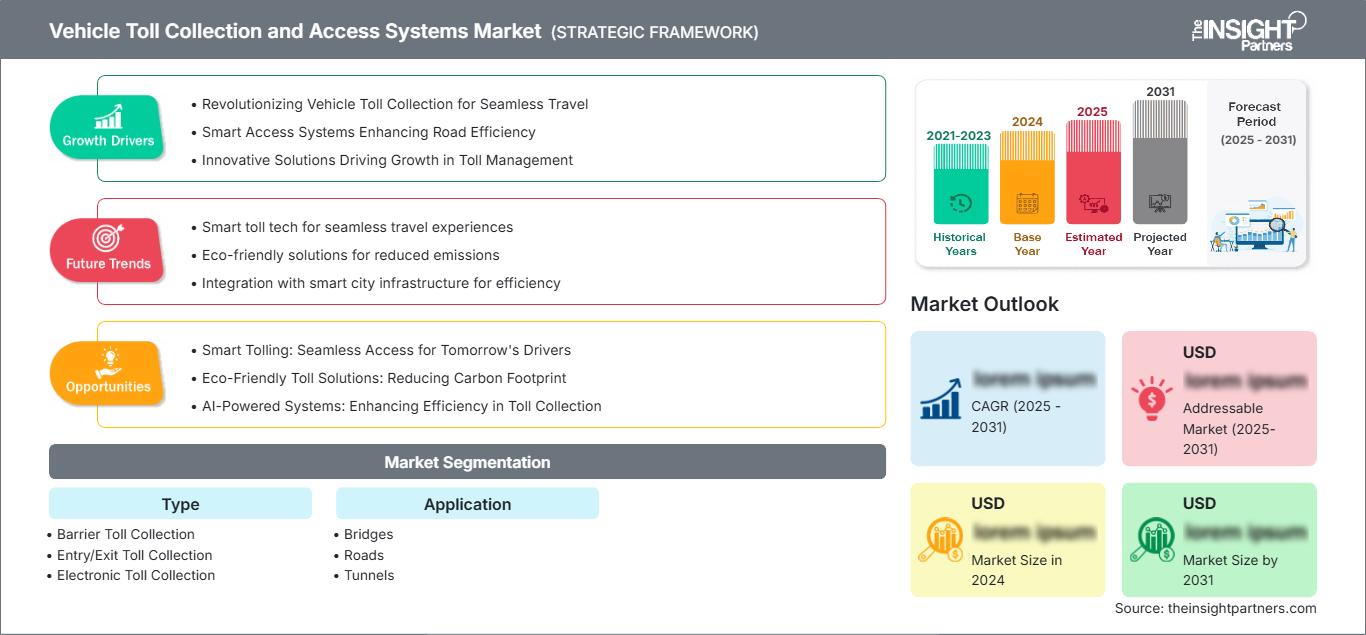
Vehicle Toll Collection and Access Systems Market: Strategic Insights
Regional Insights
North America vehicle toll collection and access systems market
North America is estimated to represent 31–34% of the global vehicle toll collection and access systems market revenue in 2025 and is projected to grow at a CAGR of 6.2–6.8% through 2034. The region benefits from extensive tolled highway, bridge, and tunnel infrastructure, while agencies are converting conventional plazas into cashless and open-road configurations. Replacement of aging lane equipment is another structural demand source.
The United States is responsible for roughly 65 to 69 percent of regional revenue by 2025 through its development in open-road tolling, congestion pricing, and interoperability among electronic payment networks. The development in Canada would come from the upgrading of highways and bridges, while that in Mexico would be driven by the development of concession-based infrastructure projects. The case of TransCore demonstrates how the region is moving towards cashless roadside operations.
U.S. vehicle toll collection and access systems Market
The US represents approximately 65–69% of the North American vehicle toll collection and access systems market revenue in 2025 and is projected to grow at a CAGR of 6.0–6.6% through 2034. Demand is concentrated around toll roads, bridges, tunnels, and metropolitan congestion-management schemes. Public agencies increasingly prioritize uninterrupted vehicle flow, transaction accuracy, and migration from cash lanes.
The market includes established deployments from TransCore, Conduent, 3M, Siemens AG, and TRMI Systems Integration, Inc., with applications extending from RFID-based electronic tolling to ANPR and digital lane processing. New York City's congestion-pricing infrastructure demonstrates how tolling technology is increasingly integrated with broader urban traffic-management objectives. The Pennsylvania Turnpike's open-road conversion similarly illustrates the movement away from conventional toll plazas.
Europe vehicle toll collection and access systems Market
Europe is estimated to hold a 26–29% of the vehicle toll collection and access systems market share in 2025 and is forecast to grow at a CAGR of 6.4–7.0% through 2034, with Germany, the UK, France, Italy, and Spain representing important deployment markets. Germany benefits from mature road-charging infrastructure and advanced vehicle identification requirements, while the UK continues to develop digital road-use and congestion-management approaches.
France, Italy, and Spain provide demand through extensive motorway, tunnel, and bridge networks, where electronic payment and automated access technologies can reduce transaction friction. European operators increasingly emphasize interoperability, data protection, low-emission mobility objectives, and integration between tolling and intelligent transportation platforms. Supplier competition therefore, extends beyond barriers toward software, ANPR, vehicle classification, payment management, and centralized control systems.
APAC vehicle toll collection and access systems Market
APAC is estimated to account for 27–30% of the global vehicle toll collection and access systems market revenue in 2025 and is projected to grow at a CAGR of 8.0–8.6% through 2034. China, Japan, South Korea, India, and Australia are key markets, with China representing a leading deployment base because of extensive expressway infrastructure.
India's rapid electronic toll expansion, Japan's mature ETC ecosystem, and South Korea's digitally integrated transport infrastructure support adoption. Australia's toll-road networks add demand for account-based and automated identification solutions. Policy emphasis on digital payments and highway modernization is strengthening demand for RFID, ANPR, machine vision, and free-flow collection architectures. India recorded more than ₹72,930 crore in electronic toll collections during fiscal 2024–25, illustrating the scale of digital tolling activity.
Middle East & Africa vehicle toll collection and access systems Market
The Middle East and Africa vehicle toll collection and access systems market is projected to expand at a CAGR of 6.5–7.2% through 2034, supported by road construction, urban mobility investment, and smart-city programs. Saudi Arabia and the UAE are leading opportunities, while South Africa contributes through established transport corridors and toll-road infrastructure.
The UAE and Saudi Arabia are investing heavily in intelligent mobility, digital infrastructure, and high-capacity urban road networks. South Africa offers replacement and modernization opportunities, while the rest of MEA includes Egypt and other markets developing toll facilities around strategic highways, tunnels, and urban projects. Energy-sector revenues and infrastructure diversification programs provide financial support for transport technology investments, particularly where automated collection can improve operating efficiency.

Segmentation Analysis
Type
The Vehicle Toll Collection and Access Systems Market Forecast indicates that the Type segment comprises Barrier Toll Collection, Entry/Exit Toll Collection, and Electronic Toll Collection. Electronic Toll Collection is expected to remain the dominant category, while Entry/Exit Toll Collection should record faster expansion as operators seek automated access control and reduced dependence on physical toll plazas. The Type segment benefits from technology convergence, with identification, classification, payment, and enforcement increasingly integrated into one transaction environment. The segment is projected to grow at a CAGR of 7.2–7.8% during 2026–2034.
- Barrier Toll Collection: Barrier Toll Collection remains important at controlled-access facilities requiring physical authorization. High-speed barriers, vehicle detectors, safety sensors, and automated payment interfaces support dependable processing while reducing manual intervention and maintaining controlled entry or exit.
- Entry/Exit Toll Collection: Entry/Exit Toll Collection is strategically relevant where charges depend on distance, location, or controlled access. Automated vehicle identification at entry and exit points enables accurate trip calculation and supports increasingly cashless operating models.
- Electronic Toll Collection: Electronic Toll Collection occupies the strongest market position because RFID credentials, ANPR, account-based payment, and digital processing can support high transaction volumes without conventional cash handling. Its interoperability and scalability make it central to modernization programs.
Application
Vehicle Toll Collection and Access Systems Market Trends indicate that the Application segment consists of Bridges, Roads, and Tunnels. Roads represent the broadest deployment environment because highway networks generate large recurring transaction volumes, while bridges and tunnels provide concentrated opportunities for automated charging and access management. Application demand increasingly reflects requirements for reliable identification, high throughput, enforcement, and remote system supervision. The segment is projected to grow at a CAGR of 6.8–7.5% during 2026–2034.
- Bridges: Bridges frequently require dependable collection because limited crossing alternatives concentrate traffic. Electronic payment, ANPR, and barrier automation can increase throughput while supporting accurate charging during peak commuter and freight periods.
- Roads: Roads represent the principal application environment because expressways and managed motorways generate sustained toll transactions. Open-road and multi-lane free-flow architectures are strategically important for reducing queues and integrating charging with wider traffic management.
- Tunnels: Tunnels require highly reliable tolling because controlled access, safety constraints, and limited alternative routes can magnify operational disruptions. Automated identification and remote monitoring support continuous processing while reducing dependence on staffed toll stations.
Opportunity Snapshot
| Application | Revenue Contribution | Trend Tag | Adoption Stage |
| Bridges | Medium | Cashless Crossing | Scaling |
| Roads | High | Free-Flow Tolling | Mature |
| Tunnels | Medium | Automated Access | Scaling |
Vehicle Toll Collection and Access Systems Market Growth Drivers and Impact Analysis
Expansion of cashless and open-road tolling infrastructure
The transition from manned toll plazas to cashless and open road structures constitutes a critical driver from a structural perspective since this enables operators to maximize throughput while minimizing infrastructure and manual transactions. Moreover, open road structures enable tolling points to be strategically located based on network management goals rather than interchanges. This is illustrated by TransCore's implementation of its Pennsylvania Turnpike project, where gantries have been used to enable RFID and license plate tolling at highway speeds. Other modernization projects have increased the demand for cameras, vehicle classification, transaction software, enforcement technology, and communications infrastructure. The influence of the market goes beyond new implementations since older systems must be gradually replaced and integrated. Providers with capabilities to integrate roadside hardware with back office processing will be able to benefit from recurring costs.
Growth of automated vehicle identification and classification
The development of ANPR, machine vision, RFID, and vehicle classification technology is increasing the capabilities of the tolling infrastructure. The systems currently available can operate in the absence of a transponder in each transaction, allowing toll by plate and free flow. An example is Nedap's ANPR Lumo, which comes with embedded analysis and deep learning features that support automatic tolling and free-flow operations. This allows increased capability in handling mixed fleets, identifying exceptions, and integrating enforcement with the transaction data. The outcome is especially important for operators looking to pursue flexible credentialing approaches and reduce roadside complexity.
Integration of tolling with intelligent transportation management
Tolling is now seen more in the context of wider intelligent transport systems and not just as an independent revenue generation system. Toll system operators can utilize the data and transaction information for managing congestion, responding to incidents, load leveling, and even for strategic planning. MITSUBISHI HEAVY INDUSTRIES MACHINERY SYSTEMS, LTD. places toll collection in line with electronic toll collection, road user charging, congestion charging, multilane free flow, and highway traffic management. This integration necessitates the need for communications, monitoring, analysis, and control capabilities that interoperate well. The commercial effect of this is that there will be more system-level contracts, with performance relying more on software integration and maintenance over time. Vendors with experience in transportation systems can hence handle wider contracts and longer-term relationships.
Vehicle Toll Collection and Access Systems Market Future Trends
AI-enabled free-flow enforcement and adaptive tolling
AI-based tolling systems are anticipated to evolve from vehicle identification to decision automation for classification, exception management, fraud detection, and enforcement purposes. Machine vision solutions will be able to couple plate detection with other vehicle characteristics to minimize reliance on physical credentials and increase transaction integrity. With time, machine learning algorithms will be integrated into dynamic pricing systems, congestion management data and central traffic management platforms. This would enable the system to be capable of reacting to traffic conditions in a smarter way while still remaining auditable. Privacy management, cybersecurity and dispute resolution policies are set to become even more relevant when dealing with larger amounts of travel information identifiable by the system.
Convergence of tolling, road-user charging, and mobility platforms
The future of the tolling system will probably be an integral part of a wider digital mobility platform, where road-user charges, congestion charges, parking access charges, managed lanes, and multi-modal mobility services will increasingly use common infrastructure for identification, account handling, payments, and enforcement. Such an approach will help to save on the installation of additional hardware at the roadside level and facilitate managing accounts while providing greater freedom for the authorities to create different schemes of charging policies. Interoperability will be vital when a motorist is driving in a jurisdiction with a different set of credentials and payments. As a result, suppliers will compete on the level of interoperability, data exchange, cybersecurity, and back-office infrastructure rather than single lane elements.
Vehicle Toll Collection and Access Systems Market Opportunities
Modernization of emerging-market toll corridors
Emerging economies offer substantial opportunities where highway construction is occurring alongside rapid digital-payment adoption. India is particularly significant because electronic toll collections have expanded rapidly and policy initiatives increasingly favor barrier-free highway charging. Similar opportunities exist across Southeast Asia, the Middle East, and selected Latin American markets where concessionaires are expanding managed road infrastructure. Vendors can target these markets with modular systems that combine RFID, ANPR, vehicle classification, payment processing, and centralized supervision. Local integration partnerships can reduce deployment complexity and improve compliance with national payment and data requirements. The strongest investment opportunities are likely to arise where new expressways, bridges, tunnels, and urban mobility programs are being developed simultaneously, allowing modern tolling architectures to be incorporated from the design stage rather than retrofitted later.
Interoperable platforms for multi-jurisdictional charging
Interoperability represents an attractive opportunity as road users increasingly cross tolling jurisdictions with different technologies, account structures, and payment mechanisms. Platform providers can develop centralized transaction and settlement layers capable of connecting RFID credentials, license-plate billing, digital wallets, and government or concessionaire databases. Such systems can help operators reduce duplicate customer records and simplify reconciliation while improving the traveler experience. Opportunity also exists in cybersecurity, identity management, dispute processing, and data analytics because larger digital tolling networks create more complex operational requirements. Suppliers that provide open interfaces and support multiple roadside technologies can reduce technology lock-in for authorities. Over the longer term, interoperable charging platforms could support road-user charging and congestion-management schemes beyond conventional toll roads.
Frequently Asked Questions

- Comprehensive Market Sizing and Forecast Analysis
- Detailed Segmentation Analysis
- In-Depth Market Dynamics Assessment
- Regional and Country-Level Insights
- Competitive Landscape and Company Benchmarking
- Strategic Business Intelligence
Recent Reports
Testimonials

The Insight Partners provided valuable market intelligence that supported our global go-to-market strategy. Their team was professional, responsive, and attentive to our feedback, providing thoughtful analysis and helpful methodological clarifications throughout the project.
Junmo Kim Chief Financial Officer (CFO), Enertech Co., Ltd.
The Insight Partners' SCADA System Market report is comprehensive, with valuable insights on current trends and future forecasts. The team was highly professional, responsive, and supportive throughout. We are very satisfied and highly recommend their services.
RAN KEDEM Partner, Reali Technologies LTDs
I requested a report on a very specific software market and the team produced the report in a few days. The information was very relevant and well presented. I then requested some changes and additions to the report. The team was again very responsive and I got the final report in less than a week.
JEAN-HERVE JENN Chairman, Future Analytica
We worked with The Insight Partners for an important market study and forecast. They gave us clear insights into opportunities and risks, which helped shape our plans. Their research was easy to use and based on solid data. It helped us make smart, confident decisions. We highly recommend them.
PIYUSH NAGPAL Sr. Vice President, High Beam Global
The Insight Partners delivered insightful, well-structured market research with strong domain expertise. Their team was professional and responsive throughout. The user-friendly website made accessing industry reports seamless. We highly recommend them for reliable, high-quality research services
YUKIHIKO ADACHI CEO, Deep Blue, LLC.
This is the first time I have purchased a market report from The Insight Partners.While I was unsure at first, I visited their web site and felt more comfortable to take the risk and purchase a market report.I am completely satisfied with the quality of the report and customer service. I had several questions and comments with the initial report, but after a couple of dialogs over email with their analyst I believe I have a report that I can use as input to our strategic planning process.Thank you so much for taking the extra time and making this a positive experience.I will definitely recommend your service to others and you will be my first call when we need further market data.
JOHN SUZUKI President and Chief Executive Officer, Board Director, BK Technologies
I wish to appreciate your support and the professionalism you displayed in the course of attending to my request for information regarding to infectious disease IVD market in Nigeria. I appreciate your patience, your guidance, and the fact that you were willing to offer a discount, which eventually made it possible for us to close a deal. I look forward to engaging The Insight Partners in the future, all thanks to the impression you have created in me as a result of this first encounter.
DR CHIJIOKE ONYIA MANAGING DIRECTOR, PineCrest Healthcare Ltd.Reason to Buy
- Informed Decision-Making
- Understanding Market Dynamics
- Competitive Analysis
- Identifying Emerging Markets
- Customer Insights
- Market Forecasts
- Risk Mitigation
- Boosting Operational Efficiency
- Strategic Planning
- Investment Justification
- Tracking Industry Innovations
- Aligning with Regulatory Trends





 Get Free Sample for