
Vibration Control System Market Size, Share & Demand by 2034
Coverage: By Type (Active, Passive); Industry (Automotive and Transportation, Aerospace and Defense, Manufacturing, Electrical and Electronics, Healthcare, Oil and Gas, Mining, Others) , and Geography (North America, Europe, Asia Pacific, and South and Central America)
- Status : Data Released
- Report Code : TIPRE00011686
- Category : Electronics and Semiconductor
- No. of Pages : 150
- Available Report Formats :


- Last update date : September 15, 2026


2025 Market Size
US$ 5.8 Bn
Base year value
2034 Forecast
US$ 7.89 Bn
Projected by 2034
CAGR 2026-2034
3.92 %
Growth rate
Addressable Market
US$ 63.58 Bn
(2026-2034)
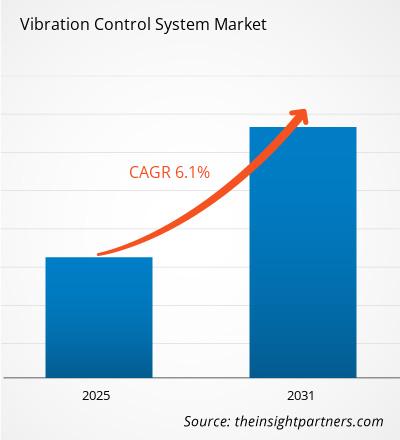
The vibration control system market was valued at US$ 5.8 Billion in 2025 and is projected to reach US$ 7.89 Billion by 2034, registering a CAGR of 3.92% during 2026–2034. The market encompasses active and passive technologies deployed across automotive and transportation, aerospace and defense, manufacturing, electrical and electronics, healthcare, oil and gas, mining, and other industrial environments where vibration reduction supports equipment reliability, precision, safety, and operating performance.
North America is expected to remain a structurally important market, with an estimated CAGR of 3.6–4.2% during 2026–2034. Demand is supported by aerospace production, defense modernization, advanced manufacturing, semiconductor equipment, healthcare imaging infrastructure, and replacement requirements for mature industrial machinery. Increasing use of electronically controlled equipment and tighter performance requirements are also encouraging integration of vibration isolation and damping technologies into new equipment platforms, contributing significantly to the Vibration Control System Market size.
Vibration Control System Market Assessment and Insights
- North America: The region is estimated to represent a 27–31% share in 2025 and grow at a CAGR of 3.6–4.2% during 2026–2034, supported by aerospace, defense, industrial automation, healthcare equipment, and advanced manufacturing applications.
- US: The US represents approximately 75–79% of North America's 2025 demand and is projected to expand at a CAGR of 3.7–4.3% during 2026–2034, led by aerospace, defense, and precision manufacturing.
- Europe: Europe accounts for an estimated 22–26% share in 2025 and is expected to register a CAGR of 3.2–3.8% through 2034, with Germany, the UK, France, Italy, and Spain supporting demand through automotive, industrial, aerospace, and machinery applications.
- Asia Pacific: Asia Pacific is estimated at 31–35% share in 2025 and is projected to grow at a CAGR of 4.4–5.1% during 2026–2034, with China, Japan, South Korea, and India benefiting from manufacturing expansion and electronics production.
- Largest Segment: Passive systems are estimated to hold a 68–72% market share in 2025 and grow at a CAGR of 3.4–4.0% during 2026–2034 because of broad industrial applicability and cost advantages.
- High Growth Segment: Active systems represent approximately 28–32% of 2025 demand and are expected to expand at a CAGR of 5.1–5.8% during 2026–2034 as precision applications increasingly require adaptive control.
- Key companies analyzed in detail: Hottinger Brüel & Kjær A/S, Continental AG, Hutchinson SA, Fabreeka International Inc., Isolation Technology Inc., Kinetic Systems Inc., Parker-Hannifin Corporation, Sentek Dynamics Inc., SPEKTRA Schwingungstechnik und Akustik GmbH, VICODA GmbH, and Trelleborg AB.
Source: The Insight Partners' analysis based on proprietary research, government publications, company annual reports, investor presentations, industry databases, and expert interviews.
The vibration control system market has evolved from predominantly mechanical isolation components toward integrated solutions combining elastomers, springs, dampers, sensors, actuators, controllers, and digital diagnostics. Vehicle electrification has changed the nature of vibration behavior since electrical systems excite at high frequencies, while aerospace systems need isolation and structural damping to keep weight low. Likewise, manufacturing automation has raised sensitivity to floor and machine vibrations such that the design has to take into account vibration management in robots, semiconductor fabrication machinery, precision stages, and inspection equipment.
As for the future, adoption is likely to become more widespread in Asia Pacific and certain emerging industrial countries owing to growth in production capability, electronics fabrication, aerospace development, and infrastructure investment. Safety and reliability regulations, as well as issues of aircraft noise reduction and energy conservation, will contribute to this effect. Increased use of simulation, condition monitoring, and electronic damping will prompt purchasers to consider performance in terms of life cycle rather than component cost alone.
Vibration Control System Market Report Scope
| Report Attribute | Details |
|---|---|
| Market size in 2025 | US$ 5.8 Billion |
| Market Size by 2034 | US$ 7.89 Billion |
| Global CAGR (2026 - 2034) | 3.92% |
| Historical Data | 2021-2024 |
| Forecast period | 2026-2034 |
Vibration Control System Market Analysis
Demand is linked to the installed base of rotating equipment, vehicles, aircraft, industrial machines, medical machines, and precision manufacturing machines. The market opportunity for vibration control systems thus spans original equipment manufacturers, engineering integrators, component manufacturers, maintenance firms, and specialty test houses. Passives are relevant due to their cost-effectiveness and durability, whereas active technology applies to scenarios requiring changeable loads or positional accuracies beyond what fixed isolation can offer.
The value chain includes elastomer, metal, composite, sensor, actuator, and electronics parts suppliers and runs through engineering, validation, equipment integration, installation, and aftermarket replacements. The supply environment is tipping towards manufacturers who can provide custom-tailored stiffness, damping, dynamic response, temperature tolerance, and mounting geometries. Automotive and industrial customers also seek shorter development cycles, encouraging suppliers to use simulation and application-specific testing before production release, according to the Vibration Control System Market report.
Technical breadth is becoming more important than just component availability in competitive positioning. Parker-Hannifin Corporation specializes in both active and passive vibration control, using engineered materials, whereas Continental AG is very strong in automotive vibration applications. Hutchinson SA, Trelleborg AB, and Fabreeka International Inc. compete in engineered elastomeric and isolation solutions. Hottinger Brüel & Kjær A/S distinguishes itself with measurement, testing, and vibration control skills that go beyond physical isolation systems.
Companies are starting to invest in adaptive systems, advanced materials, monitoring and application engineering. Isolation Technology Inc., Kinetic Systems Inc., Sentek Dynamics Inc., SPEKTRA Schwingungstechnik und Akustik GmbH, and VICODA GmbH provide for special needs in the areas of precision equipment, testing, structural dynamics, and industrial isolation. Such a market structure will favor those companies that can offer engineering services together with repeatable products. Aftermarket becomes an additional source of revenue.
● REPORT CUSTOMIZATION
Tailor This Report To Align With Your Specific Business Requirements
This report can be customized to align precisely with your business objectives, scope, and target markets. Customization options include tailored segmentation, geography, competitive analysis, and strategic insights to support informed decision-making.
Customize This Report →WHAT YOU CAN ADJUST
- ● Segmentations
- ● Geography
- ● Competitive Analysis
- ● Language Preferences
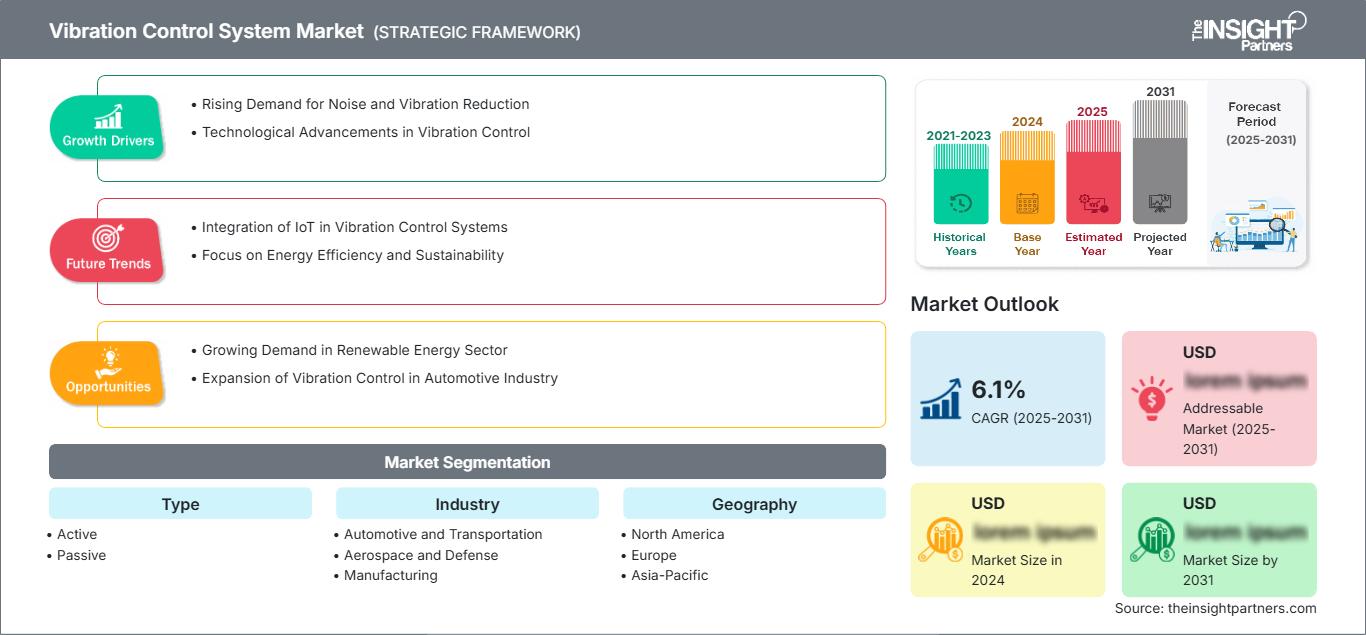
Vibration Control System Market: Strategic Insights
Regional Insights
North America Vibration Control System Market
North America is estimated to hold a 27–31% of the Vibration Control System Market share in 2025 and is projected to expand at a CAGR of 3.6–4.2% through 2034. The US remains the primary demand center because of aerospace production, defense programs, industrial automation, medical equipment, semiconductor manufacturing, and sophisticated machinery replacement. Canada contributes through energy, transportation, mining, and advanced manufacturing applications. A solid engineering background and proven supplier base ensure the success of a specification-based purchasing process within the region. Isolation performance is now considered along with machine uptime, durability, noise dampening, and maintenance needs when assessing customers’ needs. It makes engineered solutions preferred over off-the-shelf solutions in complex applications.
Modernization and investments in precision machinery in manufacturing facilities are another factor affecting regional demand for isolation products. Aerospace and defense applications have a need for solutions that can perform well under extreme vibrations and temperatures, while hospitals will require solutions ensuring a stable environment for diagnostic and imaging equipment. The market is expected to grow steadily without explosive growth due to active technologies becoming known in precision applications.
U.S. Vibration Control System Market
The US represents approximately 75–79% of North America's 2025 Vibration Control System Market demand and is expected to register a CAGR of 3.7–4.3% during 2026–2034. It is due to the concentration of aerospace, defense, automotive, industrial automation, medical devices, and precision manufacturing clients. Application competence in such industries is maintained by Parker-Hannifin Corporation and other specialty suppliers. Aerospace applications demand vibration isolation of structures, avionics, propulsion, and equipment, whereas the needs of manufacturing clients incorporate vibration isolation into robotics, machinery, and semiconductor production equipment.
Current trends in the application field imply increasing interest in solutions that unite passive vibration isolation with sensors, monitoring, or active control when precise performance demands a more complex solution. Another important part of the replacement business is also significant since established industrial facilities require refurbishment and upgrading from time to time. Procurement for the defense industry, the manufacture of aircraft, and the relocation of selected manufacturing functions are solid bases. Therefore, the US market represents a technology-driven industry, where performance, certification, reliability, and life-cycle service play an important role.
Europe Vibration Control System Market
Europe is estimated to represent a 22–26% of the Vibration Control System Market share in 2025 and is expected to grow at a CAGR of 3.2–3.8% through 2034. Germany leads the regional market, followed by the UK, France, Italy, and Spain. Germany benefits from automotive engineering, industrial machinery, automation, and aerospace manufacturing, while the UK maintains demand from aerospace, defense, transportation, and precision engineering.
In the UK market, there is a focus on aerospace, defense, rail, and advanced manufacturing, which increases demand for isolation solutions that have low weight and high performance. In Germany, the significant presence of machinery and automobiles makes it a source of high volume passive isolators, dampers, and elastomer-based solutions in addition to advanced technologies used in precise manufacturing. France gains due to aerospace and defense projects, whereas Italy and Spain contribute to the market via automotive, machinery, energy, and transportation applications. Energy efficiency and durable materials are key focuses of regional suppliers, along with digital assistance in engineering.
APAC Vibration Control System Market
APAC is estimated to hold a 31–35% of the Vibration Control System Market share in 2025 and is projected to expand at a CAGR of 4.4–5.1% through 2034, making it the leading regional market by demand. China remains the largest contributor, followed by Japan, South Korea, India, and Australia.
While China gains from its electronics, automotive, machine-building, aerospace, and infrastructure industries, Japan and South Korea retain their strengths in precision manufacturing and semiconductors. India gains in relevance due to industrial growth, transport, electronics production, and infrastructural development. Australia participates through mining, energy, and heavy industry. Automation of industrial facilities, upgrading of factories, localizing production, and manufacturing-related government programs help with implementation. Strong demand can be observed when vibration impacts productivity, longevity of equipment, measurement accuracy, or product quality.
Middle East & Africa Vibration Control System Market
The Middle East and Africa Vibration Control System Market demand is expected to expand at a CAGR of 2.8–3.5% during 2026–2034. Saudi Arabia leads regional investment, followed by the UAE and South Africa, while the rest of MEA contributes through energy, mining, construction, transportation, and industrial projects.
The energy infrastructure is another significant area of application, especially for rotating machines, compressors, pumps, turbines, and process machines. In Saudi Arabia and the United Arab Emirates, there is diversification in industrial production and more investment in infrastructure, while in South Africa, there is support from mining and industrial production. Vibration controls are being increasingly incorporated into systems where the reliability of equipment and the maintenance cost play a part in the economics of the project. Growth will be moderate but strategic.
Segmentation Analysis
Type
The type segment is divided into active and passive systems. Passive technologies remain the dominant approach because they provide dependable isolation without complex electronics, while active systems address applications requiring adaptive response and tighter vibration tolerances. The type segment is expected to register a CAGR of 3.9–4.5% during 2026–2034, with active architectures recording faster adoption as precision requirements rise, according to the Vibration Control System Market forecast.
- Active: Active systems use sensors, controllers, and actuators to counter changing vibration conditions. Their strategic importance is increasing in precision manufacturing, aerospace, electronics, and research environments where conventional isolation cannot consistently maintain required stability.
- Passive: Passive systems include established mechanical and elastomeric approaches that provide reliable isolation with comparatively low complexity. Their broad suitability across machinery, vehicles, buildings, and industrial equipment supports continued high-volume procurement.
Industry
The industry segment covers automotive and transportation, aerospace and defense, manufacturing, electrical and electronics, healthcare, oil and gas, mining, and others. The segment is expected to advance at a CAGR of 3.7–4.3% during 2026–2034 as equipment density, automation, electrification, and precision requirements increase across industrial environments, reflecting key Vibration Control System Market trends.
- Automotive and Transportation: Vehicle electrification and increasingly stringent NVH requirements are creating demand for optimized mounts, bushings, dampers, and active suspension technologies. Transportation equipment also requires vibration management to improve durability and passenger comfort.
- Aerospace and Defense: Aircraft, spacecraft, defense platforms, and associated electronics require lightweight vibration isolation capable of handling dynamic loads. Certification, reliability, and structural performance make engineered solutions strategically important.
- Manufacturing: Automated factories and precision machinery are highly sensitive to unwanted vibration. Isolation systems help protect machine accuracy, reduce downtime, and improve repeatability, particularly in advanced machining and robotic production.
- Electrical and Electronics: Semiconductor, electronics, and electrical equipment increasingly require controlled vibration environments. Isolation supports precision positioning, testing, inspection, and reliable operation of sensitive components.
- Healthcare: MRI, laboratory, diagnostic, and other sensitive medical systems benefit from vibration reduction because mechanical disturbance can affect imaging quality, measurement stability, and equipment operating conditions.
- Oil and Gas: Compressors, pumps, turbines, pipelines, and processing equipment require vibration mitigation to protect rotating assets and reduce maintenance exposure in demanding operating environments.
- Mining: Mining equipment experiences substantial mechanical loading and vibration. Engineered isolation helps protect machinery, improve operator conditions, and limit structural transmission in processing and extraction facilities.
Opportunity Snapshot
| Industry | Revenue Contribution | Trend Tag | Adoption Stage |
| Automotive and Transportation | High | EV NVH | Scaling |
| Aerospace and Defense | High | Lightweight Isolation | Mature |
| Manufacturing | High | Precision Automation | Scaling |
| Electrical and Electronics | Medium | Cleanroom Stability | Scaling |
| Healthcare | Medium | Imaging Stability | Scaling |
| Oil and Gas | Medium | Rotating Equipment | Mature |
| Mining | Medium | Heavy Equipment | Mature |
| South and Central America | Low | Industrial Retrofit | Emerging |
| Middle East and Africa | Low | Energy Projects | Emerging |
Vibration Control System Market Growth Drivers and Impact Analysis
Electrification increases high-frequency vibration management requirements
Electrification of vehicles is having an effect on the frequencies, amplitudes, and transfer of vibration of the powertrain. With the electric motors, the frequency of vibration that may be higher than that from engines may be felt by the passengers and vehicle parts due to the lesser masking effects from engine noise. This calls for mount and bushing designs that can effectively address narrow frequency vibration bands. The effects go beyond comfort for passengers since it affects electronics and battery-related parts as well. Material suppliers who can design products with simulation capabilities have opportunities in engineering programs of high value. Electrification of industrial equipment leads to similar effects with smaller motors and fast-moving parts.
Precision automation raises sensitivity to machine and floor vibration
With more applications of automation in industry, the importance of vibration mitigation is being recognized due to the fact that robots, machinery, testing machines, and semiconductors all rely on positional stability. Even slight vibration could result in low machining precision, extended cycle time, or even the formation of defects in very sensitive manufacturing processes. This is the reason why vibration mitigation becomes more considered in equipment installation and equipment purchasing rather than just being used as a maintenance solution. While active systems could be more beneficial when vibration changes during the process, passive systems continue to be favored for many general industrial applications. The resulting business opportunity lies in the transition to application-specific engineering and testing services. Companies that are capable of showing tangible benefits could be more competitive not by prices but through lifecycle economics.
Aerospace and defense modernization supports engineered isolation demand
Vibration management is vital in order for aerospace and defense platforms to perform in the face of rigorous conditions related to vibration, shock, temperature, weight, and reliability. In the case of today’s more sophisticated avionics, sensing devices, propulsion systems, and electronic loads, the effects of mechanical interference may be especially critical to the functionality of such components, leading to the need for vibration isolation. Thus, fleet upgrades and ongoing aircraft production generate a constant need for competent isolation and damping technologies. This is especially important due to the long lifecycles of aerospace equipment that provide opportunities for both original and retrofitting programs. High validation standards set higher barriers to entry for vendors than in industrial applications that are less regulated.
Vibration Control System Market Future Trends
Digital vibration management will connect isolation with condition intelligence
Future systems will increasingly combine physical isolation with sensors, digital controllers, and analytics. Instead of treating vibration as an isolated mechanical problem, equipment designers will increasingly monitor frequency behavior, operating loads, and changes in stiffness or damping over time. This approach can support adaptive control, predictive maintenance, and faster troubleshooting. Connected vibration information can also improve engineering feedback between equipment manufacturers and component suppliers by linking field performance with design parameters. In high-value assets, digital diagnostics may become an important differentiator even when the physical isolation hardware remains conventional. The strongest adoption is likely in aerospace, precision manufacturing, healthcare, and advanced machinery, where equipment downtime or accuracy losses carry substantial economic consequences. Standardized data interfaces should further facilitate integration with factory monitoring and asset-management platforms.
Advanced materials will improve low-frequency isolation and weight efficiency
Material innovation is expected to broaden the performance envelope of vibration control technologies. New elastomer formulations, engineered composites, tunable structures, and metamaterial-inspired designs can provide improved isolation without proportionally increasing system mass or size. Low-frequency isolation remains particularly challenging because effective performance often requires large physical dimensions or complex mechanical arrangements. Research into nonlinear and tunable structures is opening alternative approaches for suppressing difficult vibration regimes. Commercial adoption will depend on manufacturability, durability, temperature resistance, cost, and qualification requirements. Aerospace and precision equipment are likely to adopt advanced materials earlier because performance gains can justify higher development costs. Automotive and industrial applications should follow as production volumes increase and material processing becomes more standardized.
Vibration Control System Market Opportunities
Localized engineering for fast-growing Asian manufacturing ecosystems
Asia Pacific offers opportunities for suppliers that establish application engineering, testing, and production capabilities close to customers. China, Japan, South Korea, and India are expanding sophisticated manufacturing ecosystems where vibration performance increasingly influences automation, electronics, automotive, and machinery productivity. Local engineering can shorten design cycles, support customer-specific specifications, and reduce logistics exposure for heavy isolation components. Suppliers can also develop regional partnerships with machine builders, system integrators, and equipment manufacturers to secure recurring programs rather than depending exclusively on direct component sales. The opportunity is strongest where customers are transitioning from standardized mounts toward engineered solutions. Investment in regional testing and validation capabilities can create a further competitive advantage by allowing rapid characterization of materials, damping behavior, and installation configurations before production deployment.
Lifecycle retrofit programs can expand recurring aftermarket revenue
The installed base of industrial machinery, transportation assets, medical systems, and energy equipment creates a sizeable opportunity for retrofit-oriented vibration solutions. Aging equipment can experience changes in stiffness, damping, alignment, or foundation conditions that increase vibration over time. Replacement programs can therefore address both component deterioration and changing operating requirements. Suppliers can strengthen aftermarket positioning by offering inspection, vibration measurement, engineering assessment, replacement components, and installation support as a combined service. Such programs are particularly relevant for factories where equipment replacement is more expensive than targeted modernization. Digital measurement can identify assets requiring intervention and help customers prioritize spending according to operational risk. This service-oriented model can create more predictable revenue while strengthening relationships with plant operators and maintenance organizations.
Frequently Asked Questions

- Comprehensive Market Sizing and Forecast Analysis
- Detailed Segmentation Analysis
- In-Depth Market Dynamics Assessment
- Regional and Country-Level Insights
- Competitive Landscape and Company Benchmarking
- Strategic Business Intelligence
Recent Reports
Testimonials

The Insight Partners' SCADA System Market report is comprehensive, with valuable insights on current trends and future forecasts. The team was highly professional, responsive, and supportive throughout. We are very satisfied and highly recommend their services.
RAN KEDEM Partner, Reali Technologies LTDs
I requested a report on a very specific software market and the team produced the report in a few days. The information was very relevant and well presented. I then requested some changes and additions to the report. The team was again very responsive and I got the final report in less than a week.
JEAN-HERVE JENN Chairman, Future Analytica
We worked with The Insight Partners for an important market study and forecast. They gave us clear insights into opportunities and risks, which helped shape our plans. Their research was easy to use and based on solid data. It helped us make smart, confident decisions. We highly recommend them.
PIYUSH NAGPAL Sr. Vice President, High Beam Global
The Insight Partners delivered insightful, well-structured market research with strong domain expertise. Their team was professional and responsive throughout. The user-friendly website made accessing industry reports seamless. We highly recommend them for reliable, high-quality research services
YUKIHIKO ADACHI CEO, Deep Blue, LLC.
This is the first time I have purchased a market report from The Insight Partners.While I was unsure at first, I visited their web site and felt more comfortable to take the risk and purchase a market report.I am completely satisfied with the quality of the report and customer service. I had several questions and comments with the initial report, but after a couple of dialogs over email with their analyst I believe I have a report that I can use as input to our strategic planning process.Thank you so much for taking the extra time and making this a positive experience.I will definitely recommend your service to others and you will be my first call when we need further market data.
JOHN SUZUKI President and Chief Executive Officer, Board Director, BK Technologies
I wish to appreciate your support and the professionalism you displayed in the course of attending to my request for information regarding to infectious disease IVD market in Nigeria. I appreciate your patience, your guidance, and the fact that you were willing to offer a discount, which eventually made it possible for us to close a deal. I look forward to engaging The Insight Partners in the future, all thanks to the impression you have created in me as a result of this first encounter.
DR CHIJIOKE ONYIA MANAGING DIRECTOR, PineCrest Healthcare Ltd.Reason to Buy
- Informed Decision-Making
- Understanding Market Dynamics
- Competitive Analysis
- Identifying Emerging Markets
- Customer Insights
- Market Forecasts
- Risk Mitigation
- Boosting Operational Efficiency
- Strategic Planning
- Investment Justification
- Tracking Industry Innovations
- Aligning with Regulatory Trends





 Get Free Sample for