
Video as a sensor Market Demand, Share & Growth by 2034
Video as a sensor Market Size and Forecasts (2021 - 2034), Global and Regional Share, Trends, and Growth Opportunity Analysis Report Coverage : By Camera Type (IP, Thermal, Machine Vision, Hyperspectral), Sensor (Image Motion, Infrared), Product Type (Video Surveillance, Thermal Imaging, Hyperspectral Imaging, Machine Vision & Monitoring)
- Status : Data Released
- Report Code : TIPRE00039668
- Category : Electronics and Semiconductor
- No. of Pages : 150
- Available Report Formats :


- Last update date : September 22, 2026


2025 Market Size
US$ 79.29 Bn
Base year value
2034 Forecast
US$ 154.74 Bn
Projected by 2034
CAGR 2026-2034
7.71 %
Growth rate
Addressable Market
US$ 1,053.65 Bn
(2026-2034)
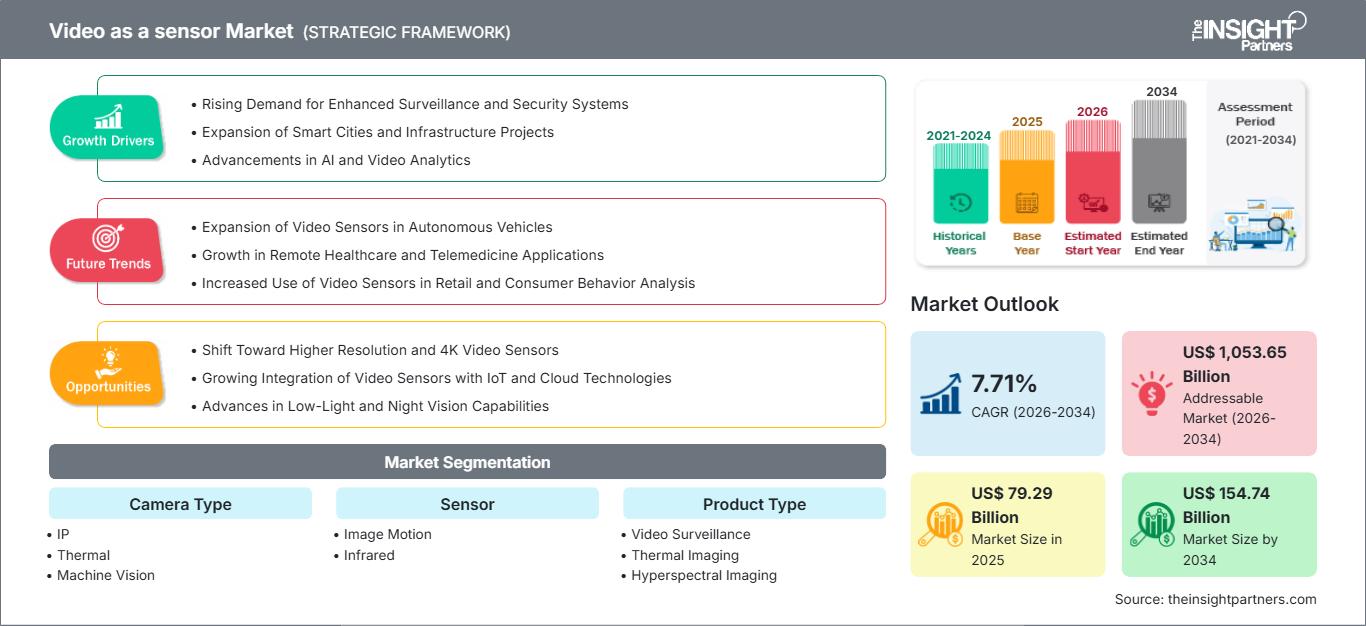
The video as a sensor market was valued at US$ 79.29 billion in 2025 and is projected to reach US$ 154.74 billion by 2034, registering a CAGR of 7.71% during 2026–2034. Adoption is expanding as cameras evolve from passive recording devices into visual intelligence nodes that support detection, classification, monitoring, and automated decision-making across security, mobility, industrial, retail, healthcare, and infrastructure environments.
North America remains a major demand center, supported by public safety modernization, critical infrastructure protection, cloud video platforms, and enterprise adoption of AI-assisted monitoring. The regional video as a sensor market size is reinforced by extensive IP camera networks, edge analytics deployments, and integration with security operations centers, while expected regional growth remains in the 7.2%–7.8% CAGR range through 2034.
Video as a sensor Market Assessment and Insights
- North America: The region accounted for an estimated 34%–36% share in 2025 and is expected to grow at a 7.2%–7.8% CAGR during 2026–2034, led by smart infrastructure, cloud surveillance, and enterprise security upgrades.
- U.S.: The U.S. represented about 78%–82% of North America in 2025 and is projected to expand at a 7.0%–7.6% CAGR, supported by strong public safety and commercial building demand.
- Europe: Europe held an estimated 24%–27% share in 2025 and is expected to grow at a 6.8%–7.4% CAGR, with Germany, the UK, France, Italy, and Spain leading deployments.
- Asia Pacific: Asia Pacific captured about 27%–30% share in 2025 and is forecast to grow at an 8.4%–9.1% CAGR, driven by China, Japan, South Korea, India, and Australia.
- Largest Segment: Video surveillance led product type demand with an estimated 47%–51% market share in 2025 and a projected 7.0%–7.6% CAGR through 2034.
- High Growth Segment: Hyperspectral imaging held an estimated 6%–8% share in 2025 and is expected to post a 10.5%–12.0% CAGR, supported by agriculture, inspection, and environmental monitoring.
- Key companies analyzed in detail: Honeywell International Inc., Motorola Solutions, Inc., Dahua Technology Co., Ltd., Bosch Sicherheitssysteme GmbH, Hangzhou Hikvision Digital Technology Co., Ltd., AT&T Inc., International Business Machines Corporation, Cisco Systems, Inc., Axis Communications AB, Johnson Controls International plc, Sony Group Corporation, Sharp Corporation, Teledyne Technologies Incorporated, Corning Incorporated, and PixArt Imaging Inc.
Source: The Insight Partners' analysis based on proprietary research, government publications, company annual reports, investor presentations, industry databases, and expert interviews.
Video as a sensor market growth reflects the transition from isolated CCTV assets to connected perception infrastructure. Whereas earlier deployments relied on logging and post-event analysis, modern solutions are built on high-quality imaging, metadata generation, edge computing, and AI-driven analysis. As a result, technology adoption is evolving in terms of preference for software-defined infrastructure, cybersecurity-enabled solutions, and interoperability of cameras, sensors, control centers, and enterprise applications.
Further implementation will be influenced by urban safety initiatives, industrial automation, smart transportation corridors, and monitoring of energy systems. New geographic markets are developing scalable deployments where camera networks start providing meaningful data for strategic planning. Concerns with privacy and data management regulations affect system architectures by pushing technology vendors to build explainable analytics capabilities, security-based access, and data storage mechanisms.
Video as a sensor Market Report Scope
| Report Attribute | Details |
|---|---|
| Market size in 2025 | US$ 79.29 Billion |
| Market Size by 2034 | US$ 154.74 Billion |
| Global CAGR (2026 - 2034) | 7.71% |
| Historical Data | 2021-2024 |
| Forecast period | 2026-2034 |
Video as a sensor Market Analysis
The video as a sensor market growth is being driven by demand for real-time situational awareness across high-traffic, high-risk, and asset-intensive environments. Firms use visuals to find breaches, track occupancy levels, ensure process quality, and limit physical inspection processes. This value chain consists of cameras, image sensors, processors, networks, video management software, cloud computing platforms, AI models, systems integrations, and service packages.
Supply dynamics have gotten better due to the availability of edge processors, CMOS sensors, thermal cameras, and AI inferencing tools. Camera vendors now integrate analytics into their devices, while cloud providers and system integrators package video data into overall automation systems. This generates a multi-layered ecosystem where hardware differentiation is done on the basis of built-in intelligence, security, interoperability, and lifecycle serviceability.
Video as a sensor market analysis indicates a competitive landscape led by security, automation, connectivity, and imaging specialists. Honeywell International Inc., Motorola Solutions, Inc., Bosch Sicherheitssysteme GmbH, Dahua Technology Co., Ltd., Hangzhou Hikvision Digital Technology Co., Ltd., Axis Communications AB, and Johnson Controls International plc compete through integrated platforms, analytics portfolios, and channel reach.
In the Video as a Sensor market report, technology firms such as International Business Machines Corporation, Cisco Systems, Inc., AT&T Inc., Sony Group Corporation, Teledyne Technologies Incorporated, Corning Incorporated, Sharp Corporation, and PixArt Imaging Inc. strengthen the ecosystem through connectivity, AI, imaging components, optics, and sensor innovation. Strategic positioning is increasingly tied to open architectures, privacy-compliant analytics, vertical solutions, and hybrid cloud-edge deployment models.
● REPORT CUSTOMIZATION
Tailor This Report To Align With Your Specific Business Requirements
This report can be customized to align precisely with your business objectives, scope, and target markets. Customization options include tailored segmentation, geography, competitive analysis, and strategic insights to support informed decision-making.
Customize This Report →WHAT YOU CAN ADJUST
- ● Segmentations
- ● Geography
- ● Competitive Analysis
- ● Language Preferences
Video as a sensor Market: Strategic Insights
Regional Insights
North America video as a sensor market
North America generated an estimated 34%–36% video as a sensor market share in 2025, supported by large installed bases of IP surveillance, public-sector security modernization, and strong adoption of video analytics in retail, logistics, utilities, and transportation. Regional demand is expected to advance at a 7.2%–7.8% CAGR during 2026–2034 as buyers upgrade from conventional monitoring to intelligent detection and event classification.
Cloud video management, edge-based analytics, and integrated access control are improving deployment economics across campuses, transport hubs, data centers, and industrial facilities. Privacy rules and cybersecurity requirements are shaping procurement, with buyers prioritizing encrypted devices, audit logs, and controlled data access. The U.S. remains the anchor market, while Canada and Mexico add demand through infrastructure, manufacturing, and border security applications.
U.S. video as a sensor Market
The U.S. accounted for roughly 78%–82% of North American demand in 2025 and is expected to grow at a 7.0%–7.6% CAGR through 2034. Adoption is highest within public safety, commercial real estate, logistics, healthcare facilities, and industrial automation applications, where the benefits of video inputs can speed up response times and increase visibility.
The company has a wide range of customers, which include Motorola Solutions, Inc., Honeywell International Inc., Johnson Controls International plc, Cisco Systems, Inc., AT&T Inc., International Business Machines Corporation, Teledyne Technologies Incorporated, and Axis Communications AB. Video analysis applications are becoming more integrated into access control, incident management, network security, and cloud evidence management systems.
Europe video as a sensor Market
Europe represented an estimated 24%–27% share of the Video as a Sensor Market in 2025 and is forecast to grow at a 6.8%–7.4% CAGR during 2026–2034. Germany leads industrial machine vision and manufacturing automation, while the UK emphasizes public safety, transport monitoring, and commercial security. France, Italy, and Spain add demand through smart city, logistics, retail, and energy infrastructure projects.
Data protection expectations are particularly influential in Europe, encouraging privacy-by-design architectures, on-device processing, and careful governance of biometric or behavior analytics. Bosch Sicherheitssysteme GmbH, Axis Communications AB, Sony Group Corporation, and Johnson Controls International plc are well-positioned through enterprise channels and compliance-focused offerings. The region’s growth is steady rather than aggressive, supported by replacement cycles and industrial modernization.
APAC video as a sensor Market
Asia Pacific held an estimated 27%–30% of the Video as a Sensor Market share in 2025 and is projected to record an 8.4%–9.1% CAGR, the fastest among major regions. China leads in camera manufacturing and urban surveillance scale, while Japan and South Korea advance machine vision, robotics, and electronics inspection.
India and Australia are expanding deployments in public infrastructure, commercial security, mining, traffic management, and smart industrial campuses. Dahua Technology Co., Ltd. and Hangzhou Hikvision Digital Technology Co., Ltd. maintain strong regional manufacturing positions, while Sony Group Corporation, Sharp Corporation, and PixArt Imaging Inc. support the imaging and component ecosystem.
Middle East & Africa video as a sensor Market
The Middle East & Africa Video as a Sensor Market is expected to grow at a 7.6%–8.3% CAGR, driven by smart city construction, airport security, energy infrastructure monitoring, and critical asset protection. Saudi Arabia and the UAE lead deployments through transport, utilities, commercial real estate, and public safety investments.
South Africa contributes demand from mining, logistics, retail, and municipal safety applications, while the rest of MEA remains project-led. Thermal imaging and long-range surveillance are important in oil and gas, border control, and perimeter protection. Vendors offering ruggedized systems, cybersecurity support, and integration services are positioned to capture regional opportunities.
Segmentation Analysis
Camera Type
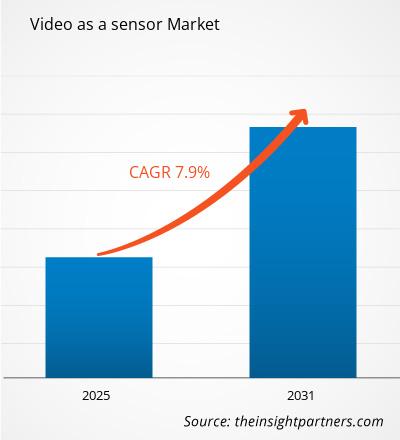
Camera Type is expected to grow at a 7.3%–8.1% CAGR during 2026–2034. The video as a sensor market scope across camera technologies is widening as buyers combine IP, thermal, machine vision, and hyperspectral systems to support security, quality inspection, infrastructure monitoring, and environmental intelligence.
- IP: IP cameras remain the mainstream deployment choice because they integrate easily with networks, video management platforms, cloud services, and analytics tools across commercial, government, and industrial sites.
- Thermal: Thermal cameras are gaining relevance in low-light, perimeter, energy, utility, and industrial safety applications where heat signatures provide reliable detection beyond visible imaging limits.
- Machine Vision: Machine vision cameras support automated inspection, robotics guidance, defect detection, and production monitoring, making them essential for factories pursuing higher quality control and lower downtime.
- Hyperspectral: Hyperspectral cameras serve specialized use cases in agriculture, food inspection, pharmaceuticals, recycling, and environmental monitoring, where spectral signatures reveal material composition and hidden defects.
Sensor
Sensor demand is projected to expand at a 7.1%–7.9% CAGR as image motion and infrared sensing become more closely integrated with analytics. These sensor layers help systems identify movement, classify events, operate in difficult lighting, and deliver continuous intelligence from distributed camera networks.
- Image Motion: Image motion sensors support motion detection, object tracking, line crossing, occupancy measurement, and anomaly alerts, reducing operator burden and improving automated response accuracy.
- Infrared: Infrared sensors strengthen night vision, thermal detection, and harsh-environment monitoring, particularly in security, industrial safety, transport corridors, and critical infrastructure applications.
Product Type
Product Type is forecast to grow at a 7.5%–8.4% CAGR during 2026–2034. Product adoption is led by surveillance and monitoring, while thermal, hyperspectral, and machine vision categories expand as organizations use visual data for safety, inspection, automation, and predictive operations.
- Video Surveillance: Video surveillance dominates deployments because security, access control, incident verification, and compliance monitoring remain core needs for enterprises, municipalities, healthcare facilities, and transport operators.
- Thermal Imaging: Thermal imaging is important for perimeter protection, equipment monitoring, fire prevention, and energy assets where visual contrast is limited or early heat detection improves response.
- Hyperspectral Imaging: Hyperspectral imaging provides differentiated value in material analysis, crop assessment, food sorting, and environmental inspection, where richer spectral datasets support precise decision-making.
- Machine Vision & Monitoring: Machine vision and monitoring systems are expanding in automated production, logistics, robotics, and quality assurance, supporting faster inspection and lower defect rates.
Opportunity Snapshot
| Product Type | Revenue Contribution | Trend Tag | Adoption Stage |
|---|---|---|---|
| Video Surveillance | High | AI Security | Mature |
| Thermal Imaging | Medium | Heat Detection | Scaling |
| Hyperspectral Imaging | Low | Spectral Insight | Emerging |
| Machine Vision & Monitoring | Medium | Factory Vision | Scaling |
Video as a sensor Market Growth Drivers and Impact Analysis
AI Analytics Converting Cameras into Decision Systems
AI analytics represents the most compelling structural factor due to its ability to transform surveillance camera networks from storage facilities into fully functional systems. Object detection, behavior classification, alerting on anomalies, license plate recognition, crowd counting, and process inspection enable end users to respond quicker and minimize human oversight. In addition, edge computing allows for reducing latency and data transfer load, thus enabling live video feeds to become a viable tool for decision-making processes in campus settings, production plants, roadways, utility sites, and retail spaces. With more sophisticated analytics, buyers are becoming more results-oriented.
Smart Infrastructure and Public Safety Modernization
With smart cities, transportation, airport, railway, port, and campus upgrading initiatives, there has been increased deployment of video sensors in public and quasi-public spaces. This is being done for various purposes, including traffic flow analysis, perimeter security, emergency responses, crowd management, detecting parked cars illegally, and monitoring the infrastructure. The significance of this market impact lies in the fact that public infrastructure projects usually involve high numbers of devices, longer service periods, and link-up with command centers. Private infrastructures are also adopting similar technologies due to their demands.
Industrial Automation and Quality Inspection Needs
Factories are now using video as sensors to optimize production, minimize losses, trace items, and automate tasks that are not possible to complete using traditional manual methods. This includes machine vision cameras, thermal sensors, and hyperspectral sensors, which help in detecting defects, controlling temperatures, robot navigation, sorting, and verifying processes. The effects are especially notable in sectors such as electronics, automobiles, food processing, pharmaceuticals, and packaging. As more and more plants integrate their visual sensors with manufacturing execution systems and predictive maintenance solutions, video becomes an integral element.
Video as a sensor Market Future Trends
Edge AI and Federated Video Intelligence
The video as a sensor market trends will increasingly center on edge AI, where cameras and gateways process data locally before sharing events, metadata, or selected clips. This architecture helps in saving cost on the cloud, improving response times, and providing privacy through limited transfer of raw video streams. Federated learning and model updates might help businesses enhance their analytics without having to consolidate sensitive video footage. Companies that offer smaller devices along with efficient AI models and secure model updates would have an edge over others as the number of deployment units increases.
Multispectral Fusion for Higher Accuracy
The coming systems will have visibility from visible light, infrared, thermal, depth, radar, and hyperspectral data to enable accurate detection in challenging operational scenarios. Multispectral fusion will help in minimizing false alarms in foggy weather, dark situations, glinting light, congested areas, and cluttered industrial sites. Such an approach favors high-value applications like autonomous inspection, energy asset monitoring, plant health check, and advanced perimeter security. With reduction in the cost of sensors and improved AI models for dataset fusion, users will begin viewing video sensors as multimodal sensors rather than cameras.
Video as a sensor Market Opportunities
Vertical Solutions for Critical Infrastructure
The Video as a sensor market forecasts point to a strong opportunity in packaged vertical solutions for utilities, airports, ports, railways, data centers, and oil and gas assets. Such customers need robust solutions that consist of video, heat detection, access control, cyber security, and workflow management technologies. Providers can create differentiation through offering pre-installed analytics, documentation, hardened equipment, and seamless integration into OT systems. The challenge has a practical orientation since consumers are transitioning from buying devices to deploying solutions that help increase uptime and security.
Cloud-Managed Analytics for Mid-Market Buyers
The mid-market enterprise requires intelligence monitoring but does not have a big security operation team or budget for advanced infrastructure. The cloud-managed video analytics offer an excellent opportunity to provide subscription services to retailers, warehouses, schools, clinics, and small manufacturing facilities. This can be done by combining cameras, storage, remote access, alerting, maintenance, and analytics within scalable packages. Such an approach cuts down on the costs involved and speeds up the process when users seek fast installation, managed systems, cybersecurity upgrades, and useful intelligence.
Frequently Asked Questions

- Comprehensive Market Sizing and Forecast Analysis
- Detailed Segmentation Analysis
- In-Depth Market Dynamics Assessment
- Regional and Country-Level Insights
- Competitive Landscape and Company Benchmarking
- Strategic Business Intelligence
Recent Reports
Testimonials

The Insight Partners provided valuable market intelligence that supported our global go-to-market strategy. Their team was professional, responsive, and attentive to our feedback, providing thoughtful analysis and helpful methodological clarifications throughout the project.
Junmo Kim Chief Financial Officer (CFO), Enertech Co., Ltd.
The Insight Partners' SCADA System Market report is comprehensive, with valuable insights on current trends and future forecasts. The team was highly professional, responsive, and supportive throughout. We are very satisfied and highly recommend their services.
RAN KEDEM Partner, Reali Technologies LTDs
I requested a report on a very specific software market and the team produced the report in a few days. The information was very relevant and well presented. I then requested some changes and additions to the report. The team was again very responsive and I got the final report in less than a week.
JEAN-HERVE JENN Chairman, Future Analytica
We worked with The Insight Partners for an important market study and forecast. They gave us clear insights into opportunities and risks, which helped shape our plans. Their research was easy to use and based on solid data. It helped us make smart, confident decisions. We highly recommend them.
PIYUSH NAGPAL Sr. Vice President, High Beam Global
The Insight Partners delivered insightful, well-structured market research with strong domain expertise. Their team was professional and responsive throughout. The user-friendly website made accessing industry reports seamless. We highly recommend them for reliable, high-quality research services
YUKIHIKO ADACHI CEO, Deep Blue, LLC.
This is the first time I have purchased a market report from The Insight Partners.While I was unsure at first, I visited their web site and felt more comfortable to take the risk and purchase a market report.I am completely satisfied with the quality of the report and customer service. I had several questions and comments with the initial report, but after a couple of dialogs over email with their analyst I believe I have a report that I can use as input to our strategic planning process.Thank you so much for taking the extra time and making this a positive experience.I will definitely recommend your service to others and you will be my first call when we need further market data.
JOHN SUZUKI President and Chief Executive Officer, Board Director, BK Technologies
I wish to appreciate your support and the professionalism you displayed in the course of attending to my request for information regarding to infectious disease IVD market in Nigeria. I appreciate your patience, your guidance, and the fact that you were willing to offer a discount, which eventually made it possible for us to close a deal. I look forward to engaging The Insight Partners in the future, all thanks to the impression you have created in me as a result of this first encounter.
DR CHIJIOKE ONYIA MANAGING DIRECTOR, PineCrest Healthcare Ltd.Reason to Buy
- Informed Decision-Making
- Understanding Market Dynamics
- Competitive Analysis
- Identifying Emerging Markets
- Customer Insights
- Market Forecasts
- Risk Mitigation
- Boosting Operational Efficiency
- Strategic Planning
- Investment Justification
- Tracking Industry Innovations
- Aligning with Regulatory Trends





 Get Free Sample for