
Vision Positioning Market Growth, Size & Forecast by 2034
Coverage: by Component (Sensors, Camera Systems, Visual Markers, Others); Solution (Navigation, Analytics, Tracking, Industrial Solutions, Others); Platform (Unmanned Aerial Vehicle/Drones, Robotics, Automated Guided Vehicle, Others); Location (Indoor Positioning System, Outdoor Positioning System); Application (Commercial, Defense) , and Geography (North America, Europe, Asia Pacific, and South and Central America)
- Status : Data Released
- Report Code : TIPRE00007636
- Category : Electronics and Semiconductor
- No. of Pages : 150
- Available Report Formats :


- Last update date : September 22, 2026


2025 Market Size
US$ 6.97 Bn
Base year value
2034 Forecast
US$ 18.51 Bn
Projected by 2034
CAGR 2026-2034
11.46 %
Growth rate
Addressable Market
US$ 112.20 Bn
(2026-2034)
The Vision positioning market is valued at US$ 6.97 Billion in 2025 and is projected to reach US$ 18.51 Billion by 2034, registering a CAGR of 11.46% from 2026 to 2034. Expansion is supported by wider deployment of camera-based localization, visual sensing, AI-enabled navigation, and autonomous platforms that require reliable positioning where conventional navigation technologies face coverage or precision limitations.
North America is expected to maintain a strong position, with an estimated CAGR of 10.5–12.5% through 2034. Industrial automation, warehouse robotics, autonomous mobile equipment, defense applications, and continued investment in AI-enabled machine vision are creating sustained demand for high-accuracy positioning capabilities across controlled and dynamic environments, contributing significantly to the overall Vision Positioning Market size.
Vision Positioning Market Assessment and Insights
- North America: The region is expected to account for a 34–38% share in 2025 and expand at a CAGR of 10.5–12.5% between 2026–2034, supported by automation investment and autonomous mobility.
- US: The US is estimated to represent 75–80% of North American revenue in 2025, expanding at a CAGR of 10.5–12.5% between 2026–2034 through robotics, logistics, defense, and industrial applications.
- Europe: Europe is estimated to hold a 25–29% share in 2025 and grow at a CAGR of 9.5–11.5% between 2026–2034, led by Germany, the UK, France, Italy, and Spain.
- Asia Pacific: Asia Pacific is estimated to command a 22–26% share in 2025 and record a CAGR of 14.0–16.5% between 2026–2034, with China, Japan, South Korea, and India driving deployment.
- Largest Segment: Unmanned Aerial Vehicle/Drones is estimated to hold a 44–48% market share in 2025 and expand at a CAGR of 12.0–14.0% from 2026–2034.
- High Growth Segment: Automated Guided Vehicle is estimated to represent a 20–24% market share in 2025 and expand at a CAGR of 18.0–21.0% from 2026–2034.
- Key companies analyzed in detail: ABB Ltd., Adtech (Shenzhen) Technology Co., Ltd., Cognex Corporation, FANUC Corporation, infsoft GmbH, OMRON Corporation, Pepperl+Fuchs SE, Senion AB, SICK AG, and SZ DJI Technology Co., Ltd.
Source: The Insight Partners' analysis based on proprietary research, government publications, company annual reports, investor presentations, industry databases, and expert interviews.
Technological development has shifted from marker-based positioning to a more advanced combination of cameras, sensors, inertial data, visual cues, and edge computing. Factory environments now require positioning that can work amidst dynamic environments, lighting conditions, and mobile obstructions. Such a technological shift has boosted the importance of computer vision, AI inference, and sensor fusion in drones, robots, autonomous vehicles, and industrial machinery.
Future investments are becoming more focused on scalable software solutions, embedded computing capabilities, and positioning systems integration. The emergence of new manufacturing hubs in the Asia Pacific region is driving demand, while automation efforts in Europe and warehousing in North America are supporting demand. Regulatory attention surrounding autonomous machines and drones is also encouraging vendors to improve reliability, traceability, safety functions, and operational awareness rather than relying solely on positioning accuracy, as highlighted in the Vision Positioning Market forecast.
Vision Positioning Market Report Scope
| Report Attribute | Details |
|---|---|
| Market size in 2025 | US$ 6.97 Billion |
| Market Size by 2034 | US$ 18.51 Billion |
| Global CAGR (2026 - 2034) | 11.46% |
| Historical Data | 2021-2024 |
| Forecast period | 2026-2034 |
Vision Positioning Market Analysis
The Vision Positioning Market growth is closely linked to the expansion of autonomous machines that must determine location, orientation, and movement without depending exclusively on satellite navigation. Information gathered by cameras and additional sensors is localizable in nature and may be processed locally, allowing robots and drones to maneuver within warehouses, manufacturing floors, cities, and other limited spaces. The ecosystem consists of optics hardware, processors, algorithms, mapping systems, system integrators, robotics providers, and end users.
Shifts in the supply side indicate a move towards combined systems rather than individual sensors. Hardware providers are integrating imaging, sensing, and processing capabilities, whereas software providers are focusing on localization, tracking, mapping, analysis, and navigation technologies. Integration may shorten time-to-deployment for customers and decrease their engineering efforts. As a result, the demand is becoming geared towards systems that integrate seamlessly with robot control systems, fleet management systems, and enterprise-level software.
Competitive positioning increasingly depends on the ability to combine perception with actionable autonomy. ABB Ltd. and FANUC Corporation leverage positioning capabilities within industrial robotics ecosystems, while Cognex Corporation emphasizes machine vision and AI-enabled inspection. OMRON Corporation, Pepperl+Fuchs SE, and SICK AG bring sensing and automation expertise, creating competitive differentiation around reliability and industrial integration. DJI extends the competitive field through autonomous aerial platforms and visual sensing, according to the Vision Positioning Market report.
Specialization firms like Infsoft GmbH and Senion AB focus on indoor positioning and spatial awareness, whereas Adtech (Shenzhen) Technology Co., Ltd. focuses on vision-based positioning and automation use cases. SZ DJI Technology Co., Ltd. bolsters the aerial platform market category. The investment focus shifts towards edge AI, sensor fusion, software portability, and ease of deployment. Companies that can provide consistent performance in multiple locations and machine categories will be able to monetize the value of their solutions more effectively.
● REPORT CUSTOMIZATION
Tailor This Report To Align With Your Specific Business Requirements
This report can be customized to align precisely with your business objectives, scope, and target markets. Customization options include tailored segmentation, geography, competitive analysis, and strategic insights to support informed decision-making.
Customize This Report →WHAT YOU CAN ADJUST
- ● Segmentations
- ● Geography
- ● Competitive Analysis
- ● Language Preferences
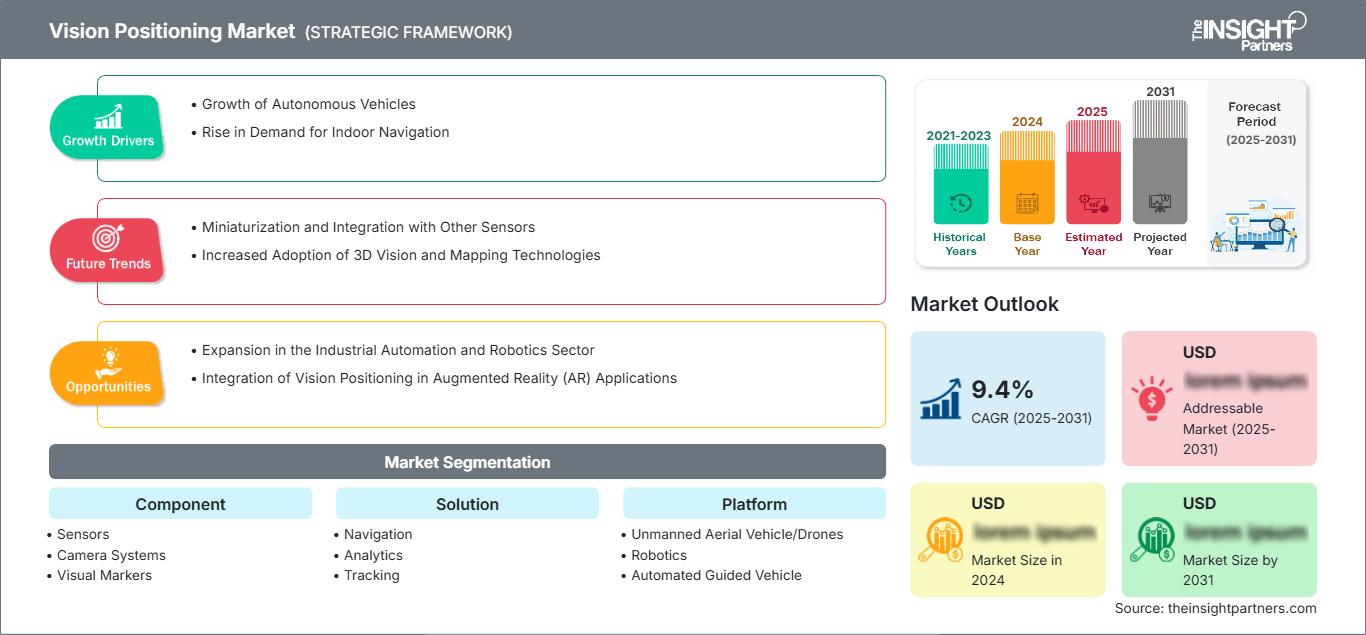
Vision Positioning Market: Strategic Insights
Regional Insights
North America Vision Positioning Market
North America is estimated to account for 34–38% of the global Vision Positioning Market revenue in 2025 and expand at a CAGR of 10.5–12.5% through 2034. Automation, warehouse technology implementation, development of autonomous robots, and investments in AI-powered industrial processes are prevalent in the area. The United States is the key contributor to revenues in the region, while Canada helps to facilitate the deployment of vision solutions in logistics, mining, aerospace, and advanced manufacturing industries. The focus moves away from individual vision sensors toward positioning solutions, which would be capable of accommodating mobile robots, autonomous forklifts, drones, and industrial analytics.
Moreover, the software and semiconductor industry in the region allows manufacturers to process visual data at the point of operation. Industrial customers become more interested in the systems that would decrease downtime and improve localization and fleet coordination. The US is estimated to contribute 75–80% of North American revenue in 2025 and is projected to grow at a CAGR of 10.5–12.5%. Regulatory developments around autonomous systems, workplace safety, and unmanned aircraft further encourage vendors to improve operational reliability and situational awareness.
U.S. Vision Positioning Market
The US is estimated to represent 75–80% of North American Vision Positioning Market revenue in 2025, supported by advanced manufacturing, logistics automation, robotics, aerospace, defense, and autonomous vehicle development. The country's adoption base includes large distribution centers, automotive facilities, electronics production, and technology-intensive warehouses. Demand increasingly favors positioning platforms that combine visual perception with inertial sensing, mapping, and AI-based interpretation.
The US market is expected to expand at a CAGR of 10.5–12.5% during 2026–2034. Companies including ABB Ltd., Cognex Corporation, FANUC Corporation, OMRON Corporation, Pepperl+Fuchs SE, and SICK AG have established technology or commercial presence across relevant automation ecosystems. Application trends increasingly emphasize autonomous mobile robots, inspection-linked navigation, fleet coordination, and GNSS-challenged positioning. Industrial customers are also evaluating cloud-to-edge architectures that permit centralized model development while preserving local, deterministic processing.
Europe Vision Positioning Market
Europe is estimated to hold a 25–29% of the Vision Positioning Market share in 2025 and expand at a CAGR of 9.5–11.5% through 2034. Germany leads regional demand, supported by advanced manufacturing and robotics. The UK, France, Italy, and Spain contribute through logistics automation, automotive production, aerospace, and smart infrastructure.
The UK is projected to grow at a CAGR of 10.0–12.0%, with demand supported by warehouse automation, autonomous systems research, and technology-intensive logistics. Germany is expected to expand at 11.0–13.0%, reflecting strong industrial robotics and machine-vision adoption. France is projected at 10.0–12.0%, while Italy and Spain are expected to record 9.5–11.5% and 9.0–11.0%, respectively. Germany remains the leading country because of its concentration of industrial automation suppliers and manufacturers.
APAC Vision Positioning Market
APAC is estimated to account for 22–26% of the global Vision Positioning Market revenue in 2025 and record a CAGR of 14.0–16.5% through 2034. China is the largest adopter of the technology, followed by Japan, South Korea, India, and Australia. Application is seen in manufacturing automation, electronics manufacturing, modernizing warehouses, and drones.
China enjoys the advantage of having large-scale manufacturing and robotics implementation, whereas Japan and South Korea are more focused on precise manufacturing and automated machinery. The increase in use of robotics in India is being fueled by logistics and manufacturing modernization, while Australia offers mining and remote operations possibilities. Industrial digitization and automation also receive government support to fuel demand regionally. China remains the largest country due to its manufacturing scale and robotics and drones presence.
Middle East & Africa Vision Positioning Market
The Middle East & Africa Vision Positioning Market is estimated to represent 5–7% of global revenue in 2025 and expand at a CAGR of 9.0–12.0% through 2034. Leading demand regions include Saudi Arabia, the UAE, and South Africa due to their need to modernize infrastructure and diversify industries for automation purposes.
Both Saudi Arabia and the UAE are implementing sophisticated logistics, smart city, industry, and infrastructure initiatives, which may involve positioning systems in difficult conditions. In addition, there are prospects in South Africa for mining, warehousing, manufacturing, and inspection automation. Also, energy infrastructure is an important field since autonomous systems could function in such huge facilities. The region's deployment levels are still not as high as in other mature markets; however, large-scale projects may fast-track development of positioning systems.
Segmentation Analysis
Component
Component adoption is expected to expand at a CAGR of 10.5–12.5% from 2026–2034. The segment encompasses hardware required to capture environmental information and convert it into usable positioning inputs. Demand is influenced by improvements in imaging, sensing resolution, embedded processing, and sensor fusion. Vendors increasingly seek compact components capable of operating reliably under industrial vibration, variable lighting, and changing scene conditions across the Vision Positioning Market.
- Sensors: Sensors support environmental awareness and motion estimation, particularly where cameras alone face occlusion, lighting, or depth limitations. Their integration improves localization resilience and supports autonomous machine operation.
- Camera Systems: Camera systems remain strategically important because they provide rich spatial information for visual localization, mapping, tracking, and navigation. Higher resolution and edge processing improve performance in demanding environments.
- Visual Markers: Visual markers remain useful where controlled positioning is required, including warehouses, production cells, and structured indoor environments. Their predictable reference points can simplify localization and deployment.
- Others: Additional components complement primary sensing architectures and can address specialized positioning requirements across different platforms and operating environments.
Solution
Solution demand is expected to grow at a CAGR of 11.5–13.5% during 2026–2034. Buyers increasingly prefer complete positioning capabilities instead of individual hardware components. Navigation, analytics, tracking, and industrial solutions can convert raw visual information into operational decisions. Integration with fleet management, robotics, manufacturing execution, and enterprise systems is becoming increasingly important as customers scale deployments across facilities, reflecting key Vision Positioning Market trends.
- Navigation: Navigation solutions support autonomous movement by estimating position, orientation, and route information. Demand is strongest where robots and drones must operate continuously without dependable satellite-based positioning.
- Analytics: Analytics solutions transform spatial and visual data into operational information, supporting utilization monitoring, process optimization, anomaly identification, and asset movement analysis.
- Tracking: Tracking solutions enable continuous monitoring of mobile assets, robots, people, or equipment, strengthening visibility across warehouses, production environments, and logistics operations.
- Industrial Solutions: Industrial solutions combine positioning with automation functions, supporting machine coordination, inspection, material handling, and autonomous workflows within production environments.
Platform
Platform adoption is projected to expand at a CAGR of 12.0–14.0% from 2026–2034. The segment benefits from increasing autonomy across aerial and ground machines. UAVs remain a major installed application base, while AGVs and robotics are gaining momentum as warehouses and factories require flexible movement. Platform-level integration allows positioning capabilities to become part of broader autonomy architectures across the Vision Positioning Market.
- Unmanned Aerial Vehicle/Drones: UAVs require accurate relative positioning for stable flight, obstacle avoidance, inspection, and navigation, particularly where satellite signals are weak or unavailable.
- Robotics: Robotics applications increasingly combine vision, mapping, and motion control, allowing machines to perform flexible tasks in dynamic industrial and service environments.
- Automated Guided Vehicle: AGVs represent a strategically important deployment area because accurate positioning supports repeatable material movement, route optimization, fleet coordination, and safer warehouse operations.
- Others: Other platforms provide specialized opportunities where visual positioning can complement conventional navigation and enable autonomous operation in constrained environments.
Location
Location solutions are expected to expand at a CAGR of 11.0–13.0% from 2026–2034. Indoor positioning remains fundamental to industrial and logistics deployments because satellite signals are unreliable inside buildings. Outdoor systems are gaining relevance for drones, autonomous vehicles, infrastructure inspection, and large industrial sites. Hybrid architectures increasingly combine multiple location technologies to improve continuity across the Vision Positioning Market.
- Indoor Positioning System: Indoor positioning systems address environments where GNSS availability is limited. Warehouses, factories, hospitals, retail facilities, and transportation hubs provide significant application potential for precise localization.
- Outdoor Positioning System: Outdoor positioning systems support drones, autonomous vehicles, infrastructure inspection, agriculture, and large industrial sites where visual references can complement satellite-based navigation.
Opportunity Snapshot
| Segment Name | Revenue Contribution | Trend Tag | Adoption Stage |
| Unmanned Aerial Vehicle/Drones | High | Aerial Autonomy | Mature |
| Robotics | High | Mobile Robotics | Scaling |
| Automated Guided Vehicle | High | Warehouse Mobility | Scaling |
| Others | Low | Specialized Platforms | Emerging |
Vision Positioning Market Growth Drivers and Impact Analysis
Expansion of Autonomous Industrial Mobility
Autonomous mobility is making the need for positioning technologies that can provide continuous interpretation of surroundings much more prevalent than static maps or predefined routes. Factories, warehouses, logistics hubs, and other types of big industrial facilities are employing mobile robots, autonomous forklifts, and flexible handling systems. Using visual positioning helps those devices keep their position in the presence of changing surroundings, temporary obstacles, or untrustworthy navigation landmarks. The commercial value goes beyond the sale of hardware as the client base needs more and more software services, maps, fleet coordination, integration, and lifecycle management solutions. This expands the revenue streams within the sector and increases the value of providers who can provide positioning solutions comprehensively. Interoperability and coordination between multiple robots may become another important purchase criterion as the density of implementation rises.
AI-Enabled Machine Vision at the Edge
AI enhances the capacity of positioning technology to analyze complex visual scenes without being as dependent upon rule-based engineering of the system. Edge processing ensures that the localization, object detection, and navigational decision-making take place closer to the machines, thereby reducing any possible delay in communication and allowing for deterministic operation. This design feature is especially beneficial in scenarios like fast manufacturing, mobile robots, and inspection systems, where latency can have an effect on efficiency and even safety. AI also helps the positioning systems to adapt to more varied object appearances and illumination conditions. The economic implications of such an innovation are visible through increased demand for embedded computing hardware, intelligent cameras, software platforms, and model management systems.
Need for Reliable Positioning in GNSS-Challenged Environments
Satellite positioning may be problematic in indoor, subterranean, congested environments or other settings where obstructions and multipath phenomena affect signal propagation. Such environments impose a structural need for other methods of positioning inside warehouses, factories, infrastructure, UAVs, and robotic vehicles. Vision positioning may offer additional environmental cues, combining with inertial and radiometric techniques, thus increasing the robustness of the architecture. It is most relevant in contexts where operational stability is directly related to performance, usage of resources, or safety. Multi-modal positioning helps avoid the limitation of relying on only one method, so that systems are able to cope with degraded visibility, radio communication, or satellite reception.
Vision Positioning Market Future Trends
Convergence of Vision, Mapping, and Generative AI
Future systems should incorporate the capabilities of visual perception combined with increasingly advanced mapping techniques and AI models that are capable of making sense of their environment rather than detecting predefined references. It will be possible for autonomous systems to perceive spatial relationships, adapt routes, and react to new situations. The generative AI will make the process of model training easier by facilitating the process of preparing data, labeling it, setting up a model, and optimizing it for particular applications. Over time, the platforms that perform positioning tasks will evolve into a more generic spatial intelligence layer that supports several machines and workflows. Such an approach will reduce the need for separate positioning applications and the use of a shared environment model between robots, drones, and autonomous cars.
Hybrid Positioning Across Indoor and Outdoor Operations
An important future avenue is the creation of positioning systems that allow continuity as objects go from indoor to outdoor spaces. Transition zones, in warehouses, harbors, airports, universities, and industrial complexes, often have different performance in terms of satellite positioning, radio technology, and visual information. It is possible to use hybrid architectures to integrate these inputs and minimize the disruptions to localization processes. Such systems will be especially useful for autonomous vehicles, inspecting drones, logistics devices, and mobile robots working on large sites. This will lead to a situation where vendors will be encouraged to create positioning software for both cases, not for indoor and outdoor spaces separately.
Vision Positioning Market Opportunities
Positioning-as-a-Service for Multi-Site Automation
Positioning-as-a-service offers an avenue to vendors by enabling them to move away from a sale model of physical equipment and instead focus on software. There is a growing need among large companies and logistics firms to automate operations in several locations with the requirement to centralize configurations, model management, map, diagnose and monitor operations. Service-based architecture is capable of providing standardization at deployment but still allows for tailoring to individual sites. More revenue is earned by vendors from a subscription-based model that includes analytics, optimization, upgrades, and fleet monitoring. It will also cut down the cost of upfront engineering for customers who do not have computer vision capabilities.
Specialized Solutions for Mining, Energy, and Infrastructure
Opportunities in mining, energy and infrastructure projects are highly interesting due to large coverage areas, rough terrains, restricted visibility, and conditions when manual surveillance may be expensive and even dangerous. Vision-based positioning may enable autonomous inspection, asset tracking, mobile equipment operation, drone operation, and remote surveillance. Suppliers may provide custom solutions with respect to dust, vibrations, varying light conditions, and sporadic communication instead of developing indoor automation solutions. Programs for regional infrastructure development in the Middle East, Australia, and other countries with intensive resource use may generate project-related opportunities. Cooperation with robotics integrators, drone service providers, industrial automation suppliers and infrastructure companies may speed up market penetration. The most promising opportunities will arise from the cases when positioning helps to improve safety, equipment utilization, or continuity of work.
Frequently Asked Questions

- Comprehensive Market Sizing and Forecast Analysis
- Detailed Segmentation Analysis
- In-Depth Market Dynamics Assessment
- Regional and Country-Level Insights
- Competitive Landscape and Company Benchmarking
- Strategic Business Intelligence
Recent Reports
Testimonials

The Insight Partners' SCADA System Market report is comprehensive, with valuable insights on current trends and future forecasts. The team was highly professional, responsive, and supportive throughout. We are very satisfied and highly recommend their services.
RAN KEDEM Partner, Reali Technologies LTDs
I requested a report on a very specific software market and the team produced the report in a few days. The information was very relevant and well presented. I then requested some changes and additions to the report. The team was again very responsive and I got the final report in less than a week.
JEAN-HERVE JENN Chairman, Future Analytica
We worked with The Insight Partners for an important market study and forecast. They gave us clear insights into opportunities and risks, which helped shape our plans. Their research was easy to use and based on solid data. It helped us make smart, confident decisions. We highly recommend them.
PIYUSH NAGPAL Sr. Vice President, High Beam Global
The Insight Partners delivered insightful, well-structured market research with strong domain expertise. Their team was professional and responsive throughout. The user-friendly website made accessing industry reports seamless. We highly recommend them for reliable, high-quality research services
YUKIHIKO ADACHI CEO, Deep Blue, LLC.
This is the first time I have purchased a market report from The Insight Partners.While I was unsure at first, I visited their web site and felt more comfortable to take the risk and purchase a market report.I am completely satisfied with the quality of the report and customer service. I had several questions and comments with the initial report, but after a couple of dialogs over email with their analyst I believe I have a report that I can use as input to our strategic planning process.Thank you so much for taking the extra time and making this a positive experience.I will definitely recommend your service to others and you will be my first call when we need further market data.
JOHN SUZUKI President and Chief Executive Officer, Board Director, BK Technologies
I wish to appreciate your support and the professionalism you displayed in the course of attending to my request for information regarding to infectious disease IVD market in Nigeria. I appreciate your patience, your guidance, and the fact that you were willing to offer a discount, which eventually made it possible for us to close a deal. I look forward to engaging The Insight Partners in the future, all thanks to the impression you have created in me as a result of this first encounter.
DR CHIJIOKE ONYIA MANAGING DIRECTOR, PineCrest Healthcare Ltd.Reason to Buy
- Informed Decision-Making
- Understanding Market Dynamics
- Competitive Analysis
- Identifying Emerging Markets
- Customer Insights
- Market Forecasts
- Risk Mitigation
- Boosting Operational Efficiency
- Strategic Planning
- Investment Justification
- Tracking Industry Innovations
- Aligning with Regulatory Trends





 Get Free Sample for