
Water Chillers Market Size, Trends & Demand by 2034
Coverage: By Type (Screw Chiller, Scroll Chiller, Centrifugal Chiller, Others); Capacity (KW) (>700, 351-700, 101-350, 0-100); Industry (Plastic and Rubber, Food and Beverage, Chemical and Petrochemical, Pharmaceutical, Others) , and Geography (North America, Europe, Asia Pacific, and South and Central America)
- Status : Data Released
- Report Code : TIPRE00022934
- Category : Electronics and Semiconductor
- No. of Pages : 150
- Available Report Formats :


- Last update date : September 24, 2026


2025 Market Size
US$ 4.06 Bn
Base year value
2034 Forecast
US$ 6.86 Bn
Projected by 2034
CAGR 2026-2034
6.0 %
Growth rate
Addressable Market
US$ 49.45 Bn
(2026-2034)
The Water Chillers market was valued at US$ 4.06 billion in 2025 and is expected to reach US$ 6.86 billion by 2034; it is estimated to record a CAGR of 6.0% during 2026-2034.
Water Chillers Market Assessment and Insights
- North America: North America is estimated to represent 27–31% share in 2025 and grow at a 5.8–6.4% CAGR between 2026–2034, supported by replacement demand, manufacturing investment, pharmaceutical production, and efficiency-focused cooling upgrades.
- US: The US is estimated to account for 82–86% of North America's 2025 market and expand at a 5.7–6.3% CAGR between 2026–2034, led by industrial retrofits and process-cooling requirements.
- Europe: Europe is estimated to hold 22–26% share in 2025 and register a 5.5–6.1% CAGR between 2026–2034. Germany, the UK, France, Italy, and Spain remain important markets because of process industries, pharmaceutical manufacturing, and stringent energy-efficiency priorities.
- Asia Pacific: Asia Pacific is estimated to command 36–40% share in 2025 and expand at a 7.3–8.0% CAGR between 2026–2034. China, Japan, India, South Korea, and Australia benefit from expanding manufacturing, pharmaceuticals, food processing, electronics, and industrial infrastructure.
- Largest Segment: Screw chillers are estimated to hold a 45–49% market share in 2025 and grow at a 6.4–6.9% CAGR during 2026–2034, reflecting broad industrial applicability.
- High Growth Segment: Centrifugal chillers are estimated to account for 20–24% share in 2025 and expand at a 7.0–7.5% CAGR during 2026–2034, supported by high-capacity installations.
- Key companies analyzed in detail: Daikin Industries, Ltd.; Thermax Limited; Trane Technologies plc; Carrier Global Corporation; Johnson Controls International plc; Blue Star Limited; LabTech S.r.l.; HIVER Aircon Pvt Ltd; M.J.L. Lab Instruments and Equipments; Sioux Corporation.
Source: The Insight Partners' analysis based on proprietary research, government publications, company annual reports, investor presentations, industry databases, and expert interviews.
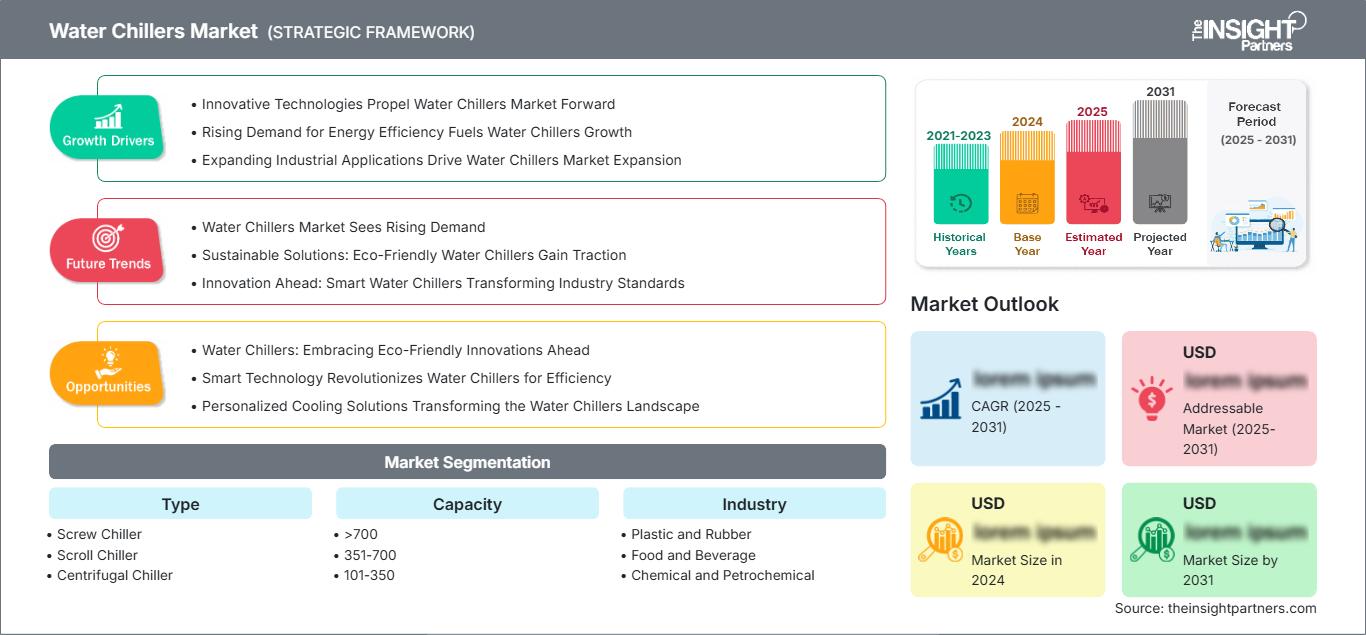
The water chillers market has evolved from conventional fixed-load cooling toward variable-speed compression, improved heat-exchanger designs, electronic controls, and lower-impact refrigerant configurations. Equipment and monitoring systems are now being integrated more and more frequently to optimize load matching and maintenance scheduling. Production economics favor modular structures that decrease installation difficulty while allowing growth of capacity along with rising thermal loads in industry.
The Water Chillers Market report indicates that, over the forecast period, investment is expected to shift toward efficient systems capable of operating under variable production loads and increasingly demanding environmental requirements. New manufacturing hubs in South and Southeast Asia should offer new prospects for installations, whereas developed countries are likely to focus on the replacement market and retrofits. Refrigerant changeovers, electrification, automation, and efficiency throughout the equipment’s lifecycle are some of the factors that are expected to affect the procurement specifications.
Water Chillers Market Report Scope
| Report Attribute | Details |
|---|---|
| Market size in 2025 | US$ 4.06 Billion |
| Market Size by 2034 | US$ 6.86 Billion |
| Global CAGR (2026 - 2034) | 6.0% |
| Historical Data | 2021-2024 |
| Forecast period | 2026-2034 |
Water Chillers Market Analysis
Water chillers market growth is closely linked to industrial processes requiring stable temperature control. Plastics extrusion and molding, food and beverages manufacturing, pharmaceuticals manufacturing, and chemicals manufacturing require chilled water in order to ensure process uniformity. The value chain includes compressor and motor suppliers, heat exchanger manufacturers, controls providers, system integrators, distributors, installers, and aftermarket services providers. There is increasing consideration for life cycle energy usage when selecting equipment.
Water Chillers Market forecast indicates that supply dynamics remain influenced by compressor availability, copper and aluminum costs, refrigerant regulations, and production localization. Larger manufacturers now offer regional assembly and servicing options to minimize risks of transportation and ensure prompt commissioning. Clients requiring uninterrupted operation schedules tend to prefer service providers that guarantee preventive maintenance, remote diagnostics, spare parts delivery, and performance guarantees. This enables recurring service income and enhances the position of integrated OEMs.
The industry is comprised of multinational HVAC producers in competition with specialized industrial cooling manufacturers. Daikin Industries, Ltd., Trane Technologies plc, Carrier Global Corporation, and Johnson Controls International plc are able to provide services to larger facilities through advanced technology and service solutions. Thermax Limited and Blue Star Limited provide competitive advantages within regions, whereas LabTech S.r.l., HIVER Aircon Pvt Ltd, M.J.L. Lab Instruments and Equipments, and Sioux Corporation are more relevant for specialized needs of processes and laboratories.
Funding is becoming oriented towards energy efficiency, intelligent control systems, lower global warming potential (GWP) refrigerants, and specific thermal management solutions. Businesses are also aligning themselves with data center applications and next-generation manufacturing capabilities, where reliability and efficiency in cooling become economically relevant factors. Differentiation strategy is thus based on compressor technologies, control systems, geographic reach, customization, and integration with building systems.
● REPORT CUSTOMIZATION
Tailor This Report To Align With Your Specific Business Requirements
This report can be customized to align precisely with your business objectives, scope, and target markets. Customization options include tailored segmentation, geography, competitive analysis, and strategic insights to support informed decision-making.
Customize This Report →WHAT YOU CAN ADJUST
- ● Segmentations
- ● Geography
- ● Competitive Analysis
- ● Language Preferences
Water Chillers Market: Strategic Insights
Regional Insights
North America Water Chillers Market
North America is estimated to hold 27–31% share of the Water Chillers Market in 2025 and record a 5.8–6.4% CAGR through 2034. The USA is the dominant region for demand due to pharmaceutical facilities, food processing, plastics production, and commercial facilities. The development of industry encourages the upgrade from the old technology to new chillers that have better performance at part load and reduced operating costs.
Canada's contribution comes through food processing, manufacturing, healthcare, and commercial facilities, while Mexico's contribution comes through industrial relocation and manufacturing expansion. The procurement processes take into account the refrigerant suitability, water efficiency, integration with control systems, and total cost of ownership. Leading companies have strong positions because of engineering capabilities, distributors, commissioning, and after-sales services. Another important source of demand is the development of data center infrastructure.
U.S. Water Chillers Market
The US represents approximately 82–86% of North America's 2025 Market share and is projected to grow at 5.7–6.3% CAGR through 2034. The demand will be aided by pharmaceuticals, plastic manufacturing, food processing, chemicals, and advanced manufacturing. Users are specifying variable speed compressors and remote monitoring to conserve energy under varying load conditions.
Large vendors such as Daikin Industries, Ltd., Trane Technologies plc, Carrier Global Corporation, and Johnson Controls International plc have set up facilities for applications engineering and service throughout the nation. Process industry users are also looking for packaged products where quick installation and maintenance considerations are critical. Growth in advanced manufacturing and data centers will drive demand for reliable cooling solutions. The need for replacing inefficient existing equipment is also an opportunity for vendors who focus on retrofit business.
Europe Water Chillers Market
Europe is estimated at 22–26% share in 2025 and is expected to expand at 5.5–6.1% CAGR through 2034. Germany is leading regional demand, followed by the UK, France, Italy, and Spain. Energy efficiency, refrigerant conversion, process automation, and process plant upgrade continue to be key factors in purchasing decisions.
The UK market has the advantage of pharmaceutical, food and beverages, and manufacturing sectors, where procurement continues to place emphasis on energy performance and control. Germany has an extensive manufacturing industry consisting of chemicals, plastics, machinery, food processing, and pharmaceutical sectors. Process manufacturing and food processing are among the main contributors from France, Italy, and Spain.
APAC Water Chillers Market
APAC is estimated to account for 36–40% of the Water Chillers Market share in 2025 and achieve a 7.3–8.0% CAGR through 2034, making it the leading regional market. China is still the largest source country, and India, Japan, South Korea, and Australia form a varied demand due to their various industrial applications.
The growth of the manufacturing industry, pharmaceuticals, food-processing industry, and electronics industry help in installations. China has benefited due to high industrial capacity, while India has received support due to localization of manufacturing and infrastructure development. Japan and South Korea give importance to efficient and automated manufacturing systems. Australia gives demand due to mining processing industries, food industries, and commercial buildings.
Middle East & Africa Water Chillers Market
Middle East and Africa Water Chillers Market is estimated to represent 4–6% of the market in 2025 and expand at a 6.0–6.8% CAGR through 2034. Saudi Arabia and the UAE spearhead regional activity, owing to the efforts of diversification of industry, infrastructure development, food processing, and the development of pharmaceuticals.
South Africa is involved through its manufacturing and process industries, whereas the rest of MEA offer possibilities associated with industrialization and infrastructure development. The high temperatures of the region increase the need for cooling, while energy-intensive plants are increasingly assessing efficient equipment to help reduce their operating costs. Saudi Arabia stands out as a major country due to its diversification of industry efforts and infrastructure development.
Segmentation Analysis
Type
Water Chillers Market trends indicate that the type is segmented into Screw Chiller, Scroll Chiller, and Centrifugal Chiller. The segment is expected to expand at different rates according to capacity requirements, operating profiles, and application complexity. Screw systems remain widely applicable across industrial and commercial environments, while centrifugal technology gains relevance in high-capacity facilities. Digital controls, intelligent monitoring capabilities, and variable-speed operation increasingly influence purchasing decisions across all three configurations as end users prioritize energy efficiency, operational flexibility, and lifecycle performance.
- Screw Chiller: Screw chillers occupy a strong position because they provide scalable capacity, stable operation, and suitability for industrial environments with variable thermal loads. Their balance between efficiency, reliability, and serviceability supports continued adoption across manufacturing and processing facilities.
- Scroll Chiller: Scroll chillers address applications requiring compact equipment, relatively straightforward installation, and dependable operation at smaller capacities. Their modular characteristics make them relevant for distributed process cooling and facilities where incremental capacity additions are preferred.
- Centrifugal Chiller: Centrifugal chillers are strategically important for large facilities requiring substantial continuous cooling. High-capacity industrial plants and infrastructure projects increasingly consider these systems where efficiency at scale and sophisticated control architectures justify higher initial investment.
Capacity
Capacity comprises >700, 351-700, 101-350, and 0-100. Capacity selection depends on process heat loads, production scale, operating schedules, and available installation space. Larger systems are particularly relevant to continuous industrial operations, whereas smaller configurations serve decentralized and laboratory-oriented requirements.
- >700: This category addresses large industrial plants and high-load installations requiring centralized chilled-water production. Demand is linked to continuous manufacturing, chemical processing, pharmaceuticals, and facilities where high thermal loads require efficient large-scale cooling infrastructure.
- 351-700: This capacity range serves medium-to-large industrial facilities seeking centralized cooling without the footprint of the largest systems. It supports process expansion, replacement projects, and applications requiring reliable chilled-water availability across multiple production stages.
- 101-350: This range fits mid-sized manufacturing and processing operations with moderate thermal loads. Its flexibility supports plastics, food and beverage, chemical, pharmaceutical, and specialized production environments where equipment scalability and manageable installation requirements are important.
- 0-100: Smaller chillers address decentralized production, laboratory, packaging, and specialized equipment cooling. Their compact footprint and simpler installation support facilities with limited space or intermittent cooling requirements, making modular deployment strategically valuable.
Industry
Industry includes Plastic and Rubber, Food and Beverage, Chemical and Petrochemical, and Pharmaceutical. The segment is expected to expand at a differentiated pace as production capacity, temperature-control requirements, and quality standards influence equipment procurement. Pharmaceutical and chemical applications generally require stringent process control, while plastics and food processing provide broad recurring demand.
- Plastic and Rubber: Plastics and rubber processors require stable cooling during molding, extrusion, and related processes. Chillers help maintain dimensional consistency and production stability, supporting replacement demand as manufacturers increase automation and throughput.
- Food and Beverage: Food and beverage facilities use process cooling across production, storage, packaging, and temperature-sensitive operations. Expansion of processed-food capacity and stricter quality requirements support demand for reliable, hygienic, and efficiently controlled chilled-water systems.
- Chemical and Petrochemical: Chemical and petrochemical facilities require dependable thermal management across reaction, condensation, separation, and process-support operations. High operating continuity makes equipment reliability, redundancy, corrosion resistance, and service responsiveness important purchasing criteria.
- Pharmaceutical: Pharmaceutical manufacturing places strong emphasis on precise temperature control, process consistency, and validated production environments. Expansion of pharmaceutical capacity and increasingly sophisticated manufacturing infrastructure supports demand for controlled and monitored cooling systems.
Opportunity Snapshot
| Industry | Revenue Contribution | Trend Tag | Adoption Stage |
| Plastic and Rubber | High | Process Cooling | Mature |
| Food and Beverage | High | Hygienic Cooling | Scaling |
| Chemical and Petrochemical | High | Process Stability | Mature |
| Pharmaceutical | Medium | Validated Cooling | Scaling |
Water Chillers Market Growth Drivers and Impact Analysis
Industrial Process Intensification
Facilities are ramping up throughput while reducing their tolerance for temperature variation, which drives the water chillers market forward. Plastic processing, chemical industries, drug manufacturing, and food companies need more consistent cooling, either in constant or varying production cycles. Increased utilization could lead to increased heat generation and thus requires efficient cooling system operation. The equipment with an efficient compressor, control capability, redundant features, and easy repair is favored here. Process intensification is another factor driving the upgrade of outdated and inadequate machines instead of just temporary cooling system deployment. The suppliers are able to design around the production load to gain better deals and the after-market business. The importance of this trend is even higher in new manufacturing countries where production lines are designed in such a way that cooling systems are incorporated right away during the plant design phase.
Energy Efficiency and Lifecycle Cost Optimization
Energy consumption has become a more influential procurement criterion as industrial operators evaluate cooling equipment through total lifecycle cost. Variable-speed compressors, optimized heat exchangers, intelligent controls, and improved part-load performance can reduce unnecessary electricity consumption when production loads fluctuate. Consequently, water chillers market growth increasingly favors equipment that combines efficient operation with measurable monitoring capabilities. The buyers also factor in the frequency of maintenance, availability of parts, amount of refrigerants needed, and the estimated lifespan of the system when evaluating the options. It alters the dynamics of competition, as the cost of purchase is not an enticing factor as long as electricity and maintenance form a significant part of the cost to be incurred over time. Companies can make their value proposition more convincing if they can measure their efficiency through practical application.
Expansion of Temperature-Sensitive Manufacturing
The expansion of pharmaceutical, food, beverage, specialty chemical, and advanced manufacturing capacity creates structural demand for controlled process cooling. These industries cannot easily tolerate temperature instability because it can affect product quality, process consistency, equipment performance, or production continuity. The water chillers market therefore benefits from capital expenditure directed toward new plants and capacity additions. Pharmaceutical manufacturing is especially significant as there are requirements for control and dependability of utilities in manufacturing. The food industry is equally dependent on thermal management during the manufacturing process. The chemical and petrochemical industries focus more on continuous operation and the robustness of their machinery. As manufacturers set up new manufacturing plants closer to the end market, suppliers get a chance to offer plant designs specific to applications.
Water Chillers Market Future Trends
Intelligent Chiller Plant Optimization
Future water chillers market trends will increasingly center on connected controls that coordinate chillers, pumps, cooling equipment, sensors, and production loads. Instead of running machinery on the basis of rigid schedules, smart technology allows adjustments based on current demand and performance. Machine learning can help detect abnormal performance, fouling, and declining efficiency in compressors prior to system failures causing downtime. Connectivity through cloud services will enable central monitoring of various plants, allowing comparisons between plants regarding energy intensity and maintenance needs. Such development will make manufacturers vie not only for the efficiency of their equipment but also for its software capabilities. The need for open communication and connectivity with management systems of the plants should become an increasingly important factor as industrial clients look for uniform control of utilities. Digitalization capabilities are likely to evolve into must-have features in the long run.
Low-GWP Refrigerant and Electrification Transition
Another important trend involves the move towards refrigerants that have a reduced impact on the environment along with equipment designs that are more suitable for electrification. Changes in regulations and corporate sustainability efforts are leading to companies moving towards changing compressor designs, heat exchanger systems, controls and refrigerant systems instead of selecting refrigerants. The introduction of a water-cooled inverter chiller from Daikin that uses R-1234ze by 2025 shows one way in which this is happening. In future equipment designs, efficiency at part load conditions, suitability for renewable energy sources and use in decarbonization programs for industries are going to be more common.
Water Chillers Market Opportunities
Localized Manufacturing and Service Ecosystems
There are many possibilities for the company to tap into by building localized systems for manufacturing, distribution, commissioning, and servicing in areas that have a rapidly growing industrial base. Assembly at the local level would minimize logistical risk and increase response time on customized installation, whereas a regional inventory of spare parts would enhance trust in the reliability of continuous process operations. India, Southeast Asia, the Middle East, and certain countries of Latin America provide opportunities where the industrial base is growing and customers require reliable technical support services. Cooperation with engineering companies and industrial integrators will allow the reduction of sales cycles by incorporating chiller specifications into plant development projects. The suppliers will be able to build their revenues from service operations such as maintenance, remote monitoring, performance optimization, and component replacement.
High-Capacity Thermal Management Solutions
This is a good business opportunity for companies that have centrifugal compressors with high technological advancements, sophisticated controls, and engineering expertise. Large chemical plants, pharmaceutical facilities, food processing units, and other plants that manufacture products in a continuous process require centralized cooling systems that can handle heavy and varied cooling loads. Companies can compete with their products’ staged capacity, redundancy, heat recovery features, and automatic system optimization apart from merely producing higher capacity cooling. Engineering companies and manufacturers of plants might also prefer products whose integration into the cooling system will ease further expansion, as more modules or chillers could be added later without redesigning the whole cooling system. Specialized plants with exceptional cooling requirements could also represent this business opportunity.
Frequently Asked Questions

- Comprehensive Market Sizing and Forecast Analysis
- Detailed Segmentation Analysis
- In-Depth Market Dynamics Assessment
- Regional and Country-Level Insights
- Competitive Landscape and Company Benchmarking
- Strategic Business Intelligence
Recent Reports
Testimonials

The Insight Partners provided valuable market intelligence that supported our global go-to-market strategy. Their team was professional, responsive, and attentive to our feedback, providing thoughtful analysis and helpful methodological clarifications throughout the project.
Junmo Kim Chief Financial Officer (CFO), Enertech Co., Ltd.
The Insight Partners' SCADA System Market report is comprehensive, with valuable insights on current trends and future forecasts. The team was highly professional, responsive, and supportive throughout. We are very satisfied and highly recommend their services.
RAN KEDEM Partner, Reali Technologies LTDs
I requested a report on a very specific software market and the team produced the report in a few days. The information was very relevant and well presented. I then requested some changes and additions to the report. The team was again very responsive and I got the final report in less than a week.
JEAN-HERVE JENN Chairman, Future Analytica
We worked with The Insight Partners for an important market study and forecast. They gave us clear insights into opportunities and risks, which helped shape our plans. Their research was easy to use and based on solid data. It helped us make smart, confident decisions. We highly recommend them.
PIYUSH NAGPAL Sr. Vice President, High Beam Global
The Insight Partners delivered insightful, well-structured market research with strong domain expertise. Their team was professional and responsive throughout. The user-friendly website made accessing industry reports seamless. We highly recommend them for reliable, high-quality research services
YUKIHIKO ADACHI CEO, Deep Blue, LLC.
This is the first time I have purchased a market report from The Insight Partners.While I was unsure at first, I visited their web site and felt more comfortable to take the risk and purchase a market report.I am completely satisfied with the quality of the report and customer service. I had several questions and comments with the initial report, but after a couple of dialogs over email with their analyst I believe I have a report that I can use as input to our strategic planning process.Thank you so much for taking the extra time and making this a positive experience.I will definitely recommend your service to others and you will be my first call when we need further market data.
JOHN SUZUKI President and Chief Executive Officer, Board Director, BK Technologies
I wish to appreciate your support and the professionalism you displayed in the course of attending to my request for information regarding to infectious disease IVD market in Nigeria. I appreciate your patience, your guidance, and the fact that you were willing to offer a discount, which eventually made it possible for us to close a deal. I look forward to engaging The Insight Partners in the future, all thanks to the impression you have created in me as a result of this first encounter.
DR CHIJIOKE ONYIA MANAGING DIRECTOR, PineCrest Healthcare Ltd.Reason to Buy
- Informed Decision-Making
- Understanding Market Dynamics
- Competitive Analysis
- Identifying Emerging Markets
- Customer Insights
- Market Forecasts
- Risk Mitigation
- Boosting Operational Efficiency
- Strategic Planning
- Investment Justification
- Tracking Industry Innovations
- Aligning with Regulatory Trends





 Get Free Sample for