
Transparent Displays Market Demand, Size & Forecast by 2034
Coverage: by Technology (LCD, OLED, and E-Paper); and Application (Consumer Electronics, Automobile, Retail, Aerospace & Defense, Media & Entertainment, and Others), and Geography (North America, Europe, Asia Pacific, and South and Central America)
- Status : Data Released
- Report Code : TIPEL00002046
- Category : Electronics and Semiconductor
- No. of Pages : 150
- Available Report Formats :


- Last update date : October 30, 2026


2025 Market Size
US$ 1.48 Bn
Base year value
2034 Forecast
US$ 25.76 Bn
Projected by 2034
CAGR 2026-2034
37.39 %
Growth rate
Addressable Market
US$ 89.42 Bn
(2026-2034)
The Transparent Displays Market is valued at US$ 1.48 Billion in 2025 and is projected to reach US$ 25.76 Billion by 2034, expanding at a CAGR of 37.39% from 2026 to 2034. The market encompasses transparent LCD, OLED, and E-Paper technologies used to display digital information while preserving visibility of objects or environments behind the display. Market is undergoing a fast commercialization process with the use of transparent panels transitioning from being in the prototype phase and demonstrations to real retail and automotive uses, as well as other commercial applications.
North America is expected to become a major commercialization market because of premium digitization of retail, development of automotive displays, immersive media installations, and consumer uses that are very technological. The Transparent Displays Market Size in North America is projected to grow at ~35% CAGR until 2034, driven by demand changing from demonstration-based to actual display systems.
Transparent Displays Market Assessment and Insights
Regional Outlook
- North America: ~25% of the global market in 2025 | ~35% CAGR through 2034. Market position: North America remains a major commercialization market, supported by advanced retail infrastructure, automotive technology development, digital signage investment, and early deployment of transparent displays in premium commercial and entertainment environments.
- US: ~80% of North American market revenue in 2025 | ~35% CAGR through 2034. Market position: The US represents the principal demand center within North America, supported by technology-intensive retailers, automotive innovation, experiential media, consumer electronics development, and established relationships between display suppliers and system integrators.
- Europe: ~20% of the global market in 2025 | ~34% CAGR through 2034. Market position: Europe combines mature premium retail and automotive ecosystems with increasing interest in advanced cockpit interfaces. Germany represents the leading country in Europe, followed by substantial technology and retail activity in the UK and France.
- Asia Pacific: ~41% of the global market in 2025 | ~43% CAGR through 2034. Market position: Asia Pacific is the largest and fastest-growing regional market, supported by display manufacturing capacity, OLED expertise, consumer electronics production, automotive innovation, and strong technology commercialization across China, South Korea, and Japan.
Segment Outlook
- Retail: ~30% Share in 2025 | ~38% CAGR through 2034. Market position: Retail leads application demand because transparent displays can combine merchandise visibility with dynamic digital content, enabling storefront communication, product demonstrations, interactive showcases, and premium experiential merchandising without completely obscuring physical products.
- Automobile: ~28% Share in 2025 | ~45% CAGR through 2034. Market position: Automobile represents the high-growth application segment as transparent interfaces increasingly support augmented-reality information, windshield displays, transparent sunroofs, digital rear-view concepts, and integrated cockpit experiences for premium and next-generation vehicles.
Competitive Coverage
Panasonic Holdings Corporation, Apple Inc., Samsung Display Co., Ltd., Sony Group Corporation, EVOLUCE GmbH, BOE Technology Group Co., Ltd., Universal Display Corporation, Pro Display Ltd., Planar Systems, Inc., NEXNOVO Technology Co., Ltd.
Methodology
The Insight Partners follows Data Collection & Secondary Research, Primary Research, Data Analysis, and Data Triangulation & Final Review to validate market estimates and insights.
Source: The Insight Partners' analysis based on proprietary research, government publications, company annual reports, investor presentations, industry databases, and expert interviews.
Markets have transitioned from experimental transparency panels towards integrated display systems. The rise of strategic significance for OLED results from its capability of self-illumination that eliminates the necessity for backlighting and allows to have more compact designs, while LCD retains significance where manufacturing experience, economics and large format display deployments play an important role. E-Paper finds its niche due to its capability of low power consumption and constant information display. Developments related to transparency, brightness, color representation, touch, flexibility and integration are expanding the range of potential applications.
Looking ahead, one can observe that the main drivers include automotive commercialization, intelligent retail environments, premium consumer electronics and immersive media. Asia Pacific continues to be the region crucial for manufacturing and technology innovation while North America and Europe represent important application regions. Investments in OLED manufacturing, transparent backplanes, automotive cockpit solutions and digital signage technologies will support the supplier community. Development of regulation on automotive displays and general infrastructure investments will help to enhance transparency display applications commercially.
Transparent Displays Market Report Scope
| Report Attribute | Details |
|---|---|
| Market size in 2025 | US$ 1.48 Billion |
| Market Size by 2034 | US$ 25.76 Billion |
| Global CAGR (2026 - 2034) | 37.39% |
| Historical Data | 2021-2024 |
| Forecast period | 2026-2034 |
Transparent Displays Market Analysis
Transparent Displays Market growth dynamics are driven by the relationship between advancements in display technologies and the readiness of their application domains to remodel physical spaces with new kinds of interface. The demand is highest in places where transparency is a benefit in itself rather than just a style feature.
Retailers, automotive companies, consumer electronics producers, media businesses, and specific customers from the aerospace and defense industries make up the key demand ecosystem. The value chain includes manufacturers of display materials, panel makers, electronic components, module manufacturers, software and content providers, system installers, and end users. OLED panels play a critical role in high-end uses, whereas LCD and E-Paper technologies continue to be used in some instances where cost efficiency, power consumption, or operating environment require it.
According to the Transparent Displays Market Report, current supply trends are centered on Asian display manufacturing centers. Samsung Display, BOE Technology Group, Panasonic, Sony, and Universal Display operate in the market in various capacities, related to panels, materials, technologies, or systems. Specialized manufacturers NEXNOVO, Pro Display, and Planar are involved in transparent and large-format displays.
Positioning in competition is more dependent on transparency, brightness, optical performance, display size, robustness, touch functionality, energy efficiency, and flexibility in integration. The advantages that Samsung Display and BOE enjoy come from their economies of scale in manufacturing displays, whereas the strengths of Panasonic and Sony lie in their proven expertise in electronic and mobility devices. Specialized suppliers can distinguish themselves via installation, customization, integration, and engineering applications specific to the particular solution.
● REPORT CUSTOMIZATION
Tailor This Report To Align With Your Specific Business Requirements
This report can be customized to align precisely with your business objectives, scope, and target markets. Customization options include tailored segmentation, geography, competitive analysis, and strategic insights to support informed decision-making.
Customize This Report →WHAT YOU CAN ADJUST
- ● Segmentations
- ● Geography
- ● Competitive Analysis
- ● Language Preferences
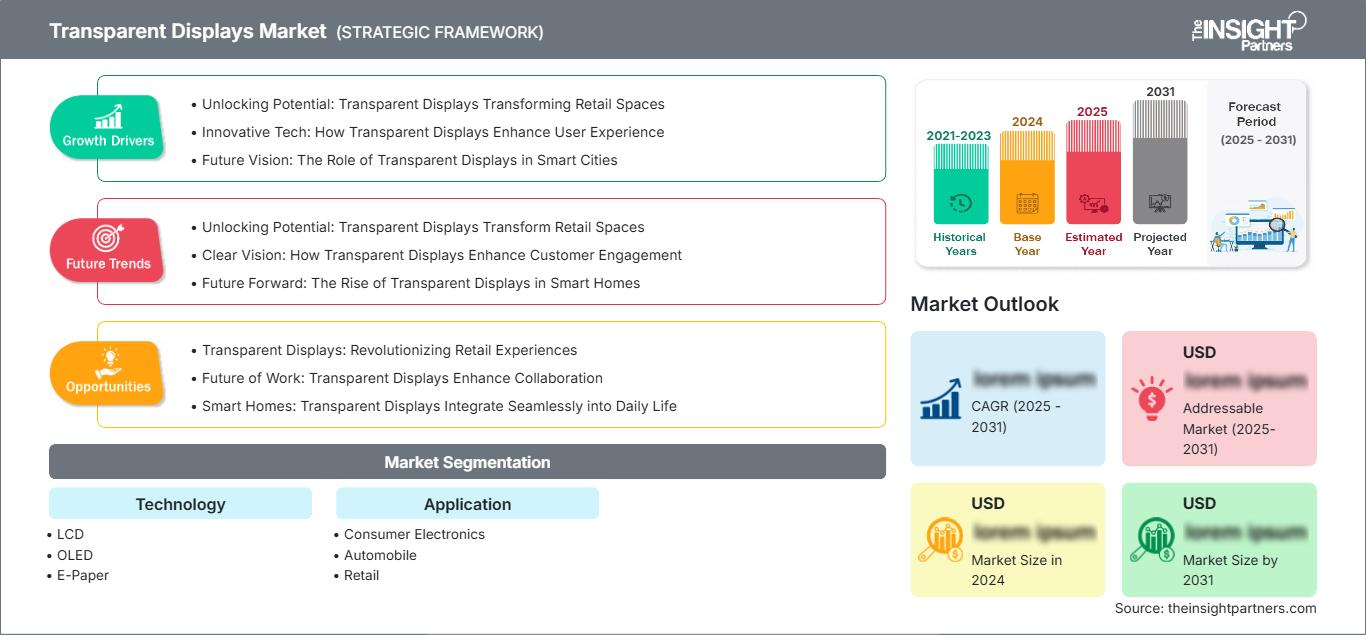
Transparent Displays Market: Strategic Insights
Regional Insights
North America Transparent Displays Market
In 2025, the North American region will represent approximately 25% of the world Transparent Displays Market share and is expected to exhibit a ~35% CAGR during the forecast period until 2034. This is attributed to high technology adoption in luxury retail, entertainment, transport, and automotive uses. Retailers in the United States leverage technology by utilizing digital space to create a bridge between physical goods and engaging digital content, while automotive companies test out new windshield and cockpit interface solutions. Availability of technology firms, specialized integrators, and advertisement systems helps accelerate the commercialization of premium installations.
This region will benefit from Canada, which provides specialized uses in commercial, architectural, and transport segments, even though the United States serves as the main demand center within the region. North American consumers value image quality, reliability, software compatibility, and measureable user engagement. It gives an opportunity to vendors able to provide a complete display solution and not just panels.
U.S. Transparent Displays Market
In 2025, the US accounted for around 80% of North America's revenue, and growth is expected to occur at a rate of around 35% CAGR till 2034. The demand is facilitated by the presence of advanced retail formats, DOOH media, automotive cockpits, entertainment centers, and high-end consumer environments. Big retailers and brands can use clear panels in stores and product showcases where the need for physical visibility is business critical.
The US has a wide array of technology providers and system integrators who can help integrate the displays with sensors, software, content management, and interactive interfaces. Technologies are advancing from static signage to contextual information, touch interface, AR visualizations, and automobile displays. Leading companies include Apple Inc., Sony Corp, Universal Display Corporation, and leading display technologies suppliers, while Asian panel manufacturers provide components and modules.
Europe Transparent Displays Market
In 2025, Europe accounted for ~20% of the global market and is forecasted to grow at a ~34% CAGR till 2034. In Europe, Germany is the front-runner owing to its automotive manufacturing presence, industrial technology capabilities, premium retail presence, and its interest in next-generation vehicle interfaces. UK is contributing via retail, media, advertising, and creative technology deployments whereas France has use cases in luxury retail, transportation, and cultural venues.
Germany and France are most relevant to commercialization in the automotive industry owing to the potential of the transparency in enabling head-up display and cockpit systems. Italy is adding to the market via luxury retail, design installations, automotive use cases, and exhibition installations whereas Spain has use cases in tourism, retail, transportation, and digital media. Overall, adoption is going to be dependent upon finding the balance between transparency, brightness, safety, power consumption, and integration needs. Premium automotive innovations and premium retail are the key drivers of high-end deployments in Europe.
APAC Transparent Displays Market
APAC comprised ~41% of the total market in 2025 and is projected to record the highest growth at a CAGR of ~43% through 2034. In the Asia-Pacific region, China is the largest country market owing to large display manufacturing capacity, technology developments within the country, automotive manufacturing, and increasing digitization in retail. South Korea brings in OLED technologies, while Japan brings advanced electronic and automotive and commercial displays capabilities.
India and Australia contribute to the development of applications markets. India has an advantage owing to expansion in premium retail, automotive technology, smart infrastructure, and consumer electronics markets, while Australia has applications for retail, entertainment, tourism, and commercial markets.
Middle East & Africa Transparent Displays Market
Middle East and Africa represents an emerging application environment, with the region modeled to record a ~31% CAGR through 2034. Saudi Arabia and the UAE provide the strongest commercial opportunities in the Middle East because investment in premium retail, tourism, hospitality, airports, entertainment venues, and smart-city infrastructure creates environments where transparent displays can provide differentiated visual communication.
For South Africa, it is a significant market in Africa for applications like retail, entertainment, transport, and commercial establishments. In other parts of the region, the adoption depends on infrastructure development, availability of skilled integrators, costs of imported panels, and development of busy commercial centers. Energy efficiency and outdoor readability are some of the factors considered, as the environment of installation could have high temperatures and bright sunshine.

Segmentation Analysis
Technology
Technology defines the underlying display architecture and determines transparency, brightness, image quality, power consumption, form factor, and deployment economics. OLED is gaining strategic importance in premium applications because it supports thin architectures and strong contrast, while LCD benefits from mature production and established integration capabilities. E-Paper remains relevant for specialized low-power applications.
- LCD maintains an important position where established manufacturing, cost control, large-area availability, and familiar system integration are priorities. Commercial signage, retail fixtures, information panels, and specialized installations can favor LCD when high-end OLED performance is not essential.
- OLED is increasingly positioned for premium retail, consumer electronics, automotive interfaces, and immersive installations. Its self-emissive architecture supports thin designs, strong contrast, and flexible integration, making it strategically important as transparent displays move toward higher-value applications.
- E-Paper serves applications emphasizing low energy consumption and persistent information visibility. Its suitability for static or frequently updated information supports specialized retail, logistics, transportation, and electronic-label applications where continuous illumination is unnecessary.
Application
Application determines the commercial use case and value proposition of transparent displays. Retail currently provides the largest revenue contribution because transparency can preserve merchandise visibility while adding digital communication. Automobile is expanding rapidly as manufacturers explore transparent HUDs, smart glass, cockpit interfaces, and immersive passenger experiences. Consumer electronics, aerospace and defense, and media and entertainment broaden the addressable opportunity.
- Consumer Electronics uses transparent displays to differentiate premium products and create new interaction models. Television, appliances, personal devices, and smart-home concepts can incorporate transparent interfaces where industrial design and spatial integration influence purchase decisions.
- Automobile is moving toward transparent and integrated display architectures for windshield information, cockpit interfaces, sunroof concepts, and passenger entertainment. Adoption depends on optical performance, safety requirements, integration with vehicle electronics, and the ability to deliver useful information without obstructing visibility.
- Retail benefits from displays that overlay digital content on physical products, enabling storefront advertising, interactive merchandising, product demonstrations, and premium brand experiences. The technology can improve use of glass surfaces while retaining visual access to merchandise.
- Aerospace & Defense represents a specialized opportunity where transparent information interfaces can support cockpit visualization, situational awareness, maintenance information, and mission-related displays. Procurement cycles and stringent reliability requirements make this a technically demanding but potentially high-value application area.
- Media & Entertainment uses transparency to create immersive installations, stage effects, exhibitions, museums, and experiential advertising. The technology is particularly useful where digital imagery needs to coexist with physical scenery, performers, products, or architectural elements.
Opportunity Snapshot
| Application | Revenue Contribution | Trend Tag | Adoption Stage |
|---|---|---|---|
| Consumer Electronics | Medium | Premium Interfaces | Scaling |
| Automobile | High | Transparent Cockpits | Scaling |
| Retail | High | Smart Storefronts | Mature |
| Aerospace & Defense | Low | Cockpit Visualization | Emerging |
| Media & Entertainment | Medium | Immersive Media | Scaling |
Transparent Displays Market Growth Drivers and Impact Analysis
Automotive Integration Expands the Addressable Display Surface
Automotive manufacturers are expanding the role of displays from conventional instrument clusters and center screens toward windshield, side-window, sunroof, rear-seat, and integrated cockpit concepts. Transparent display technologies can place contextual information within the driver's or passenger's field of view while preserving visibility of the physical environment. This capability aligns with broader development of advanced driver-assistance systems, software-defined vehicles, electric vehicles, and premium digital interiors. The commercial impact extends beyond panel sales because vehicle programs require optical components, controllers, software, sensors, calibration, and system integration. As automotive qualification cycles mature, display suppliers that can satisfy reliability, brightness, temperature, optical, and safety requirements can access longer-duration platform opportunities rather than one-time commercial installations.
Retail Digitization Converts Glass Surfaces into Interactive Media
Retail environments provide a strong use case because transparent displays can transform windows, showcases, counters, and partitions into communication surfaces without fully blocking the physical merchandise behind them. This creates an opportunity to combine digital advertising with conventional merchandising rather than replacing physical displays. Premium retailers, electronics stores, automotive showrooms, museums, and luxury brands can use transparent panels to provide product information, pricing, storytelling, promotional content, and interactive experiences. The commercial impact is also relevant to content-management providers and system integrators because retailers need scheduling, remote monitoring, touch interaction, and maintenance alongside hardware. As retail operators seek higher-value experiences from existing floor and window space, transparent displays can address both visual merchandising and digital engagement requirements.
Display Manufacturing Advances Improve Commercial Viability
Manufacturing improvements are gradually addressing several constraints that historically limited transparent display deployment, including brightness, transparency, color reproduction, panel durability, yield, and production economics. OLED manufacturing provides a route to thin self-emissive panels, while improvements in transparent backplanes and conductive structures support more advanced form factors. LCD remains important because established manufacturing ecosystems can support cost-sensitive applications. The impact of these advances is cumulative: higher performance improves the range of environments in which panels can operate, while greater production maturity can reduce integration complexity and expand supplier availability. The result is a broader addressable market spanning premium consumer products, retail systems, vehicle interiors, and specialized commercial installations.
Transparent Displays Market Future Trends
Transparent Interfaces Become Integrated with Context-Aware Systems
Future transparent display systems are likely to become increasingly connected to sensors, cameras, artificial intelligence, vehicle data, retail analytics, and environmental information. Instead of continuously presenting generic content, displays can selectively show information according to user location, gaze, product interaction, driving conditions, or surrounding activity. In automotive applications, this can support contextual windshield information and passenger experiences. In retail, the same principle can connect product recognition with personalized information. This transition changes the competitive basis of the industry because panel quality alone becomes insufficient. Suppliers will increasingly need to support software interfaces, sensing, content orchestration, and system-level integration. The Transparent Displays Market trend can increase the value captured by technology providers and integrators even when underlying panel prices become more competitive.
Transparent Displays Move Toward Flexible and Architectural Integration
Flexible substrates, transparent conductive films, improved bonding methods, and modular panel architectures are expected to expand deployment beyond conventional flat screens. Future products can increasingly integrate with curved vehicle surfaces, glass partitions, shop windows, architectural structures, and irregular product forms. Such integration allows displays to become part of the physical environment rather than discrete electronic equipment. The development path also supports new combinations of transparency and dynamic opacity, enabling surfaces to alternate between visual communication and unobstructed viewing. Commercial adoption will depend on durability, manufacturing yield, installation methods, and maintenance requirements. As these issues improve, transparent displays can become more relevant to building interiors, mobility environments, premium retail architecture, and experiential installations.
Transparent Displays Market Opportunities
Automotive Display Platforms and Integrated Mobility Systems
Automotive suppliers have an opportunity in the Transparent Displays Market Forecast to develop complete transparent display platforms rather than selling individual panels. These systems can combine transparent OLED or other display technologies with optical components, vehicle electronics, sensors, software, and content management. The strongest commercial potential lies in premium vehicles, electric vehicles, advanced cockpit systems, passenger information, and next-generation head-up display architectures. Suppliers can also pursue partnerships with automotive OEMs and Tier 1 suppliers to participate earlier in vehicle-platform development. Long qualification cycles make early technical collaboration strategically important because display geometry, electrical architecture, thermal management, and software interfaces must be considered together. Companies capable of addressing these requirements can establish deeper integration into vehicle programs while reducing dependence on standalone commercial-display projects.
Experiential Retail and Architectural Display Solutions
Retailers, airports, hospitality operators, museums, and entertainment venues can use transparent displays to create digital experiences without sacrificing the visibility or openness of physical spaces. Opportunity exists across complete solutions covering transparent panels, mounting, touch systems, content management, remote monitoring, installation, and maintenance. The addressable opportunity is especially relevant for high-value environments where brands prioritize visual differentiation and customer engagement. System integrators can create repeatable deployment packages for storefronts, product showcases, information counters, and exhibition spaces, allowing transparent displays to move from bespoke projects toward standardized configurations. This model can also create recurring revenue through software, content services, maintenance, and replacement programs, diversifying the economics beyond one-time hardware sales.
Recent Developments
- December 2025: LG Electronics Inc. — At CES 2026, LG demonstrated a mobility display concept using a transparent OLED-equipped windshield. The system was designed to present contextual information such as traffic-signal timing while preserving the driver's view, illustrating the company's continued expansion of transparent OLED technology into automotive and AI-enabled mobility applications.
- May 2025: BOE Technology Group Co., Ltd. — BOE introduced an OLED smart cockpit at SID Display Week 2025 featuring a 55-inch ultra-wide transparent sunroof with reported 46% light transmittance. The concept combined the transparent display with other OLED cockpit interfaces, highlighting the company's development of transparent display applications for next-generation vehicles.
- August 2025: Panasonic Industry Co., Ltd. — Panasonic researchers presented a film-type transparent backplane at the SID Symposium, using transparent conductive film with fine metal-mesh wiring and optimized LED mounting. The work demonstrated a pathway toward flexible, highly visible transparent LED displays and supported continued development of transparent display architectures.
Frequently Asked Questions

- Comprehensive Market Sizing and Forecast Analysis
- Detailed Segmentation Analysis
- In-Depth Market Dynamics Assessment
- Regional and Country-Level Insights
- Competitive Landscape and Company Benchmarking
- Strategic Business Intelligence
Recent Reports
Testimonials

The Insight Partners provided valuable market intelligence that supported our global go-to-market strategy. Their team was professional, responsive, and attentive to our feedback, providing thoughtful analysis and helpful methodological clarifications throughout the project.
Junmo Kim Chief Financial Officer (CFO), Enertech Co., Ltd.
The Insight Partners' SCADA System Market report is comprehensive, with valuable insights on current trends and future forecasts. The team was highly professional, responsive, and supportive throughout. We are very satisfied and highly recommend their services.
RAN KEDEM Partner, Reali Technologies LTDs
I requested a report on a very specific software market and the team produced the report in a few days. The information was very relevant and well presented. I then requested some changes and additions to the report. The team was again very responsive and I got the final report in less than a week.
JEAN-HERVE JENN Chairman, Future Analytica
We worked with The Insight Partners for an important market study and forecast. They gave us clear insights into opportunities and risks, which helped shape our plans. Their research was easy to use and based on solid data. It helped us make smart, confident decisions. We highly recommend them.
PIYUSH NAGPAL Sr. Vice President, High Beam Global
The Insight Partners delivered insightful, well-structured market research with strong domain expertise. Their team was professional and responsive throughout. The user-friendly website made accessing industry reports seamless. We highly recommend them for reliable, high-quality research services
YUKIHIKO ADACHI CEO, Deep Blue, LLC.
This is the first time I have purchased a market report from The Insight Partners.While I was unsure at first, I visited their web site and felt more comfortable to take the risk and purchase a market report.I am completely satisfied with the quality of the report and customer service. I had several questions and comments with the initial report, but after a couple of dialogs over email with their analyst I believe I have a report that I can use as input to our strategic planning process.Thank you so much for taking the extra time and making this a positive experience.I will definitely recommend your service to others and you will be my first call when we need further market data.
JOHN SUZUKI President and Chief Executive Officer, Board Director, BK Technologies
I wish to appreciate your support and the professionalism you displayed in the course of attending to my request for information regarding to infectious disease IVD market in Nigeria. I appreciate your patience, your guidance, and the fact that you were willing to offer a discount, which eventually made it possible for us to close a deal. I look forward to engaging The Insight Partners in the future, all thanks to the impression you have created in me as a result of this first encounter.
DR CHIJIOKE ONYIA MANAGING DIRECTOR, PineCrest Healthcare Ltd.Reason to Buy
- Informed Decision-Making
- Understanding Market Dynamics
- Competitive Analysis
- Identifying Emerging Markets
- Customer Insights
- Market Forecasts
- Risk Mitigation
- Boosting Operational Efficiency
- Strategic Planning
- Investment Justification
- Tracking Industry Innovations
- Aligning with Regulatory Trends





 Get Free Sample for