
AI Agents Market Trends, Size & Growth by 2034
AI Agents Market Size and Forecasts (2021 - 2034), Global and Regional Share, Trends, and Growth Opportunity Analysis Report Coverage : By Technology (Machine Learning, Natural Language Processing (NLP), Deep Learning, Computer Vision, Others); Agent System (Single Agent Systems, Multi Agent Systems); End User (Consumer, Enterprises, Industrial)
- Status : Data Released
- Report Code : TIPRE00039705
- Category : Technology, Media and Telecommunications
- No. of Pages : 150
- Available Report Formats :


- Last update date : August 10, 2026


2025 Market Size
US$ 8.23 Bn
Base year value
2034 Forecast
US$ 242.21 Bn
Projected by 2034
CAGR 2026-2034
45.61 %
Growth rate
Addressable Market
US$ 746.85 Bn
(2026-2034)
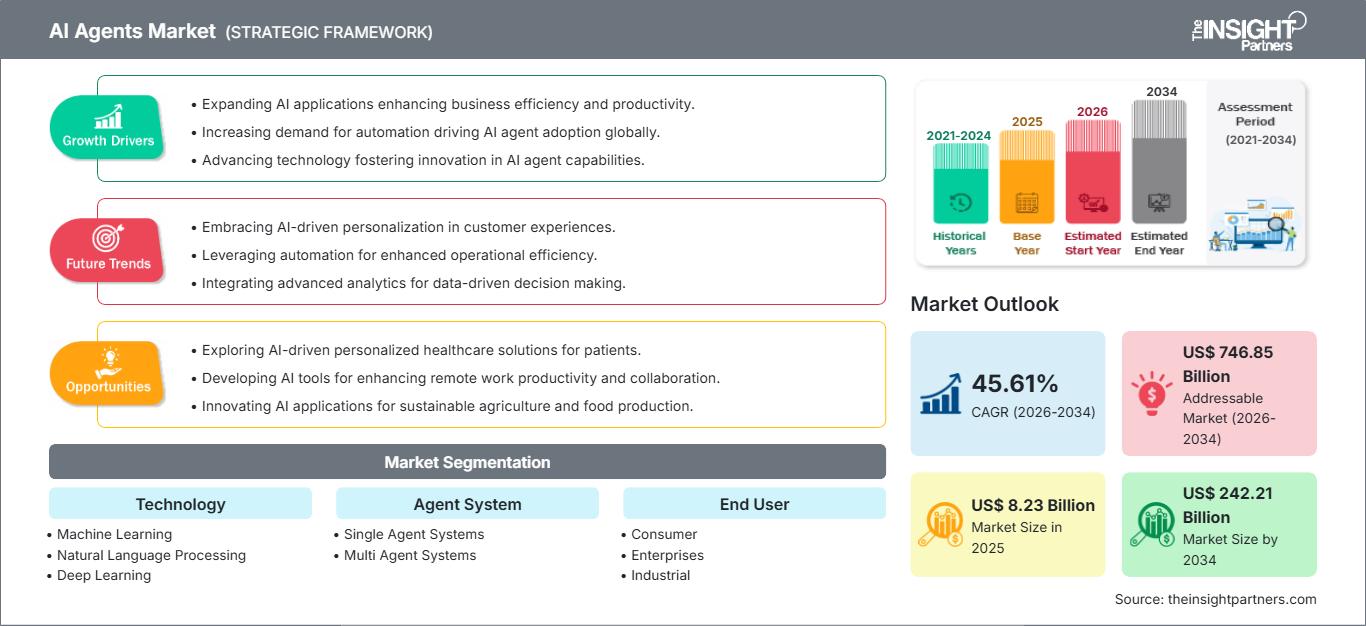
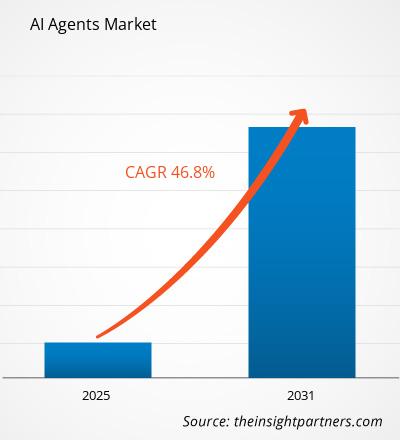
The AI agents market was valued at US$ 8.23 Billion in 2025 and is projected to reach US$ 242.21 Billion by 2034, expanding at a CAGR of 45.61% during 2026–2034. The rapid integration of autonomous reasoning systems, workflow automation platforms, and enterprise-grade generative AI solutions is reshaping digital operations across industries. Increasing adoption of intelligent agents for customer engagement, decision support, software development, and process orchestration continues to reinforce the long-term expansion trajectory of the AI agents market.
Across North America, enterprise spending on advanced automation platforms, cloud-native AI infrastructure, and agentic workflow solutions continues to accelerate. The AI agents market size in the region benefits from strong technology investments, widespread adoption of generative AI applications, and a mature software ecosystem. Supported by large-scale deployments across financial services, healthcare, and technology sectors, the regional market is expected to advance at a CAGR range of 43–47% during the forecast period.
AI Agents Market Assessment and Insights
- North America: Share in 2025 of 38–42%, supported by strong enterprise AI investment, cloud leadership, and advanced automation adoption. Expected CAGR between 43–47% during 2026–2034.
- US: Represents 76–80% of North American revenue in 2025, driven by software innovation and hyperscale infrastructure. Expected CAGR between 44–48% during 2026–2034.
- Europe: Share in 2025 of 24–28%, led by Germany, the UK, and France. Growing adoption of responsible AI frameworks supports a CAGR of 41–45% during 2026–2034.
- Asia Pacific: Share in 2025 of 22–26%, with China, Japan, India, and South Korea leading deployments. Expected CAGR between 48–52% during 2026–2034.
- Largest Segment: Natural Language Processing holds a market share of 32–36% in 2025 owing to conversational AI and enterprise assistant adoption. CAGR estimated at 46–50%.
- High Growth Segment: Multi Agent Systems accounts for 18–22% share in 2025 and is projected to expand at 50–54% CAGR due to coordinated autonomous task execution.
- Key companies analyzed in detail: Microsoft Corporation, International Business Machines Corporation, Google LLC, Oracle Corporation, Amazon Web Services, Inc., NVIDIA Corporation, Salesforce, Inc., OpenAI, Cogito Corp., Infinitus Systems, Inc.
Source: The Insight Partners' analysis based on proprietary research, government publications, company annual reports, investor presentations, industry databases, and expert interviews.
The market has evolved from rule-based automation toward autonomous systems capable of planning, reasoning, memory management, and multi-step execution. Improvements in large language models, cloud computing capacity, vector databases, and AI orchestration frameworks have reduced deployment barriers. Enterprises increasingly seek platforms that can automate knowledge work while maintaining governance and security requirements. Growing integration with enterprise applications further supports adoption across operational workflows.
Looking ahead, investment activity in the AI Agents Market is expected to expand into emerging digital economies where cloud infrastructure and AI readiness continue improving. Regulatory efforts focused on transparency, model accountability, and data governance are encouraging enterprise confidence in the market. Public and private capital flows into AI infrastructure, semiconductor capacity, and application ecosystems are likely to strengthen commercial deployment opportunities in the market across manufacturing, healthcare, financial services, retail, and public-sector environments.
AI Agents Market Report Scope
| Report Attribute | Details |
|---|---|
| Market size in 2025 | US$ 8.23 Billion |
| Market Size by 2034 | US$ 242.21 Billion |
| Global CAGR (2026 - 2034) | 45.61% |
| Historical Data | 2021-2024 |
| Forecast period | 2026-2034 |
AI Agents Market Analysis
The primary driver behind the AI agents market growth is the increasing need for autonomous decision support and workflow automation across enterprise environments. Firms are using intelligent agents for performing repeatable tasks, increasing efficiency, minimizing operational expenses, and providing better customer experiences. The increasing use of generative AI has also meant that there is more demand for technologies that can perform functions such as context management, planning, and execution.
The ecosystem includes model developers, infrastructure providers for AI technologies, cloud providers, software companies, systems integrators, and end-users. Increasing demand has been seen in technologies related to orchestration, memory layer solutions, monitoring solutions, and enterprise-level security solutions. Deployments on the cloud have provided greater scalability while simplifying the process of implementing such initiatives.
Current AI agents market analysis indicates intensifying competition among technology vendors seeking to establish platform leadership. Market players are distinguishing themselves through their model performance, enterprise integration abilities, governance capabilities, agent orchestration technologies, and industry-oriented solutions. The strategic collaborations between software providers and infrastructure vendors are contributing to the continued acceleration of commercialization.
Microsoft Corporation and OpenAI retain their relevance through ecosystem integration and enterprise implementations, while Google LLC and Amazon Web Services, Inc. keep scaling up their agent-oriented development platforms. International Business Machines Corporation, Oracle Corporation, Salesforce, Inc., NVIDIA Corporation, Cogito Corp., and Infinitus Systems, Inc. have built their strengths through application specializations, artificial intelligence infrastructure investments, automation solutions for healthcare, and conversational intelligence capabilities. Capital investments are becoming more focused on scalable agent architectures and enterprise deployment solutions.
● REPORT CUSTOMIZATION
Tailor This Report To Align With Your Specific Business Requirements
This report can be customized to align precisely with your business objectives, scope, and target markets. Customization options include tailored segmentation, geography, competitive analysis, and strategic insights to support informed decision-making.
Customize This Report →WHAT YOU CAN ADJUST
- ● Segmentations
- ● Geography
- ● Competitive Analysis
- ● Language Preferences
AI Agents Market: Strategic Insights
Regional Insights
North America AI agents market
North America represented approximately 38–42% AI agents market share in 2025. Strong cloud infrastructure, advanced digital transformation initiatives, and substantial artificial intelligence funding continue supporting regional growth. Large enterprises are actively implementing autonomous agents for customer service, software development assistance, workflow automation, and operational intelligence. Demand remains particularly strong across financial services, healthcare, retail, and technology sectors. The region is projected to expand at a CAGR of 43–47% through 2034.
With leading AI companies, hyperscale cloud service providers, and innovation-oriented technology firms present, there is a conducive business environment. The regulation debate is moving towards responsible use of AI, making businesses more confident. The increased application of agent-based technologies on business process management platforms and in enterprise software is set to boost the market during the forecast period.
U.S. AI agents Market
The United States accounts for approximately 76–80% of North American revenue in the AI Agents Market and remains the largest regional contributor. High enterprise technology expenditure, rapid adoption of generative AI, and extensive venture capital activity continue to support the expansion of the market. The country is expected to achieve a CAGR of 44–48% through 2034. Major deployments in the AI Agents Market increasingly focus on knowledge management, process automation, customer engagement, and productivity enhancement applications across a wide range of industries.
Some of the leading companies that operate in the country include Microsoft Corporation, OpenAI, Google LLC, Amazon Web Services, Inc., Salesforce, Inc., Oracle Corporation, and NVIDIA Corporation. Agent systems are increasingly being adopted by companies into their workflow software, software development processes, and customer service environment. With growing interest in security, explainability, and compliance in AI applications, there are emerging opportunities in the healthcare industry and others.
Europe AI agents Market
Europe accounted for approximately 24–28% of global revenue in 2025 and is projected to expand at a CAGR of 41–45% through the forecast period. Regional adoption is supported by digitalization initiatives, cloud investments, and expanding regulatory frameworks focused on trustworthy AI deployment.
The UK continues to be a prominent innovation center, thanks to high fintech adoption rates, AI startup presence, and enterprise technology investments. Businesses use intelligent agents more and more to assist in customer interaction, compliance tracking, and workforce productivity projects. Expansion continues due to robust software and services industries.
Germany takes a leading position among regional industrial implementations due to its high-end manufacturing capabilities and Industry 4.0 strategy. The need for autonomous operational intelligence, predictive maintenance assistance, and engineering services solutions keeps growing. Investments in industrial AI platforms will be a key growth driver.
France, Italy, and Spain collectively witness increased enterprise adoption of conversational AI, digital assistants, and operational automation platforms. Digital transformation in public administration and higher cloud adoption boost the market expansion. Investments in AI capabilities, infrastructure, and governance frameworks across industries are likely to strengthen growth opportunities.
APAC AI agents Market
Asia Pacific captured approximately 22–26% of global revenue in 2025 and is forecast to achieve the highest regional CAGR of 48–52% through 2034. Rapid digitization, increasing cloud adoption, and strong government support for AI innovation contribute to accelerating commercial deployment across the region.
China maintains its status as the premier market within the region, while Japan, South Korea, India, and Australia keep growing in the deployment of enterprise solutions. The development of manufacturing, services, healthcare, and finance is fueling significant demands for agent-based solutions across the entire region.
Middle East & Africa AI agents Market
The Middle East and Africa market is projected to advance at a CAGR of 42–46% through the forecast period. Governments and businesses have been investing heavily in digital solutions, cloud-based infrastructure, and AI-driven citizen services. Increased interest in automation solutions is continuing to drive adoption in both the public and private sectors.
Saudi Arabia and the UAE are leading the region in the adoption of solutions thanks to their national AI strategies and smart infrastructure projects. South Africa is still an important market for technology, but there has been adoption of solutions in the rest of the MEA due to digital transformation, energy industry transformation, and enterprise software adoption.
Segmentation Analysis
Technology
The Technology segment is expected to register a CAGR of 45–49% during 2026–2034. The AI agents market scope within technology continues expanding as enterprises prioritize systems capable of reasoning, perception, communication, and autonomous execution. Improved model efficiency, multimodal capabilities, and enterprise integration continue to accelerate adoption across industries.
- Machine Learning – Supports predictive intelligence, adaptive decision making, and continuous optimization. Demand remains strong across finance, healthcare, manufacturing, and retail environments where operational efficiency and data-driven insights are strategic priorities.
- Natural Language Processing – Represents the largest technology sub-segment through extensive use in conversational interfaces, enterprise assistants, knowledge management, and customer service automation. Strong enterprise demand continues to support significant strategic importance.
- Deep Learning – Enables advanced reasoning, contextual understanding, and complex pattern recognition capabilities. Adoption is increasing across intelligent automation, security analytics, and industry-specific AI solutions.
- Computer Vision – Facilitates visual recognition, inspection automation, safety monitoring, and intelligent surveillance applications. Industrial deployment remains a major contributor to long-term market relevance.
Agent System
The Agent System segment is projected to expand at a CAGR of 47–51% through the forecast period. Increasing preference for autonomous orchestration, collaborative execution, and scalable workflow management is driving adoption. Organizations are deploying agent architectures capable of handling increasingly complex operational tasks.
- Single Agent Systems – Continue serving organizations seeking focused automation for customer support, productivity enhancement, and task management. Simpler deployment models support continued demand among small and medium-sized enterprises.
- Multi Agent Systems – Emerging as a strategic architecture for coordinating workflows, collaborative reasoning, and distributed decision making. Adoption continues accelerating among large enterprises managing complex business processes.
End User
The End User segment is expected to record a CAGR of 44–48% during 2026–2034. Adoption increasingly spans consumer applications, corporate environments, and industrial operations. Growing confidence in autonomous systems and measurable productivity improvements continues to support commercialization across multiple sectors.
- Consumer – Intelligent assistants, personalized recommendations, content generation, and digital support experiences contribute to increasing adoption. User expectations for seamless and context-aware interactions continue shaping product development priorities.
- Enterprises – Account for a substantial share of commercial deployment through workflow automation, customer engagement, knowledge management, and decision support applications. Integration with enterprise software ecosystems remains strategically important.
- Industrial – Adoption focuses on predictive maintenance assistance, process optimization, quality monitoring, and operational intelligence. Manufacturing modernization initiatives continue supporting long-term growth opportunities.
Opportunity Snapshot
| End User | Revenue Contribution | Trend Tag | Adoption Stage |
| Consumer | Medium | Personal Agents | Scaling |
| Enterprises | High | Workflow Copilots | Mature |
| Industrial | Medium | Factory Intelligence | Emerging |
AI Agents Market Growth Drivers and Impact Analysis
Enterprise Automation Demand Across Knowledge Workflows
Organizations are now looking for technologies that could automate repetitive knowledge work tasks without any inconsistencies in their operations. The use of AI agents is becoming common in customer service, financial operations, human resources, software development, and compliance activities. These uses have increased productivity, decreased processing times, and improved decision-making. With the ongoing challenges faced by companies with cost optimization and efficiency, investments in digital employees are becoming more and more frequent. Integration with the current software systems will help organizations to scale up their automation efforts without replacing the entire infrastructure. This factor remains highly relevant in industries dealing with massive amounts of structured and unstructured data.
Expansion of Generative AI Infrastructure
With the fast evolution of cloud computing, AI accelerators, and foundation models, the commercial viability has greatly enhanced. Businesses are now able to leverage cutting-edge technologies via scalable cloud computing services as compared to constructing everything from scratch. Growth in infrastructure enhances fast deployment, easier management, and enhanced efficiency. The growing accessibility of security mechanisms that are industry-level has been driving adoption even within regulated industries. Vendors are consistently working on orchestration, monitoring, and governance mechanisms that ensure greater operability. With more evolved infrastructure, businesses are gaining increased comfort in leveraging agent-based technology for critical business operations.
Industrial and Sector-Specific AI Adoption
The industry-specific applications are generating a lot of value through efficiency and intelligence in operations. In manufacturing businesses, autonomous agents are being used for process monitoring and maintenance support, whereas in the healthcare industry, they are being employed for administration efficiency and support for engaging patients. Intelligent agents are being used by financial services companies for customer interaction and information processing. The customization of agents based on industry increases their relevance and improves the business results, increasing ROI. With the growing availability of industry-specific models and datasets, the utility of such agents is likely to grow even further.
AI Agents Market Future Trends
Rise of Autonomous Multi-Step Business Execution
Future deployments will move beyond conversational interactions toward fully autonomous task completion. Agent systems will increasingly plan activities, coordinate resources, communicate with enterprise applications, and execute multi-step workflows with limited human intervention. These developments represent one of the most significant AI agents market trends shaping long-term market evolution. Organizations are expected to prioritize measurable productivity outcomes, encouraging broader implementation of advanced orchestration platforms. Improved memory management, reasoning frameworks, and governance capabilities will support adoption across regulated industries while expanding commercial viability for complex enterprise use cases.
Convergence of Multimodal Intelligence Platforms
In the next stage of market evolution, the integration of processes dealing with text, audio, video, image and structured data would be necessary. Multimodal agents would help to understand context better and make comprehensive communication possible. Companies would start using one solution that would be able to cope with all the needs of enterprises through one platform. Interoperability of enterprise applications would become even more pronounced. This trend would generate new chances for vendors who offer scalable, secure and industry-focused solutions.
AI Agents Market Opportunities
Verticalized Enterprise Solutions
There is a lot of potential for those vendors who have come up with specialized agent platforms, which cater to specific industry needs such as healthcare, financial services, manufacturing, and the government sector. Enterprises today look for systems that meet their regulatory and operational needs, as compared to any kind of off-the-shelf automation software. Customized solutions provide better business results and faster adoption as well. The need for more explainable and secure systems also provides a case for specialized software.
Emerging Market Commercial Expansion
Investment opportunities are increasing across developing digital economies where cloud infrastructure, connectivity, and AI readiness continue improving. Long-term AI agents market Forecasts indicate significant expansion potential beyond traditional technology hubs. Governments actively support digital transformation initiatives and enterprise modernization programs. Localized language capabilities and industry customization create additional commercialization opportunities. Solution providers that establish early partnerships, regional deployment capabilities, and ecosystem relationships may benefit from accelerated adoption. As digital maturity improves, these emerging markets are expected to contribute an increasingly meaningful share of global revenue generation.
Frequently Asked Questions

- Comprehensive Market Sizing and Forecast Analysis
- Detailed Segmentation Analysis
- In-Depth Market Dynamics Assessment
- Regional and Country-Level Insights
- Competitive Landscape and Company Benchmarking
- Strategic Business Intelligence
Recent Reports
Testimonials

The Insight Partners provided valuable market intelligence that supported our global go-to-market strategy. Their team was professional, responsive, and attentive to our feedback, providing thoughtful analysis and helpful methodological clarifications throughout the project.
Junmo Kim Chief Financial Officer (CFO), Enertech Co., Ltd.
The Insight Partners' SCADA System Market report is comprehensive, with valuable insights on current trends and future forecasts. The team was highly professional, responsive, and supportive throughout. We are very satisfied and highly recommend their services.
RAN KEDEM Partner, Reali Technologies LTDs
I requested a report on a very specific software market and the team produced the report in a few days. The information was very relevant and well presented. I then requested some changes and additions to the report. The team was again very responsive and I got the final report in less than a week.
JEAN-HERVE JENN Chairman, Future Analytica
We worked with The Insight Partners for an important market study and forecast. They gave us clear insights into opportunities and risks, which helped shape our plans. Their research was easy to use and based on solid data. It helped us make smart, confident decisions. We highly recommend them.
PIYUSH NAGPAL Sr. Vice President, High Beam Global
The Insight Partners delivered insightful, well-structured market research with strong domain expertise. Their team was professional and responsive throughout. The user-friendly website made accessing industry reports seamless. We highly recommend them for reliable, high-quality research services
YUKIHIKO ADACHI CEO, Deep Blue, LLC.
This is the first time I have purchased a market report from The Insight Partners.While I was unsure at first, I visited their web site and felt more comfortable to take the risk and purchase a market report.I am completely satisfied with the quality of the report and customer service. I had several questions and comments with the initial report, but after a couple of dialogs over email with their analyst I believe I have a report that I can use as input to our strategic planning process.Thank you so much for taking the extra time and making this a positive experience.I will definitely recommend your service to others and you will be my first call when we need further market data.
JOHN SUZUKI President and Chief Executive Officer, Board Director, BK Technologies
I wish to appreciate your support and the professionalism you displayed in the course of attending to my request for information regarding to infectious disease IVD market in Nigeria. I appreciate your patience, your guidance, and the fact that you were willing to offer a discount, which eventually made it possible for us to close a deal. I look forward to engaging The Insight Partners in the future, all thanks to the impression you have created in me as a result of this first encounter.
DR CHIJIOKE ONYIA MANAGING DIRECTOR, PineCrest Healthcare Ltd.Reason to Buy
- Informed Decision-Making
- Understanding Market Dynamics
- Competitive Analysis
- Identifying Emerging Markets
- Customer Insights
- Market Forecasts
- Risk Mitigation
- Boosting Operational Efficiency
- Strategic Planning
- Investment Justification
- Tracking Industry Innovations
- Aligning with Regulatory Trends





 Get Free Sample for