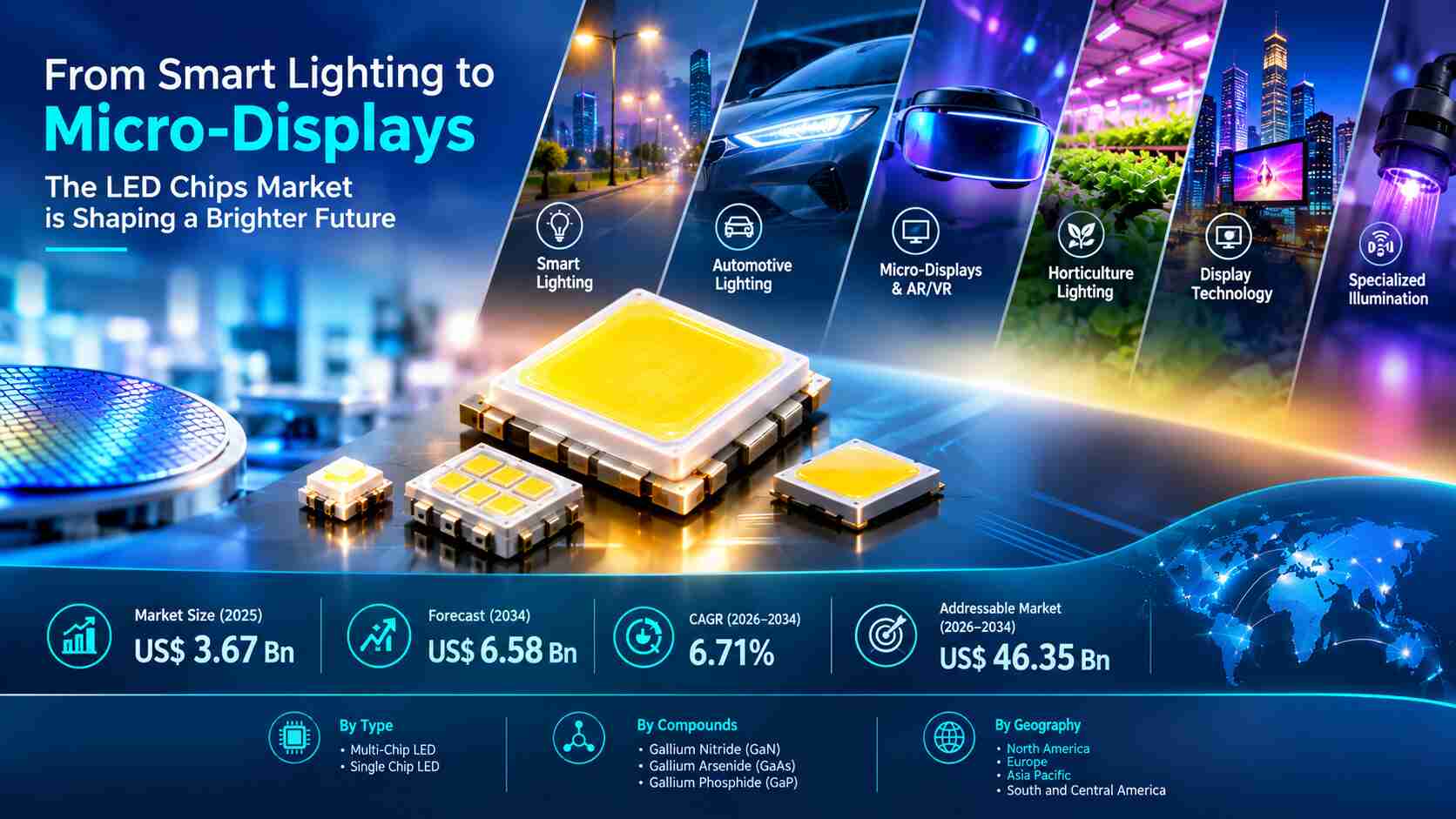
The LED Chips industry is entering a new phase of development as LED technology expands beyond conventional lighting into automotive systems, advanced displays, mobile devices, horticulture, sensing, and specialized illumination. Improvements in semiconductor materials, chip efficiency, thermal management, optical performance, and compact device architectures are creating new opportunities for LED chip manufacturers and technology providers.
According to The Insight Partners, the LED Chips Market was valued at US$ 3.67 billion in 2025 and is projected to reach US$ 6.58 billion by 2034, registering a CAGR of 6.71% during 2026–2034. The market assessment covers historical data from 2021–2024, with 2025 as the base year and forecasts extending through 2034. The report also identifies an addressable market of approximately US$ 46.35 billion during 2026–2034, highlighting the broader commercial potential across emerging applications.
Smart Lighting Is Expanding the Role of LED Chips
Energy efficiency remains an important factor supporting LED adoption. Commercial buildings, industrial facilities, warehouses, hospitality properties, municipal infrastructure, and architectural environments continue to shift toward efficient solid-state lighting. However, the role of LED chips is increasingly extending beyond simply generating higher lumen output.
Modern lighting systems require better color consistency, thermal stability, reliability, optical control, and compatibility with intelligent lighting systems. Consequently, chip manufacturers are focusing on improving efficiency while maintaining compact form factors and consistent performance.
The integration of LED chips with lighting controls and advanced optical systems is also changing product development. Instead of competing only on basic illumination performance, suppliers increasingly need to optimize chips according to the requirements of specific lighting systems and end applications.
Multi-Chip and Single-Chip LEDs Serve Different Requirements
The market is segmented into Multi-Chip LED and Single Chip LED configurations. Multi-Chip LED technology held an estimated 58–62% market share in 2025 and is projected to expand at a CAGR of approximately 6.5–7.0% during 2026–2034.
Multi-chip configurations combine multiple emitters within a compact architecture, enabling higher light output and greater optical flexibility. These characteristics make them particularly relevant for automotive lighting, professional lighting, and other applications requiring enhanced optical performance.
Single Chip LED devices continue to have an important role where simplicity, compactness, and cost control are priorities. Their architecture supports mainstream illumination and compact electronic applications, creating continued demand alongside the development of higher-output multi-chip solutions.
Semiconductor Materials Are Shaping LED Chip Innovation
Material selection is one of the most important factors influencing LED chip performance because different compound semiconductor materials provide different wavelength, efficiency, and application characteristics.
Gallium Nitride (GaN) represented approximately 68–72% of the LED Chips Market in 2025 and is projected to register a CAGR of around 7.0–7.6% through 2034. GaN is particularly important for blue and white LEDs and is increasingly relevant to high-efficiency illumination, displays, automotive lighting, and ultraviolet applications.
Gallium Arsenide (GaAs) supports infrared, red-spectrum, and specialty applications. Its characteristics make it relevant to selected sensing, communication, and specialized illumination technologies.
Gallium Phosphide (GaP) continues to serve selected visible-spectrum applications, particularly those requiring red or green emission characteristics. As application requirements become increasingly specialized, these materials can continue to occupy important positions within the LED semiconductor ecosystem.
Micro-LED and Mini-LED Open New Growth Opportunities
One of the most significant technology developments influencing the future of LED chips is the transition toward advanced display architectures. Mini-LED and Micro-LED technologies are creating demand for increasingly compact, efficient, and precisely controlled LED emitters.
Micro-LED technology has potential applications across high-performance displays, automotive interfaces, augmented and extended reality devices, wearables, and other micro-display applications. These applications place different demands on semiconductor components compared with traditional lighting.
The growing interest in Micro-LED also encourages closer integration between chip design, packaging, optics, thermal management, and display architecture. This means future competition may increasingly depend on how effectively suppliers can deliver complete performance solutions rather than focusing exclusively on individual chip efficiency.
The evolving display ecosystem is also reflected in industry activity. In December 2025, TCL CSOT acquired an 80% stake in Prima for approximately CNY 490 million, supporting its entry into the LED chip segment and strengthening its MiniLED and MicroLED capabilities.
Automotive Electronics Create Demand for Advanced LED Chips
Automotive applications are another important growth area. Modern vehicles increasingly incorporate LED technology into adaptive headlamps, daytime running lights, signaling systems, interior illumination, displays, and sensing-related applications.
Automotive LED chips need to provide compact dimensions, thermal stability, reliable optical output, consistent color performance, and long operating life. Vehicle electrification is also increasing the amount of electronic content in vehicles, creating additional opportunities for semiconductor-based lighting technologies.
Unlike some mainstream lighting applications, automotive customers often place greater emphasis on reliability, qualification, engineering support, and long-term performance. This can create opportunities for suppliers capable of providing application-specific chip architectures and technical support.
Asia Pacific Remains a Key Manufacturing and Demand Hub
Regional dynamics will remain important to the development of the global LED Chips Market. Asia Pacific accounted for approximately 47–51% of the market in 2025 and is projected to grow at a CAGR of 7.1–7.8% during 2026–2034.
China remains a major market because of its large-scale lighting and electronics manufacturing ecosystem. Japan contributes through semiconductor technology and precision equipment, while South Korea and Taiwan benefit from advanced electronics and semiconductor capabilities. India is also developing its semiconductor ecosystem, supporting longer-term opportunities for LED and related component manufacturing.
North America represented approximately 20–24% of the market in 2025, with a projected CAGR of 5.8–6.5% through 2034. Commercial lighting modernization, automotive electronics, displays, specialty illumination, and semiconductor innovation are expected to support demand.
Europe accounted for approximately 19–23% share in 2025 and is projected to expand at a CAGR of 5.9–6.6% through 2034. Germany, the UK, France, Italy, and Spain contribute through automotive, industrial, commercial, architectural, transportation, and electronics applications.
Application-Specific LED Chips Will Shape the Next Phase of Growth
The future of the LED Chips Market is increasingly being determined by application-specific performance rather than simply maximizing light output. Horticultural lighting, ultraviolet illumination, infrared sensing, automotive signaling, professional displays, architectural lighting, and industrial inspection all require different combinations of wavelength, optical power, thermal characteristics, and spectral stability.
This creates opportunities for manufacturers to develop specialized chip families targeting particular applications. GaN can support blue, white, and ultraviolet technologies, while GaAs and GaP remain relevant to specific infrared, red, amber, and visible-spectrum applications.
At the same time, chip manufacturers are increasingly integrating semiconductor design with packaging, phosphor conversion, optics, and thermal technologies. This integrated approach can help minimize performance losses between chip production and the final lighting or display system.
What to Expect Through 2034
Through 2034, the LED chip industry is expected to evolve from a predominantly lighting-oriented component market toward a broader semiconductor technology ecosystem supporting lighting, displays, automotive electronics, sensing, and specialized applications.
The LED chip market is expected to witness steady growth over the forecast period, driven by increasing demand for advanced and energy-efficient lighting technologies. Multi-Chip LEDs are likely to remain significant in high-output applications, while GaN is expected to continue playing a central role in blue, white, and high-efficiency LED technologies.
The next stage of development will likely be shaped by efficiency improvements, smaller chip architectures, thermal optimization, wavelength control, advanced packaging, and customized semiconductor solutions. As smart lighting converges with automotive electronics, advanced displays, Micro-LED, sensing, and other emerging technologies, LED chips are becoming an increasingly strategic component across the electronics and semiconductor value chain.
For businesses evaluating new technology investments, sourcing strategies, application development, or regional opportunities, understanding these trends can provide valuable insight into how LED chip demand and competitive strategies may evolve through 2034.