
LED Chips Market Growth, Trends & Forecast by 2034
Coverage: by Type (Multi-Chip LED, Single Chip LED); Compunds (Gallium Nitride, Gallium Arsenide, Gallium Phosphide) , and Geography (North America, Europe, Asia Pacific, and South and Central America)
- Status : Data Released
- Report Code : TIPRE00010549
- Category : Electronics and Semiconductor
- No. of Pages : 150
- Available Report Formats :


- Last update date : September 23, 2026


2025 Market Size
US$ 3.67 Bn
Base year value
2034 Forecast
US$ 6.58 Bn
Projected by 2034
CAGR 2026-2034
6.71 %
Growth rate
Addressable Market
US$ 46.35 Bn
(2026-2034)
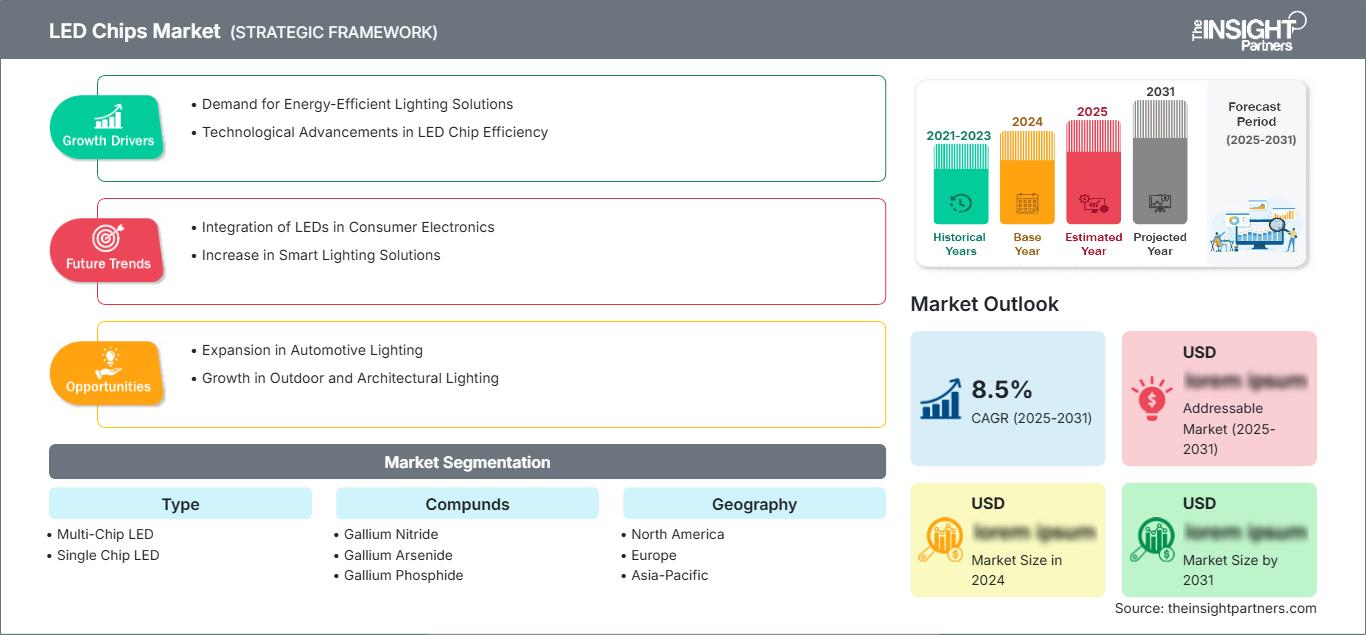
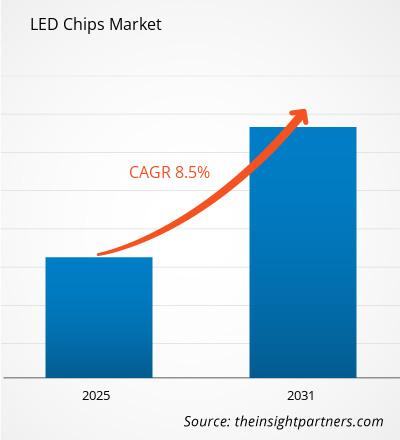
The LED Chips Market size was valued at US$ 3.67 Billion in 2025 and is projected to reach US$ 6.58 Billion by 2034, registering a CAGR of 6.71% during 2026–2034. Expansion is supported by continued LED adoption across lighting, displays, automotive systems, mobile devices, and specialized illumination. Semiconductor material development, improved chip efficiency, thermal management, and demand for compact light sources are also influencing product design and manufacturing strategies.
North America is expected to remain a technology-intensive regional market, supported by commercial lighting modernization, automotive electronics, specialty illumination, and investment in advanced semiconductor capabilities. The region is estimated to expand at a CAGR of 5.8–6.5% during 2026–2034. Increasing requirements for high-efficiency lighting and application-specific LED solutions should sustain demand for advanced chip architectures.
LED Chips Market Assessment and Insights
- North America: North America held an estimated 20–24% LED Chips Market share in 2025 and is projected to grow at a CAGR of 5.8–6.5% during 2026–2034, supported by lighting modernization, automotive applications, and specialty electronics.
- US: The US represented approximately 76–80% of North American demand in 2025 and is expected to expand at a CAGR of 5.7–6.4% during 2026–2034, supported by commercial lighting and automotive electronics.
- Europe: Europe accounted for approximately 19–23% share in 2025 and is projected to register a CAGR of 5.9–6.6% through 2034, with Germany, the UK, France, Italy, and Spain supporting efficient lighting and automotive applications.
- Asia Pacific: Asia Pacific represented approximately 47–51% share in 2025 and is expected to record a CAGR of 7.1–7.8% during 2026–2034, led by China, Japan, South Korea, Taiwan, and India.
- Largest Segment: Multi-Chip LED held an estimated market share of 58–62% in 2025, expanding at a CAGR of 6.5–7.0% during 2026–2034, supported by high-output applications.
- High Growth Segment: Gallium Nitride held approximately 68–72% share in 2025, with a projected CAGR of 7.0–7.6% during 2026–2034, supported by blue, white, and high-efficiency applications.
- Key companies analyzed in detail: AVA Technologies Inc.; Bridgelux, Inc.; Bright LED Electronics Corporation; Cree, Inc.; DOWA Electronics Materials Co., Ltd.; Epistar Corporation; Formosa Epitaxy Inc.; Goldeneye, Inc.; Hitachi Cable, Ltd.; Huga Optech Co., Ltd.
Source: The Insight Partners' analysis based on proprietary research, government publications, company annual reports, investor presentations, industry databases, and expert interviews.
The technological trends in the LED Chips Market include efficiency improvement in chips, enhanced thermal performance, compact design, and customized emissions based on the application. Multi-chip technology offers high levels of light emission and design flexibility; however, there is still relevance for single chip design due to the constraints of cost and size. GaN is the key component used in blue and white LEDs, while GaAs and GaP are useful in certain IR, red, and amber applications.
The future demand in the LED Chips Market will be determined by application-specific performance metrics rather than mere lumen generation. Some examples of such applications include automotive lighting, display backlights, horticulture lighting, UV lighting, and various special sensing applications. Production will continue from the Asia Pacific region while specialty high value applications can be found in North America and Europe.
LED Chips Market Report Scope
| Report Attribute | Details |
|---|---|
| Market size in 2025 | US$ 3.67 Billion |
| Market Size by 2034 | US$ 6.58 Billion |
| Global CAGR (2026 - 2034) | 6.71% |
| Historical Data | 2021-2024 |
| Forecast period | 2026-2034 |
LED Chips Market Analysis
There is a demand for lighting providers, display providers, automotive industry firms, electronics companies, and illumination devices providers. The LED Chips Market is motivated by the value chain that comprises substrate providers, semiconductor materials providers, epitaxial wafers producers, chips producers, packagers, modules producers, and lighting and electronics OEMs. It requires high-quality material purity, good performance of the epitaxial wafers, proper chip design, yield, and heat dissipation.
LED Chips Market goods supply varies significantly depending on the compound used. For example, gallium nitride is mainly related to the blue and white LEDs, while gallium arsenide is needed for the infrared and some red LEDs. DOWA Electronics Materials Co., Ltd provides high-purity gallium and gallium arsenide substrates, which are used in LEDs. Wafers, efficiency, defects, and equipment are some other production factors.
The competition structure in the LED Chip Market includes both LED chip producers and vertically integrated lighting firms. Bridgelux, Inc. is an example of a company manufacturing LED chips for general lighting purposes, signage, automotive use, and mobile camera flash. Both Epistar Corporation and Formosa Epitaxy Inc. have significant shares in the Asian semiconductor market. Cree, Inc., Bright LED Electronics Corporation, and Huga Optech Co., Ltd. serve varying needs in the LED supply chain.
The LED Chips Market trends show that positioning strategy is becoming more and more dependent on chip efficiency, wavelength control, yield, intellectual property and capacity to meet customized application needs. AVA Technologies Inc. and Goldeneye, Inc. are examples of specialized suppliers, whereas Hitachi Cable, Ltd. brings additional expertise in electronic materials. Suppliers try to integrate chip production with packaging, module, phosphor, optic, and thermal technologies to minimize performance loss from chip production to lighting systems.
● REPORT CUSTOMIZATION
Tailor This Report To Align With Your Specific Business Requirements
This report can be customized to align precisely with your business objectives, scope, and target markets. Customization options include tailored segmentation, geography, competitive analysis, and strategic insights to support informed decision-making.
Customize This Report →WHAT YOU CAN ADJUST
- ● Segmentations
- ● Geography
- ● Competitive Analysis
- ● Language Preferences
LED Chips Market: Strategic Insights
Regional Insights
North America LED Chips Market
North America accounted for approximately 20–24% of the LED Chips Market in 2025 and is projected to expand at a CAGR of 5.8–6.5% through 2034. USA is the key demand driver, owing to improvements in commercial lighting, automotive lighting, specialty lighting, and semiconductor innovation. Canada's contribution will be made in industrial, architectural, and technology lighting applications.
The regional demand is increasingly being driven by energy efficiency, lighting controls, and specific application performance. Automotive lighting needs miniature chips that are thermally stable whereas commercial lighting demands high performance and color uniformity. Technology innovation is essential irrespective of the fact that most of the manufacturing capabilities are located in Asia.
U.S. LED Chips Market Market
The LED Chips Market report shows that the US represented approximately 76–80% of North American demand in 2025 and is projected to grow at a CAGR of 5.7–6.4% through 2034. Commercial lighting modernization, automotive systems, displays, and specialty illumination provide the principal demand base. Bridgelux, Inc. maintains a domestic manufacturing and technology presence serving lighting and automotive-related applications.
Higher efficiency, color control, thermal stability, and smaller size are all becoming more desirable when it comes to application requirements. There are applications other than traditional replacement lamps that include automotive lighting, camera flash, architectural lighting, and professional lighting. Reliability and product availability have become increasingly important procurement considerations.
Europe LED Chips Market
Europe held approximately 19–23% share in 2025 and is projected to expand at a CAGR of 5.9–6.6% through 2034. Germany has the highest market potential due to automotive production and industry. Other European countries such as UK, France, Italy and Spain also contribute in demand through commercial lighting applications, transportations, electronics and special purpose lighting applications.
Automotive and industrial activities of Germany create demands for highly reliable LEDs in exterior lighting, indicators, displays and sensor-based lighting applications. Efficiency and vehicle electrification also contribute to advanced semiconductors lighting applications.
The UK and France have seen diverse demand for LEDs in commercial, architectural, transportation, aerospace, and electronic industries. Italy and Spain get advantage of architectural lighting, industrial upgrading, automobile manufacturing, and tourism-based infrastructure. European customers focus more on efficiency, longevity, color stability, and environmental specifications of LED products while making their choice.
APAC LED Chips Market
APAC accounted for approximately 47–51% share in 2025 and is projected to grow at a CAGR of 7.1–7.8% through 2034. China is the dominant market, with Japan, South Korea, Taiwan, and India following. The electronics ecosystem and semiconductors provide the ability to produce and consume in the region.
China enjoys strong lighting and electronics manufacturing capacity, Japan enjoys semiconductors and precision equipment, and South Korea and Taiwan enjoy high technology electronics. India is building up its semiconductor capability, and Australia is a smaller specialty market. Policy, electronics manufacturing, and LED applications fuel further regional growth.
Middle East & Africa LED Chips Market
Middle East & Africa is projected to expand at a CAGR of 5.0–5.8% through 2034. Saudi Arabia and the UAE lead technology-intensive infrastructure development, while South Africa represents an established electronics and lighting market. Rest-of-MEA demand is associated with commercial construction, infrastructure modernization, industrial facilities, and telecommunications.
Energy-efficiency objectives and large-scale infrastructure programs support LED adoption in public, commercial, hospitality, and industrial settings. The UAE is positioned as the leading specialty market, while Saudi Arabia provides significant infrastructure-related opportunity. Local chip manufacturing remains limited, making the region primarily dependent on imported components and finished LED systems.
Segmentation Analysis
Type
The Type segment is projected to grow at a CAGR of 6.3–6.9% during 2026–2034. Multi-chip configurations provide higher output, flexible optical characteristics, and improved suitability for demanding applications, while single-chip devices remain attractive where compactness, simpler construction, and cost control are priorities.
- Multi-Chip LED: Multi-Chip LED supports higher-output lighting and specialized applications by combining multiple emitters within a compact architecture. Demand is strengthened by automotive, professional lighting, and applications requiring enhanced optical performance.
- Single Chip LED: Single Chip LED remains important for straightforward illumination and compact electronics because its architecture supports simpler integration, cost control, and flexible deployment across mainstream lighting products.
Compunds
The Compunds segment is expected to register a CAGR of 6.6–7.2% during 2026–2034. Compound selection determines emission wavelength, efficiency, thermal behavior, and application suitability. Gallium nitride remains central to blue and white LEDs, while gallium arsenide and gallium phosphide serve specialized spectral requirements.
- Gallium Nitride: Gallium Nitride remains strategically important for blue and white LEDs because of its strong optical performance and suitability for high-efficiency illumination, displays, automotive lighting, and ultraviolet technologies.
- Gallium Arsenide: Gallium Arsenide supports infrared, red-spectrum, and specialty LED applications where material characteristics provide appropriate emission and device performance. It is also relevant to selected sensing and communication applications.
- Gallium Phosphide: Gallium Phosphide remains relevant to selected visible-spectrum applications, particularly where red or green emission characteristics and established device architectures provide practical performance and manufacturing advantages.
Opportunity Snapshot
| Compunds | Revenue Contribution | Trend Tag | Adoption Stage |
| Gallium Nitride | High | Blue Emitters | Mature |
| Gallium Arsenide | Medium | IR Applications | Scaling |
| Gallium Phosphide | Low | Visible Spectrum | Mature |
LED Chips Market Growth Drivers and Impact Analysis
Energy Efficiency Requirements Sustain LED Replacement Demand
Continued energy-efficient initiatives and increased prices for electricity keep pushing the replacement of traditional lighting sources with solid-state lighting. This is due to the fact that changes made at the chip level have direct impact on the efficiency, thermal management, lifespan, and fixture development. As a result, the demand expands from new buildings to existing commercial, municipal, warehouse, hospitality, and industrial lighting applications. This provides an opportunity for producers to increase production volumes while, at the same time, raising demands on efficiency without adding any cost to the system. Product competitiveness becomes dependent on color rendering capability, thermal management, reliability, and ability to operate with intelligent lighting control systems. Companies able to provide efficient chips with stable binning and reliable supply will be able to win replacement demand from several lighting sectors.
Automotive Electronics Increase Requirements for Advanced LED Chips
Auto lighting is moving from traditional illumination toward adaptive headlamps, daytime running lights, signaling, interior lighting, displays, and sensing related applications. Such applications need semiconductor lighting sources that are small form factors with controllable optical output, thermal stability, reliability, and consistent color performance. Electrification means that there is an increase in electronics per car, thus offering other applications for LED systems. Suppliers of automotive chips have to qualify, track, and achieve high lifetimes on their parts, thus prolonging development but at the same time developing a long-term relationship with the customer after the qualification process. The implications of this for chip manufacturers go beyond the volume of chips. Applications in the automotive industry may mean that performance and reliability of products become more important than price per unit, along with application engineering.
Expansion of Specialty and Application-Specific Illumination
LEDs are being increasingly used for applications involving ultraviolet LED technology, horticultural LEDs, medical device applications, industrial inspection, display applications, architectural lighting, and sensing applications. In these applications, it is important to use LEDs that have wavelength, optical output, thermal properties, or spectral stability tailored for specific needs instead of having standard white light characteristics. This means that chip manufacturers can develop higher-margin applications by designing their products according to specific customer needs. Gallium arsenide and gallium phosphide continue to be useful when spectral performance needs are different from blue or white light illumination performance, whereas gallium nitride is useful for several high-efficiency and short wavelength applications.
LED Chips Market Future Trends
Higher Integration of Chip, Package, and Optical Design
The current trends in the market of LED Chips are heading towards more integration of semiconductor design, packaging, phosphor conversion, optics, and thermal design. Buyers are not only interested in the efficiency of the chip in terms of electricity but in its performance in the system, color stability, optical extraction, and thermal properties. This is going to favor vendors who can offer chips with certain characteristics for applications and which will perform reliably in the entire light engine. It is also true for automotive and professional lighting where small differences could make an impact on light patterns and colors. Eventually, closer integration of the chip and the system will make engineering cooperation and digital design systems more important for customers' evaluation of chip performance in the intended application prior to mass production.
Greater Demand for Specialized Wavelength Platforms
Future product development is expected to emphasize wavelength-specific LED platforms for ultraviolet, infrared, horticultural, sensing, and advanced display applications. These markets require characteristics that differ from mainstream white lighting, including narrow spectral output, higher optical power, controlled thermal behavior, or specialized substrate structures. Material engineering will therefore remain central to competitive differentiation. Gallium arsenide can support selected infrared and red-spectrum applications, while gallium nitride remains important for blue, white, and ultraviolet technologies. Manufacturers may increasingly develop modular chip families that can be adapted across multiple wavelengths and package formats. Such platforms can reduce development costs while enabling application-specific optimization. The opportunity is particularly relevant for suppliers seeking to move from volume commodity products toward technically differentiated semiconductor components.
LED Chips Market Opportunities
Localized Specialty Chip Production for North American Applications
The LED Chips Market scope includes opportunities for suppliers to establish specialized production, testing, or technical-support capabilities closer to North American customers. While Asia Pacific remains the dominant manufacturing ecosystem, North American buyers increasingly value supply resilience, engineering responsiveness, and reliable availability for automotive, professional lighting, and specialty electronics. Localized operations do not necessarily require complete manufacturing relocation. Companies can combine established Asian wafer or chip production with regional application engineering, qualification, testing, and inventory capabilities. This approach can reduce customer development barriers while preserving manufacturing economics. Investment should prioritize applications where qualification requirements and performance differentiation create stronger customer retention. Automotive lighting, specialty illumination, ultraviolet systems, and high-performance commercial lighting offer potential areas for such regional strategies.
Application-Specific Platforms for Specialty Illumination
The LED Chips Market Forecasts indicate an opportunity to build differentiated chip families around specific wavelength and performance requirements rather than competing solely on standard lighting volumes. Suppliers can target ultraviolet sterilization, horticulture, infrared sensing, architectural illumination, automotive signaling, and professional display applications with tailored semiconductor structures. Such products can command stronger strategic relevance when customers require stable spectral output, thermal performance, or specialized package compatibility. Investment priorities should include epitaxial process control, substrate quality, optical extraction, thermal engineering, and application testing. Partnerships with equipment manufacturers and system integrators can accelerate qualification because chip performance must be evaluated within the final optical and electrical architecture. This strategy can also create defensible customer relationships based on technical performance rather than commodity pricing.
Recent Developments
- July 2026: Diodes Incorporated announced a $250 million all-cash acquisition of ElevATE Semiconductor to expand its analog and mixed-signal portfolio. The deal strengthens Diodes’ presence in automated test equipment (ATE) applications.
- December 2025: TCL CSOT acquired an 80% stake in Prima for approximately CNY 490 million ($70 million), marking its entry into the LED chip segment. The move supports vertical integration and strengthens its MiniLED and MicroLED capabilities.
- September 2024: Smartkem entered into a joint development agreement with Shanghai Chip Foundation to co-develop MicroLED-based backlight technology for LCDs. Smartkem will supply its organic dielectric materials, while Chip Foundation will integrate its MicroLEDs into high-performance MiniLED packages designed for higher brightness, efficiency and improved illumination uniformity.
Frequently Asked Questions

- Comprehensive Market Sizing and Forecast Analysis
- Detailed Segmentation Analysis
- In-Depth Market Dynamics Assessment
- Regional and Country-Level Insights
- Competitive Landscape and Company Benchmarking
- Strategic Business Intelligence
Recent Reports
Testimonials

The Insight Partners' SCADA System Market report is comprehensive, with valuable insights on current trends and future forecasts. The team was highly professional, responsive, and supportive throughout. We are very satisfied and highly recommend their services.
RAN KEDEM Partner, Reali Technologies LTDs
I requested a report on a very specific software market and the team produced the report in a few days. The information was very relevant and well presented. I then requested some changes and additions to the report. The team was again very responsive and I got the final report in less than a week.
JEAN-HERVE JENN Chairman, Future Analytica
We worked with The Insight Partners for an important market study and forecast. They gave us clear insights into opportunities and risks, which helped shape our plans. Their research was easy to use and based on solid data. It helped us make smart, confident decisions. We highly recommend them.
PIYUSH NAGPAL Sr. Vice President, High Beam Global
The Insight Partners delivered insightful, well-structured market research with strong domain expertise. Their team was professional and responsive throughout. The user-friendly website made accessing industry reports seamless. We highly recommend them for reliable, high-quality research services
YUKIHIKO ADACHI CEO, Deep Blue, LLC.
This is the first time I have purchased a market report from The Insight Partners.While I was unsure at first, I visited their web site and felt more comfortable to take the risk and purchase a market report.I am completely satisfied with the quality of the report and customer service. I had several questions and comments with the initial report, but after a couple of dialogs over email with their analyst I believe I have a report that I can use as input to our strategic planning process.Thank you so much for taking the extra time and making this a positive experience.I will definitely recommend your service to others and you will be my first call when we need further market data.
JOHN SUZUKI President and Chief Executive Officer, Board Director, BK Technologies
I wish to appreciate your support and the professionalism you displayed in the course of attending to my request for information regarding to infectious disease IVD market in Nigeria. I appreciate your patience, your guidance, and the fact that you were willing to offer a discount, which eventually made it possible for us to close a deal. I look forward to engaging The Insight Partners in the future, all thanks to the impression you have created in me as a result of this first encounter.
DR CHIJIOKE ONYIA MANAGING DIRECTOR, PineCrest Healthcare Ltd.Reason to Buy
- Informed Decision-Making
- Understanding Market Dynamics
- Competitive Analysis
- Identifying Emerging Markets
- Customer Insights
- Market Forecasts
- Risk Mitigation
- Boosting Operational Efficiency
- Strategic Planning
- Investment Justification
- Tracking Industry Innovations
- Aligning with Regulatory Trends





 Get Free Sample for