
Alcohol Packaging Market Size, Growth & Demand by 2034
Coverage: By Material Type (Glass, Metal, Plastic, Paper and Paperboard); Type (Primary Packaging, Secondary Packaging); Application (Beer, Wine, Spirits, Others), and Geography (North America, Europe, Asia Pacific, and South and Central America)
- Status : Data Released
- Report Code : TIPRE00014819
- Category : Chemicals and Materials
- No. of Pages : 150
- Available Report Formats :


- Last update date : August 07, 2026


2025 Market Size
US$ 76.05 Bn
Base year value
2034 Forecast
US$ 110.64 Bn
Projected by 2034
CAGR 2026-2034
4.25 %
Growth rate
Addressable Market
US$ 847.67 Bn
(2026-2034)
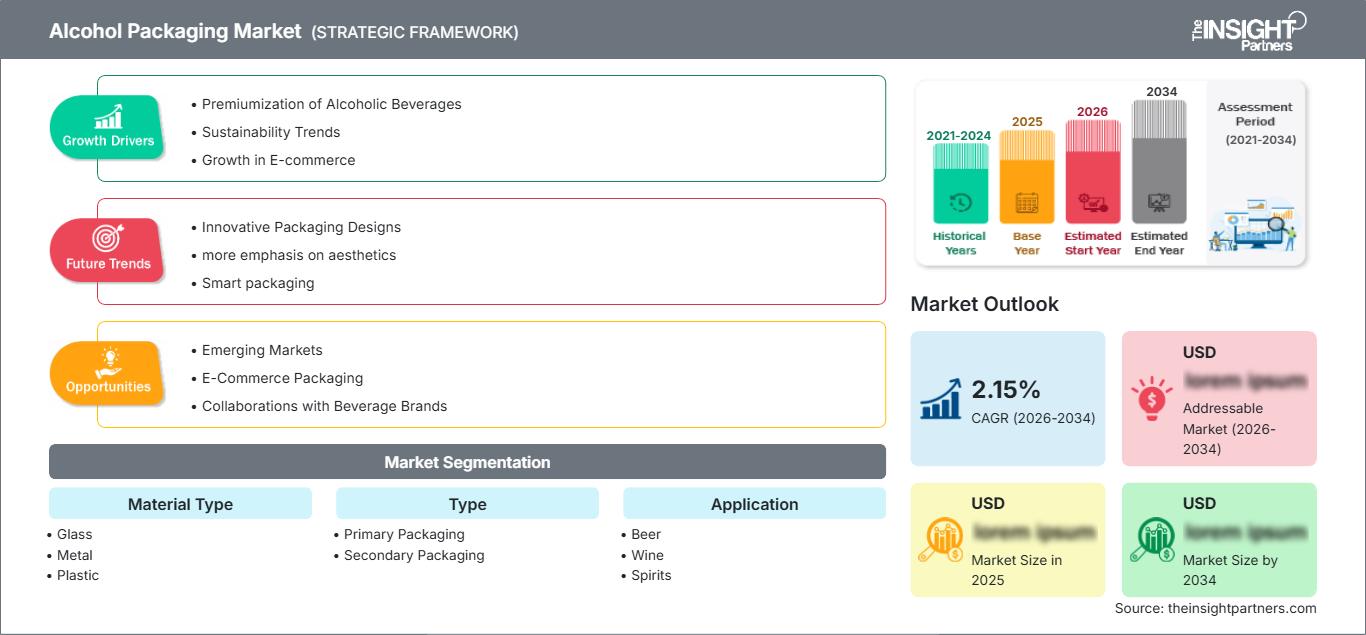
The alcohol packaging market stood at US$ 76.05 billion in 2025 and is forecasted to reach US$ 110.64 billion by 2034 at a CAGR of 4.25% between 2026 and 2034. Premium alcoholic beverages, increased international trade in beverages, and preference for sustainable packaging materials will drive the demand for alcohol packaging materials in the future. Increasingly, the producers of packaging are investing in their products in terms of lighter weight, recyclability, and better barrier technologies for better protection and compliance with changing environmental regulations.
In North America, the producers of alcohol packaging materials are making significant investments in advanced glass, aluminum, and paper-based packaging solutions to cater to their sustainability needs and the demands of premium branding. The value of the alcohol packaging market size in the region will benefit from the well-established markets for beer and spirits, the use of the circular economy model, and increased demand for recyclable beverage containers. The rate of growth in the region will continue to be steady, with the estimated CAGR of 3.8–4.3% between 2026 and 2034.
Alcohol Packaging Market Assessment and Insights
- North America: Accounted for 30–33% share in 2025 and is anticipated to grow at a CAGR of 3.8–4.3% during 2026–2034. Strong premium beverage consumption, advanced recycling infrastructure, and continuous investments in lightweight aluminum and glass packaging support regional demand.
- U.S.: Represented 78–82% of the North American market in 2025 and is projected to expand at a CAGR of 3.9–4.4% during 2026–2034. Demand is driven by craft breweries, premium spirits, canned ready-to-drink beverages, and investments in sustainable packaging technologies.
- Europe: Held 27–30% share in 2025 and is expected to register a CAGR of 3.7–4.2% during 2026–2034. Germany, France, Italy, Spain, and the UK continue to lead regional demand owing to established brewing, wine, and spirits industries alongside stringent circular economy regulations.
- Asia Pacific: Captured 28–31% share in 2025 and is forecast to grow at a CAGR of 5.2–5.8% during 2026–2034. China, India, Japan, South Korea, and Australia remain major contributors as premium alcohol consumption and domestic packaging production continue to expand.
- Largest Segment: Glass accounted for 41–45% market share in 2025 and is projected to grow at a CAGR of 3.8–4.3% during 2026–2034, supported by its premium appearance, excellent barrier properties, and high recyclability.
- High Growth Segment: Paper and Paperboard represented 9–12% market share in 2025 and is expected to expand at a CAGR of 6.2–6.8% during 2026–2034, driven by sustainability initiatives and increasing adoption of fiber-based secondary packaging.
- Key companies analyzed in detail: Amcor plc, Ardagh Group S.A., Ball Corporation, Berry Global Group, Inc., Crown Holdings, Inc., DS Smith Limited, Gerresheimer AG, Nampak Limited, Smurfit Kappa Group plc, Stora Enso Oyj.
Source: The Insight Partners' analysis based on proprietary research, government publications, company annual reports, investor presentations, industry databases, and expert interviews.
Alcoholic beverage packaging innovations have moved from being mainly functional in nature to playing an important role in brand building and sustainability. Lightweight glass bottles, infinitely recyclable aluminum cans, advanced plastic packaging, and fiber-based secondary packaging innovations have helped improve production efficiencies while lowering emissions during transport. Automations, digital printings, intelligent labeling, and barrier technology will contribute more to making the process more efficient and improving traceability and aesthetics. Another factor that has encouraged beverages producers to develop new forms of packaging is the premiumization trend that can be observed in beer, wines, and spirits.
Increasing regulatory demands for increasing recycled content in packaging and minimizing packaging waste will shift focus areas for investments within global value chains. Beverage manufacturers are now increasing recycling capabilities, using post-consumer recycled content, and implementing packaging solutions for reusing or refilling products to be aligned with the circular economy agenda. Developing regions like Asia Pacific, Latin America, and some Middle Eastern nations are now witnessing production investments because of growing consumption of alcoholic beverages, improved retail infrastructure, and favorable manufacturing conditions.
Alcohol Packaging Market Report Scope
| Report Attribute | Details |
|---|---|
| Market size in 2025 | US$ 76.05 Billion |
| Market Size by 2034 | US$ 110.64 Billion |
| Global CAGR (2026 - 2034) | 4.25% |
| Historical Data | 2021-2024 |
| Forecast period | 2026-2034 |
Alcohol Packaging Market Analysis
Increased premiumization in beer, wine, and spirits categories drives robust growth in the packaging market of alcohol products. Brand owners now depend more on packaging differentiation through premium glass bottles, embossed metal cans, attractive closures, and digitally printed labels to increase shelf presence and consumer engagement. Meanwhile, sustainability laws have boosted the demand for sustainable and lightweight packaging that will cut down on logistics costs and minimize the carbon footprint. Integrated supply chains have evolved from cooperation between raw material suppliers, converters, packaging manufacturers, beverages producers, logistics operators, and recycling companies.
The growth of ready-to-drink alcoholic beverages, craft beer, and premium spirits stimulates the demand for unique primary and secondary packaging. Investments in the production of aluminum cans, lightweight glass, recycled resin, and automation of packaging lines allow manufacturers to meet new consumption habits while ensuring the quality and legality of products. Digital solutions for inventory control, quality control, and serialization boost production flexibility.
According to the alcohol packaging market report, competition is shifting towards leadership in sustainable practices, manufacturing efficiency, geographic expansion, and innovation in product offerings beyond price wars. The firms such as Amcor plc, Ball Corporation, Crown Holdings, Inc., Ardagh Group S.A., Berry Global Group, Inc., Gerresheimer AG, DS Smith Limited, Smurfit Kappa Group plc, Stora Enso Oyj, and Nampak Limited are continuing to establish themselves as competitive players in terms of investments in recyclable materials, lightweight packaging technology, and geographic expansion of manufacturing.
There is an increase in capital expenditure in areas such as advanced recycling, digital printing, lightweight material development, and smart manufacturing. There is increasing consolidation within the packaging industry which is increasing the scale of production as well as helping firms expand their product portfolio in glass, metal, plastic, and fiber packaging. The production facilities of the companies are also being expanded to reduce logistical costs and meet increased demand from premium alcoholic beverage producers.
● REPORT CUSTOMIZATION
Tailor This Report To Align With Your Specific Business Requirements
This report can be customized to align precisely with your business objectives, scope, and target markets. Customization options include tailored segmentation, geography, competitive analysis, and strategic insights to support informed decision-making.
Customize This Report →WHAT YOU CAN ADJUST
- ● Segmentations
- ● Geography
- ● Competitive Analysis
- ● Language Preferences
Alcohol Packaging Market: Strategic Insights
Regional Insights
North America Alcohol Packaging Market
North America held 30-33% of the market share of the global alcohol packaging market share in 2025 and is expected to grow at a CAGR of 3.8-4.3% between 2026 and 2034. North America enjoys a developed alcoholic drinks industry, high consumption of premium beer and spirits, and developed packaging manufacturing industries. There is a growing demand for light weight aluminum cans, premium glass bottles, and recyclable fiber-based packaging due to the need for sustainability among beverage producers while not compromising on the quality of their products.
The United States and Canada are still the growth drivers and have a developed recycling process, circular economy packaging initiatives, and constant innovations in decorative printing and lightweight container solutions. The beverage companies use packaging made of recycled content for compliance with state environmental legislations and their sustainability goals. The growth driver also includes rising consumption of ready-to-drink alcoholic beverages, premium craft brands, and automation in packaging manufacturing facilities.
U.S. Alcohol Packaging Market
The U.S. held 78-82% share of the North America market in 2025 and is projected to record a CAGR of 3.9-4.4% between 2026 and 2034. The huge number of breweries, wineries, distilleries, and contract beverage producers in the nation drive constant demand for glass bottles, aluminum cans, closures, cartons, and secondary packaging materials. The trend towards premiumization among craft beers, bourbons, tequilas, and ready-to-drink products is driving premium packaging design adoption as a means of boosting product visibility and customer engagement and fulfilling sustainability goals.
Packaging manufacturers have kept on increasing their domestic production capacity for recyclable aluminum, lightweight glass containers, and fiber packaging to boost supply chain resilience. The rising adoption of digital printing, smart labels, and inspection systems is driving production efficiency as well as shorter production runs for limited edition launches of beverages. The consumer preference for eco-friendly packaging and the increased recycled content mandates in some states will drive demand for sustainable alcohol packaging solutions in the coming years.
Europe Alcohol Packaging Market
The market share of Europe was estimated at 27-30% in 2025, and the region will record a CAGR of 3.7-4.2% between 2026 and 2034. Europe's dominant market share is attributed to its mature brewing, winemaking, and spirits industry, developed recycling system, and strict sustainability regulations for packaging. Germany is the largest market because of its high beer production, mature packaging manufacturing industry, and use of returnable glass bottles. There is continued growth in the use of aluminum cans and packaging for premium spirits in the UK driven by technological innovations.
France, Italy, and Spain are another demand hub in Europe because of their well-known wine industries and exports of premium alcoholic beverages. Manufacturers in these nations are developing light-weight glass bottles, paper-based transport packaging, and efficient recycling methods to keep up with changes in packaging laws in Europe. Circular economy strategies and higher recycled content target will drive innovations in packaging while maintaining Europe's dominance as one of the most technologically sophisticated alcohol packaging manufacturing hubs in the world.
APAC Alcohol Packaging Market
Asia Pacific captured 28–31% of the global market in 2025 and is forecast to expand at a CAGR of 5.2–5.8% during 2026–2034, making it the fastest-growing regional market. Rising disposable incomes, urbanization, expanding premium alcohol consumption, and growing domestic beverage manufacturing continue supporting regional demand.
China leads regional consumption and packaging production, while India records the fastest expansion owing to increasing organized retail and premium spirits demand. Japan, South Korea, and Australia continue investing in recyclable packaging technologies, lightweight containers, and automated manufacturing systems supported by favorable sustainability policies and strong industrial capabilities.
Middle East & Africa Alcohol Packaging Market
According to forecasts, the CAGR for the region in the period between 2026 and 2034 will be 4.0-4.5%, driven by the growth of the hotel and tourism industries along with the development of the beverages packaging industry. Despite the differences in laws regarding the production of alcoholic drinks in different countries, there are still plenty of opportunities in premium imported products and packaging production.
South Africa is the major market in the region, owing to its highly developed industries of wineries and breweries. The UAE is a significant center of distribution of premium beverages. The investment into the advanced packaging industry is gradually growing in Saudi Arabia and other Gulf countries.
Segmentation Analysis
Material Type
The material type segment plays a decisive role in determining product protection, sustainability performance, transportation efficiency, and branding within the alcohol packaging market scope. Material selection depends on beverage category, shelf-life requirements, regulatory compliance, recyclability targets, and consumer preferences. Growing environmental regulations are encouraging manufacturers to increase recycled content while developing lightweight packaging solutions. The segment is expected to expand at a CAGR of 4.3–4.8% during 2026–2034, supported by continuous material innovations and circular economy initiatives.
- Glass: Glass remains the preferred packaging material for premium wine, spirits, and specialty beer because of its excellent barrier properties, premium appearance, chemical inertness, and high recyclability across established collection systems.
- Metal: Aluminum and steel packaging continue gaining popularity owing to lightweight construction, excellent recyclability, rapid cooling characteristics, and increasing adoption for canned beer and ready-to-drink alcoholic beverages worldwide.
- Plastic: Plastic packaging provides cost advantages, design flexibility, reduced transportation weight, and impact resistance. It continues to serve selected wine, spirits, and beverage applications where convenience and logistics efficiency remain priorities.
- Paper and Paperboard: Fiber-based packaging is primarily used for cartons, carriers, gift boxes, and shipping containers. Rising sustainability initiatives and e-commerce growth continue increasing demand for recyclable paper packaging solutions.
Type
Packaging type influences product safety, branding effectiveness, transportation performance, and supply chain efficiency throughout beverage distribution. Primary packaging remains essential for preserving beverage quality, whereas secondary packaging improves handling, storage, merchandising, and logistics. Continued investments in automation, digital printing, and sustainable packaging designs are strengthening innovation across both categories. The segment is projected to register a CAGR of 4.2–4.6% during 2026–2034.
- Primary Packaging: Primary packaging includes bottles, cans, closures, caps, and containers that directly contact alcoholic beverages. Manufacturers increasingly focus on lightweight construction, recycled materials, premium aesthetics, and enhanced barrier performance.
- Secondary Packaging: Secondary packaging includes cartons, corrugated boxes, trays, shrink wraps, and carriers designed for transportation, retail display, and product protection. Sustainability requirements continue accelerating demand for recyclable fiber-based packaging systems.
Application
Application-specific packaging requirements vary according to beverage characteristics, distribution channels, consumer preferences, and branding strategies. Manufacturers increasingly customize packaging formats for premium positioning, convenience, transportation efficiency, and environmental performance. Growing consumption of premium beverages, craft alcohol, and ready-to-drink products continues encouraging packaging innovation across beverage categories. The application segment is anticipated to grow at a CAGR of 4.5–5.0% during 2026–2034.
- Beer: Beer remains the largest application owing to substantial global production volumes, widespread consumption, and increasing adoption of lightweight aluminum cans and returnable glass bottles across mature and emerging markets.
- Wine: Wine packaging continues emphasizing premium glass bottles, lightweight designs, sustainable closures, and enhanced branding as producers seek improved export competitiveness and reduced transportation emissions.
- Spirits: Premiumization within whiskey, vodka, rum, tequila, gin, and liqueurs continues supporting demand for decorative glass packaging, premium closures, luxury labeling, and customized bottle designs that strengthen brand differentiation.
Opportunity Snapshot
| Application | Revenue Contribution | Trend Tag | Adoption Stage |
|---|---|---|---|
| Beer | High | Lightweight Cans | Mature |
| Wine | High | Premium Bottles | Mature |
| Spirits | High | Luxury Packaging | Scaling |
Alcohol Packaging Market Growth Drivers and Impact Analysis
Expansion of Premium Alcohol Consumption Worldwide
The growing preference for premium and super-premium alcoholic beverages continues to reshape packaging requirements across global markets. Consumers increasingly associate premium packaging with product quality, authenticity, and brand value, encouraging beverage producers to invest in sophisticated glass bottles, decorative closures, embossed containers, and high-quality labeling technologies. Premium wines, craft beers, aged spirits, and ready-to-drink cocktails require packaging that delivers superior aesthetics while ensuring product integrity throughout transportation and storage. Manufacturers are responding through lightweight premium glass, enhanced printing capabilities, and innovative finishing techniques that balance sustainability with luxury appeal. This transition is supporting higher-value packaging formats, strengthening long-term investment across manufacturing facilities, and creating opportunities for differentiated packaging solutions capable of meeting evolving consumer expectations and retailer requirements.
Sustainability Regulations Accelerating Material Innovation
Environmental legislation across North America, Europe, and Asia Pacific is encouraging alcohol packaging manufacturers to reduce material usage, increase recycled content, and improve recyclability throughout the product lifecycle. Governments are implementing extended producer responsibility programs, packaging waste directives, deposit return systems, and recycled-content requirements that influence material selection and manufacturing strategies. These regulatory developments have accelerated investments in lightweight glass bottles, infinitely recyclable aluminum cans, recycled polymers, and fiber-based secondary packaging. Packaging companies are also expanding closed-loop recycling partnerships with beverage producers to improve material recovery rates while lowering carbon emissions. As sustainability becomes a purchasing criterion for both consumers and brand owners, innovative low-carbon packaging technologies are expected to become increasingly important competitive differentiators.
Growth of Ready-to-Drink and Craft Beverage Categories
Rapid expansion of ready-to-drink alcoholic beverages and craft beverage production continues creating new opportunities for packaging manufacturers worldwide. Smaller production batches, seasonal product launches, and premium branding strategies require flexible packaging lines capable of supporting customized container designs, shorter production runs, and rapid changeovers. Aluminum cans have gained considerable popularity for ready-to-drink beverages because of their portability, recyclability, and convenience, while premium glass remains the preferred material for many craft spirits and specialty beers. Packaging suppliers are investing in digital printing, automation, and smart manufacturing systems that enable greater production flexibility while reducing waste and improving operational efficiency. These developments are strengthening supply chains and encouraging continued innovation throughout the beverage packaging ecosystem.
Alcohol Packaging Market Future Trends
Digital Packaging and Smart Consumer Engagement
Digital technologies are becoming an important differentiator across beverage packaging. Smart labels incorporating QR codes, serialization, near-field communication, and digital authentication features allow beverage brands to improve traceability, combat counterfeiting, and strengthen consumer engagement. The alcohol packaging market trends increasingly reflect adoption of connected packaging capable of delivering product information, promotional campaigns, sustainability credentials, and brand storytelling directly through mobile devices. As digital marketing strategies become more integrated with physical packaging, manufacturers are investing in advanced printing technologies and intelligent labeling solutions that support personalization, regulatory compliance, and supply chain transparency while enhancing customer experience.
Transition Toward Circular Packaging Systems
Circular economy principles are expected to influence packaging development more significantly throughout the forecast period. Beverage producers and packaging manufacturers are expanding refillable bottle programs, increasing post-consumer recycled content, and optimizing packaging designs for easier collection and recycling. Investments in advanced sorting technologies, chemical recycling, and reusable transport packaging are supporting resource efficiency while reducing lifecycle emissions. Collaboration among packaging suppliers, beverage companies, retailers, and recycling organizations will become increasingly important for achieving sustainability targets. These initiatives are expected to improve material recovery, reduce dependence on virgin resources, and encourage broader adoption of environmentally responsible packaging solutions across global alcohol markets.
Alcohol Packaging Market Opportunities
Expanding Sustainable Packaging Investments in Emerging Economies
Emerging economies present substantial opportunities for packaging manufacturers seeking long-term growth. Rising urbanization, increasing disposable incomes, expanding organized retail, and higher consumption of premium alcoholic beverages are encouraging investments in regional packaging production. The alcohol packaging market Forecasts indicate sustained demand for modern glass manufacturing facilities, aluminum can production, recycled material processing, and fiber-based packaging plants across Asia Pacific, Latin America, and selected Middle Eastern countries. International beverage producers increasingly prefer localized packaging supply to improve responsiveness, reduce transportation costs, and strengthen supply chain resilience. Companies capable of combining sustainable materials with cost-efficient manufacturing are well positioned to capture expanding demand within these high-growth markets.
Development of High-Value Customized Packaging Solutions
Growing competition among alcoholic beverage brands is increasing demand for customized packaging that enhances product differentiation and consumer loyalty. Manufacturers have opportunities to expand premium packaging portfolios through decorative finishes, lightweight luxury bottles, innovative closure technologies, limited-edition designs, and advanced digital printing capabilities. Investments in flexible manufacturing systems will allow faster commercialization of personalized packaging solutions for craft breweries, boutique wineries, and premium spirit producers. Increasing collaboration between packaging manufacturers and beverage companies will accelerate product innovation while supporting shorter product development cycles. As premium beverage consumption continues expanding globally, customized packaging solutions are expected to generate attractive margins and strengthen long-term strategic partnerships across the value chain.
Recent Developments
- January 27, 2026: Brown-Forman Corporation and The Coca-Cola Company introduced a new sleek 330 ml can format for the Jack Daniel's & Coca-Cola ready-to-drink (RTD) range in the UK. The redesigned can enhances shelf visibility, improves merchandising efficiency in convenience and grocery channels, and uses less packaging material than the previous format, supporting premium positioning and packaging sustainability initiatives.
- February 20, 2026: Pitú launched Pitú Batidinha in a 250 ml aseptic carton, extending carton-based aseptic technology into the ready-to-drink alcoholic beverage segment. The multilayer carton protects against light and oxygen, enables ambient storage, reduces packaging weight compared with glass, and improves transport efficiency while providing a larger printable surface for product branding.
Frequently Asked Questions

- Comprehensive Market Sizing and Forecast Analysis
- Detailed Segmentation Analysis
- In-Depth Market Dynamics Assessment
- Regional and Country-Level Insights
- Competitive Landscape and Company Benchmarking
- Strategic Business Intelligence
Recent Reports
Testimonials

The Insight Partners' SCADA System Market report is comprehensive, with valuable insights on current trends and future forecasts. The team was highly professional, responsive, and supportive throughout. We are very satisfied and highly recommend their services.
RAN KEDEM Partner, Reali Technologies LTDs
I requested a report on a very specific software market and the team produced the report in a few days. The information was very relevant and well presented. I then requested some changes and additions to the report. The team was again very responsive and I got the final report in less than a week.
JEAN-HERVE JENN Chairman, Future Analytica
We worked with The Insight Partners for an important market study and forecast. They gave us clear insights into opportunities and risks, which helped shape our plans. Their research was easy to use and based on solid data. It helped us make smart, confident decisions. We highly recommend them.
PIYUSH NAGPAL Sr. Vice President, High Beam Global
The Insight Partners delivered insightful, well-structured market research with strong domain expertise. Their team was professional and responsive throughout. The user-friendly website made accessing industry reports seamless. We highly recommend them for reliable, high-quality research services
YUKIHIKO ADACHI CEO, Deep Blue, LLC.
This is the first time I have purchased a market report from The Insight Partners.While I was unsure at first, I visited their web site and felt more comfortable to take the risk and purchase a market report.I am completely satisfied with the quality of the report and customer service. I had several questions and comments with the initial report, but after a couple of dialogs over email with their analyst I believe I have a report that I can use as input to our strategic planning process.Thank you so much for taking the extra time and making this a positive experience.I will definitely recommend your service to others and you will be my first call when we need further market data.
JOHN SUZUKI President and Chief Executive Officer, Board Director, BK Technologies
I wish to appreciate your support and the professionalism you displayed in the course of attending to my request for information regarding to infectious disease IVD market in Nigeria. I appreciate your patience, your guidance, and the fact that you were willing to offer a discount, which eventually made it possible for us to close a deal. I look forward to engaging The Insight Partners in the future, all thanks to the impression you have created in me as a result of this first encounter.
DR CHIJIOKE ONYIA MANAGING DIRECTOR, PineCrest Healthcare Ltd.Reason to Buy
- Informed Decision-Making
- Understanding Market Dynamics
- Competitive Analysis
- Identifying Emerging Markets
- Customer Insights
- Market Forecasts
- Risk Mitigation
- Boosting Operational Efficiency
- Strategic Planning
- Investment Justification
- Tracking Industry Innovations
- Aligning with Regulatory Trends





 Get Free Sample for