
Application Container Market Growth, Trends & Forecast by 2034
Coverage: By Deployment Mode (Cloud Based, On-premises); Organization Size (SMEs, Large Enterprises); Application (Production, Collaboration, Modernization, Others) , and Geography (North America, Europe, Asia Pacific, and South and Central America)
- Status : Data Released
- Report Code : TIPRE00024476
- Category : Technology, Media and Telecommunications
- No. of Pages : 150
- Available Report Formats :


- Last update date : August 26, 2026


2025 Market Size
US$ 8.18 Bn
Base year value
2034 Forecast
US$ 100.75 Bn
Projected by 2034
CAGR 2026-2034
32.18 %
Growth rate
Addressable Market
US$ 380.23 Bn
(2026-2034)
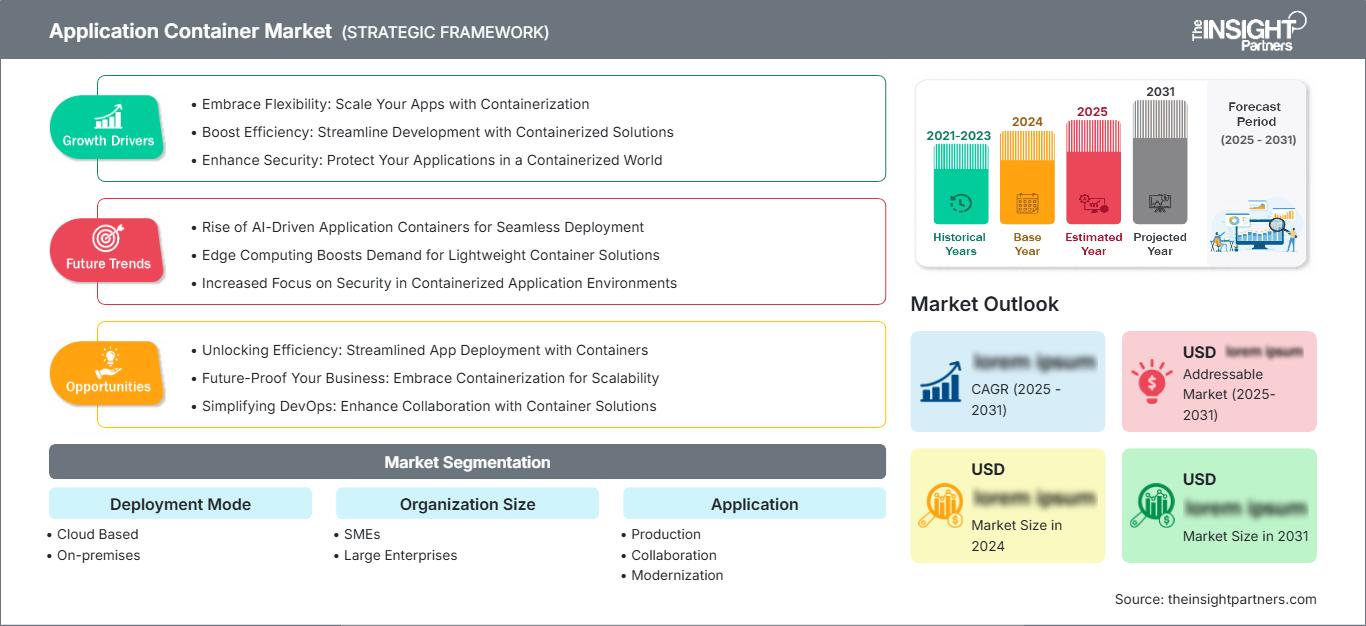
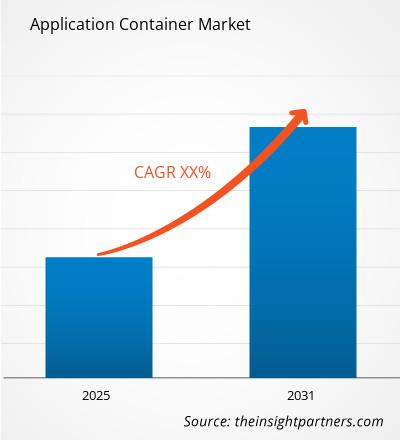
The application container market was valued at US$ 8.18 Billion in 2025 and is projected to reach US$ 100.75 Billion by 2034, registering a CAGR of 32.18% during 2026–2034. Enterprise modernization, cloud-native development, and security-driven orchestration are moving containers from developer tooling into core production infrastructure. The market is being shaped by containerized AI workloads, managed Kubernetes adoption, and consistent deployment patterns across hybrid environments.
Across North America, the application container market size is supported by a projected regional CAGR range of 31.5–33.0% during 2026–2034. Demand is anchored in hyperscale cloud capacity, regulated enterprise migration, and platform engineering investments. Public cloud maturity, DevSecOps adoption, and AI application deployment are reinforcing container use across financial services, healthcare, software, telecom, retail, and federal technology programs.
Application Container Market Assessment and Insights
- North America held 39–42% share in 2025 and is expected to grow at a CAGR range of 31.5–33.0% during 2026–2034, supported by cloud hyperscalers, mature DevOps teams, enterprise Kubernetes estates, and AI infrastructure modernization.
- US accounted for 82–85% of North America in 2025 and is projected to expand at a CAGR range of 31.8–33.2% during 2026–2034, driven by cloud-native software, federal modernization, and platform engineering.
- Europe represented 23–26% share in 2025 and is forecast to grow at a CAGR range of 29.5–31.0% during 2026–2034, with the UK, Germany, and France leading adoption through regulated cloud, manufacturing, and banking use cases.
- Asia Pacific captured 22–25% share in 2025 and is anticipated to grow at a CAGR range of 34.0–36.0% during 2026–2034, led by China, Japan, India, South Korea, and Australia across digital public infrastructure and telecom modernization.
- Largest Segment: Cloud Based held 66–70% market share in 2025 and is expected to grow at a CAGR range of 33.0–34.5% during 2026–2034 as enterprises prefer managed Kubernetes and serverless container platforms.
- High Growth Segment: Modernization held 28–32% market share in 2025 and is projected to grow at a CAGR range of 35.0–37.0% during 2026–2034 as legacy applications are refactored into microservices.
- Key companies analyzed in detail: Amazon Web Services, Inc., Apcera, Inc., Apprenda, Inc., Cisco Systems, Inc., Docker, Inc., International Business Machines Corporation, Joyent, Inc., Microsoft Corporation, Rancher Labs, Inc., VMware LLC.
Source: The Insight Partners' analysis based on proprietary research, government publications, company annual reports, investor presentations, industry databases, and expert interviews.
Container adoption has evolved from isolated development teams toward enterprise-wide operating models that link build pipelines, registries, orchestration, observability, and policy enforcement. The application container market is increasingly influenced by Kubernetes standardization, software bill of materials requirements, and production-grade image security. Changes in production paradigms are moving towards reusable internal platforms, where the operations team creates templates for controlled deployments, while the developers maintain their agility and mobility.
Moving forward, the need will increase not only within the initial cloud-native businesses but also to manufacturing companies, public-sector firms, health-care institutions, and energy companies who need to be able to rely on hybrid deployment. Countries that have been underrepresented are experiencing the positive impacts of sovereign clouds, government digital platforms, and telecom edge infrastructures.
Application Container Market Report Scope
| Report Attribute | Details |
|---|---|
| Market size in 2025 | US$ 8.18 Billion |
| Market Size by 2034 | US$ 100.75 Billion |
| Global CAGR (2026 - 2034) | 32.18% |
| Historical Data | 2021-2024 |
| Forecast period | 2026-2034 |
Application Container Market Analysis
The application container market growth is primarily driven by enterprise pressure to shorten release cycles while controlling runtime consistency across development, testing, and production. Containers offer drift management and help with microservices, API, and event-driven architectures. Another demand driver would be AI workloads requiring packaging of models, dependencies, and inference services on GPU-enabled architecture.
Value chain elements involve container runtime, registry, orchestration layer, managed Kubernetes, monitoring tools, scanning tools, and platform engineering services. The supply dynamics of containers are concentrated on cloud vendors and open source, but enterprise customers now look at support, control policies, image provenance, and integrations with identity, networking, storage, and CI/CD.
The application container market analysis shows a competitive structure led by hyperscalers and enterprise software vendors, while specialist providers remain relevant in developer experience, security, and hybrid operations. Amazon Web Services, Inc., Microsoft Corporation, International Business Machines Corporation, and VMware LLC battle with an integrated cloud and infrastructure portfolio strategy, while Docker, Inc., holds its ground within developer toolchains.
The trend of strategic investments goes towards AI-first orchestration, automation of compliance, multi-cluster governance, and cost optimization. Cisco Systems, Inc. bets on networking and observability adjacencies, Rancher Labs, Inc. builds up its Kubernetes management capabilities through SUSE ownership, and Apprenda, Inc., Apcera, Inc., and Joyent, Inc. are tied to private platforms and architectural evolution.
● REPORT CUSTOMIZATION
Tailor This Report To Align With Your Specific Business Requirements
This report can be customized to align precisely with your business objectives, scope, and target markets. Customization options include tailored segmentation, geography, competitive analysis, and strategic insights to support informed decision-making.
Customize This Report →WHAT YOU CAN ADJUST
- ● Segmentations
- ● Geography
- ● Competitive Analysis
- ● Language Preferences
Application Container Market: Strategic Insights
Regional Insights
North America application container market
North America held 39–42% application container market share in 2025 and is forecast to expand at a CAGR range of 31.5–33.0% during 2026–2034. Growth is facilitated through high cloud penetration, sophisticated DevOps, and widespread usage of Kubernetes. There is a shift towards purchasing managed container platforms that enable consolidation of deployment, identity, observability, and policy enforcement.
North America is also favored by the availability of hyperscale infrastructure and venture-backed software ecosystems. Model serving for AI, platforms for digital banking, API modernization, and zero trust architecture drive the use of containers in production. Productivity-driven purchase of managed container platforms will continue to dominate in North America, where buyers focus on platform standardization, golden paths, image pipeline security, and lower operational burden.
U.S. application container Market
The U.S. accounted for 82–85% of North America in 2025 and is projected to grow at a CAGR range of 31.8–33.2% during 2026–2034. Adoption is prominent within cloud software vendors, banks, government contractors, retailers, and healthcare networks that depend upon resilient digital operations. Business involvement is extensive, including the use of AWS, Microsoft, Docker, IBM, Cisco, VMware, and Rancher-related solutions that impact the enterprise.
Trends within applications are shifting from stateless web services to production-grade AI, data platforms, and monolith application modernization. American businesses are also utilizing containers for developer environments, regulated CI/CD pipelines, and edge workloads. Engineering platform teams are using centralized Kubernetes governance to avoid tool sprawl and enhance deployment reliability.
Europe application container Market
Europe represented 23–26% share in 2025 and is expected to grow at a CAGR range of 29.5–31.0% during 2026–2034. The UK is the leading country, supported by cloud-first banking, public sector modernization, and fintech platform development. Demand is shaped by security assurance, operational resilience, and data governance expectations, making managed and hybrid container platforms attractive to regulated enterprises.
Germany is advancing through Industry 4.0, automotive software, industrial IoT, and private cloud modernization. Manufacturers use containers to standardize workloads across plants, engineering systems, and enterprise IT. France, Italy, and Spain are expanding through telecom cloud, digital government, and retail modernization, while European buyers remain highly attentive to sovereignty, localization, and software supply chain controls.
APAC application container Market
APAC captured 22–25% share in 2025 and is projected to grow at a CAGR range of 34.0–36.0% during 2026–2034. China leads regional spending through cloud platforms, digital services, and AI infrastructure, while Japan and South Korea emphasize telecom, manufacturing, and software modernization.
India and Australia are scaling container use through fintech, public digital infrastructure, retail platforms, and managed cloud adoption. Policy-driven digitization, 5G rollout, data localization, and fast-growing developer ecosystems are supporting strong regional demand, especially for cloud-based orchestration and hybrid deployment.
Middle East & Africa application container Market
The Middle East & Africa is expected to grow at a CAGR range of 30.0–32.0% during 2026–2034, with Saudi Arabia leading adoption. Energy modernization, smart city platforms, sovereign cloud programs, and digital government services are creating demand for containerized applications across public and private infrastructure.
The UAE is expanding through fintech, logistics, and cloud data center investments, while South Africa shows adoption across banking, telecom, and retail. The rest of MEA demand remains selective but rising, particularly where organizations need scalable digital services, secure hybrid deployment, and efficient modernization of legacy enterprise applications.
Segmentation Analysis
Deployment Mode
Deployment Mode is expected to grow at a CAGR range of 32.0–33.5% during 2026–2034 as buyers balance cloud scalability with data control. The application container market scope is widening because enterprises now deploy containers across public cloud, private infrastructure, and edge environments. Cloud platforms dominate new demand, while on-premises deployments remain important for latency-sensitive, regulated, or sovereign workloads.
- Cloud Based leads demand because managed Kubernetes, serverless containers, and integrated registries simplify operations. Enterprises prefer this model for rapid scaling, AI services, automated upgrades, and global application delivery.
- On-premises remains strategically important for regulated sectors, industrial systems, and data-sensitive workloads. Adoption is strongest where enterprises need local control, predictable latency, private networking, and customized security policies.
Organization Size
Organization Size is projected to grow at a CAGR range of 31.0–32.8% during 2026–2034 as enterprises and smaller firms adopt standardized application delivery. Large enterprises account for broader production estates, while SMEs benefit from cloud-based container services that reduce infrastructure ownership. Adoption patterns increasingly depend on internal skills, governance maturity, and the need for rapid software release.
- SMEs adopt containers through cloud-native development, SaaS platforms, and managed services. Their demand is linked to lower infrastructure overhead, faster releases, simplified portability, and access to enterprise-grade deployment tooling.
- Large Enterprises represent the most mature production base due to complex application portfolios, compliance obligations, and multi-cloud strategies. They prioritize governance, cost visibility, security automation, and platform engineering.
Application
Application is forecast to grow at a CAGR range of 32.5–34.0% during 2026–2034 as containers become foundational to production operations, collaboration, and modernization. Production remains the largest application area, while modernization is the fastest-growing use case. Enterprises increasingly use containers to decouple legacy systems, standardize environments, and support distributed development.
- Production holds the strongest position because mission-critical workloads require stable orchestration, monitoring, scaling, and recovery. Demand is tied to digital banking, e-commerce, SaaS, healthcare platforms, and telecom services.
- Collaboration supports distributed engineering teams by enabling reproducible environments, shared images, and consistent CI/CD workflows. Its strategic value rises where organizations manage multiple teams, codebases, and deployment locations.
- Modernization is accelerating as enterprises refactor legacy applications into microservices and API-based architectures. It supports cloud migration, technical debt reduction, release automation, and faster integration of AI-enabled services.
Opportunity Snapshot
| Application | Revenue Contribution | Trend Tag | Adoption Stage |
| Production | High | Runtime Scale | Mature |
| Collaboration | Medium | Dev Workflow | Scaling |
| Modernization | High | Legacy Refactor | Scaling |
Application Container Market Growth Drivers and Impact Analysis
Enterprise Shift Toward Platform Engineering
Platform engineering is turning into a structural force since companies need developer velocity but do not want to have out-of-control tooling sprawl. Developer platforms within companies provide packaged solutions for Kubernetes, registry, observability, security policies, and deployment templates, making these processes standardized. This results in less time needed for onboarding, more operational consistency, and better governance. This effect is felt most by companies where there are hundreds of teams deploying services to multiple clouds. Through standardizing container operations, buyers turn containerization from something developers choose to do into something enterprises can manage.
Rising Need for Secure Software Supply Chains
Security requirements have evolved from run-time security to a complete software lifecycle. Organizations are demanding that there be signed images, vulnerability assessments, provenance tracking, access controls, and policy-based admission prior to workloads being put into production. Containers are ideal for this change due to the image being an easily managed entity for compliance, patch management, and validation. There will be increased spending on security functionality in orchestration systems, registries, and DevSecOps processes. Industries with regulatory requirements are turning to container governance to minimize their exposure to third-party risk, configuration issues, and patch lag times.
AI and Data Workloads Moving Into Containerized Operations
The adoption of AI technology has increased the need for portable and reusable runtime environments that will help bundle machine learning models, APIs, drivers, and inference services. Containers provide engineering teams the flexibility to migrate tasks between GPU clusters, cloud machines, and edge devices with lower risks of compatibility problems. This has become particularly relevant in retrieval-augmented generation, model serving, and data pipeline operations. The implications for the market include increased demand for orchestrating platforms that support accelerators and storage integration and autoscaling capabilities.
Application Container Market Future Trends
AI-Native Container Orchestration
AI-native orchestration will be one of the defining application container market trends as enterprises move from isolated models to multi-agent systems and production inference services. Future platforms will require automatic scheduling of accelerators, model-aware observability capabilities, policies, and workload placement on hybrid infrastructures. These will enable future container platforms to evolve from generic runtime frameworks to intelligent orchestrators that optimize cost, latency, and governance for AI applications. The companies that integrate Kubernetes automation, GPU capabilities, secure sandboxes, and user-friendly workflows will likely become more relevant for enterprises.
Policy-Driven Hybrid and Edge Deployment
Deployment of hybrid and edge computing will evolve into policy-based automation as opposed to manual management of clusters. Organizations such as those with manufacturing facilities, healthcare centers, retail stores, telecom hubs, and energy resources require reliable deployment without depending on connectivity from the central cloud. In the future, container platforms will include fleet management, offline capabilities, zero-trust identity, and compliance validation. This will help make container computing more relevant to the needs of distributed industries that consider downtime, latency, and data residency key.
Application Container Market Opportunities
Modernization of Regulated Enterprise Applications
Modernization offers a high-value opportunity for vendors and system integrators because regulated enterprises still operate large portfolios of monolithic applications. The application container market Forecasts indicate strong investment potential where banks, insurers, healthcare providers, and government agencies need incremental refactoring rather than wholesale replacement. Containers support phased modernization by isolating services, improving portability, and enabling controlled migration to cloud or hybrid infrastructure. Providers can differentiate by offering migration accelerators, compliance-ready reference architectures, secure registries, and managed operations for business-critical workloads.
Managed Services for Skills-Constrained Buyers
Skills shortage presents an opportunity to provide managed services that will help cut down the complexity of Kubernetes. There is a lot of demand for containerization in the industry, but due to the lack of skills in managing clusters, fine-tuning, observability, networking, and security hardening, many companies cannot leverage containers. Providers of managed services may take advantage of this trend by developing their services around architecture design, migration, governance, monitoring, and incident response, to name just a few.
Frequently Asked Questions

- Comprehensive Market Sizing and Forecast Analysis
- Detailed Segmentation Analysis
- In-Depth Market Dynamics Assessment
- Regional and Country-Level Insights
- Competitive Landscape and Company Benchmarking
- Strategic Business Intelligence
Recent Reports
Testimonials

The Insight Partners provided valuable market intelligence that supported our global go-to-market strategy. Their team was professional, responsive, and attentive to our feedback, providing thoughtful analysis and helpful methodological clarifications throughout the project.
Junmo Kim Chief Financial Officer (CFO), Enertech Co., Ltd.
The Insight Partners' SCADA System Market report is comprehensive, with valuable insights on current trends and future forecasts. The team was highly professional, responsive, and supportive throughout. We are very satisfied and highly recommend their services.
RAN KEDEM Partner, Reali Technologies LTDs
I requested a report on a very specific software market and the team produced the report in a few days. The information was very relevant and well presented. I then requested some changes and additions to the report. The team was again very responsive and I got the final report in less than a week.
JEAN-HERVE JENN Chairman, Future Analytica
We worked with The Insight Partners for an important market study and forecast. They gave us clear insights into opportunities and risks, which helped shape our plans. Their research was easy to use and based on solid data. It helped us make smart, confident decisions. We highly recommend them.
PIYUSH NAGPAL Sr. Vice President, High Beam Global
The Insight Partners delivered insightful, well-structured market research with strong domain expertise. Their team was professional and responsive throughout. The user-friendly website made accessing industry reports seamless. We highly recommend them for reliable, high-quality research services
YUKIHIKO ADACHI CEO, Deep Blue, LLC.
This is the first time I have purchased a market report from The Insight Partners.While I was unsure at first, I visited their web site and felt more comfortable to take the risk and purchase a market report.I am completely satisfied with the quality of the report and customer service. I had several questions and comments with the initial report, but after a couple of dialogs over email with their analyst I believe I have a report that I can use as input to our strategic planning process.Thank you so much for taking the extra time and making this a positive experience.I will definitely recommend your service to others and you will be my first call when we need further market data.
JOHN SUZUKI President and Chief Executive Officer, Board Director, BK Technologies
I wish to appreciate your support and the professionalism you displayed in the course of attending to my request for information regarding to infectious disease IVD market in Nigeria. I appreciate your patience, your guidance, and the fact that you were willing to offer a discount, which eventually made it possible for us to close a deal. I look forward to engaging The Insight Partners in the future, all thanks to the impression you have created in me as a result of this first encounter.
DR CHIJIOKE ONYIA MANAGING DIRECTOR, PineCrest Healthcare Ltd.Reason to Buy
- Informed Decision-Making
- Understanding Market Dynamics
- Competitive Analysis
- Identifying Emerging Markets
- Customer Insights
- Market Forecasts
- Risk Mitigation
- Boosting Operational Efficiency
- Strategic Planning
- Investment Justification
- Tracking Industry Innovations
- Aligning with Regulatory Trends





 Get Free Sample for