
Application Delivery Controller Market Size, Trends & Growth by 2034
Coverage: by Organization Size (SMEs, Large Enterprises); Component (Software, Hardware); Application (Retail and Consumer Goods, Healthcare, IT and telecom, Manufacturing, Others), and Geography (North America, Europe, Asia Pacific, and South and Central America)
- Status : Data Released
- Report Code : TIPRE00003462
- Category : Technology, Media and Telecommunications
- No. of Pages : 150
- Available Report Formats :


- Last update date : August 26, 2026


2025 Market Size
US$ 5.57 Bn
Base year value
2034 Forecast
US$ 19.67 Bn
Projected by 2034
CAGR 2026-2034
15.05 %
Growth rate
Addressable Market
US$ 107.80 Bn
(2026-2034)
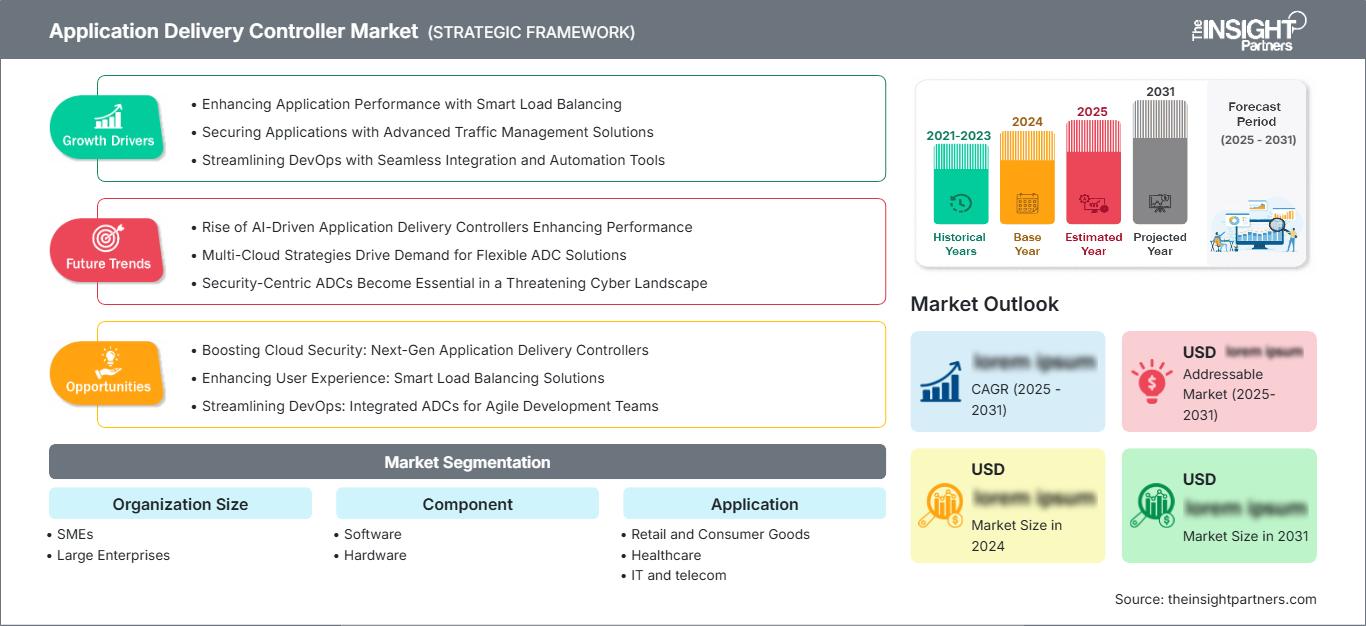
The application delivery controller market is projected to grow from US$ 5.57 Billion in 2025 to US$ 19.67 Billion by 2034, registering a CAGR of 15.05% during 2026–2034. The market is advancing as enterprises modernize application infrastructure, secure distributed workloads, and improve availability across data centers, public clouds, hybrid networks, and edge environments supporting business-critical digital services.
Across North America, the application delivery controller market size is supported by cloud migration, zero trust security programs, and high-volume digital transactions in retail, healthcare, IT, and telecom. The region is expected to grow at a CAGR range of 14.2–15.6% during 2026–2034, driven by software-defined traffic management, stricter uptime expectations, and replacement of legacy load-balancing appliances with integrated ADC platforms.
Application Delivery Controller Market Assessment and Insights
- North America accounted for 36–39% share in 2025 and is growing at a CAGR between 14.2–15.6% from 2026–2034, led by cloud-native application delivery, advanced cybersecurity spending, and large enterprise refresh cycles.
- US represented 78–82% of North America in 2025 and is growing at a CAGR between 14.0–15.4% from 2026–2034, supported by hyperscale cloud usage and regulated digital services.
- Europe held 24–27% share in 2025 and is growing at a CAGR between 13.2–14.7% from 2026–2034, with the UK, Germany, and France leading adoption across financial, telecom, and public-sector systems.
- Asia Pacific captured 22–25% share in 2025 and is growing at a CAGR between 16.4–18.1% from 2026–2034, led by China, Japan, India, South Korea, and Australia.
- Largest Segment Large Enterprises held 62–66% market share in 2025, growing at a CAGR between 14.1–15.3% during 2026–2034 due to complex traffic orchestration needs.
- High Growth Segment Software held 68–72% market share in 2025, growing at a CAGR between 16.2–18.0% during 2026–2034 as virtual ADCs scale across cloud environments.
- Key companies analyzed in detail: Array Networks, Inc., Akamai Technologies, Inc., Barracuda Networks, Inc., Cisco Systems, Inc., Cloud Software Group, Inc., Dell Technologies Inc., edgeNEXUS Limited, Fortinet, Inc., Progress Software Corporation, Radware Ltd.
Source: The Insight Partners' analysis based on proprietary research, government publications, company annual reports, investor presentations, industry databases, and expert interviews.
Enterprise application delivery has moved from fixed-load balancing toward policy-aware orchestration across encrypted traffic, APIs, containers, and hybrid infrastructure. Production dynamics now favor software appliances, subscription licensing, and cloud marketplace procurement, while hardware remains relevant for high-throughput sectors that require deterministic latency. The application delivery controller market is also shaped by rising TLS processing loads, web application protection, global server load balancing, and automation requirements linked to DevOps-led release cycles.
In the future, there will be more deployment of ADCs in the new digital economies in which banks, telecommunications providers, hospitals, and manufacturers are rethinking their applications to become resilient. Investments will be made based on the criteria of hybrid clouds and sovereign clouds, especially in cases where the data locality mandates local processing but centralized policy management. Regulations about service continuity, patient records, payments, and infrastructure security will drive the adoption of ADCs with built-in WAFs, DDoS protection, and observability.
Application Delivery Controller Market Report Scope
| Report Attribute | Details |
|---|---|
| Market size in 2025 | US$ 5.57 Billion |
| Market Size by 2034 | US$ 19.67 Billion |
| Global CAGR (2026 - 2034) | 15.05% |
| Historical Data | 2021-2024 |
| Forecast period | 2026-2034 |
Application Delivery Controller Market Analysis
The application delivery controller market growth is mainly driven by the shift from monolithic enterprise applications to API-intensive, distributed services. ADCs currently exist as an intermediary layer between users, applications, and the security control layer, enabling the distribution of traffic and performance and session policies. There are changes happening on the supply side as software companies have the advantage of rolling out the functionalities of ADCs via virtual machines, containers, and cloud images as compared to pure appliances.
In terms of demand, factors such as increasing traffic, digital customer interactions, and increased demands for resiliency have led to requirements from various sectors, such as retail requiring checkout application availability, hospitals requiring continuity of clinical applications, telecoms managing their subscriber portal, and manufacturing industries connecting their industrial applications to analytics platforms.
Competitive differentiation increasingly depends on automation, security integration, licensing flexibility, and multi-cloud operability. The application delivery controller market analysis indicates that Akamai Technologies, Inc., Fortinet, Inc., Radware Ltd., Cloud Software Group, Inc., and Progress Software Corporation are positioning ADC capabilities alongside cloud security, WAF, API protection, and observability. Array Networks, Inc., Barracuda Networks, Inc., edgeNEXUS Limited, and Cisco Systems, Inc. continue to address focused enterprise and mid-market requirements.
The investments are directed at software-based delivery, managed services channels, and security-centric bundling. The relevance of Dell Technologies Inc. is through the use of ADCs within the infrastructure ecosystems of storage, servers, and virtualization software. The vendors who make it easier to migrate from appliances, lighten the SSL process burden, and offer policy consistency management will be in good standing.
● REPORT CUSTOMIZATION
Tailor This Report To Align With Your Specific Business Requirements
This report can be customized to align precisely with your business objectives, scope, and target markets. Customization options include tailored segmentation, geography, competitive analysis, and strategic insights to support informed decision-making.
Customize This Report →WHAT YOU CAN ADJUST
- ● Segmentations
- ● Geography
- ● Competitive Analysis
- ● Language Preferences
Application Delivery Controller Market: Strategic Insights
Regional Insights
North America application delivery controller market
North America accounted for 36–39% share in 2025 and is expected to expand at a CAGR of 14.2–15.6% during 2026–2034. The region benefits from dense cloud infrastructure, high digital transaction volumes, and early adoption of zero-trust network architectures. Enterprises continue to modernize ADC estates to handle encrypted sessions, distributed APIs, and continuous application releases across hybrid clouds.
The regional application delivery controller market share is supported by healthcare digitization, online retail scaling, SaaS adoption, and telecom network modernization. Large enterprises prioritize application uptime, while mid-sized organizations are adopting managed ADC services through partners. Demand is strongest where compliance, customer experience, and cyber resilience overlap, especially in banking, insurance, healthcare, government, and digital commerce.
U.S. application delivery controller Market
The U.S. represented 78–82% of North America in 2025 and is projected to grow at a CAGR of 14.0–15.4% from 2026–2034. It is mostly adopted by financial organizations, healthcare organizations, hyperscale cloud customers, government contractors, and large retailers. As the country has an established cybersecurity industry, the market encourages the integration of ADC with WAF, bot management, API security, and identity-based access policies.
There is high vendor presence in the region, including companies such as Akamai Technologies, Inc., Barracuda Networks, Inc., Cisco Systems, Inc., Dell Technologies Inc., Fortinet, Inc., Progress Software Corporation, and Radware Ltd. Trends in applications include low-latency digital commerce, patient portals, collaboration applications, telecommunication self-service, and cloud enterprise applications.
Europe application delivery controller Market
Europe held 24–27% share of the application delivery controller market in 2025 and is expected to grow at a CAGR of 13.2–14.7% during 2026–2034. UK leads in the market due to cloud-first enterprise modernization, concentration of the finance industry and digitization of the public sector. Buyers value resilience, data privacy, and application availability, especially in payments, insurance, healthcare and digital government offerings.
Germany demonstrates strong adoption in manufacturing, automotive, industrial software and telco segments where uptime and determinism are important. Enterprises strive to achieve the balance between cloud migration and data governance locally, which creates demand for ADC solutions offering private cloud, appliance and managed hybrid deployment models without fragmentation of security policy and traffic management.
France, Italy, and Spain are advancing through cloud infrastructure investment, healthcare modernization, e-commerce growth, and telecom upgrades. France shows stronger public-sector and regulated enterprise demand, while Italy and Spain are scaling digital banking and consumer-facing applications. The application delivery controller market remains influenced by GDPR compliance and growing need for encrypted traffic inspection.
APAC application delivery controller Market
APAC captured 22–25% share of the application delivery controller market in 2025 and is forecast to grow at a CAGR of 16.4–18.1% during 2026–2034. China is the leading country, supported by large digital platforms, telecom infrastructure, and domestic data center expansion. Japan, South Korea, Australia, and India contribute through cloud adoption, 5G services, and enterprise application modernization.
Industrial and policy drivers include smart manufacturing, financial inclusion, data localization, and government digital-service programs. India’s expanding SaaS and payment ecosystems increase demand for scalable software ADCs, while Australia emphasizes secure hybrid cloud for public and private sectors. Regional buyers prioritize automation, multi-cloud support, and cost-efficient scaling over appliance-heavy procurement models.
Middle East & Africa application delivery controller Market
Middle East & Africa application delivery controller market is expected to grow at a CAGR of 13.8–15.2% during 2026–2034, with Saudi Arabia leading regional adoption. National digital transformation programs, cloud zones, smart-city projects, and energy-sector modernization are creating stronger demand for resilient application delivery. UAE adoption is concentrated in finance, aviation, retail, and government platforms.
South Africa anchors demand in banking, telecom, and enterprise cloud migration, while the Rest of MEA is gradually adopting ADCs through managed hosting and telecom-led infrastructure projects. Energy companies rely on secure application access for operational and corporate systems, making availability, DDoS protection, and hybrid deployment flexibility important purchasing factors.
Segmentation Analysis
Organization Size
The Organization Size segment is projected to grow at a CAGR of 14.5–16.0% during 2026–2034. The application delivery controller market scope across organization sizes is widening as small businesses adopt cloud-managed delivery, while large enterprises standardize global traffic policies. Adoption is shaped by application criticality, IT skills, compliance exposure, and cloud maturity.
- SMEs increasingly select virtual or managed ADC options to improve application uptime without owning complex hardware estates, making ease of deployment, pricing transparency, and bundled security strategically important.
- Large Enterprises remain the largest adoption base because they operate multi-site applications, encrypted customer portals, high-volume APIs, and distributed cloud estates requiring granular traffic control and centralized governance.
Component
The Component segment is expected to grow at a CAGR of 15.1–16.8% from 2026–2034. Software is the strategic center of demand because enterprises want faster provisioning, elastic scaling, and deployment through cloud marketplaces. Hardware maintains relevance in dedicated data centers where throughput, compliance assurance, and predictable SSL acceleration are necessary for mission-critical traffic.
- Software dominates demand as virtual ADCs, containerized delivery tools, and subscription models support DevOps automation, multi-cloud routing, and rapid capacity expansion across distributed application environments.
- Hardware remains important for telecom, banking, healthcare, and government workloads that require high-performance appliances, controlled infrastructure, and dependable encrypted traffic processing under peak loads.
Application
The Application segment is projected to grow at a CAGR of 14.8–16.3% during 2026–2034. ADC deployment varies by vertical because application downtime has different consequences across industries. Retail prioritizes transaction speed, healthcare prioritizes clinical continuity, IT and telecom focus on traffic scale, and manufacturing requires reliable access to operational and enterprise platforms.
- Retail and Consumer Goods use ADCs to support peak shopping events, omnichannel systems, payment flows, and loyalty applications where latency and failed sessions directly affect revenue conversion.
- Healthcare requires resilient delivery for electronic health records, patient portals, imaging workflows, and telehealth access, making security, identity integration, and uptime central to procurement.
- IT and telecom represent a high-intensity demand area due to subscriber portals, SaaS platforms, API gateways, edge workloads, and continuous service availability expectations.
- Manufacturing adopts ADCs for ERP, supplier portals, industrial analytics, quality systems, and remote operations, especially where hybrid cloud is linked with plant-level modernization.
Opportunity Snapshot
| Application | Revenue Contribution | Trend Tag | Adoption Stage |
| Retail and Consumer Goods | High | Peak Commerce | Mature |
| Healthcare | Medium | Clinical Access | Scaling |
| IT and telecom | High | Edge Traffic | Mature |
| Manufacturing | Medium | Plant Cloud | Scaling |
Application Delivery Controller Market Growth Drivers and Impact Analysis
Cloud migration and hybrid application estates
The process of cloud migration makes increasing demands on ADC solutions since companies do not usually migrate their entire application stack to one place. Centralized apps are kept in private data centers, customer apps are migrated to the cloud, and new services are developed using APIs and containers. As a result, challenges arise in the areas of traffic management, failover, policy consistency, and handling of encrypted traffic. ADC solutions that provide for a unified management layer that operates in the virtual, physical, and cloud-native forms of deployment help minimize the fragmentation problem for the network engineers.
Rising encrypted traffic and application-layer threats
Encrypted web traffic has made SSL inspection, certificate management, and application-layer defense central to ADC procurement. As more enterprise transactions move through HTTPS, APIs, and authenticated portals, organizations need delivery platforms that can terminate, inspect, route, and re-encrypt traffic without degrading user experience. The operational impact is visible in healthcare, finance, retail, and telecom, where application downtime or weak inspection can create compliance and reputational risk. ADC vendors are responding with integrated WAF, DDoS protection, bot mitigation, and API-aware controls. This strengthens the buying case for platforms that combine performance optimization with security enforcement at the application edge.
Digital commerce and real-time service expectations
Digital commerce, self-service portals, and mobile-first applications are raising business expectations for near-continuous availability. Retailers must manage sudden demand peaks, telecom operators must maintain subscriber services, and healthcare providers need reliable access to patient-facing systems. ADCs directly influence these outcomes by distributing traffic, monitoring server health, enabling session persistence, and supporting disaster recovery through global server load balancing. The market impact is a shift from viewing ADCs as infrastructure utilities to considering them revenue-protection assets. Enterprises increasingly evaluate ADC investments based on conversion protection, service continuity, user-experience metrics, and the ability to recover quickly from infrastructure failures.
Application Delivery Controller Market Future Trends
AI-assisted traffic operations
AI-assisted operations will become one of the defining application delivery controller market trends as enterprises try to reduce manual troubleshooting across hybrid environments. Future ADC platforms will use telemetry to detect abnormal latency, predict capacity constraints, recommend policy changes, and accelerate incident response. This trend is not limited to automation scripts; it will require explainable recommendations that network, security, and DevOps teams can validate. Vendors with deep observability, historical traffic baselines, and integrated security analytics will be better positioned. Adoption will likely start in managed services and large enterprises before spreading to mid-market buyers seeking simplified operations.
Post-quantum and advanced TLS readiness
Post-quantum cryptography planning will influence ADC roadmaps as enterprises prepare for longer-term encryption transitions. ADCs are logical control points because they terminate TLS sessions, manage certificates, and offload cryptographic processing from application servers. Future platforms will need to support evolving cipher suites while maintaining latency targets and interoperability with existing applications. This creates demand for hardware acceleration in some environments and optimized software stacks in cloud deployments. Telecom, banking, government, and healthcare buyers are expected to lead early evaluation because encrypted data retention risk and critical-service exposure make cryptographic agility a strategic infrastructure priority.
Application Delivery Controller Market Opportunities
Managed ADC services for mid-market modernization
Managed delivery models create a strong opportunity for vendors, service providers, and systems integrators serving mid-sized organizations. Many SMEs need resilient application access but lack specialist teams to tune load balancing, SSL policies, WAF rules, and health checks. Bundled services that combine ADC deployment, monitoring, policy updates, and incident response can convert underpenetrated demand into recurring revenue. The application delivery controller market Forecasts indicate that subscription-led adoption will be strongest where cloud migration is active, but internal infrastructure skills remain limited. Providers that offer clear service levels, predictable pricing, and simplified migration from legacy appliances can capture this opportunity.
Verticalized ADC packages for regulated industries
Regulated industries offer an opportunity for ADC vendors to package templates, compliance reporting, and security integrations around specific use cases. Healthcare buyers need safe patient access and clinical continuity, financial institutions need secure transaction delivery, and manufacturers want reliable industrial application connectivity. Purpose-built bundles can reduce deployment time by including preconfigured policies for authentication, SSL, WAF, logging, and high availability. This opportunity favors vendors that understand industry workflows rather than selling generic traffic management alone. Partners can further differentiate by combining ADC platforms with assessment, migration, managed detection, and compliance documentation tailored to each vertical’s risk profile.
Frequently Asked Questions

- Comprehensive Market Sizing and Forecast Analysis
- Detailed Segmentation Analysis
- In-Depth Market Dynamics Assessment
- Regional and Country-Level Insights
- Competitive Landscape and Company Benchmarking
- Strategic Business Intelligence
Recent Reports
Testimonials

The Insight Partners' SCADA System Market report is comprehensive, with valuable insights on current trends and future forecasts. The team was highly professional, responsive, and supportive throughout. We are very satisfied and highly recommend their services.
RAN KEDEM Partner, Reali Technologies LTDs
I requested a report on a very specific software market and the team produced the report in a few days. The information was very relevant and well presented. I then requested some changes and additions to the report. The team was again very responsive and I got the final report in less than a week.
JEAN-HERVE JENN Chairman, Future Analytica
We worked with The Insight Partners for an important market study and forecast. They gave us clear insights into opportunities and risks, which helped shape our plans. Their research was easy to use and based on solid data. It helped us make smart, confident decisions. We highly recommend them.
PIYUSH NAGPAL Sr. Vice President, High Beam Global
The Insight Partners delivered insightful, well-structured market research with strong domain expertise. Their team was professional and responsive throughout. The user-friendly website made accessing industry reports seamless. We highly recommend them for reliable, high-quality research services
YUKIHIKO ADACHI CEO, Deep Blue, LLC.
This is the first time I have purchased a market report from The Insight Partners.While I was unsure at first, I visited their web site and felt more comfortable to take the risk and purchase a market report.I am completely satisfied with the quality of the report and customer service. I had several questions and comments with the initial report, but after a couple of dialogs over email with their analyst I believe I have a report that I can use as input to our strategic planning process.Thank you so much for taking the extra time and making this a positive experience.I will definitely recommend your service to others and you will be my first call when we need further market data.
JOHN SUZUKI President and Chief Executive Officer, Board Director, BK Technologies
I wish to appreciate your support and the professionalism you displayed in the course of attending to my request for information regarding to infectious disease IVD market in Nigeria. I appreciate your patience, your guidance, and the fact that you were willing to offer a discount, which eventually made it possible for us to close a deal. I look forward to engaging The Insight Partners in the future, all thanks to the impression you have created in me as a result of this first encounter.
DR CHIJIOKE ONYIA MANAGING DIRECTOR, PineCrest Healthcare Ltd.Reason to Buy
- Informed Decision-Making
- Understanding Market Dynamics
- Competitive Analysis
- Identifying Emerging Markets
- Customer Insights
- Market Forecasts
- Risk Mitigation
- Boosting Operational Efficiency
- Strategic Planning
- Investment Justification
- Tracking Industry Innovations
- Aligning with Regulatory Trends





 Get Free Sample for