
Application Specific IC (ASIC) Market Share, Growth & Demand by 2034
Coverage: By Type (Full-Custom ASIC, Semi-Custom ASIC and Programmable ASIC); and Application (Consumer Electronics, Automotive, Telecommunication, Healthcare, Industrial and Others), and Geography (North America, Europe, Asia Pacific, and South and Central America)
- Status : Data Released
- Report Code : TIPTE100000898
- Category : Electronics and Semiconductor
- No. of Pages : 150
- Available Report Formats :


- Last update date : July 15, 2026


2025 Market Size
US$ 19.65 Bn
Base year value
2034 Forecast
US$ 32.20 Bn
Projected by 2034
CAGR 2026-2034
5.64 %
Growth rate
Addressable Market
US$ 235.02 Bn
(2026-2034)
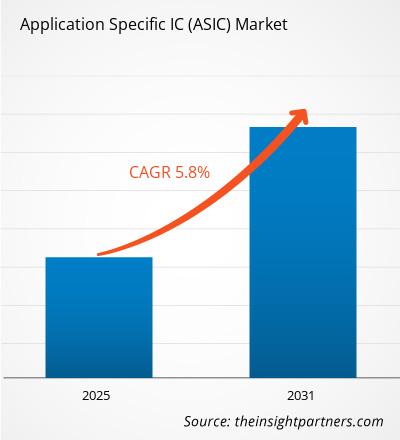
The Application Specific Integrated Circuit Market is valued at US$ 19.65 Billion in 2025 and is projected to reach US$ 32.20 Billion by 2034, registering a CAGR of 5.64% from 2026 to 2034. The market demonstrates increased use of semiconductors having customized architecture that helps enhance performance, decrease power consumption, and facilitate meeting specific application needs in communications, aerospace and defense, healthcare, automation, and commercial electronics.
North America is projected to continue being an important source of demand due to the need for customized semiconductors in advanced defense electronics, hyperscale data centers, and 5G network infrastructure. The Application Specific Integrated Circuit Market size in the region is estimated to expand at a 5.2–5.8% CAGR during 2026–2034, supported by domestic semiconductor incentives, high-value design activity, and reliable demand from aerospace, telecommunications, and medical electronics manufacturers.
Application Specific IC (ASIC) Market Assessment and Insights
- North America: North America held a 31–35% share in 2025 and is growing at a 5.2–5.8% CAGR between 2026–2034, supported by defense electronics, cloud infrastructure, and advanced semiconductor design ecosystems.
- US: The US represented 82–86% of North America in 2025 and is growing at a 5.3–5.9% CAGR between 2026–2034, led by aerospace, data center, and telecom ASIC demand.
- Europe: Europe accounted for a 22–26% share in 2025 and is growing at a 4.8–5.4% CAGR between 2026–2034, with Germany, France, the UK, Italy, and Spain leading industrial and automotive electronics adoption.
- Asia Pacific: Asia Pacific held a 34–38% share in 2025 and is growing at a 6.0–6.6% CAGR between 2026–2034, driven by China, Japan, South Korea, India, and Taiwan-linked semiconductor supply chains.
- Largest Segment: Silicon-based materials led with a 78–82% market share in 2025 and a 5.3–5.9% CAGR between 2026–2034 because silicon remains dominant in mature and advanced ASIC manufacturing.
- High Growth Segment: Indium Gallium Arsenide held a 7–10% market share in 2025 and is growing at a 6.4–7.1% CAGR between 2026–2034 as high-frequency optical and RF applications expand.
- Key companies analyzed in detail: Intel Corporation, Texas Instruments Incorporated, STMicroelectronics N.V., Infineon Technologies AG, Renesas Electronics Corporation, Analog Devices, Inc., NXP Semiconductors N.V., Qualcomm Technologies, Inc., Skyworks Solutions, Inc., and Maxim Integrated Products, Inc.
Source: The Insight Partners' analysis based on proprietary research, government publications, company annual reports, investor presentations, industry databases, and expert interviews.
Migration of technology is seeing the shift towards more heterogeneous integration of ASICs, chiplet-based architectures, and domain accelerations. The production process is undergoing a transformation as fabless design companies, IDM's, and foundry partners align early in terms of design-for-manufacturing, packaging, and qualification. This can be seen in 3 nm and 5 nm advanced nodes for compute-intensive designs, but 28 nm and mature analog nodes are still necessary for automotive, industrial, healthcare, and military requirements.
Future-oriented expansion will be driven by new geographies where incentives to manufacture electronic devices converge with rising demand for customized silicon. India, Southeast Asia, and the Middle East are drawing design centers and downstream assembly investments. At the same time, regulatory initiatives in the US, Europe, Japan, and South Korea will continue to emphasize a secure semiconductor supply chain. Expectations for aerospace certification, medical device reliability, and telecom power efficiency will drive supplier qualification and long-cycle procurement.
Application Specific IC (ASIC) Market Report Scope
| Report Attribute | Details |
|---|---|
| Market size in 2025 | US$ 19.65 Billion |
| Market Size by 2034 | US$ 32.20 Billion |
| Global CAGR (2026 - 2034) | 5.64% |
| Historical Data | 2021-2024 |
| Forecast period | 2026-2034 |
Application Specific IC (ASIC) Market Analysis
The Application Specific Integrated Circuit Market growth is supported by specialized processing requirements in 5G base stations, satellite payloads, medical imaging devices, industrial automation controllers, and secure defense electronics. ASICs are chosen if there is a need for predictable latencies, less energy consumption, more compact sizes, and greater differentiation at a hardware level compared to the generic processors. Growing demand is increasingly becoming associated with products whose functioning is characterized by a restricted thermal budget and a performance requirement.
The industry consists of electronic design automation providers, intellectual property (IP) core suppliers, fabless semiconductor providers, integrated device makers, foundries, packaging providers, testers, and end system integrators. Market supply considerations include wafer availability, process node qualification, export controls, and packaging availability. The customers are also valuing longer product life cycles in the aerospace and defense, industrial, and medical segments.
The Application Specific Integrated Circuit Market analysis shows a competitive field shaped by broad-line semiconductor suppliers and specialists with deep analog, RF, embedded processing, and connectivity portfolios. Custom silicon and foundry capabilities are being positioned by Intel Corporation on the basis of compute workloads, and Texas Instruments Incorporated, Analog Devices, Inc., and Maxim Integrated Products, Inc. are backing up signal chain and power-sensitive applications. Qualcomm Technologies, Inc. and Skyworks Solutions, Inc. are reinforcing the communications use case through their modem, RF front-ends, and connectivity prowess.
Strategic positioning is being increasingly defined not by the scope of chip offerings but more by application engineering expertise. STMicroelectronics N.V., Infineon Technologies AG, Renesas Electronics Corporation, and NXP Semiconductors N.V. are stressing automotive-quality products, supporting documentation, and systems reference designs. Funding is going to chiplet design, design verification using AI technology, advanced packaging, and supply chain security. Companies that have both a proven IP library and manufacturing know-how stand to win long-term customer commitments.
● REPORT CUSTOMIZATION
Tailor This Report To Align With Your Specific Business Requirements
This report can be customized to align precisely with your business objectives, scope, and target markets. Customization options include tailored segmentation, geography, competitive analysis, and strategic insights to support informed decision-making.
Customize This Report →WHAT YOU CAN ADJUST
- ● Segmentations
- ● Geography
- ● Competitive Analysis
- ● Language Preferences
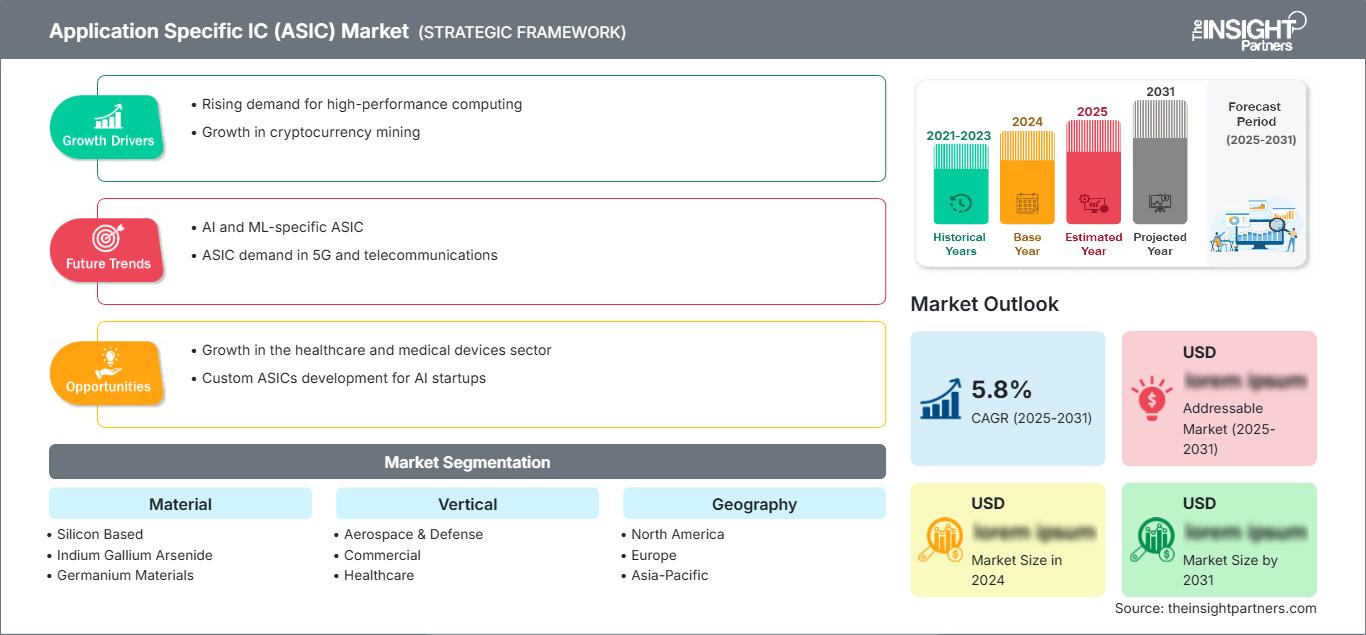
Application Specific IC (ASIC) Market: Strategic Insights
Regional Insights
North America Application Specific Integrated Circuit Market
North America accounted for a 31–35% share in 2025 and is expected to grow at a 5.2–5.8% CAGR during 2026–2034. The region benefits from high-value semiconductor design activity, defense modernization, cloud data center expansion, and medical electronics development. The Application Specific Integrated Circuit Market share in North America is also supported by strategic funding for domestic fabrication and packaging resilience.
Demand is concentrated in the US, where aerospace, secure communications, and artificial intelligence infrastructure systems demand specialized chips that perform optimally in terms of energy, latency, and dependability. The Canadian input comes through telecommunication infrastructure, industrial automation, and photonics design driven by research. Acquisition processes focus on lifecycle management, export compliance, and qualifying information, making established engineering and foundry capabilities more valuable.
U.S. Application Specific Integrated Circuit Market
The US represented 82–86% of North America in 2025 and is growing at a 5.3–5.9% CAGR during 2026–2034. Large hyperscales, defense contractors, med-tech manufacturers, and network hardware makers are boosting the usage of custom silicon to enhance system performance and to protect their intellectual property. Local government policies have also bolstered the link between design and manufacturing.
Intel Corporation has become more prominent in custom silicon dialogues, but Qualcomm Technologies, Inc., Texas Instruments Incorporated, Analog Devices, Inc., Skyworks Solutions, Inc., and NXP Semiconductors N.V. are backing communication, analog, radio frequency, and embedded applications. Trends in application comprise AI network accelerators, satellite communications payloads, low-power med-tech products, and robust industrial control systems, with customers emphasizing security and scalable production capabilities.
Europe Application Specific Integrated Circuit Market
Europe held a 22–26% share in 2025 and is expected to grow at a 4.8–5.4% CAGR during 2026–2034. Germany leads in the region due to automotive electronics, industrial automation, and power management design strengths that ensure consistent demand for ASICs. France and the UK have aerospace, defense, and secure communication programs, and Italy and Spain have industrial electronics and the automotive supply chain.
In terms of customer requirements, the focus is on functional safety, longevity, and efficiency. STMicroelectronics N.V., Infineon Technologies AG, NXP Semiconductors N.V., and Analog Devices, Inc. remain relevant players in European engineering within the power, analog, sensor, and mixed signal segments. European procurement is also driven by the desire to achieve sovereignty of semiconductors, which leads to regional engineering activities.
APAC Application Specific Integrated Circuit Market
APAC represented a 34–38% share in 2025 and is projected to expand at a 6.0–6.6% CAGR during 2026–2034. In terms of regional volume, China takes the lead, while Japan, South Korea, India, and Australia support automotive electronics, telecommunications equipment, industrial control systems, and military applications, respectively. The growth in the region depends on the electronics manufacturing value chain and governmental incentives for the semiconductor industry ecosystem.
The industrial automation industry, 5G technology rollout, and edge AI hardware have supported design efforts in the region. In Japan and South Korea, there is a high-quality demand for automotive and consumer electronics application-specific integrated circuits (ASICs). Meanwhile, in India, there is an expansion in semiconductor design services and local electronics manufacturing.
Middle East & Africa Application Specific Integrated Circuit Market
The Middle East & Africa is expected to grow at a 4.4–5.0% CAGR during 2026–2034. Saudi Arabia and UAE drive through digital infrastructure, defense, satellites, and energy automation. The South African contribution is in the form of industrial electronics, telecommunications development, and mining automation technology that requires hardening of semiconductors.
It is still smaller in size compared to North America, Europe, and APAC regions, but is becoming increasingly significant due to increasing data centers, smart infrastructure, and energy transition projects in the region. The adoption is high in areas that need secure applications for monitoring, communication, and control processes. This is because vendors rely on channels and reliable partners.
Segmentation Analysis
Material
The Material segment is estimated to grow at a 5.4–6.0% CAGR during 2026–2034 as ASIC design teams balance cost, performance, leakage, frequency, and manufacturability. The Application Specific Integrated Circuit Market scope across materials remains dominated by silicon, but compound semiconductors are gaining importance in RF, photonics, and high-speed optical communications, where traditional silicon can face performance limits.
- Silicon-Based: Silicon-based materials continue to be the go-to choice for large-scale ASIC manufacturing owing to their process maturity, manufacturing facilities, library of design elements, and testing resources in fields like communications, industry, medicine, and military electronics.
- Indium Gallium Arsenide: Indium Gallium Arsenide holds strategic significance when it comes to applications involving high-frequency circuits, photodetection, and optical communication, where sensitivity and speed are necessary considerations beyond the usual design complexity.
- Germanium Materials: Germanium Materials offer special applications where speed and optics play key roles, and silicon photonics or sensing technologies may be combined for better signal handling.
Vertical
The Vertical segment is projected to grow at a 5.5–6.2% CAGR during 2026–2034 as customers adopt ASICs to solve application-specific constraints. Telecommunications leads demand for bandwidth and energy efficiency, while aerospace and defense emphasize radiation tolerance and secure processing. Healthcare and industrial users require long lifecycle support, validated reliability, and compact designs suited to controlled environments.
- •Aerospace & Defense: Aerospace & Defense applications are defined by the need for secure communications, electronic warfare, radar, avionics, and satellite systems, which call for qualified parts, reliable performance, and long-term program support.
- Commercial: The commercial market is characterized by the proliferation of smart gadgets, connectivity, and data processing applications, where customized chips allow manufacturers to distinguish their products and improve efficiency, costs, and size.
- Healthcare: In healthcare markets, applications such as imaging, diagnosis, biosensors, patient monitoring, and implantable and mobile electronics depend on ASICs due to the need for high accuracy, low power consumption, and reliable components.
- Industrial: Industrial applications include factory automation, robotics, motor control, predictive maintenance, and edge computing systems, where ruggedized parts, reliable performance, and a prolonged product life cycle are required.
- Telecommunications: Telecommunications is strategically vital as 5G Advanced, Open RAN, fixed wireless access, optical transport, and network acceleration demand customized high-speed and low-latency silicon.
Opportunity Snapshot
| Segment Name | Revenue Contribution | Trend Tag | Adoption Stage |
| Aerospace & Defense | High | Secure Radar | Mature |
| Commercial | Medium | Smart Devices | Scaling |
| Healthcare | Medium | Diagnostic Chips | Scaling |
| Industrial | High | Edge Control | Mature |
| Telecommunications | High | 5G Acceleration | Scaling |
| Others | Low | Niche Silicon | Emerging |
Application Specific IC (ASIC) Market Growth Drivers and Impact Analysis
Expansion of High-Bandwidth Communications Infrastructure
The makers of telecommunications equipment are employing ASICS to lower power requirements as well as enhance the performance of packet processing, beamforming, modems, and RF control. The demand for improved latency and lower power requirements in 5G advanced technology, fixed wireless access, private networking, and optical transport makes ASICS appealing, where standardized processors cannot meet the efficiency criteria. The effect will be more pronounced in the case of baseband units, radio units, switches, and network accelerators. As service providers look to reduce their operational expenses, semiconductor firms that provide processing, analog, and connectivity IPs within compact systems are favored design winners.
Rising Need for Secure and Mission-Critical Electronics
Aerospace & defense programs have growing needs for silicon, which not only satisfy the needs related to security, reliability, and the operational environment but also exceed the requirements set for consumer electronic devices. The advantage provided by ASIC is that system designers can integrate encryption, signal processing, sensor fusion, and control capabilities into the hardware with predictable performance characteristics. The above-mentioned driver gets its strength from developments such as satellite constellations, radar upgrades, unmanned platforms, and secure communication networks. The market effect can be observed through longer qualification cycles, increased collaboration in engineering, and preference to vendors providing traceability, lifecycle support, and process consistency.
Power Efficiency Pressure in Edge and Medical Devices
Edge computing, wearable health care, portable diagnostic tools, and sensors for industrial purposes need more processing power without increased battery size and without generating more heat. With ASICs, engineers are able to offload certain tasks onto the hardware that is designed to perform certain calculations, thus decreasing the amount of energy needed for a task and making the reaction time faster. However, it has another consequence, as smaller and more efficient components will be able to fit better into small housing units, function longer, and provide a more reliable performance in the field.
Application Specific IC (ASIC) Market Future Trends
Chiplet-Based Custom Silicon Architectures
Application Specific Integrated Circuit Market trends are shifting toward chiplet-based architectures that allow designers to combine compute, memory interface, analog, RF, and accelerator functions without building every block on the same advanced node. This approach can improve yield, reduce design risk, and support faster product variants for telecom, automotive, and defense platforms. Over the forecast period, suppliers are expected to invest in interconnect standards, advanced packaging, and thermal management so customers can achieve application-specific performance while avoiding the full cost of monolithic leading-edge designs.
AI-Assisted Verification and Design Productivity
Design complexity is anticipated to grow with time due to the fact that ASICs will incorporate increased software-defined capabilities, safety features, and domain-specific accelerators. Artificial intelligence will assist engineers in detecting layout problems, power optimization, speeding up verification, and decreasing the likelihood of respins. This approach will not take away the need for skilled designers, but it will shorten the product cycles and increase efficiency where there are staff shortages. Suppliers who have combined their well-known IP libraries and automated verification processes will be in a good position to serve such clients.
Application Specific IC (ASIC) Market Opportunities
Custom Silicon for Open and Disaggregated Networks
Open RAN, private 5G, optical networking, and edge data centers create opportunities for ASIC suppliers that can optimize compute, packet processing, and RF control functions for specialized network architectures. Application Specific Integrated Circuit Market Forecasts indicate that vendors with reusable IP, flexible design services, and reliable packaging access can support telecom customers seeking lower power consumption and faster feature differentiation. Investment priorities should include modem acceleration, timing synchronization, secure boot, and energy-efficient switching. Companies that engage early with equipment makers and network operators can align silicon roadmaps with deployment schedules, reducing redesign risk and improving qualification confidence.
Healthcare and Industrial Reliability-Centric ASIC Programs
The fields of healthcare and industrial technology have great potential because of the need for dependable performance and continuity over shorter consumer-electronics-style lifecycles. There are opportunities in medical-imaging equipment, diagnostic devices, sensor technologies, robot control systems, and predictive maintenance systems where size and power savings matter. The investments to be made include reference platforms, regulatory compliance, longevity of the product, and application support engineering. Vendors who know the validation process can embed themselves into the system rather than provide components and thus earn ongoing income streams from different equipment lines and regional manufacturing efforts.
Recent Developments
- July 2026: Broadcom has signed a deal to provide Apple with custom chips until 2031. The chips and code shop has supplied Apple with silicon since the late 2000s when its wireless products found a home in early iPhone models. Broadcom’s silicon has found its way into iThings ever since.
- July 2026: SkyeChip Bhd announced engineering engagement with US-based Cerebras Systems Inc for the development of a custom chip design. As part of the engagement, SkyeChip is supporting the development of high-speed interface intellectual property (IP) for Cerebras’ next-generation computing initiatives,
- July 2026: The Defense Department has awarded BAE Systems US$ 16 million in Defense Production Act Title III funds to support expansion of the company's domestic processing and production capabilities for radiation-hardened microelectronics. The project would help BAE Systems reestablish its RH45 Storefront capability for trusted “Radiation Hardened by Design 45nm Application Specific Integrated Circuit and Application Specific Standard Product” offerings.
Frequently Asked Questions

- Comprehensive Market Sizing and Forecast Analysis
- Detailed Segmentation Analysis
- In-Depth Market Dynamics Assessment
- Regional and Country-Level Insights
- Competitive Landscape and Company Benchmarking
- Strategic Business Intelligence
Recent Reports
Testimonials

The Insight Partners' SCADA System Market report is comprehensive, with valuable insights on current trends and future forecasts. The team was highly professional, responsive, and supportive throughout. We are very satisfied and highly recommend their services.
RAN KEDEM Partner, Reali Technologies LTDs
I requested a report on a very specific software market and the team produced the report in a few days. The information was very relevant and well presented. I then requested some changes and additions to the report. The team was again very responsive and I got the final report in less than a week.
JEAN-HERVE JENN Chairman, Future Analytica
We worked with The Insight Partners for an important market study and forecast. They gave us clear insights into opportunities and risks, which helped shape our plans. Their research was easy to use and based on solid data. It helped us make smart, confident decisions. We highly recommend them.
PIYUSH NAGPAL Sr. Vice President, High Beam Global
The Insight Partners delivered insightful, well-structured market research with strong domain expertise. Their team was professional and responsive throughout. The user-friendly website made accessing industry reports seamless. We highly recommend them for reliable, high-quality research services
YUKIHIKO ADACHI CEO, Deep Blue, LLC.
This is the first time I have purchased a market report from The Insight Partners.While I was unsure at first, I visited their web site and felt more comfortable to take the risk and purchase a market report.I am completely satisfied with the quality of the report and customer service. I had several questions and comments with the initial report, but after a couple of dialogs over email with their analyst I believe I have a report that I can use as input to our strategic planning process.Thank you so much for taking the extra time and making this a positive experience.I will definitely recommend your service to others and you will be my first call when we need further market data.
JOHN SUZUKI President and Chief Executive Officer, Board Director, BK Technologies
I wish to appreciate your support and the professionalism you displayed in the course of attending to my request for information regarding to infectious disease IVD market in Nigeria. I appreciate your patience, your guidance, and the fact that you were willing to offer a discount, which eventually made it possible for us to close a deal. I look forward to engaging The Insight Partners in the future, all thanks to the impression you have created in me as a result of this first encounter.
DR CHIJIOKE ONYIA MANAGING DIRECTOR, PineCrest Healthcare Ltd.Reason to Buy
- Informed Decision-Making
- Understanding Market Dynamics
- Competitive Analysis
- Identifying Emerging Markets
- Customer Insights
- Market Forecasts
- Risk Mitigation
- Boosting Operational Efficiency
- Strategic Planning
- Investment Justification
- Tracking Industry Innovations
- Aligning with Regulatory Trends





 Get Free Sample for