
Assistive Technologies for Visually Impaired Market Growth, Demand & Size by 2034
Coverage: By Product Type (Educational Devices and Software, Mathematical and Science Devices, Mobility Devices, Low Vision Devices, Others); End User (Blind Schools, Enterprises and Social Organizations, Personal Use, Federation and Hospital, Others) , and Geography (North America, Europe, Asia Pacific, and South and Central America)
- Status : Data Released
- Report Code : TIPRE00020294
- Category : Technology, Media and Telecommunications
- No. of Pages : 150
- Available Report Formats :


- Last update date : August 28, 2026


2025 Market Size
US$ 5.66 Bn
Base year value
2034 Forecast
US$ 10.8 Bn
Projected by 2034
CAGR 2026-2034
7.45 %
Growth rate
Addressable Market
US$ 74.22 Bn
(2026-2034)
The assistive technologies for visually impaired market is projected to grow from US$ 5.66 Billion in 2025 to US$ 10.8 Billion by 2034, registering a CAGR of 7.45% during 2026–2034. Demand is rising as schools, workplaces, care providers, and individual users adopt devices and software that improve reading access, navigation, education, employment participation, and independent living for people with partial or complete vision loss.
North America remains a high-adoption region, with the assistive technologies for visually impaired market size supported by digital accessibility rules, special education funding, senior care needs, and enterprise inclusion programs. The region is expected to grow at a CAGR of 7.0–7.6% during 2026–2034 as screen readers, braille displays, electronic magnifiers, and smart mobility tools move deeper into institutional and personal use.
Assistive Technologies for Visually Impaired Market Assessment and Insights
- North America accounted for 35–38% share in 2025 and is expected to grow at a CAGR of 7.0–7.6% during 2026–2034, supported by mature accessibility procurement and rehabilitation services.
- US represented 82–86% of North America revenue in 2025 and is projected to grow at 7.1–7.8%, led by education technology, workplace accommodation, and veterans support programs.
- Europe held 25–28% share in 2025 and is forecast to expand at 6.7–7.3%, with the UK, Germany, France, Italy, and Spain leading assistive technology upgrades.
- Asia Pacific captured 24–27% share in 2025 and is projected to grow at 8.2–8.9%, driven by China, Japan, South Korea, India, and Australia.
- Largest Segment: Low Vision Devices held 34–38% market share in 2025 and is expected to grow at 6.8–7.4% as electronic magnifiers and wearable vision tools scale.
- High Growth Segment: Educational Devices and Software held 26–30% share in 2025 and is projected to grow at 8.0–8.7%, supported by accessible learning mandates and digital classrooms.
- Key companies analyzed in detail: Vispero; Amedia Corporation; Dolphin Computer Access Ltd.; HumanWare Technologies Inc.; Cambium Learning Group; Access Ingenuity; American Thermoform Corporation; LVI Low Vision International AB; ViewPlus Technologies, Inc.; LS&S, LLC.
Source: The Insight Partners' analysis based on proprietary research, government publications, company annual reports, investor presentations, industry databases, and expert interviews.
Technology development has shifted from standalone aids toward connected accessibility ecosystems. Earlier product cycles emphasized braille embossers, desktop magnifiers, and screen readers, while current systems combine OCR, text-to-speech, refreshable braille, mobile apps, AI image interpretation, and cloud updates. The assistive technologies for visually impaired market has also benefited from universal design expectations, because digital services increasingly need accessible interfaces at school, work, healthcare, and public service touchpoints.
The future outlook will be driven by aging demographics, inclusive policies, and improved accessibility in developing countries. The World Health Organization says that there are at least 2.2 billion people with impaired distance and near vision across the globe, generating a wide-ranging demand for vision solutions and assistive communication technologies. Investments will go towards multilingual software, mobile devices, less expensive braille systems, and devices that take minimal training time.
Assistive Technologies for Visually Impaired Market Report Scope
| Report Attribute | Details |
|---|---|
| Market size in 2025 | US$ 5.66 Billion |
| Market Size by 2034 | US$ 10.8 Billion |
| Global CAGR (2026 - 2034) | 7.45% |
| Historical Data | 2021-2024 |
| Forecast period | 2026-2034 |
Assistive Technologies for Visually Impaired Market Analysis
Demand for assistive technologies for visually impaired market growth is linked to education, workplace accommodation, rehabilitation, and personal independence. Consumers want devices that can be used together with regular computer systems, smartphones, cloud computing platforms, and digital learning systems. Textbooks and mathematical software are needed by educational institutions, compliant software environments by enterprises, and devices and applications to facilitate mobility and reading by individual consumers in private and public places.
There are many participants involved in the value chain, such as hardware manufacturers, software providers, distributors, therapists, educational institutions, hospitals, enterprises, insurance companies, and government organizations. The supply situation is being transformed as hardware becomes increasingly compact and software becomes subscription-based. The importance of training cannot be understated, as effective use of the products requires not just their availability but also training in their use.
The assistive technologies for visually impaired market analysis shows a specialist-driven competitive landscape. Vispero, HumanWare Technologies Inc., Dolphin Computer Access Ltd., ViewPlus Technologies, Inc., American Thermoform Corporation, LVI Low Vision International AB, Access Ingenuity, LS&S, LLC, Amedia Corporation, and Cambium Learning Group compete through product reliability, user support, education relationships, and channel coverage rather than mass consumer pricing alone.
Investment is moving toward AI-enabled navigation, multi-device braille connectivity, accessible STEM content, and cloud-based software licensing. Strategic positioning differs by use case: low vision suppliers emphasize image clarity and portability, software vendors defend screen reading and magnification workflows, and education providers focus on digital curriculum access. Partnerships with schools, rehabilitation centers, and employers will remain central to scaling adoption.
● REPORT CUSTOMIZATION
Tailor This Report To Align With Your Specific Business Requirements
This report can be customized to align precisely with your business objectives, scope, and target markets. Customization options include tailored segmentation, geography, competitive analysis, and strategic insights to support informed decision-making.
Customize This Report →WHAT YOU CAN ADJUST
- ● Segmentations
- ● Geography
- ● Competitive Analysis
- ● Language Preferences
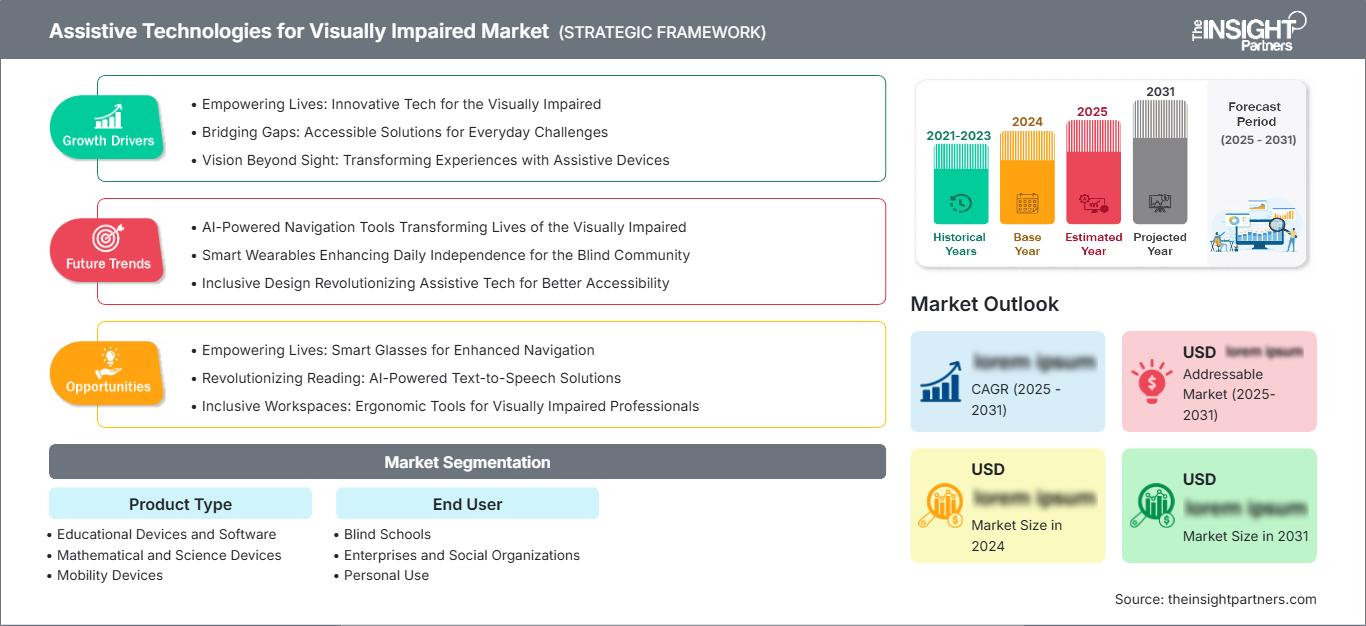
Assistive Technologies for Visually Impaired Market: Strategic Insights
Regional Insights
North America assistive technologies for visually impaired market
North America held 35–38% share in 2025 and is projected to grow at a CAGR of 7.0–7.6% during 2026–2034. The assistive technologies for visually impaired market share is reinforced by special education procurement, disability accommodation rules, rehabilitation programs, and employer spending on accessible digital work environments.
The region benefits from established distributors, trained assistive technology professionals, and reimbursement channels, although affordability remains a constraint for advanced braille and wearable devices. Demand is strongest where institutions combine device purchases with training, maintenance, and accessibility audits that ensure tools deliver measurable learning, workplace, or independent-living outcomes.
U.S. assistive technologies for the visually impaired Market
The US accounted for 82–86% of North America's revenue in 2025 and is expected to grow at 7.1–7.8% through 2034. Adoption is supported by individualized education plans, workplace accommodation requirements, veterans services, public libraries, and state-run rehabilitation agencies that purchase screen readers, magnifiers, braille systems, and mobility tools.
Company presence is deep, with Vispero, American Thermoform Corporation, ViewPlus Technologies, Inc., Access Ingenuity, LS&S, LLC, HumanWare Technologies Inc., and Dolphin Computer Access Ltd. serving institutional and personal-use demand. Growth will depend on affordability, trainer availability, and compatibility with mainstream productivity and learning platforms.
Europe assistive technologies for visually impaired Market
Europe represented 25–28% share in 2025 and is forecast to grow at 6.7–7.3% during 2026–2034. The UK leads adoption through disability support services, accessible publishing, and assistive technology distribution networks. Germany follows with strong rehabilitation infrastructure and workplace inclusion spending across public and private sectors.
France, Italy, and Spain are expanding procurement through education inclusion, aging population needs, and digital public-service accessibility. The European Accessibility Act strengthens long-term demand by pushing more organizations to address digital access, product usability, and service accessibility. Vendors with multilingual interfaces and regional support networks are well-positioned.
APAC assistive technologies for visually impaired Market
APAC held 24–27% share in 2025 and is projected to grow at 8.2–8.9% during 2026–2034. Countries like China, Japan, South Korea, India, and Australia are focusing more on inclusive education, senior care, and public accessibility. While Japan is ahead when it comes to adopting premium low vision and aging solutions, India and China present a volume opportunity due to increasing awareness and better distribution systems. Australia and South Korea have better institutional buying, especially for schools and workplaces. High cost-sensitivity demands localization and mobility-based solutions, along with cheaper products.
Middle East & Africa assistive technologies for visually impaired Market
The Middle East & Africa is expected to grow at 6.9–7.6% through 2034. Inclusion policies, healthcare advancements, and education technology investments by Saudi Arabia and the UAE spearhead adoption, while South Africa drives adoption through its rehabilitation providers, nonprofit organizations, and special schools.
The rest of MEA is still at an earlier stage of adoption due to inconsistent affordability of devices, specialist training, and distribution. Public health schemes, affordable education programs, and nonprofit organizations can increase the adoption of AT devices. Institutions would probably focus on durable mobility devices, readers, and inexpensive software rather than wearables.
Segmentation Analysis
Product Type
Product Type defines the market scope because device selection depends on age, severity of impairment, literacy, employment needs, mobility goals, and digital access requirements. This segment is projected to grow at 7.2–7.8% during 2026–2034 as users combine reading, mobility, education, and workplace tools instead of relying on one category.
- Educational Devices and Software support accessible textbooks, screen reading, braille literacy, classroom participation, and STEM learning, making them critical for schools shifting toward digital instruction and inclusive learning environments.
- Mathematical and Science Devices address tactile graphics, braille math notation, talking calculators, and accessible lab content, serving students and professionals who need structured access to technical information.
- Mobility Devices include canes, navigation aids, GPS tools, and sensor-based systems that improve route confidence, obstacle awareness, and independent movement across indoor and outdoor settings.
- Low Vision Devices include electronic magnifiers, wearable vision aids, CCTV systems, and contrast-enhancement tools, helping users with residual vision read, recognize objects, and complete daily tasks.
End User
End User is projected to grow at 7.1–7.7% during 2026–2034 as purchasing expands beyond specialist institutions into households, employers, social organizations, and hospitals. Procurement decisions vary by funding source, training capacity, usage environment, and expected outcomes, making channel support and post-sale service essential.
- Blind Schools purchase braille devices, accessible software, tactile learning materials, and classroom tools to improve literacy, digital inclusion, and subject participation for students with visual impairment.
- Enterprises and Social Organizations adopt screen readers, workplace magnification, accessible training tools, and navigation support to meet inclusion goals and improve employability for visually impaired adults.
- Personal Use reflects household demand for reading devices, mobile apps, electronic magnifiers, and mobility aids that support independent living, communication, and easier access to everyday information.
- Federation and Hospital users include rehabilitation providers, eye-care institutions, and disability organizations that recommend, train, fund, or distribute assistive tools after diagnosis or vision loss progression.
Opportunity Snapshot
| End User | Revenue Contribution | Trend Tag | Adoption Stage |
| Blind Schools | Medium | Braille Learning | Scaling |
| Enterprises and Social Organizations | Medium | Workplace Access | Scaling |
| Personal Use | High | Daily Independence | Mature |
| Federation and Hospital | Medium | Rehab Support | Scaling |
Assistive Technologies for Visually Impaired Market Growth Drivers and Impact Analysis
Growing Vision Impairment Burden and Ageing Populations
The growing number of visually impaired people will generate constant demand for the provision of aids in reading, low vision and mobility. According to the WHO, about 2.2 billion people have either near or distance vision impairment with age-related factors, cataract, refraction problems, glaucoma, diabetes-related retinopathy, and macular degeneration among the reasons. This driver widens the market by including the elderly, schoolchildren, adults of working age, and patients undergoing rehabilitation. It means that companies will have to develop products catering to various levels of vision impairment, whereas organizations will be expected to provide solutions for continuous assessment, training and funding.
Digital Accessibility Mandates in Education and Workplaces
The demand for accessibility in education systems and places of work is increasing, making it necessary for digital content, software, educational facilities, and workplaces to become accessible. Assistive technologies such as screen readers, braille displays, magnifiers, document access tools, and tactile learning objects provide a way for organizations to meet their requirements of compliance and improve participation. The significance of assistive technologies goes beyond purchasing devices since the purchase also involves training, compatibility, and updating of assistive technologies. Organizations may opt for assistive technologies that integrate well into mainstream computing systems and learning management systems.
AI, OCR, and Connected Devices Improving Usability
The advent of AI, OCR, cloud updating, and smartphone connectivity is adding value to assistive products that are useful in everyday environments. The user can recognize texts, listen to descriptions, magnify images, connect braille displays to multiple devices, or orient himself in unknown areas using less specialized equipment. Market implications of such trends include a change in focus from single-purpose assistive devices to ecosystems that offer many useful options. It becomes easier for some users to overcome the learning curve, and it becomes easier for family members, educators, employers, and health professionals to encourage product adoption.
Assistive Technologies for Visually Impaired Market Future Trends
AI-Guided Mobility and Scene Understanding
The assistive technologies for visually impaired market trends will increasingly center on AI systems that interpret surroundings, describe objects, identify text, and provide route cues through audio or haptic feedback. Future devices will likely combine cameras, sensors, smartphones, and cloud processing while keeping privacy safeguards visible to users. The strongest adoption will occur when tools are reliable indoors, work across languages, and reduce cognitive load. Vendors must prove safety, battery life, and training value before AI mobility becomes standard rather than experimental.
Accessible STEM and Tactile Digital Learning
The future will see increasing demands for products that would increase accessibility to math, science, programming, diagrams, and spatial information. The use of dynamic tactile displays, braille mathematics workflow, auditory graphing, and accessible laboratory materials could eliminate some of these barriers. Educational establishments will choose those solutions that allow for easy lesson preparation and evaluation on behalf of teachers, and not only the students, since these actions should be easy to perform. It is strategically essential because inclusion in STEM may change the funding of assistive technology.
Assistive Technologies for Visually Impaired Market Opportunities
Lower-Cost Braille and Reading Ecosystems
The assistive technologies for the visually impaired market Forecasts show opportunity in affordable braille displays, refreshable tactile tools, OCR readers, and subscription software designed for schools and personal users. Current advanced devices remain expensive, limiting adoption in lower-income regions and small institutions. Suppliers can unlock demand through modular models, financing, refurbished programs, and localized content partnerships. The opportunity is strongest where products combine durability, multilingual support, teacher resources, and compatibility with widely used smartphones or computers, reducing both upfront cost and training burden.
Institutional Services Around Assessment and Training
Hardware alone does not guarantee independence, so service-led opportunities are expanding. Schools, hospitals, employers, and rehabilitation agencies need assessments, onboarding, curriculum integration, workplace audits, and follow-up training. Vendors and distributors can create recurring revenue by bundling devices with implementation and support packages. This is particularly valuable for complex users who need multiple tools, such as screen readers, braille input, magnification, and mobility training. Organizations that measure outcomes can justify budgets more effectively and reduce abandoned-device risk.
Frequently Asked Questions

- Comprehensive Market Sizing and Forecast Analysis
- Detailed Segmentation Analysis
- In-Depth Market Dynamics Assessment
- Regional and Country-Level Insights
- Competitive Landscape and Company Benchmarking
- Strategic Business Intelligence
Recent Reports
Testimonials

The Insight Partners' SCADA System Market report is comprehensive, with valuable insights on current trends and future forecasts. The team was highly professional, responsive, and supportive throughout. We are very satisfied and highly recommend their services.
RAN KEDEM Partner, Reali Technologies LTDs
I requested a report on a very specific software market and the team produced the report in a few days. The information was very relevant and well presented. I then requested some changes and additions to the report. The team was again very responsive and I got the final report in less than a week.
JEAN-HERVE JENN Chairman, Future Analytica
We worked with The Insight Partners for an important market study and forecast. They gave us clear insights into opportunities and risks, which helped shape our plans. Their research was easy to use and based on solid data. It helped us make smart, confident decisions. We highly recommend them.
PIYUSH NAGPAL Sr. Vice President, High Beam Global
The Insight Partners delivered insightful, well-structured market research with strong domain expertise. Their team was professional and responsive throughout. The user-friendly website made accessing industry reports seamless. We highly recommend them for reliable, high-quality research services
YUKIHIKO ADACHI CEO, Deep Blue, LLC.
This is the first time I have purchased a market report from The Insight Partners.While I was unsure at first, I visited their web site and felt more comfortable to take the risk and purchase a market report.I am completely satisfied with the quality of the report and customer service. I had several questions and comments with the initial report, but after a couple of dialogs over email with their analyst I believe I have a report that I can use as input to our strategic planning process.Thank you so much for taking the extra time and making this a positive experience.I will definitely recommend your service to others and you will be my first call when we need further market data.
JOHN SUZUKI President and Chief Executive Officer, Board Director, BK Technologies
I wish to appreciate your support and the professionalism you displayed in the course of attending to my request for information regarding to infectious disease IVD market in Nigeria. I appreciate your patience, your guidance, and the fact that you were willing to offer a discount, which eventually made it possible for us to close a deal. I look forward to engaging The Insight Partners in the future, all thanks to the impression you have created in me as a result of this first encounter.
DR CHIJIOKE ONYIA MANAGING DIRECTOR, PineCrest Healthcare Ltd.Reason to Buy
- Informed Decision-Making
- Understanding Market Dynamics
- Competitive Analysis
- Identifying Emerging Markets
- Customer Insights
- Market Forecasts
- Risk Mitigation
- Boosting Operational Efficiency
- Strategic Planning
- Investment Justification
- Tracking Industry Innovations
- Aligning with Regulatory Trends





 Get Free Sample for