
Computer on Module Market Size, Share & Demand by 2034
Coverage: by Standard (SMARC, Qseven, ESM, XTX, ETX); Application (Industrial Automation, Medical, Entertainment, Transportation, Test and Measurement, Others) , and Geography (North America, Europe, Asia Pacific, and South and Central America)
- Status : Data Released
- Report Code : TIPRE00009171
- Category : Electronics and Semiconductor
- No. of Pages : 150
- Available Report Formats :


- Last update date : July 27, 2026


2025 Market Size
US$ 1.85 Bn
Base year value
2034 Forecast
US$ 3.21 Bn
Projected by 2034
CAGR 2026-2034
6.34 %
Growth rate
Addressable Market
US$ 22.93 Bn
(2026-2034)
The Computer on Module Market held a value of US$ 1.85 Billion in 2025 and is forecasted to reach a value of US$ 3.21 Billion by 2034, experiencing a CAGR of 6.34% from 2026 to 2034. Market growth will be driven by transition of embedded computing from customized boards to modular platforms, wherein standardization of processing cores minimizes risks, ensures lifecycle continuity, and allows OEMs to enhance performance without redesigning entire systems.
North America still retains a high-value consumer base, and the Computer On Module Market size is driven by the anticipated 5.8%-6.4% CAGR range for 2034. Market dynamics include reshoring of electronics manufacturing, automation within discrete manufacturing operations, and adoption of rugged edge computing in medical devices, transport infrastructure for defense-related purposes, and industrial testing facilities.
Computer on Module Market Assessment and Insights
- North America accounted for 34–37% share in 2025 and is expected to grow at a CAGR range of 5.8–6.4% during 2026–2034, led by industrial edge computing, medical devices, and domestic manufacturing resilience.
- US represented 78–82% of North America in 2025 and is forecast to expand at 5.9–6.5% CAGR during 2026–2034, supported by automation and defense electronics demand.
- Europe held 27–30% share in 2025 and should record 5.5–6.1% CAGR through 2034, with Germany, the UK, and France leading adoption across machinery, rail, and regulated medical systems.
- Asia Pacific captured 30–33% share in 2025 and is projected to grow at 7.0–7.8% CAGR during 2026–2034, led by China, Japan, South Korea, and India.
- Largest Segment Application led with Industrial Automation at 39–43% market share in 2025 and a 6.2–6.8% CAGR range during 2026–2034.
- High Growth Segment Medical represented 14–17% market share in 2025 and is expected to expand at 7.1–7.9% CAGR during 2026–2034.
- Key companies analyzed in detail: ADLINK Technology Inc., Advantech Co., Ltd., Avalue Technology Inc., congatec GmbH, Kontron AG, Avnet Embedded GmbH, PHYTEC Messtechnik GmbH, Radisys Corporation, Variscite Ltd., Yamaichi Electronics Co., Ltd.
Source: The Insight Partners' analysis based on proprietary research, government publications, company annual reports, investor presentations, industry databases, and expert interviews.
Design of standardized modules has evolved the Computer On Module Market from convenience for engineering to embedded architecture. More and more OEMs are decoupling the processor, memory, firmware, and operating system support from application-specific carrier boards. Such decoupling brings advantages of shortened validation cycles, improved procurement flexibility, and planning processor upgrade. In addition, production patterns are shifting as module vendors seek manufacturing partnerships on regional level to minimize exposure to tariffs, logistical difficulties, and long lifecycle risks.
During the forecast period, investments will be made in edge AI, rugged medical systems, transportation control, and factory automation. New geographies will scale up thanks to electronics manufacturing incentives and digitization of industry programs. Positive regulatory environment in the fields of medical safety, rail transport certification, and cybersecurity will be advantageous to suppliers of products with board support package documentation, extended availability, and traceable sourcing.
Computer on Module Market Report Scope
| Report Attribute | Details |
|---|---|
| Market size in 2025 | US$ 1.85 Billion |
| Market Size by 2034 | US$ 3.21 Billion |
| Global CAGR (2026 - 2034) | 6.34% |
| Historical Data | 2021-2024 |
| Forecast period | 2026-2034 |
Computer on Module Market Analysis
Market for Computer on Modules grows due to the need for faster design cycle times and increasing computing power density in small form factor products by the OEMs. The industrial equipment manufacturers leverage modules to upgrade their controllers, vision systems and gateways without requalification of the entire electronics platform. The medical devices companies prefer stability in platforms, software support documentation and reliable thermal performance especially when the product certification time line is very long.
The supply chain involves silicon providers, module providers, designer of carrier boards, contract manufacturers and application OEMs. The supply trends are tilting in favor of those suppliers who have multi-region manufacturing facility, extended Bill of Materials control and processor road map.
Computer On Module market report suggests a highly competitive market environment dominated by module vendors and embedded divisions of wider electronic conglomerates. ADLINK Technology Inc., Advantech Co., Ltd., congatec GmbH, and Kontron AG operate with an array of processors, carrier boards, and software enabled systems. Avalue Technology Inc. and Variscite Ltd. gain an advantage by using application-specific customized modules and Arm-based systems.
The trend in investments focuses more on developing manufacturing partnerships, local for local capabilities, and application level software solutions. Avnet Embedded GmbH, PHYTEC Messtechnik GmbH, Radisys Corporation, and Yamaichi Electronics Co., Ltd. add value by providing distribution, design services, telecom class systems, and connector reliability. The key to strategic positioning lies in lifecycle assurance rather than processor performance alone.
● REPORT CUSTOMIZATION
Tailor This Report To Align With Your Specific Business Requirements
This report can be customized to align precisely with your business objectives, scope, and target markets. Customization options include tailored segmentation, geography, competitive analysis, and strategic insights to support informed decision-making.
Customize This Report →WHAT YOU CAN ADJUST
- ● Segmentations
- ● Geography
- ● Competitive Analysis
- ● Language Preferences
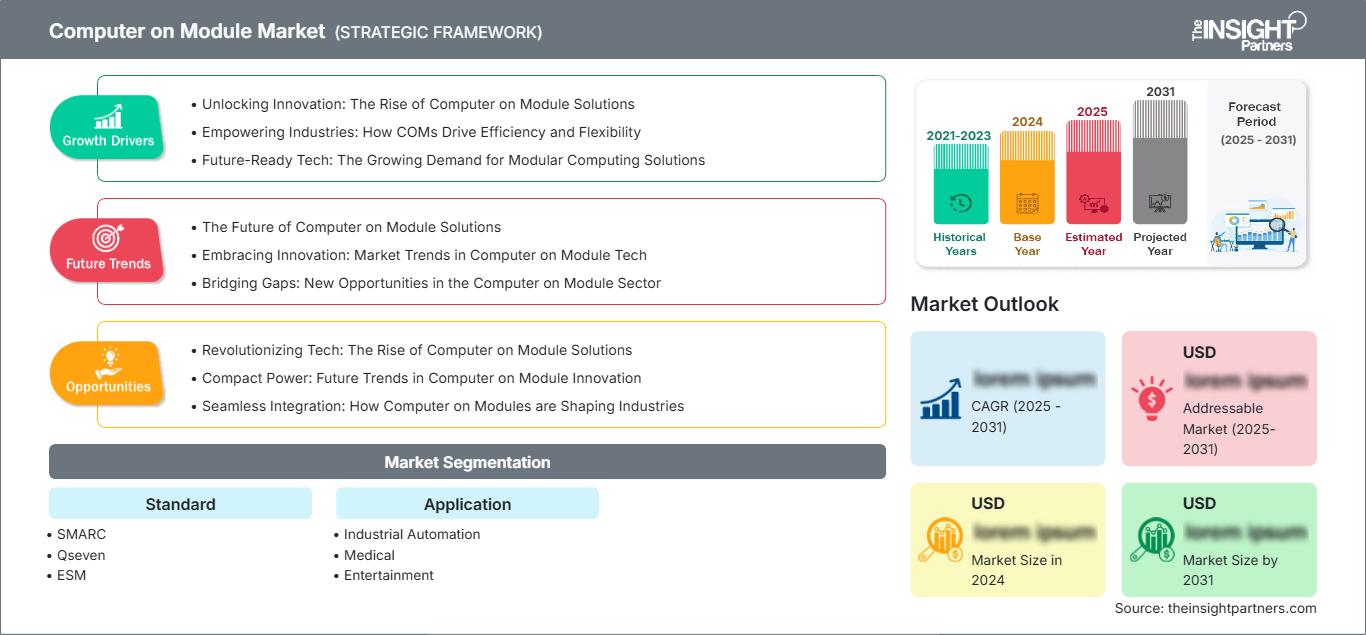
Computer on Module Market: Strategic Insights
Regional Insights
North America Computer On Module Market
The region is forecast to capture 34% to 37% Computer On Module Market share in 2025 and achieve a CAGR of 5.8% to 6.4% in the period between 2026 and 2034. Factors influencing growth include the requirement for plant modernization, edge analysis within process industries, and medical devices that need validated computing platforms. In terms of module procurement, it is driven mainly by the United States, although Canada helps transport applications, energy monitoring, and industrial control applications.
The preference for providers who have the option of local or nearshoring manufacturing, long product lifecycle plans, and successful thermal design was accentuated in 2025 by the announcement from embedded computing companies regarding collaboration on manufacturing in North America. Growth in demand exists mainly for ruggedized modules used in industrial PCs, surgery platforms, diagnostic equipment, rail electronics, and testing equipment.
U.S. Computer On Module Market
The US represented 78–82% of the North American region in 2025 and is expected to expand at a CAGR of 5.9–6.5% until 2034. The demand is primarily from automation machinery, medical imaging equipment, aerospace controls adjacent applications, and electronic test systems. In-country system integrators are turning to modular computing in order to ease engineering burden while satisfying product reliability and security needs.
The presence of companies includes ADLINK Technology Inc., Advantech Co., Ltd., congatec GmbH, Kontron AG, Avnet Embedded GmbH, and Radisys Corporation supporting OEM programs via their local sales and/or engineering and manufacturing networks. Application trends include fanless edge controllers, AI inspection systems, medical workstations, and rugged transport gateways with the need for long availability and repeatable carrier board implementation.
Europe Computer On Module Market
Europe held 27-30% of market share in 2025 and is anticipated to grow at a CAGR of 5.5-6.1% from 2026 to 2034. The largest contributor in Europe will be Germany, due to demands for modularity, long-term availability, certification and testing from machinery manufacturers, robotics companies and industrial PC makers.
The UK is driven by developments in defense electronics, rail control and medical devices, which favor low volume customization options. Germany will be driven by automation solutions, machine vision and Industry 4.0 technology. France, Italy, and Spain will be driving market through development in transportation systems, smart infrastructure and industrial machinery via modular computing to balance performance and qualification efforts.
APAC Computer On Module Market
In 2025, APAC had a share of 30–33%, which is expected to increase at a 7.0–7.8% CAGR until 2034, becoming the leading region. China dominates manufacturing, and Japan and South Korea contribute robotics and electronic components, whereas India and Australia bring demand from automation, transportation, mining, and medical applications.
Industrial growth policy, electronics localizing policy, and digital factory policy result in the penetration of technology in that area. The OEM companies are changing the approach from using only one board to the use of modules. The costs of processors exchange, thermal management, and certification have grown significantly. The Computer On Module market benefits from well-developed logistics, increasing design services, and high demand for embedded systems.
Middle East & Africa Computer On Module Market
Middle East & Africa is forecasted to have a CAGR growth rate of 5.3% - 5.9% between 2026-2034. Leading country in this region is Saudi Arabia, fueled by industrial diversification, smart infrastructure, and energy automation. UAE also contributes with transport, logistic, and data infrastructure needs, whereas South Africa contributes to mining, utilities, and industrial monitoring projects.
Projects in the region need ruggedized computers to withstand high temperature and vibration conditions and remote maintenance capability. Rest of MEA demand also depends on projects, including oil & gas projects, ports, railways, and security systems. Success comes when module providers offer extended temperature ranges, prevalidated operating systems, and integration partners locally available for field-life projects.
Segmentation Analysis
Standard
The Standard segment is expected to grow at a 6.0–6.6% CAGR during 2026–2034. The Computer On Module Market scope across standards is defined by power envelope, connector strategy, processor roadmap, and carrier board complexity. OEMs select standards based on thermal design, I/O density, lifecycle visibility, and the cost of future processor migration.
- SMARC serves compact, low-power systems requiring rich camera, display, and serial interfaces, making it strategically important for IoT gateways, handheld medical devices, and fanless edge platforms.
- Qseven remains relevant for slim embedded products where moderate I/O, low power, and cost-efficient carrier designs matter more than maximum processor scalability.
- ESM supports rugged embedded applications requiring mechanical reliability and long service life, especially where industrial environments demand stable interfaces and simplified maintenance.
- XTX is positioned in legacy and upgrade-driven programs that need continuity for existing carrier designs while extending product availability across industrial control equipment.
- ETX continues to serve mature installations where redesign costs are high, making it important for maintenance cycles, replacement programs, and controlled platform migration.
Application
The Application segment is forecast to grow at a 6.4–7.0% CAGR during 2026–2034. Industrial Automation remains the largest use case, while medical systems show the highest growth momentum. Demand is shaped by edge processing, real-time control, long certification cycles, ruggedized design, and the need to refresh compute performance without replacing application-specific electronics.
- Industrial Automation leads demand as machine controllers, robotics, and vision inspection systems require upgradeable computing, deterministic performance, and long lifecycle support across factory modernization programs.
- Medical is strategically important because diagnostic instruments, imaging workstations, and portable care systems need compact processing, thermal stability, regulatory documentation, and extended platform availability.
- Entertainment uses modules in gaming, digital signage, and interactive systems where graphics performance, compact footprints, and rapid design refresh cycles support differentiated user experiences.
- Transportation demand comes from rail, fleet, mobility, and in-vehicle systems requiring rugged operation, long availability, and reliable connectivity under vibration and temperature stress.
- Test and Measurement adopts modules for instrumentation platforms that need repeatable compute performance, stable I/O, and faster development of configurable laboratory and industrial testing systems.
Opportunity Snapshot
| Application | Revenue Contribution | Trend Tag | Adoption Stage |
| Industrial Automation | High | Edge Control | Mature |
| Medical | Medium | Diagnostic Edge | Scaling |
| Entertainment | Low | Visual Compute | Emerging |
| Transportation | Medium | Rugged Mobility | Scaling |
| Test and Measurement | Medium | Modular Labs | Mature |
Computer on Module Market Growth Drivers and Impact Analysis
Modular Design Reduces Embedded Development Risk
OEMs increasingly choose modules because the processor subsystem is the most complex and obsolescence-prone part of embedded design. By purchasing a validated module and designing only the carrier board, engineering teams reduce schematic complexity, firmware bring-up effort, and thermal validation risk. The impact is strongest in low-to-medium volume industrial and medical programs, where redesign budgets are limited and qualification timelines are long. This driver also improves procurement flexibility because system makers can refresh performance on the same product architecture when silicon roadmaps advance.
Edge AI Expands Compute Requirements in Compact Systems
Machine vision, predictive maintenance, medical imaging, and transport monitoring increasingly require inference closer to the device. Modules with CPUs, GPUs, neural processors, and high-speed memory allow OEMs to add local analytics without enlarging the full electronics footprint. The real-world impact is lower latency, reduced cloud dependence, and better data privacy for regulated or mission-critical deployments. Suppliers that combine hardware with board support packages, prevalidated operating systems, and security updates gain an advantage because customers need deployable edge platforms, not only raw compute boards.
Lifecycle Assurance Becomes a Procurement Priority
Industrial, medical, and transportation products often remain in service for seven to fifteen years, while processors and memory components refresh much faster. This mismatch makes lifecycle assurance a decisive purchasing factor. Module vendors with long availability commitments, revision control, and documented change management help OEMs avoid costly recertification. The Computer On Module Market benefits as buyers prioritize stable platforms over lowest upfront price. Procurement teams increasingly assess supplier roadmaps, manufacturing redundancy, and component traceability before approving modules for regulated or safety-sensitive programs.
Computer on Module Market Future Trends
Application-Ready Software Stacks Become Differentiators
Computer On Module Market trends will increasingly shift competition from hardware catalogs to deployable hardware-software building blocks. Future purchasing decisions will weigh pre-integrated hypervisors, industrial Linux distributions, security frameworks, and device-management tools alongside processor specifications. This transition will matter most where OEMs lack deep embedded software teams or must support mixed-critical workloads. Vendors that certify reference stacks and maintain update paths will shorten customer validation cycles, improve lifecycle confidence, and capture higher-value design wins in automation, medical, and transport applications.
Regionalized Manufacturing Reshapes Supplier Selection
Supply chain strategy will become a formal evaluation criterion as customers seek tariff resilience, shorter lead times, and lower geopolitical exposure. Module makers are likely to expand manufacturing partnerships across North America, Europe, and Asia, allowing customers to align production with end-market requirements. This trend will not eliminate global supply dependencies, but it will reduce single-region risk for qualified products. Vendors able to preserve identical specifications across plants will be better positioned for multinational OEM programs.
Computer on Module Market Opportunities
Medical Edge Platforms Offer Higher-Value Design Wins
Medical OEMs present a strong opportunity because device programs require stable compute platforms, documented quality processes, and extended support. Diagnostic imaging, patient monitoring, surgical assistance, and portable care systems increasingly need local analytics, connectivity, and secure software maintenance. Computer On Module Market Forecasts indicate that suppliers can capture premium margins by offering prevalidated medical reference designs, lifecycle documentation, and thermal engineering support. Investment should prioritize regulatory-ready design kits, cybersecurity update services, and partnerships with medical device integrators that manage certification pathways.
Industrial Retrofitting Creates Scalable Aftermarket Demand
Factories are extending machinery life while adding vision inspection, predictive maintenance, and connected control functions. This creates aftermarket demand for modules that can upgrade legacy equipment without replacing mechanical systems or full control cabinets. Vendors can target machine builders and system integrators with carrier board reference designs, rugged thermal envelopes, and migration paths from older standards. The opportunity is attractive because retrofits are recurring, fragmented, and less tied to greenfield capital cycles than new factory construction.
Recent Developments
- April 2026: Tria Technologies, an Avnet company specializing in embedded compute boards, systems, and human-machine interfaces, has launched a new COM-HPC Client computer-on-module powered by Intel Core Ultra processors. The new module is Tria's first to feature Intel's latest generation of processors and is designed for edge AI applications in sectors such as automation and robotics, where high performance and long-term reliability are essential.
- August 2025: Advantech is excited to announce the launch of two new compact Computer-on-Modules in the AOM series: the AOM-5521 Smart Mobility Architecture (SMARC) and the AOM-2521 Open Standard Module (OSM). Both modules leverage the advanced capabilities of the NXP i.MX 95 processor family, featuring a multi-domain architecture with up to 6 Arm Cortex-A55 cores running at speeds of up to 2.0GHz, along with a dedicated 2-TOPS NPU optimized for Linux-based Edge applications.
- March 2024: SolidRun, a leading innovator in high-performance System on Module (SOM) solutions and developer of embedded systems, is proud to announce the release of its ultra-compact Hailo-15 SOM. Leveraging the cutting-edge Hailo-15H AI vision processor, this groundbreaking deployment-ready solution sets a new standard in AI vision applications, offering unparalleled performance, efficiency, and flexibility.
Frequently Asked Questions

- Comprehensive Market Sizing and Forecast Analysis
- Detailed Segmentation Analysis
- In-Depth Market Dynamics Assessment
- Regional and Country-Level Insights
- Competitive Landscape and Company Benchmarking
- Strategic Business Intelligence
Recent Reports
Testimonials

The Insight Partners' SCADA System Market report is comprehensive, with valuable insights on current trends and future forecasts. The team was highly professional, responsive, and supportive throughout. We are very satisfied and highly recommend their services.
RAN KEDEM Partner, Reali Technologies LTDs
I requested a report on a very specific software market and the team produced the report in a few days. The information was very relevant and well presented. I then requested some changes and additions to the report. The team was again very responsive and I got the final report in less than a week.
JEAN-HERVE JENN Chairman, Future Analytica
We worked with The Insight Partners for an important market study and forecast. They gave us clear insights into opportunities and risks, which helped shape our plans. Their research was easy to use and based on solid data. It helped us make smart, confident decisions. We highly recommend them.
PIYUSH NAGPAL Sr. Vice President, High Beam Global
The Insight Partners delivered insightful, well-structured market research with strong domain expertise. Their team was professional and responsive throughout. The user-friendly website made accessing industry reports seamless. We highly recommend them for reliable, high-quality research services
YUKIHIKO ADACHI CEO, Deep Blue, LLC.
This is the first time I have purchased a market report from The Insight Partners.While I was unsure at first, I visited their web site and felt more comfortable to take the risk and purchase a market report.I am completely satisfied with the quality of the report and customer service. I had several questions and comments with the initial report, but after a couple of dialogs over email with their analyst I believe I have a report that I can use as input to our strategic planning process.Thank you so much for taking the extra time and making this a positive experience.I will definitely recommend your service to others and you will be my first call when we need further market data.
JOHN SUZUKI President and Chief Executive Officer, Board Director, BK Technologies
I wish to appreciate your support and the professionalism you displayed in the course of attending to my request for information regarding to infectious disease IVD market in Nigeria. I appreciate your patience, your guidance, and the fact that you were willing to offer a discount, which eventually made it possible for us to close a deal. I look forward to engaging The Insight Partners in the future, all thanks to the impression you have created in me as a result of this first encounter.
DR CHIJIOKE ONYIA MANAGING DIRECTOR, PineCrest Healthcare Ltd.Reason to Buy
- Informed Decision-Making
- Understanding Market Dynamics
- Competitive Analysis
- Identifying Emerging Markets
- Customer Insights
- Market Forecasts
- Risk Mitigation
- Boosting Operational Efficiency
- Strategic Planning
- Investment Justification
- Tracking Industry Innovations
- Aligning with Regulatory Trends





 Get Free Sample for