
Dental Chairs Market Trends, Demand & Growth by 2034
Coverage: By Product (Examination Dental Chairs, Orthodontic Dental Chairs, and Oral Surgery Dental Chairs), Type (Manual Dental Chairs and Powered Dental Chairs), End User (Hospitals & Clinics and Ambulatory Surgical Centers and Others) , and Geography (North America, Europe, Asia Pacific, and South and Central America)
- Status : Data Released
- Report Code : TIPMD00002252
- Category : Life Sciences
- No. of Pages : 150
- Available Report Formats :


- Last update date : August 24, 2026


2025 Market Size
US$ 1.22 Bn
Base year value
2034 Forecast
US$ 1.91 Bn
Projected by 2034
CAGR 2026-2034
5.09 %
Growth rate
Addressable Market
US$ 14.19 Bn
(2026-2034)
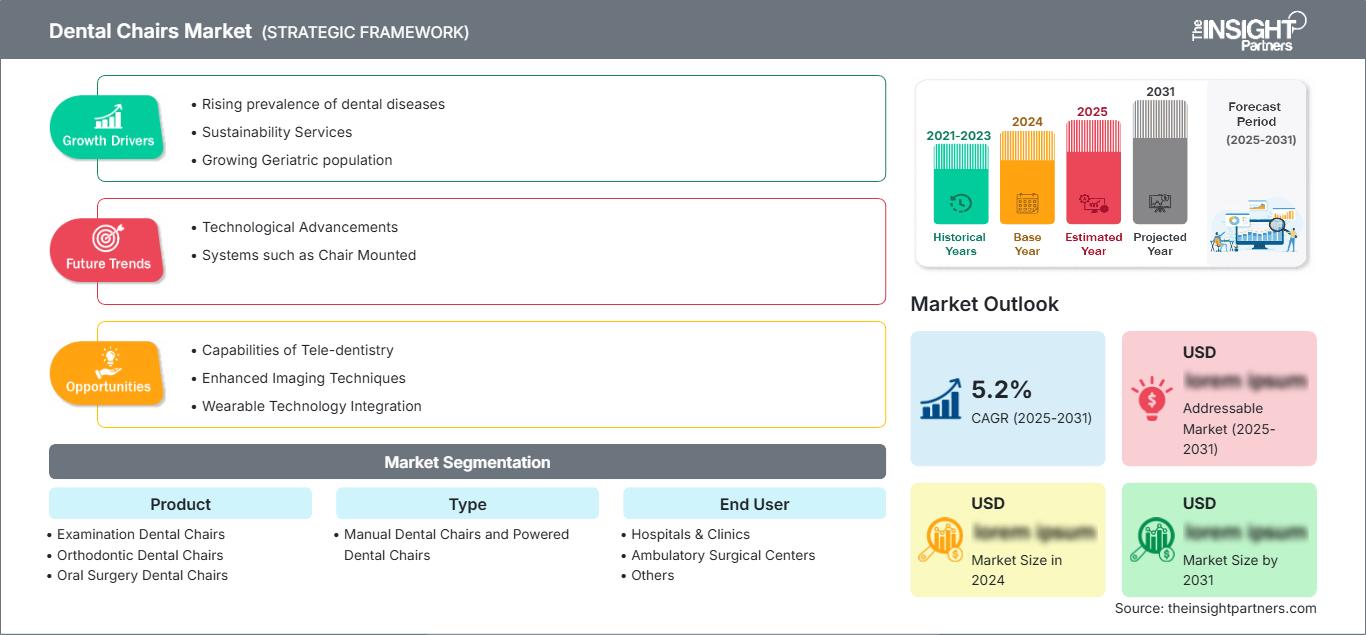
The Dental Chairs Market was valued at US$ 1.22 Billion in 2025 and is projected to reach US$ 1.91 Billion by 2034, registering a CAGR of 5.09% during 2026–2034. The market encompasses examination, orthodontic, and oral surgery chairs, with purchasing decisions increasingly shaped by ergonomics, powered positioning, infection-control design, accessibility, and integration with modern dental operatory workflows.
North American demand is expected to expand at a CAGR of 4.9–5.4% during 2026–2034. The region benefits from established dental infrastructure, replacement of aging equipment, consolidation of dental service organizations, and continued investment in ergonomic and digitally enabled operatories. These factors support resilient Dental Chairs Market size expansion despite relatively mature procedure volumes.
Dental Chairs Market Assessment and Insights
- North America: North America accounted for a 40.94% share in 2025 and is expected to grow at a CAGR of 4.9–5.4% between 2026–2034, supported by replacement demand, DSO expansion, premium equipment adoption, and established clinical infrastructure.
- US: The US represented 89–92% of North America's 2025 market and is projected to grow at a CAGR of 4.9–5.4%, reflecting high equipment replacement activity and advanced practice modernization.
- Europe: Europe held a 30.77% share in 2025 and is projected to expand at a CAGR of 4.6–5.1%. Germany, the UK, France, Italy, and Spain remain important markets because of established dental networks and replacement-oriented purchasing.
- Asia Pacific: Asia Pacific represented 23.03% of the 2025 market and is expected to grow at a CAGR of 7.0–7.8%, led by China, Japan, South Korea, India, and Australia, where clinic expansion and modernization support equipment demand.
- Largest Segment: Powered Dental Chairs held a 88–90% market share in 2025 and are expected to grow at a CAGR of 5.0–5.5%, reflecting positioning precision, operator ergonomics, and workflow efficiency.
- High Growth Segment: Oral Surgery Dental Chairs represented an estimated 18–22% share in 2025 and are projected to grow at a CAGR of 6.5–7.2%, supported by specialty procedures and surgical accessibility.
- Key companies analyzed in detail: KaVo Dental GmbH, DCI International LLC, A-dec, Inc., DentalEZ, Inc., DOME, Inc., Midmark Corporation, Planmeca Oy, OMS S.p.A., Diplomat Dental s.r.o., Forest Dental Products, Inc.
Source: The Insight Partners' analysis based on proprietary research, government publications, company annual reports, investor presentations, industry databases, and expert interviews.
The evolution of Dental Chairs has occurred from mechanical adjustable seating of the patient to clinical systems that are centered on the equipment to provide for positioning, access, infection control procedures, and ergonomic requirements of the practitioner. The development of powered movements, programing of movements, better upholstery, controls, and compatibility with the treatment room has resulted in changes in specifications for the product.
Through the forecast period, adoption is expected to be more prevalent in emerging urban dental facilities with mature markets focusing on the replacement and retrofit of current equipment. Increasing investment is expected to focus on accessibility, less maintenance components, power efficient electronics, and compatibility with operatory systems. Regulatory focus on patient safety, infection prevention, and accessible clinical environment is expected to strengthen the need for equipment that is usability-focused rather than positional-focused.
Dental Chairs Market Report Scope
| Report Attribute | Details |
|---|---|
| Market size in 2025 | US$ 1.22 Billion |
| Market Size by 2034 | US$ 1.91 Billion |
| Global CAGR (2026 - 2034) | 5.09% |
| Historical Data | 2021-2024 |
| Forecast period | 2026-2034 |
Dental Chairs Market Analysis
Dental Chairs Market growth is highly correlated with volumes of dental procedures performed, construction of new clinics, replacements, and modernizations. The chain consists of supply of motors, actuators, frame construction, upholstery, control mechanisms, hydraulics/mechanics all the way to assembled dental chairs, distributors, installation services, and servicing. Therefore, availability of components and technical assistance becomes important for supply reliability.
Also, there is an effect of the number of patients with oral diseases around the world. The World Health Organization estimates that oral diseases affect 3.5 billion people and untreated dental caries affects 2.5 billion people. That ensures a need for long-term development of clinical infrastructure, but procurement is sensitive to economic factors.
The competition in the Dental Chairs Market Report has been found to focus increasingly on aspects such as ergonomics, reliability, customization, servicing, and integration and not just the movement of the chair. The companies such as KaVo Dental GmbH, A-dec, Inc., DCI International LLC, Midmark Corporation, Planmeca Oy, DentalEZ, Inc., and Forest Dental Products, Inc. compete using their unique operatory solutions and lifecycles.
More and more investment is being made in product platforms, which allow for upgrades without having to replace the whole chair. The premium capabilities of chairs offered by KaVo Dental GmbH have improved, while A-dec, Inc. focuses more on durability and longer warranties. Planmeca Oy is marketing its new dental units based on ergonomics and infection control.
● REPORT CUSTOMIZATION
Tailor This Report To Align With Your Specific Business Requirements
This report can be customized to align precisely with your business objectives, scope, and target markets. Customization options include tailored segmentation, geography, competitive analysis, and strategic insights to support informed decision-making.
Customize This Report →WHAT YOU CAN ADJUST
- ● Segmentations
- ● Geography
- ● Competitive Analysis
- ● Language Preferences
Dental Chairs Market: Strategic Insights
Regional Insights
North America Dental Chairs Market
The North American market had a 40.94% of the Dental Chairs Market share in 2025, and is forecast to grow at a CAGR of 4.9–5.4% till 2034. Factors contributing towards this include the presence of mature dental practice, high replacement rates, DSO consolidations, and reasonable capital expenditure capability. Replacement demand favors the use of powered adjustment, ergonomic chair backs, programmable controls, and operatory integration.
The US will be the main source of demand, while Canada will contribute through clinic upgradation and specialized care centers. The aging fleet of chairs presents regular replacement demand, especially when practices consolidate multiple operatories using standardized equipment. The need for accessibility is shaping chair design trends, as seen in newer models offering lower height entry and wider transfer base.
U.S. Dental Chairs Market
The U.S. held roughly 89-92% share of the 2025 North America market and is predicted to have a CAGR of 4.9-5.4%. Diversified client base comprising large dental service providers, independent clinics, specialty clinics, and academia with replacement buying being the key mechanism driving demand.
A-dec, Inc., DCI International LLC, DentalEZ, Inc., Midmark Corporation, and Forest Dental Products, Inc. continue to be relevant due to their distribution and servicing network. Changing trends include power assisted positioning, thin back design, ergonomic design, and delivery systems integration. Multi-practice consolidations will work in favor of standardizing equipment platforms owing to similar chairs used across locations.
Europe Dental Chairs Market
In 2025, Europe was estimated to have a 30.77% share in the market, and it is estimated to have a growth rate in CAGR of 4.6 – 5.1%, with Germany as the primary country market. This region consists of an existing dental market infrastructure, replacements, specialization in dentistry, private practice, and high-quality equipment engineering.
There are two big buyers in Europe which include the UK and Germany; while the UK is driven by existing private dentistry practice, Germany is driven by its existing specialists and manufacturers. There are three other countries that contribute to the demand in Europe, including France, Italy, and Spain, driven by clinic upgrade, orthodontics, oral surgeries, and private dentistry practice.
APAC Dental Chairs Market
In 2025, APAC had a market share of 23.03% and will experience the highest CAGR of 7.0-7.8%. China dominates the regional market for dental equipment followed by Japan, South Korea, India, and Australia, where modernization levels differ in healthcare facilities.
China and India gain from growth of private dental network facilities, Japan and South Korea focus on technologically advanced equipment and replacement, Australia is characterized by development of practice infrastructure and high-end dental equipment. Healthcare investment by government agencies, urbanization, development of dental education and specialists, and expansion of specialists' services stimulate usage of dental equipment. Price accessibility is increasing in the region.
Middle East & Africa Dental Chairs Market
Middle East and Africa's demand is expected to experience a CAGR growth rate of 5.5-6.3 %. The key purchasers of the region are Saudi Arabia and the UAE owing to investments into healthcare infrastructure, private clinics development, and medical tourism. South Africa still remains one of the leading countries for Africa owing to its well-developed private dental chain.
MEA Rest represents a more variable market potential with healthcare budgets, imported equipment costs, and service provision being a factor influencing procurement. Investments into energy and infrastructure in the Gulf states result in building of new clinical centers, while other parts of Africa rely more on distribution.
Segmentation Analysis
Product
Dental Chairs product demand is differentiated by procedure complexity, patient positioning requirements, and operator access. The segment is projected to grow at a CAGR of 5.2–5.8% during 2026–2034. Examination chairs provide broad utilization, orthodontic chairs support repeated positioning requirements, while oral surgery designs increasingly emphasize access and controlled positioning.
- Examination Dental Chairs: Broadly used for routine diagnostics and preventive procedures, these chairs prioritize dependable positioning, patient entry, ergonomic access, and compatibility with general-purpose operatories.
- Orthodontic Dental Chairs: Demand is shaped by lengthy treatment sessions and repeated patient repositioning, increasing the importance of comfort, head support, accessible controls, and efficient clinician movement.
- Oral Surgery Dental Chairs: Specialty procedures require precise positioning and unobstructed access, making reinforced structures, powered movement, surgical ergonomics, and patient stability strategically important.
Type
Type-based demand is dominated by powered configurations because they improve positioning consistency and reduce physical effort. The segment is projected to grow at a CAGR of 5.0–5.5% during 2026–2034. Manual products retain relevance where acquisition cost, simplicity, or limited procedure requirements outweigh advanced positioning capabilities.
- Manual Dental Chairs: Manual configurations remain relevant in cost-sensitive practices and basic treatment environments where simple operation, lower technical complexity, and straightforward maintenance influence procurement.
- Powered Dental Chairs: Powered models support programmable positioning, controlled movement, ergonomic working heights, and repeatable workflows, making them central to premium operatories and multi-procedure clinical environments.
End User
End-user demand is projected to expand at a CAGR of 5.4–6.0% during 2026–2034, with Hospitals & Clinics representing the broadest purchasing base. Ambulatory Surgical Centers provide a smaller but strategically important specialty opportunity, while other facilities contribute through institutional and educational applications.
- Hospitals & Clinics: This category generates sustained demand because chairs are required across general dentistry, specialty treatment, outpatient care, and replacement programs within established clinical facilities.
- Ambulatory Surgical Centers: These facilities prioritize positioning precision, patient accessibility, infection-control compatibility, and efficient room utilization, supporting demand for higher-specification chair configurations.
Opportunity Snapshot
| End User | Revenue Contribution (High/Medium/Low) | Trend Tag (MAX 2 words) | Adoption Stage (Emerging/Scaling/Mature) |
|---|---|---|---|
| Hospitals & Clinics | High | Operatory Standardization | Mature |
| Ambulatory Surgical Centers | Medium | Surgical Positioning | Scaling |
Dental Chairs Market Growth Drivers and Impact Analysis
Replacement of Aging Dental Equipment Fleets
Demand due to replacements offers a relatively more predictable platform for expansion in the Dental Chairs market since dental chairs are high lifetime capital equipment that needs to be refurbished or replaced after some time. With increased adoption of operatories modernization by dental facilities, buyers are now considering the reliability and maintainability of the equipment, the replacement of upholstery, electronic control, and the upgrade capability in addition to the cost of acquisition. It becomes more relevant in case of North America and Europe because of the maturity in the installed base. In developing countries, apart from replacements, the demand due to installation of first-time equipment is also increasing with the opening of new clinics.
Ergonomics and Provider Workflow Optimization
Ergonomic design is becoming a purchase consideration due to the fact that dentists will have to carry out their operations in awkward positions for long durations. The ability to adjust height of the chair, back thickness, headrest flexibility, programmable motion and control of controls can enhance ergonomics for the dentists and the patients. Ergonomics is going to have a big impact in the market since not only will it influence the high-end products but also routine examination and orthodontic installation procedures. Manufacturers will be making use of power motion coupled with simple user interface and treatment room configuration. Ergonomics will also help in the decision of replacing chairs that restrict access of the operators or those that take up too much effort.
Accessibility Requirements Reshape Chair Specifications
There is the creation of a tangible development process due to patient accessibility through healthcare facilities catering for their patients with varying degrees of physical disability. The emerging criteria of accessibility of examination and procedure chairs will make manufacturers think about providing low access height, broad seating width, support bars, compatible lift devices, and good positioning among others. The coming out of Midmark Corporation with its new procedure chair in 2025 is a good demonstration of the application of accessibility as an essential design criterion as opposed to being optional. The market influence will be seen in various healthcare settings since accessibility in equipment enables the healthcare facilities to cater for more patients in the same room.
Dental Chairs Market Future Trends
Connected Operatory Control and Predictive Service
Dental Chairs Market trends are moving toward chairs that function as connected components within the broader operatory rather than isolated mechanical devices. Future platforms are likely to combine chair controls, treatment lights, delivery systems, imaging interfaces, and practice software through unified digital architectures. Connectivity can allow usage data to support preventive maintenance, identify abnormal movement patterns, and improve equipment utilization. Manufacturers may increasingly offer software-enabled service contracts that convert maintenance from reactive repair into scheduled intervention. Cloud-connected configuration management could also simplify deployment across dental service organizations with standardized operatories. The commercial opportunity will depend on cybersecurity, interoperability, clinician acceptance, and demonstrable productivity benefits. As connectivity matures, hardware differentiation may increasingly shift toward service ecosystems, upgradeability, data visibility, and compatibility with digital clinical workflows.
Modular Chairs Designed for Specialty Conversion
Future demand will increasingly favor modular chair architectures that allow a general-purpose operatory to support multiple procedures without complete equipment replacement. Interchangeable headrests, arm supports, upholstery configurations, delivery interfaces, lighting options, and positioning programs can enable practices to adapt rooms for examination, orthodontic, and specialty procedures. This approach can reduce capital intensity for expanding practices while improving equipment utilization. Modular design may also simplify aftermarket upgrades because clinics can replace selected components rather than entire chairs. Manufacturers will therefore have incentives to build standardized mechanical and electronic interfaces across product families. In emerging markets, modularity can support gradual modernization by allowing clinics to purchase essential configurations first and add advanced functionality as procedure volumes increase. Such architectures could become increasingly important for multi-specialty practices and compact urban clinics.
Dental Chairs Market Opportunities
Localized Manufacturing and Regional Service Networks
Dental Chairs Market Forecasts point to opportunities for manufacturers that combine regional assembly with stronger local service capabilities. Localization can reduce transportation complexity, shorten replacement-part lead times, and improve responsiveness to country-specific procurement requirements. India, Southeast Asia, the Middle East, and selected Latin American markets offer potential where dental infrastructure is expanding but imported premium equipment remains expensive. Investors can prioritize partnerships with distributors, contract manufacturers, technical service organizations, and dental education institutions. A regional strategy should emphasize reliable core platforms with configurable accessories rather than excessive product complexity. Service centers can become a competitive differentiator because downtime directly affects clinical revenue. Companies that establish parts availability, technician training, installation support, and refurbishment programs alongside equipment sales may build recurring revenue streams while improving customer retention.
Value-Based Premiumization Through Lifecycle Services
A second opportunity lies in moving beyond one-time equipment transactions toward lifecycle propositions combining installation, preventive maintenance, refurbishment, extended warranties, and upgrade programs. Dental Chairs Forecasts indicate that mature markets can support this model because replacement decisions increasingly involve total ownership economics. Suppliers can package service agreements around uptime commitments, standardized parts, scheduled inspections, upholstery renewal, and electronic upgrades. Digital monitoring could eventually enable predictive maintenance for higher-end powered chairs. Such models can also create differentiation where physical chair specifications have become broadly comparable. For buyers, predictable service expenditure can improve capital planning and reduce unexpected downtime. For manufacturers, recurring service relationships provide closer customer contact and opportunities to introduce upgraded components over the chair's usable life.
Recent Developments
- February 2026: A-dec, Inc. announced an expanded strategic partnership with Dentsply Sirona, including integration of the Dentsply Sirona Midwest Motor System directly into A-dec 500 Pro and A-dec 300 Pro delivery systems. The move strengthens interoperability between chair-side delivery equipment and advanced clinical systems, reinforcing the industry's shift toward connected operatory configurations.
- May 2025: Midmark Corporation launched the Midmark 631 Procedure Chair, designed around patient accessibility and compliant with the 2024 U.S. Access Board criteria. The product incorporates a low seat height, wide transfer surface, powered positioning, patient support features, and caregiver-oriented positioning functions, highlighting accessibility as a product-development priority.
- March 2025: Planmeca Oy introduced the Planmeca Pro50 dental unit and presented its expanded Pro family at IDS 2025. The platform emphasizes ergonomics, infection control, symmetrical operation, and close working access to the patient, demonstrating continued investment in integrated dental treatment environments.
Frequently Asked Questions

- Comprehensive Market Sizing and Forecast Analysis
- Detailed Segmentation Analysis
- In-Depth Market Dynamics Assessment
- Regional and Country-Level Insights
- Competitive Landscape and Company Benchmarking
- Strategic Business Intelligence
Recent Reports
Testimonials

The Insight Partners' SCADA System Market report is comprehensive, with valuable insights on current trends and future forecasts. The team was highly professional, responsive, and supportive throughout. We are very satisfied and highly recommend their services.
RAN KEDEM Partner, Reali Technologies LTDs
I requested a report on a very specific software market and the team produced the report in a few days. The information was very relevant and well presented. I then requested some changes and additions to the report. The team was again very responsive and I got the final report in less than a week.
JEAN-HERVE JENN Chairman, Future Analytica
We worked with The Insight Partners for an important market study and forecast. They gave us clear insights into opportunities and risks, which helped shape our plans. Their research was easy to use and based on solid data. It helped us make smart, confident decisions. We highly recommend them.
PIYUSH NAGPAL Sr. Vice President, High Beam Global
The Insight Partners delivered insightful, well-structured market research with strong domain expertise. Their team was professional and responsive throughout. The user-friendly website made accessing industry reports seamless. We highly recommend them for reliable, high-quality research services
YUKIHIKO ADACHI CEO, Deep Blue, LLC.
This is the first time I have purchased a market report from The Insight Partners.While I was unsure at first, I visited their web site and felt more comfortable to take the risk and purchase a market report.I am completely satisfied with the quality of the report and customer service. I had several questions and comments with the initial report, but after a couple of dialogs over email with their analyst I believe I have a report that I can use as input to our strategic planning process.Thank you so much for taking the extra time and making this a positive experience.I will definitely recommend your service to others and you will be my first call when we need further market data.
JOHN SUZUKI President and Chief Executive Officer, Board Director, BK Technologies
I wish to appreciate your support and the professionalism you displayed in the course of attending to my request for information regarding to infectious disease IVD market in Nigeria. I appreciate your patience, your guidance, and the fact that you were willing to offer a discount, which eventually made it possible for us to close a deal. I look forward to engaging The Insight Partners in the future, all thanks to the impression you have created in me as a result of this first encounter.
DR CHIJIOKE ONYIA MANAGING DIRECTOR, PineCrest Healthcare Ltd.Reason to Buy
- Informed Decision-Making
- Understanding Market Dynamics
- Competitive Analysis
- Identifying Emerging Markets
- Customer Insights
- Market Forecasts
- Risk Mitigation
- Boosting Operational Efficiency
- Strategic Planning
- Investment Justification
- Tracking Industry Innovations
- Aligning with Regulatory Trends





 Get Free Sample for