
Diffractive Optical Elements Market Size, Share & Growth by 2034
Coverage: By Type (Beam Splitter, Beam Shaper, Homogenizer); Industry (Healthcare, Electronics and Semiconductor, Telecommunication, Others); Application (Biomedical Devices, Laser Material Processing, LIDAR, Communication, Optical Sensors, Lithographic and Holographic Lighting, Others) , and Geography (North America, Europe, Asia Pacific, and South and Central America)
- Status : Data Released
- Report Code : TIPRE00019368
- Category : Electronics and Semiconductor
- No. of Pages : 150
- Available Report Formats :


- Last update date : August 12, 2026


2025 Market Size
US$ 248.78 Mn
Base year value
2034 Forecast
US$ 398.42 Mn
Projected by 2034
CAGR 2026-2034
6.06 %
Growth rate
Addressable Market
US$ 3,039.59 Mn
(2026-2034)
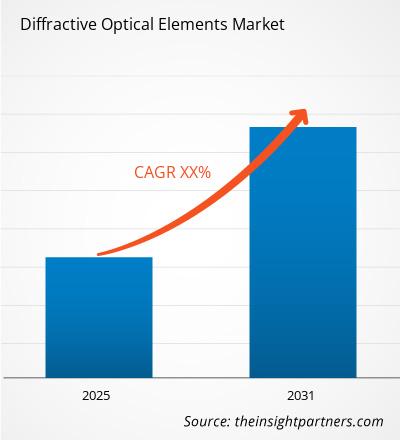
The Diffractive Optical Elements Market size was valued at US$ 248.78 Million in 2025 and is projected to reach US$ 398.42 Million in 2034, registering a CAGR of 6.06% between 2026 and 2034. This market consists of optical elements made up of micro-structures that control light diffraction instead of refraction to shape, split and control beams in laser, sensing and imaging applications. This includes beam splitters, beam shapers, homogenizers, and pattern generators which provide customized optical performance for biomedical devices, laser material processing, LIDAR, telecoms, and lithography applications.
According to the Diffractive Optical Elements market report, North America is expected to register a CAGR of 5.5-6.2% during the period 2026-2034, driven by adoption of laser technologies, semiconductor production and biomedical applications in the US and Canada. Growth will be boosted by photonics R&D spending, defense sector applications and preference for high-performance optical elements in industrial & scientific applications.
Diffractive Optical Elements Market Assessment and Insights
- North America held 28–31% share in 2025 and is growing at a CAGR of 5.5–6.2% during 2026–2034, led by laser processing, semiconductor manufacturing, and biomedical applications across the US and Canada.
- US represented 82–85% of North American revenue in 2025 and is growing at a CAGR of 5.7–6.4% during 2026–2034.
- Europe accounted for 25–28% share in 2025 and is growing at a CAGR of 5.2–5.9% during 2026–2034, led by Germany, the UK, France, Italy, and Spain.
- Asia Pacific held 32–35% share in 2025 and is growing at a CAGR of 6.8–7.5% during 2026–2034, led by China, India, Japan, South Korea, and Australia.
- Largest Segment Beam Splitter held 32–35% market share in 2025 and is growing at a CAGR of 5.8–6.5% during 2026–2034.
- High Growth Segment Homogenizer represented 22–25% market share in 2025 and is growing at a CAGR of 6.5–7.2% during 2026–2034.
- Key companies analyzed in detail: LightTrans GmbH; SintecOptronics Pte Ltd.; HOLOEYE Photonics AG; Laser Optical Engineering Ltd.; Laserglow Technologies; Broadcom Inc.; Jenoptik AG; SÜSS MicroTec SE; HOLO/OR LTD.; SILIOS Technologies; Zeiss Group; Hamamatsu Photonics K.K.
Source: The Insight Partners' analysis based on proprietary research, government publications, company annual reports, investor presentations, industry databases, and expert interviews.
Modern developments in diffractive optical elements include the use of multi-level gratings and holographic structures that allow advanced beam shaping and control in high-end applications. The modern dynamics of production include fabrication methods such as lithography and reactive ion etching along with the use of wafer manufacturing techniques to create precision diffraction surfaces. In addition, demand in Diffractive Optical Elements Market depends on system integrators who match diffractive optical element parts with the rest of the equipment.
The next stage of investment in diffractive optical elements will focus on the regions of Asia Pacific, North America, and Europe which have the highest demands for diffractive optical elements in applications related to laser material processing and advanced manufacturing. Compliance of diffractive optical elements with regulations related to medical device standards and laser safety helps with qualification of diffractive optical elements.
Diffractive Optical Elements Market Report Scope
| Report Attribute | Details |
|---|---|
| Market size in 2025 | US$ 248.78 Million |
| Market Size by 2034 | US$ 398.42 Million |
| Global CAGR (2026 - 2034) | 6.06% |
| Historical Data | 2021-2024 |
| Forecast period | 2026-2034 |
Diffractive Optical Elements Market Analysis
Market growth factors include laser technologies implementation, semiconductor manufacturing needs, medical applications and LIDAR systems development. Value chain participants include optical design software, fabrication equipment, diffractive optical elements manufacturing companies and systems integrators. Fabrication complexities, material sourcing and application-based qualification cycle define supply dynamics. Diffractive Optical Elements Market overview shows that currently beam splitters dominate the market share while homogenizers show increasing market shares thanks to applications in laser processing. Services play an important role due to the fact that design expertise, fabrication capabilities and performance testing influence overall performance and applicability of systems.
Market competition includes photonics specialists and optical element manufacturing companies. Jenoptik AG, Broadcom Inc., HOLOEYE Photonics AG, HOLO/OR LTD., SÜSS MicroTec SE, SILIOS Technologies, LightTrans GmbH, SintecOptronics Pte Ltd., Laser Optical Engineering Ltd., Laserglow Technologies, Zeiss Group and Hamamatsu Photonics K.K. compete for design capabilities, fabrication precision, application experience and installed-base relations. Investments are directed towards multifunctional designs, high power capacity and wider wavelengths range. Jenoptik AG and Broadcom stay ahead owing to their extensive portfolios and strong market position, while HOLO/OR and SÜSS MicroTec have advantages due to fabrication and semiconductor experience.
The market is seeing fast-paced technology development due to the increasing demand for advanced optical components that can increase the effectiveness and efficiency of highly complex photonic devices. Advanced lithography systems, nanoimprint technologies, electron beam patterning, and precise etching are some technologies being developed by manufacturers to create high efficiency and multi-level diffraction optical elements having excellent optical performance. High power lasers used in various applications like industrial material processing, medical imaging, additive manufacturing, and scientific research have led to an increasing demand for DOE solutions for improved beam shaping, energy distribution, and wavelength specificity. Along with this, integration of diffractive optical elements into LiDAR technology, augmented and virtual reality systems, optical communication systems, and semiconductor inspection machines has broadened the market outside its conventional boundaries of laser technology applications.
From a regional perspective, North America and Europe remain key markets for diffractive optical elements due to their well-established photonics industries, significant investments in semiconductor manufacturing, defense technologies, biomedical research, and advanced laser systems. The presence of leading research institutions, optical component manufacturers, and technology companies continues to support innovation and commercialization of high-performance DOE solutions across multiple end-use sectors. Meanwhile, Asia-Pacific is expected to register the fastest growth during the forecast period, driven by expanding semiconductor fabrication capacity, increasing electronics manufacturing, rapid adoption of industrial laser processing, and rising investments in autonomous vehicle technologies and optical communications. Countries such as China, Japan, South Korea, and Taiwan are strengthening domestic photonics capabilities through continuous investment in precision manufacturing and advanced optical technologies. Emerging markets in Latin America and the Middle East are also gradually increasing adoption of laser-based manufacturing and medical technologies, creating additional opportunities for DOE suppliers. Growing demand for miniaturized optical systems, high-speed data transmission, precision sensing, and next-generation imaging technologies is expected to sustain long-term growth across the global Diffractive Optical Elements Market.
● REPORT CUSTOMIZATION
Tailor This Report To Align With Your Specific Business Requirements
This report can be customized to align precisely with your business objectives, scope, and target markets. Customization options include tailored segmentation, geography, competitive analysis, and strategic insights to support informed decision-making.
Customize This Report →WHAT YOU CAN ADJUST
- ● Segmentations
- ● Geography
- ● Competitive Analysis
- ● Language Preferences
Diffractive Optical Elements Market: Strategic Insights
Regional Insights
North America Diffractive Optical Elements Market
North America accounted for 28–31% of Diffractive Optical Elements Market share in 2025 and is projected to grow at a CAGR of 5.5–6.2% during 2026–2034. Demand is supported by laser processing, semiconductor manufacturing, biomedical applications, LIDAR development, and defense applications across the US and Canada. The region's technology ecosystem and research investment drive consistent demand for DOE components. Jenoptik AG, Broadcom Inc., HOLOEYE Photonics AG, Hamamatsu Photonics K.K., and Zeiss Group support installed bases across industrial, medical, and research applications in the US and Canada.
U.S. Diffractive Optical Elements Market
The U.S. represented 82–85% of North American revenue in 2025 and is forecast to grow at a CAGR of 5.7–6.4% during 2026–2034. Application demand is concentrated in laser material processing, semiconductor equipment, biomedical devices, LIDAR systems, and defense applications. Company presence is reinforced by Jenoptik AG, Broadcom Inc., Hamamatsu Photonics K.K., Zeiss Group, and HOLOEYE Photonics AG. Buyers prioritize diffraction efficiency, beam quality, damage threshold, and design support, plus performance validation that reduces integration risk and improves confidence in optical system performance.
Europe Diffractive Optical Elements Market
Europe held 25–28% share in 2025 and is expected to grow at a CAGR of 5.2–5.9% during 2026–2034. Germany leads through optics manufacturing, laser technology, and industrial applications, while the UK supports demand from research and biomedical applications. France, Italy, and Spain add demand through industrial and scientific applications. Photonics industry investment and research funding favor suppliers with documented performance and quality. Jenoptik AG, HOLOEYE Photonics AG, SÜSS MicroTec SE, and Zeiss Group remain visible across industrial and research projects.
APAC Diffractive Optical Elements Market
Asia Pacific accounted for 32–35% share in 2025 and is projected to grow at a CAGR of 6.8–7.5% during 2026–2034. China leads through manufacturing, laser applications, and semiconductor production, while India expands through industrial and research applications. Japan and South Korea prioritize advanced optical elements for electronics and precision manufacturing, while Australia adds research and defense applications. Policy support for photonics and advanced manufacturing strengthen Diffractive Optical Elements Market adoption where optical performance carries significant value.
Middle East & Africa Diffractive Optical Elements Market
The Middle East & Africa market is projected to grow at a CAGR of 4.5–5.2% during 2026–2034. Saudi Arabia leads through technology investment and research development, while the UAE adds industrial and research applications. South Africa and Rest of MEA rely on research and industrial development. Technology investment and research infrastructure create demand for optical elements. Suppliers succeed when they combine product quality, technical support, and design expertise for application requirements.
Segmentation Analysis
Type
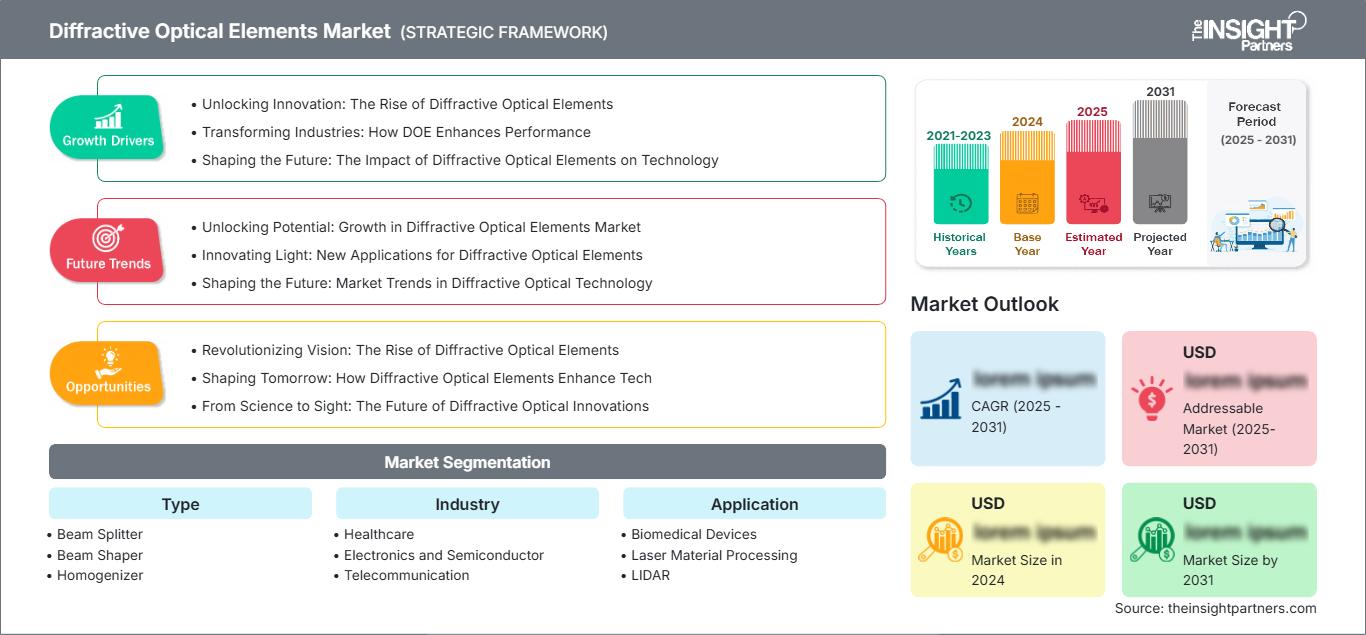
Type is projected to grow at a CAGR of 5.8–6.5% during 2026–2034. Diffractive Optical Elements Market scope covers Beam Splitter, Beam Shaper, and Homogenizer. Selection depends on beam control requirements and application-specific needs. Beam Splitter leads through established applications and widespread adoption.
- Beam Splitter elements divide incident light into multiple beams with controlled intensity distribution for interferometry, metrology, and imaging applications.
- Beam Shaper elements transform beam intensity profiles for uniform illumination, flat-top generation, and specific beam shaping requirements.
- Homogenizer elements produce uniform intensity distributions for laser processing, material treatment, and illumination applications.
Industry
Industry is forecast to grow at a CAGR of 6.0–6.7% during 2026–2034. Healthcare, Electronics and Semiconductor, and Telecommunication represent distinct application environments with varying requirements. Industry adoption grows when technology and performance drive optical element selection.
- Healthcare applications include biomedical devices, diagnostics, and therapeutic systems requiring precise optical performance.
- Electronics and Semiconductor applications encompass wafer inspection, lithography, and precision manufacturing requiring high-performance optical elements.
- Telecommunication applications include optical networking and communications requiring reliable diffractive components.
Application
Application is expected to grow at a CAGR of 6.2–6.9% during 2026–2034. Biomedical Devices, Laser Material Processing, LIDAR, Communication, Optical Sensors, and Lithographic and Holographic Lighting represent diverse application requirements driving adoption.
- Biomedical Devices applications include diagnostic and therapeutic systems requiring precise optical control.
- Laser Material Processing applications demand beam shaping and homogenization for cutting, welding, and surface treatment.
- LIDAR applications require beam splitting and shaping for distance measurement and sensing.
- Communication applications include optical networking and signal processing requiring diffractive components.
- Optical Sensors applications encompass detection and measurement systems requiring precise beam control.
- Lithographic and Holographic Lighting applications demand precision diffractive elements for printing and display.
Opportunity Snapshot
| Application | Revenue Contribution | Trend Tag | Adoption Stage |
|---|---|---|---|
| Biomedical Devices | Medium | Medical Optics | Scaling |
| Laser Material Processing | High | Beam Control | Mature |
| LIDAR | Medium | Autonomous Sensing | Scaling |
| Communication | High | Optical Networks | Mature |
| Optical Sensors | Medium | Detection Systems | Scaling |
| Lithographic and Holographic Lighting | Medium | Precision Imaging | Mature |
Diffractive Optical Elements Market Growth Drivers and Impact Analysis
Laser Technology Adoption Drives Diffractive Element Demand
Expanding laser applications across manufacturing, medicine, communications, and defense create significant demand for diffractive optical elements enabling precise beam control. Each laser system requires beam shaping, splitting, or homogenization for specific applications. The growth of industrial laser processing and medical laser applications drives consistent DOE demand. The practical impact is demand for high-performance diffractive elements supporting diverse laser system requirements.
Semiconductor Manufacturing Requires Precision Optical Control
Semiconductor fabrication processes including lithography, wafer inspection, and laser processing require precision optical elements for beam control and pattern generation. Increasing manufacturing complexity and continued scaling drive demand for advanced diffractive elements. The semiconductor industry's precision requirements and investment create consistent demand. This driver benefits suppliers that can deliver high-precision elements meeting semiconductor manufacturing requirements with documented performance.
LIDAR and Autonomous Sensing Enable New Applications
LIDAR development for autonomous vehicles, robotics, and industrial sensing creates demand for diffractive optical elements enabling beam splitting and shaping for 3D sensing. The expansion of autonomous systems and sensing applications creates new opportunities. The market impact is demand for DOE components supporting LIDAR and sensing applications with specific optical requirements.
Diffractive Optical Elements Market Future Trends
Wafer-Level Manufacturing Enables Cost-Effective Production
Diffractive Optical Elements Market trends point toward wafer-level manufacturing enabling cost-effective, high-volume production for consumer and automotive applications. The next product cycle will combine wafer-scale fabrication with advanced designs for reduced cost and improved reproducibility. This shift matters because cost reduction enables broader adoption across applications. Vendors with wafer-level manufacturing capability will be better positioned as volume requirements increase.
Multi-Level and Metasurface Designs Enhance Performance
Multi-level and metasurface diffractive designs are emerging as approaches for enhanced optical performance and expanded functionality. Next-generation elements will incorporate advanced structures for improved efficiency and spectral range. This evolution supports more sophisticated optical control. Suppliers that can deliver advanced designs with established fabrication capability will gain credibility with system developers.
Diffractive Optical Elements Market Opportunities
Custom Diffractive Solutions for Emerging LIDAR Applications
Diffractive Optical Elements Market Forecasts support investment in custom diffractive solutions for LIDAR and sensing applications requiring specific beam control characteristics. System developers need tailored solutions for application requirements. Providers can create opportunities through custom design capability. The opportunity is strongest where sensing applications create demand for specialized DOE designs.
High-Power Diffractive Elements for Industrial Laser Processing
Industrial laser processing applications requiring high-power handling create demand for robust diffractive elements capable of withstanding demanding operating conditions. Manufacturers need elements with high damage thresholds and reliability. Suppliers with high-power expertise can capture opportunities in industrial applications. This opportunity rewards companies that can deliver performance, durability, and application support.
Recent Developments
- June 2026: Kopin Corporation (NASDAQ: KOPN) a leading provider of application-specific optical systems and high-performance microdisplays for defense, training, enterprise, industrial, consumer and medical products, today announced plans to open a new Optics and Photonics Design Center in Dallas, Texas, further expanding the company’s U.S. based engineering footprint and accelerating development of next generation Neural I/o technology for the rapidly growing AI infrastructure market.
- January 2023: Coherent Corp. (Nasdaq: COHR), a leader in industrial laser optics, today announced that it introduced a product line of diffractive optical elements (DOEs) for high-power industrial lasers. Innovation in optical components is a key factor in significantly lowering the cost of ownership of industrial lasers and accelerating their adoption in both existing and new applications. Coherent leverages its proprietary nanoimprint technology and design simulation tools to offer a new line of highly customized DOEs that achieve very high optical efficiency and extremely uniform laser beams. The DOEs are available with precision optical coatings that ensure high reliability in kilowatt-class industrial lasers for a wide range of applications, including for welding, cutting, and additive manufacturing.
- January 2023: Inprentus now offers manufacturing and design services for a core component in the augmented reality optics market. The company’s blazed diffractive waveguide masters can be used for rapid prototyping and mass production of AR headset eyepieces. High-efficiency blazed waveguides can lower power consumption in headset/glasses, offering improved performance and higher manufacturing yield. Inprentus, a supplier of custom diffractive optics to a variety of industries, employs a unique and innovative nanoscale contact mode lithography technique that combines ultrahigh precision mechanical ruling of metallic surfaces and a variety of proprietary control software, sensor technology and materials science techniques. This method is designed to produce blazed diffractive patterns on optical surfaces for the purpose of controlling light. The company’s nanoscale contact mode lithography process is ideal for manufacturing master diffractive optics used for prototyping as well as high-volume replication.
Frequently Asked Questions

- Comprehensive Market Sizing and Forecast Analysis
- Detailed Segmentation Analysis
- In-Depth Market Dynamics Assessment
- Regional and Country-Level Insights
- Competitive Landscape and Company Benchmarking
- Strategic Business Intelligence
Recent Reports
Testimonials

The Insight Partners' SCADA System Market report is comprehensive, with valuable insights on current trends and future forecasts. The team was highly professional, responsive, and supportive throughout. We are very satisfied and highly recommend their services.
RAN KEDEM Partner, Reali Technologies LTDs
I requested a report on a very specific software market and the team produced the report in a few days. The information was very relevant and well presented. I then requested some changes and additions to the report. The team was again very responsive and I got the final report in less than a week.
JEAN-HERVE JENN Chairman, Future Analytica
We worked with The Insight Partners for an important market study and forecast. They gave us clear insights into opportunities and risks, which helped shape our plans. Their research was easy to use and based on solid data. It helped us make smart, confident decisions. We highly recommend them.
PIYUSH NAGPAL Sr. Vice President, High Beam Global
The Insight Partners delivered insightful, well-structured market research with strong domain expertise. Their team was professional and responsive throughout. The user-friendly website made accessing industry reports seamless. We highly recommend them for reliable, high-quality research services
YUKIHIKO ADACHI CEO, Deep Blue, LLC.
This is the first time I have purchased a market report from The Insight Partners.While I was unsure at first, I visited their web site and felt more comfortable to take the risk and purchase a market report.I am completely satisfied with the quality of the report and customer service. I had several questions and comments with the initial report, but after a couple of dialogs over email with their analyst I believe I have a report that I can use as input to our strategic planning process.Thank you so much for taking the extra time and making this a positive experience.I will definitely recommend your service to others and you will be my first call when we need further market data.
JOHN SUZUKI President and Chief Executive Officer, Board Director, BK Technologies
I wish to appreciate your support and the professionalism you displayed in the course of attending to my request for information regarding to infectious disease IVD market in Nigeria. I appreciate your patience, your guidance, and the fact that you were willing to offer a discount, which eventually made it possible for us to close a deal. I look forward to engaging The Insight Partners in the future, all thanks to the impression you have created in me as a result of this first encounter.
DR CHIJIOKE ONYIA MANAGING DIRECTOR, PineCrest Healthcare Ltd.Reason to Buy
- Informed Decision-Making
- Understanding Market Dynamics
- Competitive Analysis
- Identifying Emerging Markets
- Customer Insights
- Market Forecasts
- Risk Mitigation
- Boosting Operational Efficiency
- Strategic Planning
- Investment Justification
- Tracking Industry Innovations
- Aligning with Regulatory Trends





 Get Free Sample for