
Digital Test Equipment Market Trends, Share & Demand by 2034
Coverage: By Type (Digital Multi-meter, Digital Clamp Meter, Digital Earth Tester, Digital LCR Meter, Digital Oscilloscope, Others); Application (Consumer Electronics and Telecommunication, Aerospace and Defense, Education, Automotive and Transportation, Others) , and Geography (North America, Europe, Asia Pacific, and South and Central America)
- Status : Data Released
- Report Code : TIPRE00026890
- Category : Electronics and Semiconductor
- No. of Pages : 150
- Available Report Formats :


- Last update date : July 29, 2026


2025 Market Size
US$ 3.84 Bn
Base year value
2034 Forecast
US$ 8.13 Bn
Projected by 2034
CAGR 2026-2034
9.83 %
Growth rate
Addressable Market
US$ 56.86 Bn
(2026-2034)
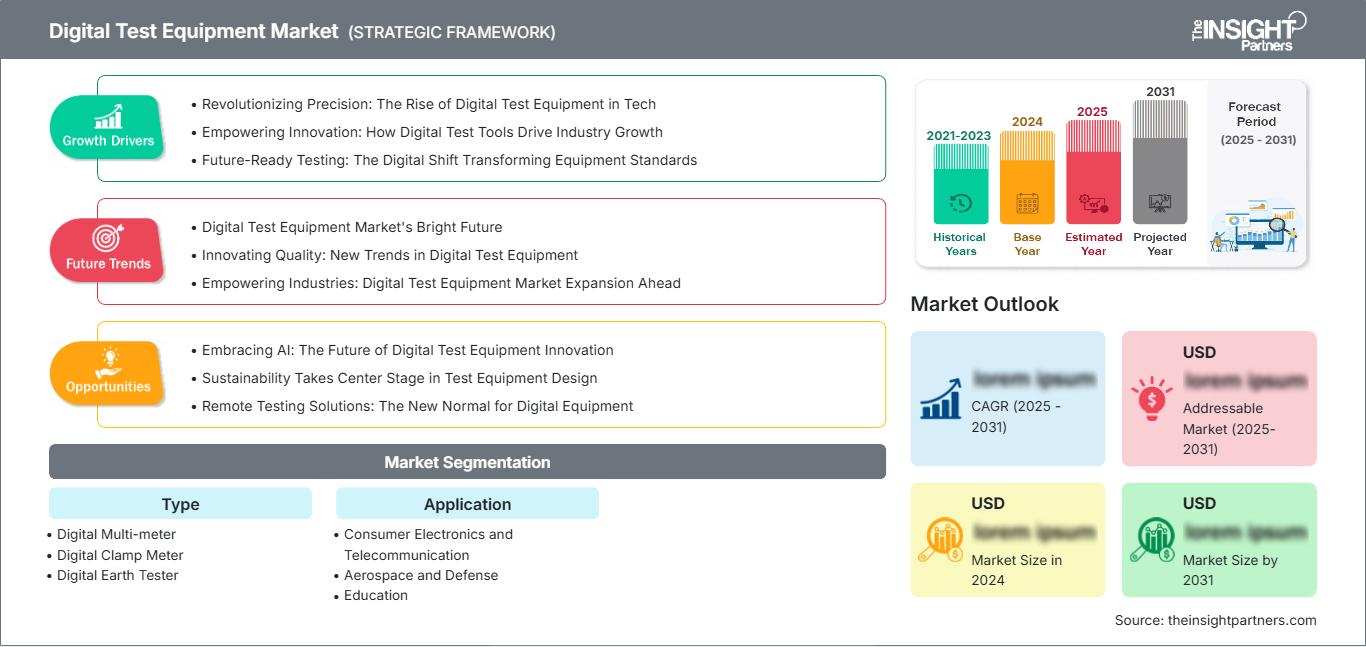
The Digital Test Equipment Market stood at US$ 3.84 Billion in 2025 and would further rise to US$ 8.13 Billion by 2034, posting a CAGR of 9.83%. This market includes digital multi-meters, digital clamp meters, digital earth testers, digital LCR meters, and digital oscilloscopes that are deployed in consumer electronics & telecommunication, aerospace & defense, education, automotive, and transportation segments.
Valuation of North America Digital Test Equipment Market size is estimated to grow at a CAGR of 8.5 – 9.3% between 2026 – 2034. This regional market is driven by the testing needs for aerospace electronics, 5G laboratories, and semiconductor reshoring. This regional market is also propelled by high installed bases in calibration laboratories, defense contractors, telecom equipment manufacturers, and automotive electronics projects.
Digital Test Equipment Market Assessment and Insights
- North America held 31–35% share in 2025 and is growing at a CAGR of 8.5–9.3% during 2026–2034, led by 5G testing, defense electronics, semiconductor validation, and electric vehicle diagnostics.
- US represented 77–81% of North American revenue in 2025 and is growing at a CAGR of 8.6–9.4% during 2026–2034, supported by telecom, aerospace, and semiconductor R&D.
- Europe accounted for 24–28% share in 2025 and is growing at a CAGR of 7.8–8.6% during 2026–2034, with Germany, the UK, France, Italy, and Spain leading adoption.
- Asia Pacific held 29–33% share in 2025 and is growing at a CAGR of 10.4–11.2% during 2026–2034, led by China, Japan, South Korea, India, and Australia.
- Largest Segment Digital Oscilloscope held 34–38% market share in 2025 and is growing at a CAGR of 9.4–10.2% during 2026–2034 due to signal-integrity and power-electronics testing.
- High Growth Segment Digital LCR Meter represented 12–16% of the Digital Test Equipment Market share in 2025 and is growing at a CAGR of 10.8–11.6% during 2026–2034, supported by component validation.
- Key companies analyzed in detail: Fluke Corporation; IDEAL INDUSTRIES, INC.; Keysight Technologies, Inc.; The L.S. Starrett Company; National Instruments Corporation; Rohde & Schwarz GmbH & Co. KG; Texas Instruments Incorporated; Teradyne, Inc.; Tektronix, Inc.; Yokogawa Electric Corporation.
Source: The Insight Partners' analysis based on proprietary research, government publications, company annual reports, investor presentations, industry databases, and expert interviews.
Digital Test Instruments have developed from stand-alone equipment to software-controlled and application-oriented devices. The production demands include more bandwidth, improved current measurements, automatic calibration, and ruggedness in the field applications. Suppliers are juggling between portable digital test instruments for maintenance and high end oscilloscopes, LCR meters and modular systems for labs, manufacturing facilities, and defense validation processes.
The future demands will include localization of electronics, electric mobility, smart grids and additional investments in science, technology, engineering, and math. The purchasing will be dominated by instruments that allow fast sampling rates, cloud-based reporting, cybersecurity features, and traceability in calibration. The regulatory needs in the aerospace, medical electronics, energy safety and telecommunication certifications will make Digital Test Equipment Market resilient across developed and developing nations.
Digital Test Equipment Market Report Scope
| Report Attribute | Details |
|---|---|
| Market size in 2025 | US$ 3.84 Billion |
| Market Size by 2034 | US$ 8.13 Billion |
| Global CAGR (2026 - 2034) | 9.83% |
| Historical Data | 2021-2024 |
| Forecast period | 2026-2034 |
Digital Test Equipment Market Analysis
The growth factors in market are miniaturization in electronics, 5G network installations, design of electric vehicles, aerospace tests, and factory automation. The value chain consists of suppliers of precision components, producers of sensors and probes, developers of firmware, distributors, calibrators, and software integrators. The buyers require precise measurements of voltage, current, resistance, impedance, grounding, and waveform.
Supply factors include resolution of the converters, safety standards of the enclosure, quality of the probes, display components, wireless capability, and service networks. The market is characterized by the differentiation of suppliers through software solutions for automation, remote diagnosis, education packages, and library applications. Purchase decisions of procurement professionals are more concerned about lifecycle cost, accuracy, calibration cycle time, and test system integration than just the purchase cost.
Competitive environment in the Digital Test Equipment Market Report includes diversified instrumentation companies and specialized electrical tools providers. Major players include Keysight Technologies, Inc., Tektronix, Inc., Rohde & Schwarz GmbH & Co. KG, National Instruments Corporation, and Teradyne, Inc. They compete in automated laboratories, RF-related validation, and test systems in manufacturing, while Fluke Corporation and IDEAL INDUSTRIES, INC. dominate in the field instruments segment.
The Influence On Demand: Texas Instruments Inc. influences demand via semiconductor reference design and power electronics ecosystem; L.S. Starrett Company and Yokogawa Electric Corporation offer metrology skills and industrial measurement. Software-based process, wide-bandwidth oscilloscope, improved clamp meter, and compact LCR Meter have attracted the investor's attention. The positioning tactics are based on accuracy, conformity to standards, installation base, channel, and training.
● REPORT CUSTOMIZATION
Tailor This Report To Align With Your Specific Business Requirements
This report can be customized to align precisely with your business objectives, scope, and target markets. Customization options include tailored segmentation, geography, competitive analysis, and strategic insights to support informed decision-making.
Customize This Report →WHAT YOU CAN ADJUST
- ● Segmentations
- ● Geography
- ● Competitive Analysis
- ● Language Preferences
Digital Test Equipment Market: Strategic Insights
Regional Insights
North America Digital Test Equipment Market
Share of North America in the market was recorded between 31-35% in 2025 and is expected to grow at a CAGR of 8.5-9.3% between 2026 and 2034. This growth is attributed to semiconductor packaging, aerospace electronics, telecom laboratories, electrification of automobiles, and industrial maintenance programs.
Replacement trends are influenced by demand for high sampling rates, electrically safe testing, automated test reports, and calibration tracking. The market is positively impacted by developed distribution channels, military purchases, and R&D activities on wireless systems, power electronics, and connected devices.
U.S. Digital Test Equipment Market
The United States accounted for 77–81% of the North America revenue in 2025 and will experience growth at a CAGR of 8.6–9.4% from 2026 to 2034. The application areas are found in semiconductor laboratories, defense electronics, telecom testing, industrial maintenance, and electric vehicle design.
Fluke Corporation, Keysight Technologies, Inc., National Instruments Corporation, Tektronix, Inc., and Teradyne, Inc. have good visibility through direct sales and education campaigns, calibration services. Current application trends include digital oscilloscopes, smart multimeters, automatic test benches, and clamp meters.
Europe Digital Test Equipment Market
The market share of Europe was 24–28% in 2025 and it is expected to register growth at a rate of 7.8-8.6% CAGR for the period of 2026-2034. Germany is leading due to its demand for automotive electronics, industrial automation, energy systems, and precision engineering.
UK is contributing due to demand for aerospace, defense, telecom labs, and universities. France, Italy, and Spain are contributing because of the transportation electrification, electronics education, renewable energy, and manufacturing automation. The customers from Europe give more importance to safety certification, calibration, and repairability of products.
APAC Digital Test Equipment Market
Asia Pacific accounted for 29–33% share in 2025 and is forecast to grow at a CAGR of 10.4–11.2% during 2026–2034. China leads through electronics manufacturing, telecom equipment, electric vehicles, and component testing.
Japan and South Korea support high-accuracy adoption, while India and Australia add growth through education labs, mobility, utilities, and defense electronics. Policy support for semiconductor localization and digital manufacturing strengthens demand, although price sensitivity remains influential.
Middle East & Africa Digital Test Equipment Market
The Middle East & Africa market is projected to grow at a CAGR of 6.9–7.7% during 2026–2034. Saudi Arabia leads as energy, petrochemical, defense, infrastructure, and technical education projects require dependable electrical testing.
The UAE supports demand from aviation, data centers, utilities, and electronics service providers, while South Africa and Rest of MEA rely on mining, grid maintenance, and training laboratories. Harsh environments increase demand for rugged instruments.
Segmentation Analysis
Type
Type is projected to grow at a CAGR of 9.0–9.8% during 2026–2034. The Digital Test Equipment Market scope covers handheld tools, bench instruments, grounding testers, impedance measurement, and waveform analysis. Buyers select products according to safety category, accuracy, bandwidth, portability, training needs, and compatibility with automated reporting or production systems.
- Digital Multi-meter devices remain essential for voltage, current, resistance, continuity, and troubleshooting tasks across field maintenance, education, electronics repair, and industrial service environments.
- Digital Clamp Meter products support non-contact current measurement, improving technician safety and speed in power distribution, facilities maintenance, automotive service, and renewable energy checks.
- Digital Earth Tester instruments address grounding integrity, lightning protection, substation safety, and construction compliance where reliable earth resistance readings reduce electrical risk.
- Digital LCR Meter devices are strategically important for capacitors, inductors, resistors, sensors, and filters as electronics makers validate tolerance, stability, and component quality.
- Digital Oscilloscope instruments lead high-value demand by visualizing signal timing, noise, transients, and power behavior across electronics design, education, defense, and automotive validation.
Application
Application is forecast to grow at a CAGR of 9.5–10.3% during 2026–2034. Consumer electronics and telecommunication remain major demand bases because device complexity and high-frequency signal behavior require repeatable validation. Aerospace and defense prioritize accuracy and traceability, while education, automotive, and transportation create volume demand for practical, durable, and software-supported instruments.
- Consumer Electronics and Telecommunication demand is shaped by device miniaturization, RF modules, charging systems, and network equipment that require fast debugging, waveform visibility, and quality control.
- Aerospace and Defense users prioritize calibration records, signal integrity, harsh-environment reliability, and secure validation workflows for avionics, radar, communications, and mission electronics.
- Education adoption is driven by laboratory modernization, hands-on engineering curricula, vocational training, and affordable instruments that help students learn measurement fundamentals.
- Automotive and Transportation applications rely on testing for electric drivetrains, sensors, battery systems, charging interfaces, rail electronics, and connected mobility platforms.
Opportunity Snapshot
| Application | Revenue Contribution | Trend Tag | Adoption Stage |
| Consumer Electronics and Telecommunication | High | 5G Labs | Mature |
| Aerospace and Defense | Medium | Secure Validation | Scaling |
| Education | Medium | Teaching Kits | Scaling |
| Automotive and Transportation | High | EV Testing | Scaling |
Digital Test Equipment Market Growth Drivers and Impact Analysis
Electronics complexity increases validation intensity
The combination of faster processor speeds, denser boards, mixed signal interfaces, fast charging technology, and wireless connections makes manual checking ineffective with modern devices. The engineers require a digital oscilloscope, an LCR meter, and a multimeter to identify problems in timing, impedance matching, heat stress, and voltage instability. The effect on the market would be greater demand for tools with larger bandwidths and higher resolutions, as well as those featuring automated measurements and software solutions that minimize debugging time.
Electrification expands field and laboratory testing
There is need for more precise electrical measurements of electric cars, chargers, battery packs, trains, solar inverters, and network components. Clamp meters help in checking currents without interfering with circuits, whereas earth testers help in testing for proper grounding. Oscilloscopes assist in diagnosing the performance of switches in power electronics. This will make manufacturers benefit in case their products integrate both safety and durability with the ability to perform guided tests.
Education and workforce training widen installed bases
Technical colleges, universities, and business learning centers require reliable tools that can demonstrate measurement basics as well as reflect the latest practices in the industry. Inexpensive digital multimeters and oscilloscopes create brand awareness at an early stage of education, while software-based training and remote laboratories make it possible to combine both approaches. The result is a wider replacement cycle, since education institutions upgrade their tools in order to be prepared for power electronics, embedded systems, communication circuits, and automation.
Digital Test Equipment Market Future Trends
Software-defined measurement workflows
Digital Test Equipment Market trends point toward instruments that behave less like standalone hardware and more like connected measurement platforms. Future systems will automate setup, capture metadata, compare results with limits, and export reports into quality systems. This shift will be strongest in telecom, aerospace, and electronics manufacturing, where engineering teams need repeatable workflows across multiple benches. Vendors that combine intuitive software, secure updates, and open interfaces will capture recurring value from calibration, analytics, and test automation services.
Portable instruments gain higher intelligence
Handheld tools will gain richer displays, guided diagnostics, wireless synchronization, and safer measurement modes as field teams face complex electrified systems. The boundary between bench-grade accuracy and portable usability will narrow, especially in automotive service, renewable maintenance, and industrial troubleshooting. Intelligent meters can reduce training burden by warning users about incorrect ranges, unsafe connections, or abnormal patterns. Suppliers that maintain ruggedness while adding connected features will improve differentiation beyond price and basic specifications.
Digital Test Equipment Market Opportunities
Application bundles for electric mobility validation
Digital Test Equipment Market Forecasts support investment in bundled solutions for electric vehicles, chargers, battery packs, and transport electronics. Vendors can package oscilloscopes, clamp meters, probes, safety accessories, training content, and reporting templates around defined workflows. The opportunity is attractive because buyers want faster deployment, safer operation, and consistent measurements across engineering, service, and quality teams. Suppliers that align products with battery diagnostics, inverter testing, and charging infrastructure verification can move from transactional sales to solution-led accounts.
Education labs as long-term channel builders
Institutions expanding electronics, telecom, and mobility programs need complete laboratory ecosystems rather than isolated instruments. Vendors can supply multimeters, oscilloscopes, LCR meters, experiment boards, cloud exercises, and maintenance contracts to standardize instruction. This opportunity builds early familiarity among future engineers and technicians while supporting public workforce initiatives. Companies that make procurement simple, provide teaching materials, and ensure local service can secure repeat refresh cycles and influence professional tool preferences beyond graduation.
Recent Developments
- November 2025: Keysight Technologies, Inc. (NYSE: KEYS) announced a new series of high-power ATE system power supplies, expanding its power test portfolio with three automated test equipment (ATE) product families: the RP5900 Series Regenerative DC Power Supplies, the EL4900 Series Regenerative DC Electronic Loads, and the DP5700 Series System DC Power Supplies. These next-generation solutions provide high density, bi-directional and regenerative capabilities, and intelligent automation software, helping engineers validate designs more efficiently and accelerate time to market.
-
July 2025: ANRITSU CORPORATION has developed and launched new software options for its Radio Communication Test Station MT8000A, designed to evaluate the radio frequency (RF) performance of 5G devices such as smartphones. These options support key technologies specified in 3GPP Release 17, including 1024QAM modulation for downlink and Tx Switching 2Tx to 2Tx for uplink, enabling accurate and flexible evaluation of 5G devices with enhanced transmit/receive (TRx) performance.
- January 2025: Vitrek, a US-based manufacturer of high-end test, measurement and signal recording equipment, announced that it has introduced a new test automation software package — QT Insite. This, the latest in their line of Quick Test software releases, is distinguished by its streamlined use of system resources and robust features. Designed to work with Vitrek’s 95X, 98X and V7X series of hipot testers as well as the company’s 964i high-voltage switches, QT Insite software helps automate test procedures by simplifying test design, set-up and data tracking.
Frequently Asked Questions

- Comprehensive Market Sizing and Forecast Analysis
- Detailed Segmentation Analysis
- In-Depth Market Dynamics Assessment
- Regional and Country-Level Insights
- Competitive Landscape and Company Benchmarking
- Strategic Business Intelligence
Recent Reports
Testimonials

The Insight Partners' SCADA System Market report is comprehensive, with valuable insights on current trends and future forecasts. The team was highly professional, responsive, and supportive throughout. We are very satisfied and highly recommend their services.
RAN KEDEM Partner, Reali Technologies LTDs
I requested a report on a very specific software market and the team produced the report in a few days. The information was very relevant and well presented. I then requested some changes and additions to the report. The team was again very responsive and I got the final report in less than a week.
JEAN-HERVE JENN Chairman, Future Analytica
We worked with The Insight Partners for an important market study and forecast. They gave us clear insights into opportunities and risks, which helped shape our plans. Their research was easy to use and based on solid data. It helped us make smart, confident decisions. We highly recommend them.
PIYUSH NAGPAL Sr. Vice President, High Beam Global
The Insight Partners delivered insightful, well-structured market research with strong domain expertise. Their team was professional and responsive throughout. The user-friendly website made accessing industry reports seamless. We highly recommend them for reliable, high-quality research services
YUKIHIKO ADACHI CEO, Deep Blue, LLC.
This is the first time I have purchased a market report from The Insight Partners.While I was unsure at first, I visited their web site and felt more comfortable to take the risk and purchase a market report.I am completely satisfied with the quality of the report and customer service. I had several questions and comments with the initial report, but after a couple of dialogs over email with their analyst I believe I have a report that I can use as input to our strategic planning process.Thank you so much for taking the extra time and making this a positive experience.I will definitely recommend your service to others and you will be my first call when we need further market data.
JOHN SUZUKI President and Chief Executive Officer, Board Director, BK Technologies
I wish to appreciate your support and the professionalism you displayed in the course of attending to my request for information regarding to infectious disease IVD market in Nigeria. I appreciate your patience, your guidance, and the fact that you were willing to offer a discount, which eventually made it possible for us to close a deal. I look forward to engaging The Insight Partners in the future, all thanks to the impression you have created in me as a result of this first encounter.
DR CHIJIOKE ONYIA MANAGING DIRECTOR, PineCrest Healthcare Ltd.Reason to Buy
- Informed Decision-Making
- Understanding Market Dynamics
- Competitive Analysis
- Identifying Emerging Markets
- Customer Insights
- Market Forecasts
- Risk Mitigation
- Boosting Operational Efficiency
- Strategic Planning
- Investment Justification
- Tracking Industry Innovations
- Aligning with Regulatory Trends





 Get Free Sample for