
Digital Textile Printing Inks Market Size, Share & Forecast by 2034
Coverage: by Ink Type (Reactive, Acid, Direct Disperse, Sublimation, Pigment, and Others); Application (Clothing/Garments, Households, Technical Textiles, Display, and Others), and Geography (North America, Europe, Asia Pacific, and South and Central America)
- Status : Data Released
- Report Code : TIPRE00003435
- Category : Chemicals and Materials
- No. of Pages : 150
- Available Report Formats :


- Last update date : July 22, 2026


2025 Market Size
US$ 986.55 Mn
Base year value
2034 Forecast
US$ 2,509.92 Mn
Projected by 2034
CAGR 2026-2034
10.93 %
Growth rate
Addressable Market
US$ 15,455.04 Mn
(2026-2034)
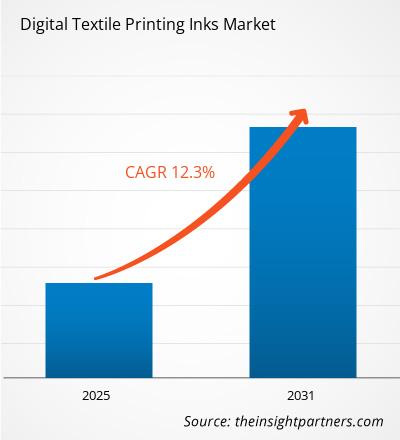
The Digital Textile Printing Inks Market was valued at US$ 986.55 Million in 2025 and is projected to reach US$ 2,509.92 Million by 2034, registering a CAGR of 10.93% during 2026–2034. Expansion is supported by on-demand textile production, shorter fashion cycles, and increasing use of inkjet-compatible formulations across clothing, households, technical textiles, and display applications.
Across North America, the Digital Textile Printing Inks Market size outlook is expected to advance at an estimated 9.4–10.4% CAGR, supported by customized apparel demand and the reshoring of short-run textile production. Adoption is reinforced by water-based pigment systems, sportswear printing, and brand interest in lower-waste workflows. The region also benefits from technical textile applications where print precision, compliance, and repeatability are critical.
Digital Textile Printing Inks Market Assessment and Insights
- North America: Share in 2025 of 24–28% and CAGR between 9.4–10.4%. Demand is supported by fashion customization, technical textiles, sportswear, and water-based pigment ink adoption.
- US: Share in 2025 of 78–82% of North America and CAGR between 9.6–10.6%. Apparel decorators, e-commerce brands, and textile innovators sustain adoption.
- Europe: Share in 2025 of 27–31% and CAGR between 9.0–10.0%. Germany, Italy, the UK, France, and Spain lead through sustainable printing and fashion clusters.
- Asia Pacific: Share in 2025 of 34–38% and CAGR between 11.8–12.8%. China, India, Japan, South Korea, and Bangladesh support regional scale through textile manufacturing depth.
- Largest Segment: Clothing/Garments held market share of 50–54% in 2025 and CAGR of 10.6–11.6% during 2026–2034.
- High Growth Segment: Pigment inks held market share of 22–26% in 2025 and CAGR of 12.4–13.4% during 2026–2034.
- Key companies analyzed in detail: Kornit Digital Ltd., BASF SE, Dover Corporation, DuPont de Nemours, Inc., DyStar Singapore Pte. Ltd., Hongsam Digital Science and Technology Co., Ltd., Huntsman International LLC, Ricoh Printing Solutions Europe B.V., Sawgrass Technologies, Inc., Sensient Imaging Technologies S.A.
Source: The Insight Partners' analysis based on proprietary research, government publications, company annual reports, investor presentations, industry databases, and expert interviews.
The market has evolved from niche sample printing toward industrial-scale production as printheads, fixation chemistry, pretreatment systems, and color management software improved. Textile mills increasingly use digital inkjet lines to reduce screen preparation, lower inventory risk, and enable rapid design changes. The Digital Textile Printing Inks Market now reflects a broader conversion of apparel, décor, and display supply chains from long-run analog processes toward flexible, data-driven manufacturing.
During the forecast period, investments will revolve around Asia Pacific region’s capacity, Europe’s sustainable regulation, and nearshoring in the North American region. Rising regulations regarding water usage, chemical discharge, and volatile emission is boosting the adoption of low-impact inks. The growth will also be driven by fashion brands’ need for small batch sizes, rapid replenishment, and a printing-on-demand strategy, which ensures less deadstock while being flexible in design. Ink manufacturers who understand the chemistry, application process, and manufacturing process will have an edge in retaining customers.
Digital Textile Printing Inks Market Report Scope
| Report Attribute | Details |
|---|---|
| Market size in 2025 | US$ 986.55 Million |
| Market Size by 2034 | US$ 2,509.92 Million |
| Global CAGR (2026 - 2034) | 10.93% |
| Historical Data | 2021-2024 |
| Forecast period | 2026-2034 |
Digital Textile Printing Inks Market Analysis
Digital Textile Printing Inks Market growth is being driven by customized fashion, direct-to-garment production, soft signage, and printed home textiles. Suppliers of ink are experiencing gains due to the trend of textile manufacturers moving towards short-run production, which requires fast setup, color accuracy, and low waste levels. The demand is highest among brands that perform numerous product launches, requiring the supply chain to react within days as opposed to months.
The system comprises dye and pigment chemistry, print heads, pretreats, fabric finishing, and software. There are reactive inks used in cotton and viscose substrates, acid inks for silk and nylon, disperse and sublimation inks for polyester, and pigment inks, which provide substrate versatility. The supply side is influenced by pigment suspension capabilities, colorant availability, binder capabilities, printhead compatibility, and textile chemical compliance. The buyer's considerations include batch-to-batch consistency, shelf-life, nozzle recovery, and field service support before approving commercial ink systems.
Digital Textile Printing Inks Market analysis shows a competitive field split between integrated printer-ink platforms and specialty chemical suppliers. Kornit Digital Ltd. focuses on ecosystem control through proprietary pigment inks. At the same time, DuPont de Nemours, Inc., Huntsman International LLC, BASF SE, and DyStar Singapore Pte. Ltd. emphasize chemistry depth, textile know-how, and global technical support.
Dover Corporation, Ricoh Printing Solutions Europe B.V., Sawgrass Technologies, Inc., Hongsam Digital Science and Technology Co., Ltd., and Sensient Imaging Technologies S.A. make the market stronger by integrating equipment, expertise in sublimation, supplying regionally, and offering custom color systems. Strategic positioning is now more about having reliable combinations of ink and printer, certification, services, and assisting customers in saving water, energy, and fabric waste. Printer OEM and textile mill partnerships become increasingly significant since validated processes minimize downtime and fast-track the qualification process for customers.
● REPORT CUSTOMIZATION
Tailor This Report To Align With Your Specific Business Requirements
This report can be customized to align precisely with your business objectives, scope, and target markets. Customization options include tailored segmentation, geography, competitive analysis, and strategic insights to support informed decision-making.
Customize This Report →WHAT YOU CAN ADJUST
- ● Segmentations
- ● Geography
- ● Competitive Analysis
- ● Language Preferences
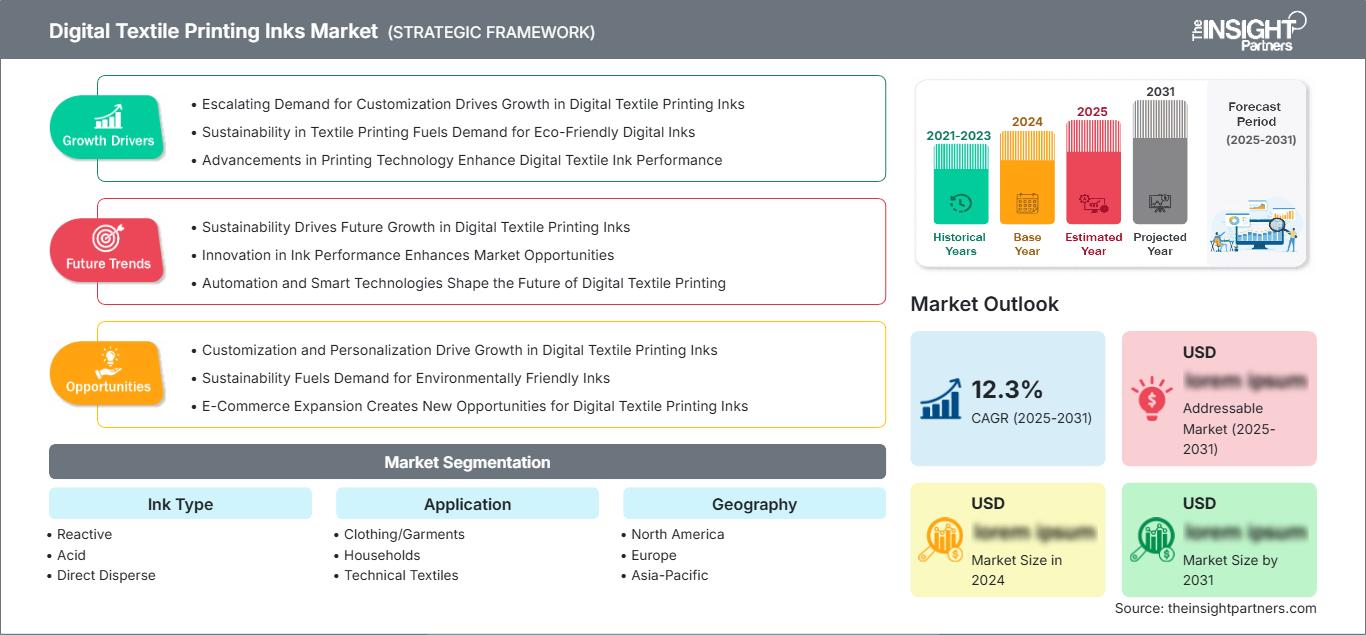
Digital Textile Printing Inks Market: Strategic Insights
Regional Insights
North America Digital Textile Printing Inks Market
North America accounted for 24–28% of revenue in 2025 and is expected to grow at a 9.4–10.4% CAGR. The region benefits from e-commerce apparel, collegiate merchandise, promotional textiles, and growing demand for nearshore production. The Digital Textile Printing Inks Market share in North America is supported by premium applications where speed, color repeatability, and compliance matter.
Water-based pigment inks are gaining acceptance because they simplify workflows and reduce resource intensity compared with conventional routes. Technical textiles, medical fabrics, and sportswear provide additional growth channels. The region’s installed base of digital printers, strong service networks, and brand preference for shorter supply chains sustain adoption despite relatively higher labor and operating costs. North American buyers also place high value on repeatable color profiles, quick technical troubleshooting, and inks that support compliance documentation for branded apparel and institutional customers.
U.S. Digital Textile Printing Inks Market
The U.S. represented 78–82% of North American revenue in 2025 and is forecast to register a 9.6–10.6% CAGR. Demand is concentrated in direct-to-garment apparel, customized merchandise, sportswear, décor fabrics, and soft signage. Brand owners use digital printing to support small batches, regional fulfillment, and quick design refresh cycles.
Company presence is broad, with Kornit Digital Ltd., DuPont de Nemours, Inc., Dover Corporation, Sawgrass Technologies, Inc., and Sensient Imaging Technologies S.A. serving printers and textile converters. Application trends favor pigment systems for cotton-rich apparel, sublimation inks for polyester sportswear, and specialty formulations for technical textile producers seeking durable and repeatable prints. U.S. customers also prioritize domestic distribution, rapid color profiling, and technical service that can support decentralized print shops as well as industrial production sites.
Europe Digital Textile Printing Inks Market
Europe held 27–31% of revenue in 2025 and is projected to expand at a 9.0–10.0% CAGR. Italy remains highly influential through fashion, textile finishing, and design-led printing clusters. Germany leads in technical textiles and process discipline, while the UK supports customized apparel, home décor, and soft signage demand.
France, Spain, and Portugal add demand through apparel, luxury textiles, hospitality décor, and export-oriented printing. European buyers increasingly prioritize chemical compliance, wastewater reduction, and traceable supply chains. This favors suppliers with certified formulations, strong technical service, and inks designed for lower-temperature curing, improved fixation, and reduced post-processing requirements. Regional mills are also investing in digital sampling and short-run production to serve fashion brands that require frequent design approvals and faster seasonal development cycles.
APAC Digital Textile Printing Inks Market
Asia Pacific accounted for 34–38% of revenue in 2025 and is expected to grow at a 11.8–12.8% CAGR. China leads due to its large textile capacity, printer manufacturing, and export demand. India, Bangladesh, Vietnam, South Korea, Japan, and Australia support expansion through apparel, décor, and industrial fabric applications.
Policy support for textile modernization, rising domestic consumption, and brand pressure for faster supply chains reinforce regional adoption. Disperse and sublimation inks remain important for polyester-rich output, while reactive and pigment systems expand with cotton garments and home textiles. Local suppliers compete on cost, service speed, and application-specific color performance. Export-focused converters are also using digital lines for sampling, micro-runs, and design validation before committing to larger production programs.
Middle East & Africa Digital Textile Printing Inks Market
The Middle East and Africa are projected to grow at an 8.2–9.2% CAGR. Saudi Arabia and the UAE lead regional demand through hospitality, retail, events, sports merchandise, and interior décor projects. South Africa contributes through apparel decoration, promotional textiles, and small-batch production serving local brands.
Energy-intensive textile finishing remains a constraint, but investment in tourism, infrastructure, and branded retail creates opportunities for display graphics and décor fabrics. Import dependence for inks and printers makes technical service availability important. Suppliers that provide training, stable logistics, and substrate-specific guidance can improve adoption across fragmented printing operations.
Segmentation Analysis
Ink Type
The Ink Type segment is expected to grow at a 10.8–11.8% CAGR during 2026–2034. The Digital Textile Printing Inks Market scope covers dye-based and pigment-based formulations matched to fiber chemistry, printer architecture, and finishing requirements. Selection depends on fabric composition, wash fastness, color depth, hand feel, production speed, and regulatory requirements. As customers diversify substrates, suppliers are expanding color libraries, pretreatment compatibility, and curing guidance to reduce qualification time across different textile workflows.
- Reactive: Reactive inks remain important for cotton, viscose, and linen applications requiring bright shades, strong wash fastness, and premium hand feel in apparel and home textile production.
- Acid: Acid inks serve silk, wool, and nylon applications where color vibrancy, soft touch, and fiber-specific bonding are essential for scarves, luxury apparel, and technical fabrics.
- Direct Disperse: Direct disperse inks support polyester printing where penetration, heat fixation, and durable color performance matter for flags, sportswear, and synthetic décor textiles.
- Sublimation: Sublimation inks are strategically important for polyester sportswear, soft signage, and promotional products because they deliver vivid output, fast production, and strong compatibility with transfer workflows.
- Pigment: Pigment inks are expanding rapidly because they work across multiple fibers, reduce water-intensive washing steps, and support simplified production for apparel, décor, and customized merchandise.
Application
The Application segment is projected to grow at a 10.5–11.5% CAGR through 2034. Demand is led by fashion and garment production, while household textiles, technical textiles, and display graphics expand the addressable base. Users value digital printing for shorter lead times, design flexibility, lower inventory exposure, and the ability to personalize products economically. Application priorities differ by buyer group, with apparel emphasizing softness and speed, households valuing design range, and technical textiles requiring durability and process validation.
- Clothing/Garments: Clothing and garments dominate demand as fashion brands, decorators, and e-commerce sellers adopt digital printing for personalization, rapid sampling, limited editions, and reduced finished-goods inventory.
- Households: Household textiles include curtains, upholstery, cushions, bedding, and décor fabrics, where digital printing enables design variety, seasonal refreshes, and customization for residential and hospitality buyers.
- Technical Textiles: Technical textiles use digital inks for functional, medical, protective, automotive, and industrial fabrics where durability, repeatability, and substrate compatibility are more important than fashion-led design cycles.
- Display: Display applications include soft signage, flags, exhibition graphics, and retail backdrops, where sublimation and disperse inks provide bright colors, lightweight substrates, and efficient short-run production.
Opportunity Snapshot
| Application | Revenue Contribution | Trend Tag | Adoption Stage |
| Clothing/Garments | High | On-Demand | Scaling |
| Households | Medium | Custom Décor | Scaling |
| Technical Textiles | Medium | Functional Print | Emerging |
| Display | Medium | Soft Signage | Mature |
Digital Textile Printing Inks Market Growth Drivers and Impact Analysis
Shift Toward On-Demand Textile Production
The fashion industry, sports clothing manufacturers, and promotional products providers are making a transition from forecast-based manufacturing to demand-based fulfillment. Digital inkjet printing cuts down on set-up times, allows for regular revisions of the designs, and ensures economical production in small batches. The direct result of all this is increased ink usage in decentralization centers and print-on-demand centers. It is felt most intensely in cases of clothes and soft signage, which are characterized by high SKU proliferation and fast turnaround times. The ink providers will profit when printers order certified inks that guarantee color matching throughout multiple orders. With brands reducing their overproduction and stockpiles of unsellable goods, digital printing will become a useful technique for meeting actual demand.
Sustainability Pressure on Water and Chemical Use
Textile printing is coming under pressure due to the potential need for a lot of washing, screens, and chemicals to be used in traditional processes. Digital textile ink solutions offer a way to lessen waste through precise printing and less wastage in preparation. In particular, pigment technology is key as it enables simplified pretreatment and post-treatment for multiple applications. Sustainability goals set out by clothing brands are being implemented through the procurement of sustainable chemistry, restricted substances lists, and traceability. Suppliers who offer inks that are water-based and have low emissions can tap into the demands of those mills that wish to comply with client audits while minimizing resource use.
Expansion of Polyester Sportswear and Soft Signage
Polyester continues to be used for sports apparel, performance wear, flags, banners, and display textiles. Sublimation and disperse ink are thus set to gain from demand for lightweight, long-lasting, and colorful printed fabrics. Event marketing, retail displays, and teamwear need constant change of designs, which makes digital printing economically viable. The driver is also conducive for improvements in hardware since faster printers need inks that have stable jetting and fast drying properties and good transfer efficiency. Suppliers who enhance their ink chemistry for recycled polyester and stretchable fabrics will be able to meet sustainable practices as well as move into performance wear and display channels.
Digital Textile Printing Inks Market Future Trends
Pigment Ink Platforms for Multi-Fiber Printing
Digital Textile Printing Inks Market trends point toward pigment platforms that work across cotton, blends, and selected synthetics with fewer process steps. Future systems will be based on soft handfeel, improved washability, reduced curing temperature, and better binders. This is because there is a need for mills to have more flexible manufacturing lines that allow switching of products without complicated chemical changes. Greater use of pigments will lead to reduced exposure to wastewater and economical production for short-run printing jobs. Competitiveness will be based on the ability to balance the factors of color, handfeel, durability, and printhead reliability.
Integrated Ink, Printer, and Workflow Ecosystems
In the future, growth will rely heavily on an ecosystem for ink production instead of simply the supply of the ink itself. The printer, ink, pretreatment, curing equipment, and software need to work as systems in order to guarantee consistent quality through speed. Color management and predictive maintenance, aided by artificial intelligence, will help ink performance become clearer during the operation. Customers will favor suppliers who minimize downtime and make it easier to qualify among fabrics. This will make it advantageous for suppliers with hardware partnerships, application labs, and field support. It makes it more difficult to change providers due to the combination of ink-printer certification.
Digital Textile Printing Inks Market Opportunities
Nearshore Production for Fashion and Merchandise
Nearshore printing hubs provide a practical opportunity for ink suppliers because brands want faster replenishment, lower logistics risk, and reduced markdown exposure. Digital Textile Printing Inks Market Forecasts increasingly support investment in regional production cells located close to consumer markets. These facilities require inks that perform reliably across varied fabrics and small production lots. Suppliers can capture value by offering qualification support, color libraries, compliance documentation, and service packages for decorators and contract printers. The opportunity is strongest where e-commerce platforms, licensed merchandise, and fashion brands need rapid product launches without committing to large offshore inventories.
Technical Textiles and Functional Fabric Printing
Technical textiles represent an attractive investment path because buyers value performance consistency, documentation, and specialized application support. Medical textiles, protective fabrics, automotive interiors, filtration media, and industrial materials need inks that meet durability, safety, and compatibility requirements. This creates opportunities for premium formulations with stronger margins than commodity apparel inks. Suppliers can differentiate through testing support, substrate-specific profiles, and collaboration with fabric manufacturers. Demand may scale gradually, but qualification cycles create durable customer relationships once inks are approved. Companies that combine chemistry expertise with regulatory understanding can build defensible positions in these higher-value applications. Early engagement with converters can also help suppliers influence specifications before projects reach commercial production.
Recent Developments
- June 2026: Siegwerk has completed its acquisition of Hi-Tech Inks, a leading Indian manufacturer of flexographic and gravure printing inks. This acquisition enhances Siegwerk's growth strategy and solidifies its commitment to India, a key strategic market. The merger positions the combined entity as the largest player in India's flexible packaging inks market, with over 20 percent market share.
- May 2026: NUtec Digital Ink has launched Ruby R10-DTF, a high-performance UV-curable Direct-to-Film ink designed for LED-UV printers. This ink solution enables quick decal production, eliminating the manual weeding process required by traditional vinyl applications, thereby significantly reducing production time and labor costs for print providers.
Frequently Asked Questions

- Comprehensive Market Sizing and Forecast Analysis
- Detailed Segmentation Analysis
- In-Depth Market Dynamics Assessment
- Regional and Country-Level Insights
- Competitive Landscape and Company Benchmarking
- Strategic Business Intelligence
Recent Reports
Testimonials

The Insight Partners' SCADA System Market report is comprehensive, with valuable insights on current trends and future forecasts. The team was highly professional, responsive, and supportive throughout. We are very satisfied and highly recommend their services.
RAN KEDEM Partner, Reali Technologies LTDs
I requested a report on a very specific software market and the team produced the report in a few days. The information was very relevant and well presented. I then requested some changes and additions to the report. The team was again very responsive and I got the final report in less than a week.
JEAN-HERVE JENN Chairman, Future Analytica
We worked with The Insight Partners for an important market study and forecast. They gave us clear insights into opportunities and risks, which helped shape our plans. Their research was easy to use and based on solid data. It helped us make smart, confident decisions. We highly recommend them.
PIYUSH NAGPAL Sr. Vice President, High Beam Global
The Insight Partners delivered insightful, well-structured market research with strong domain expertise. Their team was professional and responsive throughout. The user-friendly website made accessing industry reports seamless. We highly recommend them for reliable, high-quality research services
YUKIHIKO ADACHI CEO, Deep Blue, LLC.
This is the first time I have purchased a market report from The Insight Partners.While I was unsure at first, I visited their web site and felt more comfortable to take the risk and purchase a market report.I am completely satisfied with the quality of the report and customer service. I had several questions and comments with the initial report, but after a couple of dialogs over email with their analyst I believe I have a report that I can use as input to our strategic planning process.Thank you so much for taking the extra time and making this a positive experience.I will definitely recommend your service to others and you will be my first call when we need further market data.
JOHN SUZUKI President and Chief Executive Officer, Board Director, BK Technologies
I wish to appreciate your support and the professionalism you displayed in the course of attending to my request for information regarding to infectious disease IVD market in Nigeria. I appreciate your patience, your guidance, and the fact that you were willing to offer a discount, which eventually made it possible for us to close a deal. I look forward to engaging The Insight Partners in the future, all thanks to the impression you have created in me as a result of this first encounter.
DR CHIJIOKE ONYIA MANAGING DIRECTOR, PineCrest Healthcare Ltd.Reason to Buy
- Informed Decision-Making
- Understanding Market Dynamics
- Competitive Analysis
- Identifying Emerging Markets
- Customer Insights
- Market Forecasts
- Risk Mitigation
- Boosting Operational Efficiency
- Strategic Planning
- Investment Justification
- Tracking Industry Innovations
- Aligning with Regulatory Trends





 Get Free Sample for