
Digital Signal Processors (DSP) Market Share, Demand & Growth by 2034
Coverage: by IC Design (Standard DSP, DSP Systems-On-Chip (DSP SOC), Embedded DSP); Application (IT and Telecommunication, Consumer Electronics, Automotive, Industrial, Aerospace and Defense, Medical, Others), and Geography (North America, Europe, Asia Pacific, and South and Central America)
- Status : Data Released
- Report Code : TIPRE00013140
- Category : Electronics and Semiconductor
- No. of Pages : 150
- Available Report Formats :


- Last update date : August 05, 2026


2025 Market Size
US$ 21.64 Bn
Base year value
2034 Forecast
US$ 36.35 Bn
Projected by 2034
CAGR 2026-2034
5.93 %
Growth rate
Addressable Market
US$ 262.66 Bn
(2026-2034)
The Digital Signal Processors Market size stood at US$ 21.64 Billion in 2025 and is forecast to rise to US$ 36.35 Billion in 2034, achieving a CAGR of 5.93% from 2026 to 2034. The market is evolving with the increasing importance of real-time processing, embedded intelligence, and efficient semiconductor architectures within communications, mobility, medical, industrial, and military applications.
In North America, the Digital Signal Processors Market value is estimated to be growing at a CAGR of 5.4–6.2% due to the increasing deployment of 5G infrastructure, aerospace electronics, medical imaging systems, and connected vehicles which will drive the need for deterministic signal processing. Growth in the region will also be supported by a capable semiconductor design ecosystem, defense electronics initiatives, and edge analytics requirements of enterprises.
Digital Signal Processors (DSP) Market Assessment and Insights
- North America held 31–34% share in 2025 and is growing at a CAGR range of 5.4–6.2% during 2026–2034, supported by telecom infrastructure, aerospace electronics, medical systems, and defense signal intelligence.
- US represented 78–82% of North America in 2025 and is growing at a CAGR range of 5.5–6.3%, led by semiconductor design and defense demand.
- Europe accounted for 22–25% share in 2025 and is advancing at a CAGR range of 4.9–5.7%, with Germany, France, the UK, Italy, and Spain leading automotive, industrial, and aerospace electronics adoption.
- Asia Pacific captured 34–38% share in 2025 and is expanding at a CAGR range of 6.4–7.2%, led by China, Japan, South Korea, India, and Taiwan.
- Largest Segment IT and Telecommunication held 29–33% market share in 2025 and is growing at a CAGR range of 5.7–6.5%, supported by 5G, routing, and baseband workloads.
- High Growth Segment Automotive held 13–16% market share in 2025 and is growing at a CAGR range of 6.8–7.8%, driven by ADAS, EV control, and in-cabin intelligence.
- Key companies analyzed in detail: Altera Corporation, Analog Devices, Inc., Broadcom Inc., CEVA, Inc., NXP Semiconductors N.V., Infineon Technologies AG, LSI Corporation, Marvell Technology, Inc., MIPS Technologies, Inc., and Texas Instruments Incorporated.
Source: The Insight Partners' analysis based on proprietary research, government publications, company annual reports, investor presentations, industry databases, and expert interviews.
The DSP architectures have evolved from stand-alone arithmetic accelerators into programmable, embedded, and system-on-chip (SoC) solutions that incorporate signal processing, memory, interconnections, and energy efficiency. Current production economics make fabless design, economies of scale from foundries, software development kits, and IP reuse attractive. The Digital Signal Processors Market is indicative of these trends with original equipment manufacturers (OEMs) requiring processing engines capable of handling tasks such as audio, video, radar, modem, motor control, and machine vision applications without excessive energy consumption.
Future requirements will span telecom densification, software-defined vehicles, connected factories, and imaging-driven medical devices. The depth of Asia Pacific manufacturing, European vehicle electronics, and North American defense and medical designs will be key investment themes. Government mandates for automotive safety, spectral efficiency, cybersecurity, and medical device functionality will benefit platform providers offering long-lived support and flexible processing options.
Digital Signal Processors (DSP) Market Report Scope
| Report Attribute | Details |
|---|---|
| Market size in 2025 | US$ 21.64 Billion |
| Market Size by 2034 | US$ 36.35 Billion |
| Global CAGR (2026 - 2034) | 5.93% |
| Historical Data | 2021-2024 |
| Forecast period | 2026-2034 |
Digital Signal Processors (DSP) Market Analysis
The Digital Signal Processors Market growth is driven by the increasing amount of real-time data generated through wireless networks, connected devices, vehicles, factory sensing systems, and imaging technologies. DSPs perform multiply-accumulate computations, filtering, compression, modulation, and recognition tasks more quickly and efficiently than general-purpose processors. The demand for DSPs is highest when there is latency, power, and determinism that affect the performance of the product.
The ecosystem consists of companies related to IP provider, semiconductor design firm, foundry firm, embedded software company, module manufacturer, and OEM system integrator. Analog Devices, Inc. provides precise mixed signal platform solutions, and CEVA, Inc. provides DSP and AI processor IP solutions. Companies like NXP Semiconductors N.V., Infineon Technologies AG, Marvell Technology, Inc., and Broadcom Inc. have linked signal processing with applications.
Competitive forces in the market for Digital Signal Processors include a move towards power efficiency, multicore, configurable intellectual property, software, and application accelerators. Texas Instruments is an important player in embedded processors, Altera Corporation is a provider of FPGA and SoC accelerators, and MIPS Technologies Inc. deals with embedded compute subsystems. The legacy of LSI Corporation is significant for storage and communication architectures incorporated in wider semiconductor families.
The investment dynamics focus on embedded DSP cores in SoCs, AI-enabled signal processing, automotive-grade controllers, and high-bandwidth communications processors. Competitive positioning will be based on developer communities, process technology, reference designs, and safety/medical compliance. Processor vendors with analog front ends, security, and software can protect their margins in highly integrated systems.
● REPORT CUSTOMIZATION
Tailor This Report To Align With Your Specific Business Requirements
This report can be customized to align precisely with your business objectives, scope, and target markets. Customization options include tailored segmentation, geography, competitive analysis, and strategic insights to support informed decision-making.
Customize This Report →WHAT YOU CAN ADJUST
- ● Segmentations
- ● Geography
- ● Competitive Analysis
- ● Language Preferences
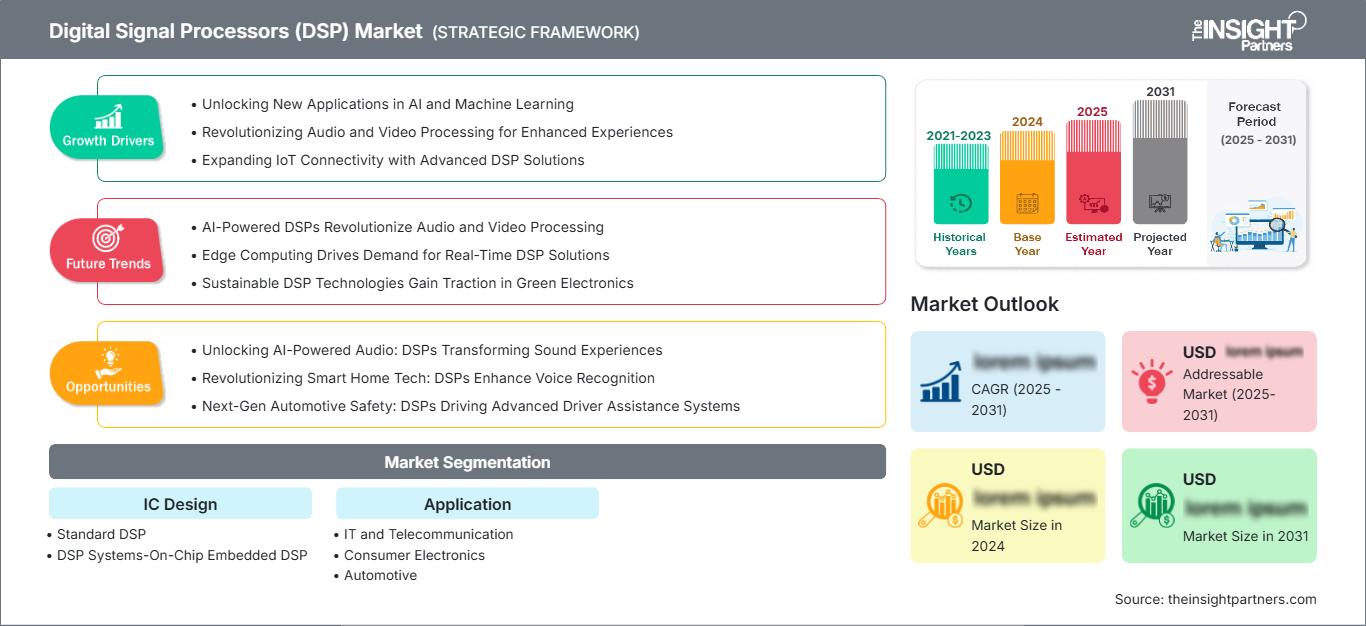
Digital Signal Processors (DSP) Market: Strategic Insights
Regional Insights
North America Digital Signal Processors Market
North America held 31–34% share in 2025 and is projected to grow at a CAGR range of 5.4–6.2% through 2034. The Digital Signal Processors Market share is supported by US semiconductor design, defense electronics, 5G radio access networks, medical imaging, and industrial automation. Regional demand also benefits from edge AI investment and cloud-connected device ecosystems.
The United States leads design activity, while Canada contributes through telecom, aerospace, and AI research clusters. Growth is tempered by foundry dependence and skilled engineering shortages, yet domestic semiconductor incentives and defense procurement provide resilience. Buyers prioritize secure supply, long lifecycle components, and software-supported platforms for safety-critical or mission-critical deployment.
U.S. Digital Signal Processors Market
The US represented 78–82% of North America in 2025 and is forecast to grow at a CAGR range of 5.5–6.3%. Analog Devices, Inc., Texas Instruments Incorporated, Broadcom Inc., Marvell Technology, Inc., Altera Corporation, and MIPS Technologies, Inc. support design, IP, embedded processing, and communications silicon. Applications include base stations, defense sensors, medical devices, audio systems, and automotive electronics.
Demand is strengthened by defense modernization, broadband infrastructure, and advanced medical equipment manufacturing. US buyers value high reliability, export compliance, cybersecurity, and software continuity. Automotive applications are expanding through radar processing, audio enhancement, battery management, and sensor fusion, while industrial users deploy DSP-enabled control loops for robotics, inspection, and predictive maintenance.
Europe Digital Signal Processors Market
In 2025, Europe had a market share of 22–25%, and it will have growth between 4.9% and 5.7% CAGR. Germany is leading the market in automotive electronics, industrial automation, and powertrain control. The UK has its share of contributions in terms of aerospace, telecom research, and defense electronics, whereas France has avionics, medical equipment, and communication systems. Infineon Technologies AG drives semiconductor manufacturing within the region.
Italy and Spain contribute via their share in industrial machinery, the automotive industry supply chain, smart infrastructure, and medical devices. In terms of procurement, the region values functional safety, energy efficiency, sustainability, and long support cycles. Europe will have growth slower than Asia Pacific, but it still possesses engineering expertise and high automotive segment demands for durable adoption of DSP technologies.
APAC Digital Signal Processors Market
In 2025, Asia Pacific occupied 34-38% market share and has forecasted a CAGR of 6.4-7.2%. China dominates volume consumption due to applications in smartphones, networking, industrial automation, and electric cars. Japan and South Korea have added value through applications in the automobile, imaging, robotics, and consumer electronics. India’s contributions come from telecom infrastructures and electronics design services.
Taiwan possesses a well-developed semiconductor manufacturing platform for advanced packaging and SOC production. Policies on 5G networks, electronics manufacturing, smart manufacturing, and electric vehicle platforms continue to boost the industry. Manufacturing density, proximity of suppliers, and fast device refresh cycles work positively for the Digital Signal Processors Market in APAC.
Middle East & Africa Digital Signal Processors Market
Middle East & Africa is projected to grow at a CAGR range of 4.6–5.4% as Saudi Arabia, the UAE, South Africa, and the rest of MEA invest in telecom networks, surveillance electronics, healthcare infrastructure, and industrial digitization. The UAE leads premium smart-city and communications deployment, while Saudi Arabia expands connected infrastructure.
Regional demand is linked to 5G coverage, energy automation, airport systems, and defense electronics. Adoption depends on import channels, systems integration capacity, and maintenance skills. Growth is smaller than APAC, but high-value infrastructure programs create opportunities for DSP-enabled networking, imaging, monitoring, and secure communications platforms.
Segmentation Analysis
IC Design
IC Design is expected to grow at a CAGR range of 5.6–6.4% from 2026 to 2034 as the Digital Signal Processors Market scope spans discrete processors, embedded cores, and SoC-level integration. OEMs increasingly prefer architectures that reduce board space, power consumption, and software complexity while preserving real-time throughput for communications, audio, imaging, control, and sensor workloads.
- Standard DSP remains important for applications requiring predictable processing, established toolchains, and moderate customization, especially in industrial control, audio equipment, medical devices, and legacy communications platforms.
- DSP Systems-On-Chip Embedded DSP gains strategic importance as vendors integrate DSP cores into SoCs for smartphones, vehicles, networking equipment, and edge devices requiring compact, power-efficient, application-specific processing.
Application
Application is projected to grow at a CAGR range of 5.8–6.6% during 2026–2034 as DSPs move deeper into connectivity, mobility, automation, healthcare, and defense systems. The segment benefits from higher data rates, richer sensor streams, advanced audio and video processing, and the need to execute signal algorithms locally instead of relying only on cloud resources.
- IT and Telecommunication leads revenue contribution because baseband processing, routers, optical networking, modems, and 5G infrastructure require high-throughput filtering, coding, beamforming, and compression.
- Consumer Electronics uses DSPs in smartphones, wearables, cameras, speakers, televisions, and gaming devices where audio clarity, image enhancement, voice recognition, and battery efficiency affect user experience.
- Automotive demand rises as vehicles add radar, audio processing, power electronics, battery management, infotainment, driver monitoring, and sensor fusion across electric and software-defined platforms.
- Industrial adoption is supported by motor control, machine vision, robotics, vibration monitoring, test equipment, and predictive maintenance systems that require deterministic real-time processing.
- Aerospace and Defense applications rely on DSPs for radar, sonar, electronic warfare, secure communications, navigation, avionics, and surveillance systems operating under strict reliability requirements.
- Medical systems use DSPs in ultrasound, hearing aids, patient monitoring, imaging, diagnostics, and portable devices where low noise, low power, and rapid signal interpretation are critical.
Opportunity Snapshot
| Application | Revenue Contribution | Trend Tag | Adoption Stage |
| IT and Telecommunication | High | 5G Baseband | Mature |
| Consumer Electronics | High | Voice AI | Mature |
| Automotive | Medium | Sensor Fusion | Scaling |
| Industrial | Medium | Motor Control | Scaling |
| Aerospace and Defense | Medium | Secure Radar | Mature |
| Medical | Low | Portable Imaging | Scaling |
Digital Signal Processors (DSP) Market Growth Drivers and Impact Analysis
5G and Edge Networks Increase Real-Time Processing Load
For telecommunication systems, DSPs are required for functions like modulation, demodulation, beamforming, echo cancellation, compression, and coding of channels as traffic transitions to more crowded environments using 5G technology, fixed wireless access, private networks, and edge gateways. The ITU and national regulatory bodies will continue to license additional spectrum to provide higher-bandwidth services. This influences the DSP market by driving demand for vendors that supply efficient processor cores, baseband processing capabilities, and software toolsets that help reduce time-to-market.
Software-Defined Vehicles Expand DSP Content
The automotive platform is evolving to include signal rich features such as radar signal processing, audio enhancement, cabin monitoring, battery management, motor control, and software updates over air. In the process, DSPs can be useful in making noisy sensor inputs into meaningful signals without violating power and latency constraints. The resulting impact on the market will be from single use electronic control units to domain controllers/SoCs with embedded signal processing capabilities. The semiconductor companies stand to gain in case they offer their customers automotive qualified devices, safety reports, software and scalable architecture.
Industrial Automation Requires Deterministic Control
Factories, utilities, and logistics facilities are adopting robotics, machine vision, predictive maintenance, and precision motor drives that depend on rapid signal interpretation. DSPs support vibration analysis, current sensing, torque control, image preprocessing, and closed-loop response where cloud latency is unacceptable. The market impact is higher demand for rugged, low-power processors integrated with analog interfaces and security features. Industrial buyers value long availability, stable software, and predictable timing more than headline peak performance. Vendors that support real-time operating systems, development boards, and application libraries can reduce engineering friction and accelerate deployment across equipment makers.
Digital Signal Processors (DSP) Market Future Trends
AI-Assisted Signal Processing Moves to the Edge
Digital Signal Processors Market trends will increasingly reflect the merging of classical signal processing with compact AI models running close to sensors. Future DSP platforms will filter raw signals, extract features, and support inference for voice, vibration, imaging, radar, and biomedical data before transmission. This reduces bandwidth, improves privacy, and lowers latency in devices that cannot rely on constant cloud access. The trend will favor hybrid architectures combining DSP cores, neural accelerators, and secure memory. Suppliers with strong software ecosystems and model-optimization tools will be better positioned as customers demand intelligent processing within constrained power envelopes.
Configurable DSP IP Becomes Central to SoC Differentiation
As semiconductor companies design specialized SoCs, configurable DSP IP will become more important than one-size-fits-all processor blocks. Device makers need cores that can be tuned for audio, modem, radar, motor-control, imaging, or sensor-fusion workloads while minimizing die area and energy use. This trend supports licensing models, reusable verification environments, and domain-specific software libraries. It also increases the strategic value of CEVA, Inc., MIPS Technologies, Inc., and FPGA-oriented platforms where customers want flexibility before committing to fixed silicon. The result is a market where customization and ecosystem support matter as much as raw processing speed.
Digital Signal Processors (DSP) Market Opportunities
Automotive Sensor Fusion and Power Electronics Platforms
Digital Signal Processors Market Forecasts point to strong opportunity in automotive platforms that combine radar, audio, battery, motor-control, and driver-monitoring workloads within scalable electronic architectures. Suppliers can target OEMs seeking fewer chips, lower power, and common software across vehicle lines. The investment case is strongest for automotive-qualified DSP cores, reference designs, middleware, and safety-ready documentation. Partnerships with Tier 1 suppliers and EV platform developers can expand design wins. Companies that demonstrate stable performance across temperature, noise, vibration, and electromagnetic interference will be well placed as software-defined vehicles increase real-time signal workload.
Portable Medical and Remote Monitoring Devices
Medical equipment makers need compact, low-power processors that convert sensor signals into reliable diagnostic or monitoring outputs. DSP suppliers can pursue opportunities in ultrasound probes, hearing aids, ECG monitors, wearable health devices, and point-of-care imaging systems. The opportunity is attractive because healthcare providers are expanding remote care and portable diagnostics to improve access and reduce facility pressure. Vendors must support low noise, regulatory documentation, security, and long product lifecycles. Analog front-end integration, embedded algorithms, and validated development tools can help device manufacturers shorten approval timelines while improving battery life and measurement consistency.
Recent Developments
- July 2026: Analog Devices, Inc. completed the acquisition of Empower Semiconductor, expanding its high-density power portfolio for AI-era computing platforms and strengthening support for compact, power-efficient electronics that complement advanced signal-processing systems.
- March 2026: NXP Semiconductors N.V. announced new innovations for advanced physical AI with NVIDIA, reinforcing its strategy to combine embedded processing, connectivity, and intelligent edge capabilities for robotics, mobility, and industrial systems.
- March 2026: Analog Devices, Inc. announced a new Thailand manufacturing facility to strengthen global manufacturing resilience, supporting supply assurance for mixed-signal, power, and signal-processing components used across automotive, industrial, communications, and healthcare electronics.
Frequently Asked Questions

- Comprehensive Market Sizing and Forecast Analysis
- Detailed Segmentation Analysis
- In-Depth Market Dynamics Assessment
- Regional and Country-Level Insights
- Competitive Landscape and Company Benchmarking
- Strategic Business Intelligence
Recent Reports
Testimonials

The Insight Partners' SCADA System Market report is comprehensive, with valuable insights on current trends and future forecasts. The team was highly professional, responsive, and supportive throughout. We are very satisfied and highly recommend their services.
RAN KEDEM Partner, Reali Technologies LTDs
I requested a report on a very specific software market and the team produced the report in a few days. The information was very relevant and well presented. I then requested some changes and additions to the report. The team was again very responsive and I got the final report in less than a week.
JEAN-HERVE JENN Chairman, Future Analytica
We worked with The Insight Partners for an important market study and forecast. They gave us clear insights into opportunities and risks, which helped shape our plans. Their research was easy to use and based on solid data. It helped us make smart, confident decisions. We highly recommend them.
PIYUSH NAGPAL Sr. Vice President, High Beam Global
The Insight Partners delivered insightful, well-structured market research with strong domain expertise. Their team was professional and responsive throughout. The user-friendly website made accessing industry reports seamless. We highly recommend them for reliable, high-quality research services
YUKIHIKO ADACHI CEO, Deep Blue, LLC.
This is the first time I have purchased a market report from The Insight Partners.While I was unsure at first, I visited their web site and felt more comfortable to take the risk and purchase a market report.I am completely satisfied with the quality of the report and customer service. I had several questions and comments with the initial report, but after a couple of dialogs over email with their analyst I believe I have a report that I can use as input to our strategic planning process.Thank you so much for taking the extra time and making this a positive experience.I will definitely recommend your service to others and you will be my first call when we need further market data.
JOHN SUZUKI President and Chief Executive Officer, Board Director, BK Technologies
I wish to appreciate your support and the professionalism you displayed in the course of attending to my request for information regarding to infectious disease IVD market in Nigeria. I appreciate your patience, your guidance, and the fact that you were willing to offer a discount, which eventually made it possible for us to close a deal. I look forward to engaging The Insight Partners in the future, all thanks to the impression you have created in me as a result of this first encounter.
DR CHIJIOKE ONYIA MANAGING DIRECTOR, PineCrest Healthcare Ltd.Reason to Buy
- Informed Decision-Making
- Understanding Market Dynamics
- Competitive Analysis
- Identifying Emerging Markets
- Customer Insights
- Market Forecasts
- Risk Mitigation
- Boosting Operational Efficiency
- Strategic Planning
- Investment Justification
- Tracking Industry Innovations
- Aligning with Regulatory Trends





 Get Free Sample for