
Digital Textile Printing Market Share, Growth & Demand by 2034
Coverage: by Printing Process (Roll to Roll and DTG); Ink Type (Sublimation, Pigment, Reactive, Acid, and Others); Application (Textile and Decor, Industrial, Soft Signage, and Direct to Garment) , and Geography (North America, Europe, Asia Pacific, and South and Central America)
- Status : Data Released
- Report Code : TIPMC00002535
- Category : Manufacturing and Construction
- No. of Pages : 150
- Available Report Formats :


- Last update date : July 28, 2026


2025 Market Size
US$ 6,865.33 Mn
Base year value
2034 Forecast
US$ 19,005.37 Mn
Projected by 2034
CAGR 2026-2034
11.98 %
Growth rate
Addressable Market
US$ 113,496.08 Mn
(2026-2034)
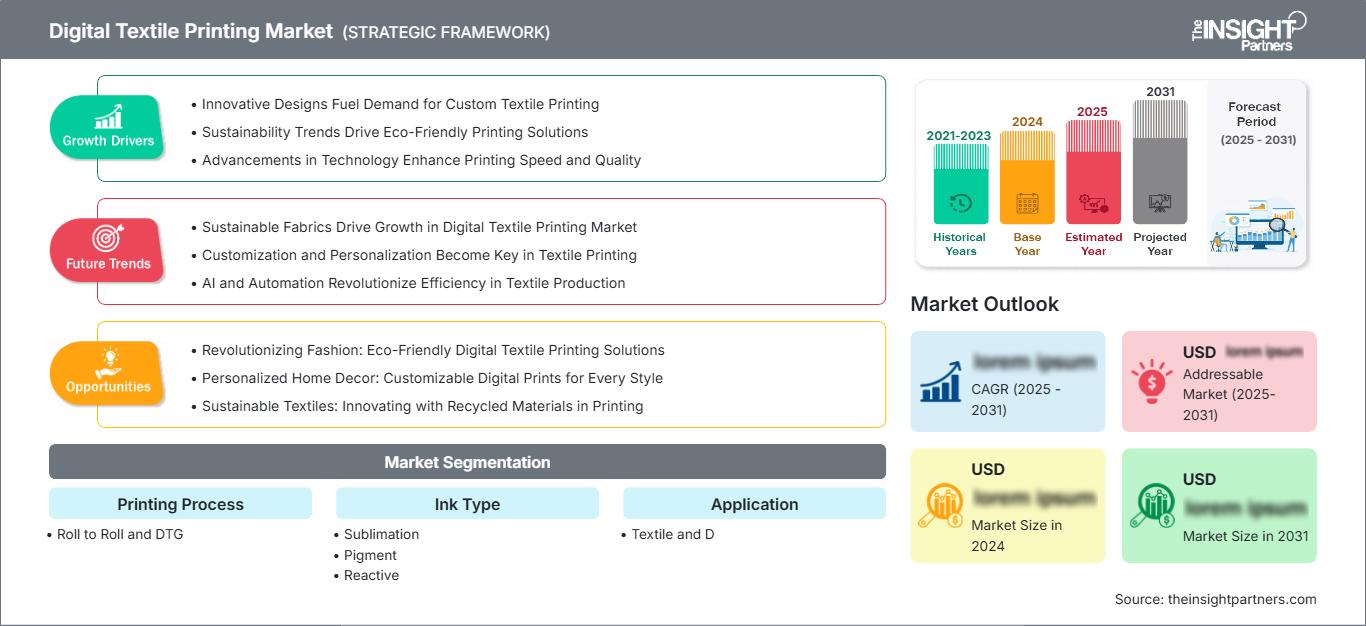
The digital textile printing market was valued at US$ 6,865.33 Million in 2025 and is projected to reach US$ 19,005.37 Million by 2034. The market is expected to grow at a CAGR of 11.98% during 2026–2034, supported by rising demand for short-run textile production, personalized apparel, sustainable printing workflows, and faster design-to-delivery cycles across fashion, home textile, signage, and industrial fabric applications.
North America is expected to maintain a measured but resilient expansion profile, with an estimated CAGR range of 10.6–11.4% through 2034. The digital textile printing market size in the region is influenced by localized apparel fulfillment, premium home décor customization, and growing investment in pigment-based systems that reduce process complexity for small-batch producers and digitally native brands.
Digital Textile Printing Market Assessment and Insights
- North America held 24–27% share in 2025 and is projected to grow at a CAGR of 10.6–11.4% during 2026–2034, supported by print-on-demand apparel networks, branded merchandise, and sustainability-led equipment upgrades.
- US accounted for 78–82% of North America in 2025 and is forecast to expand at a CAGR of 10.8–11.6% during 2026–2034.
- Europe represented 31–34% share in 2025 and is expected to grow at a CAGR of 10.9–11.7% during 2026–2034, led by Italy, Germany, the UK, France, and Spain.
- Asia Pacific captured 33–36% share in 2025 and is projected to grow at a CAGR of 12.8–13.6% during 2026–2034, led by China, India, Japan, and South Korea.
- Largest Segment Roll to Roll printing held 62–66% market share in 2025 and is expected to grow at a CAGR of 11.3–12.1% during 2026–2034.
- High Growth Segment DTG printing held 34–38% market share in 2025 and is expected to grow at a CAGR of 12.6–13.4% during 2026–2034.
- Key companies analyzed in detail: Seiko Epson Corporation, Mimaki Engineering Co., Ltd., Kornit Digital Ltd., Electronics for Imaging, Inc., d.gen Inc., Durst Group AG, Konica Minolta, Inc., Ricoh Company, Ltd., SPGPrints B.V., ColorJet Group.
Source: The Insight Partners' analysis based on proprietary research, government publications, company annual reports, investor presentations, industry databases, and expert interviews.
Digital textile printing technology has progressed beyond sampling and marketing pieces into full-scale production thanks to improved printheads, chemical pretreatments for the fabric, and advanced color management software, which have helped to close the gap with rotary and screen-printing technologies in terms of print quality. Now the digital textile printing industry enjoys solutions that enable production workflows that save time in set-up, decrease inventory risks, and make it possible to produce small-batch designs.
The growth of the industry will be driven by Asian production capabilities in textiles, European recycling standards, and re-shoring of decorated garments in North America. Buyers will look for solutions that use less water, enable fast artwork switching, and provide consistent color reproduction – all of which is possible through an ecosystem of printers, ink, and software.
Digital Textile Printing Market Report Scope
| Report Attribute | Details |
|---|---|
| Market size in 2025 | US$ 6,865.33 Million |
| Market Size by 2034 | US$ 19,005.37 Million |
| Global CAGR (2026 - 2034) | 11.98% |
| Historical Data | 2021-2024 |
| Forecast period | 2026-2034 |
Digital Textile Printing Market Analysis
Market growth in digital textile printing is driven by the need for fast fashion capsule collections, personalized sportswear designs, soft signage and décor lines, all featuring frequent updates. Brands have been utilizing digital technologies to minimize minimum order quantities and decrease sampling time. Meanwhile, textile mills consider inkjet technologies as an opportunity to produce more diverse output without running lengthy analog production runs.
The supply chain is based on printhead availability, ink formulation, pretreatment compatibility and finishing capacity. Equipment manufacturers are developing their service networks, as equipment up-time and consistent color performance define the profitability of converters. Software companies providing RIP solutions, fabric companies, chemical formulators, and digital textile printing fulfillment solutions represent the supply chain as well.
Analysis of the market reveals that there is stiff competition among companies such as Seiko Epson Corporation, Mimaki Engineering Co., Ltd., Kornit Digital Ltd., Electronics for Imaging, Inc., and Durst Group AG in terms of productivity, a wide variety of inks, automation, and workflow integration. The specialist vendors include d.gen Inc., SPGPrints B.V., and ColorJet Group and provide solutions tailored to the regional converter needs.
The strategic focus of the industry players is on earning revenue from the entire lifecycle of the products including ink, service, training, and software rather than selling the hardware. Companies such as Konica Minolta, Inc. and Ricoh Company, Ltd. have experience in printhead technology and industrial imaging, while Kornit Digital Ltd. provides integrated direct-to-garment platforms.
● REPORT CUSTOMIZATION
Tailor This Report To Align With Your Specific Business Requirements
This report can be customized to align precisely with your business objectives, scope, and target markets. Customization options include tailored segmentation, geography, competitive analysis, and strategic insights to support informed decision-making.
Customize This Report →WHAT YOU CAN ADJUST
- ● Segmentations
- ● Geography
- ● Competitive Analysis
- ● Language Preferences
Digital Textile Printing Market: Strategic Insights
Regional Insights
North America digital textile printing market
North America held 24–27% share in 2025 and is forecast to grow at a CAGR of 10.6–11.4% during 2026–2034. The regional digital textile printing market share is supported by direct-to-consumer apparel platforms, localized promotional merchandise, and premium home textile personalization, particularly where short lead times and SKU flexibility outweigh very high-volume analog economics.
Printers in the region are adopting pigment and DTG systems to serve cotton-rich apparel, teamwear, and corporate merchandise. Structural drivers include domestic fulfillment centers, e-commerce-driven customization, and brand pressure to reduce overproduction. Equipment replacement is selective, but converters are investing where digital systems improve turnaround, waste control, and repeat ordering across distributed production sites.
U.S. Digital Textile Printing Market
The US accounted for 78–82% of North America in 2025 and is projected to expand at a CAGR of 10.8–11.6% during 2026–2034. The demand is largely for decorated clothing, sports goods, drop shipping through online platforms, and soft signage, where quick change of artwork and small runs help protect margins.
The company's presence is indicated by the vendors of equipment and services for DTG, roll-to-roll printing, and hybrid printing. US converters are also using web-to-print solutions and workflow automation due to variable order volumes. The applications include cotton clothing, polyester sportswear, décor materials, and event graphics needing precise colors and quick delivery.
Europe Digital Textile Printing Market
Europe represented 31–34% share in 2025 and is expected to grow at a CAGR of 10.9–11.7% during 2026–2034. Italy remains a leading country because of fashion textile clusters, premium finishing capabilities, and machinery know-how. Germany supports technical textile adoption, while the UK advances personalized apparel and design-led interiors.
France, Spain, and Italy add demand through luxury fashion, home décor, and Mediterranean textile supply chains that require shorter seasonal cycles. Regulatory pressure around wastewater, chemicals, and waste reduction supports digital adoption when paired with certified inks and efficient finishing. Europe’s installed base is mature, but replacement demand favors productivity and sustainability upgrades.
APAC Digital Textile Printing Market
APAC captured 33–36% share in 2025 and is projected to grow at a CAGR of 12.8–13.6% during 2026–2034. China is the leading country, supported by textile scale, export capacity, and automation investment. India is expanding through apparel clusters, while Japan and South Korea contribute precision engineering and high-quality applications.
Australia remains smaller but steady, driven by décor, signage, and localized fulfillment. Policy interest in cleaner processing, textile park modernization, and manufacturing digitization supports adoption. Industrial drivers include polyester sportswear, sublimation signage, cotton apparel exports, and supplier pressure to reduce water, inventory, and sampling waste.
Middle East & Africa Digital Textile Printing Market
The Middle East & Africa is expected to grow at a CAGR of 9.4–10.2% during 2026–2034. The UAE is the leading country for premium interiors, hospitality textiles, and event graphics, while Saudi Arabia supports demand through infrastructure, tourism, and retail development. South Africa contributes apparel, décor, and signage applications.
The rest of MEA demand remains project-led, with adoption tied to distributor coverage, training, and consumable availability. Energy and infrastructure investment can lift textile decoration needs, but financing constraints limit rapid equipment replacement. Digital systems gain relevance where localized production reduces import lead times and supports customized hospitality and retail environments.
Segmentation Analysis
Printing Process
Printing Process is expected to grow at a CAGR of 11.7–12.5% during 2026–2034. The digital textile printing market scope across printing process is defined by converter economics, substrate format, and fulfillment model. Roll to Roll supports industrial fabric throughput, while DTG enables personalized garments, online drops, and localized micro-factory production.
- Roll-to-roll remains the dominant process for continuous fabric, polyester applications, home textiles, and signage, offering higher throughput, repeatable color control, and stronger economics for medium-to-large production batches.
- DTG serves garment decorators, online sellers, and branded merchandise providers by enabling detailed prints, short runs, and rapid personalization directly on finished apparel with limited setup complexity.
Ink Type
Ink Type is projected to grow at a CAGR of 11.5–12.3% during 2026–2034. Ink choice determines fabric compatibility, pretreatment needs, fixation method, fastness, and environmental profile. Sublimation remains central for polyester, pigment is expanding through simpler processing, reactive supports cotton quality, and acid inks serve premium nylon, silk, and specialty textiles.
- Sublimation is widely used for polyester apparel, sportswear, flags, and soft signage because it delivers strong color vibrancy, wash durability, and efficient transfer workflows for synthetic fabrics.
- Pigment is gaining strategic importance because it can print across multiple fiber types, reduces washing steps, and supports lower-water workflows for fashion, décor, and DTG applications.
- Reactive remains important for cotton, viscose, and natural fibers, where hand feel, deep shades, and wash fastness are critical for premium apparel and home textile products.
- Acid serves silk, wool, nylon, and selected technical fabrics, supporting high-quality color output in scarves, swimwear, activewear, and specialty textile applications requiring strong fiber affinity.
Application
Application is expected to grow at a CAGR of 11.8–12.6% during 2026–2034. Textile applications dominate because apparel, décor, and signage increasingly require fast artwork changes and lower inventory risk. The D application category is emerging around digitally enabled design, decoration, and display uses where customization and small-batch economics are decisive.
- Textile and Decor includes apparel, home fabrics, sportswear, and soft signage, with demand driven by customization, seasonal collections, and the need to reduce sampling, screens, and excess inventory.
- Advertisements represent design-led decoration and display applications where rapid graphics, localized production, and product differentiation support adoption across events and retail environments.
Opportunity Snapshot
| Application | Revenue Contribution | Trend Tag | Adoption Stage |
| Textile | High | On Demand | Scaling |
| Advertisements | Medium | Retail Graphics | Emerging |
Digital Textile Printing Market Growth Drivers and Impact Analysis
Shift to On-Demand Apparel Fulfillment
Brands are cutting their risks through reducing inventory and going from forecasting-driven mass production to order-related decoration and replenishment. Such a trend will directly support the adoption of DTG and roll-to-roll technology due to the ability to change print files without any additional steps like screen or plate preparation or lengthy setups. The trend will work best on online apparel, teamwear, merchandise, and capsule collection segments, where there is a variety of designs and shorter lifecycles. For converters, it means earning money through small orders and better sell-through and reduced risks of markdowns for buyers. It will positively influence the digital textile printing industry due to the integration of printers in fulfillment centers with web-to-print solutions, color libraries, and automatic order processing.
Sustainability Pressure on Textile Wet Processing
Textile manufacturers have come under increasing pressure related to wastewater, chemical discharges, energy consumption, and fabric waste. Digital printing tackles all these challenges by being more efficient in how it prints and by decreasing the need for screens, sampling, waste, and large batch sizes. Pigment printing processes are especially important because they can offer an easier process than dye methods, which demand extensive washing procedures. The business advantage is the increased value proposition for the mill for brands that are evaluated on their environmental record, audits performed by retailers, and low-inventory strategies. Adoption will be driven by more than regulatory requirements because decreased reworks, faster approval cycles, and fewer obsolete inventories increase resiliency of operations in clothing, household textiles, and signage chains.
Improved Printhead, Ink, and Workflow Integration
Improvements in industrial inkjet performance are reflected in greater reliability of the nozzles, more accurate drop positioning, color gamut expansion, and stability of textile inks. These upgrades help to minimize machine downtime and enable printing on a wider variety of fabrics. Workflows are also an important factor, as the process of preparing for jobs, color matching, nesting, and tracking production plays a crucial role in the profitability of the digital machines. The reason why the vendors now offer bundled solutions which include not only printers but also RIPs, maintenance services, inks and finishing advice, is that converters are thus able to move from sampling to production. This helps to speed up the qualification process by the brands and makes production more predictable and widespread among textile mills, garment decorators and special fabric manufacturers.
Digital Textile Printing Market Future Trends
Single-Step and Near-Waterless Production Systems
Future digital textile printing market trends will increasingly center on single-step systems that combine pretreatment, printing, fixation, and quality control in a more compact workflow. The trend is relevant because labor shortages and energy costs are pushing converters to simplify production while maintaining color and wash performance. Near-waterless approaches will gain attention in regions where textile processing faces discharge limits or water stress. Vendors that validate durable pigment and hybrid ink platforms can address broader fiber mixes without complex wet finishing. Over time, this trend may reduce the gap between sample-room flexibility and industrial-scale productivity.
AI-Assisted Color Control and Micro-Factory Networks
AI-enabled color management, predictive maintenance, and automated job routing are anticipated to transform distributed textile manufacturing. Microfactories will be able to have small digital solutions nearer to demand centers, thereby cutting logistics delays and facilitating localized drops of goods. The real value is to be derived from consistency of profiles across facilities, automated proofing of artwork, and data related to production, which will enable online demand to be matched against printer capabilities. These capabilities suit software-centric solutions providers more than others. Buyers benefit from faster replenishments, regionalization of assortments, and lower finished prints stocks globally.
Digital Textile Printing Market Opportunities
Expansion into Home Textile Customization
Home textile customization offers a practical investment route because curtains, cushions, bedding, wall coverings, and décor fabrics increasingly require differentiated patterns without long inventory commitments. The digital textile printing market forecasts point to stronger value creation where converters connect design libraries, online visualization tools, and roll-to-roll production. Retailers can test regional aesthetics, seasonal palettes, and designer collaborations with lower minimums. Equipment suppliers can target this opportunity through wider-format systems, décor-grade color management, and application support for polyester, cotton, and blended fabrics. The opportunity is strongest where interior brands need faster launches and controlled obsolescence risk.
Regional Textile Parks and SME Converter Upgrades
The presence of textile parks, industrial zones, and small to medium converters constitutes an actionable opportunity in the area for suppliers who can provide financing, training, maintenance, and consumables. There is great demand among SMEs for digitization, but it is inhibited by issues concerning operator competence, color uniformity, and ROI. The provision of bundled offerings that include application recipes, certified ink, remote monitoring, and workflow templates may speed up the process. Governments and development agencies, concerned with greener manufacturing practices, may also provide support in terms of modernization via the provision of shared resources or incentives.
Recent Developments
- July 2026- Brother International Corporation has introduced the GTX300 Hybrid Garment Printer, a new digital printing solution designed to provide apparel decorators with greater flexibility by combining direct-to-garment (DTG) and direct-to-film (DTF) printing capabilities in a single platform. The new system enables businesses to handle a wider range of customization requirements without investing in separate printing equipment
- September 2024: Seiko Epson Corporation announced that Epson has entered into an agreement with affiliates of Siris Capital Group, LLC, including Electronics for Imaging, Inc., to acquire all interests in Fiery, LLC ("Fiery"), a U.S.-based company which is the leading provider of digital front end* ("DFE") servers and workflow solutions for the print industry
- March 2024: Mimaki USA, announced TRAPIS, a next-generation digital transfer sublimation printing system that makes textile production more environmentally friendly by reducing up to 90 percent of wastewater, compared to conventional methods. This system does not require wastewater treatment facilities and can be located in an office or extended studio location.
Frequently Asked Questions

- Comprehensive Market Sizing and Forecast Analysis
- Detailed Segmentation Analysis
- In-Depth Market Dynamics Assessment
- Regional and Country-Level Insights
- Competitive Landscape and Company Benchmarking
- Strategic Business Intelligence
Recent Reports
Testimonials

The Insight Partners' SCADA System Market report is comprehensive, with valuable insights on current trends and future forecasts. The team was highly professional, responsive, and supportive throughout. We are very satisfied and highly recommend their services.
RAN KEDEM Partner, Reali Technologies LTDs
I requested a report on a very specific software market and the team produced the report in a few days. The information was very relevant and well presented. I then requested some changes and additions to the report. The team was again very responsive and I got the final report in less than a week.
JEAN-HERVE JENN Chairman, Future Analytica
We worked with The Insight Partners for an important market study and forecast. They gave us clear insights into opportunities and risks, which helped shape our plans. Their research was easy to use and based on solid data. It helped us make smart, confident decisions. We highly recommend them.
PIYUSH NAGPAL Sr. Vice President, High Beam Global
The Insight Partners delivered insightful, well-structured market research with strong domain expertise. Their team was professional and responsive throughout. The user-friendly website made accessing industry reports seamless. We highly recommend them for reliable, high-quality research services
YUKIHIKO ADACHI CEO, Deep Blue, LLC.
This is the first time I have purchased a market report from The Insight Partners.While I was unsure at first, I visited their web site and felt more comfortable to take the risk and purchase a market report.I am completely satisfied with the quality of the report and customer service. I had several questions and comments with the initial report, but after a couple of dialogs over email with their analyst I believe I have a report that I can use as input to our strategic planning process.Thank you so much for taking the extra time and making this a positive experience.I will definitely recommend your service to others and you will be my first call when we need further market data.
JOHN SUZUKI President and Chief Executive Officer, Board Director, BK Technologies
I wish to appreciate your support and the professionalism you displayed in the course of attending to my request for information regarding to infectious disease IVD market in Nigeria. I appreciate your patience, your guidance, and the fact that you were willing to offer a discount, which eventually made it possible for us to close a deal. I look forward to engaging The Insight Partners in the future, all thanks to the impression you have created in me as a result of this first encounter.
DR CHIJIOKE ONYIA MANAGING DIRECTOR, PineCrest Healthcare Ltd.Reason to Buy
- Informed Decision-Making
- Understanding Market Dynamics
- Competitive Analysis
- Identifying Emerging Markets
- Customer Insights
- Market Forecasts
- Risk Mitigation
- Boosting Operational Efficiency
- Strategic Planning
- Investment Justification
- Tracking Industry Innovations
- Aligning with Regulatory Trends





 Get Free Sample for