
Eco-Friendly Cable Market Size, Share & Growth by 2034
Coverage: by Product Type (Polyethylene Based, Polypropylene Based, Others); Application (Communication, Petrochemicals, Manufacturing, Others) , and Geography (North America, Europe, Asia Pacific, and South and Central America)
- Status : Data Released
- Report Code : TIPRE00011006
- Category : Electronics and Semiconductor
- No. of Pages : 150
- Available Report Formats :


- Last update date : August 25, 2026


2025 Market Size
US$ 1.36 Bn
Base year value
2034 Forecast
US$ 1.9 Bn
Projected by 2034
CAGR 2026-2034
3.79 %
Growth rate
Addressable Market
US$ 14.81 Bn
(2026-2034)
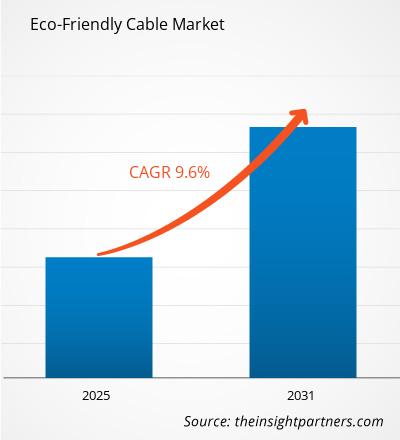
The global Eco-Friendly Cable market was valued at US$ 1.36 billion in 2025 and is expected to reach US$ 1.9 billion by 2034; it is estimated to record a CAGR of 3.79% during 2026-2034.
Eco-Friendly Cable Market Assessment and Insights
- North America held 21–24% Eco-Friendly Cable Market share in 2025 and is projected to grow at a 4.0–4.6% CAGR during 2026–2034, supported by grid modernization, data centers, transit upgrades, and safer-building specifications.
- US represented 78–82% of North American revenue in 2025 and should expand at a 4.1–4.7% CAGR through 2034.
- Europe accounted for 27–30% share in 2025 and is expected to record a 4.2–4.8% CAGR, led by Germany, the UK, France, Italy, and Spain.
- Asia Pacific captured 39–43% share in 2025 and should advance at a 4.8–5.4% CAGR, led by China, Japan, South Korea, and India.
- Largest Segment Polyethylene Based cables held 45–49% market share in 2025 and are projected to post a 4.0–4.6% CAGR during 2026–2034.
- High Growth Segment Communication represented 33–37% market share in 2025 and is expected to grow at a 4.7–5.3% CAGR during 2026–2034.
- Key companies analyzed in detail: Alpha Wire; Fujikura Ltd.; Furukawa Electric Co., Ltd.; Hitachi, Ltd.; JMACS Japan Co., Ltd.; Kuramo Electric Co., Ltd.; Nexans S.A.; Oki Electric Cable Co., Ltd.; Prysmian S.p.A.; and Shikoku Cable Co., Ltd.
Source: The Insight Partners' analysis based on proprietary research, government publications, company annual reports, investor presentations, industry databases, and expert interviews.
The evolution in cable design will move beyond simple compound substitution to lifecycle engineering. Manufacturers are combining low smoke, zero halogen, recyclable thermoplastic, thin walls, recycled metal materials, and manufacturing techniques that reduce waste and energy consumption. Polyethylene continues to be an important component due to its excellent dielectric characteristics, which contribute to the creation of power and communication cables. Polypropylene is being developed due to its ability to recycle and withstand heat. Qualification will begin to associate the chemical composition of the compound with flame spread, smoke generation, mechanical resistance, electrical losses, and carbon performance data.
From now until 2034, investments will be focused in Asia manufacturing clusters, European circular economy initiatives, and North America energy grid and digitalization. Regulations on public procurement, building fire codes, restricted substances, and customer Scope 3 targets will favor product declaration transparency. Emerging capacities in India and Southeast Asia will open up opportunities for regional supply chain diversification, while recycled polymers, bio-sourced materials, and cable recycling will differentiate suppliers. Suppliers that ensure compound availability and multi-standard certification will benefit from sustainability requirements into ongoing platform business.
Eco-Friendly Cable Market Report Scope
| Report Attribute | Details |
|---|---|
| Market size in 2025 | US$ 1.36 Billion |
| Market Size by 2034 | US$ 1.9 Billion |
| Global CAGR (2026 - 2034) | 3.79% |
| Historical Data | 2021-2024 |
| Forecast period | 2026-2034 |
Eco-Friendly Cable Market Analysis
Eco-Cable Growth depends on safer buildings, increased broadband infrastructure, renewable power generation, electrified industries, and halogen-free cable replacements. The industry value chain includes raw material suppliers, metal processors, compounders, cable makers, distributors, installers, engineering firms, and asset owners. Cost dynamics include cost of polymers, flame retardant fillers, extrusion efficiency, wire cost, testing costs, and certification of the same construction in multiple regions.
The supply chain favors producers who can develop their own formulations or build lasting relationships with compounders. The buyers are interested in reduced environmental effects; however, qualification will continue to prioritize dielectric properties, bend radius, resistance to oil, temperature ranges, smoke behavior, and service life. Recycling is progressing most rapidly where traceability and consistency can be achieved without contamination or unstable processes.
The Competitive Landscape for Eco-Friendly Cable Market suggests rivalry between diversified international cable companies and application-oriented Japanese experts. Nexans S.A. and Prysmian S.p.A. take advantage of wide range of products in energy and communications, whereas Furukawa Electric Co., Ltd., Fujikura Ltd., and Hitachi, Ltd. link material science to infrastructure initiatives. Alpha Wire, JMACS Japan Co., Ltd., Kuramo Electric Co., Ltd., Oki Electric Cable Co., Ltd., and Shikoku Cable Co., Ltd. highlight their flexibility, industrial, robotic, communications, and specialty constructions.
Competitive strategy revolves around proven carbon footprint, halogen-free properties, recycling feedstocks, efficiency in transmitting signals, and production capacity. R&D investments focus on closed-loop recycling systems, digital product passports, renewable energy plants, and formulations compatible with current installations. Diversification of product range plays an important role but, still, documented environmental friendliness and timely delivery are crucial, since changing cables may require retesting of connectors, routes, and fire protection.
● REPORT CUSTOMIZATION
Tailor This Report To Align With Your Specific Business Requirements
This report can be customized to align precisely with your business objectives, scope, and target markets. Customization options include tailored segmentation, geography, competitive analysis, and strategic insights to support informed decision-making.
Customize This Report →WHAT YOU CAN ADJUST
- ● Segmentations
- ● Geography
- ● Competitive Analysis
- ● Language Preferences
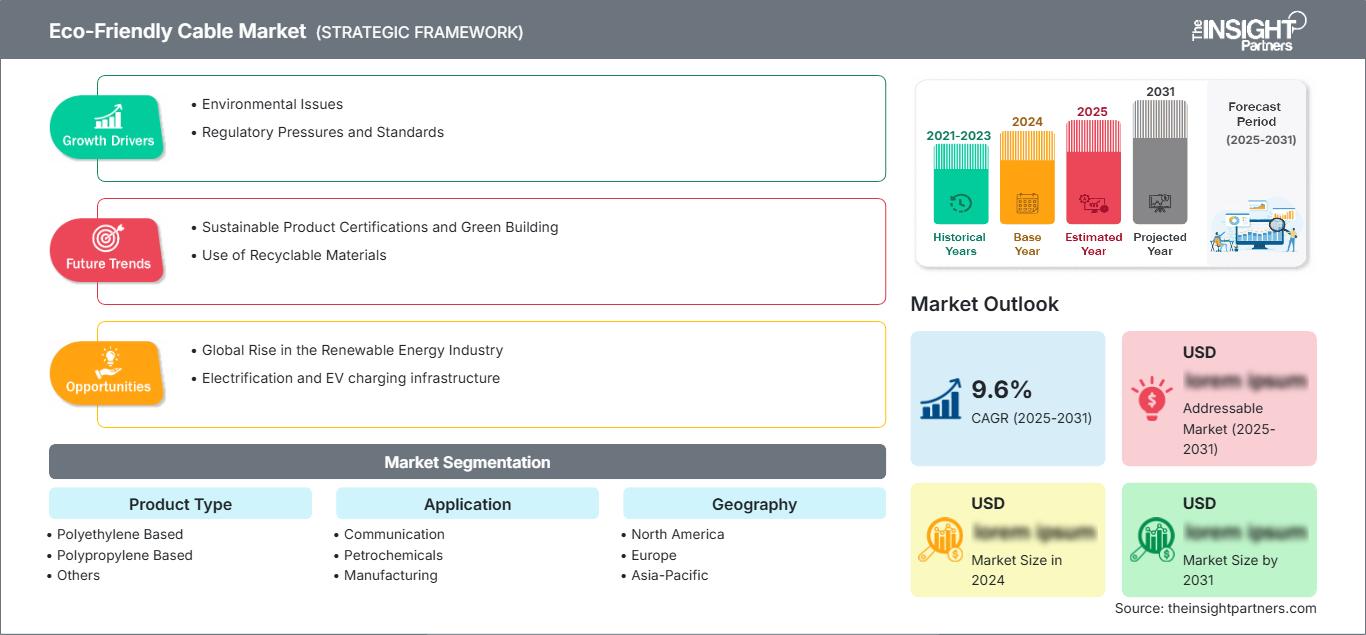
Eco-Friendly Cable Market: Strategic Insights
Regional Insights
North America Eco-Friendly Cable Market
North America had a 21–24% share in the Eco-Friendly Cable Market in 2025 and is estimated to experience a 4.0–4.6% CAGR up to 2034. Utility hardening, hyperscale data centers, broadband infrastructure, advanced manufacturing, and transportation investments help increase demand. Materials that have a low-smoke and halogen-free construction find utility where the risk of fires and corrosion needs to be reduced in an enclosed space.
Growing regional demand for environmental product declarations, recycling content, RoHS documentation, and third-party safety approvals has been observed. The United States leads design and consumption; Canada provides renewable energy and institutional demand; Mexico helps with manufacturing cables and equipment. Availability locally is crucial since projects' timetables are sensitive to costs of conductors, qualification time, and compound lead time.
U.S. Eco-Friendly Cable Market
The US represented 78–82% of North American revenue in 2025 and is expected to grow at a 4.1–4.7% CAGR during 2026–2034. Data centers, semiconductor facilities, grid upgrades, electric mobility, and automated plants create demand for low-smoke communication, control, and power cables. Alpha Wire, Nexans S.A., Prysmian S.p.A., and Japanese suppliers maintain commercial channels serving these applications.
Procurement is shifting from simple material declarations toward project-level carbon documentation and lifecycle consistency. Communication installations favor compact, flame-safe jackets, while manufacturing sites require oil, abrasion, and flex resistance. Domestic-content incentives can support regional production, although customers still balance environmental attributes against listing coverage, installation familiarity, connector compatibility, and total delivered cost.
Europe Eco-Friendly Cable Market
Europe held 27-30% of global sales revenue in 2025 and is expected to grow at a 4.2-4.8% CAGR until 2034. Germany is driven by industrial automation, railways, auto factories, renewables and grids, and product documentation. In the UK, demand is driven by data centers, transit, offshore energy production, and buildings, with fire safety and embodied carbon requirements influencing specifications.
France offers opportunities in nuclear, rail, telecoms, and public infrastructure; Italy has cable manufacturing, grids, and building renovations; Spain provides renewable energy production and digital network installation. Procurement in Europe relies increasingly on Construction Products Regulation classifications, REACH regulation, environmental declarations, and circularity criteria. Suppliers that can demonstrate the chemistry, smoke performance, recycled content, and energy-efficient transmission capabilities will have framework agreement opportunities.
APAC Eco-Friendly Cable Market
Asia Pacific held 39–43% share in 2025 and is forecast to grow at a 4.8–5.4% CAGR, the fastest regional pace. China leads through electronics, telecom, renewable energy, and industrial scale; Japan and South Korea contribute advanced materials, rail, robotics, and high-specification manufacturing.
India’s grid, broadband, metro, and factory investment broadens demand, while Australia supports mining, renewables, and data centers. Dense supply chains improve cost competitiveness, but export programs require multi-market compliance. Producers combining high-volume extrusion with verified low-smoke formulations and material traceability can gain share.
Middle East & Africa Eco-Friendly Cable Market
Middle East and Africa should register a 3.7–4.3% CAGR through 2034. Saudi Arabia leads through urban development, industrial diversification, renewable projects, and data centers, while the UAE adds airports, smart buildings, logistics, and digital infrastructure.
South Africa contributes mining, utilities, manufacturing, and commercial construction; the rest of MEA remains project-driven. Heat, ultraviolet exposure, and fire safety create demanding specifications. Vendors offering certified products, regional inventory, contractor training, and durable polyethylene or polypropylene compounds can reduce project risk.
Segmentation Analysis
Product Type
The Product Type segment is projected to grow at a 4.2–4.8% CAGR during 2026–2034. Eco-Friendly Cable Market scope covers recyclable and reduced-impact insulation or jacketing systems built around polyethylene, polypropylene, and other qualified compounds. Adoption depends on dielectric performance, flame retardancy, flexibility, chemical resistance, temperature capability, extrusion stability, recycled-content traceability, and compatibility with established connectors and installation methods.
- Polyethylene Based cables hold the leading position because strong dielectric properties, moisture resistance, and broad processing familiarity support communication, power, and industrial constructions while enabling halogen-free formulations and recycled inputs.
- Polypropylene Based cables gain strategic importance where recyclability, lower density, thermal performance, and fatigue resistance matter, although compound design must balance stiffness, flame behavior, and low-temperature flexibility.
Application
The Application segment is expected to register a 4.4–5.0% CAGR during 2026–2034. Communication leads through broadband, data centers, and enterprise networks, while petrochemicals prioritize low-smoke, oil-resistant, and safety-certified constructions. Manufacturing demand spans robotics, machinery, and control systems. Across applications, adoption strengthens when environmental documentation accompanies equal or better electrical, mechanical, and fire performance.
- Communication is the high-growth application, supported by fiber densification, data-center cabling, broadband expansion, and demand for compact low-smoke jackets that reduce material use and corrosive fire emissions.
- Petrochemicals require cables with chemical, oil, heat, and flame resistance, making qualification rigorous and favoring suppliers that combine safer compounds with dependable performance in hazardous operating environments.
- Manufacturing uses flexible control, robotic, sensor, and power cables, where abrasion resistance, repeated motion, machine uptime, and restricted-substance compliance determine whether greener formulations achieve scalable adoption.
Opportunity Snapshot
| Application | Revenue Contribution | Trend Tag | Adoption Stage |
| Communication | High | Fiber Densification | Scaling |
| Petrochemicals | Medium | Safer Plants | Mature |
| Manufacturing | High | Robotic Flex | Scaling |
| Others | Low | Green Buildings | Emerging |
Eco-Friendly Cable Market Forecasts favor communication and manufacturing programs that pair recurring volumes with specification-driven differentiation. Suppliers should prioritize verified material declarations, application testing, compound security, and installer guidance to convert pilot approvals into repeat business.
Eco-Friendly Cable Market Growth Drivers and Impact Analysis
Fire Safety and Restricted-Substance Compliance
Property developers, public transport agencies, data center operators, and industries are all specifying low smoke, halogen free cabling systems to ensure less corrosion of harmful gases as well as reduced visibility due to fires. RoHS and REACH compliance is important in ensuring chemical traceability in terms of insulation materials, pigments, stabilizers, and flame retardant properties. There are benefits of this regulation not only for high-end applications but also in facilitating international sale of equipment and avoiding redesigning of the cables. The manufacturers have to balance both their smoke and toxicity needs while at the same time considering flame propagation, mechanical and dielectric properties. Manufacturers with controlled formulations, extensive third party listings, and consistent testing results enjoy reduced qualification period.
Grid, Renewable, and Digital Infrastructure Expansion
Electrical grids, renewable energy sources, data centers, and broadband infrastructure all need large amounts of cable for power, control, and communications purposes. As reported by the International Energy Agency, expansion of electricity transmission is putting pressure on supply chains and increasing the need for planning and purchasing. Embodied carbon, transmission losses, resiliency, and recycling are among several factors which favor eco-conscious cable designs as assets take into consideration their installation cost. The demand goes from transmission to internal distribution within the data center, including cooling, sensors, and backup power. The actual effect is qualification of more recyclable polyethylene, jackets with lower smoke emission, and conductor design efficiency.
Corporate Decarbonization Extends into Cable Procurement
Scope 3 activities in manufacturing firms, telecoms providers, utilities companies, and builders’ organizations now extend to purchases of equipment and materials. The cable comes into view due to its content of copper, aluminum, polymers, and high-energy fabrication process, which result in quantifiable embodied emissions. Purchasing departments are demanding footprint information, eco-declarations, recycled-content certification, and recovery schemes from their suppliers. This creates new competitive dynamics in favor of suppliers that can prove their site-specific manufacture statistics rather than use general sustainability rhetoric. Commercial benefits for the supplier include a position of preferred supplier, extended contracts, and take-back schemes. Yet the recycled material should retain its conductivity, purity, extrusion characteristics, and longevity.
Eco-Friendly Cable Market Future Trends
Mass-Balance and Bio-Attributed Polymer Adoption
Eco-Friendly Cable Market trends will increasingly include mass-balance and bio-attributed polyethylene or polypropylene that reduces fossil feedstock exposure without forcing immediate changes to cable geometry or processing equipment. The future adoption will rely on chain of custody certification, fire and aging performances which match the existing one and customer acceptance for allocating-based carbon accounting. Initially, the products need to be applied mainly in premium cables related to communication, construction, and specialty industry applications in order to receive an added value through environmental certification. For suppliers, it will be necessary to create databases related to the chemical composition of the material, additives, and carbon factors.
Digital Product Passports and Cable-Level Traceability
Future cables will come with physical products along with their digital records of polymer chemistry, amount of recycling, carbon footprints, certification of compliance, and how to handle at the end of life cycle. The QR coding may facilitate contractors' validation, asset management, maintenance, and decisions on recovery. This development will put companies having integration of laboratory data, manufacturing data, and enterprise data in an advantageous position because sustainability information needs consistency from batch to batch and from plant to plant. Digital traceability may further allow building material passports, which would enable the building owner to know how much copper and polymers can be recovered during the building renovation.
Eco-Friendly Cable Market Opportunities
Closed-Loop Cable Recovery Services
Manufacturers can build recurring relationships by collecting installation scrap and decommissioned cable, separating metals and polymers, and reintegrating qualified materials into production. Investment should target reverse logistics, regional consolidation hubs, automated sorting, and contracts with certified recyclers. The opportunity is strongest with utilities, telecom operators, data centers, and industrial campuses that generate predictable volumes and need auditable waste outcomes. Recovery programs can lower raw-material exposure, support recycled-content targets, and create service revenue beyond product sales. Success requires transparent pricing, contamination rules, chain-of-custody records, and designs that facilitate separation. Partnerships with distributors and contractors can extend collection reach without requiring every manufacturer to build standalone networks.
Application-Specific Low-Smoke Cable Platforms
Suppliers can invest in modular cable platforms tailored to data centers, rail systems, factories, and petrochemical facilities. A common material architecture, adapted through conductor size, shielding, armor, and jacket geometry, can reduce qualification cost while addressing distinct fire, chemical, flex, and electromagnetic requirements. The opportunity lies in reference specifications, connector compatibility, installation trials, and digital compliance packs that help engineering firms approve greener alternatives. Regional technical centers should support flame testing, bend-life evaluation, and failure analysis. By linking compound science with application engineering, manufacturers can earn design-in positions, reduce customer switching, and move from spot transactions toward multi-project supply agreements.
Recent Developments
- August 2026: Hanwha Solutions is moving ahead with the commercialization of a new eco-friendly power cable jacket material designed to reduce the environmental impact of power infrastructure. The company’s Wire & Cable Division has completed customer validation of CHBA-8241RC, a high-density polyethylene-based cable jacket compound containing 50% post-consumer recycled plastic. According to Hanwha Solutions, the material can reduce product-related carbon emissions by approximately 34% compared with conventional alternatives, while maintaining comparable electrical and processing performance.
- April 2025: Nexans is expanding its low-carbon cable portfolio with a new range of low-voltage cables containing 10% recycled aluminum. The initiative is part of the company’s broader circularity strategy, aimed at reducing the environmental footprint of both its operations and customers. The new cables will be manufactured at Nexans’ Jeumont facility in northern France and introduced across the French market during 2025. They will cover a range of low-voltage applications, including electricity distribution networks, industrial installations and photovoltaic systems.
- April 2025: Ducab Group has launched its latest innovation, the High Voltage (HV) Fiber Optic cable, at the Middle East Energy 2025 exhibition in Dubai. As the first of its kind in the GCC, this pioneering product will deliver smarter, greener, and more resilient power solutions to support growing global energy demand and diversification. The launch also marks a strategic step in Ducab’s global expansion, particularly in highly regulated markets like the European Union (EU), where its advanced design and compliance with international sustainability standards provide a competitive edge.
Frequently Asked Questions

- Comprehensive Market Sizing and Forecast Analysis
- Detailed Segmentation Analysis
- In-Depth Market Dynamics Assessment
- Regional and Country-Level Insights
- Competitive Landscape and Company Benchmarking
- Strategic Business Intelligence
Recent Reports
Testimonials

The Insight Partners' SCADA System Market report is comprehensive, with valuable insights on current trends and future forecasts. The team was highly professional, responsive, and supportive throughout. We are very satisfied and highly recommend their services.
RAN KEDEM Partner, Reali Technologies LTDs
I requested a report on a very specific software market and the team produced the report in a few days. The information was very relevant and well presented. I then requested some changes and additions to the report. The team was again very responsive and I got the final report in less than a week.
JEAN-HERVE JENN Chairman, Future Analytica
We worked with The Insight Partners for an important market study and forecast. They gave us clear insights into opportunities and risks, which helped shape our plans. Their research was easy to use and based on solid data. It helped us make smart, confident decisions. We highly recommend them.
PIYUSH NAGPAL Sr. Vice President, High Beam Global
The Insight Partners delivered insightful, well-structured market research with strong domain expertise. Their team was professional and responsive throughout. The user-friendly website made accessing industry reports seamless. We highly recommend them for reliable, high-quality research services
YUKIHIKO ADACHI CEO, Deep Blue, LLC.
This is the first time I have purchased a market report from The Insight Partners.While I was unsure at first, I visited their web site and felt more comfortable to take the risk and purchase a market report.I am completely satisfied with the quality of the report and customer service. I had several questions and comments with the initial report, but after a couple of dialogs over email with their analyst I believe I have a report that I can use as input to our strategic planning process.Thank you so much for taking the extra time and making this a positive experience.I will definitely recommend your service to others and you will be my first call when we need further market data.
JOHN SUZUKI President and Chief Executive Officer, Board Director, BK Technologies
I wish to appreciate your support and the professionalism you displayed in the course of attending to my request for information regarding to infectious disease IVD market in Nigeria. I appreciate your patience, your guidance, and the fact that you were willing to offer a discount, which eventually made it possible for us to close a deal. I look forward to engaging The Insight Partners in the future, all thanks to the impression you have created in me as a result of this first encounter.
DR CHIJIOKE ONYIA MANAGING DIRECTOR, PineCrest Healthcare Ltd.Reason to Buy
- Informed Decision-Making
- Understanding Market Dynamics
- Competitive Analysis
- Identifying Emerging Markets
- Customer Insights
- Market Forecasts
- Risk Mitigation
- Boosting Operational Efficiency
- Strategic Planning
- Investment Justification
- Tracking Industry Innovations
- Aligning with Regulatory Trends





 Get Free Sample for