
Electrical Bushings Market Growth, Trends & Demand by 2034
Coverage: by Type (Resin Impregnated Paper (RIP), Oil Impregnated Paper (OIP), Others); Insulation (Polymeric, Glass, Porcelain); Application (Switchgear, Transformer, Others); End User (Industries, Utilities, Others) , and Geography (North America, Europe, Asia Pacific, and South and Central America)
- Status : Data Released
- Report Code : TIPRE00008922
- Category : Electronics and Semiconductor
- No. of Pages : 150
- Available Report Formats :


- Last update date : August 11, 2026


2025 Market Size
US$ 2.88 Bn
Base year value
2034 Forecast
US$ 4.04 Bn
Projected by 2034
CAGR 2026-2034
3.83 %
Growth rate
Addressable Market
US$ 31.43 Bn
(2026-2034)
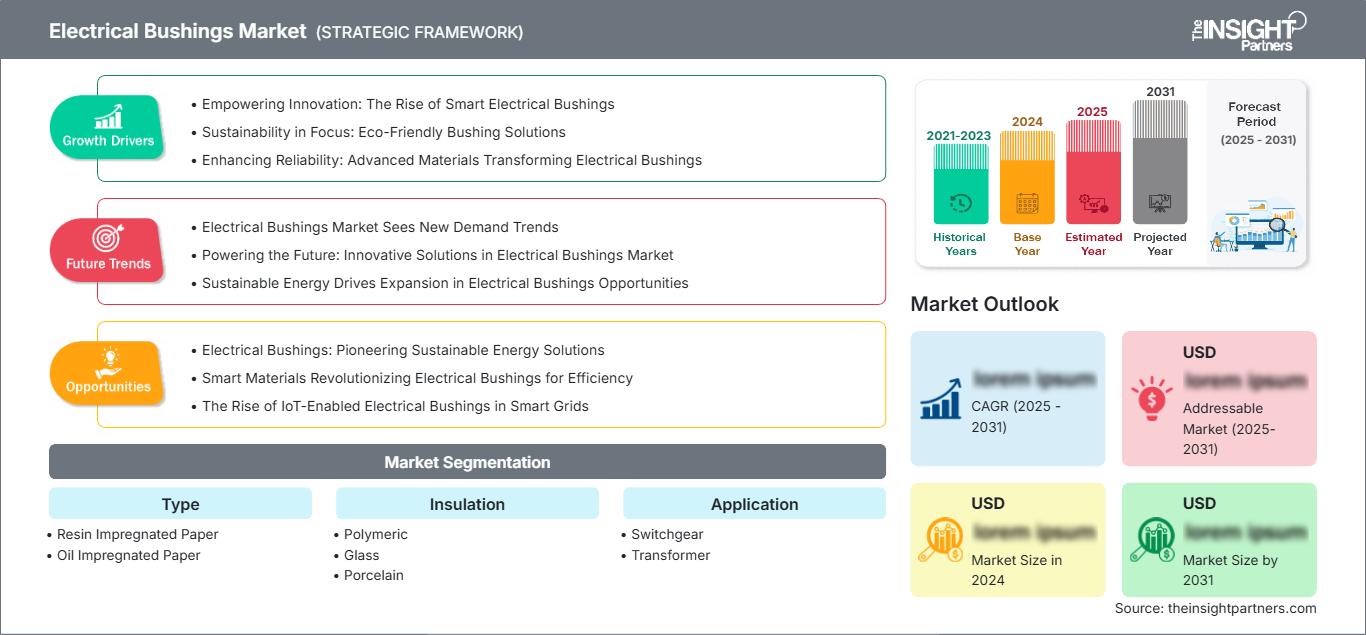
The Electrical Bushings Market size stood at US$ 2.88 billion in 2025 and is predicted to rise to US$ 4.04 billion in 2034, growing at a CAGR of 3.83% during 2026-2034. Growth stems from the indispensable importance of bushings for transferring energized wires within grounded enclosures of transformers and switchgears. The replacement, additional substation construction, and increased voltage connections ensure a solid footing for steady growth across the globe.
North America region's Electrical Bushings Market size is anticipated to expand at a modeled CAGR of 3.2–3.7% up to 2034. The aging transformer fleet, resilience investments, and interconnection of data centers are driving demand. Utilities' focus on condition-based maintenance is supporting the procurement of resin-impregnated paper as well as polymeric solutions.
Electrical Bushings Market Assessment and Insights
- North America: Accounted for 22–25% Electrical Bushings Market share in 2025 and is projected to grow at 3.2–3.7% CAGR between 2026–2034, supported by transformer replacement, grid hardening, and new high-load interconnections.
- US: Represented 78–82% of North American demand in 2025 and is forecast to expand at 3.3–3.8% CAGR between 2026–2034.
- Europe: Held 23–26% in 2025 and is expected to register 3.1–3.6% CAGR between 2026–2034, led by Germany, the UK, and France through offshore-grid and substation renewal programs.
- Asia Pacific: Captured 39–43% share in 2025 and is projected to grow at 4.2–4.7% CAGR between 2026–2034, with China, India, Japan, and South Korea supporting transmission additions.
- Largest Segment: Transformer applications held 64–68% market share in 2025 and are forecast to expand at 3.8–4.3% CAGR during 2026–2034.
- High Growth Segment: Polymeric insulation represented 24–28% market share in 2025 and is projected to register 4.5–5.0% CAGR during 2026–2034.
- Key companies analyzed in detail: ABB Ltd., Bharat Heavy Electricals Limited, Eaton Corporation plc, GE Vernova Inc., GIPRO GmbH, Hubbell Incorporated, Nexans S.A., Polycast International, RHM International, LLC, and Siemens Energy AG.
Source: The Insight Partners' analysis based on proprietary research, government publications, company annual reports, investor presentations, industry databases, and expert interviews.
Production technology evolution is moving away from wet and bulky systems to dry resin-impregnated cores and composite casings. Technology qualification, moisture management, and tighter interface specifications are being imposed on top of automation of winding and casting processes. Electrical Bushings Market size expansion in this context depends increasingly not only on shipment volumes but also on qualifications, voltage level requirements, and documentation of reliability. Extended utility testing and evaluation cycles benefit traditional producers, but niche providers still have a chance for business where specific geometry or fast engineering support is critical for procurement decisions.
Up to 2034, growing demand will gravitate towards India, Southeast Asia, Gulf countries, and some African transmission corridors as generation is gradually moving away from load centers. Investments in grid development, renewables integration, and electrification initiatives will help secure tender pipelines, while higher fire and environmental safety standards will contribute to dry bushings acceptance. Producers who will be able to offer localized testing, keep strategic resin and conductor stock, and prove their products' compatibility with existing transformers will be able to capitalize on opportunities.
Electrical Bushings Market Report Scope
| Report Attribute | Details |
|---|---|
| Market size in 2025 | US$ 2.88 Billion |
| Market Size by 2034 | US$ 4.04 Billion |
| Global CAGR (2026 - 2034) | 3.83% |
| Historical Data | 2021-2024 |
| Forecast period | 2026-2034 |
Electrical Bushings Market Analysis
Utility capital budgets continue to drive demand, as each new or upgraded electrical transformer demands insulation of current flow through a grounded tank. Renewable energy sources require long-distance interface equipment, and industry electrification increases switchgear application. The supply chain brings paper, epoxy resins, porcelain, silicone rubber, and copper and aluminum material providers together with winding manufacturers, casters, transformer OEMs, test facilities, utilities, and service organizations.
Qualification of the supply is paramount. Dryness of cellulose, resin impregnation, consistent curing, flange sealing, and partial discharge performance ensure reliability on-site. Extended lead time on high-voltage equipment results in framework contracts and dual source arrangements, but utilities hesitate to use an approved design without testing. As such, producers must strike a balance between platform standardization and dimensional flexibility.
Demand is fueled by utility capital budgets, as each new or refurbished electrical transformer requires insulation of current flow through the grounded tank. Sources of renewable energy necessitate interface equipment for long distances, while industry electrification adds to the need for switchgears. Supply involves the combination of paper, epoxy resins, porcelain, silicone rubber, and copper and aluminum material suppliers with winding manufacturers, casters, transformer Original Equipment Manufacturers, test centers, utilities, and servicing entities.
The qualification of the supply is crucial. Dryness of the cellulose, resin impregnation, uniform curing, flange sealing, and partial discharge properties guarantee reliability in use. The lead time on high voltage equipment leads to framework agreements and dual sourcing, although the utilities are not willing to implement the approved design without testing it. Consequently, the manufacturers have to find the balance between platform standardization and dimensional variation.
● REPORT CUSTOMIZATION
Tailor This Report To Align With Your Specific Business Requirements
This report can be customized to align precisely with your business objectives, scope, and target markets. Customization options include tailored segmentation, geography, competitive analysis, and strategic insights to support informed decision-making.
Customize This Report →WHAT YOU CAN ADJUST
- ● Segmentations
- ● Geography
- ● Competitive Analysis
- ● Language Preferences
Electrical Bushings Market: Strategic Insights
Regional Insights
North America Electrical Bushings Market
The share of North America within Electrical Bushings Market was 22–25% in 2025 and will continue growing at a CAGR of 3.2–3.7% until 2034. The market shares are defined by the existing transformer fleet, storm hardening programs, and increasing interconnection needs owing to data center load, renewable generation capacity, and manufacturing loads.
Canada will drive the growth through hydro transmission, remote substations, and cold climate needs, whereas Mexico will grow on the back of industrial nearshoring and related distribution investments. The procurement behavior is conservative due to long down time that bushing failure may require, making supplier approval, local testing, emergency stocking, and field service a relevant criteria for purchasing decision along with pricing. Dry resin and polymeric solutions become more popular due to lower oil maintenance and handling costs.
U.S. Electrical Bushings Market
The US accounted for 78–82% of North American demand in 2025 and should record 3.3–3.8% CAGR through 2034. Replacement need is substantial because the Department of Energy has reported that much of the transformer fleet has exceeded 25 years of service. Transmission expansion, wildfire mitigation, and hyperscale computing loads are increasing specifications for high-reliability transformer and switchgear interfaces.
ABB Ltd., GE Vernova Inc., Eaton Corporation plc, Hubbell Incorporated, and RHM International, LLC maintain relevant product, engineering, or customer-service footprints. Transformer applications dominate project value, while switchgear demand benefits from substation automation and industrial power-quality investments. Buyers prioritize short-circuit withstand, partial-discharge margins, compatibility with legacy tanks, and rapid outage support. Domestic capacity initiatives may shorten delivery chains, although rigorous utility qualification continues to limit rapid supplier substitution.
Europe Electrical Bushings Market
Europe constituted 23-26% of global demand in 2025 and is expected to exhibit a 3.1-3.6% CAGR through 2034. Germany holds regional value through transmission upgrade, renewable integration, and industrial applications. The UK holds value due to offshore-wind tie-ins and substation modernization. Both regions adopt dry insulation and composite casing for minimal maintenance and safety. France gains value through nuclear fleet operations and transmission upgrade. Italy gains value due to interconnections and renewable-dominant southern networks. Spain gains value due to solar and wind evacuation capability.
EU regulations concerning hazardous substances and decarbonization policies of utilities favor oil-less construction. Siemens Energy AG, ABB Ltd., Nexans S.A., and GIPRO GmbH hold strong regional significance. Qualification criteria continue to be stringent, favoring high costs due to proven reliability, low partial discharge, and serviceability on varied transformer fleets.
APAC Electrical Bushings Market
Asia-Pacific was responsible for 39–43% of 2025 requirement and will achieve CAGR of 4.2-4.7% through 2034. Leading countries include China through UHV network and replacement purchases; India, through transmission corridors, renewable evacuation, and grid distribution; Japan and South Korea, for reliability, size, and earthquake resistance.
Australia includes utility renewable tie-ins and grid reinforcement. Industrial development, electric transport, and capacity additions will boost demand from transformer and switchgear application. Manufacturing is highly localized, but high-voltage qualification, export approval, and resin processing remain the differentiators between superior and commodity producers.
Middle East & Africa Electrical Bushings Market
This market will record growth at a rate of 3.6-4.1% CAGR till 2034. Saudi Arabia dominates due to diversified generation capacity, stronger transmission systems and huge industrial projects, while the UAE promotes its smart grid initiatives, solar energy, and urban infrastructure development. High temperature, sandstorms, salinity, and high UV radiation make it essential to have adequate creepage distances and resilient enclosures.
Replacement of old equipment will continue to drive South Africa's replacement market, while the rest of the Middle East & Africa develops selectively by interconnector projects, mining operations, and urban grid distribution. Timing of project implementation will depend on tenders' timelines. Companies having qualified polymeric enclosures for desert conditions and local inventories will be best suited to meet these challenges.
Segmentation Analysis
Type
Type is projected to expand at 3.7–4.2% CAGR during 2026–2034. The Electrical Bushings Market scope by type reflects a gradual shift toward dry resin systems, although oil-impregnated paper remains entrenched in high-voltage installed fleets. Selection depends on voltage class, fire policy, maintenance philosophy, outage risk, and OEM qualification, with retrofit compatibility slowing complete technology substitution.
- Resin Impregnated Paper: Adoption is scaling in new transformers and indoor substations because dry construction reduces leakage risk, simplifies maintenance, and supports composite housings with lower handling weight.
- Oil Impregnated Paper: The technology retains a strong installed-base position in high-voltage transformers, supported by familiar utility procedures, proven dielectric performance, and extensive replacement specifications.
Insulation
Insulation is forecast to register 4.0–4.5% CAGR during 2026–2034. Materials determine mechanical strength, pollution performance, weight, and failure behavior. Polymeric housings gain fastest as utilities seek lighter, shatter-resistant solutions; porcelain remains important for proven durability and standardized procurement; glass addresses selected applications where visual inspection and stable dielectric characteristics are valued.
- Polymeric: Demand rises in seismic, polluted, and space-constrained sites because silicone-based housings provide hydrophobicity, reduced weight, and safer handling, though long-term formulation quality remains crucial.
- Glass: Glass serves targeted utility and industrial installations where dimensional stability, dielectric integrity, and visible condition assessment support maintenance planning, but supplier availability is comparatively narrower.
- Porcelain: Porcelain preserves a mature position through established standards, mechanical rigidity, and long operating history, particularly where utilities prioritize proven service records over weight reduction.
Application
Application is expected to grow at 3.8–4.3% CAGR during 2026–2034. Transformer demand dominates value because bushings are essential interfaces across generation, transmission, and distribution equipment. Switchgear provides a diversified secondary stream tied to substation expansion, industrial power systems, and compact designs. Voltage rating, current capacity, fault duty, and enclosure geometry shape qualification requirements.
- Switchgear: Procurement follows medium- and high-voltage substation additions, renewable collector systems, rail electrification, and industrial upgrades, favoring compact epoxy and polymeric interfaces with consistent casting quality.
- Transformer: This is the largest application, supported by new grid capacity and replacement of aging assets; long service expectations make dielectric margins, sealing integrity, and retrofit fit strategically important.
End User
End User is projected to advance at 3.6–4.1% CAGR during 2026–2034. Utilities account for recurring high-value procurement through transmission, distribution, and generation assets, while industries require bushings for captive substations, process plants, mining, rail, and data centers. Purchasing criteria differ: utilities emphasize standards and fleet consistency, whereas industrial buyers often prioritize uptime and delivery speed.
- Industries: Demand is distributed across metals, chemicals, mining, manufacturing, rail, and digital infrastructure, where unplanned electrical downtime can justify premium products and preventive replacement programs.
- Utilities: Utilities remain the core customer group because grid expansion and fleet renewal generate repeat tenders, stringent qualification regimes, and long-term requirements for spares, testing, and field support.
Opportunity Snapshot
| End User | Revenue Contribution | Trend Tag | Adoption Stage |
| Industries | Medium | Uptime Retrofits | Scaling |
| Utilities | High | Grid Renewal | Mature |
Electrical Bushings Market Growth Drivers and Impact Analysis
Aging transformer fleets accelerate replacement procurement
Transformers experience an increasing risk of failure due to aging past what was originally intended at their design stage. Bushings are subject to regular inspections, since water contamination, oil leaks, heating, and partial discharge problems may eventually lead to complete transformer failure. Replacing an unreliable bushing is considerably less complicated than replacing a transformer and thus creates an argument for maintenance activities even in case of declining investments in infrastructure. Condition monitoring systems detect degradation at early stages, changing unexpected repair to planned purchases. Manufacturers are favored by their ability to replicate old dimensions, ensure proven interchangeability, and field service during limited time periods for the replacement. This effect is more pronounced in North America and Europe.
Renewable interconnection expands high-voltage equipment needs
Renewable sources such as wind power, solar power, battery storage, and remote generation need collector substations, step-up transformers, switch gear, and long-distance grid connections. For each new connection point, there is a new demand for bushings based on voltages, currents, insulation coordination, degree of pollution, and environmental exposure. Renewable power generation is usually situated farther from conventional load centers, requiring more grid assets and increased grid complexity in order to reliably carry electricity to market. Renewable energy sources from offshore installations and deserts increase requirements for salinity, ultraviolet exposure, thermal cycling, and maintenance access. The driver expands potential demand from replacement of existing utilities to specification-driven projects. Composite bushing manufacturers with robust application engineering can take advantage of this trend.
Industrial electrification raises reliability requirements
Load centers like data centers, semiconductors, metal works, rail networks, mining facilities, and chemical plants are adding to their power loads while increasing the economic value of continuous power availability. The users are installing captive substations, parallel feeders, transformers, and switchgears, which add up to more requirements for bushings in medium voltage and high voltage systems. Life cycle risk is increasingly becoming more important than the upfront price in purchase decisions, since one failure would disrupt critical operations and lead to a longer time before restart. Buyers of the industrial type are looking for proof of partial discharge resistance, temperature margin, short lead times, and available replacements. This creates two effects on the market: increased volumes of equipment in growing load areas and more opportunities in the aftermarket for replacement by way of inspections.
Electrical Bushings Market Future Trends
Sensor-enabled bushings move maintenance toward prediction
The Electrical Bushings market trends will increasingly depend on internal or external sensing of temperature, leakage current, capacitance, dielectric losses, and partial discharge. The utilities are moving from routine offline testing towards continuous health monitoring of their assets, especially those with high-voltage critical transformers having long lead times for replacement. The accuracy of data collected and the way it is interpreted will be as important as the sensors themselves since any false readings could jeopardize the operations of the equipment. Suppliers can establish themselves in the market by offering calibrated standards, secure communication, fleet-wide analysis, and compatibility with transformer management systems.
Dry insulation and recyclable materials gain specification weight
Procurement requirements are set to increasingly prioritize low oil content, low fire load, light-weight housing, and clearer routes to the end-of-life of products. Resin-treated papers and polymers appear to be the technologies that can capitalize on this trend, but material choice is going to have to deal with questions about curing processes, weather resistance, recyclability, and dielectric stability over time. Manufacturers will have to document their product lifecycles, rather than making vague sustainability promises, addressing leakage prevention, reduced need for maintenance, light weight during transportation, and possible ways of disposing of products. Product design, in other words, might be a combination of optimized resin use, modular metal parts, and safe disassembly of housing.
Electrical Bushings Market Opportunities
Build regional retrofit inventories for critical transformer fleets
Electrical Bushings Market Forecasts reveal an opportunity in regionally held, engineered retrofit kits. Transformers are often run in mixed age fleets from different decades and manufacturers, so dimension matching and proper outage scheduling become big problems. Suppliers could identify installed bases, design for prevalent flange and conductor styles, and pre-qualify flexible bushing solutions together with utilities. Testing services and logistics support would enhance the offering and minimize reliance on special import orders. This is an example of a business model that generates repeat sales without any new transformer purchases. It makes sense to start with North American, European and some industrial fleets, where the combination of age, outage cost and procurement makes a good case for regional inventory.
Localize dry-type production near fast-growing grid programs
India, the Gulf, Southeast Asia, and parts of Africa offer investment potential for resin processing, composite assembly, and electrical testing close to expanding transmission programs. Localization can lower freight exposure, shorten tender response, and satisfy domestic-content requirements, while imported critical materials preserve quality during ramp-up. A phased strategy should begin with assembly and routine testing, then add winding, impregnation, casting, and advanced high-voltage laboratories as demand stabilizes. Joint ventures with transformer manufacturers or established insulator specialists can accelerate qualification and customer access. Success depends on process discipline, technician training, controlled resin storage, and global design governance, preventing local cost advantages from weakening partial-discharge performance or product consistency.
Recent Developments
- May 2025: Hitachi Energy launched two bushing innovations designed to address increasing operational challenges and advance the sustainability goals of transformer manufacturers and grid owners and operators. AirRIP Flex Cable Termination Bushing (CTB) is a fully dry, plug-in outdoor bushing for cable-end terminations, which provides safer, cleaner, and more reliable high-voltage connections. The solution unites Hitachi Energy’s field-proven Resin Impregnated Paper (RIP) dry bushing platform and Prysmian’s leadership in high-voltage cable systems to co-create Prysmian’s new HV dry-type cable termination.
- May 2026: Trench Group GmbH, a global leader in mission-critical high-voltage grid infrastructure, today launches its comprehensive 765 kV strategy in the United States at the IEEE PES Transmission & Distribution Conference in Chicago. The company presents its full 765 kV portfolio alongside major milestones: the award of a 765 kV CVT project in Texas, supporting the state’s first 765 kV transmission lines, and the Grand Opening of its purpose-built bushings factory in Charlotte, North Carolina in July 2026.
- March 2025: Transformers & Rectifiers (India) Ltd. (TARIL) has announced the launch of its 245 kV high-voltage bushings, designed for use in the manufacturing of high-voltage transformers. The company disclosed the development through a stock exchange filing. The new bushings will be manufactured by TARIL’s subsidiary, TARIL Switchgear Pvt. Ltd., at its Changodar facility near Ahmedabad. The company will produce two variants of the 245 kV bushings — air-to-oil and oil-to-oil — to cater to different transformer application requirements. TARIL stated that the products will undergo stringent quality control processes to ensure high reliability, performance, and compliance with industry standards, reinforcing the company’s focus on delivering advanced high-voltage equipment solutions.
Frequently Asked Questions

- Comprehensive Market Sizing and Forecast Analysis
- Detailed Segmentation Analysis
- In-Depth Market Dynamics Assessment
- Regional and Country-Level Insights
- Competitive Landscape and Company Benchmarking
- Strategic Business Intelligence
Recent Reports
Testimonials

The Insight Partners' SCADA System Market report is comprehensive, with valuable insights on current trends and future forecasts. The team was highly professional, responsive, and supportive throughout. We are very satisfied and highly recommend their services.
RAN KEDEM Partner, Reali Technologies LTDs
I requested a report on a very specific software market and the team produced the report in a few days. The information was very relevant and well presented. I then requested some changes and additions to the report. The team was again very responsive and I got the final report in less than a week.
JEAN-HERVE JENN Chairman, Future Analytica
We worked with The Insight Partners for an important market study and forecast. They gave us clear insights into opportunities and risks, which helped shape our plans. Their research was easy to use and based on solid data. It helped us make smart, confident decisions. We highly recommend them.
PIYUSH NAGPAL Sr. Vice President, High Beam Global
The Insight Partners delivered insightful, well-structured market research with strong domain expertise. Their team was professional and responsive throughout. The user-friendly website made accessing industry reports seamless. We highly recommend them for reliable, high-quality research services
YUKIHIKO ADACHI CEO, Deep Blue, LLC.
This is the first time I have purchased a market report from The Insight Partners.While I was unsure at first, I visited their web site and felt more comfortable to take the risk and purchase a market report.I am completely satisfied with the quality of the report and customer service. I had several questions and comments with the initial report, but after a couple of dialogs over email with their analyst I believe I have a report that I can use as input to our strategic planning process.Thank you so much for taking the extra time and making this a positive experience.I will definitely recommend your service to others and you will be my first call when we need further market data.
JOHN SUZUKI President and Chief Executive Officer, Board Director, BK Technologies
I wish to appreciate your support and the professionalism you displayed in the course of attending to my request for information regarding to infectious disease IVD market in Nigeria. I appreciate your patience, your guidance, and the fact that you were willing to offer a discount, which eventually made it possible for us to close a deal. I look forward to engaging The Insight Partners in the future, all thanks to the impression you have created in me as a result of this first encounter.
DR CHIJIOKE ONYIA MANAGING DIRECTOR, PineCrest Healthcare Ltd.Reason to Buy
- Informed Decision-Making
- Understanding Market Dynamics
- Competitive Analysis
- Identifying Emerging Markets
- Customer Insights
- Market Forecasts
- Risk Mitigation
- Boosting Operational Efficiency
- Strategic Planning
- Investment Justification
- Tracking Industry Innovations
- Aligning with Regulatory Trends





 Get Free Sample for