
Electronic Resistors Market Size, Share & Growth by 2034
Coverage: By Type (Fixed, Variable); Lead Presence (Leaded, Surface Mount); Application (Industrial, Automotive, Consumer Electronics, Commercial, Others) , and Geography (North America, Europe, Asia Pacific, and South and Central America)
- Status : Data Released
- Report Code : TIPRE00017136
- Category : Electronics and Semiconductor
- No. of Pages : 150
- Available Report Formats :


- Last update date : August 25, 2026


2025 Market Size
US$ 6.65 Bn
Base year value
2034 Forecast
US$ 10.35 Bn
Projected by 2034
CAGR 2026-2034
5.03 %
Growth rate
Addressable Market
US$ 77.11 Bn
(2026-2034)
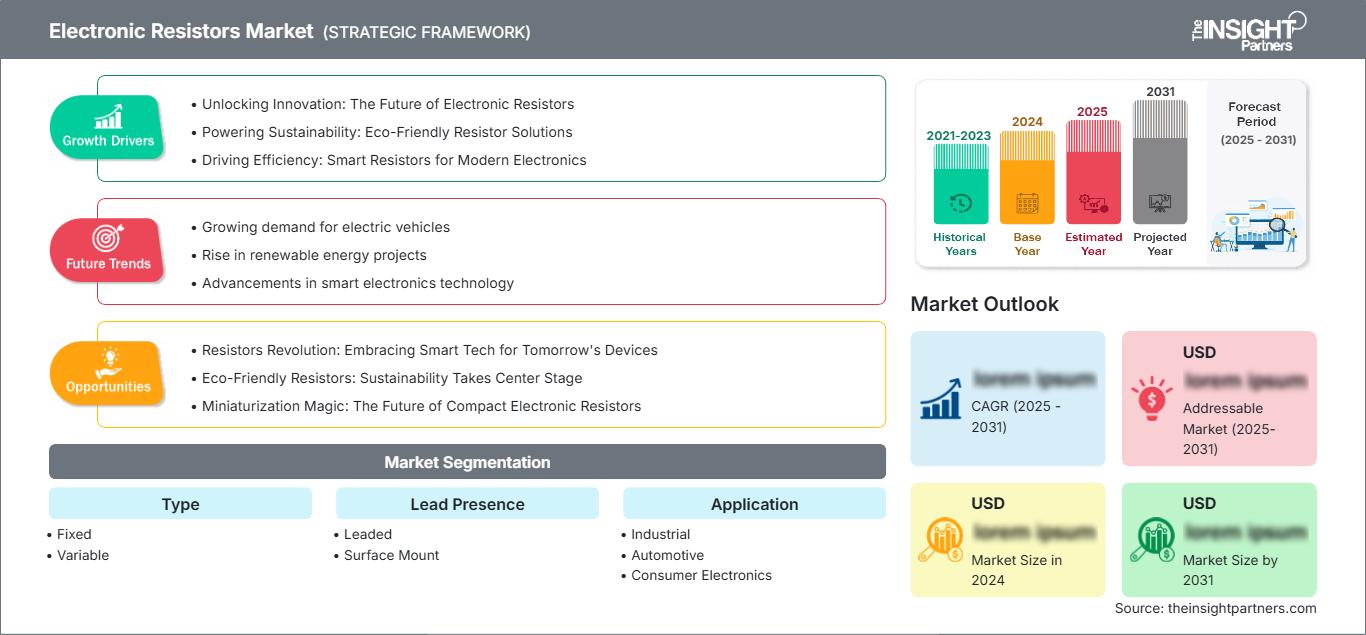
Electronic Resistors Market is positioned as a foundational passive-component category supporting current regulation, voltage division, signal conditioning, sensing, and power management across electronic systems. The market was valued at US$ 6.65 Billion in 2025 and is projected to reach US$ 10.35 Billion by 2034, expanding at a CAGR of 5.03% during 2026–2034. Demand is increasingly influenced by miniaturization, electrification, higher power density, and reliability requirements.
In North America, Electronic Resistors Market size is supported by automotive electronics, industrial automation, data infrastructure, and defense-oriented electronics manufacturing. The regional market is estimated to expand at a 4.8–5.4% CAGR during 2026–2034, with demand strengthened by vehicle electrification, advanced power-management architectures, and continued investment in resilient domestic electronics supply chains.
Electronic Resistors Market Assessment and Insights
- North America: North America is expected to account for a 24–28% share in 2025 and grow at a 4.8–5.4% CAGR between 2026–2034, supported by automotive electronics, industrial controls, aerospace systems, and localized component sourcing.
- US: The US represents an estimated 82–86% of North America's 2025 demand, with a 4.7–5.3% CAGR during 2026–2034, led by industrial automation and automotive electronics.
- Europe: Europe is estimated at a 22–26% share in 2025 and a 4.5–5.1% CAGR through 2034, with Germany, the UK, France, Italy, and Spain supporting automotive, industrial, and energy-electronics demand.
- Asia Pacific: Asia Pacific is projected to hold a 38–42% share in 2025 and expand at a 5.4–6.0% CAGR, led by China, Japan, South Korea, India, and Taiwan-linked electronics manufacturing.
- Largest Segment: Fixed resistors are expected to hold a 68–72% market share in 2025, expanding at a 4.6–5.0% CAGR between 2026–2034 because of broad circuit-level utilization.
- High Growth Segment: Automotive applications are estimated at a 24–28% market share in 2025 and are projected to grow at a 5.8–6.4% CAGR through 2034.
- Key companies analyzed in detail: ASJ Pte Ltd., Bourns, Inc., Murata Manufacturing Co., Ltd., Ohmite Manufacturing Co. LLC, Queen Mao Electronic Co., Ltd., ROHM CO., LTD., TE Connectivity, TT Electronics plc, Vishay Intertechnology, Inc., and YAGEO Corporation.
Source: The Insight Partners' analysis based on proprietary research, government publications, company annual reports, investor presentations, industry databases, and expert interviews.
The Electronic Resistors market trends indicate a shift away from conventional through-hole type resistors and towards surface-mount, precision, pulse-resistant, current-sensing, and high power types. The manufacture of electronic resistors now focuses on automation-friendly assembly, narrow tolerances, better thermal management, and vehicle certification. Higher electronic content in automobiles, industrial controllers, and consumer goods is driving the need for specification of the resistors according to applications and not just the resistance value.
In the coming years, investments will be made in flexible manufacturing capabilities, regional manufacture, advanced materials, and automatic inspection. The emergence of electronics manufacturing hubs in India and Southeast Asia should provide more options when it comes to sourcing resistors, while the automotive needs of Europe and the supply chain strategies of North America can drive the manufacture of qualified resistors locally.
Electronic Resistors Market Report Scope
| Report Attribute | Details |
|---|---|
| Market size in 2025 | US$ 6.65 Billion |
| Market Size by 2034 | US$ 10.35 Billion |
| Global CAGR (2026 - 2034) | 5.03% |
| Historical Data | 2021-2024 |
| Forecast period | 2026-2034 |
Electronic Resistors Market Analysis
The Electronic Resistors Market growth is directly dependent on the number and sophistication of electronic circuits in automotive, industrial machinery, power systems, home appliances, communication devices, and control systems. The value chain covers ceramics and metals, resistive films or alloy materials, component manufacturing, termination, testing, packaging, distribution, and integration into original equipment. Vehicle electronics drive up the demand for current-sensing and power resistors, while industrial automation increases the need for precision and robustness.
The supply continues to be influenced by material costs, substrate availability, geographical concentration, and qualification cycles. Surface mount types enjoy the benefits of automation and smaller printed circuit board design, while through hole types continue to be relevant for high-power, maintainable, and special purpose equipment. Thus, Electronic Resistors Market growth is a function of unit growth and evolution to more sophisticated components capable of dealing with environmental stress.
Product portfolio range, qualification capabilities, customization, and production capacity are becoming key factors that will determine competitive positioning. YAGEO Corporation, Vishay Intertechnology, Inc., Murata Manufacturing Co., Ltd., and ROHM CO., LTD. have extensive passive components portfolios, while Bourns, Inc., TE Connectivity, TT Electronics plc, and Ohmite Manufacturing Co. LLC focus on power, precision, sensors, and industrial requirements products. ASJ Pte Ltd. and Queen Mao Electronic Co., Ltd. will provide additional regional supply options.
According to the Electronic Resistors Market report, investments in the industry will shift from mere capacity to miniaturization, power density increase, qualification for automobiles, and availability. Partnerships between manufacturers, distributors, and original equipment manufacturers become more common, along with multi-location production operations. Competitive differentiation will be achieved through board space reduction, thermal performance improvement, shorter qualification time, and availability for components replacement resulting in requalification.
● REPORT CUSTOMIZATION
Tailor This Report To Align With Your Specific Business Requirements
This report can be customized to align precisely with your business objectives, scope, and target markets. Customization options include tailored segmentation, geography, competitive analysis, and strategic insights to support informed decision-making.
Customize This Report →WHAT YOU CAN ADJUST
- ● Segmentations
- ● Geography
- ● Competitive Analysis
- ● Language Preferences
Electronic Resistors Market: Strategic Insights
Regional Insights
North America Electronic Resistors Market
The North American region is projected to account for 24-28% of the world market by 2025 and experience a growth rate of 4.8-5.4% CAGR until 2034. The leading country in the region will be the US due to high demand for electronic systems in the areas of automotive electronics, industrial automation, aerospace equipment, telecommunications, and data center power systems.
In terms of purchasing decisions, traceability, qualification, and continuity of supply have become the key factors, not necessarily the lowest price per unit. The demand for surface mount resistors and power resistor technologies is driven by such trends as electrification of vehicles, modernization of factories, and power conversion technologies. The local manufacture of electronics also provides additional motivation for suppliers to locate production and stock in other places.
U.S. Electronic Resistors Market
The US represents approximately 82–86% of North America's 2025 demand and is expected to grow at a 4.7–5.3% CAGR through 2034. Electronic Resistors Market share within the region is reinforced by extensive automotive, aerospace, defense, industrial, telecommunications, and medical electronics activity. Major suppliers maintain broad distribution and engineering support.
There is an increasing trend towards precise current measurements, high power dissipation capability, smaller surface mount packages and components qualified for tough conditions. Electrified automobiles and charging systems call for greater reliability of power management ICs whereas automation in manufacturing plants calls for increased usage of resistors in motor control, sensor and programmable systems. Local sourcing is another factor making supplier qualification even more important.
Europe Electronic Resistors Market
Europe is expected to have a 22-26% market share in 2025 and grow with a 4.5-5.1% CAGR between 2026 and 2034. The German national market will continue to be dominant. Automotive electronics, industrial automation, equipment for renewable energy, and energy efficiency programs constitute diverse demand sources.
The UK has a demand source from aerospace, industrial controls, telecommunications, and advanced manufacturing. In Germany, there is demand from automotive engineering and factory automation; whereas, in France, there is a strong presence in aerospace, transportation, energy, and industrial electronics. Demand from Italy and Spain comes from automotive industry, industrial machinery, renewable energy systems, and consumer appliances.
APAC Electronic Resistors Market
APAC is valued to be in a 38-42% share in 2025 and expected to increase at a 5.4-6.0% CAGR from 2025 to 2034, led by China. Japan and South Korea are key contributors to automotive and electronics manufacturing, while India and Australia will contribute to industrial and infrastructure uses.
China is helped by the use of electronics manufacturing, automotive electric vehicles, and industrial automation. Japan focuses on precision and reliability, while South Korea helps semiconductors and consumer electronics ecosystem. India is improving electronics manufacturing, while Australia makes contributions through energy, mining, and industrial application sectors. Policies that promote domestic electronics manufacturing and diversification of regional supply chain will ensure resistor capacity investment.
Middle East & Africa Electronic Resistors Market
The Middle East and Africa demand is projected to grow at a CAGR of 5.2-6.0% from 2026 to 2034. Saudi Arabia will lead this region's growth, followed by UAE, South Africa, and MEA as a whole; infrastructural development, energy systems, transportation, and industrial development contribute to the use of components.
Both Saudi Arabia and UAE are focusing on diversification and industrialization, and South Africa is the foundation of mining, industrial automation, and power applications; while the Rest of MEA is relatively small but growing in relevance due to telecom, distributed generation, electric mobility, and industrial machinery applications. The resistor demand will be positively influenced by the growing use of electronic controls in those applications.
Segmentation Analysis
Type
Type is expected to expand at a 4.7–5.0% CAGR from 2026–2034. Fixed products retain broad penetration because resistance values can be selected directly for established circuit designs, while variable devices serve adjustment, calibration, sensing, and control applications. Product selection increasingly depends on tolerance, temperature coefficient, pulse capability, and package constraints.
- Fixed: Fixed resistors remain the principal choice for standardized circuit functions, offering predictable electrical characteristics, scalable manufacturing, and broad availability across consumer, industrial, automotive, and commercial electronic assemblies.
- Variable: Variable resistors retain strategic relevance where designers require adjustment, calibration, tuning, or user control, particularly in instrumentation, industrial equipment, audio systems, and selected power-management applications.
Lead Presence
Lead Presence is projected to grow at a 4.8–5.2% CAGR during 2026–2034. Surface-mount components benefit from automated assembly and board miniaturization, while leaded products remain important in power, legacy, serviceable, and mechanically demanding equipment. Procurement strategies increasingly combine both formats according to thermal, assembly, and reliability requirements.
- Leaded: Leaded resistors continue serving higher-power and serviceable designs where mechanical clearance, heat dissipation, manual handling, or established assembly processes influence component selection.
- Surface Mount: Surface-mount resistors benefit from compact footprints, automated placement, shorter electrical paths, and high-density PCB layouts, making them strategically important for modern automotive, consumer, communications, and industrial electronics.
Application
Application is forecast to grow at a 5.0–5.4% CAGR during 2026–2034. Automotive applications should record the strongest momentum as electronic control units, battery systems, charging equipment, sensing, and power conversion become more prevalent. Industrial and consumer applications provide a broader base across equipment categories.
- Industrial: Industrial demand is supported by automation, motor drives, instrumentation, power supplies, control panels, robotics, and factory equipment requiring reliable resistance, sensing, and thermal-management functions.
- Automotive: Automotive demand is strengthened by electrification, advanced driver-assistance systems, battery management, power conversion, lighting, infotainment, and increasing electronic control content across conventional and electric vehicles.
- Consumer Electronics: Consumer electronics require compact, cost-efficient resistor arrays and chip components for power management, signal conditioning, display systems, appliances, computing devices, and connected products.
- Commercial: Commercial applications encompass office equipment, communications hardware, building systems, security equipment, payment devices, and other electronic infrastructure requiring dependable and readily replaceable passive components.
Opportunity Snapshot
| Application | Revenue Contribution | Trend Tag | Adoption Stage |
| Industrial | High | Factory Automation | Mature |
| Automotive | High | Vehicle Electrification | Scaling |
| Consumer Electronics | High | Device Miniaturization | Mature |
| Commercial | Medium | Smart Infrastructure | Scaling |
Electronic Resistors Market Growth Drivers and Impact Analysis
Rising Electronic Content in Electrified Vehicles
Vehicle electrification is increasing the number and sophistication of circuits used for battery management, power conversion, sensing, thermal control, charging, and electronic control. Resistors are required for current measurement, voltage division, protection, feedback, balancing, and signal conditioning across these architectures. The commercial impact extends beyond unit volumes because electrified platforms often require higher-performance components with tighter qualification, improved thermal behavior, and enhanced environmental durability. Suppliers capable of providing AEC-Q200-qualified products and compact power-handling formats can capture design opportunities earlier in vehicle development cycles. The resulting shift favors manufacturers with automotive engineering resources, application support, and stable production. It also increases the strategic importance of current-sense and power resistor portfolios as automakers and tier suppliers redesign electrical architectures around higher voltage and power density.
Expansion of Industrial Automation and Power Electronics
Industrial automation is increasing the deployment of programmable controllers, sensors, motor drives, robotics, power supplies, and monitoring equipment, each containing multiple resistor functions. More sophisticated machines require precision sensing, stable feedback, current limiting, and thermal management, creating demand for components with tighter electrical tolerances and stronger pulse performance. The impact is particularly relevant in factories upgrading equipment rather than replacing entire production lines, because resistor requirements can increase as control functionality is added to existing machinery. Power-electronics expansion also raises the importance of high-wattage and low-resistance designs. Manufacturers that combine standard chip resistors with specialized power and sensing products can address broader bills of materials, improve customer retention, and reduce substitution risk when industrial customers qualify components for long operating cycles.
Miniaturization and Higher PCB Component Density
Electronic equipment is becoming smaller while integrating more processing, connectivity, sensing, and power-management functionality. This creates direct demand for smaller resistor packages that maintain stable electrical characteristics without compromising manufacturing yield. Surface-mount formats are particularly suited to automated assembly because they support compact layouts, high placement speeds, and shorter electrical interconnections. The market impact extends into materials engineering, where manufacturers must manage thermal stress, termination reliability, resistance drift, and mechanical robustness within increasingly small packages. Miniaturization also encourages customers to consolidate component variants and select standardized product families capable of covering multiple designs. Suppliers that offer broad resistance ranges, compact case sizes, precise tolerances, and automotive or industrial qualification can therefore improve design-in opportunities while supporting customers seeking greater PCB utilization efficiency.
Electronic Resistors Market Future Trends
AI Hardware and Data Infrastructure Resistor Optimization
AI computing infrastructure will influence resistor design by increasing power density across servers, accelerator boards, power supplies, cooling systems, and network equipment. Future architectures are likely to require more precise current monitoring and power-management feedback while operating under tighter thermal constraints. This should encourage adoption of low-resistance current-sense products, precision thin-film components, and specialized power resistors with stronger pulse-handling characteristics. Manufacturers may increasingly optimize electrical and thermal specifications together rather than treating resistance tolerance as the primary performance measure. Another emerging direction is application-specific qualification for high-duty-cycle infrastructure, where component reliability directly affects system availability. As data-center operators seek higher rack power densities, resistor suppliers with compact packages, predictable thermal behavior, and long operating-life characteristics should gain relevance across power-conversion and monitoring subsystems.
Intelligent Component Qualification and Digital Supply Chains
Procurement is expected to become more data-driven as electronics manufacturers seek greater visibility into component availability, lifecycle status, compliance, and manufacturing location. Digital product information, automated qualification records, traceability, and parametric comparison tools can shorten engineering selection cycles and reduce procurement uncertainty. For resistor manufacturers, this trend creates an opportunity to make product data more interoperable with customer design and sourcing systems. Standardized digital specifications can also simplify substitution decisions when supply disruptions occur, provided electrical and environmental requirements remain equivalent. Over time, customers may evaluate suppliers using combined measures covering technical performance, delivery resilience, environmental compliance, and lifecycle support. This approach should favor manufacturers that maintain consistent documentation, multiple qualified production sources, and clear product-roadmap visibility across standard and specialized resistor families.
Electronic Resistors Market Opportunities
Localized Production for Automotive and Industrial Programs
Manufacturers can capture investment opportunities by expanding qualified production and inventory closer to major automotive and industrial assembly clusters. Regionalized supply can reduce logistics exposure, shorten replenishment cycles, and improve responsiveness when customers face production changes. The opportunity is particularly attractive for products requiring lengthy qualification, because customers are more likely to value continuity and documentation once a component is designed into a platform. Suppliers can prioritize compact automotive-grade chip resistors, current-sense products, and industrial power devices where technical specifications create stronger differentiation than commodity pricing. Partnerships with distributors, contract manufacturers, and tier suppliers can further improve market access. Electronic Resistors Market Forecasts should therefore be interpreted alongside manufacturing-location decisions, qualification lead times, and customer concentration when evaluating capacity investments and regional expansion strategies.
High-Power and Precision Resistor Portfolio Expansion
A second opportunity lies in developing higher-value resistor products for power conversion, battery systems, industrial drives, renewable-energy equipment, testing systems, and precision instrumentation. These applications place greater emphasis on resistance stability, pulse capability, temperature behavior, thermal dissipation, and mechanical reliability, allowing suppliers to compete on engineering performance rather than volume alone. Investment can target advanced resistive materials, wider terminals, improved substrates, automated inspection, and application-specific packaging. Portfolio expansion should be aligned with customer design cycles because specialized components often require extensive validation before reaching volume production. Companies that combine engineering support with scalable manufacturing can use these products to diversify revenue beyond standard chip resistors. Electronic Resistors Market Forecasts consequently favor suppliers capable of translating application requirements into qualified, repeatable component platforms.
Recent Developments
- March 2026: Ohmite Manufacturing Company entered into a distribution agreement with RFMW to expand access to its portfolio of surface-mount current-sense resistors, high-power resistors, high-current braking resistors, multi-kilowatt load banks, and board-level heatsinks. The agreement also covers Ohmite’s thick-film, wirewound, and ceramic resistor technologies, supported through RFMW’s global sales network and technical distribution capabilities.
- February 2025: ROHM Co., Ltd. expanded its general-purpose chip resistor portfolio with the MCRx series, including the MCRS high-power series and MCRL low-resistance, high-power series. The redesigned internal structure supports higher power handling while maintaining compact dimensions, with the development targeting automotive, industrial, and other electronic applications requiring improved reliability and miniaturization.
- December 2025: Indian Link Chain Manufacturers Limited announced its acquisition of a majority stake in RRP Electronics Limited, strengthening its planned entry into semiconductor and high-technology electronics markets. RRP Electronics provides outsourced semiconductor assembly and testing services alongside capabilities in electro-optics and medical-device components. The transaction also included plans to rename the acquiring company RRP Electronics India Limited.
Frequently Asked Questions

- Comprehensive Market Sizing and Forecast Analysis
- Detailed Segmentation Analysis
- In-Depth Market Dynamics Assessment
- Regional and Country-Level Insights
- Competitive Landscape and Company Benchmarking
- Strategic Business Intelligence
Recent Reports
Testimonials

The Insight Partners' SCADA System Market report is comprehensive, with valuable insights on current trends and future forecasts. The team was highly professional, responsive, and supportive throughout. We are very satisfied and highly recommend their services.
RAN KEDEM Partner, Reali Technologies LTDs
I requested a report on a very specific software market and the team produced the report in a few days. The information was very relevant and well presented. I then requested some changes and additions to the report. The team was again very responsive and I got the final report in less than a week.
JEAN-HERVE JENN Chairman, Future Analytica
We worked with The Insight Partners for an important market study and forecast. They gave us clear insights into opportunities and risks, which helped shape our plans. Their research was easy to use and based on solid data. It helped us make smart, confident decisions. We highly recommend them.
PIYUSH NAGPAL Sr. Vice President, High Beam Global
The Insight Partners delivered insightful, well-structured market research with strong domain expertise. Their team was professional and responsive throughout. The user-friendly website made accessing industry reports seamless. We highly recommend them for reliable, high-quality research services
YUKIHIKO ADACHI CEO, Deep Blue, LLC.
This is the first time I have purchased a market report from The Insight Partners.While I was unsure at first, I visited their web site and felt more comfortable to take the risk and purchase a market report.I am completely satisfied with the quality of the report and customer service. I had several questions and comments with the initial report, but after a couple of dialogs over email with their analyst I believe I have a report that I can use as input to our strategic planning process.Thank you so much for taking the extra time and making this a positive experience.I will definitely recommend your service to others and you will be my first call when we need further market data.
JOHN SUZUKI President and Chief Executive Officer, Board Director, BK Technologies
I wish to appreciate your support and the professionalism you displayed in the course of attending to my request for information regarding to infectious disease IVD market in Nigeria. I appreciate your patience, your guidance, and the fact that you were willing to offer a discount, which eventually made it possible for us to close a deal. I look forward to engaging The Insight Partners in the future, all thanks to the impression you have created in me as a result of this first encounter.
DR CHIJIOKE ONYIA MANAGING DIRECTOR, PineCrest Healthcare Ltd.Reason to Buy
- Informed Decision-Making
- Understanding Market Dynamics
- Competitive Analysis
- Identifying Emerging Markets
- Customer Insights
- Market Forecasts
- Risk Mitigation
- Boosting Operational Efficiency
- Strategic Planning
- Investment Justification
- Tracking Industry Innovations
- Aligning with Regulatory Trends





 Get Free Sample for