
Embedded Processor Market Size, Trends & Demand by 2034
Coverage: By Type (Microprocessors, Microcontrollers, Digital Signal Processors, Others); Application (Consumer Electronics, IT & Telecom, Aerospace & Defense, Automotive, Pharmaceutical, Others) , and Geography (North America, Europe, Asia Pacific, and South and Central America)
- Status : Data Released
- Report Code : TIPRE00020755
- Category : Electronics and Semiconductor
- No. of Pages : 150
- Available Report Formats :


- Last update date : August 12, 2026


2025 Market Size
US$ 34.99 Bn
Base year value
2034 Forecast
US$ 65.36 Bn
Projected by 2034
CAGR 2026-2034
7.19 %
Growth rate
Addressable Market
US$ 452.81 Bn
(2026-2034)
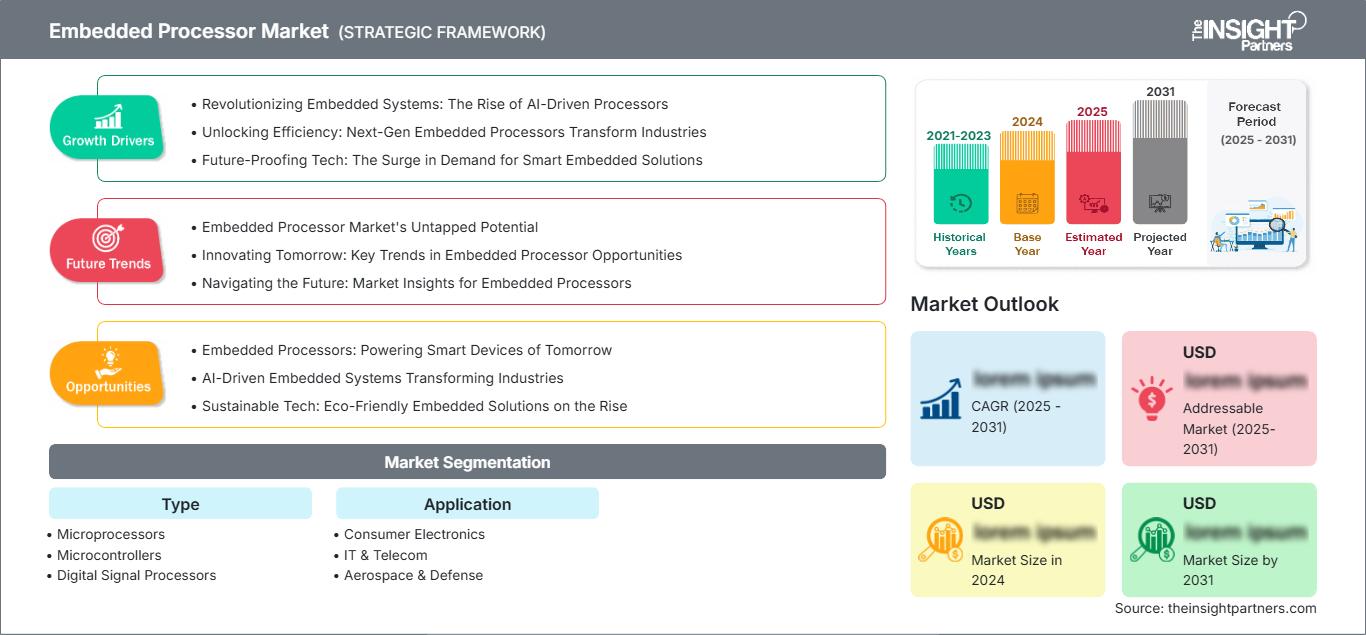
The Embedded Processor Market Size is estimated to reach US$ 34.99 billion in 2025 and further grow to US$ 65.36 billion by 2034, at a CAGR of 7.19% from 2026 to 2034. The market size is expected to continue to grow due to strong demand for embedded processing technology in consumer electronics, automotive, industrial automation, and IoT segments worldwide.
In terms of region, North America is expected to remain one of the key regions in the Embedded Processor market, where the market is expected to experience steady growth at a CAGR of 6.5 – 7.2% between 2026 and 2034. Some structural factors driving the market include growing IoT device deployment, developments in AI and machine learning applications, and increasing automation in all industries.
Embedded Processor Market Assessment and Insights
- North America: The region commands approximately 32–36% Embedded Processor Market share in 2025 and is growing at a CAGR range of 6.5–7.2% between 2026–2034, driven by robust manufacturing ecosystem, technological advancements, and high consumer demand for connected devices and intelligent systems.
- US: The United States accounts for 75–80% share in 2025 and is growing at a CAGR range of 6.3–7.0% between 2026–2034, reflecting mature market conditions with continuous innovation cycles and edge computing platform migration.
- Europe: The region holds approximately 22–26% share in 2025 and is growing at a CAGR range of 6.8–7.4% between 2026–2034, with the UK, Germany, and France leading adoption through automotive electronics and industrial automation initiatives.
- Asia Pacific: The region represents approximately 30–34% share in 2025 and is growing at a CAGR range of 7.8–8.5% between 2026–2034, with China, Japan, South Korea, and India driving growth through consumer electronics manufacturing and smart device adoption.
- Largest Segment: The Microcontrollers segment holds approximately 48–52% market share in 2025 and is growing at a CAGR range of 7.0–7.6% between 2026–2034, reflecting dominant adoption for IoT endpoints, industrial controllers, and automotive sub-systems.
- High Growth Segment: The Digital Signal Processors segment represents approximately 18–22% market share in 2025 and is growing at a CAGR range of 8.2–8.8% between 2026–2034, driven by AI inference at edge, 5G infrastructure, and automotive ADAS applications.
- Key companies analyzed in detail: Applied Micro Circuits Corporation, Infineon Technologies AG, Intel Corporation, Marvell Technology, Inc., Mouser Electronics, Inc., NXP Semiconductors N.V., NVIDIA Corporation, Qualcomm Technologies, Inc., Renesas Electronics Corporation, and Texas Instruments Incorporated.
Source: The Insight Partners' analysis based on proprietary research, government publications, company annual reports, investor presentations, industry databases, and expert interviews.
The Embedded Processor market has grown from primitive computing components to more complex platforms incorporating multi-core processors, AI processors, and other co-processors designed specifically to handle machine learning tasks. The focus in hardware design has moved towards energy-efficient processors with advanced node technology, whereas software development is more inclined towards utilizing edge computing technologies and real-time operating systems.
According to the Embedded Processor Market forecast, the industry will see growing demand and deployment of embedded processors in new markets such as Asia Pacific and Middle East, along with increased spending on next-generation embedded processors that are used in autonomous cars, smart cities, and industrial Internet of Things deployments. Tailwinds in terms of regulatory requirements in cybersecurity and energy efficiency are driving innovation cycles and premium features adoption in the industry.
Embedded Processor Market Report Scope
| Report Attribute | Details |
|---|---|
| Market size in 2025 | US$ 34.99 Billion |
| Market Size by 2034 | US$ 65.36 Billion |
| Global CAGR (2026 - 2034) | 7.19% |
| Historical Data | 2021-2024 |
| Forecast period | 2026-2034 |
Embedded Processor Market Analysis
Main demand drivers in the Embedded Processor Market include exponential IoT/connected devices proliferation, automotive electronics complexity with ADAS and electrification, as well as edge computing technology development aimed at minimizing data processing delay and enhancing local data processing security. Value chain includes semiconductor design vendors, foundries with advanced node processor fabrication capability, package and test providers, and system integrators providing development platforms and embedded software solutions. Supply dynamics include capabilities in semiconductor fabrication improvements, 5G technology roll-out providing reliable connectivity, and pricing pressure from incumbents and regional players.
The distribution channels in the Embedded Processor Market range from direct sales by processor manufacturers to device makers, regional distributors serving regional systems designers, as well as online platforms allowing fast prototyping by small and mid-size organizations. Integration into customer development infrastructure, cloud computing, and third party software offerings is becoming a key differentiator as customers prefer to have full visibility in their embedded design development process instead of isolated processor solutions.
The competitive environment in the Embedded Processor Market is characterized by traditional semiconductor powerhouses such as Intel Corporation and NVIDIA Corporation operating alongside niche-focused vendors like NXP Semiconductors N.V. and Texas Instruments Incorporated, each seeking differentiation based on processing prowess, energy efficiency aspects, and development ecosystems. Trends in investments demonstrate consolidation efforts in which big firms acquire small innovative firms to increase AI accelerators, edge computing features, and domain-specific offerings, while venture capital keeps pouring into firms creating future generation processors for autonomous applications and industrial automation.
According to the Embedded Processor Market report, positioning in the market is now focused not only on the processor price but on the overall cost of ownership, the quality of development ecosystem, and long-term availability guarantees as well. Market leaders are extending their service offerings by providing customers with reference designs, SDKs, and long-term programs because they understand that the designers see processor platforms as a means of product differentiation.
● REPORT CUSTOMIZATION
Tailor This Report To Align With Your Specific Business Requirements
This report can be customized to align precisely with your business objectives, scope, and target markets. Customization options include tailored segmentation, geography, competitive analysis, and strategic insights to support informed decision-making.
Customize This Report →WHAT YOU CAN ADJUST
- ● Segmentations
- ● Geography
- ● Competitive Analysis
- ● Language Preferences
Embedded Processor Market: Strategic Insights
Regional Insights
North America Embedded Processor Market
The North American region controls about 32-36% of the global Embedded Processor market in 2025 and has been forecasted to witness a CAGR of 6.5-7.2% from 2026 to 2034. North America is blessed with an established semiconductor industry, advanced IoT infrastructure, and awareness among system designers of performance and efficiency enhancement through modern platform implementation.
Growth drivers in the region include constant advancements in AI and edge computing, replacement of old embedded processors, and integration of the processing platforms with wider cloud and corporate ecosystem. Larger companies now prefer platforms that provide features of real-time processing, AI accelerator and centralized management system.
U.S. Embedded Processor Market
The United States accounts for approximately 75–80% of North American Embedded Processor share in 2025 and is growing at a CAGR range of 6.3–7.0% between 2026–2034. As the dominant market within the region, the US reflects mature adoption levels with continuous innovation-driven replacement demand and ongoing technology upgrades among commercial and industrial system designers of all sizes.
Company presence includes all major semiconductor providers maintaining registered distribution networks, including Intel Corporation, NVIDIA Corporation, Qualcomm Technologies, Inc., and Texas Instruments Incorporated, each competing through platform capabilities and development ecosystem differentiation. Application trends indicate growing demand for AI-enabled processors among large enterprises, edge computing solutions for small businesses, and high-end service tiers featuring machine learning accelerators and real-time analytics tools.
Europe Embedded Processor Market
The region of Europe possesses approximately 22–26% of the world’s Embedded Processor market share by 2025, growing at a CAGR range of 6.8–7.4% from 2026-2034. This is due to its expertise in automotive electronics, industrial automation, and the use of integrated processor solutions within member states enabling cross-border device management.
Approximately 18–22% of the regional demand comes from the United Kingdom, where high semiconductor design proficiency and industrial IoT infrastructure enable businesses to conduct themselves internationally. Germany is the leading national market with a share of 24–28%, with this being down to the high level of automotive electronics and strict enforcement through functional safety and cybersecurity regulations.
France, Italy, and Spain together make up 35–40% of the regional demand with France leading through aerospace and defense, Italy through industrial automation and robotics, and Spain through telecommunications infrastructure and smart cities.
APAC Embedded Processor Market
The Asia Pacific region constitutes about 30-34% of Global Embedded Processor Market share in 2025 and will grow at a CAGR of 7.8-8.5% in the period from 2026-2034. It is the fastest-growing region, with China accounting for about 35-40% of APAC demand, followed by Japan, South Korea, India, and Australia, who are focusing on the production of electronic devices and Smart Devices.
Industrial drivers for the embedded processor are expansion in consumer electronics, increase in automotive electronics, and commercialization between cities with the need for better processing capacity and efficiency monitoring of processing energy. Some of the policy drivers include new regulation in India and Southeast Asia, investment in infrastructure for smart manufacturing corridors and governments’ incentives.
Middle East & Africa Embedded Processor Market
The Middle East and Africa form an Emerging Embedded Processor Market with a growth rate projection between 8.5% to 9.2% CAGR from 2026 to 2034. Vision 2030 and the development of technology corridors in Saudi Arabia have been driving the use of the embedded processor technology.
The UAE forms a regional hub with modern telecommunication and compliance infrastructure in place. South Africa is the most developed market in Africa because of telecommunication infrastructures, mining automation, and transport monitoring systems that operate in different conditions and need an embedded processor.
Segmentation Analysis
Type
The Type segment is projected to grow at a CAGR range of 7.0–7.6% between 2026–2034. This segmentation reflects distinct technology requirements, deployment scenarios, and adoption patterns across different embedded processor categories, with microcontrollers dominating demand due to comprehensive IoT, industrial, and automotive applications.
- Microprocessors: Represents approximately 28–32% of type demand, driven by high-performance computing applications, embedded PCs, and industrial automation requiring advanced processing capabilities, multi-core architectures, and support for complex operating systems and application frameworks.
- Microcontrollers: Commands approximately 48–52% market share, reflecting dominant adoption for IoT endpoints, consumer electronics, industrial controllers, medical devices, and automotive sub-systems where low cost, energy efficiency, integrated peripherals, and real-time control characteristics match largest volume application requirements.
- Digital Signal Processors: Accounts for approximately 18–22% of demand and is growing at a CAGR range of 8.2–8.8%, driven by AI inference at edge, 5G infrastructure, automotive ADAS, and audio/video processing applications requiring specialized signal processing capabilities and high computational throughput.
Application
The Application segment is projected to grow at a CAGR range of 7.0–7.6% between 2026–2034. This segmentation distinguishes between different end-use verticals that deploy embedded processors, each with distinct performance requirements, certification needs, and technology adoption patterns.
- Consumer Electronics: Represents approximately 38–42% of application demand, including smartphones, wearables, smart home devices, and gaming consoles requiring high-performance, energy-efficient processors with integrated connectivity and multimedia processing capabilities for enhanced user experiences.
- IT & Telecom: Commands approximately 18–22% market share, encompassing networking equipment, telecommunications infrastructure, data center servers, and enterprise systems requiring reliable, high-throughput processors supporting 5G, cloud computing, and enterprise networking applications.
- Aerospace & Defense: Accounts for approximately 12–16% of demand, including avionics systems, defense electronics, satellites, and unmanned systems requiring radiation-hardened, certified processors meeting stringent reliability, security, and performance standards for mission-critical applications.
- Automotive: Represents approximately 16–20% market share and is growing at a CAGR range of 8.0–8.6%, driven by ADAS, electric vehicle powertrains, in-vehicle infotainment, and autonomous driving systems requiring functional safety-certified processors with real-time processing and AI acceleration capabilities.
- Pharmaceutical: Accounts for approximately 8–12% of demand, including medical devices, diagnostic equipment, laboratory automation, and pharmaceutical manufacturing systems requiring certified processors meeting regulatory compliance, data integrity, and patient safety requirements.
Opportunity Snapshot
| Application | Revenue Contribution | Trend Tag | Adoption Stage |
|---|---|---|---|
| Consumer Electronics | High | Smart Home Integration | Mature |
| IT & Telecom | High | 5G Infrastructure | Scaling |
| Aerospace & Defense | Medium | Mission-Critical Systems | Mature |
| Automotive | High | ADAS and EV Integration | Scaling |
| Pharmaceutical | Medium | Medical Device IoT | Emerging |
Embedded Processor Market Growth Drivers and Impact Analysis
IoT and Connected Device Proliferation
IoT deployments on a global scale continue at an accelerated pace where the demand for ubiquitous, low-power, and cost-effective embedded processors from billions of connected devices in homes, industries, and cities becomes a necessity. Consumer electronics and IoT applications create a huge demand from billions of units where smart home devices, industrial sensors, and wearables constitute a huge volume of units each year through device refreshing and new product launches.
IoT deployments and 5G connectivity technologies are generating enormous new demands for embedded processors which would process different kinds of communications and tasks. Billions of devices will become connected in the coming years where a dire need arises for low-power and cost-effective processors that provide edge intelligence capabilities.
AI and Machine Learning at Edge
Rising demand for artificial intelligence and machine learning technologies on the edge continues to spur developments in embedded processor designs up to 2034. As more intelligence gets moved out of centralized cloud data centers and onto the edge, there becomes a need for processors that have specific accelerators and instruction sets designed for AI and ML.
The automobile sector is seeing rapid advances due to rising demand for more than 150 million units every year with increasing demand for complex processing arising due to ADAS, infotainment, and electric vehicles. The development of chipsets, power efficiency, and integration of specialized co-processors for AI/ML plays a key role in such advances.
Automotive Electronics and Electrification
Automotive and transportation end user segment will turn out to be the most critical engine of growth for embedded processors in next 10 years. The need for processors that are functional safety certified and can provide real-time computing, AI computing, and security for applications related to powertrain, ADAS, and infotainment systems comes from electric vehicle penetration, autonomous driving technologies, and vehicle connectivity trends.
High level of automation requires tremendous amount of real-time processing capability inside the vehicle independent of network connectivity. Convergence of 5G connectivity and AI in edge devices is presenting great opportunities for the industry because of fundamental change in architecture where intelligence will be built in silicon of device.
Embedded Processor Market Future Trends
Edge AI and Heterogeneous Computing
The Embedded Processor Market trends indicate that intelligent and localized processing with machine learning algorithms and AI accelerators built into embedded processors will be able to offer more intelligent decision-making capabilities in real time for all kinds of applications in devices. Major companies are already implementing dedicated NPU accelerators, Tensor cores, and other technologies that convert raw sensor data into actionable information, thus providing self-sufficient operations that do not depend on cloud computing.
The future platforms will combine computer vision with the help of cameras, sensor fusion of various data sources, as well as connectivity through 5G modems in order to generate edge intelligence profiling and build personal AI models that would increase performance while decreasing energy consumption. Heterogeneous computing will include CPU, GPU, and NPU processing, as well as other accelerators.
Advanced Node and Chiplet Architectures
As embedded processors become increasingly sophisticated, providers will evolve to offer advanced node processes and chiplet-based architectures that address performance, power, and cost optimization objectives. Leading manufacturers are developing platforms that integrate multiple dies using advanced packaging technologies, enabling heterogeneous integration of logic, memory, and analog components optimized for specific application requirements.
This evolution will require new design methodologies, verification frameworks, and supply chain partnerships as processor architectures become critical components of system-level optimization strategies. Semiconductor foundries are expected to invest substantially in advanced node capacity and chiplet interoperability standards, creating opportunities for providers to develop specialized solutions serving this emerging market segment alongside traditional monolithic processor deployments.
Embedded Processor Market Opportunities
Emerging Market Electronics Manufacturing
Asia Pacific, Middle East, and Africa regions present substantial growth opportunities as governments implement electronics manufacturing initiatives and commercial system designers modernize device capabilities. India's proposed semiconductor fabrication incentives, GCC technology corridor projects, and African telecommunications infrastructure growth create multi-billion-dollar addressable markets for providers offering localized solutions, regional support infrastructure, and application-specific expertise.
Market entry strategies should prioritize partnerships with local device manufacturers, integration with regional development ecosystems, and device certification aligned with emerging regulatory frameworks. Early movers establishing brand recognition and designer relationships in these markets will benefit from switching costs and network effects as device volumes approach and system designers seek proven, supported solutions rather than evaluating new vendors under time pressure.
Long-Term Support and Industrial Programs
System designers increasingly recognize strategic value of long-term availability, extended lifecycle support, and industrial-grade reliability beyond consumer processor specifications, creating opportunities for providers to migrate customers from standard products to premium industrial programs. Margins on long-term support programs substantially exceed standard product revenues, making service tier expansion critical profitability driver for semiconductor providers seeking sustainable competitive advantages.
Value-added offerings including 10–15 year availability guarantees, extended temperature range operation, enhanced reliability testing, and dedicated technical support enable providers to differentiate on total value rather than processor pricing alone. Successful migration strategies combine demonstrable reliability case studies, tiered pricing models rewarding expanded adoption, and customer success programs ensuring clients realize maximum value from comprehensive industrial processor capabilities.
Recent Developments
- March 2026: Renesas Electronics Corporation announced general availability of Renesas 365, a comprehensive software platform accelerating software-defined vehicle innovation with R-Car Gen 5 SoC-based end-to-end multi-domain solution platform for automotive applications.
- February 2026: NXP Semiconductors N.V. unveiled industry-first 10BASE-T1S PMD transceiver delivering scalable, cost-effective Ethernet to intelligent edge, advancing automotive and industrial IoT connectivity with enhanced physical layer capabilities.
- October 2025: NVIDIA Corporation released DGX Spark powered by GB10 Grace Blackwell Superchip, bringing advanced AI computing capabilities to embedded and edge computing applications with OEM offerings at different price points for diverse deployment scenarios.
Frequently Asked Questions

- Comprehensive Market Sizing and Forecast Analysis
- Detailed Segmentation Analysis
- In-Depth Market Dynamics Assessment
- Regional and Country-Level Insights
- Competitive Landscape and Company Benchmarking
- Strategic Business Intelligence
Recent Reports
Testimonials

The Insight Partners' SCADA System Market report is comprehensive, with valuable insights on current trends and future forecasts. The team was highly professional, responsive, and supportive throughout. We are very satisfied and highly recommend their services.
RAN KEDEM Partner, Reali Technologies LTDs
I requested a report on a very specific software market and the team produced the report in a few days. The information was very relevant and well presented. I then requested some changes and additions to the report. The team was again very responsive and I got the final report in less than a week.
JEAN-HERVE JENN Chairman, Future Analytica
We worked with The Insight Partners for an important market study and forecast. They gave us clear insights into opportunities and risks, which helped shape our plans. Their research was easy to use and based on solid data. It helped us make smart, confident decisions. We highly recommend them.
PIYUSH NAGPAL Sr. Vice President, High Beam Global
The Insight Partners delivered insightful, well-structured market research with strong domain expertise. Their team was professional and responsive throughout. The user-friendly website made accessing industry reports seamless. We highly recommend them for reliable, high-quality research services
YUKIHIKO ADACHI CEO, Deep Blue, LLC.
This is the first time I have purchased a market report from The Insight Partners.While I was unsure at first, I visited their web site and felt more comfortable to take the risk and purchase a market report.I am completely satisfied with the quality of the report and customer service. I had several questions and comments with the initial report, but after a couple of dialogs over email with their analyst I believe I have a report that I can use as input to our strategic planning process.Thank you so much for taking the extra time and making this a positive experience.I will definitely recommend your service to others and you will be my first call when we need further market data.
JOHN SUZUKI President and Chief Executive Officer, Board Director, BK Technologies
I wish to appreciate your support and the professionalism you displayed in the course of attending to my request for information regarding to infectious disease IVD market in Nigeria. I appreciate your patience, your guidance, and the fact that you were willing to offer a discount, which eventually made it possible for us to close a deal. I look forward to engaging The Insight Partners in the future, all thanks to the impression you have created in me as a result of this first encounter.
DR CHIJIOKE ONYIA MANAGING DIRECTOR, PineCrest Healthcare Ltd.Reason to Buy
- Informed Decision-Making
- Understanding Market Dynamics
- Competitive Analysis
- Identifying Emerging Markets
- Customer Insights
- Market Forecasts
- Risk Mitigation
- Boosting Operational Efficiency
- Strategic Planning
- Investment Justification
- Tracking Industry Innovations
- Aligning with Regulatory Trends





 Get Free Sample for