
Enterprise Flash Storage Market Growth, Demand & Size by 2034
Coverage: by Type (All-Flash Array, Hybrid Flash Array); Industry (IT & Telecom, BFSI, Healthcare, Automotive, Government and Defense, Others), and Geography (North America, Europe, Asia Pacific, and South and Central America)
- Status : Data Released
- Report Code : TIPRE00013147
- Category : Electronics and Semiconductor
- No. of Pages : 150
- Available Report Formats :


- Last update date : August 26, 2026


2025 Market Size
US$ 23.24 Bn
Base year value
2034 Forecast
US$ 48.99 Bn
Projected by 2034
CAGR 2026-2034
8.64 %
Growth rate
Addressable Market
US$ 323.83 Bn
(2026-2034)
The Enterprise Flash Storage Market is experiencing growth as enterprises upgrade their data infrastructure for latency-sensitive applications, AI applications, analytics, virtualization, and cloud native workloads. The market is worth US$ 23.24 Billion in 2025 and is estimated to reach US$ 48.99 Billion by 2034, posting a CAGR of 8.64% during 2026-2034. Factors driving adoption include faster storage interfaces, NAND density improvement, software-defined approaches, and need for resilient enterprise data infrastructure.
North America continues to be an essential market due to its dense data center infrastructure, cloud migration, cybersecurity needs, and rapid deployment of AI applications that require high-performance storage architecture. Replacement of older disk storage systems, usage of NVMe-based solutions, and preference for a higher workload density storage infrastructure are factors affecting the Enterprise Flash Storage Market size.
Enterprise Flash Storage Market Assessment and Insights
- North America: North America maintains a leading position, with a 2025 Enterprise Flash Storage Market share of 35–38% and CAGR of 7.8–8.3% between 2026–2034. Mature data-center infrastructure and rapid AI deployment sustain enterprise storage investment.
- US: The US represents 63–67% of North American revenue in 2025 and is expected to grow at 7.7–8.2% CAGR during 2026–2034, supported by hyperscale infrastructure and enterprise modernization.
- Europe: Europe accounts for 25–28% share in 2025 and is projected to expand at 7.0–7.6% CAGR through 2034. Germany, the UK, France, Italy, and Spain support demand through cloud adoption and data sovereignty requirements.
- Asia Pacific: Asia Pacific captures 26–29% share in 2025 and is expected to record 10.5–11.3% CAGR during 2026–2034. China, Japan, South Korea, and India lead regional investment through digitalization and expanding data-center capacity.
- Largest Segment: All-Flash Array holds a 68–72% market share in 2025 and is projected to grow at 8.2–8.8% CAGR during 2026–2034, reflecting performance-led deployments.
- High Growth Segment: Hybrid Flash Array represents a 28–32% market share in 2025 and is expected to achieve 10.8–11.6% CAGR during 2026–2034 as enterprises balance performance and storage economics.
- Key companies analyzed in detail: Dell Technologies Inc., Hewlett Packard Enterprise Company, Hitachi Vantara LLC, Huawei Technologies Co., Ltd., International Business Machines Corporation, NetApp, Inc., Pure Storage, Inc., Tintri, Inc., Western Digital Corporation, Infinidat Ltd.
Source: The Insight Partners' analysis based on proprietary research, government publications, company annual reports, investor presentations, industry databases, and expert interviews.
The architecture of storage has shifted from traditional disk-based systems to optimized flash storage systems including NVMe, high density NAND, deduplication, compression, tiering, and software-based management. The market for Enterprise Flash Storage has come to depend on performance considerations more than merely expanding capacity. Integration of controllers, storage software, cybersecurity, and cloud management is becoming standard, while modular systems permit scalability of capacity and performance independently.
The Enterprise Flash Storage Market forecast indicates that future trends are likely to include AI-friendly storage, disaggregated architectures, optimization through QLC capacity, and subscription-based purchasing models. New markets in Southeast Asia, India, and the Middle East are emerging in importance due to growing digital infrastructure. The concerns of regulators about data sovereignty, cyber resilience, and energy efficiency are beginning to affect purchase considerations, making it necessary to seek storage systems with higher efficiency and less overhead.
Enterprise Flash Storage Market Report Scope
| Report Attribute | Details |
|---|---|
| Market size in 2025 | US$ 23.24 Billion |
| Market Size by 2034 | US$ 48.99 Billion |
| Global CAGR (2026 - 2034) | 8.64% |
| Historical Data | 2021-2024 |
| Forecast period | 2026-2034 |
Enterprise Flash Storage Market Analysis
The demand will continue to be influenced by AI, real-time analytics, virtualization, transactional database workloads, and cloud-native applications with known latency requirements. The Enterprise Flash Storage Market growth is also driven by the transition of applications from spinning media solutions. The market includes not only NAND flash suppliers, SSDs makers, and storage-array makers but also controller technology companies, software developers, distribution companies, systems integrators, cloud providers, and enterprises buying those solutions, so controller performance and software differentiation is also significant along with the raw capacity of the flash.
The Enterprise Flash Storage Market report shows that the supply side of the market will stay dependent on NAND price, component availability, controller technologies, and enterprise SSD qualification cycles. The density of the NAND can optimize capacity costs, whereas QLC solution allows extending flash storage applications for secondary workloads. So, in this context, data reduction, endurance management, workload-specific tuning, and business models are becoming competitive factors for storage suppliers rather than raw capabilities.
The Enterprise Flash Storage Market trends indicate that competition in the sector is mainly between diverse infrastructure providers and flash-first infrastructure specialists. Dell Technologies Inc. offers PowerStore together with overall infrastructure solutions, Hewlett Packard Enterprise Company prioritizes Alletra and GreenLake. International Business Machines Corporation distinguishes itself through FlashSystem resiliency and automation, while Pure Storage, Inc. has its edge in software-defined flash and subscriptions.
In terms of positioning, there are also some regional and workloads-oriented preferences among the competitors. NetApp, Inc. provides flash infrastructure and hybrid cloud data management solutions, Hitachi Vantara LLC is known for enterprise data platforms, and Huawei Technologies Co., Ltd. specializes in AI storage systems. Tintri, Inc. deals with virtualized workloads, Infinidat Ltd. offers cyber-resilient enterprise storage, and Western Digital Corporation is a leader in storage components.
● REPORT CUSTOMIZATION
Tailor This Report To Align With Your Specific Business Requirements
This report can be customized to align precisely with your business objectives, scope, and target markets. Customization options include tailored segmentation, geography, competitive analysis, and strategic insights to support informed decision-making.
Customize This Report →WHAT YOU CAN ADJUST
- ● Segmentations
- ● Geography
- ● Competitive Analysis
- ● Language Preferences
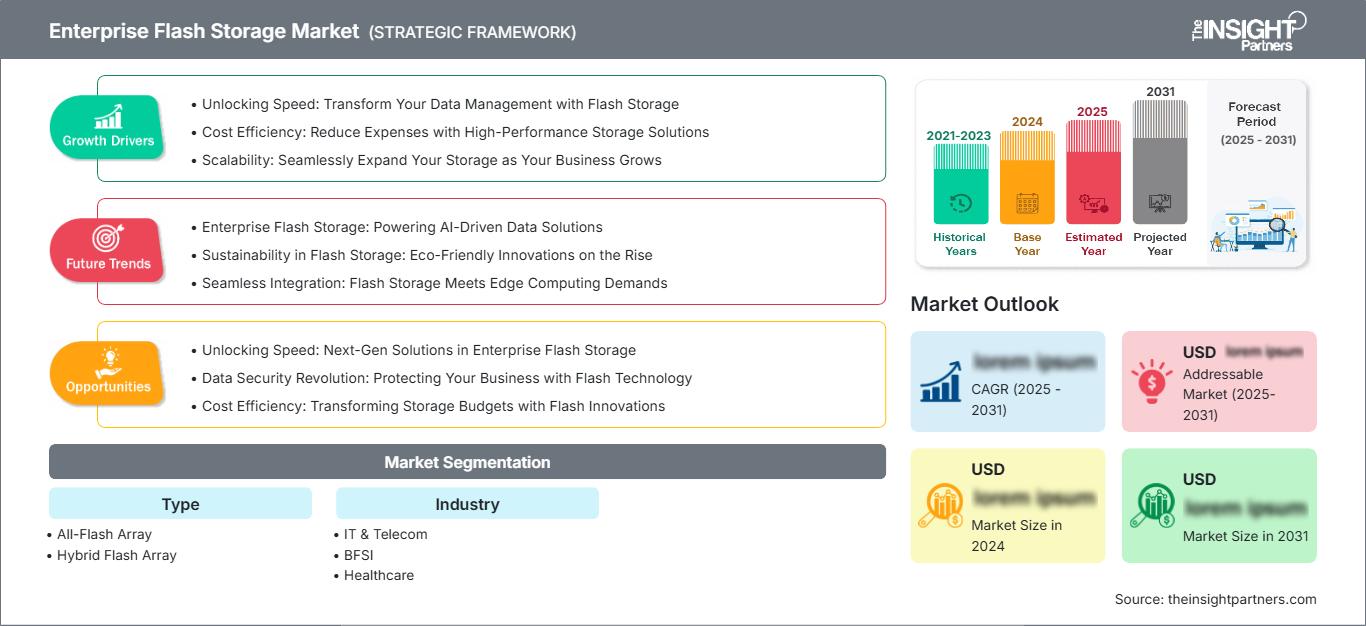
Enterprise Flash Storage Market: Strategic Insights
Regional Insights
North America Enterprise Flash Storage Market
The share of North America Enterprise Flash Storage Market was 35-38% in 2025 and is predicted to grow at a rate of 7.8-8.3% CAGR between 2025 and 2034. Advantages for this region include hyperscale infrastructure clustering, enterprise IT budgets, cloud adoption, and high interest in low latency infrastructures for handling databases, analytics, virtualization, and artificial intelligence applications. The United States is the leading country in the region because of technology corporations, banks, hospitals, and governmental agencies upgrading their storage environments.
Current investments in the Enterprise Flash Storage Market are focused on such characteristics as cybersecurity, energy efficiency, automation, and flexibility of scaling. Storage solutions that have combined block, file, and object features may help in reducing infrastructure fragmentation while being able to handle hybrid cloud solutions. Moreover, North American customers show more interest in consuming purchases which give suppliers the opportunity to match capacity increases with workload increase. Data protection and recovery requirements also favor the usage of enterprise flash systems.
U.S. Enterprise Flash Storage Market
The US holds 63-67% of the revenue share of North America in 2025 and will register a 7.7-8.2% CAGR over 2026-2034. Enterprise applications, hyperscale data centers, AI infrastructure, and modernization drive the need for high-performing arrays. Dell Technologies Inc., Hewlett Packard Enterprise Company, International Business Machines Corporation, NetApp, Inc., and Pure Storage, Inc. hold a significant market share.
Application needs in the Enterprise Flash Storage Market range from financial transaction processing, health care analytics, government application suites, cloud services, and enterprise virtualization. AI infrastructure includes fast checkpointing, throughput performance, and quick recoveries. Storage decisions take into account power density and automation along with latency. The US market therefore is looking for solutions that can provide flash performance combined with cyber recovery, policy-driven operations, and hybrid cloud interface.
Europe Enterprise Flash Storage Market
Europe had 25–28% Enterprise Flash Storage Market share in 2025, with a projected CAGR growth of 7.0–7.6% through 2034, with Germany being the leading country. The UK companies' key focus is on cloud modernization and compliance workloads, whereas Germany focuses on digitizing industry and manufacturing data and sovereign infrastructure. Other countries contributing include France, Italy, and Spain through public sector modernization, financial services, telecoms, and increased data center capabilities.
The European procurement processes in the Enterprise Flash Storage Market now value data sovereignty, energy efficiency, cyber resilience, and lifecycle management. Companies are therefore adopting architectures that consolidate their workloads without increasing physical infrastructure. Germany and UK are still significant sources of demand due to the presence of mature enterprise technology ecosystem, while France gains from investments in cloud and digital infrastructure. Italy and Spain also present further opportunity due to the modernization of the local applications and data infrastructure.
APAC Enterprise Flash Storage Market
APAC holds a 26–29% share in 2025 and is projected to grow at 10.5–11.3% CAGR through 2034, making it the fastest-growing major region. China leads, followed by Japan, South Korea, India, and Australia. Expanding data centers, digital services, telecommunications, AI deployment, and manufacturing automation are increasing demand for high-performance storage.
Policy support for digital infrastructure and domestic technology capabilities strengthens investment. China benefits from large-scale data infrastructure, Japan from advanced enterprise systems, South Korea from semiconductor and technology ecosystems, and India from rapid digitization. Australia contributes through cloud and data-center expansion. Regional buyers increasingly assess storage for scalability, workload consolidation, cybersecurity, and power efficiency.
Middle East & Africa Enterprise Flash Storage Market
Middle East and Africa is projected to grow at 8.2–8.8% CAGR during 2026–2034. Saudi Arabia leads regional momentum, supported by digital transformation and large infrastructure programs, while the UAE benefits from cloud, AI, and data-center investment. South Africa remains an important enterprise technology center, with the rest of MEA developing through telecommunications and public-sector modernization.
The factors affecting procurement include energy availability, data center building, sovereign cloud, and diversification of the infrastructure. The flash storage is becoming more significant because of the shortage of space and the need for high application availability in terms of performance per rack. Another important factor that is considered by regional businesses is resilience due to the need for reliable data access.

Segmentation Analysis
Type
Type represents a core architectural decision because buyers balance performance, capacity economics, application criticality, and infrastructure modernization. The Enterprise Flash Storage Market scope includes all-flash and hybrid flash configurations, with all-flash systems leading adoption. Type is projected to expand at 8.2–8.8% CAGR during 2026–2034 as enterprises prioritize predictable performance and simplified management.
- All-Flash Array: All-flash arrays occupy the principal position in performance-sensitive deployments, particularly databases, virtualization, analytics, and AI. Their strategic importance comes from consistent latency, high IOPS, and increasing capacity density.
- Hybrid Flash Array: Hybrid flash arrays serve organizations balancing performance requirements with storage economics. They remain relevant for mixed workloads where frequently accessed data benefits from flash while less active information uses lower-cost capacity.
Industry
Industry segmentation reflects differences in workload intensity, regulatory requirements, data volumes, and technology budgets. The Enterprise Flash Storage Market is projected to expand across all listed industries at 8.0–8.7% CAGR during 2026–2034, with IT and telecom remaining the largest demand center and AI-intensive sectors creating additional performance requirements.
- IT & Telecom: IT and telecom organizations require scalable storage for cloud platforms, network operations, virtualization, and digital services, making high-performance arrays strategically important for service continuity.
- BFSI: Banks and financial institutions prioritize low latency, transaction integrity, resilience, and rapid recovery, supporting flash adoption for databases, analytics, fraud detection, and customer-facing applications.
- Healthcare: Healthcare organizations increasingly require dependable storage for clinical applications, imaging, electronic records, analytics, and research while maintaining stringent availability and data governance requirements.
- Automotive: Connected vehicles, simulation, manufacturing automation, and advanced engineering workflows generate data-intensive workloads, encouraging flash deployment where rapid processing and reliable access influence development cycles.
- Government and Defense: Government and defense environments emphasize secure, resilient, high-availability infrastructure for mission-critical applications, intelligence workloads, communications, and sensitive information requiring controlled access.
Opportunity Snapshot
| Industry | Revenue Contribution | Trend Tag | Adoption Stage |
|---|---|---|---|
| IT & Telecom | High | AI Infrastructure | Mature |
| BFSI | High | Low-Latency | Mature |
| Healthcare | Medium | Clinical Analytics | Scaling |
| Automotive | Medium | Edge Processing | Scaling |
| Government and Defense | Medium | Cyber Resilience | Scaling |
Enterprise Flash Storage Market Growth Drivers and Impact Analysis
AI and real-time workloads are increasing storage performance requirements
Training, inference, analytics, and enterprise applications that leverage real-time technologies need the fast transfer of massive amounts of data between computation and storage levels. This is causing a shift from capacity-based assessment to latencies, bandwidth, parallelism, and recovery performance. Such effects are clearly noticeable in the growing significance of NVMe designs, dense flash configurations, smart caching techniques, and accelerated computing-oriented storage systems. Data centers should also deal with issues related to the power and physical limitations of systems due to growing loads. The IEA expects electricity use of global data centers to exceed 945 TWh in 2030, which makes efficient infrastructure particularly significant. This means that storage vendors have an advantage if they are able to improve performance of workloads without increasing their size and energy consumption accordingly.
Legacy infrastructure replacement is broadening enterprise flash adoption
Enterprises are reconsidering their disk-based array investments as maintenance expenses, performance limitations, and management complexities become more apparent. Flash is seen as an avenue for consolidation and improvement of performance, efficiency, and reduced hardware requirements. The business benefit goes beyond the mere cost of the new hardware as data reduction, tiering, cloud access, and enhanced recovery options often accompany migration efforts. Thus, enterprises have several operational arguments for investing in flash technology rather than focusing solely on performance gains. Where capacity considerations are paramount, hybrid flash solutions continue to be important, whereas the all-flash approach is increasingly used in mission-critical scenarios. This two-tiered solution facilitates market expansion as it enables vendors to cater to both workload types within one organization.
Cyber resilience is becoming a procurement requirement
Ransomware attacks, downtime, and concerns about the integrity of the data have made storage systems shift from just being an area of capacity to a layer of resilience. Customers are beginning to consider features like immutable snapshotting, anomaly detection, quick recovery, replication, and isolated recovery environment when choosing storage systems. The outcome of this development favors vendors who offer flash performance combined with integrated security and management. For instance, the International Business Machines Corporation has recently released its 2026 FlashSystem series that features agentic AI and fifth generation FlashCore systems designed to enhance threat detection and recovery. As more demands for security arise, storage vendors may benefit from integrated cyber resilience solutions.
Enterprise Flash Storage Market Future Trends
AI-native storage management will become a standard architecture layer
Enterprise storage management is moving toward systems that can interpret workload behavior, identify anomalies, recommend capacity changes, and automate routine administrative actions. Over the forecast period, AI-native management is likely to evolve from an optional feature into a standard operating layer across storage arrays. Vendors will increasingly combine telemetry, predictive analytics, policy engines, and automated recovery workflows. This shift can reduce administrative effort while improving consistency across distributed infrastructure. Storage platforms will also become more tightly integrated with AI orchestration stacks, enabling data placement and protection policies to respond to workload priorities. As enterprise AI moves from experimentation into production, storage intelligence will become increasingly important for maintaining performance, governance, and resilience across heterogeneous environments.
Disaggregated and consumption-based storage will reshape procurement
Storage infrastructure is likely to become increasingly modular, allowing enterprises to scale capacity, compute resources, and performance independently. Disaggregated architectures can reduce overprovisioning by aligning resources more closely with workload requirements. At the same time, subscription and storage-as-a-service models will give organizations greater flexibility in funding infrastructure refresh cycles. Vendors may increasingly compete through lifecycle guarantees, non-disruptive upgrades, software functionality, and service-level commitments rather than hardware specifications alone. QLC flash will support broader capacity-oriented use cases as density improves, while TLC and higher-endurance media will remain important for demanding workloads. The resulting market structure should favor suppliers capable of combining modular hardware with intelligent software and predictable lifecycle economics.
Enterprise Flash Storage Market Opportunities
AI data pipelines create opportunities for workload-specific storage platforms
Investors and vendors can target storage platforms designed specifically around AI data pipelines rather than treating AI as another conventional application. Opportunities include high-throughput repositories, rapid checkpoint storage, metadata optimization, distributed file systems, and integrated recovery capabilities. Differentiation can come from validated reference architectures that connect storage with accelerated computing, networking, and data-management software. HPE’s 2026 storage announcements illustrate this direction, including the HPE Alletra Storage MP X10000 and expanded capabilities for AI data pipelines. Enterprise buyers should prioritize architectures with measurable throughput, scalable metadata handling, and flexible data placement. The Enterprise Flash Storage Market Forecasts therefore favor suppliers that can demonstrate workload-level value rather than only array-level specifications.
Energy-efficient flash creates an investment path beyond performance
Energy efficiency can become a stronger commercial differentiator as data-center power availability increasingly constrains expansion. Investors can prioritize storage technologies that improve capacity per rack, reduce unnecessary data movement, increase utilization, and support automated workload placement. This opportunity extends to software that identifies underused capacity and optimizes performance without unnecessary hardware expansion. Vendors can also develop lifecycle programs that simplify upgrades while extending infrastructure value. The combination of flash density, data reduction, modular components, and intelligent management can help enterprises meet operational targets while controlling infrastructure costs. The strongest opportunities are likely to emerge where storage efficiency can be quantified against workload performance, power consumption, physical footprint, and recovery requirements.
Recent Developments
- August 2026: KIOXIA showcased its latest flash memory and SSD innovations at FMS 2026, highlighting technologies designed to meet the performance, scalability and energy-efficiency demands of next-generation AI infrastructure. The company featured its GP1 Series PCIe 6.0 NVMe SSD optimized for GPU-direct access, CM10 Series PCIe 6.0 enterprise SSDs using 10th-generation BiCS FLASH, and NX1 Series data-center SSDs supporting direct liquid cooling. KIOXIA also discussed emerging storage architectures including computational storage, CXL and NVMe to address evolving AI workloads.
- February 2026: IBM unveiled its next-generation FlashSystem portfolio, introducing the FlashSystem 5600, 7600 and 9600 enterprise storage systems alongside FlashSystem.ai, an agentic AI platform designed to automate storage management, monitoring, diagnosis and remediation. The new systems deliver up to 40% greater data efficiency than the previous generation, while IBM’s fifth-generation FlashCore Module provides hardware-accelerated ransomware detection, analytics and data reduction, including ransomware detection in under 60 seconds. The portfolio is designed to reduce manual storage-management effort by up to 90% and support AI, mission-critical and data-intensive workloads.
- March 2025: Infortrend introduced its first U.2 NVMe all-flash expansion enclosure, the JB 4000U, designed for AI, media and entertainment, and backup applications requiring high-speed data access and large storage capacity. The 2U system supports up to 24 U.2 NVMe SSDs, delivers up to 24 GB/s throughput in a dual-controller configuration, and provides up to 1.47PB of capacity per unit, with up to three JBOFs scaling capacity to 4.4PB.
Frequently Asked Questions

- Comprehensive Market Sizing and Forecast Analysis
- Detailed Segmentation Analysis
- In-Depth Market Dynamics Assessment
- Regional and Country-Level Insights
- Competitive Landscape and Company Benchmarking
- Strategic Business Intelligence
Recent Reports
Testimonials

The Insight Partners provided valuable market intelligence that supported our global go-to-market strategy. Their team was professional, responsive, and attentive to our feedback, providing thoughtful analysis and helpful methodological clarifications throughout the project.
Junmo Kim Chief Financial Officer (CFO), Enertech Co., Ltd.
The Insight Partners' SCADA System Market report is comprehensive, with valuable insights on current trends and future forecasts. The team was highly professional, responsive, and supportive throughout. We are very satisfied and highly recommend their services.
RAN KEDEM Partner, Reali Technologies LTDs
I requested a report on a very specific software market and the team produced the report in a few days. The information was very relevant and well presented. I then requested some changes and additions to the report. The team was again very responsive and I got the final report in less than a week.
JEAN-HERVE JENN Chairman, Future Analytica
We worked with The Insight Partners for an important market study and forecast. They gave us clear insights into opportunities and risks, which helped shape our plans. Their research was easy to use and based on solid data. It helped us make smart, confident decisions. We highly recommend them.
PIYUSH NAGPAL Sr. Vice President, High Beam Global
The Insight Partners delivered insightful, well-structured market research with strong domain expertise. Their team was professional and responsive throughout. The user-friendly website made accessing industry reports seamless. We highly recommend them for reliable, high-quality research services
YUKIHIKO ADACHI CEO, Deep Blue, LLC.
This is the first time I have purchased a market report from The Insight Partners.While I was unsure at first, I visited their web site and felt more comfortable to take the risk and purchase a market report.I am completely satisfied with the quality of the report and customer service. I had several questions and comments with the initial report, but after a couple of dialogs over email with their analyst I believe I have a report that I can use as input to our strategic planning process.Thank you so much for taking the extra time and making this a positive experience.I will definitely recommend your service to others and you will be my first call when we need further market data.
JOHN SUZUKI President and Chief Executive Officer, Board Director, BK Technologies
I wish to appreciate your support and the professionalism you displayed in the course of attending to my request for information regarding to infectious disease IVD market in Nigeria. I appreciate your patience, your guidance, and the fact that you were willing to offer a discount, which eventually made it possible for us to close a deal. I look forward to engaging The Insight Partners in the future, all thanks to the impression you have created in me as a result of this first encounter.
DR CHIJIOKE ONYIA MANAGING DIRECTOR, PineCrest Healthcare Ltd.Reason to Buy
- Informed Decision-Making
- Understanding Market Dynamics
- Competitive Analysis
- Identifying Emerging Markets
- Customer Insights
- Market Forecasts
- Risk Mitigation
- Boosting Operational Efficiency
- Strategic Planning
- Investment Justification
- Tracking Industry Innovations
- Aligning with Regulatory Trends





 Get Free Sample for