
Ethernet Storage Fabric Hardware Market Growth, Trends & Forecast by 2034
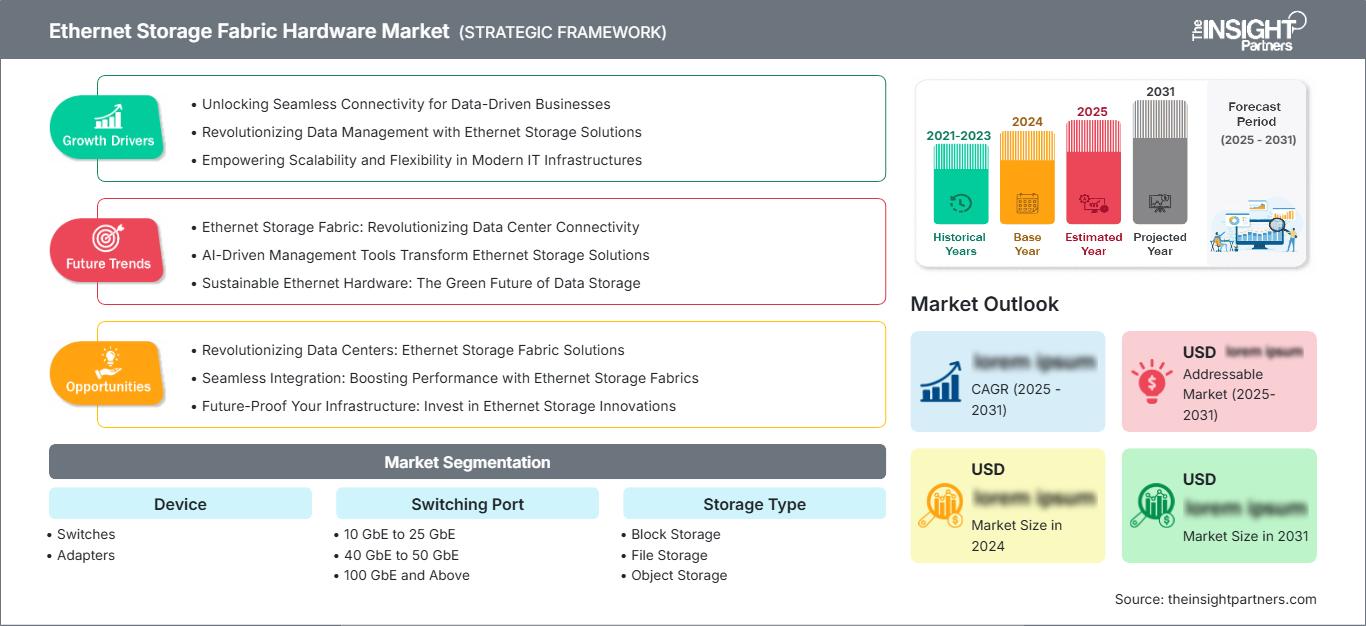
Coverage: By Device (Switches, Adapters); Switching Port (10 GbE to 25 GbE, 40 GbE to 50 GbE, 100 GbE and Above); Storage Type (Block Storage, File Storage, Object Storage, Hyper-Converged Infrastructure); Application (Enterprise Data Center, Cloud Service Provider Data Center, Telecommunications, Government) , and Geography (North America, Europe, Asia Pacific, and South and Central America)
- Status : Data Released
- Report Code : TIPRE00019880
- Category : Electronics and Semiconductor
- No. of Pages : 150
- Available Report Formats :


- Last update date : August 27, 2026


2025 Market Size
US$ 1.68 Bn
Base year value
2034 Forecast
US$ 4.3 Bn
Projected by 2034
CAGR 2026-2034
11.04 %
Growth rate
Addressable Market
US$ 26.47 Bn
(2026-2034)
The Ethernet Storage Fabric Hardware Market was valued at US$ 1.68 Billion in 2025 and is projected to reach US$ 4.3 Billion by 2034, registering a CAGR of 11.04% during 2026–2034. Expansion reflects the transition toward high-throughput, low-latency Ethernet architectures that connect storage, compute, and accelerator resources across enterprise, cloud, telecommunications, and government environments while preserving standards-based interoperability and operational familiarity.
Within North America, the Ethernet Storage Fabric Hardware Market size is expected to advance at a modelled CAGR of 10.2–11.0% through 2034. Dense AI clusters, broad NVMe over Fabrics adoption, and sustained hyperscale capacity additions are raising demand for lossless switching and intelligent adapters. Procurement is also shifting toward 100 GbE and faster ports as operators consolidate storage and data networks under common automation and telemetry frameworks.
Ethernet Storage Fabric Hardware Market Assessment and Insights
- North America: Accounted for a modelled 36–39% share in 2025 and is forecast to grow at 10.2–11.0% CAGR between 2026–2034, supported by hyperscale AI infrastructure, cloud storage modernization, and mature Ethernet engineering ecosystems.
- US: Represented 82–86% of North American revenue in 2025 and is projected to expand at 10.4–11.2% CAGR between 2026–2034 as cloud providers deploy faster back-end fabrics.
- Europe: Held a modelled 25–28% share in 2025 and should grow at 9.5–10.4% CAGR between 2026–2034, led by the UK, Germany, and France through sovereign-cloud and regulated-data investments.
- Asia Pacific: Captured a modelled 27–30% share in 2025 and is expected to post 12.2–13.3% CAGR between 2026–2034, with China, Japan, South Korea, and India driving cloud and telecom capacity.
- Largest Segment: Switches held a modelled 61–65% market share in 2025 and should record 10.5–11.4% CAGR during 2026–2034 as port density and fabric bandwidth rise.
- High Growth Segment: 100 GbE and Above represented a modelled 29–33% market share in 2025 and is forecast to grow at 14.0–15.2% CAGR during 2026–2034.
- Key companies analyzed in detail: NVIDIA Corporation, Huawei Technologies Co., Ltd., Juniper Networks, Inc., Arista Networks, Inc., Hewlett Packard Enterprise Company, Intel Corporation, Dell Technologies Inc., Cisco Systems, Inc., Fujitsu Limited, and Fortinet, Inc.
Source: The Insight Partners' analysis based on proprietary research, government publications, company annual reports, investor presentations, industry databases, and expert interviews.
Ethernet storage fabrics have progressed from general purpose LAN connectivity to deterministic and loss aware fabrics for distributed flash, hyper-convergence and data pipeline fed by accelerators. The combination of merchant silicon, programmable ASICs, DPUs, SmartNICs and 25, 100, 400, and 800 GbE roadmaps now drives production economics, with mature multivendor 800G interoperability and transition to 1.6T interfaces reducing integration risk and incentivizing customers to regard Ethernet as scalable storage fabric and not an alternative network.
Going forward, investments will expand from mature US-based hyperscaler customers to sovereign clouds, regional AI factories, telecom edge locations and open digital infrastructure. Ultra Ethernet Consortium’s standards, increasing adoption of SONiC, and procurement policies for interoperability will improve supply base access. Power considerations will drive high radix switch, linear optics and utilization via telemetry, whereas support of domestic cloud capacity in Europe, Asia Pacific and the Middle East will drive deployment geography diversity.
Ethernet Storage Fabric Hardware Market Report Scope
| Report Attribute | Details |
|---|---|
| Market size in 2025 | US$ 1.68 Billion |
| Market Size by 2034 | US$ 4.3 Billion |
| Global CAGR (2026 - 2034) | 11.04% |
| Historical Data | 2021-2024 |
| Forecast period | 2026-2034 |
Ethernet Storage Fabric Hardware Market Analysis
The Ethernet Storage Fabric Hardware Market will thrive due to the growing disparity between storage bandwidth and aging networks. Machine learning, real-time analytics, and database disaggregation generate consistent east-west data transfer that is beneficial for lossless delivery and predictable latency. More and more customers are purchasing switches, adapters, optics, and orchestration as a single fabric solution because congestion control and telemetry require an end-to-end approach.
Market supply trends in the Ethernet Storage Fabric Hardware Market include advanced silicon for switches, fast-speed SerDes, network processors, optical transceivers, and validated firmware. Port upgrades drive up average hardware content yet at the same time raise validation expenses and pose additional power density issues. Cisco predicts that over 60% of all switch ports deployed in data centers will operate at 100 Gbps or above in 2025, signaling a quick move away from 10 GbE standards for server and storage interconnects.
The Ethernet Storage Fabric Hardware Market analysis reveals that competition will move from standalone throughput to fabric results integration. NVIDIA Corporation integrates Spectrum switches with SuperNICs and DPUs; Cisco Systems, Inc. integrates processing and security services; Arista Networks, Inc. differentiates using EOS-based automation; and Juniper Networks, Inc. emphasizes intent-driven operations. Networking with servers and storage combinations from Hewlett Packard Enterprise Company and Dell Technologies Inc. become stronger.
Ecosystem control becomes the key aspect of strategic positioning in the Ethernet Storage Fabric Hardware Market. Huawei Technologies Co., Ltd. and Fujitsu Limited provide regional infrastructure solutions; Intel Corporation provides adapter and silicon solutions; and Fortinet, Inc. incorporates converged security into the data center fabric. Funds will be invested in 800G platforms, programmable congestion management, and operational telemetry. Companies which will be able to certify multivendor storage stacks and provide lifecycle automation must protect their margins in view of silicon commodification and open architectures pressure from customers.
● REPORT CUSTOMIZATION
Tailor This Report To Align With Your Specific Business Requirements
This report can be customized to align precisely with your business objectives, scope, and target markets. Customization options include tailored segmentation, geography, competitive analysis, and strategic insights to support informed decision-making.
Customize This Report →WHAT YOU CAN ADJUST
- ● Segmentations
- ● Geography
- ● Competitive Analysis
- ● Language Preferences
Ethernet Storage Fabric Hardware Market: Strategic Insights
Regional Insights
North America Ethernet Storage Fabric Hardware Market
North America’s Ethernet Storage Fabric Hardware Market share was modelled at 36–39% in 2025, with a 10.2–11.0% CAGR expected during 2026–2034. There is strong capital investment into hyperscale facilities, early accelerator cluster deployment, and deep NVMe-over-Ethernet engineering know-how in the region. Enterprises are transitioning away from individual storage networks towards leaf-spine architectures that allow automation, observability, and multitenancy segmentation in hybrid-cloud environments. Back-end AI networking has emerged as an important new source of demand, in addition to front-end bandwidth increases for ingesting and distributing training data.
The Ethernet Storage Fabric Hardware Market forecast indicates that depth of supply supports adoption. Product, integrations, or channel capabilities of NVIDIA Corporation, Arista Networks, Inc., Cisco Systems, Inc., Hewlett Packard Enterprise Company, Intel Corporation, Dell Technologies Inc., Juniper Networks, Inc., and Fortinet, Inc. are available in the region. New spine layers are being deployed using 100 GbE and higher speeds, while 25 GbE is retained at server edges. The American market also enjoys open networking ecosystem development, concentration of colocation facilities, and procurement processes which recognize value of latency, power consumption, and interoperability. There was a sharp increase in Ethernet switch sales in data centers in 2025 as investments into AI increased.
U.S. Ethernet Storage Fabric Hardware Market
The US represented a modelled 82–86% of North American revenue in 2025 and is forecast to grow at 10.4–11.2% CAGR through 2034. The hyperscaler providers, neocloud operators, finance organizations, research labs, and the US government are utilizing Ethernet fabrics for storage-intensive AI and analytics workloads. The applications are driving the demand for enterprise data centers and cloud service provider infrastructures in which users require deterministic congestion management, sub-microsecond visibility, and automation in thousands of nodes.
High participation of vendors can be observed in the Ethernet Storage Fabric Hardware Market. The NVIDIA Corporation has come up with its Spectrum-X Ethernet switch that has a SuperNIC platform and claims that it will improve the performance of AI networks by 1.6 times as compared to standard Ethernet and in February 2025, the Cisco Systems, Inc. launched N9300 Smart Switches with AMD Pensando DPUs. The Arista Networks, Inc. provides support for high-performance AI and routing, and the server suppliers integrate certified adapters in the servers.
Europe Ethernet Storage Fabric Hardware Market
Europe held a modelled 25–28% share in 2025 and is expected to expand at 9.5–10.4% CAGR through 2034. Leadership is seen in the UK through cloud regions, financial services infrastructure, and research computing. Upgrades to higher speed Ethernet for resilient file, object, and block storage is facilitated by the dense data center ecosystem of London, with encryption, segmentation, and auditable telemetry being important aspects of supplier selection for regulated industries.
Germany follows through industrial digitization, sovereign cloud strategies, and colocation investment in the Frankfurt area. Interoperable fabrics are important as they will be used to link factory data, SAP class workloads, and private cloud storage without proprietary lock-in. Public cloud capabilities and national digital sovereignty concerns form France, whereas Italy and Spain benefit from data center construction, telecommunication upgrades, and cloud migrations in the public sector. Energy efficiency and lifecycle support are important in all markets as power issues can affect deployment of high density systems. Partners include Hewlett Packard Enterprise Company, Cisco Systems, Inc., Juniper Networks, Inc., Huawei Technologies Co., Ltd., and Fujitsu Limited.
APAC Ethernet Storage Fabric Hardware Market
Asia Pacific captured a modelled 27–30% Ethernet Storage Fabric Hardware Market in 2025 and is forecast to record 12.2–13.3% CAGR through 2034. China excels through its cloud infrastructure, telecommunications investments, production of domestic switches, and massive digital public platforms. Japan and South Korea focus on low-latency business applications, manufacturing, and AI research networks.
Data localization policies in India, expansion of cloud regions, and digital public infrastructure in India will drive capacity growth quickly, and the colocation and government upgrade programs in Australia will help maintain their valuable deployments. Regional incentives for semiconductors, cloud, and AI infrastructures could help develop the ecosystem, even though the procurement process is vulnerable to power and cross-border technologies.
Middle East & Africa Ethernet Storage Fabric Hardware Market
The Middle East and Africa Ethernet Storage Fabric Hardware Market is forecast to grow at a modelled 10.8–11.8% CAGR during 2026–2034. Saudi Arabia leads through sovereign-cloud, smart-city, and AI infrastructure programs, followed by the UAE’s hyperscale and colocation expansion. Both markets require high-capacity fabrics that connect storage-intensive analytics with resilient government and energy systems.
South Africa provides sub-Saharan demand through finance services, telecommunication services, and regional cloud services, while Rest of MEA develops selectively on the basis of neutral carriers. Energy data, cybersecurity, and infrastructure investments favor switching that is modular in nature, although power limitations and lack of expertise may delay implementation periods.
Segmentation Analysis
Device
The Device segment in the Ethernet Storage Fabric Hardware Market is expected to grow at 10.8–11.7% CAGR during 2026–2034. Its Ethernet Storage Fabric Hardware Market scope spans high-radix switches and intelligent host adapters whose coordinated congestion control determines storage performance. Switch refreshes generate the larger revenue pool, while adapters gain strategic importance as NVMe, virtualization, encryption, and telemetry functions move closer to servers.
- Switches: Form the control and forwarding core of the fabric, with demand tied to port density, buffer architecture, telemetry, power efficiency, and migration toward 400G and 800G spine layers.
- Adapters: Connect servers and storage endpoints while accelerating transport, virtualization, security, and congestion functions; SmartNIC and DPU designs are increasingly important for multitenant clouds and disaggregated infrastructure.
Switching Port
The Switching Port segment is projected to expand at 12.1–13.0% CAGR between 2026–2034. Migration is two-speed: enterprises retain 10–25 GbE for endpoint economics, while cloud and AI operators standardize on 100 GbE and above for aggregation and back-end fabrics. Higher lane rates reduce topology depth but increase optical, thermal, and qualification requirements.
- 10 GbE to 25 GbE: Remains prevalent for enterprise server attachment and brownfield refreshes because it balances bandwidth, cabling reuse, adapter availability, and manageable power consumption across mixed workloads.
- 40 GbE to 50 GbE: Serves transitional aggregation and specialized server links, offering useful density where operators need more capacity without immediately redesigning optics, cabling, and switching architectures.
- 100 GbE and Above: Commands strategic investment for cloud, AI, and storage backbones, where fewer fabric tiers, high-radix designs, congestion control, and 400G-to-800G migration improve cluster utilization.
Storage Type
The Storage Type segment should grow at 10.7–11.6% CAGR during 2026–2034. Block environments emphasize latency and lossless transport, file systems require parallel throughput, and object platforms prioritize scale-out economics. Hyper-converged infrastructure links storage growth directly to east-west replication, making fabric design central to application consistency, failure recovery, and capacity expansion.
- Block Storage: Drives stringent latency, packet-loss, and availability requirements for databases and transactional systems, making validated NVMe transport, multipathing, and predictable congestion behavior central procurement criteria.
- File Storage: Supports collaborative, media, engineering, and research workloads, with demand favoring scalable east-west bandwidth and fabrics that sustain parallel access without complex proprietary networking.
- Object Storage: Expands with cloud-native applications, analytics, backup, and AI datasets; operators prioritize cost-efficient scale, durable replication traffic, and flexible connectivity across distributed storage nodes.
- Hyper-Converged Infrastructure: Combines compute and storage on common clusters, increasing sensitivity to fabric utilization, node-to-node replication, software-defined policy, and consistent performance during expansion or failure recovery.
Application
The Application segment is forecast to grow at 11.0–11.9% CAGR during 2026–2034. Cloud service providers lead performance requirements, enterprise centers contribute broad refresh demand, telecommunications operators distribute storage closer to network edges, and government buyers emphasize sovereignty and security. Each application values standards-based interoperability, but purchasing cycles and tolerance for operating complexity differ materially.
- Enterprise Data Center: Provides steady modernization demand as organizations consolidate networks, refresh virtualization platforms, and support analytics while retaining familiar Ethernet operations, security controls, and multivendor procurement.
- Cloud Service Provider Data Center: Sets the performance frontier through massive east-west traffic, accelerated computing, rapid port-speed transitions, and rigorous automation requirements across front-end, back-end, and storage networks.
- Telecommunications: Uses distributed fabrics for network functions, subscriber data, and edge clouds, prioritizing deterministic performance, compact form factors, remote operations, and resilience across geographically dispersed facilities.
- Government: Invests in sovereign cloud, defense, research, and citizen-service platforms, with purchasing shaped by supply-chain assurance, long support cycles, segmentation, encryption, and compliance requirements.
Opportunity Snapshot
| Application | Revenue Contribution | Trend Tag | Adoption Stage |
| Enterprise Data Center | High | Fabric Consolidation | Scaling |
| Cloud Service Provider Data Center | High | AI Back-End | Mature |
| Telecommunications | Medium | Edge Storage | Scaling |
| Government | Medium | Sovereign Cloud | Emerging |
Ethernet Storage Fabric Hardware Market Growth Drivers and Impact Analysis
AI Clusters Raise Storage Throughput Requirements
Accelerated computing alters the economics of storage networks due to the reduced utility of expensive GPUs resulting from unpredictable arrival of training data, checkpoints or model parameters. An AI center may devote 30 to 50 percent of its processing time to transferring data over networks, hence the cost and significance of congestion, loss and telemetry. Ethernet fabrics solve this issue by utilizing high radix switching, smart network interfaces, RDMA, and workload-based routing. However, this impact goes further than the accelerator interconnects in that front-end and storage networks need to ingest big data, respond to inference requests and transfer checkpoints without interfering with general-purpose computing. Hence, consumers are considering the behavior of the entire fabric and not just individual port rates.
NVMe and Disaggregated Infrastructure Favor Ethernet
NVMe-based storage and composable infrastructure separate capacity from individual servers, increasing traffic between compute nodes and pooled resources. Ethernet provides a familiar operational model, broad silicon ecosystem, and standards pathway from 25G server attachment to 400G and 800G aggregation. This lowers retraining and integration barriers compared with isolated specialist fabrics, especially for enterprises managing hybrid estates. Hardware demand grows across switches, adapters, cables, and optics because performance depends on coordinated flow control and queue management. The practical impact is a broader addressable market: database, virtualization, analytics, and private-cloud teams can adopt high-performance storage networking without abandoning existing automation frameworks. Suppliers that certify NVMe transport, multipathing, observability, and failure recovery across multivendor stacks are positioned to convert pilot projects into fleet-wide refresh programs.
Cloud and Sovereign Data Center Expansion Broadens Demand
Capacity additions by hyperscalers, neoclouds, colocation providers, telecom operators, and governments create recurring demand for storage fabrics at multiple performance tiers. New facilities can deploy leaf-spine architectures from inception, avoiding the compromises of legacy three-tier networks. Sovereign-cloud programs add requirements for domestic data handling, supply-chain assurance, and local support, widening opportunities for global vendors and regional integrators. The market impact appears in both volume and mix: 10–25 GbE remains relevant for cost-sensitive endpoints, while spine layers migrate toward 100 GbE and above. Vendors able to offer scalable reference designs, long lifecycle commitments, and energy-aware telemetry can participate earlier in facility planning. This improves attachment rates for adapters and optics while creating software and support revenue around hardware deployments.
Ethernet Storage Fabric Hardware Market Future Trends
800G Normalization and the 1.6T Transition
Ethernet Storage Fabric Hardware Market trends will increasingly reflect the normalization of multivendor 800G and engineering preparation for 1.6T. Operators will deploy 800G first in AI back-end and high-capacity spine layers, then extend it toward storage aggregation as optics mature. Linear and partially retimed optical designs can reduce power and latency for short-reach links, although host quality and interoperability testing remain decisive. Ethernet Alliance demonstrations in 2025 showed 800G moving from staged proof to routine multivendor operation. Vendors should therefore compete on usable density, thermal design, telemetry, and qualification coverage rather than raw speed. The transition should also stimulate adapter, cable, and test-equipment refresh cycles.
Programmable Fabrics Become Operationally Autonomous
Switches and adapters will evolve into coordinated policy and telemetry systems that identify congestion, isolate tenants, and remediate faults before storage applications breach service objectives. High-frequency streaming data from switches, SuperNICs, GPUs, and management platforms provides more granular visibility than periodic polling, which can miss millisecond anomalies. Open telemetry and gNMI interfaces should make these capabilities usable across multivendor estates. Procurement will increasingly score hardware on closed-loop operations, not only forwarding performance. Suppliers that expose trustworthy data models and integrate with enterprise observability stacks can reduce troubleshooting time, protect accelerator utilization, and create recurring software value around otherwise commoditizing hardware.
Ethernet Storage Fabric Hardware Market Opportunities
Validated Reference Designs for Midmarket AI Infrastructure
Midmarket enterprises want AI-capable infrastructure but often lack teams to tune lossless Ethernet, optics, storage software, and accelerator networks independently. Vendors can address this gap through validated reference designs that combine switches, adapters, cables, telemetry, and deployment automation for defined cluster sizes. Channel partners should package site assessment, migration, and performance verification as repeatable services. The commercial opportunity is attractive because customers value reduced integration risk more than component-level discounting. Designs should support phased expansion from 100G server links to 400G or 800G spines, preserve standard management interfaces, and document power requirements. Partnerships among networking, server, and storage suppliers can shorten sales cycles and improve attachment revenue.
Sovereign and Edge Cloud Fabric Modernization
Governments, telecom operators, and regulated industries are building regional cloud and edge facilities that require compact, resilient storage fabrics with strong segmentation and remote management. Suppliers should target these projects with modular platforms, long support commitments, and locally qualified integration partners. Opportunity is strongest where national data policies intersect with AI, citizen services, energy analytics, or telecom cloud modernization. Hardware portfolios must balance 25G economics at distributed endpoints with 100G-and-above aggregation, while software should simplify zero-touch provisioning and audit reporting. Financing, training, and spare-parts programs can differentiate bids in emerging markets. Early engagement with facility designers helps align switching density, optics, cooling, and redundancy before procurement specifications become fixed.
Recent Developments
- July 2026: DriveNets has expanded its AI networking portfolio with new high-capacity AI Fabric platforms designed to address the growing networking requirements of large-scale artificial intelligence infrastructure. The solutions are aimed at AI clusters that require high bandwidth, low latency and predictable, lossless connectivity between large numbers of GPUs and other accelerators. The new platforms build on DriveNets' Ethernet-based AI Fabric architecture, which combines networking hardware, software and services into a full-stack solution. The platform is designed to support backend, frontend and storage networks while allowing customers to use different GPUs, NICs and optical components without being locked into a single vendor.
- June 2026: Arista Networks has introduced its new 7060XE7 Series, a portfolio of 1.6-terabit networking platforms designed to support large-scale artificial intelligence infrastructure. The new systems are aimed at rack-scale AI deployments, where networking has become a critical part of the overall computing architecture as AI clusters expand from thousands to hundreds of thousands of accelerators. The 7060XE7 Series is designed to support both scale-up and scale-out AI fabrics, providing high-bandwidth, low-latency connectivity between AI accelerators, memory and other components. Arista says the platforms address the high-density, power and thermal requirements of next-generation AI data centres and can operate in air-cooled, liquid-cooled and hybrid-cooled environments.
- March 2026: Keysight Technologies has introduced the AresONE 1600GE, a purpose-built 1.6T Ethernet AI workload emulation platform designed to help network equipment manufacturers, chip developers, hyperscalers and AI data-centre operators validate next-generation AI fabrics. The platform is designed for networks using emerging 224G SerDes electrical lanes and aims to reduce development time, testing costs and deployment risks. The launch comes as AI infrastructure moves toward higher network speeds and greater switch port densities. The increasing use of 800GE and 1600GE connections can reduce the number of network tiers in AI clusters, but it also creates new challenges around link integrity, congestion and the accurate reproduction of AI communication patterns.
Frequently Asked Questions

- Comprehensive Market Sizing and Forecast Analysis
- Detailed Segmentation Analysis
- In-Depth Market Dynamics Assessment
- Regional and Country-Level Insights
- Competitive Landscape and Company Benchmarking
- Strategic Business Intelligence
Recent Reports
Testimonials

The Insight Partners' SCADA System Market report is comprehensive, with valuable insights on current trends and future forecasts. The team was highly professional, responsive, and supportive throughout. We are very satisfied and highly recommend their services.
RAN KEDEM Partner, Reali Technologies LTDs
I requested a report on a very specific software market and the team produced the report in a few days. The information was very relevant and well presented. I then requested some changes and additions to the report. The team was again very responsive and I got the final report in less than a week.
JEAN-HERVE JENN Chairman, Future Analytica
We worked with The Insight Partners for an important market study and forecast. They gave us clear insights into opportunities and risks, which helped shape our plans. Their research was easy to use and based on solid data. It helped us make smart, confident decisions. We highly recommend them.
PIYUSH NAGPAL Sr. Vice President, High Beam Global
The Insight Partners delivered insightful, well-structured market research with strong domain expertise. Their team was professional and responsive throughout. The user-friendly website made accessing industry reports seamless. We highly recommend them for reliable, high-quality research services
YUKIHIKO ADACHI CEO, Deep Blue, LLC.
This is the first time I have purchased a market report from The Insight Partners.While I was unsure at first, I visited their web site and felt more comfortable to take the risk and purchase a market report.I am completely satisfied with the quality of the report and customer service. I had several questions and comments with the initial report, but after a couple of dialogs over email with their analyst I believe I have a report that I can use as input to our strategic planning process.Thank you so much for taking the extra time and making this a positive experience.I will definitely recommend your service to others and you will be my first call when we need further market data.
JOHN SUZUKI President and Chief Executive Officer, Board Director, BK Technologies
I wish to appreciate your support and the professionalism you displayed in the course of attending to my request for information regarding to infectious disease IVD market in Nigeria. I appreciate your patience, your guidance, and the fact that you were willing to offer a discount, which eventually made it possible for us to close a deal. I look forward to engaging The Insight Partners in the future, all thanks to the impression you have created in me as a result of this first encounter.
DR CHIJIOKE ONYIA MANAGING DIRECTOR, PineCrest Healthcare Ltd.Reason to Buy
- Informed Decision-Making
- Understanding Market Dynamics
- Competitive Analysis
- Identifying Emerging Markets
- Customer Insights
- Market Forecasts
- Risk Mitigation
- Boosting Operational Efficiency
- Strategic Planning
- Investment Justification
- Tracking Industry Innovations
- Aligning with Regulatory Trends





 Get Free Sample for