
Fiber Optic Circulators Market Growth, Share & Trends by 2034
Coverage: By Type (3 - Ports, 4 - Ports, More than 4 - Ports); Application (Telecommunications, Medical and Imaging, Semiconductor Equipment, Others), and Geography (North America, Europe, Asia Pacific, and South and Central America)
- Status : Data Released
- Report Code : TIPRE00014529
- Category : Electronics and Semiconductor
- No. of Pages : 150
- Available Report Formats :


- Last update date : September 28, 2026


2025 Market Size
US$ 1.24 Bn
Base year value
2034 Forecast
US$ 2.16 Bn
Projected by 2034
CAGR 2026-2034
6.36 %
Growth rate
Addressable Market
US$ 15.38 Bn
(2026-2034)
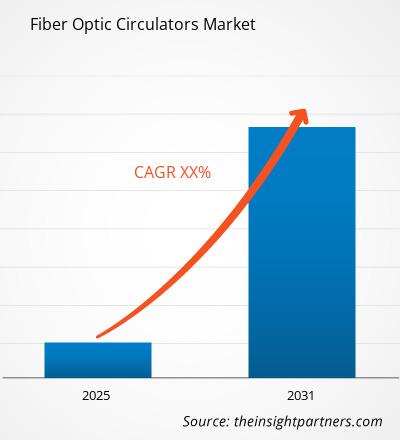
The Fiber Optic Circulators Market is expected to grow from US$ 1.24 Billion in 2025 to US$ 2.16 Billion by 2034, recording a CAGR of 6.36%. Factors influencing the growth include the application in routing optical signals, bidirectional communication, wavelength operations, and precision photonics in various settings like telecommunications, medicine and imaging, and semiconductor equipment.
The North America Fiber Optic Circulators Market is expected to grow at a CAGR of 5.8–6.5% between 2026 and 2034. Contributing factors include the advancement of broadband infrastructure, coherent optical networking, and incorporation of optical imaging technologies in the healthcare sector.
Fiber Optic Circulators Market Assessment and Insights
- North America held 29–32% share in 2025 and is growing at a CAGR of 5.8–6.5% during 2026–2034, supported by optical network upgrades, FTTH expansion, and photonics manufacturing.
- US represented 78–82% of North American revenue in 2025 and is growing at a CAGR of 5.9–6.6% during 2026–2034, led by telecom, defense, and medical imaging users.
- Europe accounted for 23–26% share in 2025 and is growing at a CAGR of 5.5–6.2% during 2026–2034, with Germany, the UK, France, Italy, and Spain leading adoption.
- Asia Pacific captured 34–37% share in 2025 and is growing at a CAGR of 6.9–7.6% during 2026–2034, led by China, Japan, South Korea, India, and Taiwan-linked component ecosystems.
- Largest Segment 3 - Ports devices held 58–62% market share in 2025 and are growing at a CAGR of 5.9–6.6% during 2026–2034 because they support core bidirectional routing needs.
- High Growth Segment Semiconductor Equipment represented 18–21% market share in 2025 and is growing at a CAGR of 7.0–7.8% during 2026–2034, supported by laser, metrology, and sensing demand.
- Key companies analyzed in detail: AC Photonics, Inc.; AFW Technologies Pty Ltd.; Agiltron Inc.; Clearfield, Inc.; DPM Photonics; IDIL Fibres Optiques; Laser 2000 GmbH; LEAD Fiber Optics Co., Ltd.; OF-Link Communications Co., Ltd.; Shenzhen Lightcomm Technology Co., Ltd.
Source: The Insight Partners' analysis based on proprietary research, government publications, company annual reports, investor presentations, industry databases, and expert interviews.
Optical circulators have transitioned from experimental laboratory parts to commercially available passive parts in wavelength dense systems, optical sensing and high-speed access network solutions. Production technology has been enhanced by advances in micro-optics packaging, polarization maintaining fibers, better insertion loss management and higher isolation performance. The market is increasingly driven by telecom service providers who need smaller size routing parts and instrumentation manufacturers who need robust optical performance irrespective of wavelengths.
The future demand would be boosted by fiber density, optical coherence tomography, lidar studies and semiconductor lasers applications that would benefit from reliable non-reciprocal routing elements. Asia-Pacific brings volume through manufacturing of photonics components, North America and Europe focus on qualified parts for controlled and high reliability applications. Standards driven buying practices, RoHS compliance, Telcordia requirements and system miniaturization would ensure suppliers' attention to repeatability, thermal stability and polarization dependent loss performance.
Fiber Optic Circulators Market Report Scope
| Report Attribute | Details |
|---|---|
| Market size in 2025 | US$ 1.24 Billion |
| Market Size by 2034 | US$ 2.16 Billion |
| Global CAGR (2026 - 2034) | 6.36% |
| Historical Data | 2021-2024 |
| Forecast period | 2026-2034 |
Fiber Optic Circulators Market Analysis
Growth in Fiber Optic Circulators is attributed to bandwidth increase, single fiber bi-directional communication, and requirement for handling reflections in optical configurations. The circulators are used by telecom providers in WDM, OADM, amplifiers, and monitoring configuration setups, whereas healthcare and industries use them for OCT, sensing, and test systems. The reason for their importance lies in sequential routing of light from one port to another without back propagation.
Value chain is comprised of micro-optics suppliers, ferrule/fiber suppliers, coating suppliers, assembly suppliers, distributors, and OEM system integrators. Supply chain relies on magneto optical crystals, polarization maintaining fibers, connector quality, environmental testing, and small form factor packaging. On the part of the buyer, the analysis focuses on insertion loss, isolation, return loss, wavelength range, power handling capacity, and port quantity.
The Fiber Optic Circulators Market report indicates a competition landscape that is made up of catalog suppliers, custom photonics providers, and telecom component suppliers. AC Photonics, Inc., Agiltron Inc., OF-Link Communications Co., Ltd., and Shenzhen Lightcomm Technology Co., Ltd. compete by offering different wavelengths and polarization-maintaining variants while Clearfield, Inc. caters to network deployment requirements through its offerings of optical components.
Among the investment trends there will be high power circulators, OCT compatible circulator modules, small 3 port circulators, and customized 4 port circulators. AFW Technologies Pty Ltd., DPM Photonics, IDIL Fibres Optiques, Laser 2000 GmbH, and LEAD Fiber Optics Co., Ltd. increase their market share using distribution and integration skills and competencies. Strategic positioning will be based on qualification possibilities and optical performance.
● REPORT CUSTOMIZATION
Tailor This Report To Align With Your Specific Business Requirements
This report can be customized to align precisely with your business objectives, scope, and target markets. Customization options include tailored segmentation, geography, competitive analysis, and strategic insights to support informed decision-making.
Customize This Report →WHAT YOU CAN ADJUST
- ● Segmentations
- ● Geography
- ● Competitive Analysis
- ● Language Preferences
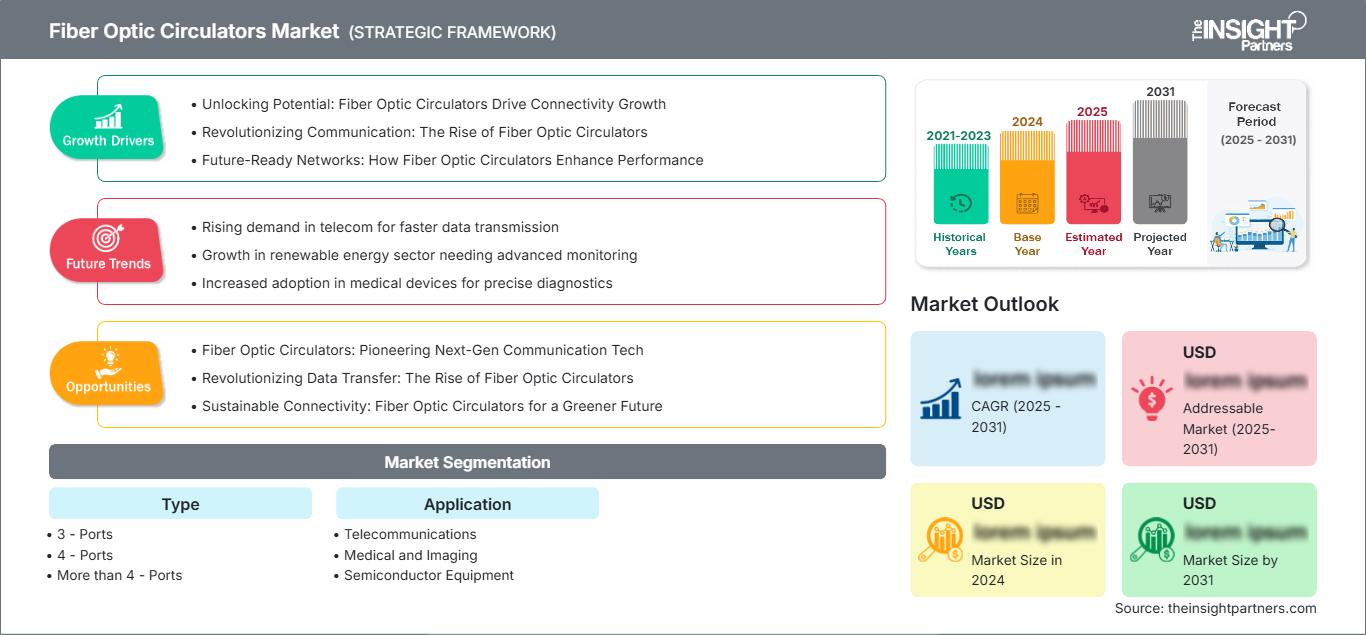
Fiber Optic Circulators Market: Strategic Insights
Regional Insights
North America Fiber Optic Circulators Market
The market share of North America was 29-32% of Fiber Optic Circulators in 2025, and is anticipated to grow with a CAGR of 5.8-6.5% from 2026 to 2034. The applications include carriers, data communications, medical imaging research, aerospace photonics and university laboratories, where high-efficiency signal isolation is required.
The structural factors involved are broadband funding, 5G backhaul, FTTH installations, and availability of suppliers of photonic components. The companies supporting the regional availability through their product lines are AC Photonics, Inc., Agiltron Inc., and Clearfield, Inc. The buyers look for traceability and standard connector compatibility.
U.S. Fiber Optic Circulators Market
North America had accounted for 78-82% of total revenue share in 2025, and it is projected to expand at a CAGR of 5.9-6.6% over 2026-2034. Application areas that contribute to demand include telecommunication, OCT imaging, fiber sensing, test equipment, and semiconductor process tools that need optical signal routing within specified wavelengths.
Firm presence includes AC Photonics, Inc., based in Santa Clara, Agiltron Inc., in Massachusetts, and Clearfield, Inc., in fiber installation ecosystem. The Market derives advantage from defense photonics projects, upgrading of broadband networks, and development of medical devices, where suppliers need to give datasheets, environmental ratings, and custom connectors.
Europe Fiber Optic Circulators Market
Europe held 23-26% market share in 2025 and is expected to register a CAGR of 5.5-6.2% between 2026-2034. Europe’s growth will be driven by Germany with the help of industrial lasers, metrology, and research instruments. The UK will aid the photonics lab and telecom testing segment, whereas France, Italy, and Spain will increase demand from fiber sensing, medical imaging, and optical instrumentation.
Certified products and RoHS compliance and stability across a wide range of temperatures are preferred among European buyers. IDIL Fibres Optiques and Laser 2000 GmbH cater to specialty photonics channels, while DPM Photonics meets the needs of custom components. Europe will have moderate growth as its regional application needs qualify for optical systems for industries and healthcare.
APAC Fiber Optic Circulators Market
Asia-Pacific has held 34–37% market share in 2025, with a forecasted growth rate of 6.9–7.6% during 2026–2034. China dominates the market due to its production of components and optical networks. Japan and South Korea provide the market through demand for semiconductors, sensing, and instrumentation. India and Australia contribute due to telecom modernization and research uses.
National policies and drivers behind the growth of the market include broadband initiatives, semiconductor localization, and photonics manufacturing cluster. The companies that strengthen the supply chain in the region include Shenzhen Lightcomm Technology Co., Ltd., LEAD Fiber Optics Co., Ltd., and OF-Link Communications Co., Ltd. by their optical circulators, isolators, couplers, and WDM.
Middle East & Africa Fiber Optic Circulators Market
Growth for the Middle East and Africa (MEA) region has been estimated to be in the range of 5.7-6.4% CAGR during 2026-2034 years driven by fiber infrastructure development in Saudi Arabia, connectivity projects in smart cities in the UAE, and demand generated by backbone upgrades and institutional connections in South Africa & Rest of MEA.
Context in terms of energy and infrastructure is important since the fiber network helps in oil and gas monitoring, utility communications, and government communication security purposes. Although the demand from MEA is lower than other regions, optical circulators are installed where the use of bi-directional fiber, sensing, and monitoring architecture justifies the need for high-performance components.
Segmentation Analysis
Type
Type is projected to grow at a CAGR of 6.0–6.7% during 2026–2034. The Market scope covers 3 - Ports, 4 - Ports, and More than 4 - Ports configurations. Selection depends on routing complexity, optical path isolation, wavelength band, packaging format, and whether the end system needs standard telecom routing or advanced instrumentation flexibility.
- 3 - Ports devices dominate because they support the most common signal path, moving light from port 1 to port 2 and reflected signals toward port 3.
- 4 - Ports devices serve systems requiring additional routing flexibility, bidirectional channel separation, or more complex add-drop arrangements in telecom and laboratory optical layouts.
- More than 4 - Ports configurations are specialized products used in research, sensing, or custom instrumentation where designers need compact routing beyond standard sequential paths.
Application
Application is forecast to grow at a CAGR of 6.2–6.9% during 2026–2034. Application demand is strongest where reflected or counter-propagating light must be managed without adding bulky switching hardware. Telecommunications remains the largest use area, while medical and imaging systems need low back-reflection routing and semiconductor equipment benefits from stable laser and metrology paths.
- Telecommunications uses circulators in WDM, optical add-drop, amplifier, monitoring, and bidirectional single-fiber architectures where low insertion loss and isolation protect signal quality.
- Medical and Imaging demand is linked to OCT, endoscopy, spectroscopy, and biomedical optical systems that require precise separation of launched and returned light.
- Semiconductor Equipment adoption is rising in laser tools, metrology, interferometry, and sensing platforms where stable routing improves measurement repeatability and optical path control.
Opportunity Snapshot
| Application | Revenue Contribution | Trend Tag | Adoption Stage |
| Telecommunications | High | Fiber Routing | Mature |
| Medical and Imaging | Medium | OCT Imaging | Scaling |
| Semiconductor Equipment | Medium | Laser Metrology | Emerging |
Fiber Optic Circulators Market Growth Drivers and Impact Analysis
Fiber Densification Raises Demand for Bidirectional Routing
Telecom networks continue shifting toward higher fiber utilization as operators expand FTTH, metro transport, and 5G backhaul capacity. Optical circulators help carry upstream and downstream signals over efficient architectures while isolating reflected paths that could degrade performance. The market impact is strongest in dense access networks and WDM systems where saving fiber strands and reducing optical noise have direct cost implications. As network equipment vendors standardize compact passive component modules, qualified circulators become recurring procurement items rather than one-off laboratory devices. This driver supports volume demand for 3-port devices and customized wavelength options across the Market.
OCT and Biomedical Imaging Require Low Back-Reflection Paths
Medical imaging systems, especially OCT platforms, depend on clean separation between launched light and returned signals. Circulators improve signal-to-noise performance by directing reflections toward detectors while limiting unwanted feedback into sources. The market impact is a steady shift from general-purpose components toward devices with tighter wavelength, packaging, and reliability specifications. Imaging equipment makers value low insertion loss, stable polarization behavior, and small footprints because these parameters influence resolution, repeatability, and system size. Suppliers that can support prototype batches and production qualification gain an advantage as biomedical optics moves from research labs into broader clinical instrumentation.
Semiconductor Tools Increase Precision Photonics Content
Semiconductor equipment increasingly uses photonics for inspection, metrology, interferometry, wafer alignment, and laser processing. These tools require predictable routing of optical signals and protection from back-reflections that can disturb lasers or measurement paths. The impact is rising demand for high-stability, polarization-maintaining, and custom-packaged circulators that can operate inside tightly engineered optical subsystems. Component qualification is lengthy, but successful design-ins can generate repeat orders over tool life cycles. This driver also encourages closer collaboration between circulator suppliers, optical module designers, and equipment manufacturers seeking compact assemblies with documented performance over temperature and power ranges.
Fiber Optic Circulators Market Future Trends
Higher-Power Polarization-Maintaining Designs Expand Use Cases
Fiber Optic Circulators Market trends point toward higher-power polarization-maintaining designs for fiber lasers, sensing, instrumentation, and semiconductor tools. Future products will need to combine low insertion loss, high extinction ratio, thermal stability, and compact packaging without sacrificing reliability. Demand will move beyond standard telecom wavelengths as laboratories and OEMs work across visible, near-infrared, and specialty bands. Suppliers with micro-optics expertise and configurable manufacturing lines will be better positioned because customers increasingly ask for wavelength, connector, fiber type, and packaging changes during qualification.
Application-Specific Modules Replace Standalone Components
Future procurement will increasingly favor circulator-based subassemblies that integrate connectors, couplers, filters, isolators, or monitoring taps for faster OEM integration. This shift reduces engineering effort for equipment makers and gives suppliers more value per design-in. Telecom vendors may use compact modules for access and WDM nodes, while imaging and semiconductor customers will prefer validated optical blocks. The trend rewards companies that can move from catalog sales to co-engineered modules with documentation, repeatability, and scalable production support.
Fiber Optic Circulators Market Opportunities
Custom OCT and Sensing Packages for OEM Programs
Fiber Optic Circulators Market Forecasts support investment in OEM-ready packages for OCT, spectroscopy, lidar, and fiber sensing platforms. Equipment developers often need small batches during prototyping, followed by controlled production once the optical path is validated. Suppliers can create opportunity by offering wavelength tuning, fiber selection, connector customization, environmental testing, and assembly documentation as one package. This approach helps buyers reduce integration risk and accelerates design approval. The most attractive accounts are medical imaging, industrial sensing, and laboratory instrument makers that value technical support more than the lowest unit price.
Localized Supply Partnerships for Telecom Rollouts
Telecom equipment makers and fiber deployment contractors need dependable component supply during broadband and backhaul rollouts. Circulator suppliers can build opportunity through regional distributors, stocked variants, and application support for WDM, OADM, and bidirectional single-fiber systems. Localized partnerships reduce lead-time risk and help customers resolve connector, wavelength, and packaging questions before deployment. This opportunity is strongest in Asia Pacific and North America, where fiber investment is large and procurement favors qualified alternatives. Vendors that combine standard catalog availability with fast customization can gain share without competing only on price.
Recent Developments
- March 2026: SENKO Advanced Components, a global leader in fiber optic connectivity, announced a breakthrough in detachable fiber connectivity for Co-Packaged Optics (CPO). The new Lightmatter vClick Optics architecture integrates SENKO’s detachable Metallic PIC Coupler (MPC) and SEAT optical interface, enabling high-bandwidth fiber array units (FAUs) designed for advanced packaging and high-volume production.
- March 2026: Advanced Fiber Resources (AFR) unveiled a comprehensive portfolio of core optical components and solutions for both datacom and telecom network applications at OFC 2026, held March 17–19 at the Los Angeles Convention Center. With a strong focus on high-speed connectivity and long-haul transmission, AFR’s exhibit highlighted innovations tailored for next-generation network architectures—spanning datacenters, AI clusters, and backbone networks.
- March 2026: STL [NSE: STLTECH], a leading connectivity solutions provider for AI-ready digital infrastructure, announced a significant breakthrough in optical communication with the launch of India’s first Hollow Core Fibre (HCF) cable. This innovation, from STL’s industry-leading R&D engine, is designed to meet the low-latency and high-bandwidth requirements of modern Data Centres, Hyperscalers, and High-Frequency transmission networks.
Frequently Asked Questions

- Comprehensive Market Sizing and Forecast Analysis
- Detailed Segmentation Analysis
- In-Depth Market Dynamics Assessment
- Regional and Country-Level Insights
- Competitive Landscape and Company Benchmarking
- Strategic Business Intelligence
Recent Reports
Testimonials

The Insight Partners' SCADA System Market report is comprehensive, with valuable insights on current trends and future forecasts. The team was highly professional, responsive, and supportive throughout. We are very satisfied and highly recommend their services.
RAN KEDEM Partner, Reali Technologies LTDs
I requested a report on a very specific software market and the team produced the report in a few days. The information was very relevant and well presented. I then requested some changes and additions to the report. The team was again very responsive and I got the final report in less than a week.
JEAN-HERVE JENN Chairman, Future Analytica
We worked with The Insight Partners for an important market study and forecast. They gave us clear insights into opportunities and risks, which helped shape our plans. Their research was easy to use and based on solid data. It helped us make smart, confident decisions. We highly recommend them.
PIYUSH NAGPAL Sr. Vice President, High Beam Global
The Insight Partners delivered insightful, well-structured market research with strong domain expertise. Their team was professional and responsive throughout. The user-friendly website made accessing industry reports seamless. We highly recommend them for reliable, high-quality research services
YUKIHIKO ADACHI CEO, Deep Blue, LLC.
This is the first time I have purchased a market report from The Insight Partners.While I was unsure at first, I visited their web site and felt more comfortable to take the risk and purchase a market report.I am completely satisfied with the quality of the report and customer service. I had several questions and comments with the initial report, but after a couple of dialogs over email with their analyst I believe I have a report that I can use as input to our strategic planning process.Thank you so much for taking the extra time and making this a positive experience.I will definitely recommend your service to others and you will be my first call when we need further market data.
JOHN SUZUKI President and Chief Executive Officer, Board Director, BK Technologies
I wish to appreciate your support and the professionalism you displayed in the course of attending to my request for information regarding to infectious disease IVD market in Nigeria. I appreciate your patience, your guidance, and the fact that you were willing to offer a discount, which eventually made it possible for us to close a deal. I look forward to engaging The Insight Partners in the future, all thanks to the impression you have created in me as a result of this first encounter.
DR CHIJIOKE ONYIA MANAGING DIRECTOR, PineCrest Healthcare Ltd.Reason to Buy
- Informed Decision-Making
- Understanding Market Dynamics
- Competitive Analysis
- Identifying Emerging Markets
- Customer Insights
- Market Forecasts
- Risk Mitigation
- Boosting Operational Efficiency
- Strategic Planning
- Investment Justification
- Tracking Industry Innovations
- Aligning with Regulatory Trends





 Get Free Sample for