
Game Engines Market Growth, Demand & Size by 2034
Coverage: By Type (3D Game Engines, 2.5D Game Engines, 2D Game Engines); Application (PC Games, Mobile Games, Training and Simulation, TV Games), and Geography (North America, Europe, Asia Pacific, and South and Central America)
- Status : Data Released
- Report Code : TIPRE00014298
- Category : Electronics and Semiconductor
- No. of Pages : 150
- Available Report Formats :


- Last update date : September 17, 2026


2025 Market Size
US$ 3.64 Bn
Base year value
2034 Forecast
US$ 14.08 Bn
Projected by 2034
CAGR 2026-2034
16.22 %
Growth rate
Addressable Market
US$ 74.81 Bn
(2026-2034)
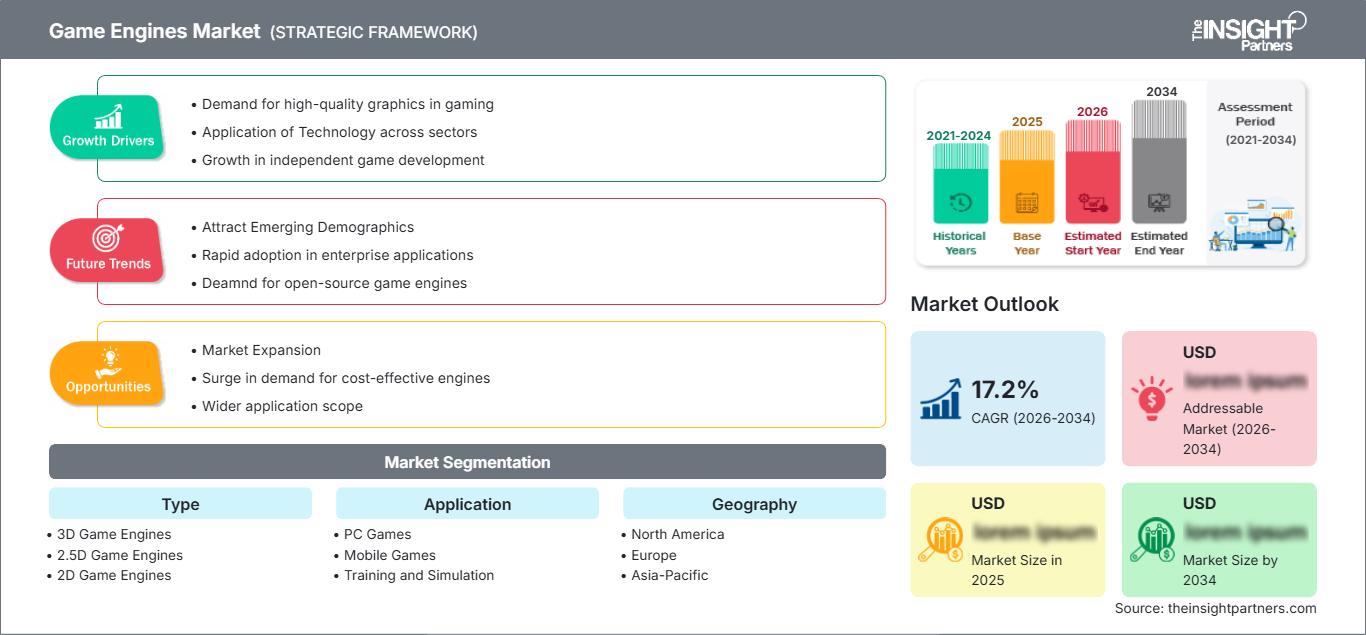
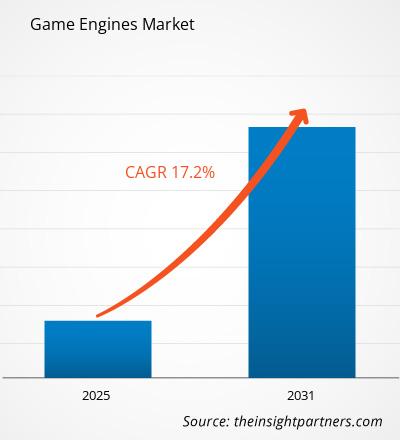
The Game Engines Market is expanding as developers prioritize reusable software frameworks for graphics, physics, audio, artificial intelligence integration, and cross-platform deployment. The market is valued at US$ 3.64 Billion in 2025 and is projected to reach US$ 14.08 Billion by 2034, reflecting a CAGR of 16.22% during 2026–2034. Growth is supported by rising game production complexity, mobile gaming penetration, immersive technologies, and broader use of real-time 3D development.
North America remains a structurally important development hub, supported by established studios, advanced computing infrastructure, and strong investment in interactive entertainment. The Game Engines Market size is expected to expand at an estimated CAGR of 15.0–16.5% between 2026–2034, with demand reinforced by PC and console development, cloud-enabled production workflows, and growing adoption of real-time 3D technologies.
Game Engines Market Assessment and Insights
- North America: North America is expected to hold a 34–38% Game Engines Market share in 2025 and expand at a 15.0–16.5% CAGR between 2026–2034, supported by established studios, advanced developer ecosystems, and sustained investment in interactive entertainment.
- US: The US is expected to represent 80–84% of North America's 2025 market and grow at a 14.8–16.3% CAGR between 2026–2034, supported by major studios and technology-intensive development.
- Europe: Europe is estimated to account for a 24–28% share in 2025 and grow at a 14.5–16.0% CAGR during 2026–2034, led by the UK, Germany, France, Sweden, and Poland, where established studios and technical talent support engine adoption.
- Asia Pacific: Asia Pacific is estimated to command a 34–38% share in 2025 and grow at a 17.0–19.0% CAGR during 2026–2034, led by China, Japan, South Korea, and India through mobile gaming, esports, and expanding development capacity.
- Largest Segment: 3D Game Engines represent an estimated 74–78% market share in 2025 and are expected to grow at a 15.5–17.0% CAGR during 2026–2034, reflecting intensive visual and simulation requirements.
- High Growth Segment: Mobile Games represent an estimated 39–43% application share in 2025 and are expected to grow at an 18.0–20.0% CAGR during 2026–2034, supported by broad smartphone distribution.
- Key companies analyzed in detail: Epic Games, Crytek, GameSalad, Leadwerks Software, Marmalade Technologies Limited, OGRE, Scirra Ltd., Unity Technologies, Valve Corporation, and YoYo Games.
Source: The Insight Partners' analysis based on proprietary research, government publications, company annual reports, investor presentations, industry databases, and expert interviews.
There is an ongoing shift away from proprietary pipelines to engines that allow the processing of rendering, physics, animations, networking, asset management, and deployment all within one integrated system. There are more tendencies toward real-time rendering, physics-based graphics, procedural generation, virtual production, and artificial intelligence solutions. All of those have started to shape the development of engines.
There is also a transformation in the economics of production, where game developers want a faster production cycle and less duplication of technologies. Game engine vendors compete in terms of editor productivity, asset systems, multiplayer support, analytics, monetization solutions, and support for new hardware technologies. That creates a favorable condition for platforms that would serve both indie studios and big players, and specialized engines remain relevant too.
Game Engines Market Report Scope
| Report Attribute | Details |
|---|---|
| Market size in 2025 | US$ 3.64 Billion |
| Market Size by 2034 | US$ 14.08 Billion |
| Global CAGR (2026 - 2034) | 16.22% |
| Historical Data | 2021-2024 |
| Forecast period | 2026-2034 |
Game Engines Market Analysis
Drivers of growth for Game Engines Market include expansion of game development in mobile, PC, console, and immersive formats along with increasing demand for scalable rendering and simulation. The market ecosystem consists of engine providers, middleware providers, hardware providers, content providers, publishers, platforms operators and independent game studios. Engine software serves as an intermediary layer between development tools and downstream distribution.
The demand for Game Engines can be facilitated by repeated use of the same assets and development pipelines in various releases. Collaboration in the cloud, digital assets libraries, multiplatform build system and automated testing can help to decrease engineering overheads. On the supplier side, the providers should constantly invest in rendering capabilities, developer tools, security, integration with platforms and technical documentation. All of these factors present certain barriers for small vendors but offer potential opportunities for specialized open-source and light-weight engines.
Competitive position in the Game Engines Market analysis is becoming more dependent on the depth of the ecosystem than on the rendering capabilities alone. Epic Games leverages the positioning of Unreal Engine in high fidelity development. Unity Technologies is focused on broad support of various platforms and production workflows. Valve Corporation maintains strategic position with Source 2 engine and its distribution ecosystem. Crytek, Leadwerks Software, GameSalad, Marmalade Technologies Limited, OGRE, Scirra Ltd. and YoYo Games provide solutions to different needs of developers.
Increasing investments are made into AI-assisted development, procedural workflows, real-time collaboration and integration of development with deployment processes. Unity 2025 vision included stability, production verification, platform reach and performance improvement, while 2026 vision of Unity mentioned collaboration of developers and coding agents. Thus, competitive advantage is shifting towards integrated development environment rather than individual rendering capabilities.
● REPORT CUSTOMIZATION
Tailor This Report To Align With Your Specific Business Requirements
This report can be customized to align precisely with your business objectives, scope, and target markets. Customization options include tailored segmentation, geography, competitive analysis, and strategic insights to support informed decision-making.
Customize This Report →WHAT YOU CAN ADJUST
- ● Segmentations
- ● Geography
- ● Competitive Analysis
- ● Language Preferences
Game Engines Market: Strategic Insights
Regional Insights
North America Game Engines Market
North America is estimated to represent 34–38% of the Game Engines Market in 2025 and is projected to grow at a 15.0–16.5% CAGR through 2034. The area enjoys the advantage of a high density of publishers, independent studios, technology firms, universities, and platform companies. The US continues to be the largest contributor, while Canada acts as a supplement by offering studios and tech skills.
There is a particular demand for engines that work for high-end PC and console games, for multiplayer capabilities, for cinematic quality rendering, and for cross-platform releases. Investments in areas such as artificial intelligence, cloud computing, and real-time graphics are pushing developers towards updating their production processes. Regulations concerning privacy, digital markets, consumer rights, and IP laws also have an impact on the design of the platforms.
U.S. Game Engines Market
The U.S. accounts for an estimated 80–84% of North America's 2025 market and is projected to grow at a 14.8–16.3% CAGR through 2034. Diverse customers come from big publishers, individual developers, tech companies, and universities. Epic Games, Unity Technologies, Valve Corporation, and other entities of the ecosystem ensure considerable visibility for developers in the field of PC, console, mobile, and immersive platforms.
The trend in the application domain is becoming more cross-platform development, live services, multiplayer features, and high-end graphics. Besides, developers examine the possibility of applying artificial intelligence for helping in writing codes and content to become more productive. It is the combination of existing intellectual property portfolio, distribution system, and venture activities that help engines to become popular.
Europe Game Engines Market
Europe is estimated to hold a 24–28% share of the Game Engines Market in 2025 and is projected to grow at a 14.5–16.0% CAGR through 2034. The UK leads the regional ecosystem, followed by Germany, France, Sweden, Poland, Italy, and Spain. Mature game-development communities support demand across PC, console, mobile, and simulation applications.
The UK has robust networks in publishing, development, and education, which makes engine use and technical expertise easy. Germany has been participating via studios, auto visualization, simulations, and engineering uses. France has a large pool of developers and government support to the creative industry. Italy and Spain are still growing by way of studios, mobile games, digital education, and investment in interactive media, thus increasing the customer base in Europe.
APAC Game Engines Market
APAC is estimated to represent a 34–38% share in 2025 and is projected to grow at a 17.0–19.0% CAGR through 2034, making it the leading high-growth regional market. China takes the lead, followed by Japan, South Korea, India, and Australia thanks to mobile games, esports, and development infrastructure.
China benefits from huge local demand and abundant studio capacity, whereas Japan and South Korea have their strong console, mobile and esports sectors. India is growing fast as an efficient developer and service provider hub, and Australia is contributing through its studios and technical knowledge. Digital government policies, increased broadband deployment, and cloud infrastructures help to drive engine adoption.
Middle East & Africa Game Engines Market
Middle East and Africa are projected to expand at a 16.0–18.0% CAGR through 2034, with Saudi Arabia and the UAE emerging as leading regional contributors. The development of platforms as a result of investments in the entertainment sector, digitalization, esports, and gaming development ecosystems has created a need for easily-accessible development platforms.
Investments in the entertainment sector have been favorable for Saudi Arabia. Meanwhile, UAE is a hub for technology and media within the region. South Africa still plays an important role as a development center, thanks to existing technical expertise and creative studios. RoMEA holds promise for the future as connectivity is improved and digital economy strategies pursued.
Segmentation Analysis
Type
Type selection directly influences development economics, visual quality, hardware requirements, and target platforms. The 3D Game Engines category remains dominant because modern commercial titles increasingly require real-time environments, advanced lighting, physics, animation, and spatial interaction. The overall type segment is expected to expand at a 15.5–17.0% CAGR during 2026–2034. The Game Engines Market scope therefore increasingly centers on scalable 3D production while retaining demand for lighter development frameworks.
- 3D Game Engines: These engines hold the strongest position because developers require advanced rendering, physics, animation, and spatial capabilities for premium PC, console, mobile, and immersive experiences.
- 2.5D Game Engines: 2.5D frameworks serve projects combining two-dimensional gameplay with depth, perspective, and layered environments, offering a practical balance between visual complexity and development efficiency.
- 2D Game Engines: 2D engines remain important for mobile, independent, educational, and casual titles where lower hardware requirements, rapid iteration, and accessible development workflows influence platform selection.
Application
Application demand is diversifying as developers target multiple monetization models and hardware environments. Mobile Games provide the broadest addressable developer base, while PC Games continue to require increasingly sophisticated rendering and networking. The application segment is expected to grow at an 18.0–20.0% CAGR during 2026–2034, supported by expanding digital distribution and cross-platform production.
- PC Games: PC development remains strategically important for premium releases, competitive gaming, simulations, and independent titles, requiring flexible engines capable of supporting high-performance graphics and broad hardware configurations.
- Mobile Games: Mobile development benefits from extensive smartphone penetration and scalable distribution, while engines help developers optimize graphics, controls, monetization, and performance across fragmented device environments.
- Training and Simulation: Simulation applications use game-engine capabilities for interactive visualization, scenario modeling, and immersive training, extending engine adoption beyond conventional entertainment into enterprise and institutional environments.
- TV Games: Connected television and interactive entertainment applications create a smaller but specialized opportunity, requiring simplified interfaces, controller compatibility, optimized performance, and integration with evolving smart-TV ecosystems.
Opportunity Snapshot
| Application | Revenue Contribution | Trend Tag | Adoption Stage |
|---|---|---|---|
| PC Games | High | Premium Graphics | Mature |
| Mobile Games | High | Cloud Delivery | Scaling |
| Training and Simulation | Medium | Immersive Training | Scaling |
| TV Games | Low | Connected Play | Emerging |
Game Engines Market Growth Drivers and Impact Analysis
Cross-platform development is becoming a core production requirement
Developers increasingly need to release the same intellectual property across smartphones, PCs, consoles, browsers, and emerging immersive devices. An efficient engine could help in the consolidation of asset pipelines, input methods, rendering engines, and delivery mechanisms, thereby minimizing the complexity that results from having to work with multiple development toolchains. This need influences buying considerations from mere graphics assessment to overall productivity over time. Providers that have consistent multi-platform build environments can be integrated within the entire development pipeline, thus raising switching costs. Cross-platform support is especially important for small developers who have very few engineering resources. Cross-platform support will also make it possible for portfolio reuse, whereby publishers can port existing franchises to different platforms without rewriting any core technology.
Artificial intelligence is reshaping development productivity and tooling
Artificial intelligence is becoming an increasingly important layer within development environments, influencing coding assistance, asset creation, testing, debugging, animation, and procedural content workflows. Its market impact is not limited to automated content generation. Engine developers are being asked to support the use of engine-based controlled interfaces by AI software to communicate with assets, scripts, scenes, and other production data. This can lead to a reduction in unnecessary engineering work and iterations, especially when the team size is small. Nevertheless, there is a risk associated with issues such as copyright, model origin, security, quality control, and monitoring of the process by humans. Thus, engine developers have a chance to distinguish themselves by offering AI-powered capabilities within the framework of governance.
Real-time 3D is expanding beyond conventional entertainment workflows
Game-engine technology increasingly supports applications outside conventional game production, including simulation, training, digital twins, visualization, education, architecture, automotive development, and virtual production. These use cases create additional demand for real-time rendering, physics, interactive environments, and asset interoperability. Commercially, this leads to a wider customer base which will assess engines based on factors such as visualization quality, workflow support, security, and life-cycle management as opposed to their gaming capabilities. In addition, enterprise customers can offer more stable demand than individual gaming applications, assisting vendors in diversifying their risk profile. On the side of the engine vendors, moving out into related industries enlarges the target market and promotes the development of enterprise-level collaborative solutions, access control, and information management.
Game Engines Market Future Trends
AI-native development environments will become more integrated
Game Engines Market trends increasingly point toward development environments where AI assistants participate directly in coding, debugging, testing, asset preparation, and project management. Not running separately as applications but rather embedded into the editors and tied to project context, these features will provide developers with the ability to specify gameplay mechanics, get suggestions for optimization, generate testing scenarios, or find performance issues via natural language interactions. It is also expected that the permissions control, audibility, choice of models, and secured access to project data will be an essential part of engine offerings. The roadmap of Unity for 2026 already includes cooperation of creators with coding agents.
Unified real-time ecosystems will connect development and live operations
Future platforms are likely to connect authoring, deployment, analytics, monetization, multiplayer services, and live-operations management more tightly. This evolution could reduce the need for developers to combine numerous third-party systems and may encourage deeper platform relationships. Engine providers will increasingly compete on the ability to support an entire product lifecycle rather than only the initial build phase. Cross-platform telemetry, automated optimization, cloud collaboration, and continuous content delivery should become more important as games operate for longer periods. The distinction between engine software and surrounding developer services may consequently become less pronounced. Providers that successfully connect development data with operational feedback can help studios iterate based on actual player behavior while reducing workflow fragmentation.
Game Engines Market Opportunities
Localized development ecosystems can unlock emerging-market demand
Game Engines Market Forecasts indicate significant opportunity in countries where developer communities are expanding faster than established engine infrastructure. India, Southeast Asia, the Middle East, and selected Latin American markets offer growing pools of technical talent and increasingly sophisticated digital consumers. Engine providers can address these markets through localized education, documentation, pricing structures, certification programs, community partnerships, and cloud-based development access. Such initiatives can reduce barriers for small studios that cannot support complex infrastructure or expensive technical teams. Strategic partnerships with universities, incubators, publishers, and development associations could further accelerate adoption. The strongest opportunity lies in building sustainable developer ecosystems rather than relying exclusively on enterprise licensing. Local talent development can also create long-term demand for specialized tools, middleware, and services.
Simulation and enterprise visualization offer diversification potential
Enterprise adoption provides a strategic opportunity for engine vendors seeking revenue streams beyond conventional game development. Training, industrial simulation, product visualization, architecture, defense preparation, healthcare education, and virtual production can all use real-time rendering and interactive environments. Providers can target these applications with secure collaboration, data interoperability, role-based access, lifecycle support, and integration with enterprise software. Such requirements differ from consumer game development and may justify specialized products, services, or licensing structures. Vendors with mature rendering and physics capabilities can extend existing technology into these markets without rebuilding the underlying engine. Partnerships with industrial software companies and systems integrators can improve access to enterprise customers. This expansion could reduce dependence on game-release cycles and increase the resilience of engine-related revenue.
Recent Developments
- June 2026: Epic Games announced that Unreal Engine 6 is in development during the State of Unreal keynote at Unreal Fest Chicago. The company stated that the next generation will combine capabilities developed through Unreal Engine 5 with a broader development pipeline designed to support games across traditional platforms and Fortnite-based ecosystems.
- July 2026: Unity Technologies announced the Unity 7 roadmap at Unite Seoul, positioning the next-generation authoring platform around collaboration among developers, artists, producers, and coding agents. Unity stated that Unity 7 is designed to work with existing AI tools across the development lifecycle and will not require a traditional upgrade path from Unity 6.
- March 2026: Unity Technologies published its 2026 Unity Game Development Report, identifying smaller projects, cautious AI adoption, broader player reach, cross-play, and diversification of the games business as major development themes. The report indicates that 52% of surveyed developers prioritize smaller-scale projects as a risk-reduction approach, highlighting continued pressure for efficient production.
Frequently Asked Questions

- Comprehensive Market Sizing and Forecast Analysis
- Detailed Segmentation Analysis
- In-Depth Market Dynamics Assessment
- Regional and Country-Level Insights
- Competitive Landscape and Company Benchmarking
- Strategic Business Intelligence
Recent Reports
Testimonials

The Insight Partners provided valuable market intelligence that supported our global go-to-market strategy. Their team was professional, responsive, and attentive to our feedback, providing thoughtful analysis and helpful methodological clarifications throughout the project.
Junmo Kim Chief Financial Officer (CFO), Enertech Co., Ltd.
The Insight Partners' SCADA System Market report is comprehensive, with valuable insights on current trends and future forecasts. The team was highly professional, responsive, and supportive throughout. We are very satisfied and highly recommend their services.
RAN KEDEM Partner, Reali Technologies LTDs
I requested a report on a very specific software market and the team produced the report in a few days. The information was very relevant and well presented. I then requested some changes and additions to the report. The team was again very responsive and I got the final report in less than a week.
JEAN-HERVE JENN Chairman, Future Analytica
We worked with The Insight Partners for an important market study and forecast. They gave us clear insights into opportunities and risks, which helped shape our plans. Their research was easy to use and based on solid data. It helped us make smart, confident decisions. We highly recommend them.
PIYUSH NAGPAL Sr. Vice President, High Beam Global
The Insight Partners delivered insightful, well-structured market research with strong domain expertise. Their team was professional and responsive throughout. The user-friendly website made accessing industry reports seamless. We highly recommend them for reliable, high-quality research services
YUKIHIKO ADACHI CEO, Deep Blue, LLC.
This is the first time I have purchased a market report from The Insight Partners.While I was unsure at first, I visited their web site and felt more comfortable to take the risk and purchase a market report.I am completely satisfied with the quality of the report and customer service. I had several questions and comments with the initial report, but after a couple of dialogs over email with their analyst I believe I have a report that I can use as input to our strategic planning process.Thank you so much for taking the extra time and making this a positive experience.I will definitely recommend your service to others and you will be my first call when we need further market data.
JOHN SUZUKI President and Chief Executive Officer, Board Director, BK Technologies
I wish to appreciate your support and the professionalism you displayed in the course of attending to my request for information regarding to infectious disease IVD market in Nigeria. I appreciate your patience, your guidance, and the fact that you were willing to offer a discount, which eventually made it possible for us to close a deal. I look forward to engaging The Insight Partners in the future, all thanks to the impression you have created in me as a result of this first encounter.
DR CHIJIOKE ONYIA MANAGING DIRECTOR, PineCrest Healthcare Ltd.Reason to Buy
- Informed Decision-Making
- Understanding Market Dynamics
- Competitive Analysis
- Identifying Emerging Markets
- Customer Insights
- Market Forecasts
- Risk Mitigation
- Boosting Operational Efficiency
- Strategic Planning
- Investment Justification
- Tracking Industry Innovations
- Aligning with Regulatory Trends





 Get Free Sample for