
Graphic Processor Market Demand, Share & Growth by 2034
Coverage: by Type (2D Processor, and 3D Processor); Technology (Dedicated Graphic Processor, Integrated Graphic Processor, and Hybrid); Application (Smart Phones, Tablets & Laptop, Workstations and Gaming, and Media & Entertainment), and Geography (North America, Europe, Asia Pacific, and South and Central America)
- Status : Data Released
- Report Code : TIPEL00002324
- Category : Electronics and Semiconductor
- No. of Pages : 150
- Available Report Formats :


- Last update date : September 17, 2026


2025 Market Size
US$ 107.18 Bn
Base year value
2034 Forecast
US$ 971.03 Bn
Projected by 2034
CAGR 2026-2034
27.75 %
Growth rate
Addressable Market
US$ 3,978.15 Bn
(2026-2034)
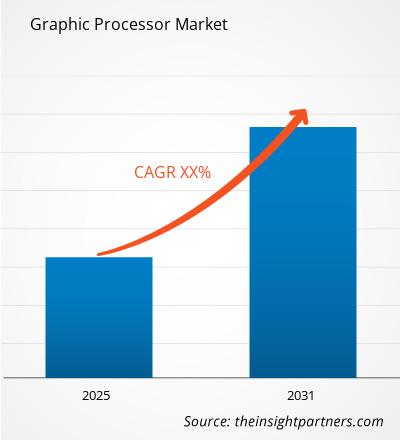
The Graphic Processor Market is valued at US$ 107.18 Billion in 2025 and is projected to reach US$ 971.03 Billion by 2034, expanding at a CAGR of 2.75% from 2026 to 2034. The market encompasses processor architectures designed for graphics rendering, parallel computation, visualization, and increasingly AI-enabled workloads across consumer and professional computing environments.
Demand conditions indicate that Graphic Processor Market size is being shaped by AI-enabled personal computing, advanced gaming, content creation, and accelerator-intensive infrastructure. North America remains structurally important because of concentrated semiconductor design capabilities, hyperscale computing investment, and established workstation ecosystems, while Asia Pacific benefits from large-scale electronics manufacturing and expanding digital-device adoption.
Graphic Processor Market Assessment and Insights
- North America accounts for a 36–38% Graphic Processor Market share in 2025 and is projected to grow at a 17–19% CAGR between 2026–2034, supported by hyperscale infrastructure, advanced semiconductor ecosystems, and high-value professional computing demand.
- US represents 44–46% of North America in 2025 and is expected to expand at a 17–19% CAGR during 2026–2034, reflecting concentrated cloud, AI, gaming, and workstation demand.
- Europe holds a 17–19% share in 2025 and is anticipated to record a 16–18% CAGR during 2026–2034, led by Germany, the United Kingdom, France, Italy, and Spain as AI infrastructure and professional visualization investments increase.
- Asia Pacific represents a 30–32% share in 2025 and is forecast to grow at a 18–20% CAGR during 2026–2034, with China, Japan, South Korea, and India benefiting from semiconductor manufacturing, mobile electronics, gaming, and AI infrastructure expansion.
- Largest Segment is Dedicated Graphic Processor, estimated at a 40–44% market share in 2025 and growing at a 18–20% CAGR during 2026–2034, reflecting demand for high-throughput graphics and accelerator workloads.
- High Growth Segment is Hybrid, representing a 10–14% market share in 2025 and expanding at a 30–32% CAGR during 2026–2034, supported by flexible performance and power-efficiency requirements.
- Key companies analyzed in detail: Intel Corporation, Advanced Micro Devices, Inc., NVIDIA Corporation, NXP Semiconductors N.V., Texas Instruments Incorporated, Micron Technology, Inc., Sony Group Corporation, Toshiba Corporation, Samsung Electronics Co., Ltd., Broadcom Inc.
Source: The Insight Partners' analysis based on proprietary research, government publications, company annual reports, investor presentations, industry databases, and expert interviews.
Technological development in the Graphic Processor Market has resulted in moving graphics processors from being display-oriented devices to being programmable parallel computers. Dedicated architectures keep providing capabilities for gaming, workstations, visualization, and accelerating AI, whereas integrated ones keep consolidating graphics, compute, and AI functionalities within small processors. Advances in packaging, memory bandwidth, chiplets, ray tracing, and AI rendering affect product roadmaps and increase performance per watt relevance.
Investment in the Graphic Processor Market is set to diversify geographically from well-established compute hubs to new Asian markets and sovereign digital infrastructure initiatives over the forecast period. Availability of energy sources, local semiconductor policies, packaging technologies, and data center permit process would have an impact on deployment timetables. Europe is also placing emphasis on sovereign compute capabilities, while India is developing its growing GPU ecosystem by means of cloud and AI infrastructures.
Graphic Processor Market Report Scope
| Report Attribute | Details |
|---|---|
| Market size in 2025 | US$ 107.18 Billion |
| Market Size by 2034 | US$ 971.03 Billion |
| Global CAGR (2026 - 2034) | 27.75% |
| Historical Data | 2021-2024 |
| Forecast period | 2026-2034 |
Graphic Processor Market Analysis
Demand is becoming diversified into smartphones, PCs, gaming consoles, workstations, media creation, and acceleration infrastructure. Graphic Processor Market growth potential will be driven by increased demand for parallel computing, high visual fidelity, artificial intelligence use cases, and replacement demand due to inability of the older generation systems to meet current demands. Value chain includes chip architecture, wafer manufacturing, memory, advanced packaging, board assembly, systems integration, software stacks, Original Equipment Manufacturer, cloud provider, and application developer. Supply is dependent on advanced-node capacity, high bandwidth memory availability, substrates, and advanced packaging.
From device perspective, integrated processor provides better power efficiency and simpler systems design, while separate processors have higher memory bandwidth and more flexible scalability options. Mobile devices continue to play an important role in terms of volumes; however, value content is coming from data center and professional workloads. Thus, Graphic Processor Market is balancing between high volumes with price sensitivity versus low volumes with more expensive accelerators creating specific purchase cycles in value chain.
The competitive positioning is becoming more and more dependent on the combination of silicon, memory architecture, interconnect, software stack, development platform and system optimization. According to Graphic Processor Market analysis, Intel Corporation, Advanced Micro Devices, Inc., and NVIDIA Corporation are developing differentiated platforms for client, professional and acceleration compute workloads. NVIDIA Corporation is focusing on the integration of hardware and networking technologies, Advanced Micro Devices, Inc. on Instinct and Ryzen, and Intel Corporation on Arc Pro.
Key investment trends in the Graphic Processor Market include focus on advanced process nodes, high bandwidth memory, multi-GPU system and software stack optimization. Micron Technology, Inc. and Samsung Electronics Co., Ltd. are remaining strategically relevant through memory supply, while Broadcom Inc. and NXP Semiconductors N.V. are taking part in the adjacent connectivity and embedded computing ecosystem. Sony Group Corporation, Toshiba Corporation and Texas Instruments Incorporated are providing additional exposure to imaging, electronics, embedded processing, and systems.
● REPORT CUSTOMIZATION
Tailor This Report To Align With Your Specific Business Requirements
This report can be customized to align precisely with your business objectives, scope, and target markets. Customization options include tailored segmentation, geography, competitive analysis, and strategic insights to support informed decision-making.
Customize This Report →WHAT YOU CAN ADJUST
- ● Segmentations
- ● Geography
- ● Competitive Analysis
- ● Language Preferences
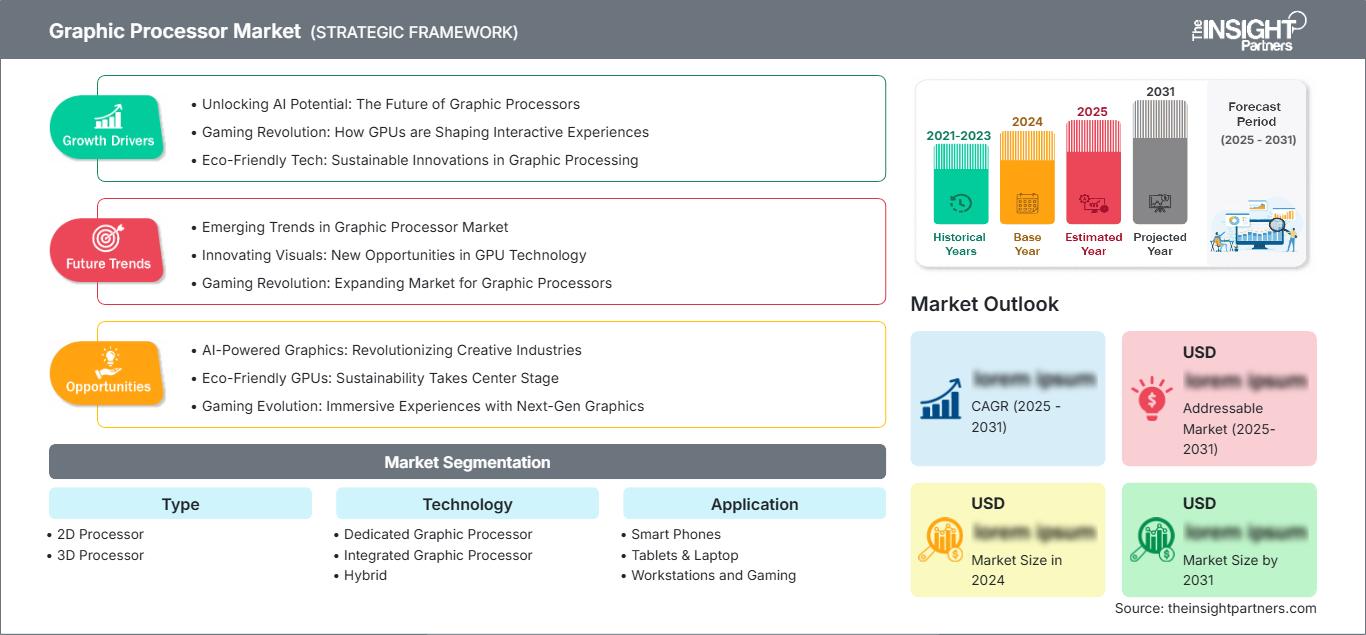
Graphic Processor Market: Strategic Insights
Regional Insights
North America Graphic Processor Market
North America maintains a 36–38% share in 2025 and is projected to expand at a 17–19% CAGR during 2026–2034. There is an advantage to the region in the form of hyperscale computing, high performance semiconductors, gaming, visualization services and AI infrastructure. The United States still represents the main demand source, while Canada and Mexico provide complementary technologies, manufacturing and integration capabilities.
According to the Graphic Processor Market report, expansion is fueled by large cloud spending and the presence of key accelerator developers. The power consumption of data centers increased by 17% in 2025, demonstrating both infrastructure expansion and stressing the importance of efficient computing. Localization of the supply chain and semiconductor incentives make up the regional investment; however, energy availability, permitting, advanced packaging and memory are among the limiting factors.
U.S. Graphic Processor Market
The U.S. represents 44–46% of North American revenue in 2025 and is projected to grow at a 17–19% CAGR during 2026–2034. The ecosystem includes hyper-scale data centers, AI developers, gaming systems, workstation customers, semiconductor architects, and large cloud services providers. The demand is focused on high-performance computing where compute density and software compatibility affect procurement decisions.
Company participation is widespread in both client and accelerator sectors, including Intel Corporation, Advanced Micro Devices, Inc., and NVIDIA Corporation as key players. Trends in applications include the increasing demand for AI inference, professional visualization, gaming, and content creation. Semiconductors policies further support capacity and supply chain diversity in the country, making the strategic importance of advanced packaging, memory, and accelerators even more relevant. An example of the trend is the 2026 Intel Corporation's Arc Pro line.
Europe Graphic Processor Market
Europe represents a 17–19% share in 2025 and is expected to grow at a 16–18% CAGR during 2026–2034, with Germany leading regional revenue. Germany brings together automotive design, industrial automation, research computation, and professional visualization. The United Kingdom is building out sovereign AI infrastructure, whereas France focuses on domestic computation and data center infrastructure.
Italy and Spain bring their contribution by way of manufacturing, gaming, media production, enterprise digitization, and cloud infrastructure. Within the region, rising costs of electricity and energy efficiency are increasing the need for performance per watt. Germany's industrial landscape allows advanced visualization and simulation, whereas the United Kingdom and France add to demand for AI acceleration. This maintains Europe's strategic relevance amidst its fragmented market structure.
APAC Graphic Processor Market
APAC holds a 30–32% share in 2025 and is forecast to expand at a 18–20% CAGR during 2026–2034. China is the dominant nation due to its extensive electronics manufacturing capabilities, gaming, cloud computing, and local technology investments. The role of Japan and South Korea in the market is provided via electronics, automobiles, memory, and semiconductors sectors.
India and Australia extend the regional reach via cloud, enterprise computing, public digital infrastructure, and business software applications. India is expected to exhibit growth at a rate of around 19-20% CAGR during the forecast period due to hyperscaling and sovereign AI efforts.
Middle East & Africa Graphic Processor Market
Middle East & Africa is estimated to expand at a 12–15% CAGR during 2026–2034, with Saudi Arabia and the UAE leading regional adoption. Growing demand for accelerator-enabled computing environments has resulted from investments in cloud infrastructures, smart cities, and AI solutions.
While South Africa acts as the main source of technology in Africa, RoMEA is evolving by way of telecommunications and enterprise infrastructure modernization efforts. The energy availability acts as a competitive advantage of the Gulf markets despite the impact of cooling needs, dependency on imports, and expensive data center infrastructure on its cost structure.
Segmentation Analysis
Type
Type segmentation distinguishes 2D Processor and 3D Processor architectures according to graphics complexity, rendering requirements, and computational workloads. The segment is expected to expand at a 15–17% CAGR during 2026–2034 as applications increasingly require real-time visualization, simulation, gaming, professional rendering, and AI-assisted graphics processing. 3D workloads generally demand greater parallel throughput, memory bandwidth, and specialized rendering capabilities.
- 2D Processor supports display rendering, interface acceleration, embedded visualization, and cost-sensitive systems. Demand remains relevant where workloads prioritize efficient display processing rather than intensive three-dimensional rendering or advanced parallel computation.
- 3D Processor serves gaming, workstation visualization, simulation, design, rendering, and immersive applications. Its strategic importance is increasing as real-time ray tracing, AI-enhanced rendering, and higher-resolution visual workloads raise performance requirements.
Technology
Technology includes Dedicated Graphic Processor, Integrated Graphic Processor, and Hybrid architectures. The segment is forecast to grow at a 18–20% CAGR during 2026–2034, reflecting simultaneous demand for high-performance dedicated solutions and increasingly capable integrated designs. Hybrid architectures provide an additional path where users require flexible performance while managing energy and form-factor constraints.
- Dedicated Graphic Processor provides independent graphics resources and memory, making it strategically important for high-performance gaming, professional visualization, AI acceleration, and demanding computational workloads.
- Integrated Graphic Processor combines graphics functionality within a broader processor package. Adoption is supported by mobile devices, thin laptops, enterprise PCs, and applications where power efficiency and compact system design are priorities.
- Hybrid combines integrated and dedicated capabilities to balance battery life, responsiveness, and peak performance. Its strategic relevance is increasing in premium notebooks, professional systems, and emerging heterogeneous-computing platforms.
Application
Application covers Smart Phones, Tablets & Laptop, Workstations and Gaming, and Media & Entertainment. The segment is projected to advance at a 16–18% CAGR during 2026–2034, supported by increasing visual-computing requirements, richer digital content, gaming adoption, and AI-enabled experiences. Device refresh cycles and application complexity will determine the pace of value migration across categories.
- Smart Phones represent a high-volume application base where integrated graphics increasingly support computational photography, gaming, video processing, and on-device AI within strict thermal and battery constraints.
- Tablets & Laptop demand is shaped by productivity, creative applications, AI-enabled software, and premium mobile computing. Integrated and hybrid architectures are particularly relevant because they balance portability with increasingly demanding workloads.
- Workstations and Gaming require high graphics throughput, dedicated memory, ray tracing, simulation, and low-latency rendering. The category supports premium accelerator demand and benefits from professional visualization and gaming refresh cycles.
- Media & Entertainment depends on accelerated video editing, rendering, animation, visual effects, broadcasting, and immersive content creation. Higher resolution and real-time production workflows increase the value of parallel graphics processing.
Opportunity Snapshot
| Application | Revenue Contribution (High/Medium/Low) | Trend Tag (MAX 2 words) | Adoption Stage (Emerging/Scaling/Mature) |
| Smart Phones | High | On-device AI | Mature |
| Tablets & Laptop | Medium | AI PCs | Scaling |
| Workstations and Gaming | High | Ray Tracing | Scaling |
| Media & Entertainment | Medium | Real-time Rendering | Scaling |
Graphic Processor Market Growth Drivers and Impact Analysis
AI-Accelerated Computing Expansion
AI workloads will lead to accelerated-computer procurement moving away from graphics-based buying to overall compute infrastructure procurement. According to the International Energy Agency, the energy consumption by data centers rose by 17% in 2025, while those that focused on AI were growing even faster. These are some indications of the physical reality of accelerated-computing adoption. This trend works well for processors that have abilities to perform parallel inferencing, model serving, visualization, and simulation. High-bandwidth memory, effective interconnects, and liquid-cooling systems will be needed more. Commercially, this means that suppliers will face a larger addressable workload but more software compatibility challenges as well.
Advanced Visual Computing in Professional Workflows
There has been a growing demand for real-time visualization in sectors such as engineering, architecture, health care, media creation, and industrial simulation. Graphics cards that feature ray tracing, AI-driven rendering, virtual production, and high-resolution graphics workflows need much more parallel processing capabilities compared to regular office applications. The market outcome of this is an emerging high-end segment in which there will be a demand for higher-class processors featuring increased memory capacity and software compatibility. In this case, the release of Intel Corporation’s Arc Pro B series in 2026 can be seen as a clear example of this trend.
Semiconductor Localization and Supply-Chain Resilience
There is rising focus on domestic semiconductor production capabilities, advanced packaging, and essential component supplies by governments and manufacturers. GPU manufacturing requires the latest logic, memory, substrates, packaging, and high-speed interconnects; any disruption along the line may result in delivery issues. Geographical diversification reduces risks, and new manufacturing and packaging facilities can help strengthen supply chain resilience. On the other hand, local manufacturing entails higher capital cost, increasing production costs in the short run. Companies with well-established relations with their foundry, memory, board, and cloud partners are better placed to handle allocations volatility.
Graphic Processor Market Future Trends
AI-Native Graphics Architectures
Graphic Processor Market trends are expected to move toward architectures designed simultaneously for graphics, AI inference, media processing, and general parallel computation. Future products will increasingly combine graphics engines with specialized matrix acceleration, unified memory, advanced interconnects, and software stacks optimized for heterogeneous workloads. The distinction between a graphics processor and a broader accelerator is therefore likely to become less rigid. Client systems may execute more inference locally to reduce latency and cloud dependence, while professional and data-center systems will prioritize scalable accelerator fabrics. Vendors that coordinate silicon, memory, networking, compilers, and application libraries can capture greater system value. Energy efficiency will remain a central design criterion as AI workloads become more continuous and interactive. This transition should encourage architectural differentiation based on throughput per watt, memory movement, software portability, and deployment flexibility rather than raw graphics specifications alone.
Heterogeneous Computing Across Devices
The next phase of product development is likely to emphasize heterogeneous computing, where CPUs, GPUs, NPUs, and specialized accelerators operate cooperatively. Premium laptops, smartphones, workstations, vehicles, and industrial systems will increasingly distribute workloads according to latency, power, privacy, and performance requirements. Hybrid architectures can become particularly useful when applications alternate between light everyday processing and short periods of intensive graphics or AI computation. Software frameworks will need to abstract hardware differences so developers can target multiple processing resources without rebuilding applications for every device. This trend also supports stronger system-level optimization, because memory sharing, scheduling, thermal management, and interconnect performance become as important as individual processor capability. Over time, heterogeneous designs could broaden accelerator adoption in devices where dedicated graphics hardware was previously constrained by cost, battery capacity, or physical space.
Graphic Processor Market Opportunities
Sovereign Compute Infrastructure
Graphic Processor Market Forecasts indicate an investment opportunity in sovereign and regional computing infrastructure as governments seek greater control over AI capacity, sensitive workloads, and digital services. Europe, India, the Middle East, and selected Asian economies are increasing attention to domestic or regionally controlled compute resources. Investors and technology suppliers can target opportunities spanning accelerator clusters, memory, networking, cooling, power management, and software orchestration rather than focusing solely on processor sales. The most attractive projects will likely combine predictable institutional demand with reliable power and high-capacity connectivity. Strategic partnerships between cloud operators, governments, system integrators, and semiconductor vendors can improve utilization and reduce deployment risk. This creates opportunities for companies capable of delivering complete computing environments, particularly where procurement decisions prioritize lifecycle economics, energy efficiency, security, and local technical support.
Edge and Professional AI Acceleration
Another opportunity lies in extending high-performance graphics and AI acceleration beyond centralized data centers. Workstations, industrial systems, healthcare devices, automotive platforms, creative-production environments, and advanced laptops can benefit from local inference and visualization. WHO's continuing digital-health strategy emphasizes responsible and scalable digital technologies, reinforcing the need for capable computing at the point of use where privacy, latency, and reliability matter. Suppliers can address this opportunity through efficient integrated processors, modular dedicated accelerators, multi-GPU workstation solutions, and software optimized for local execution. Commercial success will depend on balancing compute capability with thermal limits, power consumption, certification, and application compatibility. The opportunity is therefore broader than processor specifications and favors vendors able to deliver validated platforms for defined professional or industry workloads.
Recent Developments
- May 2025: Intel has expanded its portfolio of graphics and artificial intelligence hardware with the introduction of new Arc Pro B-Series GPUs, additional deployment options for its Gaudi 3 AI accelerators, and a software framework for developing locally running AI agents. The announcements were made at Computex 2025 in Taipei, as Intel outlined its strategy for providing scalable computing solutions for AI developers, professional workstations and enterprise applications. The company also marked 40 years of operations and collaboration with Taiwan's technology ecosystem.
- June 2026: NVIDIA’s hardware partners used Computex 2026 in Taipei to introduce a broad range of new products powered by GeForce RTX technology. The lineup spans graphics cards, gaming laptops, pre-built desktops and high-refresh-rate G-SYNC Compatible displays, giving gamers and creators more options across different performance and form-factor categories. The showcase includes new designs based on NVIDIA’s GeForce RTX 50 Series, which use the company’s Blackwell architecture and support technologies such as DLSS 4.5, ray tracing and NVIDIA Reflex.
- January 2026: AMD used CES 2026 to expand its computing portfolio across artificial intelligence, gaming, graphics and software, introducing new Ryzen AI processors, additional Ryzen AI Max+ chips, a compact AI developer platform and updates to its ROCm software ecosystem. The company also unveiled a new flagship gaming processor designed to push desktop performance further. The announcements reflect AMD’s broader strategy of making AI capabilities available across consumer PCs, business systems, gaming machines and developer platforms rather than limiting AI acceleration to data centers.
Frequently Asked Questions

- Comprehensive Market Sizing and Forecast Analysis
- Detailed Segmentation Analysis
- In-Depth Market Dynamics Assessment
- Regional and Country-Level Insights
- Competitive Landscape and Company Benchmarking
- Strategic Business Intelligence
Recent Reports
Testimonials

The Insight Partners' SCADA System Market report is comprehensive, with valuable insights on current trends and future forecasts. The team was highly professional, responsive, and supportive throughout. We are very satisfied and highly recommend their services.
RAN KEDEM Partner, Reali Technologies LTDs
I requested a report on a very specific software market and the team produced the report in a few days. The information was very relevant and well presented. I then requested some changes and additions to the report. The team was again very responsive and I got the final report in less than a week.
JEAN-HERVE JENN Chairman, Future Analytica
We worked with The Insight Partners for an important market study and forecast. They gave us clear insights into opportunities and risks, which helped shape our plans. Their research was easy to use and based on solid data. It helped us make smart, confident decisions. We highly recommend them.
PIYUSH NAGPAL Sr. Vice President, High Beam Global
The Insight Partners delivered insightful, well-structured market research with strong domain expertise. Their team was professional and responsive throughout. The user-friendly website made accessing industry reports seamless. We highly recommend them for reliable, high-quality research services
YUKIHIKO ADACHI CEO, Deep Blue, LLC.
This is the first time I have purchased a market report from The Insight Partners.While I was unsure at first, I visited their web site and felt more comfortable to take the risk and purchase a market report.I am completely satisfied with the quality of the report and customer service. I had several questions and comments with the initial report, but after a couple of dialogs over email with their analyst I believe I have a report that I can use as input to our strategic planning process.Thank you so much for taking the extra time and making this a positive experience.I will definitely recommend your service to others and you will be my first call when we need further market data.
JOHN SUZUKI President and Chief Executive Officer, Board Director, BK Technologies
I wish to appreciate your support and the professionalism you displayed in the course of attending to my request for information regarding to infectious disease IVD market in Nigeria. I appreciate your patience, your guidance, and the fact that you were willing to offer a discount, which eventually made it possible for us to close a deal. I look forward to engaging The Insight Partners in the future, all thanks to the impression you have created in me as a result of this first encounter.
DR CHIJIOKE ONYIA MANAGING DIRECTOR, PineCrest Healthcare Ltd.Reason to Buy
- Informed Decision-Making
- Understanding Market Dynamics
- Competitive Analysis
- Identifying Emerging Markets
- Customer Insights
- Market Forecasts
- Risk Mitigation
- Boosting Operational Efficiency
- Strategic Planning
- Investment Justification
- Tracking Industry Innovations
- Aligning with Regulatory Trends





 Get Free Sample for