
Headlight Control Module Market Demand, Trends & Forecast by 2034
Coverage: by Technology (Halogen, LED, Xenon); Application (High Beam Assist, Headlight Leveling, On/Off function, Bending/Cornering); Vehicle Type (Passenger Cars, Light Commercial Vehicles, Heavy Commercial Vehicles) , and Geography (North America, Europe, Asia Pacific, and South and Central America)
- Status : Data Released
- Report Code : TIPRE00006612
- Category : Electronics and Semiconductor
- No. of Pages : 150
- Available Report Formats :


- Last update date : September 17, 2026


2025 Market Size
US$ 4.68 Bn
Base year value
2034 Forecast
US$ 6.54 Bn
Projected by 2034
CAGR 2026-2034
3.79 %
Growth rate
Addressable Market
US$ 50.96 Bn
(2026-2034)
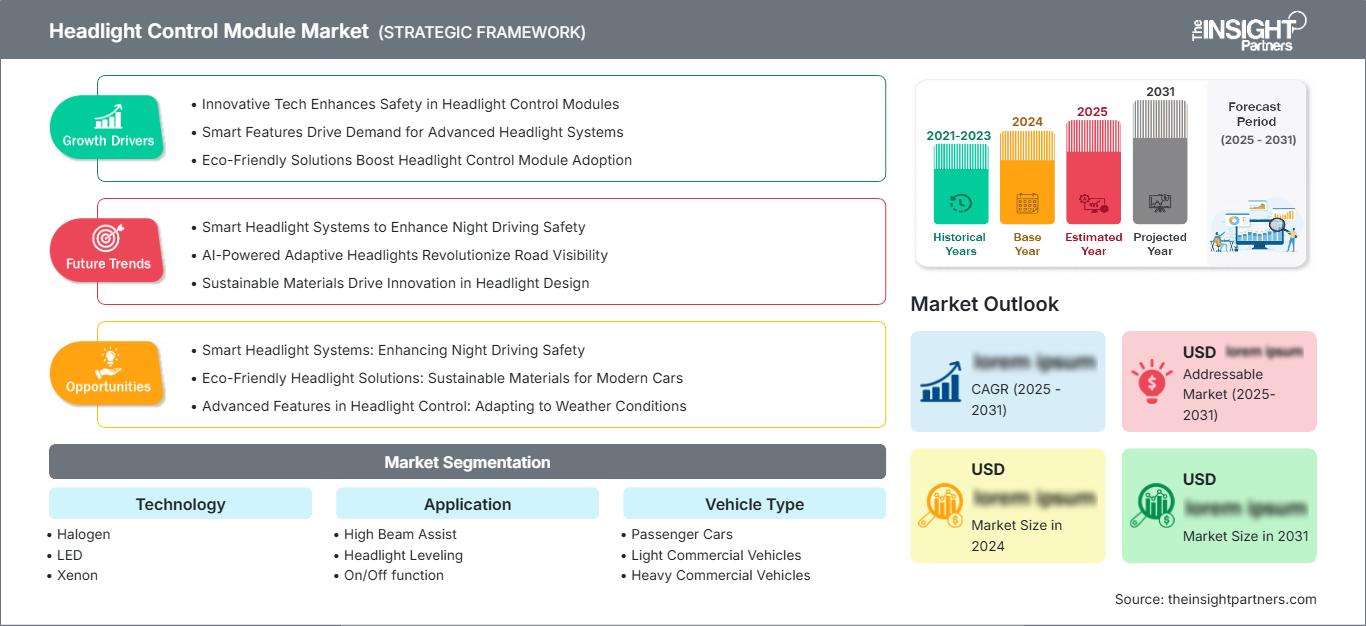
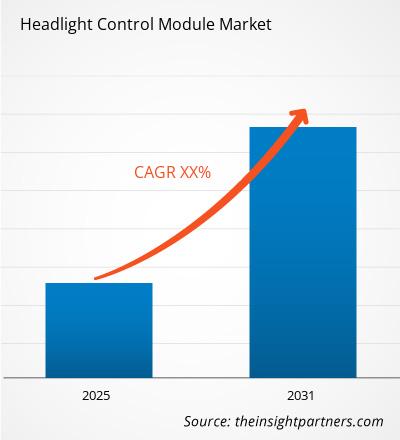
Headlight Control Module Market was valued at US$ 4.68 Billion in 2025 and is projected to reach US$ 6.54 Billion by 2034, expanding at a CAGR of 3.79% during 2026–2034. Demand is impacted by the electrification of the automobile, increased content of electronics, usage of adaptive lights, safety regulations, and enhanced lighting and camera/sensor integration in both passenger and commercial automobiles.
It is estimated that North America will see a CAGR of 3.5-4.5% between 2023 and 2034. Factors such as the increasing premiumization of automobiles, replacement of traditional lighting electronics, the growing popularity of adaptive beam features, and continued integration of lighting controls with ADAS and central vehicle electronics drive the Headlight Control Module market size.
Headlight Control Module Market Assessment and Insights
- North America held a 24–28% share in 2025 and is projected to grow at a CAGR of 3.5–4.5% between 2026–2034, supported by premium vehicle demand, electronic integration, safety technologies, and adaptive lighting adoption.
- US represented a 19–22% share in 2025 and is expected to expand at a CAGR of 3.6–4.6% between 2026–2034, supported by vehicle electronics upgrades and increasing adaptive lighting penetration.
- Europe accounted for a 27–31% share in 2025 and is forecast to grow at a CAGR of 3.2–4.2% during 2026–2034, led by Germany, France, the UK, Italy, and Spain, where premium vehicles and advanced lighting systems remain significant.
- Asia Pacific represented a 39–43% share in 2025 and is anticipated to expand at a CAGR of 4.2–5.2% between 2026–2034, led by China, Japan, South Korea, and India through high vehicle production and growing electronic content.
- Largest Segment: LED held a 58–62% market share in 2025 and is projected to grow at a CAGR of 4.1–5.1% during 2026–2034, reflecting its expanding role in adaptive lighting.
- High Growth Segment: High Beam Assist represented a 22–26% market share in 2025 and is estimated to grow at a CAGR of 5.0–6.0% during 2026–2034, supported by safety-oriented automation.
- Key companies analyzed in detail: Aptiv PLC; Continental AG; Denso Corporation; HELLA GmbH and Co. KGaA; Lear Corporation; Magneti Marelli S.p.A.; NXP Semiconductors NV; Renesas Electronics Corporation; Valeo SA; ZKW Group GmbH.
Source: The Insight Partners' analysis based on proprietary research, government publications, company annual reports, investor presentations, industry databases, and expert interviews.
There has been development of the Headlight Control Module Market from lighting controls using relays and mechanical components to electronic designs which handle multiple processes via software, sensors, and semiconductors. This is because there has been quick adoption of LED technology since light control involves electrical drivers, thermal management, diagnostics, and interface. Manufacturing is expected to move towards integration of compact assemblies to handle tight vehicle construction as well as matrix, adaptive, leveling, and cornering lighting controls.
In the next ten years, electrification and software-driven designs in vehicles will result in an increased market size for lighting electronics due to investment in areas of programmable controllers, LED management systems, semiconductors efficiency, cyber security, and sensor fusion. There is also UNECE Regulation No. 149 which regulates the road illumination devices.
Headlight Control Module Market Report Scope
| Report Attribute | Details |
|---|---|
| Market size in 2025 | US$ 4.68 Billion |
| Market Size by 2034 | US$ 6.54 Billion |
| Global CAGR (2026 - 2034) | 3.79% |
| Historical Data | 2021-2024 |
| Forecast period | 2026-2034 |
Headlight Control Module Market Analysis
Headlight Control Module Market growth is driven by the increased electronics in automobiles and the trend away from fixed lighting towards adaptive and software-based lighting. Today’s modules control LED drivers, sensors, vehicle network communications, headlamp positioning, and diagnostic systems. Thus, the value chain includes semiconductor companies, lighting system companies, optical parts companies, wiring/connectivity companies, software providers, Tier 1 companies, and vehicle OEMs. The higher level of integration adds value to modules despite modest growth in vehicle production.
Semiconductors play a crucial role in the supply chain in the form of microcontrollers, power management ICs, transceivers, sensors, thermal components, optical assemblies, and PCBs. There are several requirements that suppliers must meet: thermal performance, electromagnetic compatibility, functional safety, cybersecurity, and packaging needs. It is important for semiconductor companies to provide parts, as controllers used for headlights are being incorporated into vehicle electronic architecture. Localization is also a growing trend for OEMs.
Analysis of Headlight Control Module Market Report illustrates that there exists a highly consolidated ecosystem where leading global automotive suppliers integrate their experience in lighting with electronics, software, sensing, and vehicle networking. Continental AG and Aptiv PLC compete on the basis of comprehensive vehicle electronics offerings, while Denso Corporation and Valeo SA offer an integration of lighting with power, sensing and control. HELLA GmbH & Co. KGaA and ZKW Group GmbH retain their focus on lighting, while Magneti Marelli S.p.A. is known for sophisticated headlighting solutions and electronics.
Investments are made into the areas of LED matrix control, high-definition beam forming, compact size, thermal management, and software-based functionalities. NXP Semiconductors NV and Renesas Electronics Corporation offer semiconductor platforms which make more complex control solutions possible. Lear Corporation specializes in vehicle electrical and electronic systems. It means that competitive differentiation is moving from lighting controllers to integrated solutions which are able to manage lighting, sensing, vehicle communication and diagnostics, and future communication functionalities.
● REPORT CUSTOMIZATION
Tailor This Report To Align With Your Specific Business Requirements
This report can be customized to align precisely with your business objectives, scope, and target markets. Customization options include tailored segmentation, geography, competitive analysis, and strategic insights to support informed decision-making.
Customize This Report →WHAT YOU CAN ADJUST
- ● Segmentations
- ● Geography
- ● Competitive Analysis
- ● Language Preferences
Headlight Control Module Market: Strategic Insights
Regional Insights
North America Headlight Control Module Market
North America accounted for 24-28% of the Headlight Control Module Market Share in 2025 and will grow with a CAGR of 3.5-4.5% until 2034. The US is the key market within the region, but Canada also participates with consumer cars, fleets, and automobile production. Premium car applications drive the demand for electronic and adaptive lighting systems.
Consumers in North America prefer efficiency, automated light beam control, diagnostic, and compatibility with other vehicle components. High-end lighting is also more associated with camera-based driver assistance and computing. Suppliers that have good cooperation with automakers and manufacturing plants can take advantage of platform awards, but it is very difficult because of the cost pressure from more advanced lighting features in more affordable cars.
U.S. Headlight Control Module Market
The US accounted for 19–22% of the North American market in 2025 and is projected to register CAGR growth of 3.6–4.6% during the forecast period until 2034. Factors driving demand include premium SUVs, pickup trucks, passenger vehicles, and increasing electronic content. Aptiv PLC, Continental AG, Denso Corporation, Lear Corporation, and other suppliers are present within vehicle-electronics projects.
The trends for application areas are LED control, high-beam automation, headlight leveling, cornering light, and integration of diagnostics. There is also an increased demand for modules capable of efficient communication with vehicle systems and meeting functional safety standards. With the increase of centralized electronics architectures, lighting controllers are becoming increasingly distributed and even integrated into domain controllers.
Europe Headlight Control Module Market
Europe had a market share of 27-31% in 2025 and is estimated to have a CAGR of 3.2-4.2% until 2034. The leading country in this region in terms of demand is Germany. The UK, France, Italy, and Spain support the volume due to premium car manufacture, manufacturing, electrification, and adoption of electronically controlled light sources respectively.
The UK sustains its demand through its high-end automotive production and technology-based vehicles. Germany has great influence in the region on account of its OEM presence, engineering skills, and high-end lighting technologies. France has a combination of vehicle manufacture and supply skills. Italy, on the other hand, contributes through automotive designs and high-end cars.
APAC Headlight Control Module Market
APAC is estimated to have a 39–43% market share in 2025 and is projected to grow at a CAGR of 4.2-5.2% up to 2034. The most dominant market is China because of the high volume of production, electrification, and advanced automotive electronics in its country. Japan and South Korea benefit from OEM and semiconductor ecosystem while India from manufacturing capability.
Regional demand is strengthened through EV adoption, luxury trend, localization, and growing electronic components per vehicle. China plays a critical role in the development of adaptive LED lighting and digital front-end while Japan stresses reliability and efficiency. South Korea participates in electronics integration while India gains relevance through increased automotive manufacturing and localization.
Middle East & Africa Headlight Control Module Market
Middle East & Africa is estimated to grow at a CAGR of 2.8% to 3.8% through 2034 with strong adoption in Saudi Arabia and the UAE. The growth in adoption will be driven by imported high-end vehicles, infrastructure, replacement of vehicles, and need for safety devices. However, vehicle manufacturing is low.
South Africa still plays an important role in the market due to vehicle assembly, aftermarket services, and commercial vehicles. The demand for premium vehicles is higher in Saudi Arabia and the UAE than in the rest of the MEA which is highly price-sensitive. Investments in energy and infrastructure may drive gradual vehicle development, but the adoption of sophisticated lighting modules will depend on vehicles and imports.
Segmentation Analysis
Technology
Technology comprises Halogen, LED, and Xenon. LED is estimated to grow at a CAGR of 4.1–5.1% during 2026–2034, remaining the largest technology category because its controllability, efficiency, packaging flexibility, and compatibility with adaptive functions make it suitable for increasingly electronic vehicle architectures. Halogen and Xenon remain relevant in installed vehicle fleets.
- Halogen maintains a substantial installed base because of low acquisition cost, established replacement infrastructure, and continued use in price-sensitive vehicle segments. Its strategic importance is increasingly concentrated in entry-level applications and aftermarket replacement.
- LED represents the leading technology because individual light sources can be electronically controlled to support adaptive beams, styling signatures, energy efficiency, and compact headlamp architectures. Its flexibility supports both safety and design requirements.
- Xenon remains relevant in premium and legacy vehicle fleets where high-intensity discharge systems are already installed. Demand is primarily replacement-oriented, while new-vehicle adoption is increasingly constrained by the broader transition toward LED architectures.
Application
Application includes High Beam Assist, Headlight Leveling, On/Off function, and Bending/Cornering. The application segment is estimated to grow at a CAGR of 4.0–5.0% during 2026–2034 as electronically controlled functions become more integrated with vehicle sensors and network architectures. Safety-oriented automation is expected to support higher-value functionality.
- High Beam Assist is increasingly important because automated beam switching can improve nighttime visibility while reducing glare for other road users. Integration with cameras and adaptive lighting controllers supports broader deployment.
- Headlight Leveling supports beam-position management under varying vehicle load and driving conditions. Electronic control improves consistency and can be integrated with suspension, vehicle-height, and diagnostic information.
- On/Off function remains foundational across all lighting architectures and represents the simplest control requirement. Its strategic role persists because reliable switching, diagnostics, and network communication remain necessary even in advanced systems.
- Bending/Cornering functions improve illumination around curves and intersections by adjusting light distribution or beam direction. Their value increases when coordinated with steering angle, vehicle speed, navigation, and sensor information.
Opportunity Snapshot
| Application | Revenue Contribution | Trend Tag | Adoption Stage |
|---|---|---|---|
| High Beam Assist | High | Beam Automation | Scaling |
| Headlight Leveling | Medium | Load Compensation | Mature |
| On/Off function | High | Basic Control | Mature |
| Bending/Cornering | Medium | Curve Illumination | Scaling |
Headlight Control Module Market Growth Drivers and Impact Analysis
Rapid Expansion of LED and Adaptive Lighting Architectures
LED systems provide automakers with greater control over light distribution, packaging, styling, and energy consumption than conventional technologies. The ability to control individual emitters enables adaptive beam functions that respond to road conditions and surrounding traffic. FORVIA HELLA, for example, describes matrix systems using micro-LED clusters with up to 25,000 pixels, illustrating how lighting electronics are becoming substantially more granular. Forvia This evolution increases the need for capable controllers, drivers, communication interfaces, and thermal-management systems. The commercial impact extends beyond premium vehicles as modular LED architectures become more scalable. Suppliers that can reduce controller size and cost while maintaining functional safety can address broader vehicle platforms. Consequently, lighting electronics are becoming a more strategic component of vehicle architecture rather than a narrowly defined illumination control.
Vehicle Electrification Raises Demand for Efficient Electronic Control
Battery-electric and hybrid vehicles place greater emphasis on energy efficiency, thermal management, packaging, and electronic integration. Although headlamps represent a relatively limited portion of vehicle energy consumption, efficient LED systems can support overall electrical-load optimization while providing additional functional flexibility. Valeo has highlighted lighting solutions across 12V, 48V, and high-voltage vehicle architectures, reflecting the diversity of electrical platforms now entering production. V
Valeo Electrification also creates more opportunities to integrate lighting with centralized vehicle computers, body controllers, and sensor networks. The resulting impact is a gradual increase in software and semiconductor content within lighting systems. Suppliers must therefore develop controllers capable of efficient power conversion, diagnostics, communication, and thermal control. These requirements can raise average module sophistication even when vehicle-unit growth remains comparatively moderate.
Integration of Lighting With ADAS and Vehicle Sensing
Advanced lighting is increasingly connected with cameras, radar, navigation data, steering inputs, and other vehicle signals. This integration allows high-beam assist, adaptive driving beams, cornering functions, and road-focused illumination to respond dynamically to driving conditions. UNECE Regulation No. 149 provides detailed requirements for road illumination devices, including provisions affecting adaptive front-lighting systems, reinforcing the need for controlled and compliant deployment. UNECE The market impact is a shift toward controllers capable of deterministic communication and real-time light adjustment. Lighting suppliers are consequently working more closely with semiconductor companies and ADAS technology providers. As vehicles become increasingly software-defined, headlight control functions can also become updateable and diagnosable through broader electronic architectures, creating additional requirements for cybersecurity, functional safety, and software validation.
Headlight Control Module Market Future Trends
Software-Defined Adaptive Lighting Becomes a Vehicle Interface
The Headlight Control Module Market trends are moving toward software-defined lighting that can modify beam distribution, signatures, projections, and user experiences through programmable control. Future systems may use centralized computing to coordinate multiple lighting zones while receiving information from cameras, navigation systems, steering sensors, and connected vehicle functions. This architecture can make lighting behavior more adaptable throughout the vehicle lifecycle. Manufacturers may increasingly separate optical hardware from software-controlled functions, allowing updates to improve performance or introduce approved features without redesigning the complete headlamp. Such architectures will require stronger cybersecurity, diagnostics, validation, and software-management processes. Lighting can also become a communication interface through controlled road projections and external signals. Suppliers with expertise across optics, electronics, embedded software, and vehicle networking should therefore gain greater relevance as lighting moves deeper into software-defined vehicle architecture.
Integration of Lighting, Sensors, and Front-End Design
Future headlamp systems are likely to become increasingly integrated with vehicle-front structures, sensing hardware, and exterior design elements. The objective is to reduce packaging complexity while creating coherent modules that combine illumination, sensing protection, and visual identity. FORVIA HELLA's 2026 Front Phygital Shield for the BMW iX3 demonstrates this direction by integrating full-LED headlamps with radar sensors within a front-end module. Forvia Similar approaches can reduce standalone components and create new engineering relationships between lighting, body, and ADAS teams. This trend may increase demand for thermal management, transparent materials, sensor-compatible optics, and integrated electronics. It can also influence manufacturing, because suppliers will need capabilities spanning multiple component disciplines. Over time, the headlamp may become a multifunctional front-end subsystem rather than an isolated illumination assembly.
Headlight Control Module Market Opportunities
Expansion of High-Definition Lighting in Electric Vehicles
Electric vehicles provide an opportunity in the Headlight Control Module Market Forecast for suppliers to introduce compact, efficient, software-controlled lighting architectures alongside redesigned front-end packaging. EV platforms often place greater emphasis on aerodynamic surfaces, brand-specific signatures, and integration of sensors behind smooth front fascia structures. Suppliers can target this opportunity by developing modular LED controllers capable of supporting high-definition beam shaping, dynamic signatures, and communication functions while minimizing thermal and packaging requirements. Headlight Control Module Forecasts should therefore consider the increasing value content associated with electronically managed lighting rather than relying only on vehicle production volumes. Strategic partnerships with EV manufacturers can help suppliers secure platform positions early in development. Investments in micro-LED control, power electronics, optical design, and software validation can create differentiated offerings for premium and increasingly high-volume electric vehicle programs.
Remanufacturing and Lifecycle Services for Advanced Lighting
Advanced lighting creates a growing lifecycle opportunity because complete LED and electronic headlamp assemblies can carry substantially higher replacement values than conventional lamps. Remanufacturing can reduce material consumption while preserving functionality, provided optical performance, electronics reliability, sealing, and regulatory compliance can be maintained. Valeo and Stellantis launched a remanufactured LED headlamp in Europe in April 2025, demonstrating commercial movement toward circular lighting solutions. Valeo Suppliers can expand this opportunity through standardized diagnostics, replaceable modules, repairable electronic assemblies, and certified remanufacturing processes. Independent repair networks and OEM aftersales channels can provide additional distribution routes. Investment should prioritize component traceability, testing equipment, calibration procedures, and digital service records so that lifecycle products can meet the performance expectations associated with modern electronically controlled headlamps.
Recent Developments
- July 2026: Infineon Technologies completed its acquisition of the non-optical analog/mixed-signal sensor portfolio from ams OSRAM, strengthening its sensor business across automotive, industrial, consumer and medical applications. The acquired business is expected to generate around €230 million in 2026 revenue, while approximately 230 employees joined Infineon, including teams in Valencia,
- April 2026: Marelli showcased its latest automotive lighting technologies at Auto China 2026, highlighting the shift toward software-defined lighting platforms. The company presented its production-ready Thin Corner-to-Corner Headlamp with touch and voice interaction, Flat Lit Surface digital rear lighting using OLED and Folia-LED, and h-Digi® MicroLED headlamps in 25K and 40K pixel configurations for high-precision adaptive lighting, road projection and enhanced driving safety.
- April 2025: Valeo and Appotronics announced a strategic partnership to develop next-generation automotive front-lighting systems combining Valeo’s lighting, electronic control and software expertise with Appotronics’ ALPD® laser display technology. The new system is designed to enhance adaptive driving beam (ADB) functionality, improve road safety and comfort, and add high-definition road-surface information projection and outdoor movie projection capabilities.
Frequently Asked Questions

- Comprehensive Market Sizing and Forecast Analysis
- Detailed Segmentation Analysis
- In-Depth Market Dynamics Assessment
- Regional and Country-Level Insights
- Competitive Landscape and Company Benchmarking
- Strategic Business Intelligence
Recent Reports
Testimonials

The Insight Partners' SCADA System Market report is comprehensive, with valuable insights on current trends and future forecasts. The team was highly professional, responsive, and supportive throughout. We are very satisfied and highly recommend their services.
RAN KEDEM Partner, Reali Technologies LTDs
I requested a report on a very specific software market and the team produced the report in a few days. The information was very relevant and well presented. I then requested some changes and additions to the report. The team was again very responsive and I got the final report in less than a week.
JEAN-HERVE JENN Chairman, Future Analytica
We worked with The Insight Partners for an important market study and forecast. They gave us clear insights into opportunities and risks, which helped shape our plans. Their research was easy to use and based on solid data. It helped us make smart, confident decisions. We highly recommend them.
PIYUSH NAGPAL Sr. Vice President, High Beam Global
The Insight Partners delivered insightful, well-structured market research with strong domain expertise. Their team was professional and responsive throughout. The user-friendly website made accessing industry reports seamless. We highly recommend them for reliable, high-quality research services
YUKIHIKO ADACHI CEO, Deep Blue, LLC.
This is the first time I have purchased a market report from The Insight Partners.While I was unsure at first, I visited their web site and felt more comfortable to take the risk and purchase a market report.I am completely satisfied with the quality of the report and customer service. I had several questions and comments with the initial report, but after a couple of dialogs over email with their analyst I believe I have a report that I can use as input to our strategic planning process.Thank you so much for taking the extra time and making this a positive experience.I will definitely recommend your service to others and you will be my first call when we need further market data.
JOHN SUZUKI President and Chief Executive Officer, Board Director, BK Technologies
I wish to appreciate your support and the professionalism you displayed in the course of attending to my request for information regarding to infectious disease IVD market in Nigeria. I appreciate your patience, your guidance, and the fact that you were willing to offer a discount, which eventually made it possible for us to close a deal. I look forward to engaging The Insight Partners in the future, all thanks to the impression you have created in me as a result of this first encounter.
DR CHIJIOKE ONYIA MANAGING DIRECTOR, PineCrest Healthcare Ltd.Reason to Buy
- Informed Decision-Making
- Understanding Market Dynamics
- Competitive Analysis
- Identifying Emerging Markets
- Customer Insights
- Market Forecasts
- Risk Mitigation
- Boosting Operational Efficiency
- Strategic Planning
- Investment Justification
- Tracking Industry Innovations
- Aligning with Regulatory Trends





 Get Free Sample for