
Healthcare Lighting Market Trends, Demand & Growth by 2034
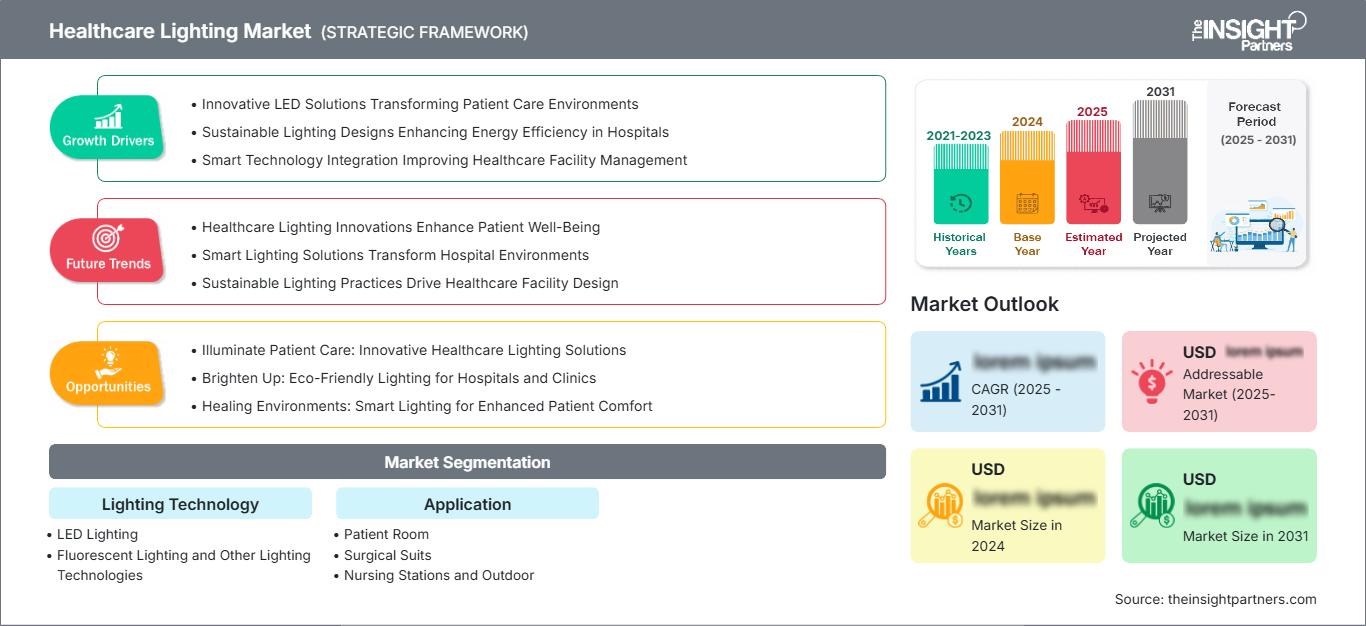
Coverage: By Lighting Technology (LED Lighting, Fluorescent Lighting and Other Lighting Technologies); Application (Patient Room, Surgical Suits, Nursing Stations and Outdoor) , and Geography (North America, Europe, Asia Pacific, and South and Central America)
- Status : Data Released
- Report Code : TIPTE100001332
- Category : Electronics and Semiconductor
- No. of Pages : 150
- Available Report Formats :


- Last update date : September 17, 2026


2025 Market Size
US$ 10.42 Bn
Base year value
2034 Forecast
US$ 17.94 Bn
Projected by 2034
CAGR 2026-2034
6.22 %
Growth rate
Addressable Market
US$ 128.35 Bn
(2026-2034)
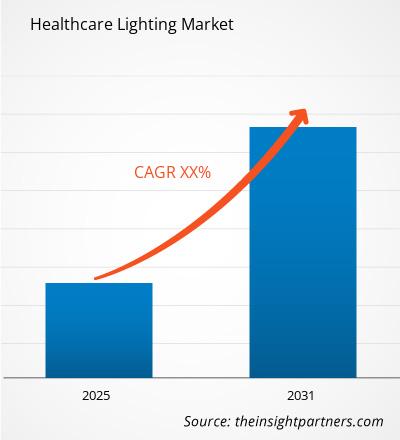
The Healthcare Lighting Market is valued at US$ 10.42 Billion in 2025 and is projected to reach US$ 17.94 Billion by 2034, advancing at a CAGR of 6.22% during 2026–2034. Growth of the market is driven by the modernization of clinical environments in hospitals, upgrading of existing fixtures, and the integration of efficient lighting into building systems. Market demand is influenced by issues such as patient comfort, visibility for clinical purposes, energy management, infection control needs, and facility renovation programs.
The North American Healthcare Lighting Market is structurally attractive, growing at a CAGR of 6.4–7.1% up to 2034. It derives its attractiveness from the extensive need for renovation of hospitals, capital spending in health care, and wide-scale use of LED controls.
Healthcare Lighting Market Assessment and Insights
- North America: North America is projected to represent a 34–38% share in 2025 and expand at a 6.4–7.1% CAGR between 2026–2034, supported by hospital modernization, energy-efficiency requirements, and established procurement channels.
- US: The US is estimated to contribute 86–90% of North America's 2025 share, with growth of 6.3–7.0% during 2026–2034 as hospitals upgrade patient rooms and surgical environments.
- Europe: Europe is estimated at a 27–30% share in 2025 and a 5.8–6.5% CAGR through 2034, led by Germany, the UK, France, Italy, and Spain through efficiency upgrades and modernization.
- Asia Pacific: Asia Pacific is estimated at a 24–28% share in 2025 and a 7.0–8.0% CAGR during 2026–2034, with China, Japan, India, South Korea, and Australia driving new capacity and retrofit activity.
- Largest Segment: LED Lighting holds an estimated 70–76% market share in 2025 and is expected to expand at a 6.8–7.6% CAGR through 2034.
- High Growth Segment: Outdoor applications represent an estimated 10–15% share in 2025 and are projected to grow at a 7.2–8.1% CAGR through 2034.
- Key companies analyzed in detail: Acuity Inc., Signify Holding, Hubbell Incorporated, KLS Martin Group, TRILUX GmbH & Co. KG, Zumtobel Group AG, Cree, Inc., Eaton Corporation plc, Herbert Waldmann GmbH & Co. KG, General Electric Company.
Source: The Insight Partners' analysis based on proprietary research, government publications, company annual reports, investor presentations, industry databases, and expert interviews.
The lighting in healthcare facilities is no longer limited to just lighting but lighting designed specifically according to the applications in patient rooms, surgical rooms, nurses’ stations, imaging rooms, and circulation areas. The emergence of LEDs has brought changes in the fixture designs due to improvements in optical control, heat generation, longer re-lamping period, and color tuning capability. The manufacturing approach tends to move towards an integration of standard fixtures with healthcare-specific housings, control units, and regulations compliance, while the purchasing process considers the fixture cost along with life cycle cost.
Going forward over the forecast period, investments are likely to be made in connected fixtures, adaptable controls, and retrofit systems that can be incorporated into the hospital building management system. New healthcare construction in the Asia-Pacific and the Middle East regions will increase the size of the addressable market, while energy efficiency regulations and phase-down of fluorescent lamps will boost the need for replacement lighting systems.
Healthcare Lighting Market Report Scope
| Report Attribute | Details |
|---|---|
| Market size in 2025 | US$ 10.42 Billion |
| Market Size by 2034 | US$ 17.94 Billion |
| Global CAGR (2026 - 2034) | 6.22% |
| Historical Data | 2021-2024 |
| Forecast period | 2026-2034 |
Healthcare Lighting Market Analysis
Growth of Healthcare Lighting Market demand is highly dependent on building projects including hospitals, renovations, energy management initiatives, and clinical process needs. The value chain includes LED packages, driver electronics, optics, lamps and luminaires, sensors, controls, distributors, electrical contractors, facility managers, and healthcare buyers. Supply-side factors are increasingly biased towards manufacturers that can assure component supply while adhering to tough electrical, thermal, hygienic, and installation specifications.
It is also becoming an increasingly specification-driven environment where patient rooms call for low-glare ambient and examination lighting, operating rooms need uniform illumination, good shadow handling, and easy-to-clean surfaces; nurse stations need reliable task lighting and eye comfort throughout long shifts, and outdoor lighting installations must be about safety and way-finding. Such different needs present an opening for suppliers who have modifiable lighting product lines rather than generic commercial lighting products.
Market positioning now relies more on application engineering, control integration, and portfolio of healthcare products. Patient-focused solutions have been introduced by Acuity Inc., while professional lighting with infrastructure connection services are offered by Signify Holding. General electrical distribution solutions are provided by Hubbell Incorporated and Eaton Corporation plc, while KLS Martin Group and Herbert Waldmann GmbH & Co. KG focus on highly specialized medical illumination systems. TRILUX GmbH & Co. KG and Zumtobel Group AG are still relevant in specifications-driven projects in Europe.
Due to market fragmentation into general lighting, architectural lighting, and medical-device specialists, investment in the sector should be focused on software controls, systems that offer tuning possibilities, hygienic fixtures, and retrofit solutions. Technology and brands of Cree, Inc. and General Electric Company are among contributors to the market, while specialists provide their solutions for clinical applications. Analysis of the Healthcare Lighting Market Report reveals that positioning strategy relies heavily on efficiency of hardware solutions combined with advantages in operations.
● REPORT CUSTOMIZATION
Tailor This Report To Align With Your Specific Business Requirements
This report can be customized to align precisely with your business objectives, scope, and target markets. Customization options include tailored segmentation, geography, competitive analysis, and strategic insights to support informed decision-making.
Customize This Report →WHAT YOU CAN ADJUST
- ● Segmentations
- ● Geography
- ● Competitive Analysis
- ● Language Preferences
Healthcare Lighting Market: Strategic Insights
Regional Insights
North America Healthcare Lighting Market
North America will have a market share of 34–38% in 2025 and grow at a CAGR of 6.4–7.1% from 2025 to 2034. Dominant market demand will come from the US market owing to its well-developed hospitals, regular cycle of renovations, energy management programs and spec activity. Canada's contributions will come from healthcare infrastructure renewal and efficiency-driven capital spending programs.
Regional procurement environment favors well-established players with wide distribution, technical service and compliance information. Patient rooms and operating theaters will be prominent areas for retrofit installations while connected lighting control systems are more often becoming part of large-scale modernization projects. The Healthcare Lighting Market Share will stay high due to the presence of replacement demand along with new build demand.
U.S. Healthcare Lighting Market
The US market makes up about 86–90% of the 2025 North America market and has a forecasted growth rate of 6.3–7.0% CAGR until 2034. Growth factors include the renovation of existing hospitals, development of out-patient centers, improvements in operating rooms, and focus on patient-oriented settings. Hospitals prefer uniform products that facilitate maintenance in several facilities.
Acuity Inc., Hubbell Incorporated, Eaton Corporation plc, and General Electric Company have an involvement in relevant ecosystems in lighting and electrical technologies. Multi-functional lighting products are needed for patient rooms, whereas high precision illumination is sought after in surgery rooms. The US market also sees the benefit of adopting lighting controls which can minimize waste of energy through occupancy sensors and scheduling of lights.
Europe Healthcare Lighting Market
Share of Europe is expected to be about 27-30%, growing with 5.8-6.5% CAGR till 2034. Countries including Germany and the UK are leading the market on the account of modernization and efficiency goals. Other countries like France, Italy, and Spain make contributions through refurbishment and replacement of aging devices.
In Germany, a well-defined specification framework encourages the usage of efficient and compliant luminaires, which in turn benefits manufacturers like TRILUX GmbH & Co. KG and Zumtobel Group AG. In the UK, there is emphasis on modernization of health care estates and cost reduction of operation. France, Italy, and Spain increasingly focus on LED replacements, ease of maintenance, and clinical environment improvement.
APAC Healthcare Lighting Market
In APAC, the market share will be around 24–28% in 2025 and will register a growth rate of 7.0–8.0% CAGR till 2034. In terms of markets, China leads, followed by Japan, India, South Korea, and Australia. The construction of hospitals and expansion of urban healthcare along with modernization drives the market in both public and private hospitals.
China and India are driving the market for new constructions, while Japan and South Korea stress on modernization and patient comfort. There is consistent demand in Australia owing to well-established healthcare infrastructure. Energy efficiency, as well as digitally managed buildings, have been receiving policy focus, which could favorably impact connected lighting.
Middle East & Africa Healthcare Lighting Market
MEA is forecast to comprise about 5-7% of the total addressable market in 2025 and is projected to grow at a CAGR of 7.0-8.2% between 2025 and 2034. The key investors in MEA are Saudi Arabia and the UAE, while the leading sub-Saharan market is South Africa.
Development of healthcare-cities, expansion of hospitals, and diversification of infrastructures are driving the demand for durable lighting solutions. Healthcare projects in Saudi Arabia and the UAE offer chances for integrated lighting solutions, while MEA countries apart from South Africa still have a retrofit orientation. Procurement is driven by financing of projects, cost of energy, availability of service, and infrastructure stability.
Segmentation Analysis
Lighting Technology
Lighting Technology is expected to grow at a 6.5–7.3% CAGR during 2026–2034. LED systems dominate purchasing because they combine efficiency, long operating life, controllability, and application flexibility. Fluorescent fixtures remain relevant in installed bases, but replacement economics and regulatory pressure increasingly favor LED upgrades. Other technologies retain specialized roles where clinical or architectural requirements justify alternative sources.
- LED Lighting: LED Lighting remains the principal technology choice for healthcare facilities, supported by efficient operation, long service life, controllable output, and compatibility with sensors, dimming, and tunable-white systems.
- Fluorescent Lighting: Fluorescent Lighting remains present across older hospitals and institutional buildings, particularly where replacement budgets are constrained, but its strategic importance is declining as efficient retrofit alternatives become easier to deploy.
- Other Lighting Technologies: Other Lighting Technologies serve specialized applications requiring particular optical, architectural, or clinical characteristics, creating a narrower but persistent demand base within healthcare environments.
Application
Application is projected to expand at a 6.1–7.0% CAGR during 2026–2034. Demand varies substantially by clinical function, with patient rooms requiring comfort-oriented illumination and surgical environments demanding high-performance systems. Nursing stations depend on visual clarity for extended tasks, while outdoor installations support security and navigation. Application-specific specifications increasingly influence product selection and system architecture.
- Patient Room: Patient Room lighting emphasizes low glare, multiple illumination modes, visual comfort, and simple controls that support patients and caregivers across routine, examination, reading, and nighttime activities.
- Surgical Suits: Surgical Suits require high-quality, stable illumination, controlled shadows, precise optical performance, and cleanable construction, making this application strategically important for specialized medical lighting suppliers.
- Nursing Stations: Nursing Stations require consistent task illumination and comfortable visual conditions during extended shifts, increasingly encouraging integrated controls, localized lighting, and layouts that minimize glare on displays.
- Outdoor: Outdoor healthcare lighting supports entrances, pathways, parking areas, emergency access, and security zones, with demand shaped by durability, weather resistance, energy efficiency, and automated control requirements.
Opportunity Snapshot
| Application | Revenue Contribution (High/Medium/Low) | Trend Tag | Adoption Stage |
| Patient Room | High | Patient Comfort | Mature |
| Surgical Suits | High | Precision Illumination | Mature |
| Nursing Stations | Medium | Task Control | Scaling |
| Outdoor | Low | Smart Security | Scaling |
Healthcare Lighting Market Growth Drivers and Impact Analysis
Hospital Renovation and Replacement of Legacy Lighting Systems
A substantial installed base of conventional fixtures creates recurring replacement opportunities as hospitals seek lower energy consumption, fewer maintenance interventions, and improved illumination quality. Renovation projects are particularly important because healthcare facilities operate continuously and cannot tolerate frequent lighting failures or disruptive maintenance. LED retrofits can often be implemented in phases, allowing hospitals to prioritize patient rooms, corridors, nursing stations, and operating areas according to capital availability. The market impact extends beyond fixture sales because retrofit projects frequently introduce controls, sensors, drivers, and commissioning services. Vendors with standardized retrofit families can therefore shorten specification cycles and reduce installation complexity. This driver also supports demand during periods when new hospital construction moderates, giving suppliers a more stable addressable opportunity across mature healthcare systems.
Energy Efficiency and Lifecycle Cost Management
Healthcare organizations increasingly evaluate lighting through total cost of ownership rather than purchase price alone. Facilities operate for long hours, and lighting can represent a persistent electricity and maintenance expense across large campuses. Efficient LED systems, occupancy controls, scheduling, and daylight-responsive dimming can reduce unnecessary operation while maintaining required illumination levels. The financial impact is especially relevant for multi-building hospital systems where standardized controls can aggregate savings across thousands of fixtures. Procurement teams are also considering maintenance access, driver replacement, cleaning requirements, and product service life when comparing suppliers. As energy prices and sustainability objectives influence capital planning, lighting projects can become part of broader facility-efficiency programs rather than isolated electrical upgrades. This expands the decision-making group from lighting specialists to facility executives, sustainability teams, and financial managers.
Patient-Centered Lighting and Clinical Environment Design
Healthcare facilities are placing greater emphasis on environments that support patient comfort while maintaining caregiver functionality. Lighting contributes to visual comfort, nighttime conditions, wayfinding, examination activities, and the perceived character of patient spaces. This has encouraged products with multiple lighting modes, adjustable color characteristics, reduced glare, and controls that separate patient and caregiver requirements. The commercial impact is shifting value toward multifunction luminaires rather than single-purpose fixtures. Manufacturers that can document usability, maintainability, and compatibility with healthcare workflows can strengthen their position during design specifications. Demand also benefits from the expansion of patient-centered design beyond acute hospitals into outpatient centers, rehabilitation facilities, senior living, and long-term care. Consequently, healthcare lighting is increasingly evaluated as part of the broader built environment rather than solely as an electrical commodity.
Healthcare Lighting Market Future Trends
Connected Lighting as a Hospital Infrastructure Layer
Healthcare facilities are likely to treat connected lighting increasingly as an infrastructure layer that can interact with occupancy sensing, building management, environmental monitoring, and facility analytics. Instead of controlling luminaires individually, operators can manage zones according to schedules, occupancy, daylight availability, and operational requirements. Future systems may also use networked diagnostics to identify failures before they affect clinical areas, improving maintenance planning. Interoperability will become more important because hospitals typically operate heterogeneous building systems installed across multiple construction phases. Suppliers that offer open communication architectures and straightforward commissioning tools can reduce integration risk. The Healthcare Lighting Market trend should also increase recurring revenue opportunities through software, monitoring, maintenance, and analytics services. Over time, connected infrastructure could shift purchasing decisions from fixture specifications toward measurable facility outcomes, creating a broader strategic role for lighting manufacturers.
Tunable and Human-Centric Illumination Strategies
Tunable lighting is expected to move beyond premium demonstration projects toward more practical deployment in patient rooms, recovery areas, staff spaces, and selected clinical environments. Systems capable of adjusting intensity and color characteristics can create distinct daytime, examination, evening, and nighttime conditions while maintaining operational flexibility. Future adoption will depend on intuitive controls, evidence-based specifications, and manageable installation costs. Healthcare designers may increasingly coordinate lighting with architectural finishes, daylight conditions, and room functions instead of specifying a single fixed output. This Healthcare Lighting Market Trend could increase demand for luminaires with programmable drivers and standardized control interfaces. The strongest commercial opportunities are likely to emerge where hospitals can apply one platform across multiple room types without creating complicated operating procedures. Product simplicity will therefore remain as important as tunability when facilities evaluate next-generation lighting investments.
Healthcare Lighting Market Opportunities
Retrofit Platforms for Multi-Facility Healthcare Networks
Large healthcare networks offer an attractive opportunity for suppliers that develop standardized retrofit platforms capable of addressing different room configurations without extensive customization. A successful platform can combine compatible luminaires, drivers, controls, sensors, and installation accessories while allowing facility teams to phase upgrades according to capital budgets. Suppliers can strengthen their position by providing digital specification tools, preconfigured bills of materials, commissioning support, and maintenance documentation. The opportunity is particularly relevant in mature markets where existing buildings represent a larger addressable base than new construction. Vendors should prioritize interoperability and predictable installation times because hospital projects operate under strict scheduling constraints. Strategic partnerships with electrical contractors and facility-management providers can further improve deployment capacity. Healthcare Lighting Market Forecasts indicate that scalable retrofit models can create durable demand while reducing the sales friction associated with bespoke project-by-project specifications.
Integrated Lighting Solutions for Emerging Healthcare Infrastructure
Emerging healthcare markets provide opportunities to supply complete lighting packages during new hospital construction rather than relying only on replacement cycles. China, India, Southeast Asia, the Gulf states, and selected African markets are developing healthcare capacity that can incorporate efficient lighting from the design stage. Suppliers can target this opportunity through modular product families, local distribution partnerships, technical training, and project-specific engineering. A particularly attractive strategy is to combine patient-room, surgical, nursing-station, and outdoor requirements under coordinated control architectures. This can simplify procurement while establishing a platform for later maintenance and expansion. Manufacturers should also adapt products to local electrical conditions, climate, hygiene requirements, and service capabilities. Success will depend less on premium specifications alone and more on reliable project delivery, lifecycle support, and the ability to meet local procurement expectations.
Recent Developments
- August 2026: Wipro Consumer Care & Lighting acquired a 60% stake in premium skincare brand DERMATOUCH at an enterprise value of ₹387.5 crore, marking its entry into India’s premium, digital-first skincare segment. The remaining 40% stake is planned for acquisition over three years, with the existing founders and management continuing to lead operations.
- July 2026: Wipro Consumer Care & Lighting agreed to acquire TTK Healthcare’s Eva and Good Home brands for ₹256 crore plus GST. The transaction expands Wipro’s presence across personal care, home care, air care, and fragrance categories, with the brands having generated combined revenue of approximately ₹148 crore in FY2025–26.
- October 2025: Sunwave Health and Lightning Step Technologies merged to form an integrated technology platform for behavioral health providers, supported by a strategic growth investment from BVP Forge. The combination is intended to accelerate product development, customer success, sales expansion, and technology capabilities across behavioral healthcare.
Frequently Asked Questions

- Comprehensive Market Sizing and Forecast Analysis
- Detailed Segmentation Analysis
- In-Depth Market Dynamics Assessment
- Regional and Country-Level Insights
- Competitive Landscape and Company Benchmarking
- Strategic Business Intelligence
Recent Reports
Testimonials

The Insight Partners' SCADA System Market report is comprehensive, with valuable insights on current trends and future forecasts. The team was highly professional, responsive, and supportive throughout. We are very satisfied and highly recommend their services.
RAN KEDEM Partner, Reali Technologies LTDs
I requested a report on a very specific software market and the team produced the report in a few days. The information was very relevant and well presented. I then requested some changes and additions to the report. The team was again very responsive and I got the final report in less than a week.
JEAN-HERVE JENN Chairman, Future Analytica
We worked with The Insight Partners for an important market study and forecast. They gave us clear insights into opportunities and risks, which helped shape our plans. Their research was easy to use and based on solid data. It helped us make smart, confident decisions. We highly recommend them.
PIYUSH NAGPAL Sr. Vice President, High Beam Global
The Insight Partners delivered insightful, well-structured market research with strong domain expertise. Their team was professional and responsive throughout. The user-friendly website made accessing industry reports seamless. We highly recommend them for reliable, high-quality research services
YUKIHIKO ADACHI CEO, Deep Blue, LLC.
This is the first time I have purchased a market report from The Insight Partners.While I was unsure at first, I visited their web site and felt more comfortable to take the risk and purchase a market report.I am completely satisfied with the quality of the report and customer service. I had several questions and comments with the initial report, but after a couple of dialogs over email with their analyst I believe I have a report that I can use as input to our strategic planning process.Thank you so much for taking the extra time and making this a positive experience.I will definitely recommend your service to others and you will be my first call when we need further market data.
JOHN SUZUKI President and Chief Executive Officer, Board Director, BK Technologies
I wish to appreciate your support and the professionalism you displayed in the course of attending to my request for information regarding to infectious disease IVD market in Nigeria. I appreciate your patience, your guidance, and the fact that you were willing to offer a discount, which eventually made it possible for us to close a deal. I look forward to engaging The Insight Partners in the future, all thanks to the impression you have created in me as a result of this first encounter.
DR CHIJIOKE ONYIA MANAGING DIRECTOR, PineCrest Healthcare Ltd.Reason to Buy
- Informed Decision-Making
- Understanding Market Dynamics
- Competitive Analysis
- Identifying Emerging Markets
- Customer Insights
- Market Forecasts
- Risk Mitigation
- Boosting Operational Efficiency
- Strategic Planning
- Investment Justification
- Tracking Industry Innovations
- Aligning with Regulatory Trends





 Get Free Sample for