
Heterojunction Bipolar Transistor Market Demand, Share & Growth by 2034
Coverage: By Type (NPN, SiGe, InGaP); Application (Electronic, Mobile Correspondence) , and Geography (North America, Europe, Asia Pacific, and South and Central America)
- Status : Data Released
- Report Code : TIPRE00021275
- Category : Electronics and Semiconductor
- No. of Pages : 150
- Available Report Formats :


- Last update date : August 19, 2026


2025 Market Size
US$ 1.35 Bn
Base year value
2034 Forecast
US$ 2.77 Bn
Projected by 2034
CAGR 2026-2034
8.34 %
Growth rate
Addressable Market
US$ 18.53 Bn
(2026-2034)
Heterojunction Bipolar Transistor Market is valued at US$ 1.35 Billion in 2025 and is projected to reach US$ 2.77 Billion by 2034, expanding at a CAGR of 8.34% from 2026 to 2034. Demand is supported by continued adoption of high-frequency semiconductor architectures across wireless infrastructure, mobile communication equipment, and specialized electronic systems requiring high linearity, gain, efficiency, and frequency performance.
North American demand is expected to expand at an estimated 8.0–8.8% CAGR through 2034, supported by advanced wireless infrastructure investment and domestic semiconductor manufacturing initiatives. The region benefits from established RF design capabilities, defense electronics programs, and demand for compact high-linearity components. The Heterojunction Bipolar Transistor Market size outlook also reflects continued semiconductor capital expenditure and increasing requirements for high-frequency signal processing.
Heterojunction Bipolar Transistor Market Assessment and Insights
- North America: North America is estimated to hold a 31–35% share in 2025 and expand at a 8.0–8.8% CAGR between 2026–2034, supported by RF infrastructure, defense electronics, semiconductor design activity, and advanced communications equipment demand.
- US: The US is estimated to represent 82–86% of North America's 2025 demand, with a 8.1–8.9% CAGR between 2026–2034, driven by communications, aerospace, defense, and semiconductor innovation.
- Europe: Europe is estimated to account for a 19–23% share in 2025 and grow at a 6.4–7.2% CAGR between 2026–2034, led by Germany, the UK, France, Italy, and specialized industrial electronics applications.
- Asia Pacific: Asia Pacific is estimated to command a 36–40% share in 2025 and advance at a 9.0–9.8% CAGR between 2026–2034, with China, Japan, South Korea, Taiwan, and India benefiting from electronics manufacturing and communications infrastructure.
- Largest Segment: NPN is estimated to hold a 44–48% market share in 2025 and expand at a 7.6–8.4% CAGR between 2026–2034, reflecting broad RF and electronic adoption.
- High Growth Segment: Mobile Correspondence is estimated to hold a 35–39% market share in 2025 and grow at a 9.0–9.8% CAGR between 2026–2034 as wireless connectivity requirements intensify.
- Key companies analyzed in detail: Diotec Semiconductor, GCS Electronics Limited, GraSen Technology LLP, IBM, Infineon Technologies AG, Kopin Corporation, Qorvo, Inc., Renesas Electronics Corporation, STMicroelectronics, WIN Semiconductors.
Source: The Insight Partners' analysis based on proprietary research, government publications, company annual reports, investor presentations, industry databases, and expert interviews.
HBT market growth will be driven by developments in compound semiconductor manufacturing technology, RF integration capabilities, and high-frequency communications technology. SiGe technology has enhanced performance in silicon-based processes, whereas InGaP and GaAs HBT technologies continue to meet rigorous demands for RF technology. Process control, wafer uniformity, thermal considerations, and smaller packaging have enabled manufacturers to develop high-frequency products without enlarging the size of components.
Expansion will be influenced by emerging wireless installations, localized production of semiconductors in different regions, and investments in RF manufacturing. The region that will become more strategic due to an increase in communication equipment manufacturing and compound semiconductor manufacturing capacity will be Asia Pacific, whereas North America will maintain its position due to advanced design and defense programs.
Heterojunction Bipolar Transistor Market Report Scope
| Report Attribute | Details |
|---|---|
| Market size in 2025 | US$ 1.35 Billion |
| Market Size by 2034 | US$ 2.77 Billion |
| Global CAGR (2026 - 2034) | 8.34% |
| Historical Data | 2021-2024 |
| Forecast period | 2026-2034 |
Heterojunction Bipolar Transistor Market Analysis
Demand is based on RF systems wherein the trade-off between linearity, frequency response, gain, and power must be achieved through design restrictions. The Heterojunction Bipolar Transistor Market future potential is, therefore, determined not by the performance of semiconductor units in general but by communication infrastructure, wireless products, and special electronic content. The HBT products exist in the value chain from substrate and epitaxial wafer suppliers to equipment integrators through foundries, product manufacturers, and RF modules producers.
The supply scenario will also continue to be affected by the challenges involved in compound semiconductors. SiGe HBTs can make use of silicon production processes, but GaAs and InGaP types will require more specialized production process equipment. This will have an effect on the economics of capacity, qualification cycles, and suppliers. The industry semiconductor revenues for 2025 were estimated to be US$795.6 billion according to WSTS, which is reflective of robust semiconductor markets despite the specialist nature of HBTs.
Competitive environment of the Heterojunction Bipolar Transistor Market Report includes integrated semiconductor providers, RF companies, foundries, and technology companies. Qorvo retains its GaAs and InGaP HBT technologies for wireless infrastructure that include high linearity amplifier components, while WIN Semiconductors offers compound semiconductor fabrication capabilities relevant to RF applications. Infineon Technologies AG, Renesas Electronics Corporation, and STMicroelectronics represent themselves in the field of RF and semiconductor industry with HBT technologies positioned through various applications.
Investment strategies are increasingly focused on process technology, yield improvements, RF performance, and supply security instead of volume growth. IBM is contributing with semiconductor technology research capabilities, while GCS Electronics Limited and specialized companies provide foundry and compound semiconductor capabilities. Thus, the competitive environment favors those suppliers that are capable of merging their capabilities in terms of performance, manufacturing, qualifications, engineering, and wafers supply.
● REPORT CUSTOMIZATION
Tailor This Report To Align With Your Specific Business Requirements
This report can be customized to align precisely with your business objectives, scope, and target markets. Customization options include tailored segmentation, geography, competitive analysis, and strategic insights to support informed decision-making.
Customize This Report →WHAT YOU CAN ADJUST
- ● Segmentations
- ● Geography
- ● Competitive Analysis
- ● Language Preferences
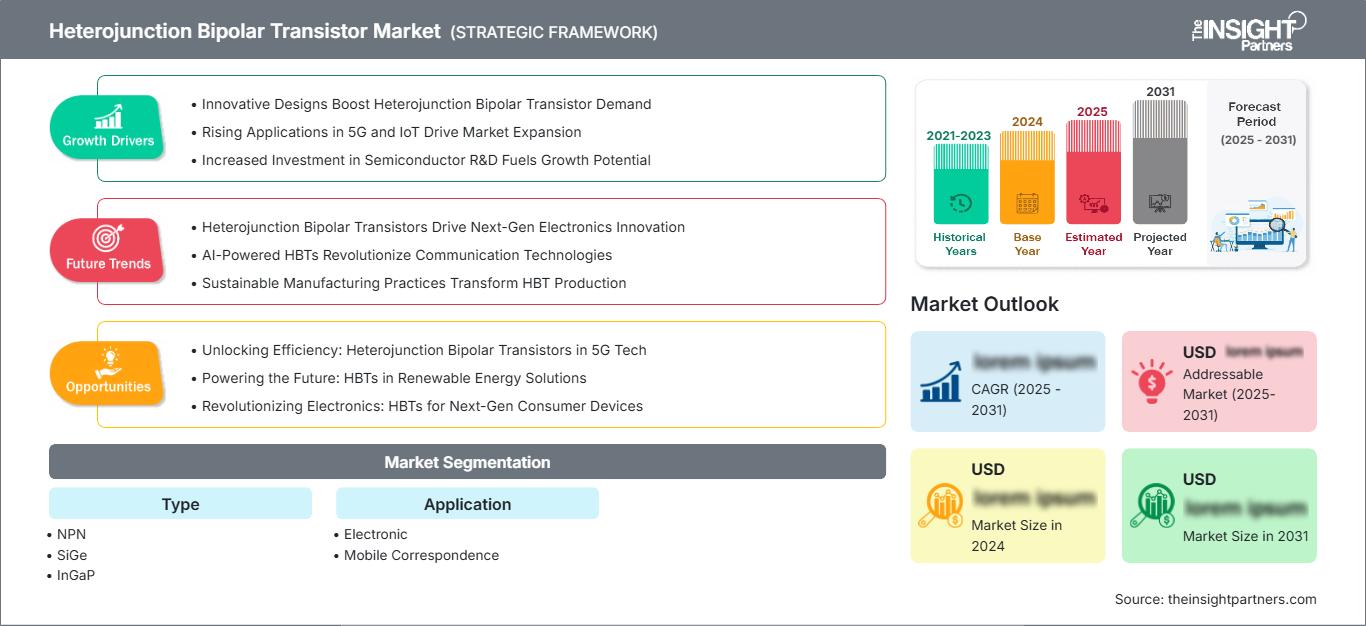
Heterojunction Bipolar Transistor Market: Strategic Insights
Regional Insights
North America Heterojunction Bipolar Transistor Market
North America is represented by a forecasted share of 31% to 35% in 2025 and a CAGR of 8.0% to 8.8% until 2034. United States is the leader in the region, thanks to wireless infrastructure, aerospace, defense electronics, and the development of RF technology. Knowledge of compound semiconductors and mature design ecosystem help overcome qualification barriers to HBT-based products in harsh environments. In addition, government policies that focus on the independence of domestic semiconductor industry favor investments in fabrication and packaging.
North America’s supply base includes integrated semiconductor players, specialized RF producers, R&D organizations, and compound-semiconductors foundries. There is a growing need for high-linearity, low-noise, and high-frequency parts for communication and defense-related applications. Canada represents its interests via telecommunications and R&D activities, while Mexico offers the experience of electronics manufacturing. North America's leading position is guaranteed by the deep knowledge of application engineering and close cooperation between device manufacturers and systems designers.
U.S. Heterojunction Bipolar Transistor Market
The US makes up an estimated 82%-86% of the demand in North America by 2025 and is projected to experience 8.1%-8.9% CAGR growth until 2034. The demand includes mobile infrastructure, aerospace, defense, test equipment, and specialty electronics. Qorvo and IBM contribute key technology exposure, whereas international vendors offer sales, design, and application support throughout the region.
Trends in applications continue to focus on RF front end, driver amplifiers, high frequency instrumentation, and communication systems that require linear operation in challenging signal conditions. Additionally, domestic semiconductor policies promote capacity diversification and investment in technology. The market has benefited from the presence of strong university and research communities, an experienced RF engineer base, and substantial defense electronics spending.
Europe Heterojunction Bipolar Transistor Market
Europe is represented in 19-23% share for 2025 and CAGR of 6.4-7.2% from 2025 to 2034. The region's leader in demand is Germany, driven by automotive electronics, industrial systems, semiconductor devices engineering and communications equipment. The United Kingdom offers demand in terms of aerospace electronics, defense, research and RF technologies, whereas France possesses significant strategic importance in aerospace and telecommunications sectors. Italy and Spain offer application-specific demand through industrial electronics and communications.
Germany enjoys advantages due to highly developed semiconductor and industrial technology infrastructure and is home to such regional semiconductor player as Infineon Technologies AG. The UK and France focus on high-reliability electronics and defense-specific systems, whereas Italy and Spain offer opportunities in terms of applications. Moderately growing Europe market of electronics is explained by well-developed electronics markets, but strategic investments into semiconductors, supply chain diversification and RF technology developments should secure a 6.4-7.2% CAGR and Germany leadership.
APAC Heterojunction Bipolar Transistor Market
APAC is forecasted for a 36–40% market share in 2025 and 9.0–9.8% CAGR till 2034. China and Taiwan drive the regional ecosystem, backed by electronics manufacturing and compound semiconductor foundries. Japan and South Korea participate via advanced electronics, whereas India and Australia provide opportunities in communications and technologies.
Drivers of growth in the region comprise of electronics production, wireless infrastructure spending and semiconductor localization programs. Regionally, Taiwan is important for compound semiconductor foundry industry, while China benefits from the communications equipment production. Japan and South Korea favor electronics-related initiatives. India gets additional growth from communications sector. Thus, APAC region will remain the dominant market with CAGR of 9.0%-9.8%.
Middle East & Africa Heterojunction Bipolar Transistor Market
Middle East and Africa demand remains comparatively smaller but is modeled to expand at a 5.0–6.0% CAGR through 2034. Saudi Arabia and the UAE lead regional opportunities through telecommunications modernization, digital infrastructure, and advanced communications investment. South Africa provides the strongest African base through industrial and communications applications.
Technology infrastructure development and high-speed communications requirements are strengths for the UAE, while digital transformation initiatives in Saudi Arabia help deploy equipment. South Africa is still key for regional connections and electronics. Opportunities elsewhere in MEA are limited but include telecoms development and satellite communications. Energy diversification and digital infrastructure development will eventually expand the range of applications possible.
Segmentation Analysis
Type
The Type segment is expected to expand at a 7.7–8.6% CAGR from 2026–2034. Device selection depends on frequency, gain, linearity, process compatibility, power requirements, and application economics. NPN remains broadly deployed, while SiGe and InGaP technologies gain strategic importance where higher-frequency performance and integration requirements justify specialized process architectures.
- NPN: NPN devices maintain broad relevance in RF and electronic circuits because of established design practices, predictable switching behavior, and compatibility with numerous amplifier and signal-processing architectures.
- SiGe: SiGe HBTs support high-frequency integrated designs by combining RF performance with silicon manufacturing compatibility, making them strategically relevant for communications, automotive electronics, and mixed-signal systems.
- InGaP: InGaP HBTs remain important for high-linearity RF amplification, particularly where thermal stability, gain, efficiency, and frequency performance are prioritized within wireless infrastructure designs.
Application
The Application segment is projected to grow at a 8.8–9.6% CAGR from 2026–2034. Communications remain central because HBT architectures provide useful linearity and gain characteristics for RF signal chains. Electronic applications provide a broader base, while mobile communication systems should benefit from continuing network modernization and higher RF content.
- Electronic: Electronic applications provide diversified demand across RF circuits, instrumentation, industrial equipment, and specialized semiconductor systems where controlled high-frequency characteristics are required.
- Mobile Correspondence: Mobile Correspondence benefits from wireless infrastructure expansion, RF front-end complexity, and higher performance requirements for base stations, repeaters, and compact communication equipment.
Opportunity Snapshot
| Application | Revenue Contribution | Trend Tag | Adoption Stage |
| Electronic | High | RF Integration | Mature |
| Mobile Correspondence | High | 5G RF | Scaling |
Heterojunction Bipolar Transistor Market Growth Drivers and Impact Analysis
Expansion of High-Frequency Wireless Infrastructure
Wireless networks require RF components that can sustain high linearity, gain, and efficiency across increasingly demanding signal environments. HBT-based amplifiers remain relevant where these characteristics must be achieved within compact RF chains. The commercial impact extends beyond base stations because repeaters, distributed antenna systems, private networks, and point-to-point radios also require high-performance amplification. Qorvo's portfolio illustrates this positioning, with GaAs HBT products supporting 5G massive MIMO and wireless infrastructure applications. The broader semiconductor cycle also provides supportive conditions, with WSTS reporting strong 2025 growth across communications-related electronics and projecting continued industry expansion.
Demand for High-Linearity RF Signal Processing
Higher data rates and denser spectrum utilization increase the importance of signal integrity within RF chains. HBT architectures can provide high gain and linearity characteristics that support amplification stages where distortion control is important. This creates opportunities in infrastructure, satellite communications, instrumentation, and specialized defense electronics. Product qualification remains significant because system designers evaluate gain stability, thermal behavior, reliability, package parasitics, and frequency response together. Suppliers capable of providing characterized reference designs and application support can therefore capture greater design influence than vendors competing only on device pricing.
Semiconductor Supply-Chain Localization
Government and industry initiatives focused on semiconductor resilience are encouraging regional capacity development, supplier diversification, and greater visibility across critical manufacturing stages. For HBT technologies, localization can be particularly consequential because compound-semiconductor processes rely on specialized materials, epitaxy, wafer fabrication, and packaging capabilities. New investment can reduce dependence on concentrated supply sources while creating additional opportunities for qualified foundries and device manufacturers. The effect should be strongest in North America and Asia Pacific, where semiconductor investment and electronics manufacturing are already substantial. Companies that secure qualified second sources and long-term wafer relationships can improve supply continuity while reducing exposure to geopolitical or logistical disruptions.
Heterojunction Bipolar Transistor Market Future Trends
Greater Integration of RF Functions
Future designs are likely to combine HBT amplification with additional RF functions, reducing component count and shortening signal paths. Integration can improve footprint efficiency while simplifying assembly and potentially reducing parasitic losses. The Heterojunction Bipolar Transistor Market trend will favor suppliers with capabilities spanning device technology, packaging, matching networks, and application-specific RF design. SiGe HBT platforms are particularly positioned for integration because their silicon compatibility supports mixed-signal architectures. InGaP and GaAs technologies will retain importance where specialized frequency and power characteristics outweigh integration advantages. Over time, device differentiation should increasingly depend on complete RF subsystem performance rather than transistor specifications alone. This transition may also increase collaboration between foundries and system-level semiconductor companies.
Optimization for Next-Generation Wireless Architectures
Future HBT development will increasingly target wireless architectures that demand wider bandwidth, improved energy efficiency, and greater linearity. Network equipment designers are expected to optimize RF chains around advanced modulation schemes and increasingly dense antenna configurations. Device suppliers will consequently emphasize thermal control, bias stability, packaging, and frequency coverage alongside conventional gain metrics. The result should be more application-specific HBT portfolios rather than broad families of general-purpose devices. Suppliers with strong characterization capabilities can use system-level modeling to shorten design cycles and improve first-pass qualification. Such capabilities should become particularly valuable as communications equipment moves toward more complex multi-band and high-capacity configurations.
Heterojunction Bipolar Transistor Market Opportunities
Localized Compound Semiconductor Manufacturing
Investment opportunities exist in regional compound-semiconductor manufacturing, especially where governments and major electronics producers seek greater supply-chain resilience. HBT production requires specialized epitaxy, wafer processing, and testing expertise, creating opportunities for foundries that can offer qualified capacity to multiple device companies. Taiwan, North America, Japan, and selected European locations are strategically positioned because of existing semiconductor ecosystems. Investors should prioritize facilities with flexible process platforms, strong yield-management capabilities, and access to experienced RF engineering teams. Partnerships between foundries and fabless RF companies can further reduce commercialization risk by aligning process development with application requirements. Such models can also improve capacity utilization across cyclical communications markets.
Application-Specific RF Device Platforms
A second opportunity lies in application-specific HBT platforms designed for targeted wireless, aerospace, defense, and instrumentation requirements. Instead of competing solely through standardized transistor specifications, suppliers can develop qualified devices around particular frequency bands, power levels, thermal conditions, and package constraints. The Heterojunction Bipolar Transistor Market Forecast therefore favors business models that combine semiconductor technology with reference designs, evaluation hardware, simulation support, and long-term application engineering. Suppliers serving smaller but technically demanding niches can achieve stronger customer retention because qualification costs create switching barriers. Investment should focus on platforms where performance requirements are difficult to satisfy with conventional silicon alternatives.
Recent Developments
- September 2024: Ohio State University researchers demonstrated a tunnel-junction-enabled gallium nitride (GaN) heterojunction bipolar transistor (HBT) designed to overcome performance limitations associated with conventional p-type base contacts. The proposed structure uses p+/n+ tunnel junctions, allowing the emitter, collector, and base to use contacts suitable for n-type GaN while eliminating the need for emitter/base regrowth. The device achieved collector current densities of up to 28 kA/cm² and is aimed at advancing III-nitride HBTs for next-generation RF and mm-wave applications, with further improvements in current gain, base conductivity, material quality, and device scaling identified as priorities.
- June 2026: IBM unveiled a sub-1-nanometer 0.7 nm chip technology featuring a new 3D “nanostack” architecture that vertically stacks and staggers nanosheet transistors to improve transistor density, performance, and energy efficiency. The technology was experimentally validated through CMOS integration and inverter demonstrations and represents a major advancement in next-generation semiconductor architectures. While the development is primarily CMOS-focused, advances in advanced transistor integration and BiCMOS-compatible semiconductor technologies could support future high-performance applications involving integrated bipolar and CMOS devices.
Frequently Asked Questions

- Comprehensive Market Sizing and Forecast Analysis
- Detailed Segmentation Analysis
- In-Depth Market Dynamics Assessment
- Regional and Country-Level Insights
- Competitive Landscape and Company Benchmarking
- Strategic Business Intelligence
Recent Reports
Testimonials

The Insight Partners' SCADA System Market report is comprehensive, with valuable insights on current trends and future forecasts. The team was highly professional, responsive, and supportive throughout. We are very satisfied and highly recommend their services.
RAN KEDEM Partner, Reali Technologies LTDs
I requested a report on a very specific software market and the team produced the report in a few days. The information was very relevant and well presented. I then requested some changes and additions to the report. The team was again very responsive and I got the final report in less than a week.
JEAN-HERVE JENN Chairman, Future Analytica
We worked with The Insight Partners for an important market study and forecast. They gave us clear insights into opportunities and risks, which helped shape our plans. Their research was easy to use and based on solid data. It helped us make smart, confident decisions. We highly recommend them.
PIYUSH NAGPAL Sr. Vice President, High Beam Global
The Insight Partners delivered insightful, well-structured market research with strong domain expertise. Their team was professional and responsive throughout. The user-friendly website made accessing industry reports seamless. We highly recommend them for reliable, high-quality research services
YUKIHIKO ADACHI CEO, Deep Blue, LLC.
This is the first time I have purchased a market report from The Insight Partners.While I was unsure at first, I visited their web site and felt more comfortable to take the risk and purchase a market report.I am completely satisfied with the quality of the report and customer service. I had several questions and comments with the initial report, but after a couple of dialogs over email with their analyst I believe I have a report that I can use as input to our strategic planning process.Thank you so much for taking the extra time and making this a positive experience.I will definitely recommend your service to others and you will be my first call when we need further market data.
JOHN SUZUKI President and Chief Executive Officer, Board Director, BK Technologies
I wish to appreciate your support and the professionalism you displayed in the course of attending to my request for information regarding to infectious disease IVD market in Nigeria. I appreciate your patience, your guidance, and the fact that you were willing to offer a discount, which eventually made it possible for us to close a deal. I look forward to engaging The Insight Partners in the future, all thanks to the impression you have created in me as a result of this first encounter.
DR CHIJIOKE ONYIA MANAGING DIRECTOR, PineCrest Healthcare Ltd.Reason to Buy
- Informed Decision-Making
- Understanding Market Dynamics
- Competitive Analysis
- Identifying Emerging Markets
- Customer Insights
- Market Forecasts
- Risk Mitigation
- Boosting Operational Efficiency
- Strategic Planning
- Investment Justification
- Tracking Industry Innovations
- Aligning with Regulatory Trends





 Get Free Sample for