
HV Switchgear Market Trends, Demand & Growth by 2034
Coverage: by Types (Air Insulated, Gas Insulated, Oil Insulated, Other Types); Components (Air-Insulated Switchgears, Gas-Insulated Switchgears, Other Insulations); Applications (Industrial, Infrastructure Development, Oil and Gas, Power Generation, Processing and Manufacturing, Transmission and Distribution, Transportation, Utilities Sector, Other Applications) , and Geography (North America, Europe, Asia Pacific, and South and Central America)
- Status : Data Released
- Report Code : TIPRE00007858
- Category : Electronics and Semiconductor
- No. of Pages : 150
- Available Report Formats :


- Last update date : September 15, 2026


2025 Market Size
US$ 59.46 Bn
Base year value
2034 Forecast
US$ 84.5 Bn
Projected by 2034
CAGR 2026-2034
3.98 %
Growth rate
Addressable Market
US$ 653.76 Bn
(2026-2034)
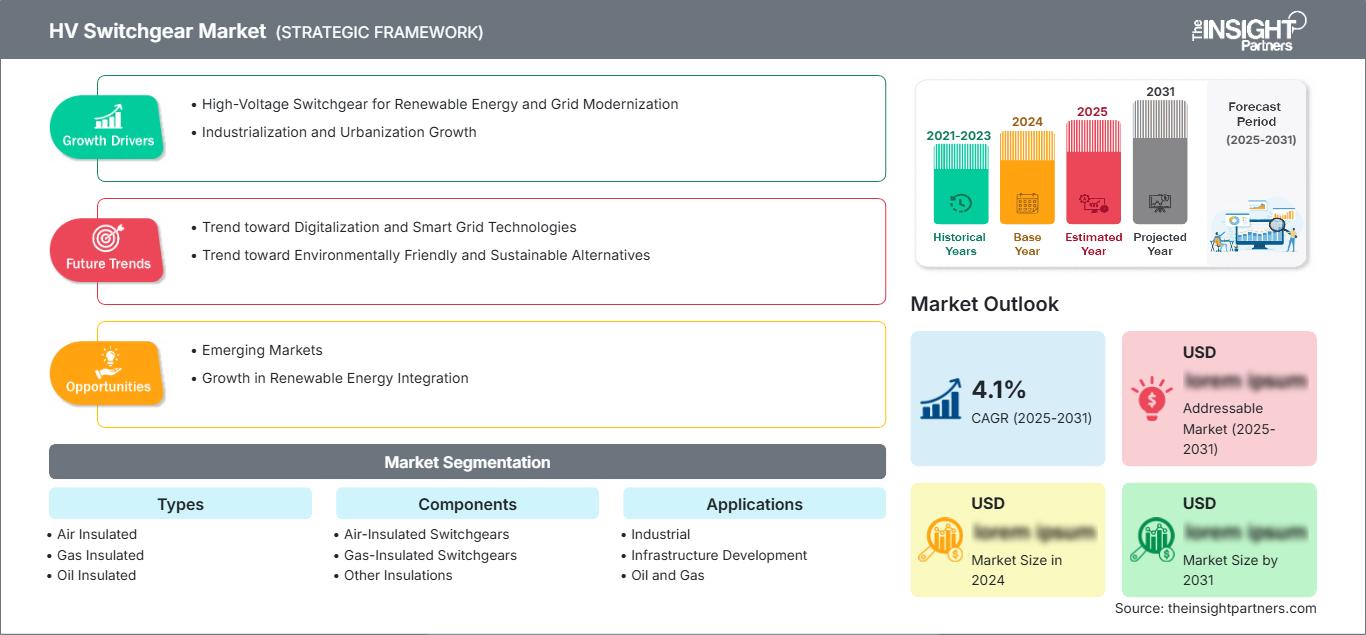
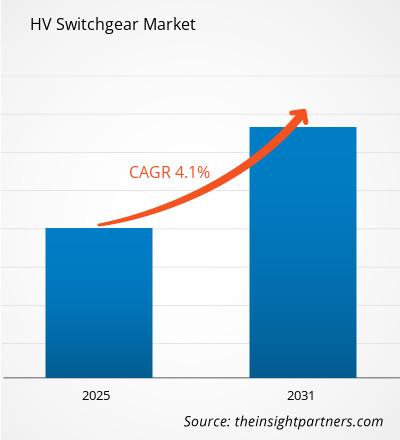
The HV Switchgear Market was valued at US$ 59.46 Billion in 2025 and is projected to reach US$ 84.5 Billion by 2034, expanding at a CAGR of 3.98% from 2026 to 2034. The demand is driven by transmission system upgrades, renewables penetration, industrial electrification, and the replacement of old electrical assets. The Market can be considered as an integral part of the modern electricity network that ensures protection, isolation, switching, and regulated power transfers through high-voltage systems.
The growth rate of the North American HV Switchgear Market Size over the forecast period from 2026 to 2034 will reach 3.7%-4.1% per annum due to such drivers as transmission reinforcement, grid resilience, data centers' demand for electricity, and aging substations replacement. Moreover, there is the developed procurement process for utilities and increasingly high demands on the reliability of the network in the region.
HV Switchgear Market Assessment and Insights
- North America: North America is expected to represent a 23–27% share in 2025, growing at a 3.7–4.1% CAGR between 2026–2034. Grid modernization, data centers, transmission reinforcement, and replacement programs sustain equipment demand across utilities and industrial users.
- US: The US is estimated to account for 78–82% of North America in 2025, expanding at a 3.8–4.2% CAGR between 2026–2034, supported by grid resilience and large-load interconnection requirements.
- Europe: Europe is estimated at a 22–25% share in 2025, growing at a 3.5–3.9% CAGR between 2026–2034. Germany, the UK, France, Italy, and Spain remain important markets, driven by renewable integration, interconnection, replacement, and decarbonization requirements.
- Asia Pacific: Asia Pacific is estimated at a 39–43% share in 2025, growing at a 4.2–4.6% CAGR between 2026–2034. China, India, Japan, South Korea, and Australia lead regional activity through transmission expansion, industrialization, renewable integration, and electrification.
- Largest Segment: Gas Insulated is estimated at a 48–52% market share in 2025, expanding at a 4.1–4.4% CAGR between 2026–2034, supported by compact substations and high-density urban applications.
- High Growth Segment: Transportation is estimated at a 5–8% market share in 2025, growing at a 5.2–5.6% CAGR between 2026–2034, supported by railway electrification and high-capacity transit infrastructure.
- Key companies analyzed in detail: ABB Ltd., China XD Electric Group Co. Ltd., Fuji Electric Co., Ltd., General Electric Company, Crompton Greaves Limited, Henan Pinggao Electric Co., Ltd., Hitachi, Ltd., Hyosung Corporation, HD Hyundai Heavy Industries Co., Ltd., Mitsubishi Electric Corporation, Nissin Electric Co., Ltd.
Source: The Insight Partners' analysis based on proprietary research, government publications, company annual reports, investor presentations, industry databases, and expert interviews.
In the case of the HV Switchgear market, the market has moved from the traditional electromechanical switchgears to more sophisticated ones, with features like compact insulation, better interrupting capabilities, monitoring, automation, and environment-related aspects. Gas-insulated designs have grown in popularity where land space and reliability considerations call for higher sophistication levels in equipment, but air-insulated designs still hold relevance due to their lower cost for outdoor substations. Moreover, manufacturers are also developing products that can cater to growing environmental concerns, in the form of alternate insulation methods and reduction in SF6 usage. Monitoring is now an integral part of switchgears, which enables utilities to link condition monitoring with substation automation.
As we look towards the future, it is projected that investments will target transmission corridors, renewable energy connections, electrification of industries, and replacing older infrastructure. According to the International Energy Agency, investment in grids, which is currently at about $400 billion each year, is going to need to be increased by an additional 50% to cater to electricity demand requirements by the year 2030. These demands are therefore going to open up many opportunities for manufacturers who have the ability to produce in a scalable way. There are also increasing demands for equipment other than traditional SF6-intensive equipment due to environmental regulations.
HV Switchgear Market Report Scope
| Report Attribute | Details |
|---|---|
| Market size in 2025 | US$ 59.46 Billion |
| Market Size by 2034 | US$ 84.5 Billion |
| Global CAGR (2026 - 2034) | 3.98% |
| Historical Data | 2021-2024 |
| Forecast period | 2026-2034 |
HV Switchgear Market Analysis
The growth rate of HV switchgear is directly proportional to electricity consumption, growth in the transmission network, penetration of renewable power sources, and aging substation replacement. Utilities and transmission networks are the base demand segments, whereas industries, transportation networks, energy developments, and infrastructures are secondary opportunities. The value chain includes electrical steel, copper, and aluminum, insulation, circuit breaker, disconnector, control, enclosures, engineering, testing, commissioning, and life cycle management. According to IEA, there is a backlog of more than 2,500 GW of renewables, storage, and heavy load capabilities waiting for grid connection.
Supply dynamics will be influenced by supply capacity shortages and longer purchasing cycle for the equipment. To overcome this, manufacturers will expand their footprint and implement design standardization and component localization, which will result in decreased lead time and margin protection from the price volatility in materials. Testing and certification of the high voltage equipment take a long time, making it difficult to enter quickly. The suppliers who have an installed base have an advantage due to the replacement cycle.
In regard to the HV Switchgear Market report, there is a competitive situation that involves global electrical equipment companies, transmission equipment specialists, and regional players. ABB Ltd., Hitachi, Ltd., Mitsubishi Electric Corporation, Fuji Electric Co., Ltd., and General Electric Company are competing in a portfolio approach including high-voltage switchgear, circuit breakers, substations, automation, and grid solution. China XD Electric Group Co. Ltd. and Henan Pinggao Electric Co., Ltd. are strong players in large transmission projects, especially in the Asian continent. Crompton Greaves Limited and Nissin Electric Co., Ltd. meet particular regional and specialized needs.
The investment trend is moving towards manufacturing capacity increase, environmentally friendly insulation systems, digital substations, and tailored solutions for renewable energy and large power consumption applications. In 2025, Fuji Electric has declared that the company will change its manufacturing process and increase the capacity for transmission and distribution equipment due to renewable energy sources, data centers, semiconductor plants, and replacement purposes. Consequently, competition is changing its focus from equipment provision to manufacturing capacity, engineering services, environmental performance, project execution, and lifecycle services.
● REPORT CUSTOMIZATION
Tailor This Report To Align With Your Specific Business Requirements
This report can be customized to align precisely with your business objectives, scope, and target markets. Customization options include tailored segmentation, geography, competitive analysis, and strategic insights to support informed decision-making.
Customize This Report →WHAT YOU CAN ADJUST
- ● Segmentations
- ● Geography
- ● Competitive Analysis
- ● Language Preferences
HV Switchgear Market: Strategic Insights
Regional Insights
North America HV Switchgear Market
North America is expected to capture a 23-27% of the HV Switchgear Market share in 2025 and grow at a 3.7-4.1% CAGR up to 2034. The region's market dynamics will be driven by aging transmission systems, rising demand for electricity, increased interconnectivity of renewables, and resilience initiatives. There will be also need to prepare the networks for increased load requirements from data centers, manufacturing plants, electric vehicles, and DERs. Demand for replacements ensures stability since many substations need upgrading even when the entire power system is already developed. Reliability, monitoring compatible with cybersecurity needs, environmental considerations, and reduced equipment downtimes have been key considerations in procurement decisions.
The US will represent the main regional market, while Canada adds via utility modernization, renewable integration, and transmission upgrades. Power grid congestion and delayed connections support the need for substation development and high-capacity transmission lines. IEA reports grid supply chain limitations and lengthy development periods for electricity-system expansion projects as key issues at the global level. Manufacturers with regional presence, good relationships with utilities, engineering services, and equipment suitable for replacing old technology will benefit. México will offer incremental demand due to industrialization and manufacturing investments.
U.S. HV Switchgear Market
The US is projected to have 78%–82% of North America's total in 2025, growing at a CAGR of 3.8%–4.2%. The demand will center on utility transmission, substations, renewable interconnection, industrial installations, and heavy load plants. Demand from data centers and manufacturing will add to the needs for reliable high-voltage systems. The need for replacement of aging equipment will also contribute to the demand.
The companies that offer suitable technologies and infrastructure for the market in question include ABB Ltd., General Electric Company, Hitachi, Ltd., and Mitsubishi Electric Corporation. Modern utilities assess the quality of the equipment not only by its reliability and environment impact, but also by its maintainability and ability to be used in digital substation systems. High capacity interconnection infrastructure is also required in large renewable energy generation projects, which adds to the opportunities for the use of high voltage breakers, GIS, AIS, and hybrid solutions.
Europe HV Switchgear Market
Europe is predicted to contribute to 22-25% in 2025, while it experiences 3.5-3.9% CAGR until 2034. Germany is leading the countries, with the UK, France, Italy, and Spain following. The regional demand drivers include renewable integration, interconnection, reinforcement, and environmental factors influencing high voltage equipment.
The UK is upgrading its transmission network to facilitate offshore wind connections and increasing its network capacity. In Germany, there is a need for increased grid infrastructure to transfer renewable electricity from northern generation points to regions where industrial demand is observed. In France, transmission demand is driven by the requirements related to nuclear, renewables, and industrial electrification. Italy is upgrading its network capacity, together with renewable integration and interconnection demands, whereas Spain is developing its grids to accommodate solar and wind generation.
APAC HV Switchgear Market
The APAC region will capture 39%-43% in 2025, growing at a 4.2%-4.6% CAGR, making it the dominant region. China is still the largest region, followed by Japan, India, South Korea, and Australia. Industrial growth and transmission investments drive equipment demand.
In China, UHV transmission technology promotes GIS purchases. In India, upgrading of the transmission capacities takes place in conjunction with renewable power generation. In Japan and South Korea, upgrades, reliability, and cutting-edge technology are important. In Australia, investments in network infrastructures have to take place to connect renewable energy sources. India's investments in its electricity infrastructures are particularly fascinating, as 83% of all electricity investments in the country focus on renewables in 2024.
Middle East & Africa HV Switchgear Market
MEA should register growth at a CAGR of 4.5–4.9%, backed by expansion of utilities, industrialization, deployment of renewable energy, and infrastructure development. Saudi Arabia and the UAE lead investment in the region, while South Africa still plays a critical role in improving its power grids and power reliability.
Infrastructural development and energy transition programs in Saudi Arabia will drive demand for high-voltage equipment, while the UAE will invest in increasing grid capacity as part of urbanization and diversifying sources of energy generation. South Africa needs upgrades to its network and replacement of old equipment. Opportunities for the remaining MEA countries will come from transmission infrastructure projects, industrial zones, renewable energy, and electrification.
Segmentation Analysis
Types
The Types segment is expected to grow at a 3.7–4.2% CAGR from 2026–2034. Air-insulated and gas-insulated configurations dominate procurement because they address different space, cost, reliability, and environmental requirements. Oil-insulated equipment retains selected applications, while alternative architectures can gain traction where specialized performance or environmental considerations influence specifications. The HV Switchgear Market scope increasingly encompasses equipment selection based on lifecycle cost, footprint, maintenance requirements, and installation conditions.
- Air Insulated: Air-insulated systems remain important for outdoor substations and applications where available land supports economical installation. Their established engineering practices, accessibility, and maintenance characteristics sustain demand across utilities and industrial facilities.
- Gas Insulated: Gas-insulated systems maintain a strong position in compact substations, dense urban locations, and high-reliability transmission applications. Their smaller footprint supports deployment where land constraints and operational continuity are significant procurement considerations.
- Oil Insulated: Oil-insulated configurations retain specialized demand in selected installations where established operating practices, insulation characteristics, and equipment availability influence procurement decisions. Replacement requirements provide continued but comparatively limited market relevance.
- Other Types: Alternative configurations address specialized voltage, installation, environmental, and operational requirements. Adoption depends on project specifications, regulatory conditions, technology maturity, and the ability of manufacturers to demonstrate long-term reliability.
Components
The Components segment is projected to grow at a 3.6–4.1% CAGR from 2026–2034. Component selection increasingly reflects the required insulation architecture, voltage level, fault-handling capability, footprint, and environmental profile. Utilities and industrial buyers are also considering digital monitoring, maintenance accessibility, and compatibility with existing substations when selecting complete switchgear systems.
- Air-Insulated Switchgears: Air-insulated switchgears remain widely deployed where land availability, maintenance accessibility, and established utility specifications favor conventional outdoor or indoor configurations. Their broad installed base supports recurring replacement and expansion demand.
- Gas-Insulated Switchgears: Gas-insulated switchgears are strategically important for compact high-voltage substations and constrained locations. Demand benefits from urbanization, transmission expansion, and applications requiring high operational availability with reduced physical footprint.
- Other Insulations: Other insulation approaches support specialized applications and emerging environmental requirements. Their importance is increasing as utilities investigate alternatives that reduce environmental impact while maintaining interruption performance, safety, and grid reliability.
Applications
The Applications segment is expected to expand at a 3.9–4.4% CAGR from 2026–2034. Transmission and distribution remains the principal demand center, while renewable generation, industrial electrification, transportation, and infrastructure modernization create additional requirements. Application-specific specifications increasingly determine voltage ratings, insulation selection, automation requirements, environmental performance, and lifecycle service expectations.
- Industrial: Industrial facilities require dependable high-voltage protection for process continuity, captive generation, and large motors. Procurement prioritizes safety, reliability, maintainability, and integration with plant electrical systems.
- Infrastructure Development: Infrastructure projects use high-voltage equipment across airports, rail systems, urban developments, water facilities, and large public assets. Long operating lives and stringent reliability requirements influence equipment selection.
- Oil and Gas: Oil and gas facilities require robust high-voltage systems for production, processing, pipelines, terminals, and offshore assets. Reliability, hazardous-area considerations, and continuity of operations remain central purchasing factors.
- Power Generation: Generation facilities require switchgear for generator connection, auxiliary systems, evacuation infrastructure, and protection. Renewable projects increasingly add demand as new generating assets require reliable grid interconnection.
- Processing and Manufacturing: Processing and manufacturing plants depend on high-voltage systems to support energy-intensive operations. Equipment modernization is influenced by production expansion, electrical safety, efficiency requirements, and aging infrastructure.
- Transmission and Distribution: Transmission and distribution represents the core application base because utilities continually expand, reinforce, and replace substations. Renewable integration and rising electricity demand strengthen requirements for high-capacity switching and protection.
- Transportation: Transportation is a high-growth application as rail electrification and high-capacity transit systems expand. High-voltage equipment supports traction substations, railway power networks, and infrastructure requiring reliable electrical conversion and protection.
- Utilities Sector: Utilities remain the principal buyers because switchgear is fundamental to transmission, distribution, protection, and substation operation. Long-term asset-management programs create recurring demand for replacements and network upgrades.
- Other Applications: Specialized applications include data infrastructure, commercial complexes, institutional facilities, and emerging electrification projects. Demand depends strongly on project scale, local grid configuration, and reliability requirements.
Opportunity Snapshot
| Applications | Revenue Contribution (High/Medium/Low) | Trend Tag | Adoption Stage |
|---|---|---|---|
| Industrial | High | Plant Electrification | Mature |
| Infrastructure Development | Medium | Urban Grid | Scaling |
| Oil and Gas | Medium | Asset Modernization | Mature |
| Power Generation | High | Renewable Integration | Scaling |
| Processing and Manufacturing | High | Factory Expansion | Scaling |
| Transmission and Distribution | High | Grid Reinforcement | Mature |
| Transportation | Medium | Rail Electrification | Scaling |
| Utilities Sector | High | Grid Resilience | Mature |
| Other Applications | Low | Load Expansion | Emerging |
HV Switchgear Market Growth Drivers and Impact Analysis
Transmission Expansion for Renewable and Large-Load Integration
The fast-growing trend of renewables generation and electricity-dependent applications increases the need for high-capacity transmission infrastructure. Solar and wind energy, power storage, electric vehicles, and data centers generate new connection needs that today's infrastructure cannot always provide without adding new substations and switchgears. According to the IEA, there are still about 2,500 GW of renewable, storage, and load projects waiting in the global grid pipeline. This creates new opportunities for higher sales of high-voltage breakers, GIS, AIS, protection solutions, and substation components. From a manufacturer perspective, it means more projects on the pipeline and increased demand for standard equipment platforms. From a purchasing side, this translates into delivery reliability, compatibility, environmental efficiency, and support.
Replacement of Aging Transmission and Substation Assets
Decaying electrical infrastructure results in a robust cycle of replacement that is unrelated to the building of any additional generating capacity. Many electric utilities utilize infrastructure that was built many decades ago, resulting in the need for modernization, protection, improved fault interruption, and increased reliability. This cycle of replacement also offers the possibility of introducing monitoring systems and insulation with lower emissions without having to completely reengineer the network architecture. The business impact is large since the procurement process will likely favor incumbent suppliers that have experience in the certification process and are knowledgeable about the existing infrastructure. Suppliers can leverage their position within this cycle by adding other value-added services along with the equipment.
Environmental Requirements and Transition Toward Lower-Emission Technologies
Environmental regulations have prompted utilities and industrial consumers to reevaluate insulation technologies used in high-voltage apparatus. SF6 has traditionally had good insulating properties; however, it has a very high global warming potential, making it more prone to regulation and customer scrutiny. In response, technology manufacturers are now producing new gas mixes, vacuum-based interrupters, and hybrid designs that combine electrical efficiency with environmental friendliness. Hitachi Energy, for instance, made news of delivering an SF6-free 550 kV GIS by 2025 in China. This trend opens up possibilities for increased replacement when customers are trying to achieve environmental goals together with efficiency.
HV Switchgear Market Future Trends
Digitalized and Condition-Aware High-Voltage Substations
HV Switchgear Market trends are moving toward connected equipment capable of supplying condition information throughout the asset lifecycle. Sensors, digital relays, thermal monitoring, breaker diagnostics, communication interfaces, and analytics can improve visibility into equipment health without requiring frequent physical inspection. Future installations are likely to combine switchgear with digital-substation architectures, enabling utilities to correlate electrical measurements with maintenance history and operating conditions. Artificial intelligence may increasingly support anomaly detection and maintenance prioritization, particularly for large fleets of substations. This evolution changes procurement criteria from equipment specifications alone toward interoperability, data availability, cybersecurity, and service capability. Vendors with established automation portfolios can integrate switching equipment with broader grid-control environments, while utilities can potentially reduce unplanned outages and optimize maintenance schedules through better asset intelligence.
Modular and Environmentally Optimized Substation Architectures
Future deployment is expected to favor modular substation configurations that reduce engineering time, simplify installation, and improve scalability. Standardized GIS modules, hybrid switchgear, packaged substations, and prefabricated electrical assemblies can support faster deployment where transmission expansion is constrained by labor, permitting, or site complexity. Environmental optimization will develop alongside modularization, particularly through SF6-free insulation and compact architectures. This combination is relevant for renewable interconnection, data centers, rail systems, and urban substations where schedule and footprint are important. Manufacturers may increasingly design equipment around standardized platforms that can be configured for multiple voltage classes and project requirements. Such architectures can improve factory utilization, reduce engineering duplication, and make supply planning more predictable while allowing utilities to deploy capacity in phases.
HV Switchgear Market Opportunities
Localized Manufacturing for High-Growth Grid Investment Markets
The HV Switchgear Market Forecasts indicate attractive opportunities for suppliers that localize manufacturing and engineering in regions with expanding transmission programs. India, Southeast Asia, the Middle East, and selected African markets are increasing investment in electricity networks while seeking greater supply-chain resilience. Local production can reduce logistics exposure, improve responsiveness to utility specifications, and support qualification requirements. Manufacturers can prioritize modular production, regional testing facilities, and partnerships with engineering, procurement, and construction companies. India's grid investment needs are particularly significant because renewable additions and industrial electrification are increasing transmission requirements. Companies can also use local manufacturing to strengthen after-sales capabilities, shorten service response times, and build relationships with utilities pursuing multi-year procurement programs.
Lifecycle Services and Retrofit Programs for Existing Assets
A substantial opportunity exists beyond new equipment through retrofit, refurbishment, diagnostics, and lifecycle management. Utilities increasingly need to extend asset life while improving protection, monitoring, and environmental performance without replacing complete substations. Suppliers can develop retrofit packages for circuit breakers, control systems, monitoring devices, insulation components, and protection equipment. Such solutions can address budget constraints while minimizing outages and civil works. Service programs also provide manufacturers with recurring revenue and direct access to installed equipment data, strengthening future replacement positioning. The opportunity is particularly relevant in mature North American and European networks, where asset density is high and modernization budgets must be allocated carefully. Combining diagnostics with replacement planning can allow utilities to prioritize the highest-risk equipment and improve capital-efficiency outcomes.
Recent Developments
- April 2026: Fuji Electric Co., Ltd. announced plans to expand switchboard production capacity at its Malaysia factory to support growing data-center demand. The investment will add production equipment and strengthen manufacturing of skid systems and container powertrain units, with overall production capacity planned to increase by 1.5 times and construction scheduled to begin in June 2026.
- May 2026: ABB Ltd. announced approximately US$200 million of investment across European medium-voltage manufacturing facilities over three years, including projects in Italy, Bulgaria, Finland, Germany, Norway, and Poland. The program is designed to expand production capacity and improve availability of SF6-free switchgear and grid-automation products as utilities, industrial customers, and data centers modernize electrical infrastructure.
- October 2025: Hitachi, Ltd. announced that Hitachi Energy received its first 1,100 kV gas-insulated switchgear order for China's UHV transmission system. The equipment will support the Nanchang UHV substation expansion in Jiangxi and will be manufactured at Hitachi Energy's high-voltage switchgear facility in Xiamen, reinforcing its participation in China's large-scale UHV grid build-out.
Frequently Asked Questions

- Comprehensive Market Sizing and Forecast Analysis
- Detailed Segmentation Analysis
- In-Depth Market Dynamics Assessment
- Regional and Country-Level Insights
- Competitive Landscape and Company Benchmarking
- Strategic Business Intelligence
Recent Reports
Testimonials

The Insight Partners provided valuable market intelligence that supported our global go-to-market strategy. Their team was professional, responsive, and attentive to our feedback, providing thoughtful analysis and helpful methodological clarifications throughout the project.
Junmo Kim Chief Financial Officer (CFO), Enertech Co., Ltd.
The Insight Partners' SCADA System Market report is comprehensive, with valuable insights on current trends and future forecasts. The team was highly professional, responsive, and supportive throughout. We are very satisfied and highly recommend their services.
RAN KEDEM Partner, Reali Technologies LTDs
I requested a report on a very specific software market and the team produced the report in a few days. The information was very relevant and well presented. I then requested some changes and additions to the report. The team was again very responsive and I got the final report in less than a week.
JEAN-HERVE JENN Chairman, Future Analytica
We worked with The Insight Partners for an important market study and forecast. They gave us clear insights into opportunities and risks, which helped shape our plans. Their research was easy to use and based on solid data. It helped us make smart, confident decisions. We highly recommend them.
PIYUSH NAGPAL Sr. Vice President, High Beam Global
The Insight Partners delivered insightful, well-structured market research with strong domain expertise. Their team was professional and responsive throughout. The user-friendly website made accessing industry reports seamless. We highly recommend them for reliable, high-quality research services
YUKIHIKO ADACHI CEO, Deep Blue, LLC.
This is the first time I have purchased a market report from The Insight Partners.While I was unsure at first, I visited their web site and felt more comfortable to take the risk and purchase a market report.I am completely satisfied with the quality of the report and customer service. I had several questions and comments with the initial report, but after a couple of dialogs over email with their analyst I believe I have a report that I can use as input to our strategic planning process.Thank you so much for taking the extra time and making this a positive experience.I will definitely recommend your service to others and you will be my first call when we need further market data.
JOHN SUZUKI President and Chief Executive Officer, Board Director, BK Technologies
I wish to appreciate your support and the professionalism you displayed in the course of attending to my request for information regarding to infectious disease IVD market in Nigeria. I appreciate your patience, your guidance, and the fact that you were willing to offer a discount, which eventually made it possible for us to close a deal. I look forward to engaging The Insight Partners in the future, all thanks to the impression you have created in me as a result of this first encounter.
DR CHIJIOKE ONYIA MANAGING DIRECTOR, PineCrest Healthcare Ltd.Reason to Buy
- Informed Decision-Making
- Understanding Market Dynamics
- Competitive Analysis
- Identifying Emerging Markets
- Customer Insights
- Market Forecasts
- Risk Mitigation
- Boosting Operational Efficiency
- Strategic Planning
- Investment Justification
- Tracking Industry Innovations
- Aligning with Regulatory Trends





 Get Free Sample for