
Hybrid Flash Enterprise Storage Market Trends, Size & Growth by 2034
Coverage: By Type (SAS, SATA); Application (Enterprise, Government, Schools, Others) , and Geography (North America, Europe, Asia Pacific, and South and Central America)
- Status : Data Released
- Report Code : TIPRE00024017
- Category : Electronics and Semiconductor
- No. of Pages : 150
- Available Report Formats :


- Last update date : September 15, 2026


2025 Market Size
US$ 13.51 Bn
Base year value
2034 Forecast
US$ 27.91 Bn
Projected by 2034
CAGR 2026-2034
8.40 %
Growth rate
Addressable Market
US$ 185.96 Bn
(2026-2034)
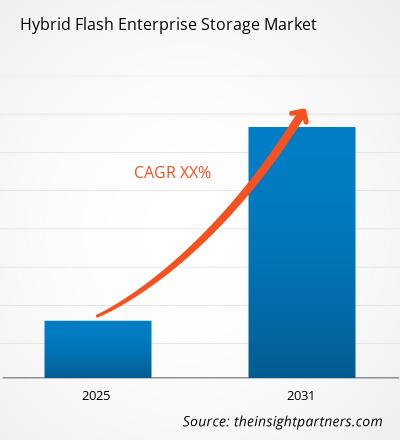
The Hybrid Flash Enterprise Storage Market was valued at US$ 13.51 Billion in 2025 and is projected to reach US$ 27.91 Billion by 2034, registering a CAGR of 8.40% during 2026–2034. The market covers enterprise storage architectures that combine flash performance with capacity-oriented media, enabling organizations to balance workload responsiveness, storage economics, scalability, data protection, and operational continuity across demanding information environments.
North America is expected to remain a major regional contributor, with the Hybrid Flash Enterprise Storage Market size supported by data-center modernization and continued investment in AI-ready infrastructure. The region is estimated to expand at a 7.8–8.5% CAGR during 2026–2034, as enterprises modernize legacy arrays while retaining cost-efficient capacity tiers for secondary and mixed workloads.
Hybrid Flash Enterprise Storage Market Assessment and Insights
- North America: North America is estimated to hold a 31–35% share in 2025 and is projected to grow at a 7.8–8.5% CAGR between 2026–2034, supported by data-center modernization, hybrid-cloud adoption, and enterprise AI infrastructure.
- US: The US represents 76–80% of North American demand in 2025 and is expected to grow at a 8.0–8.7% CAGR between 2026–2034, driven by AI workloads, cybersecurity, and infrastructure refresh cycles.
- Europe: Europe accounts for a 25–29% share in 2025 and is projected to grow at an 7.5–8.2% CAGR between 2026–2034, led by Germany, the UK, France, Italy, and Spain through cloud modernization and regulated data management.
- Asia Pacific: Asia Pacific represents a 27–31% share in 2025 and is expected to grow at an 9.0–9.7% CAGR between 2026–2034, led by China, Japan, South Korea, India, and Australia.
- Largest Segment: SAS represents a 58–62% market share in 2025 and is projected to grow at a 7.8–8.4% CAGR during 2026–2034, reflecting enterprise performance and reliability requirements.
- High Growth Segment: Government represents a 15–19% market share in 2025 and is projected to grow at an 8.7–9.4% CAGR during 2026–2034, supported by modernization and secure data infrastructure.
- Key companies analyzed in detail: Dell Technologies Inc., Hewlett Packard Enterprise Company, Hitachi Vantara LLC, Huawei Technologies Co., Ltd., International Business Machines Corporation, NetApp, Inc., Oracle Corporation, Broadcom Inc., New H3C Technologies Co., Ltd., Infinidat Ltd.
Source: The Insight Partners' analysis based on proprietary research, government publications, company annual reports, investor presentations, industry databases, and expert interviews.
This Hybrid Flash Enterprise Storage Market segment has transformed from typical storage systems based on disk drives to solutions that include flash tiers, massive storage capabilities, intelligent caching, data reduction, tiering automation, and software-based management. SAS is still important in the design of performance-focused enterprise storage systems, whereas SATA is suitable for capacity-based environments. The focus of manufacturing and design is now more on the controller efficiency, integration of nonvolatile memory, data deduplication, compression, predictive analytics, and upgradeability of the platform without disruption.
Moving forward, the drivers of adoption will be from new cloud regions, sovereign infrastructure initiatives, and enterprises planning their storage infrastructure to accommodate AI-based applications. Concerns over data residency and cybersecurity are also driving enterprises to keep greater control of their most crucial datasets. The investment is thus being made in platforms that can support traditional applications as well as analytics workloads without necessarily replacing current storage infrastructures.
Hybrid Flash Enterprise Storage Market Report Scope
| Report Attribute | Details |
|---|---|
| Market size in 2025 | US$ 13.51 Billion |
| Market Size by 2034 | US$ 27.91 Billion |
| Global CAGR (2026 - 2034) | 8.40% |
| Historical Data | 2021-2024 |
| Forecast period | 2026-2034 |
Hybrid Flash Enterprise Storage Market Analysis
Hybrid Flash Enterprise Storage Market growth drivers include increased enterprise data volume, application modernization, virtualization, database growth, and infrastructure demands driven by AI. The industry comprises storage systems providers, semiconductor and memory providers, drive providers, networking providers, cloud providers, systems integrators, software providers, and enterprise IT. Buyers pay more attention to performance/price ratio, usable capacity, reliability, ability to recover from errors, ease of management, and application support.
The supply factors include the price of NAND chips, availability of hard disks, controller technology, enclosures manufacturing, and integration of enterprise software. Hybrid approach still remains relevant since it allows using high-performance flash to serve most frequently used data, while inexpensive storage is used for less important data. In such a way, buyers have an opportunity to develop a differentiated buying strategy based on overall storage economics, rather than choosing a single media type for all tasks.
According to the Hybrid Flash Enterprise Storage Market Report, there is stiff competition in the market with dominant presence from mature infrastructure players with established enterprise networks. Competition in the market is driven by integration of storage systems, services and solutions provided by such companies as Dell Technologies Inc., Hewlett Packard Enterprise Company, Hitachi Vantara LLC, IBM, NetApp, Inc., and Oracle Corporation. Meanwhile, companies like Huawei Technologies Co., Ltd. and New H3C Technologies Co., Ltd. increase competition in Asia, and Infinidat Ltd. specializes in capacity-based enterprise storage and performance-driven architectures.
Companies invest strategically into becoming ready for artificial intelligence, automated management of storage, cyber resilience, cloud compatibility and flexibility in business models. NetApp is expanding its data infrastructure platform based on AI applications, and Dell and HPE are developing platforms aimed at enterprise and AI integration. Broadcom Inc. brings competition in terms of enterprise software and infrastructure solutions.
● REPORT CUSTOMIZATION
Tailor This Report To Align With Your Specific Business Requirements
This report can be customized to align precisely with your business objectives, scope, and target markets. Customization options include tailored segmentation, geography, competitive analysis, and strategic insights to support informed decision-making.
Customize This Report →WHAT YOU CAN ADJUST
- ● Segmentations
- ● Geography
- ● Competitive Analysis
- ● Language Preferences
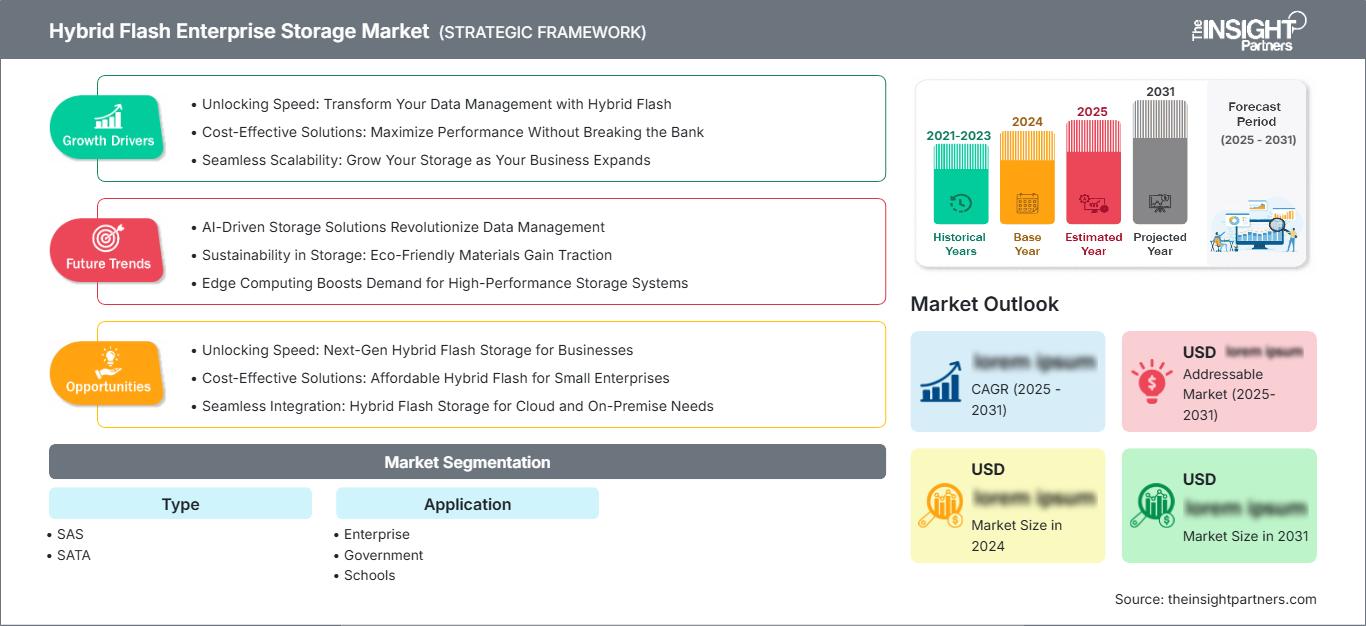
Hybrid Flash Enterprise Storage Market: Strategic Insights
Regional Insights
North America Hybrid Flash Enterprise Storage Market
North America is estimated to represent a 31–35% Hybrid Flash Enterprise Storage Market Share in 2025 and is expected to grow at a 7.8–8.5% CAGR through 2034. The US is the principal regional market, supported by hyperscale data-center investment, enterprise cloud adoption, cybersecurity requirements, and modernization of aging storage infrastructure. Canada contributes through financial services, public-sector modernization, healthcare, and cloud workloads.
Enterprise customers are demanding more storage systems that will be able to handle database, virtualization, analytics, backups, and artificial intelligence workloads all under one management system. Hybrids are still needed when the customer wants the speed of flash but cannot afford to implement high-quality flash throughout their entire capacity system. Investments in private clouds, collocation, and regulatory infrastructure are also driving demand.
U.S. Hybrid Flash Enterprise Storage Market
The US is estimated to be about 76–80% of the total North American demand in 2025 and expected to experience growth of 8.0–8.7% CAGR up to 2034. Dell Technologies Inc., Hewlett Packard Enterprise Company, IBM, NetApp, Inc., Oracle Corporation, Broadcom Inc., and Infinidat Ltd. have substantial enterprise infrastructure footprint.
Application trends will become increasingly driven by AI, virtualization, ransomware resistance, and analytics. The storage solutions should provide fast access to active data sets and be cost-effective when it comes to capacity provision for backups and less frequently accessed information. Nondisruptive upgrades and policy-based data management are also becoming priorities.
Europe Hybrid Flash Enterprise Storage Market
The Europe region is expected to hold the market share of 25-29% of the Hybrid Flash Enterprise Storage Market in 2025 and is predicted to grow at a CAGR of 7.5-8.2% until 2034. Germany is leading the demand in the region owing to its manufacturing industry, automobile industry, financial services sector, and digital transformation within enterprises. The UK still matters owing to cloud services, financial organizations, the health sector, and modernization within the public sector. The French region is reaping benefits from digital transformation of governments, aerospace, financial services, and data-intensive sectors.
APAC Hybrid Flash Enterprise Storage Market
In APAC, the market share stands at 27–31%, while growth forecasted is 9.0–9.7% CAGR till 2034. China dominates the regional market for storage, followed by Japan, South Korea, India, and Australia. Increased digitization of enterprises, cloud computing, telecommunication sector, financial sector, manufacturing industries, and public sector modernization boost up the demand for storage needs.
China has large-scale tech infrastructures in the country. India sees growth in its digital infrastructure and cloud computing. Japan and South Korea focus on robust infrastructure. Australia sees cloud, government, financial, and regulated workloads to keep the demand for storage solutions going strong.
Middle East & Africa Hybrid Flash Enterprise Storage Market
The Middle East and Africa market is projected to grow at a 7.0–7.8% CAGR through 2034. Saudi Arabia and the UAE lead regional opportunities through smart-city programs, cloud infrastructure, financial digitization, and government technology investment. South Africa remains important for financial services, telecommunications, and enterprise computing.
MEA's remaining demand is in public sector modernization, banking, healthcare, telecoms, and data centers. The hybrid approach offers an effective compromise for performance vs. economics of storage in instances where an organization is building up its digital infrastructure but with a tight control on its budget.
Segmentation Analysis
Type
The Type segment is projected to expand at a 7.8–8.5% CAGR during 2026–2034. SAS retains strong relevance in enterprise environments requiring predictable performance, redundancy, and established compatibility with storage arrays. SATA remains strategically important for capacity-focused workloads, backup repositories, and secondary storage. The segmentation scope therefore reflects different workload priorities rather than simple media substitution, with organizations commonly combining performance and capacity tiers.
- SAS: Maintains a strong enterprise position because of dual-port connectivity, mature reliability characteristics, predictable performance, and compatibility with demanding storage-array architectures supporting mission-critical workloads.
- SATA: Remains important for capacity-oriented applications where lower acquisition cost and high-density storage are prioritized. It supports backup, archival, secondary data, and less frequently accessed enterprise information.
Application
The Application segment is expected to grow at an 8.1–8.9% CAGR during 2026–2034. Enterprise deployments remain the principal demand center because organizations require storage for databases, virtualization, applications, analytics, and backup. Government adoption is increasingly influenced by sovereign infrastructure and cybersecurity requirements, while schools are modernizing digital learning environments and administrative systems. The segment reflects varied procurement priorities across institutional environments.
- Enterprise: Represents the core application base, with demand spanning databases, virtualization, analytics, business applications, backup, cybersecurity, and hybrid-cloud infrastructure requiring balanced performance and capacity economics.
- Government: Demand is shaped by digital public services, data sovereignty, cybersecurity, records management, and modernization of legacy IT systems, creating requirements for resilient and controllable enterprise storage.
- Schools: Storage adoption supports learning-management systems, administrative databases, digital content, research workloads, and campus applications, with purchasing decisions often emphasizing affordability and simplified administration.
Opportunity Snapshot
| Application | Revenue Contribution | Trend Tag | Adoption Stage |
|---|---|---|---|
| Enterprise | High | AI Storage | Mature |
| Government | Medium | Sovereign Data | Scaling |
| Schools | Low | Digital Learning | Scaling |
Hybrid Flash Enterprise Storage Market Growth Drivers and Impact Analysis
AI-driven growth in enterprise data workloads
With artificial intelligence (AI), there is increased demand for volume, velocity, and performance of enterprise data infrastructures. Datasets used in training, vector databases, model checkpoints, inference pipeline and analytics repositories can create storage environments which need not only fast storage but also significant storage capacity. A hybrid architecture could solve the problem by ensuring that the datasets used actively are stored on fast media, while the rest of the information will be stored in economic tiers. There is more to the implications of AI than simply the need for additional capacity, as AI-driven workloads generate increased demand for data protection, metadata management, throughputs, and storage automation. Vendors who include AI awareness in their storage solutions will have an advantage when the enterprise moves from pilot to production workloads.
Growing cybersecurity and resilience requirements
Ransomware and disruption of operations are affecting the storage buying process. Organizations demand immutable recovery points, isolated backups, fast recovery, detection of anomalies, and protection based on policies in the storage environment. Hybrid systems are capable of meeting these demands by segregating the operational datasets that are accessed more often from the protected capacity tier and backup systems. This is commercially relevant since storage acquisitions are now assessed through a business continuity perspective as opposed to pure capacity or performance measures. Vendors that are able to incorporate cyber-resilience, monitoring, and recovery management systems into their platforms may be able to make their products relevant to the financial services sector, healthcare organizations, government institutions, and large enterprises.
Modernization of legacy enterprise storage estates
Large organizations continue to operate heterogeneous storage environments built through multiple technology generations, creating operational complexity and uneven performance. Modernization programs are encouraging enterprises to consolidate workloads, simplify management, introduce automation, and increase infrastructure utilization. Hybrid storage provides a transitional architecture because it can deliver flash performance for active applications while retaining capacity-efficient media for secondary workloads. This reduces the pressure to migrate every dataset to premium flash immediately. The market impact is strongest where organizations face aging controllers, expiring support contracts, virtualization changes, or data-center consolidation projects. Storage vendors can capitalize by offering nondisruptive upgrades, migration tools, data reduction, and subscription models that reduce the operational barriers associated with replacing established infrastructure.
Hybrid Flash Enterprise Storage Market Future Trends
Hybrid Flash Enterprise Storage Market trends toward AI-aware data placement
Future platforms are likely to use machine learning and policy engines to determine where enterprise data should reside based on access frequency, application criticality, performance requirements, and cost. Automated tiering can move active datasets toward flash while shifting colder information toward capacity-oriented media without requiring administrators to manage individual datasets manually. AI-aware storage may also predict workload changes before performance degradation occurs. This capability will become more relevant as enterprises run mixed environments containing transactional applications, analytics, AI pipelines, backups, and archives. Storage vendors will increasingly differentiate through intelligent orchestration rather than hardware specifications alone. The resulting architecture should improve utilization, reduce administrative effort, and extend infrastructure value while preserving application-level performance.
Autonomous storage management and consumption-based infrastructure
Storage administration is moving toward autonomous operations that identify performance bottlenecks, predict failures, optimize resources, and automate routine configuration. Enterprise platforms are also increasingly offered through consumption-based models that allow organizations to align infrastructure capacity with changing workloads. This combination can reduce the distinction between traditional storage procurement and cloud-style infrastructure consumption. Future systems are likely to provide automated capacity forecasting, application-aware optimization, cyber-risk monitoring, and software-driven upgrades through centralized interfaces. For hybrid deployments, policy engines may coordinate data across on-premises arrays, private clouds, and public-cloud services. These capabilities will increase the strategic value of storage software and services, shifting competition from hardware capacity toward operational intelligence, flexibility, and lifecycle economics.
Hybrid Flash Enterprise Storage Market Opportunities
AI-ready hybrid storage for regulated enterprises
The Hybrid Flash Enterprise Storage Market Forecasts indicate an opportunity to develop AI-ready storage platforms for regulated organizations that cannot move all sensitive information to public-cloud environments. Financial services, healthcare, government, and critical infrastructure operators require strong governance while adopting analytics and AI. Vendors can address this need through hybrid architectures combining high-performance flash tiers, capacity storage, encryption, immutable protection, and policy-based data placement. Investment opportunities include storage software, metadata management, cybersecurity integration, and infrastructure designed for sovereign or private AI deployments. Providers that simplify movement between performance and capacity tiers can help customers introduce AI workloads without wholesale infrastructure replacement. This creates a pathway for incremental modernization and recurring software or service revenue.
Regional infrastructure for sovereign and private clouds
Emerging sovereign-cloud programs create opportunities for storage suppliers that can deliver localized infrastructure, compliance controls, and lifecycle support. Governments and regulated enterprises increasingly require data to remain within defined jurisdictions while still accessing cloud-style scalability and management. Hybrid storage is well suited to these requirements because it can combine local performance tiers with scalable capacity while maintaining centralized governance. Investment should focus on regional data-center partnerships, managed storage services, cybersecurity capabilities, and integration with virtualization and container platforms. Suppliers can also develop reference architectures tailored to government, banking, healthcare, and education. Local technical support and predictable service models will be important differentiators where organizations require operational continuity and regulatory accountability.
Recent Developments
- August 2026: HCLTech and NetApp expanded their partnership to offer hybrid cloud Storage-as-a-Service (STaaS), combining HCLTech’s Utility for Everything (U4X) framework with NetApp Keystone’s pay-as-you-go storage model to support AI, generative AI and traditional enterprise workloads. The offering enables enterprises to scale storage, performance and data services based on demand while strengthening data readiness and governance and supporting HCLTech’s AI Factory suite, helping organizations move AI initiatives from pilots to broader production deployments.
- February 2026: Infortrend launched its EonStor GS 5024U hybrid flash storage solution to support AI training, high-performance computing (HPC) and intelligent surveillance workloads, combining high-speed NVMe storage for active datasets with HDD capacity for colder data. The system delivers up to 125 GB/s throughput and 2.4 million IOPS, scales to 20 PB in hybrid configurations and can reduce storage costs by more than 50% compared with all-flash deployments, while providing up to 100 GB/s throughput even with HDD-only configurations.
- June 2026: KIOXIA highlighted its latest flash storage and SSD technologies at HPE Discover Las Vegas 2026, showcasing solutions for AI, hybrid cloud, enterprise and space-based computing. The portfolio includes LC9 Series Enterprise NVMe SSDs for high-capacity AI storage, CM Series and PM7 Series SSDs for mission-critical and cost-efficient enterprise workloads, and CD9P Series Data Center NVMe SSDs for virtualization, while its collaboration with HPE extends to the International Space Station and future lunar missions.
Frequently Asked Questions

- Comprehensive Market Sizing and Forecast Analysis
- Detailed Segmentation Analysis
- In-Depth Market Dynamics Assessment
- Regional and Country-Level Insights
- Competitive Landscape and Company Benchmarking
- Strategic Business Intelligence
Recent Reports
Testimonials

The Insight Partners' SCADA System Market report is comprehensive, with valuable insights on current trends and future forecasts. The team was highly professional, responsive, and supportive throughout. We are very satisfied and highly recommend their services.
RAN KEDEM Partner, Reali Technologies LTDs
I requested a report on a very specific software market and the team produced the report in a few days. The information was very relevant and well presented. I then requested some changes and additions to the report. The team was again very responsive and I got the final report in less than a week.
JEAN-HERVE JENN Chairman, Future Analytica
We worked with The Insight Partners for an important market study and forecast. They gave us clear insights into opportunities and risks, which helped shape our plans. Their research was easy to use and based on solid data. It helped us make smart, confident decisions. We highly recommend them.
PIYUSH NAGPAL Sr. Vice President, High Beam Global
The Insight Partners delivered insightful, well-structured market research with strong domain expertise. Their team was professional and responsive throughout. The user-friendly website made accessing industry reports seamless. We highly recommend them for reliable, high-quality research services
YUKIHIKO ADACHI CEO, Deep Blue, LLC.
This is the first time I have purchased a market report from The Insight Partners.While I was unsure at first, I visited their web site and felt more comfortable to take the risk and purchase a market report.I am completely satisfied with the quality of the report and customer service. I had several questions and comments with the initial report, but after a couple of dialogs over email with their analyst I believe I have a report that I can use as input to our strategic planning process.Thank you so much for taking the extra time and making this a positive experience.I will definitely recommend your service to others and you will be my first call when we need further market data.
JOHN SUZUKI President and Chief Executive Officer, Board Director, BK Technologies
I wish to appreciate your support and the professionalism you displayed in the course of attending to my request for information regarding to infectious disease IVD market in Nigeria. I appreciate your patience, your guidance, and the fact that you were willing to offer a discount, which eventually made it possible for us to close a deal. I look forward to engaging The Insight Partners in the future, all thanks to the impression you have created in me as a result of this first encounter.
DR CHIJIOKE ONYIA MANAGING DIRECTOR, PineCrest Healthcare Ltd.Reason to Buy
- Informed Decision-Making
- Understanding Market Dynamics
- Competitive Analysis
- Identifying Emerging Markets
- Customer Insights
- Market Forecasts
- Risk Mitigation
- Boosting Operational Efficiency
- Strategic Planning
- Investment Justification
- Tracking Industry Innovations
- Aligning with Regulatory Trends





 Get Free Sample for