
Hybrid Memory Cube (HMC) and High-bandwidth Memory (HBM) Market Size, Trends & Demand by 2034
Coverage: by Memory Type (Hybrid Memory Cube (HMC), High-Bandwidth Memory (HBM)); Product Type (Graphics Processing Unit (GPU), Central Processing Unit (CPU), Accelerated Processing Unit (APU), Field-Programmable Gate Array (FPGA), Application-Specific Integrated Circuit (ASIC)); Application (Graphics, High-Performance Computing, Networking, Data Centers) , and Geography (North America, Europe, Asia Pacific, and South and Central America)
- Status : Data Released
- Report Code : TIPRE00011492
- Category : Electronics and Semiconductor
- No. of Pages : 150
- Available Report Formats :


- Last update date : September 15, 2026


2025 Market Size
US$ 3.34 Bn
Base year value
2034 Forecast
US$ 10.05 Bn
Projected by 2034
CAGR 2026-2034
13.02 %
Growth rate
Addressable Market
US$ 58.24 Bn
(2026-2034)
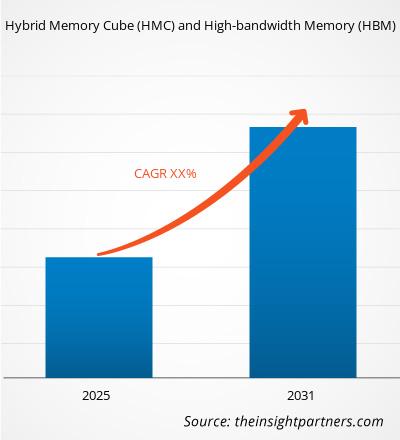
The global Hybrid Memory Cube (HMC) and High-bandwidth Memory (HBM) market was valued at US$ 3.34 billion in 2025 and is expected to reach US$ 10.05 billion by 2034; it is estimated to record a CAGR of 13.02% during 2026-2034.
Hybrid Memory Cube (HMC) and High-bandwidth Memory (HBM) Market Assessment and Insights
- North America: The region is estimated to represent 31–35% share in 2025 and grow at a 13.5–15.5% CAGR between 2026–2034, supported by AI accelerators, hyperscale data centers, advanced packaging, and semiconductor ecosystem depth.
- US: The US accounts for an estimated 86–90% of North American demand in 2025, growing at 13.8–15.8% CAGR between 2026–2034 as cloud computing and accelerator deployments expand.
- Europe: Europe holds an estimated 15–18% share in 2025 and is expected to grow at 12.0–14.0% CAGR, led by Germany, the UK, France, Italy, and Spain through HPC, automotive computing, and industrial digitization.
- Asia Pacific: Asia Pacific represents an estimated 39–43% share in 2025 and is projected to expand at 15.0–17.0% CAGR, led by South Korea, China, Japan, and Taiwan-linked semiconductor manufacturing ecosystems.
- Largest Segment: High-Bandwidth Memory holds an estimated 84–88% market share in 2025 and is expected to expand at 15.0–17.0% CAGR between 2026–2034.
- High Growth Segment: Data Centers represent an estimated 46–50% market share in 2025 and are projected to grow at 15.5–17.5% CAGR between 2026–2034.
- Key companies analyzed in detail: Advanced Micro Devices, Inc.; FUJITSU; Intel Corporation; Micron Technology, Inc.; NVIDIA Corporation; Open-Silicon, Inc.; Rambus Inc.; Samsung Electronics Co., Ltd.; SK hynix Inc.; Xilinx, Inc.
Source: The Insight Partners' analysis based on proprietary research, government publications, company annual reports, investor presentations, industry databases, and expert interviews.
There has been a change from standard memory interfaces to vertically integrated memory technologies with several memory dies placed near the compute engine. The technology of HBM has become very significant since wide interfaces and stacked dies have helped in mitigating the bandwidth constraints posed by the standard external memory. Hence, there is an effort in advanced DRAM node development, through silicon interconnects, thermal management, and packaging. HMC still plays a role wherever latency and bandwidth density necessitate its use.
The future development in terms of geographical location may extend beyond North America and East Asia. There can be growth of the European HPC program, Middle East data center investments, and Asian AI ecosystem, which will increase the demands on high bandwidth memory. The regulations regarding semiconductor localization, strategic funding, and energy efficiency will motivate investments in packaging, memory manufacturing, testing, and processor memory integration.
Hybrid Memory Cube (HMC) and High-bandwidth Memory (HBM) Market Report Scope
| Report Attribute | Details |
|---|---|
| Market size in 2025 | US$ 3.34 Billion |
| Market Size by 2034 | US$ 10.05 Billion |
| Global CAGR (2026 - 2034) | 13.02% |
| Historical Data | 2021-2024 |
| Forecast period | 2026-2034 |
Hybrid Memory Cube (HMC) and High-bandwidth Memory (HBM) Market Analysis
The growing demands on data access rates required to train and infer AI models make memory bandwidth one of the key parameters limiting system performance, thus driving demand for Hybrid Memory Cube and High-Bandwidth Memory solutions due to their higher bandwidth compared to that of standard RAM without proportional increases in PCB connectivity complexity. This market is served by a number of players, including DRAM producers, logic vendors, packagers, substrate producers, accelerator producers, and hyperscaler customers.
The supply situation becomes increasingly affected not only by the capacity of advanced DRAM technologies but also by advanced packaging capacity, thermal performance, and yield rates. For HBM, there are tight relationships between memory and logic technologies, and qualification cycles may prevent fast switching of suppliers. The capacity planning is increasingly dependent on long-term customer agreements, advanced packaging and process readiness.
According to the Hybrid Memory Cube and High-Bandwidth Memory Market Report, Competitive positioning is evolving into vertical integration. Customers and platform developers include NVIDIA Corporation and Advanced Micro Devices, Inc., while Samsung Electronics Co., Ltd., SK hynix Inc., and Micron Technology, Inc. are competing for advanced memory manufacturing. Participants involved in the process through processors and computing platforms are Intel Corporation and FUJITSU. Intellectual property, FPGA, interface, or ASIC competencies are provided by Rambus Inc., Xilinx, Inc., and Open-Silicon, Inc.
Priorities of investments evolve toward next-generation HBM, advanced packaging, thermal management, and custom memory products. Roadmap of Samsung Electronics Co., Ltd. has been extended. The development of HBM4 and HBM4E has been accelerated at SK hynix Inc. Moreover, HBM4 and beyond are under development at Micron Technology, Inc. Competitive advantages will be gained by being able to optimize memory design, manufacturing, packaging, validation, and accelerators roadmaps as a whole.
● REPORT CUSTOMIZATION
Tailor This Report To Align With Your Specific Business Requirements
This report can be customized to align precisely with your business objectives, scope, and target markets. Customization options include tailored segmentation, geography, competitive analysis, and strategic insights to support informed decision-making.
Customize This Report →WHAT YOU CAN ADJUST
- ● Segmentations
- ● Geography
- ● Competitive Analysis
- ● Language Preferences
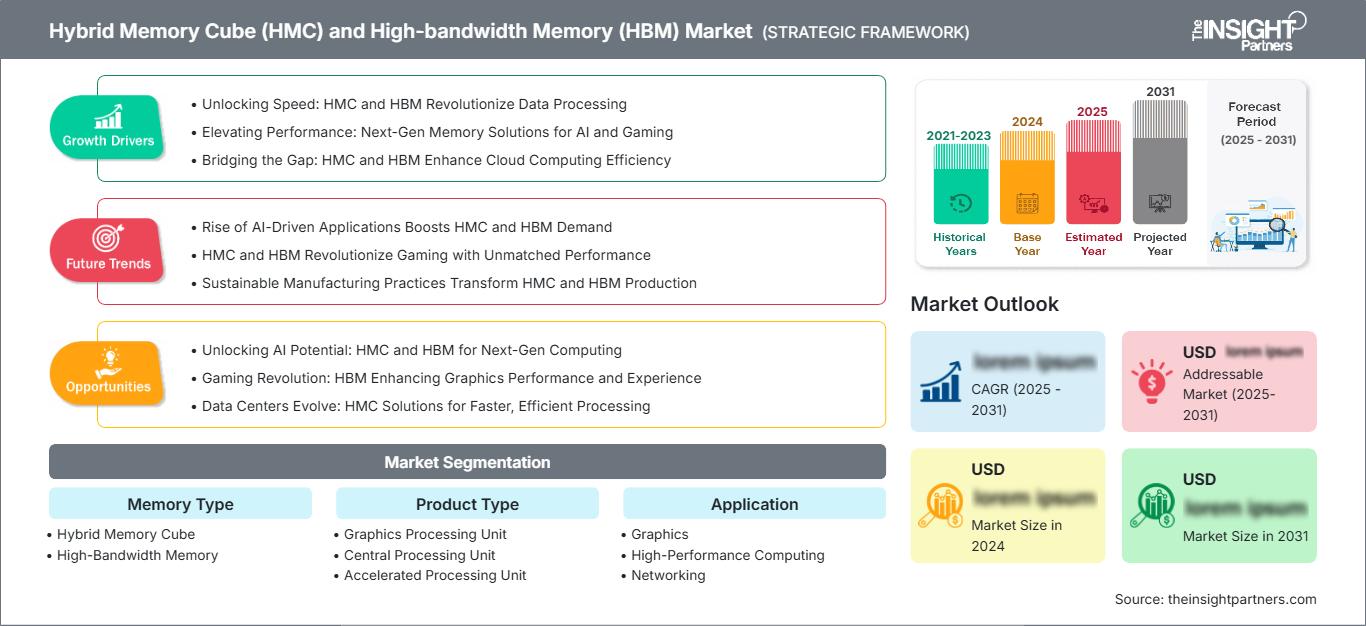
Hybrid Memory Cube (HMC) and High-bandwidth Memory (HBM) Market: Strategic Insights
Regional Insights
North America Hybrid Memory Cube and High-Bandwidth Memory Market
North America is estimated to hold 31–35% Hybrid Memory Cube and High-Bandwidth Memory Market share in 2025 and expand at a 13.5–15.5% CAGR through 2034. The US dominates regional consumption because hyperscalers, accelerator developers, cloud providers, and semiconductor designers are concentrated within the region. AI infrastructure expansion is strengthening requirements for high bandwidth, low latency, and dense memory integration.
Demand is also driven by the federal semiconductor programs, data centers’ spending, and AI computing platform development. The support from Canada comes from research, cloud infrastructure, and specialty computing. Adoption within the region will tend to focus on HBM due to the performance of the accelerators being highly dependent on memory bandwidth.
U.S. Hybrid Memory Cube and High-Bandwidth Memory Market
The US represents an estimated 86–90% of North American demand in 2025 and is expected to grow at 13.8–15.8% CAGR. NVIDIA Corporation, Advanced Micro Devices, Inc., Intel Corporation, and major cloud operators create a strong domestic demand base. AI accelerators, HPC systems, and large-scale data centers remain major applications.
Trends in the application space include increasing usage of memory-hungry AI training and inference algorithms. The US has the advantage of semiconductor design know-how, favorable policies from its government, and large investments in hyperscale infrastructure. Though memory production is still internationally sourced, the development of accelerators domestically adds to the pull for high-quality HBM. Qualification and performance are becoming key buying considerations.
Europe Hybrid Memory Cube and High-Bandwidth Memory Market
Europe is forecasted to have 15–18% share in 2025 and 12.0–14.0% CAGR with Germany being the leading country in terms of regional demand. The UK, Germany, France, Italy, and Spain contribute to HPC, automotive electronics, industrial computing, and research infrastructure. Europe continues to focus on semiconductor resilience and advanced computing solutions.
The UK has active research and AI computing ecosystem, Germany – automotive, industrial, and embedded computing applications, France – aerospace, defense, research, and semiconductor solutions. Italy and Spain are working on development of data centers, industrial digitization, and research ecosystems. Hence, European demand has greater diversification than the hyperscale one, but HPC and AI remain key growth drivers.
APAC Hybrid Memory Cube and High-Bandwidth Memory Market
APAC holds an estimated 39–43% share in 2025 and is projected to grow at 15.0–17.0% CAGR, making it the leading regional market. South Korea is especially important because of advanced memory manufacturing, while China, Japan, India, and Australia contribute through semiconductor, AI, cloud, research, and infrastructure development.
South Korea leads the pack, backed up by HBM manufacturing capabilities and advanced packaging. China is improving its domestic computing supply chain, Japan has semiconductor equipment and research capabilities, India is building out its data centers and AI capabilities, and Australia is developing HPC and cloud workloads.
Middle East & Africa Hybrid Memory Cube and High-Bandwidth Memory Market
The Middle East and Africa region is developing from a smaller base as Saudi Arabia and the UAE invest in AI infrastructure, cloud platforms, and large data centers. South Africa remains an important regional technology hub. The regional CAGR is estimated at 11.0–13.0%, with Saudi Arabia leading demand.
National digital transformation and artificial intelligence investments are advantages for Saudi Arabia, whereas UAE is working on hyperscale and sovereign computing facilities. Enterprise and research computing facilities are backed by South Africa, whereas others will follow gradually. Availability of energy, building of data centers, and national digital strategy will decide the pace of implementation of advanced memory.
Segmentation Analysis
Memory Type
Memory Type is expected to grow at 14.0–16.0% CAGR between 2026–2034. Demand is increasingly concentrated in architectures that maximize bandwidth per package while limiting energy and latency penalties. HBM is gaining broad platform acceptance, whereas HMC remains strategically relevant for specialized architectures requiring dense, low-latency memory connectivity.
- Hybrid Memory Cube: Hybrid Memory Cube remains relevant for specialized computing designs requiring high bandwidth and compact memory integration. Its strategic value is strongest where architecture-specific optimization can justify specialized implementation.
- High-Bandwidth Memory: High-Bandwidth Memory commands the dominant position because stacked DRAM, wide interfaces, and proximity to accelerators address bandwidth constraints in AI, HPC, and data-center systems.
Product Type
Product Type segment in the Hybrid Memory Cube and High-Bandwidth Memory Market is forecast to expand at 14.5–16.5% CAGR during 2026–2034. Accelerator-centric architectures are increasing memory bandwidth requirements, while CPU and ASIC designs are incorporating advanced memory interfaces for heterogeneous computing. Product selection increasingly depends on workload characteristics, package architecture, thermal constraints, and software optimization.
- Graphics Processing Unit: GPUs represent the primary platform for high-bandwidth memory adoption because parallel workloads require sustained data throughput for training, inference, simulation, and visualization.
- Central Processing Unit: CPUs increasingly incorporate faster memory architectures as heterogeneous computing expands, particularly where data-intensive analytics and AI workloads demand higher bandwidth than conventional memory configurations provide.
- Accelerated Processing Unit: APUs benefit from integrated compute and graphics architectures, creating demand for memory systems that can serve multiple processing functions while maintaining bandwidth and power efficiency.
- Field-Programmable Gate Array: FPGAs use advanced memory architectures in networking, industrial, defense, and specialized acceleration, where configurable processing requires flexible and high-throughput data access.
- Application-Specific Integrated Circuit: ASIC adoption is rising as hyperscalers develop customized AI accelerators, increasing demand for memory architectures tailored to specific workloads, package designs, and performance requirements.
Application
Application is projected to grow at 15.0–17.0% CAGR through 2034, with data-center and HPC workloads leading adoption. The scope of advanced memory is widening as AI, networking, graphics, and scientific computing increasingly require sustained bandwidth, predictable latency, and improved energy efficiency.
- Graphics: Graphics workloads require high data throughput for rendering, simulation, visualization, and AI-enhanced graphics. Advanced memory supports increasingly complex models and higher-resolution computational workloads.
- High-Performance Computing: HPC systems use high-bandwidth memory to accelerate scientific simulations, engineering workloads, and analytics where memory throughput can constrain processor utilization.
- Networking: Networking applications benefit from rapid movement of packet, routing, and analytics data, making high-bandwidth memory relevant to programmable networking and infrastructure acceleration.
- Data Centers: Data centers represent the largest application segment as AI servers, accelerator clusters, and hyperscale systems increasingly require memory bandwidth to sustain compute utilization.
Opportunity Snapshot
| Application | Revenue Contribution (High/Medium/Low) | Trend Tag | Adoption Stage |
| Graphics | Medium | AI Rendering | Scaling |
| High-Performance Computing | High | Exascale Compute | Scaling |
| Networking | Medium | Network AI | Scaling |
| Data Centers | High | AI Clusters | Mature |
Hybrid Memory Cube (HMC) and High-bandwidth Memory (HBM) Market Growth Drivers and Impact Analysis
AI Accelerator Bandwidth Requirements
Modern AI models make increasing use of the need for transfer of large amounts of parameters and intermediate data between compute and memory subsystems. Existing memory interfaces may impose limits on the usage of accelerators in cases where computational performance increases faster than memory bandwidth. High-performance architectures address this issue by providing multiple memory dies in close proximity to compute elements and extremely wide interfaces. This results in an increase in the value of accelerators due to improved performance, especially in training and inference clusters, where the accelerator usage is key to the efficiency of the entire infrastructure. These factors motivate the early introduction of advanced memory specifications in accelerator and cloud platforms. This also fosters cooperation between DRAM manufacturers, packaging technology companies, and CPU vendors.
Advanced Packaging and Heterogeneous Integration
The progression of advanced packaging is expanding the practical role of vertically stacked memory in computing systems. Interposers, hybrid bonding, thermal-management techniques, and increasingly sophisticated package architectures allow memory to be positioned closer to compute dies while supporting higher bandwidth density. These capabilities create a reinforcing effect because improved packaging enables more capable memory architectures, while stronger demand for HBM justifies investment in packaging capacity and process engineering. The impact extends across the semiconductor value chain, including substrates, testing, assembly, bonding equipment, and thermal materials. Suppliers able to achieve high yields and consistent package performance can become strategically important to accelerator platforms. Packaging therefore increasingly influences memory availability, qualification timelines, and total system economics alongside DRAM process technology.
Hyperscale Computing and Customized Silicon
Hyperscale operators are developing customized processors and accelerators to improve performance, energy efficiency, and workload economics. These ASIC and accelerator programs require memory architectures that can be optimized around specific compute pipelines rather than generalized processor specifications. Advanced memory therefore becomes part of system-level co-design, influencing package dimensions, bandwidth allocation, power budgets, thermal characteristics, and software architecture. Customized silicon also broadens the customer base beyond traditional GPU platforms, increasing opportunities for memory suppliers that can support differentiated configurations. The effect is particularly important in AI inference, where operators seek lower cost per token and predictable throughput at scale. As hyperscalers expand internally designed silicon, qualification relationships and engineering collaboration are likely to become more important competitive factors.
Hybrid Memory Cube (HMC) and High-bandwidth Memory (HBM) Market Future Trends
HBM4 and Higher-Stack Architectures
Future generations will increasingly emphasize greater stack heights, faster interfaces, improved power efficiency, and enhanced thermal control. HBM4 and subsequent architectures are expected to become central to accelerator roadmaps as AI systems demand higher bandwidth without proportionally increasing package footprint. More advanced stacking will require improvements in bonding, yield management, thermal materials, and testing. Memory suppliers are likely to differentiate through customized capacities and interface configurations rather than standardized products alone. The transition toward higher-layer stacks will also increase the importance of package-level reliability because mechanical and thermal stresses become more difficult to manage. These changes should encourage closer cooperation among memory manufacturers, logic designers, advanced packaging specialists, and system companies, making memory development increasingly integrated with broader platform engineering.
Custom Memory for AI Platforms
Customized HBM configurations in the Hybrid Memory Cube and High-Bandwidth Memory Market Trends are likely to become more prominent as AI accelerator architectures diversify. Different workloads can require distinct combinations of capacity, bandwidth, latency, power efficiency, and physical integration. Rather than treating memory as a standardized commodity, platform developers increasingly have incentives to specify memory characteristics during early chip design. This trend could create longer engineering engagements between memory suppliers and accelerator developers, while also increasing switching costs after qualification. Customization may cover stack height, density, interface characteristics, power profiles, and package integration. Over time, the boundary between memory product development and accelerator development is likely to become less distinct. Suppliers with flexible manufacturing and strong co-design capabilities should therefore be positioned to participate in differentiated AI platforms.
Hybrid Memory Cube (HMC) and High-bandwidth Memory (HBM) Market Opportunities
Regional Advanced Packaging Expansion
Investment in advanced packaging outside established semiconductor clusters presents an opportunity to diversify the supply chain while addressing rising HBM demand. Governments and semiconductor companies can target packaging, testing, substrate, and bonding capabilities rather than focusing exclusively on wafer fabrication. New regional facilities can reduce logistics exposure, shorten qualification cycles, and support local accelerator ecosystems. For investors, packaging capacity can provide an attractive entry point because HBM growth depends not only on DRAM output but also on the ability to assemble and validate complex stacked structures. Strategic partnerships with processor designers and memory manufacturers can improve utilization and accelerate customer qualification. Regions building AI infrastructure can also use packaging investments to develop broader semiconductor capabilities and retain more value from domestic data-center growth.
Specialized Memory Solutions for Custom Accelerators
Custom accelerator programs create opportunities for memory suppliers in the Hybrid Memory Cube and High-Bandwidth Memory Market Forecast to develop differentiated products rather than competing solely on standardized capacity and pricing. Suppliers can work directly with ASIC, FPGA, CPU, and GPU developers to optimize memory configuration, package architecture, thermal behavior, and power characteristics for specific workloads. Such collaborations can generate deeper engineering relationships and improve visibility into future demand. The opportunity is particularly relevant for inference accelerators, networking processors, and domain-specific AI systems where memory requirements differ from large training GPUs. Companies investing in programmable interfaces, customized stack configurations, and advanced validation can address fragmented demand more effectively. Strategic alignment with cloud operators and semiconductor designers may also improve long-term capacity planning as custom silicon adoption expands.
Recent Developments
- July 2026: Samsung Electronics and SK hynix reportedly reconsidered the timeline for adopting hybrid bonding in HBM, with 16-high HBM4E potentially representing an early adoption point. Industry observers cited easing urgency as alternative thermal technologies develop.
- August 2026: SK hynix highlighted optical interconnects and co-packaged optics as potential technologies for addressing data-movement bottlenecks in large-scale AI systems, extending its technology roadmap beyond conventional HBM performance improvements.
- July 2026: Samsung Electronics was reportedly targeting large-scale hybrid-bonding production for around 2029–2030, with the technology expected to support next-generation HBM and potentially align with NVIDIA’s future Feynman AI GPU platform..
Frequently Asked Questions

- Comprehensive Market Sizing and Forecast Analysis
- Detailed Segmentation Analysis
- In-Depth Market Dynamics Assessment
- Regional and Country-Level Insights
- Competitive Landscape and Company Benchmarking
- Strategic Business Intelligence
Recent Reports
Testimonials

The Insight Partners provided valuable market intelligence that supported our global go-to-market strategy. Their team was professional, responsive, and attentive to our feedback, providing thoughtful analysis and helpful methodological clarifications throughout the project.
Junmo Kim Chief Financial Officer (CFO), Enertech Co., Ltd.
The Insight Partners' SCADA System Market report is comprehensive, with valuable insights on current trends and future forecasts. The team was highly professional, responsive, and supportive throughout. We are very satisfied and highly recommend their services.
RAN KEDEM Partner, Reali Technologies LTDs
I requested a report on a very specific software market and the team produced the report in a few days. The information was very relevant and well presented. I then requested some changes and additions to the report. The team was again very responsive and I got the final report in less than a week.
JEAN-HERVE JENN Chairman, Future Analytica
We worked with The Insight Partners for an important market study and forecast. They gave us clear insights into opportunities and risks, which helped shape our plans. Their research was easy to use and based on solid data. It helped us make smart, confident decisions. We highly recommend them.
PIYUSH NAGPAL Sr. Vice President, High Beam Global
The Insight Partners delivered insightful, well-structured market research with strong domain expertise. Their team was professional and responsive throughout. The user-friendly website made accessing industry reports seamless. We highly recommend them for reliable, high-quality research services
YUKIHIKO ADACHI CEO, Deep Blue, LLC.
This is the first time I have purchased a market report from The Insight Partners.While I was unsure at first, I visited their web site and felt more comfortable to take the risk and purchase a market report.I am completely satisfied with the quality of the report and customer service. I had several questions and comments with the initial report, but after a couple of dialogs over email with their analyst I believe I have a report that I can use as input to our strategic planning process.Thank you so much for taking the extra time and making this a positive experience.I will definitely recommend your service to others and you will be my first call when we need further market data.
JOHN SUZUKI President and Chief Executive Officer, Board Director, BK Technologies
I wish to appreciate your support and the professionalism you displayed in the course of attending to my request for information regarding to infectious disease IVD market in Nigeria. I appreciate your patience, your guidance, and the fact that you were willing to offer a discount, which eventually made it possible for us to close a deal. I look forward to engaging The Insight Partners in the future, all thanks to the impression you have created in me as a result of this first encounter.
DR CHIJIOKE ONYIA MANAGING DIRECTOR, PineCrest Healthcare Ltd.Reason to Buy
- Informed Decision-Making
- Understanding Market Dynamics
- Competitive Analysis
- Identifying Emerging Markets
- Customer Insights
- Market Forecasts
- Risk Mitigation
- Boosting Operational Efficiency
- Strategic Planning
- Investment Justification
- Tracking Industry Innovations
- Aligning with Regulatory Trends





 Get Free Sample for