
IGCT Market Size, Trends & Demand by 2034
Coverage: by Deployment Type (Asymmetric IGCT, Reverse Blocking IGCT, and Reverse Conducting IGCT) and Application (Drive, Traction, Converter, and Others) , and Geography (North America, Europe, Asia Pacific, and South and Central America)
- Status : Data Released
- Report Code : TIPRE00003150
- Category : Electronics and Semiconductor
- No. of Pages : 150
- Available Report Formats :


- Last update date : September 17, 2026


2025 Market Size
US$ 784.21 Mn
Base year value
2034 Forecast
US$ 1,569.37 Mn
Projected by 2034
CAGR 2026-2034
8.01 %
Growth rate
Addressable Market
US$ 10,581.69 Mn
(2026-2034)
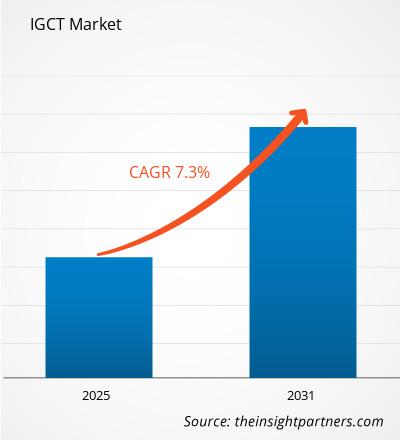
The IGCT market was valued at US$ 784.21 Million in 2025 and is projected to reach US$ 1,569.37 Million by 2034, registering a CAGR of 8.01% during 2026–2034. Market includes asymmetric IGCT, reverse-blocking IGCT, and reverse-conducting IGCT devices for various drives, traction, converters, and other high-power applications driven by factors such as industrial electrification, upgrading of the electrical grid, energy from renewable sources, and electrification of transportation.
North America IGCT market size is forecasted to grow at a projected CAGR of 6.8–7.6% from 2026 to 2034 on account of modernization of the medium-voltage industrial systems and rising demand for high-current switch devices due to their reliability. The US continues to be the major regional consumer of IGCTs.
IGCT Market Assessment and Insights
- North America represents a 28–32% share in 2025 and is projected to grow at a 6.8–7.6% CAGR between 2026–2034, supported by industrial drives, grid modernization, and high-reliability power conversion.
- US accounts for 22–26% share in 2025 and is expected to expand at a 7.2–8.0% CAGR between 2026–2034, led by data-center infrastructure, industrial electrification, and transmission upgrades.
- Europe holds a 24–28% share in 2025 and is projected to grow at a 6.8–7.6% CAGR between 2026–2034, with Germany, the UK, France, Italy, and Spain supporting industrial and renewable-power applications.
- Asia Pacific commands a 34–38% share in 2025 and is expected to register an 8.8–9.6% CAGR between 2026–2034, with China, Japan, South Korea, and India driving manufacturing and transportation applications.
- Largest Segment is Asymmetric IGCT, representing a 48–52% market share in 2025 and growing at a 7.5–8.3% CAGR during 2026–2034, supported by industrial drives and converters.
- High Growth Segment is Traction, representing an 18–22% market share in 2025 and growing at a 9.0–10.0% CAGR during 2026–2034, reflecting railway electrification and high-power mobility systems.
- Key companies analyzed in detail: ABB Ltd., Amepower, Inc., CRRC Corporation Limited, General Electric Company, Infineon Technologies AG, Mitsubishi Electric Corporation, Tianjin Century Electronics Co., Ltd., Hitachi Energy Ltd., Toshiba Energy Systems & Solutions Corporation, Dynex Semiconductor Ltd.
Source: The Insight Partners' analysis based on proprietary research, government publications, company annual reports, investor presentations, industry databases, and expert interviews.
The technology has advanced from traditional gate turn-off designs to integrated press-pack designs with capabilities of handling higher currents, faster switching, lower conduction losses, and improved converter protection. The current technology development trends include increasing voltage and current capacities, better heat dissipation capabilities, and multi-level converter integration. These advances enable the technology to be used in tough industrial drives, traction applications, renewable power conversion, and high power transmission applications where reliability and efficiency go hand in hand.
In future, the demand will expand into emerging manufacturing centers in Asia as well as selected Middle Eastern infrastructure projects. Investments in renewable generation, increased transmission capacity, industrial automation, and railway electrification provide an expanded addressable market for high power semiconductor technology. Efficiency and reliability considerations in regulations help promote equipment upgrades, whereas supply chain considerations encourage local manufacture of power semiconductor devices and converter assemblies.
IGCT Market Report Scope
| Report Attribute | Details |
|---|---|
| Market size in 2025 | US$ 784.21 Million |
| Market Size by 2034 | US$ 1,569.37 Million |
| Global CAGR (2026 - 2034) | 8.01% |
| Historical Data | 2021-2024 |
| Forecast period | 2026-2034 |
IGCT Market Analysis
The growth in the IGCT market is strongly associated with the requirement for controlling high current and voltage where conduction efficiency and robustness are more important than high switching frequencies. The value chain consists of wafer processing, semiconductor fabrication, press-pack assembly, gate unit integration, cooling systems, converter engineering, and commissioning of systems. Competition among suppliers is based on the device ratings, reliability, thermal performance, and application engineering.
The demand is mainly in machines with a long operational life cycle and expensive to replace such as medium voltage drives, railway traction, energy converter systems, and transmissions. The structure of supply is specialized since there is a need for application-specific testing and proven reliability of qualified high-power devices. Current products from Hitachi Energy and CRRC's semiconductors operations are examples that show the relevance of press pack packaging, integrated control and high current.
As per the IGCT market report, the competitors consist of the power-semiconductors as well as diversifiers. ABB Ltd. has a legacy of technological advantage while Hitachi Energy Ltd. pays attention to its high-power semiconductors and converters. Information about power devices is available from Infineon Technologies AG, Mitsubishi Electric Corporation, and Dynex Semiconductor Ltd. CRRC Corporation Limited is related to traction and industrial applications rather than others. Toshiba Energy Systems & Solutions Corporation is added in the list of suppliers from Japan.
The positioning strategy for the products has moved to relationship creation within the converter systems instead of standalone sales of the devices. In addition, General Electric Company is relevant due to its ecosystems related to the transmission and electrification. Moreover, Amepower, Inc. and Tianjin Century Electronics Co., Ltd. have specific applications. The investments in the devices include their high rating, reliability, testing facility, and application engineering.
● REPORT CUSTOMIZATION
Tailor This Report To Align With Your Specific Business Requirements
This report can be customized to align precisely with your business objectives, scope, and target markets. Customization options include tailored segmentation, geography, competitive analysis, and strategic insights to support informed decision-making.
Customize This Report →WHAT YOU CAN ADJUST
- ● Segmentations
- ● Geography
- ● Competitive Analysis
- ● Language Preferences
IGCT Market: Strategic Insights

Regional Insights
North America IGCT market
North America is estimated to account for a 28–32% IGCT market share of the global market in 2025 and is projected to expand at a 6.8–7.6% CAGR through 2034. Industrial automation, transmission modernization, data-center infrastructure, and electrification support demand for high-power switching equipment. The region also benefits from established engineering capabilities and replacement requirements across installed industrial converter fleets.
North America consists of the United States, the dominant market at the national level, due to its extensive industry and grid reliability investments. The requirement of the product is driven by applications in drives, converter and transmission related equipment, which require high capacity current carrying capabilities and reliable thermal performance. Canada offers projects in the mining, metal, utilities and transport sectors.
U.S. IGCT Market
The U.S. represents an estimated 78–82% share of North America's IGCT market in 2025 and is expected to grow at a 7.2–8.0% CAGR during 2026–2034. Demand is supported by industrial drives, large electrical loads, grid reinforcement, and transportation infrastructure. High-power converter deployments also benefit from the country's expanding electrification requirements.
ABB Limited, General Electric Company, Infineon Technologies AG, and many other global players stay relevant in the marketplace with their line-ups of electrical system components and semiconductors. The trend for application is towards converters and drives, where traction is still strategically important with regards to rail upgrades. Data centers’ expansion indirectly creates a need for stronger electrical systems that would be more resistant to failures.
Europe IGCT Market
The Europe market accounts for 24–28% in 2025 and is expected to witness growth of 6.8–7.6% CAGR during 2025-2034. Germany is the dominant player due to the presence of industrial automation, rail equipment, renewable energy systems, and advanced power electronics manufacturing sector. Efficiency and grid flexibility initiatives further boost the potential of replacement and upgrades of high-power converters. The UK market is boosted by rail electrification, renewables, and investments in the transmission segment. Conversion technology has applications in areas that have requirements for power flow control and reliable performance. Industrial consumers need efficient, reliable, maintainable, and robust systems for supplying electrical equipment. Germany is the dominant player in Europe owing to its industrial machinery, traction equipment, wind power, and advanced electrical engineering sector. Applications demanding reliability, efficiency of conduction, and proven qualifications drive the demand in the market. Rail, energy infrastructure drives the market in France, whereas industrial drives & manufacturing drive the market in Italy, and renewable power drive the market in Spain.
APAC IGCT Market
APAC is estimated to command a 34–38% share in 2025 and is projected to grow at an 8.8–9.6% CAGR through 2034, making it the leading regional market. China is the largest national market, followed by Japan, South Korea, and India, with Australia contributing through mining and grid projects.
Automation, high speed rail, renewable energy generation, and manufacturing of power electronics are key drivers of regional demand. China leverages large scale manufacturing as well as traction applications, whereas Japan and South Korea focus on manufacturing of industrial machinery. India presents growth opportunities due to transmission, renewable energy penetration, and manufacturing, owing to increasing demand for electrification.
Middle East & Africa IGCT Market
The Middle East and Africa market will experience growth in the 6.0% to 7.0% CAGR between 2026 and 2034 on the back of the expansion in grid network, industrial activities, renewable energy generation, and infrastructure upgrades. Saudi Arabia drives the regional demand, with the UAE following behind, while South Africa contributes a solid foundation for Africa through utilities and industrial segments.
In Saudi Arabia and the UAE, there is development of high power consumption infrastructure and renewable energy projects, which require reliable converters and electrical components. South Africa continues to be significant through mining and utilities applications, and the Rest of MEA region has selective opportunities in transmission projects, industrial processing, and renewable projects.
Segmentation Analysis
Deployment Type
Deployment Type is projected to grow at a 7.6–8.2% CAGR during 2026–2034. Adoption depends on voltage requirements, converter architecture, reverse-voltage behavior, thermal constraints, and system protection design. As equipment operators seek higher efficiency without compromising ruggedness, selection increasingly depends on the interaction between semiconductor topology and the complete converter rather than device characteristics alone.
- Asymmetric IGCT maintains the strongest market position because it provides high-current switching with low conduction losses and is suitable for converter architectures using separate recovery diodes. Its strategic importance remains high across industrial drives, renewable converters, and demanding medium-voltage systems.
- Reverse Blocking IGCT addresses applications requiring inherent reverse-voltage blocking within the semiconductor. Demand is concentrated in specialized converter and protection architectures where simplified bidirectional arrangements and low conduction losses justify the technology's application-specific positioning.
- Reverse Conducting IGCT integrates a freewheeling diode within the device structure, reducing component count in suitable converter designs. Its compact configuration supports traction, renewable, and high-power conversion systems where thermal performance and packaging efficiency influence equipment design.
Application
Application is projected to grow at a 7.9–8.5% CAGR during 2026–2034. Application requirements differ significantly by load profile, operating voltage, switching frequency, and duty cycle. Drive and converter systems form the established base, while traction applications benefit from railway electrification, propulsion upgrades, and increasing demand for efficient high-power power-electronic architectures.
- Drive remains a core application because medium-voltage industrial motors require efficient variable-speed control. Cement, metals, mining, marine, and process industries continue to value rugged switching devices capable of handling demanding continuous-duty operating conditions.
- Traction represents the fastest-expanding application category, supported by railway electrification and propulsion modernization. High current capability, thermal robustness, and long service life make IGCT-based architectures relevant for demanding rail and heavy-mobility converter systems.
- Converter demand spans renewable-energy systems, transmission equipment, and industrial power conversion. IGCTs are strategically positioned where low conduction losses, high voltage ratings, and reliable switching support system-level efficiency and operating stability.
- Others encompasses specialized high-power applications where technical requirements are not fully represented by drive, traction, or converter categories.
Opportunity Snapshot
| Application | Revenue Contribution (High/Medium/Low) | Trend Tag (MAX 2 words) | Adoption Stage (Emerging/Scaling/Mature) |
| Drive | High | Motor Efficiency | Mature |
| Traction | Medium | Rail Electrification | Scaling |
| Converter | High | Grid Flexibility | Scaling |
| Others | Low | Specialty Power | Emerging |
IGCT Market Growth Drivers and Impact Analysis
Industrial Electrification Raises Demand for High-Power Drives
Industrial electrification is increasing the installed base of electrically driven equipment across metals, mining, cement, chemicals, marine systems, and process manufacturing. High-power motors frequently operate under demanding thermal and load conditions, creating a requirement for robust converter architectures. IGCT devices remain relevant where low conduction losses and high current capability provide advantages over alternatives at comparable voltage classes. The market impact is strongest in brownfield modernization, where operators can upgrade drive systems without redesigning entire production lines. Replacement cycles also create recurring demand because aging converters require semiconductor refurbishment, spare devices, and upgraded gate units. As manufacturers pursue energy efficiency and predictable maintenance, equipment suppliers can capture value through integrated drive packages, service agreements, and application engineering rather than component supply alone. This supports stable demand across both developed industrial economies and expanding manufacturing regions.
Grid Modernization Expands High-Power Conversion Requirements
Grid modernization is creating a broader requirement for controllable power conversion as renewable generation, distributed resources, and variable electrical loads become more prominent. IGCT-based systems can serve selected high-power converter architectures where low conduction losses and rugged press-pack construction are advantageous. The market impact extends beyond semiconductor purchases because each converter installation requires engineering, cooling, gate-control equipment, protection systems, and commissioning. Utilities and industrial power users increasingly evaluate lifecycle efficiency and fault tolerance when upgrading aging assets. This favors suppliers with validated high-power device portfolios and established system-integration capabilities. The trend also strengthens demand for higher-voltage products capable of supporting multilevel converter configurations. As transmission networks become more interconnected and renewable resources expand, procurement decisions are likely to place greater emphasis on reliability, component qualification, serviceability, and long-term availability rather than initial semiconductor cost.
Railway Electrification Strengthens Traction Semiconductor Demand
Railway modernization provides a distinct demand pathway because traction converters operate under high electrical loads, frequent acceleration cycles, and stringent reliability requirements. IGCT technology is suited to selected propulsion architectures where high current handling, ruggedness, and efficient conduction are important. The commercial impact is particularly visible in markets expanding metro, high-speed rail, freight electrification, and intercity networks. Traction manufacturers increasingly integrate power semiconductors into broader propulsion platforms, making early technical qualification an important competitive factor. Once a device family is approved for a train platform, supplier relationships can persist through long production and maintenance cycles. This creates a higher-value opportunity than spot component sales but also raises qualification barriers. Companies with established rail references, manufacturing consistency, and application engineering capabilities are therefore positioned to benefit from transportation investment while smaller suppliers face longer validation timelines.
IGCT Market Future Trends
Higher-Rating Devices for Multilevel Converter Architectures
Future product development is expected to emphasize higher voltage and current ratings while improving thermal behavior and turn-off capability. The direction is visible in recent semiconductor portfolios featuring higher-rated asymmetric and reverse-conducting devices for industrial and transmission applications. As multilevel converter architectures become more sophisticated, device selection will increasingly depend on balancing blocking voltage, conduction loss, switching performance, and cooling requirements. Higher-rated components can reduce the number of semiconductor devices required in selected converter designs, potentially simplifying system architecture. Manufacturers are also likely to refine wafer structures, gate units, and press-pack interfaces to improve controllability and reliability. The result should be a gradual migration toward more application-specific device families rather than a single universal IGCT platform. Procurement teams will consequently place greater emphasis on complete electrical and thermal qualification.
Integration of Semiconductor Intelligence with Converter Monitoring
A second emerging direction is greater integration between power-semiconductor operation and digital converter monitoring. Advanced gate units, optical interfaces, thermal sensing, condition monitoring, and predictive maintenance software can provide more detailed information about device operating conditions. This IGCT market trend could change purchasing criteria by allowing equipment operators to evaluate semiconductor health alongside converter performance. Data-driven maintenance is particularly relevant for traction systems, industrial drives, renewable converters, and utility assets where unplanned outages have significant operational costs. Over time, suppliers may differentiate through diagnostic capability, digital service layers, and lifecycle analytics rather than semiconductor specifications alone. Such integration can also support remote troubleshooting and better spare-parts planning. The commercial opportunity is therefore likely to shift toward semiconductor-plus-control packages that combine the physical device with monitoring, protection, and service functionality.
IGCT Market Opportunities
Localized Manufacturing and Resilient Component Supply
Supply-chain resilience in the IGCT market forecast presents an opportunity for manufacturers to expand regional production, testing, packaging, and technical-support capabilities. High-power semiconductor customers often require long product lifecycles, consistent qualification, and dependable access to replacement devices, making supply continuity a strategic purchasing criterion. Companies that establish regional inventories or qualified secondary production routes can reduce exposure to transportation disruptions and concentrated manufacturing dependencies. Asia Pacific offers particular potential because of its expanding industrial base and semiconductor manufacturing ecosystem, while North America and Europe provide opportunities for application engineering and strategic inventory. Investment priorities should focus on packaging quality, testing infrastructure, wafer sourcing, and gate-unit compatibility rather than capacity expansion alone. Partnerships with converter manufacturers can further strengthen market access by embedding devices within equipment platforms. This approach can create recurring aftermarket demand while reducing procurement friction for large industrial and infrastructure customers.
Application-Specific Platforms for Renewable and Traction Systems
Application-specific product platforms offer another opportunity because renewable converters and traction systems have different electrical, thermal, mechanical, and service requirements. Rather than competing solely on standardized device ratings, suppliers can develop optimized semiconductor and gate-unit combinations for defined converter topologies. Renewable applications can prioritize efficiency, thermal cycling, and grid-support functionality, while traction systems require vibration tolerance, long service intervals, and stringent qualification. Investment should therefore target co-development programs with converter and rolling-stock manufacturers. Early involvement in system design can improve the probability of platform qualification and create longer commercial relationships. Suppliers can also use reference designs and digital engineering tools to shorten customer development cycles. This model is especially relevant in emerging markets where new railway corridors, renewable projects, and industrial facilities are being designed concurrently, allowing semiconductor suppliers to influence architecture before equipment specifications become fixed.
Recent Developments
- April 2026: Hitachi Energy has developed a new Integrated Gate-Commutated Thyristor (IGCT) platform designed to support high-power applications with voltage ratings of up to 8.5 kV. The technology is intended to help reduce converter complexity and cost while providing higher current-handling and turn-off capabilities.
- October 2025: Hitachi Energy unveiled a broad portfolio of power, sustainability and digital technologies ahead of the 8th China International Import Expo (CIIE) in Shanghai, highlighting solutions designed to support grid modernization, renewable-energy integration and the transition toward a lower-carbon power system.
- March 2026: Hitachi Energy showcased a broad portfolio of advanced power semiconductor technologies at the Applied Power Electronics Conference (APEC) 2026 in San Antonio, Texas, highlighting new devices designed to improve the efficiency, power density and performance of electrical systems. The event ran from March 22 to 26 at the Henry B. González Convention Center.
Frequently Asked Questions

- Comprehensive Market Sizing and Forecast Analysis
- Detailed Segmentation Analysis
- In-Depth Market Dynamics Assessment
- Regional and Country-Level Insights
- Competitive Landscape and Company Benchmarking
- Strategic Business Intelligence
Recent Reports
Testimonials

The Insight Partners' SCADA System Market report is comprehensive, with valuable insights on current trends and future forecasts. The team was highly professional, responsive, and supportive throughout. We are very satisfied and highly recommend their services.
RAN KEDEM Partner, Reali Technologies LTDs
I requested a report on a very specific software market and the team produced the report in a few days. The information was very relevant and well presented. I then requested some changes and additions to the report. The team was again very responsive and I got the final report in less than a week.
JEAN-HERVE JENN Chairman, Future Analytica
We worked with The Insight Partners for an important market study and forecast. They gave us clear insights into opportunities and risks, which helped shape our plans. Their research was easy to use and based on solid data. It helped us make smart, confident decisions. We highly recommend them.
PIYUSH NAGPAL Sr. Vice President, High Beam Global
The Insight Partners delivered insightful, well-structured market research with strong domain expertise. Their team was professional and responsive throughout. The user-friendly website made accessing industry reports seamless. We highly recommend them for reliable, high-quality research services
YUKIHIKO ADACHI CEO, Deep Blue, LLC.
This is the first time I have purchased a market report from The Insight Partners.While I was unsure at first, I visited their web site and felt more comfortable to take the risk and purchase a market report.I am completely satisfied with the quality of the report and customer service. I had several questions and comments with the initial report, but after a couple of dialogs over email with their analyst I believe I have a report that I can use as input to our strategic planning process.Thank you so much for taking the extra time and making this a positive experience.I will definitely recommend your service to others and you will be my first call when we need further market data.
JOHN SUZUKI President and Chief Executive Officer, Board Director, BK Technologies
I wish to appreciate your support and the professionalism you displayed in the course of attending to my request for information regarding to infectious disease IVD market in Nigeria. I appreciate your patience, your guidance, and the fact that you were willing to offer a discount, which eventually made it possible for us to close a deal. I look forward to engaging The Insight Partners in the future, all thanks to the impression you have created in me as a result of this first encounter.
DR CHIJIOKE ONYIA MANAGING DIRECTOR, PineCrest Healthcare Ltd.Reason to Buy
- Informed Decision-Making
- Understanding Market Dynamics
- Competitive Analysis
- Identifying Emerging Markets
- Customer Insights
- Market Forecasts
- Risk Mitigation
- Boosting Operational Efficiency
- Strategic Planning
- Investment Justification
- Tracking Industry Innovations
- Aligning with Regulatory Trends





 Get Free Sample for