
Induction Motor Market Trends, Size & Forecast by 2034
Coverage: by Type (Single phase induction motor, Three phase induction motor); Application (Residential, Industrial, Commercial, Agriculture, Transportation); Efficiency class (IE1, IE2, IE3, IE4) , and Geography (North America, Europe, Asia Pacific, and South and Central America)
- Status : Data Released
- Report Code : TIPRE00005003
- Category : Electronics and Semiconductor
- No. of Pages : 150
- Available Report Formats :


- Last update date : September 28, 2026


2025 Market Size
US$ 15.01 Bn
Base year value
2034 Forecast
US$ 30.27 Bn
Projected by 2034
CAGR 2026-2034
8.11 %
Growth rate
Addressable Market
US$ 203.57 Bn
(2026-2034)
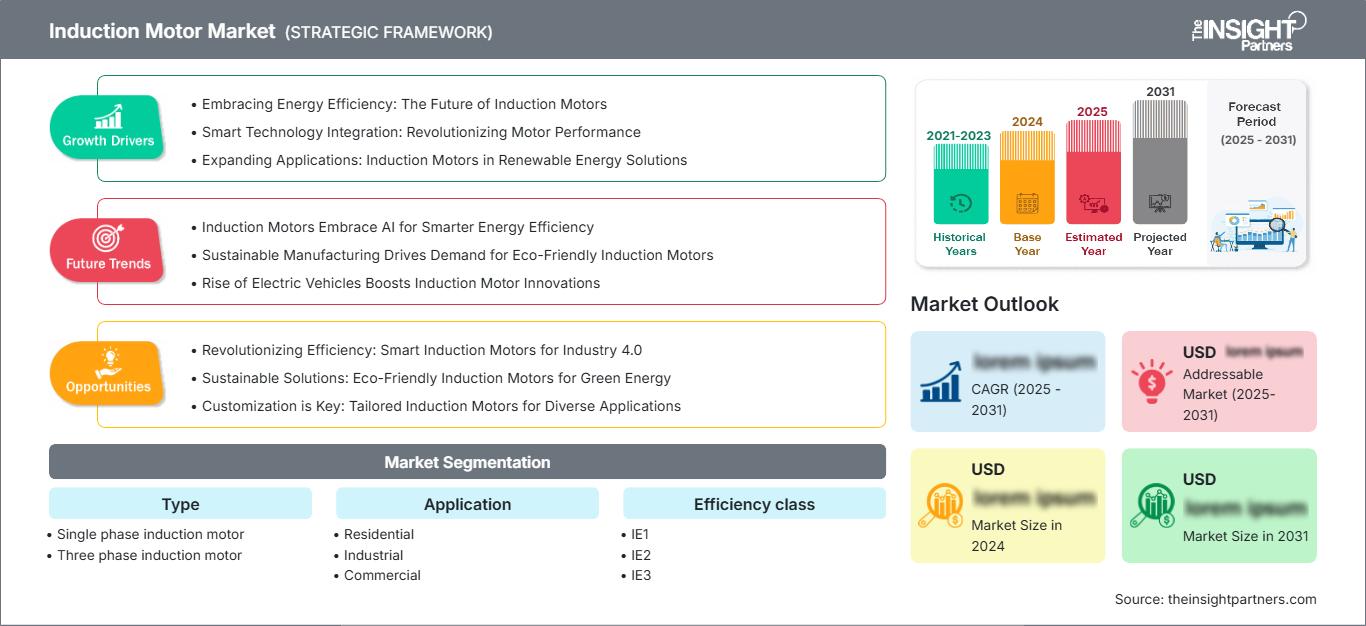
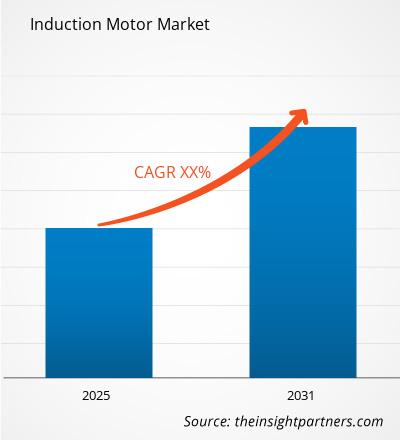
The Induction Motor Market is undergoing sustained expansion as industrial electrification, energy-efficiency requirements, and motor replacement programs increase demand across multiple end-use sectors. The market was valued at US$ 15.01 Billion in 2025 and is projected to reach US$ 30.27 Billion by 2034, registering a CAGR of 8.11% from 2026 to 2034. Demand is supported by the broad installed base, proven reliability, and cost-effective operation of induction motor technologies.
North America presents a structurally attractive environment, supported by industrial automation, infrastructure modernization, and increasingly stringent efficiency requirements. The Induction Motor Market size in the region is expected to advance at approximately 6.8–8.0% CAGR between 2026 and 2034, with replacement of aging equipment and adoption of higher-efficiency motors supporting demand across manufacturing, water infrastructure, HVAC, and commercial facilities.
Induction Motor Market Assessment and Insights
- North America: North America is estimated to account for 24–28% Induction Motor Market share in 2025, growing at a 7.0–8.0% CAGR between 2026–2034. Industrial modernization, efficiency standards, and replacement demand support steady adoption across manufacturing, utilities, HVAC, and process industries.
- US: The US represents approximately 76–82% of North American demand in 2025, with a 7.1–8.1% CAGR between 2026–2034, supported by manufacturing investment, infrastructure upgrades, and federal motor-efficiency requirements.
- Europe: Europe holds approximately 22–26% share in 2025, expanding at a 6.8–7.8% CAGR between 2026–2034. Germany, Italy, France, the UK, and Spain remain important markets, supported by stringent efficiency requirements and industrial automation.
- Asia Pacific: Asia Pacific accounts for approximately 39–44% share in 2025, with a 9.0–10.5% CAGR between 2026–2034. China, Japan, India, and South Korea lead demand through manufacturing expansion, infrastructure investment, and efficiency programs.
- Largest Segment: Three phase induction motors represent approximately 70–76% market share in 2025, supported by industrial applications, with a 7.8–8.8% CAGR from 2026–2034.
- High Growth Segment: IE4 motors account for approximately 18–23% market share in 2025, supported by efficiency regulations and replacement programs, with a 10.0–11.5% CAGR from 2026–2034.
- Key companies analyzed in detail: ABB Ltd., Baldor Electric Company, Emerson Electric Company, Kirloskar Electric Company, Marathon Electric, Nidec Motor Corporation, Regal Beloit Corporation, Schneider Electric, Siemens AG, Toshiba.
Source: The Insight Partners' analysis based on proprietary research, government publications, company annual reports, investor presentations, industry databases, and expert interviews.
The Induction Motor Market has seen developments towards more efficient, specialized systems as compared to standardized electromechanical equipment. The three-phase squirrel cage structure is essential for industrial facilities due to its mechanical design, dependability, and applicability to variable speed drives. Simultaneously, the improvement of rotor and stator structures, insulation system, cooling methods, bearings, and production accuracy increases the efficiency while keeping compactness and reliability.
Further development in the market is being impacted by energy-efficient regulations and industrial decarbonization. The IEA claims that only three out of five electric industrial motors worldwide are regulated through minimum energy performance standards; thus, there is great potential for replacement driven by efficiency considerations. The developing countries have great expansion opportunities; on the other hand, the developed countries need premium efficiency improvements.
Induction Motor Market Report Scope
| Report Attribute | Details |
|---|---|
| Market size in 2025 | US$ 15.01 Billion |
| Market Size by 2034 | US$ 30.27 Billion |
| Global CAGR (2026 - 2034) | 8.11% |
| Historical Data | 2021-2024 |
| Forecast period | 2026-2034 |
Induction Motor Market Analysis
Industrial applications continue to form the main driver of growth. Induction motors find application in pumps, compressors, conveyors, fans, machinery tools, materials handling and manufacturing machinery and thus provide ongoing need for both initial and spare parts. As such, Induction Motor Market growth will be affected by the construction of factories, process automation, infrastructure projects and energy management programs. Manufacturers purchase electrical steel, copper, aluminum, insulation, bearings and casting to produce finished induction motors.
Efficiency needs have become more pronounced when compared to the cost of purchase alone in the value chain. While higher efficiencies may result in higher initial cost of acquisition, they lower the electricity consumption over a long time period of use. According to IEA, industrial motor efficiency standards and incentives are key measures for improving the efficiency and quickening replacement of inefficient motors. There is an opportunity for producers of efficient induction motors.
Market positioning is increasingly becoming dependent on product line breadth, scale of manufacture, efficiency performance, and application engineering. According to the Induction Motor Market report, ABB Ltd., Siemens AG, Schneider Electric, Nidec Motor Corporation, and Emerson Electric Company occupy strategic positions in the context of industrial motor applications, whereas Kirloskar Electric Company and Toshiba cater to regional needs. Other players in the market include Regal Beloit Corporation, Baldor Electric Company, and Marathon Electric, who offer product lines in commercial and industrial applications.
The strategic focus for investments is now more on designs featuring high efficiencies, regional manufacture, and motor drives. For example, ABB's 2025 investment in Indian low-voltage motor manufacture is a typical case in point, along with the launch of IE5 motors using induction technology. According to the company, the new line caters to the following applications: metals, cement, textiles, pharmaceuticals, food and beverages, and paper.
● REPORT CUSTOMIZATION
Tailor This Report To Align With Your Specific Business Requirements
This report can be customized to align precisely with your business objectives, scope, and target markets. Customization options include tailored segmentation, geography, competitive analysis, and strategic insights to support informed decision-making.
Customize This Report →WHAT YOU CAN ADJUST
- ● Segmentations
- ● Geography
- ● Competitive Analysis
- ● Language Preferences
Induction Motor Market: Strategic Insights
Regional Insights
North America Induction Motor Market
North America represented approximately 24–28% share in 2025 and is projected to grow at 7.0–8.0% CAGR from 2026–2034. The US leads in regional consumption, followed by Canada and Mexico. Reshoring of manufacturing, investments in water infrastructure, HVAC improvements, and automation are enabling the replacement of old motors with efficient ones.
Regulatory drivers are facilitating this process. The US Department of Energy (DoE) is responsible for energy conservation and testing criteria for covered electric motors, with the introduction of new expanded scope criteria expected. Canada is maintaining its own efficiency criteria for electric motors, which were recently updated to IE3 levels.
U.S. Induction Motor Market
The US accounts for approximately 76–82% of North American demand in 2025, equivalent to roughly 18–22% of global demand, and is expected to expand at 7.1–8.1% CAGR from 2026–2034. Major applications include manufacturing equipment, pumps, compressors, HVAC systems, and process machinery.
Companies such as ABB Ltd., Baldor Electric Company, Emerson Electric Company, Nidec Motor Corporation, Schneider Electric, Siemens AG, and Toshiba have industrial motor competencies or market share. Efficiency regulations continue to be significant determinants of demand; according to the DOE, covered motors must comply with certain conservation and testing standards. The agency's policy statement on enforcement in 2026 also shows that motor efficiency and compliance continue to receive regulatory attention.
Europe Induction Motor Market Market
Europe held approximately 22–26% share in 2025 and is expected to grow at 6.8–7.8% CAGR from 2026–2034, with Germany leading regional demand. Efficiency regulation remains particularly influential, while industrial automation, process electrification, and replacement of legacy equipment support sustained purchasing.
The UK maintains demand through manufacturing modernization, building-services equipment, and industrial energy-management programs. Germany has the strongest industrial base and significant demand from machinery, automotive production, chemicals, and process industries. France, Italy, and Spain provide additional demand through manufacturing, food processing, utilities, and commercial infrastructure. EU rules require specified motor categories to meet IE3 or IE4 requirements, reinforcing premium-efficiency adoption.
APAC Induction Motor Market Market
APAC accounts for approximately 39–44% share in 2025 and is projected to grow at 9.0–10.5% CAGR from 2026–2034, with China leading. Japan and South Korea emphasize efficiency and automation, while India expands manufacturing and infrastructure investment. Australia remains focused on efficient industrial and commercial equipment.
Regional demand benefits from manufacturing capacity, urban infrastructure, water systems, and industrial electrification. Japan requires IE3 performance for relevant three-phase industrial motors under its Top Runner framework, while South Korea applies IE3 standards to three-phase induction motors. These policies complement broader regional modernization and energy-efficiency initiatives.
Middle East & Africa Induction Motor Market
Middle East and Africa demand is expanding from a smaller base, with the region expected to record approximately 6.0–7.5% CAGR from 2026–2034. Saudi Arabia leads demand, followed by the UAE and South Africa, with applications concentrated in oil and gas, water, mining, HVAC, utilities, and infrastructure.
Energy-intensive projects create opportunities for efficient motors, particularly where pumping, ventilation, and process equipment operate continuously. Saudi Arabia applies IE3 requirements to specified three-phase cage induction motors, while the UAE mandates IE3 efficiency for industrial motors. Infrastructure development across the region is therefore increasingly connected with equipment efficiency and lifecycle-cost considerations.
Segmentation Analysis
Type
Type segmentation remains fundamental because application requirements differ substantially between household equipment and industrial machinery. Three phase designs dominate higher-power applications because they provide smoother torque, higher efficiency, and strong starting performance. Single phase products remain important for lower-power equipment. The Induction Motor Market scope therefore spans complementary demand pools, with the segment expected to expand at approximately 7.6–8.6% CAGR from 2026–2034.
- Single phase induction motor: Single phase induction motors serve residential appliances, small pumps, fans, compressors, and light-duty agricultural equipment. Their straightforward construction and compatibility with single-phase electricity maintain demand across distributed and lower-power applications.
- Three phase induction motor: Three phase induction motors hold the strongest position in industrial applications because of their efficiency, durability, torque characteristics, and suitability for continuous-duty machinery, including pumps, compressors, conveyors, and production equipment.
Application
Application segmentation reflects the broad operating environments in which induction motors are installed. Industrial uses remain dominant because motors form essential components of production and process systems, while residential, commercial, and agricultural demand provides diversification. Application demand is expected to expand at approximately 8.0–9.0% CAGR from 2026–2034, supported by electrification and equipment modernization.
- Residential: Residential demand centers on pumps, fans, compressors, cooling equipment, and household machinery. Buyers increasingly prioritize efficiency, noise characteristics, reliability, and lifecycle operating costs as appliance efficiency requirements become more prominent.
- Industrial: Industrial applications represent the core demand base, covering pumps, compressors, conveyors, machine tools, fans, mixers, and process equipment. Continuous-duty operation makes efficiency, thermal management, reliability, and serviceability critical purchasing criteria.
- Commercial: Commercial installations include HVAC equipment, pumps, ventilation systems, refrigeration equipment, and building services. Demand is shaped by energy-management objectives, operating hours, building modernization, and the need to reduce maintenance interruptions.
- Agriculture: Agriculture uses induction motors for irrigation pumps, ventilation, grain handling, compressors, and processing equipment. Adoption is influenced by electrification, water-management requirements, rural infrastructure, and the operating economics of pumping systems.
- Transportation: Transportation applications include auxiliary systems, ventilation, pumps, cooling equipment, and specialized machinery. Adoption remains more application-specific than industrial demand, with reliability, compactness, environmental resistance, and integration requirements influencing motor selection.
Efficiency class
Efficiency class is increasingly important as energy costs and regulatory requirements influence equipment selection. IE1 and IE2 remain relevant within installed and replacement bases, while IE3 and IE4 gain share in regulated and energy-intensive applications. The segment is expected to grow at approximately 9.0–10.5% CAGR from 2026–2034, led by higher-efficiency replacements.
- IE1: IE1 represents the lower-efficiency category and remains relevant in legacy equipment and markets where minimum efficiency requirements are less stringent. Replacement opportunities increasingly emerge as users evaluate lifecycle energy costs.
- IE2: IE2 provides an intermediate efficiency position and continues to serve applications where regulatory requirements, installed-base compatibility, and purchase economics influence motor selection.
- IE3: IE3 is a major premium-efficiency category for industrial installations and is increasingly supported by mandatory standards. Its combination of efficiency, availability, and established manufacturing capacity makes it central to replacement programs.
- IE4: IE4 represents a higher-efficiency option for applications where operating hours and energy savings justify additional investment. European requirements and efficiency-focused industrial programs are strengthening demand for this category.
Opportunity Snapshot
| Application | Revenue Contribution (High/Medium/Low) | Trend Tag | Adoption Stage |
|---|---|---|---|
| Residential | Medium | Appliance Efficiency | Scaling |
| Industrial | High | Factory Automation | Mature |
| Commercial | Medium | HVAC Retrofit | Scaling |
| Agriculture | Medium | Pump Electrification | Scaling |
| Transportation | Low | Auxiliary Systems | Emerging |
Induction Motor Market Growth Drivers and Impact Analysis
Industrial automation and manufacturing capacity expansion
Industrial automation is increasing the installed base of electrically driven machinery, particularly in manufacturing, logistics, food processing, chemicals, metals, and discrete production. Pumps, conveyor systems, compressors, fans, and machine tools still rely very much on powerful motors. In the process of upgrading the equipment, the consideration of factors like compatibility with variable frequency drives, operation characteristics, environment and maintenance, apart from horsepower, is becoming more important. According to IEA, industrial motors are one of the main categories of electricity demand and, at the same time, improvements in the standards and incentives can help replace inefficient models faster. The described tendency allows manufacturers of high-performance motors to earn more from their production since high-performance motors allow saving money on operation during long-time operation period.
Global tightening of motor-efficiency requirements
Regulation of efficiency is changing the purchasing of motors by setting up minimum efficiency standards and shrinking the size of the addressable market of inefficient motors. Europe has set up IE3 and higher as minimum efficiency standards for certain categories of motors and even established IE4 standards for some power ranges. Japan and South Korea have efficiency regulations for three-phase induction motors, while the US keeps updating its federal standards for motors. These have implications for product range, certification process, testing facilities, and manufacturing economics. At the same time, they prompt end users to change their motors before breakdown, when electricity savings would make up for the cost of investment. In addition to that, the implementation of minimum energy-performance standards is increasing the demand for suppliers of motors manufactured at IE3 and IE4 standards.
Expansion of electrified infrastructure and process equipment
Increasingly growing demand is created for the use of electromechanical drives in such applications as water treatment, district cooling, utilities of industry, mining, food processing, and construction infrastructure. Reliable electromechanical devices such as motor-driven pumps, fans, compressors, conveyors, and handling systems are required, generating increasing demand for induction motors. The emerging markets are especially promising in terms of replacement and installation due to expansion of their industrial capacity and infrastructure. Efficiency investment in emerging and developing markets is expected to increase faster than in advanced markets according to the IEA forecast. It increases the significance of efficiency in new installations and gives a chance to the supplier of motors to produce them locally, to organize regional servicing and supply standard products with regard to local power supply conditions.
Induction Motor Market Future Trends
Greater adoption of premium-efficiency and digitally monitored motors
The Induction Motor Market trend for the future is expected to focus on the combination of efficiency and digital management. With the help of sensors, connected drives, condition-monitoring systems, and predictive maintenance, the user can determine if there is any wear in the bearings, any overheating, any vibrations, insulation issues, or abnormal loads even before the problem appears. This is especially true for continuous process industries because of the high costs that are associated with unscheduled downtime, which may go beyond the cost of the motor. The evaluation of premium efficiency motors will be more and more focused on the entire motor system rather than individual parts. The use of digital services, standardized connectivity, and software-assisted commissioning is likely to be increased by the manufacturers.
Induction architectures optimized for specialized efficiency requirements
Future product development would involve specialized induction structures designed to be efficient without compromising the efficiency of current manufacturing techniques. Rotor design, quality of electrical steel, copper use, insulations, cooling, and bearings are just some aspects of induction motors that could be engineered for particular applications and environments. Hybrids that leverage both the induction technology and synchronous features could also have an impact through improved efficiency without sacrificing certain manufacturing benefits. For instance, Nidec Corporation has provided examples of high-efficiency motor design that involves both induction and synchronous features. This would lead to a product line segmented by application, operation, efficiency, and drive requirements.
Induction Motor Market Opportunities
Localized premium-efficiency manufacturing in emerging economies
The opportunities within emerging economies can be captured through localized manufacturing of IE3 and IE4 motors along with customization of products according to the voltage, temperature, enclosure type, and duty ratings within these regions. The emerging economies including India, Southeast Asia, the Middle East, and Latin America provide attractive environments due to the fact that industrial capability, infrastructure investments, and energy efficiency programs are growing simultaneously within these regions. The localization can help in reducing logistical costs, lead time, and availability of replacement markets. The suppliers should emphasize on the modular product platform approach where the commonality is maintained among different frame sizes but the configuration will be specific to the application. The Induction Motor Market Forecasts reveal that the suppliers who can effectively balance manufacturing economics with energy-efficient motors will benefit from growing replacement cycles.
Integrated motor, drive, and service solutions
Another opportunity is in combining motors with variable frequency drives, control systems, monitoring systems, and life-cycle services. Consumers today tend to consider the combination of energy usage, availability, maintenance, and performance of the whole system as opposed to just buying motors based on nameplate data. Suppliers, therefore, can maximize value capture through offering bundled services for pumps, fans, compressors, conveyors, and processing equipment. Through digital commissioning, remote diagnostics, spare parts plans, and predictive maintenance, suppliers will not only be able to generate service revenues but also ensure better customer retention. The opportunity will apply most to big industrial plants which use thousands of motors at one time.
Recent Developments
- September 2025: ABB Ltd. announced an investment exceeding INR 140 crore to expand and modernize its low-voltage motor manufacturing capacity in India and introduced a locally manufactured IE5 motor range based on induction technology. The range covers 45 kW to 1000 kW and is designed for demanding industrial applications including metals, cement, textiles, pharmaceuticals, food and beverage, and paper.
- July 2025: Nidec Motor Corporation published technical work examining superconducting induction motor concepts and their potential application to future electric-drive systems. The discussion examined high-temperature superconducting materials in induction-motor rotor structures, reflecting the company's ongoing technical exploration of advanced motor architectures and efficiency-oriented technologies.
- June 2025: Nidec Motor Corporation continued its technical series covering AC motor structures and induction-machine characteristics, including squirrel-cage and single-phase configurations. The material highlighted the continuing role of induction motors in general-purpose industrial applications and described differences in construction and operating principles relevant to motor selection and application engineering.
Frequently Asked Questions

- Comprehensive Market Sizing and Forecast Analysis
- Detailed Segmentation Analysis
- In-Depth Market Dynamics Assessment
- Regional and Country-Level Insights
- Competitive Landscape and Company Benchmarking
- Strategic Business Intelligence
Recent Reports
Testimonials

The Insight Partners provided valuable market intelligence that supported our global go-to-market strategy. Their team was professional, responsive, and attentive to our feedback, providing thoughtful analysis and helpful methodological clarifications throughout the project.
Junmo Kim Chief Financial Officer (CFO), Enertech Co., Ltd.
The Insight Partners' SCADA System Market report is comprehensive, with valuable insights on current trends and future forecasts. The team was highly professional, responsive, and supportive throughout. We are very satisfied and highly recommend their services.
RAN KEDEM Partner, Reali Technologies LTDs
I requested a report on a very specific software market and the team produced the report in a few days. The information was very relevant and well presented. I then requested some changes and additions to the report. The team was again very responsive and I got the final report in less than a week.
JEAN-HERVE JENN Chairman, Future Analytica
We worked with The Insight Partners for an important market study and forecast. They gave us clear insights into opportunities and risks, which helped shape our plans. Their research was easy to use and based on solid data. It helped us make smart, confident decisions. We highly recommend them.
PIYUSH NAGPAL Sr. Vice President, High Beam Global
The Insight Partners delivered insightful, well-structured market research with strong domain expertise. Their team was professional and responsive throughout. The user-friendly website made accessing industry reports seamless. We highly recommend them for reliable, high-quality research services
YUKIHIKO ADACHI CEO, Deep Blue, LLC.
This is the first time I have purchased a market report from The Insight Partners.While I was unsure at first, I visited their web site and felt more comfortable to take the risk and purchase a market report.I am completely satisfied with the quality of the report and customer service. I had several questions and comments with the initial report, but after a couple of dialogs over email with their analyst I believe I have a report that I can use as input to our strategic planning process.Thank you so much for taking the extra time and making this a positive experience.I will definitely recommend your service to others and you will be my first call when we need further market data.
JOHN SUZUKI President and Chief Executive Officer, Board Director, BK Technologies
I wish to appreciate your support and the professionalism you displayed in the course of attending to my request for information regarding to infectious disease IVD market in Nigeria. I appreciate your patience, your guidance, and the fact that you were willing to offer a discount, which eventually made it possible for us to close a deal. I look forward to engaging The Insight Partners in the future, all thanks to the impression you have created in me as a result of this first encounter.
DR CHIJIOKE ONYIA MANAGING DIRECTOR, PineCrest Healthcare Ltd.Reason to Buy
- Informed Decision-Making
- Understanding Market Dynamics
- Competitive Analysis
- Identifying Emerging Markets
- Customer Insights
- Market Forecasts
- Risk Mitigation
- Boosting Operational Efficiency
- Strategic Planning
- Investment Justification
- Tracking Industry Innovations
- Aligning with Regulatory Trends





 Get Free Sample for