
Industrial PC Market Demand, Trends & Forecast by 2034
Coverage: by Type (Rugged, Non-Rugged); IPC Type (Panel IPC, Rack Mount IPC, Box IPC, Embedded IPC, DIN Rail IPC, Others); End Use Industry (Automotive, Healthcare, Aerospace and Defense, Semiconductor and Electronics, Energy and Power, Oil and Gas, Others);, and Geography (North America, Europe, Asia Pacific, and South and Central America)
- Status : Data Released
- Report Code : TIPRE00009333
- Category : Electronics and Semiconductor
- No. of Pages : 150
- Available Report Formats :


- Last update date : September 18, 2026


2025 Market Size
US$ 5.83 Bn
Base year value
2034 Forecast
US$ 10.5 Bn
Projected by 2034
CAGR 2026-2034
6.75 %
Growth rate
Addressable Market
US$ 73.77 Bn
(2026-2034)
The Industrial PC Market was valued at US$ 5.83 Billion in 2025 and is projected to reach US$ 10.5 Billion by 2034, registering a CAGR of 6.75% from 2026 to 2034. The demand for the same is getting influenced by the digitization of manufacturing facilities, interconnected devices, edge computing capabilities, machine vision, and software-driven industrial operations. The market will be developing based on the technology platform where computing is used for automation, controlling, visualization, and processing industrial data.
The North American region will experience growth and development due to modernizing the manufacturing resources along with adopting computing in proximity to machines and processes. It has been forecasted that the Industrial PC Market Size in this region will grow at a CAGR of 5.8% - 6.3% during 2026 - 2034 due to industrial automation investments, reshoring activities, cybersecurity considerations, and edge computing architectures.
Industrial PC Market Assessment and Insights
- North America: North America is expected to account for a 31–35% share in 2025 and grow at a 5.8–6.3% CAGR between 2026–2034, supported by factory modernization, reshoring, edge automation, and investment in resilient production infrastructure.
- US: The US represents approximately 72–76% of North America's 2025 share and is projected to expand at a 5.7–6.2% CAGR between 2026–2034, led by automation and semiconductor manufacturing.
- Europe: Europe is estimated at a 27–31% share in 2025, with a 6.0–6.5% CAGR between 2026–2034. Germany, the UK, France, Italy, and Spain support demand through smart manufacturing, machine modernization, and energy-efficiency initiatives.
- Asia Pacific: Asia Pacific is estimated to hold a 34–38% share in 2025 and register a 7.5–8.1% CAGR between 2026–2034, led by China, Japan, South Korea, India, and expanding electronics manufacturing.
- Largest Segment: Non-Rugged systems are estimated to command a 58–62% market share in 2025, with a 6.4–6.9% CAGR between 2026–2034, reflecting broad factory and machine automation deployments.
- High Growth Segment: Embedded IPC is estimated at a 17–21% market share in 2025, with an 8.2–9.0% CAGR between 2026–2034, driven by compact edge control and machine-integrated computing.
- Key companies analyzed in detail: ABB Ltd., Advantech Co., Ltd., American Portwell Technology, Inc., Avalue Technology Inc., Beckhoff Automation GmbH & Co. KG, DFI, IEI Integration Corp., Kontron S and T AG, NEXCOM International Co., Ltd., Siemens AG.
Source: The Insight Partners' analysis based on proprietary research, government publications, company annual reports, investor presentations, industry databases, and expert interviews.
Innovation within the Industrial PC market has progressed from traditional panel PCs to miniaturized, fanless, modular, and edge-enabled systems. Enhanced processing power, solid-state storage, industrial Ethernet, virtualization, and acceleration capabilities give industrial PCs the ability to perform analytics in conjunction with control and visualization operations. Manufacturing facilities now demand greater lifecycle capability, temperature range, resistance to vibration, remote diagnosis options, and compatibility with current automation standards.
The adoption in the future will expand into developing manufacturing economies as governments and industrial organizations allocate investments for the development of connected factories, semiconductor fabrication plants, renewable energy equipment, and automated logistics. Attention to cybersecurity, energy efficiency, functional safety, and resiliency issues also drives the need among buyers for replacing general-purpose computing with industrial solutions. This trend will contribute to further investments in ruggedization, embedded technology, and industrial computing life cycles.
Industrial PC Market Report Scope
| Report Attribute | Details |
|---|---|
| Market size in 2025 | US$ 5.83 Billion |
| Market Size by 2034 | US$ 10.5 Billion |
| Global CAGR (2026 - 2034) | 6.75% |
| Historical Data | 2021-2024 |
| Forecast period | 2026-2034 |
Industrial PC Market Analysis
The development of the Industrial PC market is aided by the shift from centralized automation system to distributed computation at the level of machines and lines. Computing solutions are required in order to process sensor data, run visualization applications, enable machine vision and interact with PLC and enterprise systems. Ecosystem includes processors, memory, storage, industrial displays, networking, software, system integration, and support for whole product lifecycle.
Factors affecting supply still include availability of processors, qualification of industrial components, customization needs and long cycle of support. Suppliers tend to develop their solutions based on modularity, flexible CPU configuration, industrial Ethernet and slots for expansion to make single platform compatible with multiple machine configurations. Value chain benefits those who can provide performance, reliability, cybersecurity, temperature management and availability in addition to computing capabilities.
The Industrial PC Market Report reflects a market that is characterized by automation industry giants and specialist industrial computing suppliers. ABB Ltd and Siemens AG are able to benefit from their wide automation systems, whereas Advantech Co., Ltd, Beckhoff Automation GmbH & Co. KG, DFI, IEI Integration Corp, and NEXCOM International Co., Ltd focus on specialized computing platforms. Kontron S and T AG, Avalue Technology Inc, American Portwell Technology, Inc., and other specialists compete on the basis of customization, embedded solutions, ruggedization, and application-specific configurations.
Investments are being made into edge AI, machine vision, cybersecurity, and high-performance computing for the production line. Suppliers are incorporating new generations of processors, graphics acceleration, remote management, and industrial connectivity along with supporting compatibility with existing automation systems. Differentiation will consequently be based more on computing platforms as a whole, integration, engineering, and lifecycle management. Buyers are considering the total cost of deployment and maintenance along with the initial costs of hardware.
● REPORT CUSTOMIZATION
Tailor This Report To Align With Your Specific Business Requirements
This report can be customized to align precisely with your business objectives, scope, and target markets. Customization options include tailored segmentation, geography, competitive analysis, and strategic insights to support informed decision-making.
Customize This Report →WHAT YOU CAN ADJUST
- ● Segmentations
- ● Geography
- ● Competitive Analysis
- ● Language Preferences
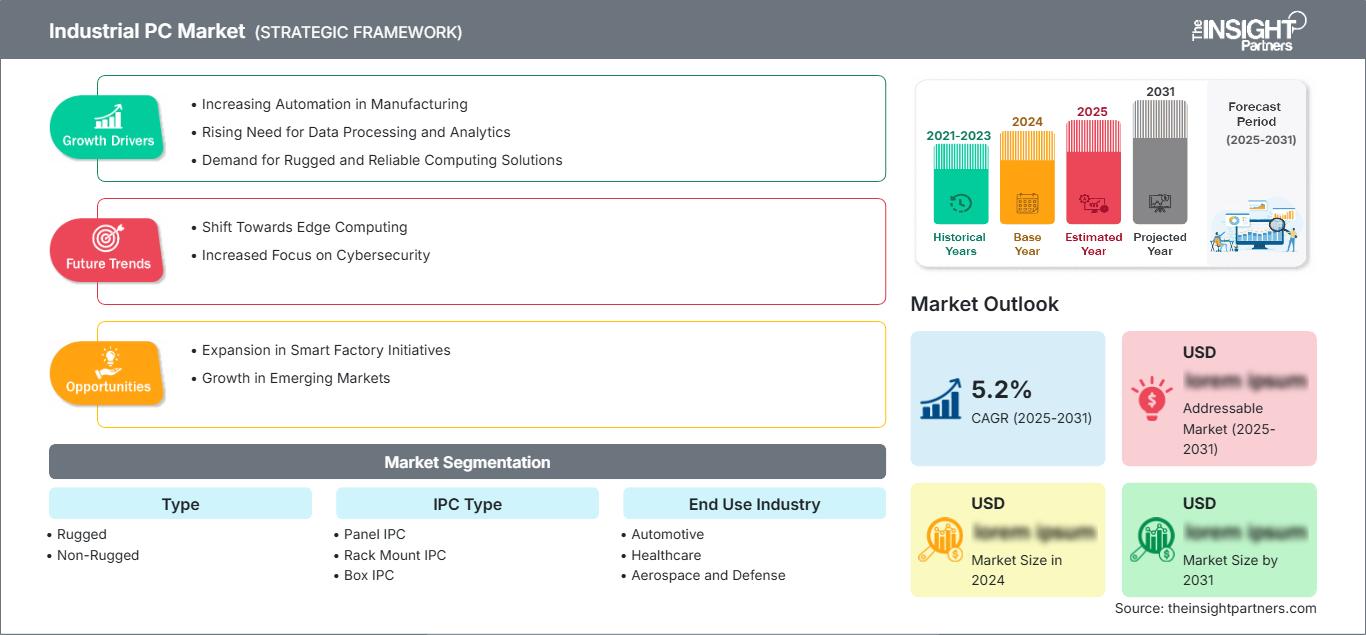
Industrial PC Market: Strategic Insights
Regional Insights
North America Industrial PC Market
North America is expected to constitute 31–35%, with Industrial PC Market Share anticipated to grow at a 5.8–6.3% CAGR through 2034. The US is responsible for the majority of regional demand, whereas Canada is a contributor via energy, mining, food processing, and industrial automation applications. Manufacturing reshoring, investments in semiconductors, and warehouse automation are strengthening demands for dependable edge computing.
IPC utilization is connected with upgrading the production equipment of the legacy generation. Automotive manufacturing facilities, aerospace facilities, pharmaceutical industry, and energy producers demand computing systems that facilitate machine vision, real-time monitoring, and secure connectivity. Vendors with extensive automation solutions can incorporate IPCs with controllers and industrial networks, whereas specialists are catering to needs related to rugged, embedded, and application-specific solutions. Consequently, the demand trend is moving towards long-operating lifecycle solutions.
U.S. Industrial PC Market
The United States makes up around 72-76% of North America’s 2025 percentage and is forecast to grow at a rate of 5.7-6.2% CAGR. The growth drivers include semiconductor manufacturing, automotive manufacturing, aerospace manufacturing, logistics automation, and process industry upgrades. Edge deployment in industrial computing solutions is becoming common in order to reduce latency and improve visibility into operations.
Company presence includes automation companies and dedicated IPC manufacturers, where applications include human machine interface (HMI) and machine control, industrial vision and AI inferencing. Manufacturing investments backed by the government and localization in the supply chain will drive investments in new facilities, while cybersecurity demands are boosting secure boot, trusted hardware, remote management, and software environments. Standardization of platforms that can replicate across multiple factories has become another priority for buyers.
Europe Industrial PC Market
Estimated at 27–31% market share for 2025 and growing at a CAGR of 6.0–6.5%, Europe consists of Germany, the leader market, due to advanced machinery and automotive manufacturing. The UK, France, Italy, and Spain add through aerospace, electronics, energy, food processing, and industrial automation. Market dynamics of the region strongly depend on developments within smart manufacturing and energy efficiency.
UK will keep adopting edge computing in manufacturing and logistics applications, Germany will continue generating high demand from automation-oriented plants and machinery producers, France will benefit from aerospace and industrial upgrading, Italy and Spain will generate demand via machinery, automotive parts, food processing, and renewable energy equipment. Buyers in Europe attach importance to such characteristics of platforms as cybersecurity, lifecycle support, interoperability, and energy efficient computing.
APAC Industrial PC Market
In 2025, APAC is expected to hold an 34–38% market share and register a 7.5–8.1% CAGR, positioning itself as the highest regional growth driver. In terms of regions, China ranks highest, followed by Japan, South Korea, India, and Australia. The markets are supported by investments in electronics, automotive, semiconductors, and industrial automation.
In China, the development of factory automation and electronics manufacturing is prevalent, while in Japan, the use of robotics and accurate manufacturing is the key. South Korea has support in semiconductors and electronics manufacturing facilities, whereas India is developing its manufacturing processes through automation. Australia adds mining and energy sectors into the equation.
Middle East & Africa Industrial PC Market
MEA demand is developing from a low installed base, with MEA forecasted to grow at a 6.2-6.8% CAGR. Saudi Arabia and UAE lead investments in the region, driven by industrial diversification projects, energy projects, logistics, and intelligent infrastructures. South Africa also participates with its mining, manufacturing, utilities, and process industries.
Saudi Arabia is increasingly incorporating automation systems in its industrial diversification initiatives, whereas UAE is increasing its footprint in intelligent manufacturing and logistics infrastructures. South Africa still plays a vital role in mining and industrial processing. RoMEA demand comes from utilities, oil and gas, transport, and infrastructure upgrades. Tough environmental conditions are conducive for rugged computing systems.
Segmentation Analysis
Type
The Type segment in the Industrial PC Market is divided into Rugged and Non-Rugged systems and is expected to grow at a 6.2–6.9% CAGR from 2026–2034. Non-rugged platforms retain broader deployment across controlled factory environments, while rugged systems gain importance where vibration, dust, humidity, temperature variation, or physical exposure create higher reliability requirements. Product selection increasingly depends on operating conditions and lifecycle economics.
- Rugged: Rugged IPCs serve mining, transportation, defense, energy, outdoor automation, and harsh production environments. Their reinforced enclosures, extended temperature tolerance, shock resistance, and sealed construction support applications where standard computing platforms face higher failure risks.
- Non-Rugged: Non-rugged systems remain widely used in factories, control rooms, packaging, electronics assembly, and machine automation. Their broader configuration choices and lower deployment complexity support high-volume industrial applications where environmental exposure is relatively controlled.
IPC Type
The IPC Type segment in the Industrial PC Market is projected to expand at a 6.8–7.5% CAGR from 2026–2034, supported by diversification toward compact and application-specific architectures. Embedded and box configurations are gaining strategic relevance as manufacturers place computing closer to equipment, while panel and rack systems remain important for visualization, control, and centralized industrial applications.
- Panel IPC: Panel IPCs combine computing and display functionality for HMI, machine control, process monitoring, and operator interfaces. Their integrated architecture simplifies installation and provides a consistent interface for production personnel.
- Rack Mount IPC: Rack mount IPCs support centralized control, industrial servers, data acquisition, and demanding applications requiring expansion capacity. They remain relevant where standardized cabinet-based infrastructure and high processing capability are required.
- Box IPC: Box IPCs provide compact computing without an integrated display, making them suitable for machine vision, edge analytics, gateways, and distributed control. Their modular connectivity supports varied industrial equipment configurations.
- Embedded IPC: Embedded IPCs integrate computing directly into machines, vehicles, robotics, and automation systems. Their compact footprint, lower power requirements, and proximity to sensors and controllers support rapid edge processing and decentralized architectures.
- DIN Rail IPC: DIN Rail IPCs are designed for compact control cabinets and distributed automation. Their installation format supports space-efficient deployments in infrastructure, energy, building automation, and machine-control applications.
- Others: Other architectures address specialized deployment requirements where conventional form factors are unsuitable. Demand is generally application-specific, with purchasing decisions influenced by integration requirements, operating environment, and available expansion capabilities.
End Use Industry
The End Use Industry segment in the Industrial PC Market is forecast to grow at a 6.6–7.4% CAGR from 2026–2034. Industrial automation is expanding across discrete and process manufacturing, increasing the need for reliable computing for control, visualization, analytics, and machine connectivity. Sector-specific requirements increasingly determine processor performance, ruggedization, storage, and networking configurations.
- Automotive: Automotive factories use IPCs for robotics, machine vision, assembly-line control, quality inspection, traceability, and manufacturing execution interfaces. Increasing vehicle-electronics complexity further expands computing requirements throughout production.
- Healthcare: Healthcare manufacturing and facility operations use industrial computing for medical equipment, laboratory automation, imaging systems, and controlled environments where reliability, long availability, and secure operation are important.
- Aerospace and Defense: Aerospace and defense applications demand rugged computing for simulation, manufacturing, inspection, avionics-related production, and mission-support systems. Long qualification cycles and environmental requirements favor specialized industrial platforms.
- Semiconductor and Electronics: Semiconductor and electronics facilities require IPCs for automated material handling, inspection, testing, process monitoring, and equipment control. High precision and continuous operation make reliable edge computing particularly important.
- Energy and Power: Energy applications include substations, power generation, grid monitoring, renewable-energy systems, and distributed control. Industrial computers provide local processing, visualization, communications, and condition monitoring.
- Oil and Gas: Oil and gas operators deploy rugged IPCs for process control, monitoring, data acquisition, and remote infrastructure. Environmental durability and long-term availability are important selection factors.
- Others: Other industries include food processing, chemicals, logistics, mining, water treatment, and building automation. Adoption depends on automation intensity, environmental conditions, machine connectivity, and requirements for local data processing.
Sales Channel
The Sales Channel segment in the Industrial PC Market is expected to grow at a 6.0–6.8% CAGR from 2026–2034. Offline channels remain important for engineered systems requiring customization, commissioning, and integration support, while online purchasing is gaining relevance for standardized configurations and replacement equipment. Channel selection increasingly depends on deployment complexity and technical support requirements.
- Online: Online channels facilitate product comparison, configuration, availability checks, and replacement purchases. Their relevance is increasing for standardized IPCs and modular components purchased by technically experienced industrial customers.
- Offline: Offline channels remain dominant for customized installations involving system integrators, distributors, engineering consultation, commissioning, and after-sales support. Complex automation environments typically require direct technical coordination before procurement.
Opportunity Snapshot
| End Use Industry | Revenue Contribution (High/Medium/Low) | Trend Tag | Adoption Stage |
|---|---|---|---|
| Automotive | High | Smart Factories | Scaling |
| Healthcare | Medium | Automated Labs | Scaling |
| Aerospace and Defense | Medium | Rugged Computing | Scaling |
| Semiconductor and Electronics | High | Edge Inspection | Scaling |
| Energy and Power | High | Grid Automation | Scaling |
| Oil and Gas | Medium | Remote Control | Mature |
| Others | Medium | Process Automation | Scaling |
Industrial PC Market Growth Drivers and Impact Analysis
Factory automation is increasing demand for decentralized computing
Moving away from traditional architecture based solely on PLCs to connected manufacturing that integrates control, visualization, analytics, and machine intelligence will make a greater demand for computing solutions located close to the machine and line levels. Industrial computers may perform computations locally, provide visualizations, interface with industrial networks, and run machine vision applications without depending on centralized systems. The effect is most pronounced in industries such as automotive, electronics, packaging, and machinery manufacturing because any downtime and deviation in quality can be very expensive in such environments. When manufacturing facilities are equipped with robots, automated inspection, and connected devices, there will be a need for computing capabilities at more points of operation.
Edge AI is broadening the computational role of industrial PCs
Incorporating AI inference to production equipment will increase the usage of industrial computers beyond just monitoring and control of production processes. The use of machine vision, predictive maintenance, anomaly detection, quality inspection, and process optimization necessitates processing at the edge. The industrial computers which come fitted with advanced processors and GPUs, NPUs, as well as fast networking, can perform inference close to the production assets. This provides the opportunity for industrial computer vendors to create competitive advantages through accelerated computing, thermal management, memory capacity, and software compatibility. The adoption of industrial computing will be critical for applications in the electronics, automotive, logistics, and semiconductor industries where high-speed inspections and real-time decisions have implications on the throughput rate.
Long lifecycle requirements are reinforcing demand for purpose-built platforms
Industrial customers frequently operate equipment for substantially longer periods than consumer computing refresh cycles, creating a need for stable hardware, component availability, controlled revisions, and predictable support. Purpose-built industrial PCs address these requirements through extended temperature ranges, industrial-grade components, mechanical durability, and lifecycle management. This characteristic reduces the operational disruption associated with frequent hardware replacement and simplifies validation for regulated or safety-sensitive applications. Industries such as energy, aerospace, pharmaceuticals, transportation, and process manufacturing place particular value on continuity because replacing computing hardware may require engineering changes and system requalification. Suppliers capable of maintaining product families and providing long-term technical support therefore gain an advantage in project-based procurement. Lifecycle assurance also encourages customers to consider total ownership costs rather than initial purchase prices alone.
Industrial PC Market Future Trends
AI-enabled industrial computing will become increasingly modular
Industrial PC Market trends are expected to move toward modular AI architectures that allow customers to select processing, graphics, networking, storage, and accelerator capabilities according to workload requirements. Rather than replacing entire systems when computational needs increase, manufacturers can adopt expandable platforms with standardized interfaces and modular acceleration. This approach can reduce redesign requirements as machine-vision and inference workloads evolve. Future systems are also likely to integrate more sophisticated remote management, cybersecurity monitoring, and health diagnostics. Vendors may increasingly combine hardware with software development kits, device-management platforms, and AI frameworks to simplify deployment. Modular edge computing should be particularly relevant for manufacturers operating diverse equipment fleets, because standardized hardware families can support multiple applications while retaining configurable processing and connectivity.
Industrial computing will increasingly converge with cybersecurity and lifecycle management
Future procurement decisions are expected to evaluate computing hardware as part of a broader operational technology security and lifecycle framework. Secure boot, hardware-based identity, encrypted storage, controlled firmware updates, remote monitoring, and vulnerability management will become increasingly important as IPCs connect directly with enterprise networks and cloud platforms. Manufacturers are also likely to demand stronger fleet-level visibility, allowing operators to monitor device health, software status, storage utilization, and component conditions remotely. This convergence will shift competitive positioning from hardware specifications toward lifecycle capabilities. Vendors that provide secure update mechanisms, documented component histories, long-term operating-system support, and remote administration can improve the manageability of distributed installations. Such capabilities will be particularly valuable for multinational manufacturers managing standardized automation architectures across multiple plants.
Industrial PC Market Opportunities
Expansion of embedded computing in machine builders
Machine builders represent an attractive opportunity because embedded computing can be designed directly into equipment rather than added as a separate control component. Suppliers can develop application-specific platforms combining processors, I/O, networking, storage, and industrial communication interfaces in compact packages. This creates opportunities for recurring business as equipment manufacturers standardize computing platforms across machine families. Vendors can also provide engineering services, board customization, thermal design, and lifecycle management to strengthen relationships with original equipment manufacturers. The opportunity is particularly relevant in robotics, packaging, inspection, material handling, and automated assembly, where machine intelligence is becoming an integral design requirement. Long-term agreements with machine builders can provide predictable volumes while enabling suppliers to optimize hardware platforms for specific workloads and operating conditions.
Opportunity for regionalized industrial computing supply chains
Industrial manufacturers are increasingly seeking resilient supply chains for critical automation components, creating opportunities for IPC suppliers with regional manufacturing, inventory, technical support, and customization capabilities. Localized production and distribution can reduce lead times and improve responsiveness for replacement equipment and new factory projects. The opportunity is significant across Asia Pacific, North America, and Europe, where industrial investment is expanding while customers remain sensitive to component shortages and geopolitical disruption. Suppliers can strengthen positioning through regional configuration centers, standardized product families, local engineering teams, and lifecycle commitments. Industrial PC Market Forecasts should therefore consider not only unit demand but also changes in procurement models, localization strategies, and service requirements. These factors can reshape supplier selection and create room for specialized regional partnerships.
Recent Developments
- October 2025: Advantech Co., Ltd. introduced the MIC-780 fanless industrial box PC using Intel Core Ultra processors with an integrated NPU. The platform was designed for industrial AI workloads and combines rugged construction with modular I/O expansion, positioning edge AI processing closer to production assets. The product targets industrial automation applications requiring higher local computing capability.
- June 2025: Advantech Co., Ltd. expanded its DIN-rail edge computing portfolio with the ARK-1251 and ARK-1222 platforms for machine automation, collaborative robotics, and smart-city gateways. The systems incorporate fanless designs, flexible expansion, remote diagnostics, hardware monitoring, and security features, demonstrating the continued shift toward compact computing platforms for distributed industrial applications.
- 2025: Siemens AG continued expanding its SIMATIC industrial computing portfolio, including panel and box PC configurations designed for industrial visualization, machine data processing, control, and decentralized applications. The 2025 SIMATIC documentation highlights rugged panel PCs, maintenance-free configurations, and multiple form factors, reinforcing the importance of flexible industrial computing architectures across factory automation environments.
Frequently Asked Questions

- Comprehensive Market Sizing and Forecast Analysis
- Detailed Segmentation Analysis
- In-Depth Market Dynamics Assessment
- Regional and Country-Level Insights
- Competitive Landscape and Company Benchmarking
- Strategic Business Intelligence
Recent Reports
Testimonials

The Insight Partners' SCADA System Market report is comprehensive, with valuable insights on current trends and future forecasts. The team was highly professional, responsive, and supportive throughout. We are very satisfied and highly recommend their services.
RAN KEDEM Partner, Reali Technologies LTDs
I requested a report on a very specific software market and the team produced the report in a few days. The information was very relevant and well presented. I then requested some changes and additions to the report. The team was again very responsive and I got the final report in less than a week.
JEAN-HERVE JENN Chairman, Future Analytica
We worked with The Insight Partners for an important market study and forecast. They gave us clear insights into opportunities and risks, which helped shape our plans. Their research was easy to use and based on solid data. It helped us make smart, confident decisions. We highly recommend them.
PIYUSH NAGPAL Sr. Vice President, High Beam Global
The Insight Partners delivered insightful, well-structured market research with strong domain expertise. Their team was professional and responsive throughout. The user-friendly website made accessing industry reports seamless. We highly recommend them for reliable, high-quality research services
YUKIHIKO ADACHI CEO, Deep Blue, LLC.
This is the first time I have purchased a market report from The Insight Partners.While I was unsure at first, I visited their web site and felt more comfortable to take the risk and purchase a market report.I am completely satisfied with the quality of the report and customer service. I had several questions and comments with the initial report, but after a couple of dialogs over email with their analyst I believe I have a report that I can use as input to our strategic planning process.Thank you so much for taking the extra time and making this a positive experience.I will definitely recommend your service to others and you will be my first call when we need further market data.
JOHN SUZUKI President and Chief Executive Officer, Board Director, BK Technologies
I wish to appreciate your support and the professionalism you displayed in the course of attending to my request for information regarding to infectious disease IVD market in Nigeria. I appreciate your patience, your guidance, and the fact that you were willing to offer a discount, which eventually made it possible for us to close a deal. I look forward to engaging The Insight Partners in the future, all thanks to the impression you have created in me as a result of this first encounter.
DR CHIJIOKE ONYIA MANAGING DIRECTOR, PineCrest Healthcare Ltd.Reason to Buy
- Informed Decision-Making
- Understanding Market Dynamics
- Competitive Analysis
- Identifying Emerging Markets
- Customer Insights
- Market Forecasts
- Risk Mitigation
- Boosting Operational Efficiency
- Strategic Planning
- Investment Justification
- Tracking Industry Innovations
- Aligning with Regulatory Trends





 Get Free Sample for