
Intelligent PDU Market Size, Growth & Trends by 2034
Intelligent PDU Market Size and Forecasts (2021–2034), Global and Regional Share, Trends, and Growth Opportunity Analysis Report Coverage : By Type (Metered, Monitored, Automatic Transfer Switch, Hot Swap, Dual Circuit), Power Phase (Single Phase, Three Phase), Application (Datacenters, Industrial Power Solutions, VoIP Phone Systems, Educational Labs, Commercial Applications/Network Closets), Industry (Telecom & IT, BFSI, Government, Energy, Industrial Manufacturing, Healthcare, Transportation, Others)
- Status : Data Released
- Report Code : TIPRE00039488
- Category : Electronics and Semiconductor
- No. of Pages : 150
- Available Report Formats :


- Last update date : September 22, 2026


2025 Market Size
US$ 1.4 Bn
Base year value
2034 Forecast
US$ 2.53 Bn
Projected by 2034
CAGR 2026-2034
6.85 %
Growth rate
Addressable Market
US$ 17.81 Bn
(2026-2034)
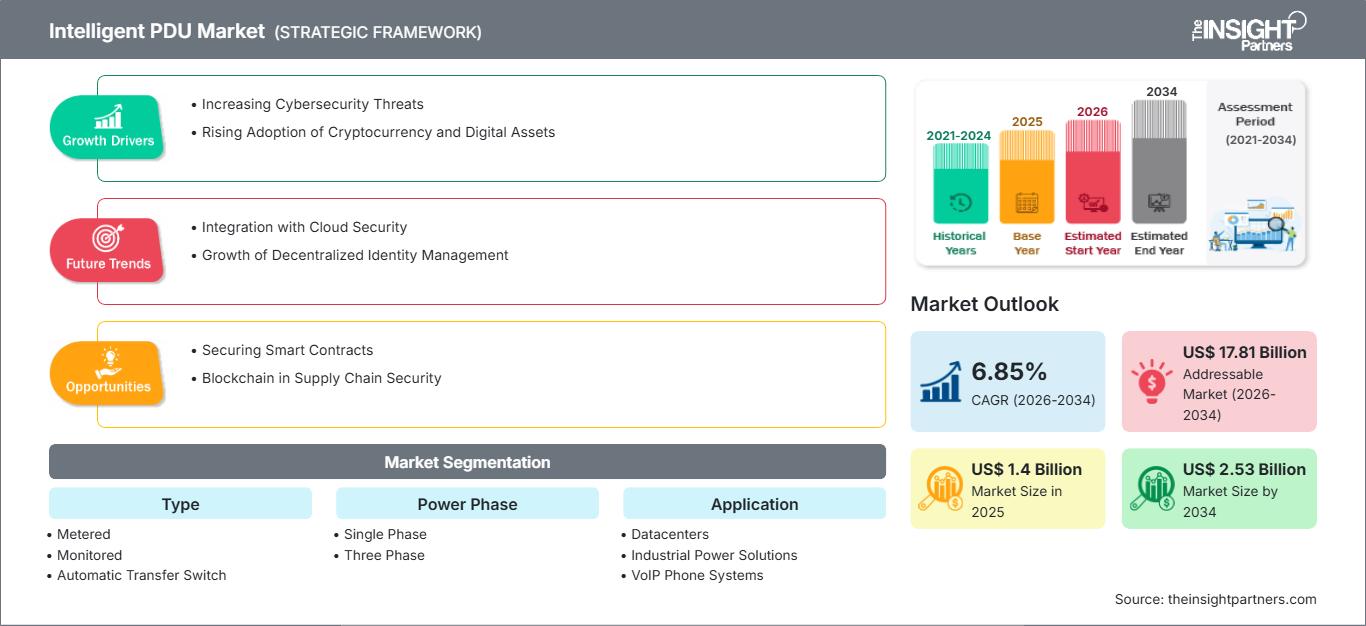
The Intelligent PDU Market combines intelligent power distribution, remote monitoring, outlet-level control, and power-quality visibility for facilities where uptime and energy accountability are operational priorities. The market is valued at US$ 1.4 Billion in 2025 and is projected to reach US$ 2.53 Billion by 2034, expanding at a 6.85% CAGR from 2026 to 2034. Adoption is increasingly linked to higher rack densities, distributed computing, and requirements for granular infrastructure management.
North America remains a structurally important demand center, with an estimated 6.8–7.4% CAGR through 2034. Expansion of hyperscale and colocation capacity, together with modernization of enterprise electrical infrastructure, supports deployment. The Intelligent PDU market size opportunity is further shaped by demand for remote outlet control, environmental telemetry, capacity planning, and operational resilience across increasingly power-intensive computing environments.
Intelligent PDU Market Assessment and Insights
- North America: North America is expected to command a 34–38% Intelligent PDU market share in 2025, growing at a 6.8–7.4% CAGR between 2026–2034, supported by data center construction, enterprise modernization, and increasingly dense IT loads requiring intelligent power visibility.
- US: The US is estimated to represent 28–32% of the market in 2025, expanding at a 6.9–7.5% CAGR between 2026–2034, led by hyperscale facilities, colocation expansion, and edge infrastructure.
- Europe: Europe is projected to hold a 24–28% share in 2025 and expand at a 6.2–6.9% CAGR between 2026–2034, with Germany, the UK, France, and the Netherlands benefiting from data center investment and energy-efficiency requirements.
- Asia Pacific: Asia Pacific is estimated at 25–29% share in 2025, with a 7.1–7.9% CAGR between 2026–2034. China, Japan, India, South Korea, and Australia are central markets as cloud capacity and digital infrastructure expand.
- Largest Segment: Monitored PDUs are estimated at a 31–35% market share in 2025, with a 6.9–7.5% CAGR through 2034, reflecting demand for circuit-level visibility.
- High Growth Segment: Three Phase systems represent an estimated 39–43% market share in 2025, expanding at a 7.2–7.8% CAGR through 2034 as high-density facilities increase power requirements.
- Key companies analyzed in detail: Citilog, Cubic Corporation, EFKON India, IMTAC, Intelvision Technologies, Iteris, Inc., Nuance Communications, Inc., Savari, Inc., Thales Group, and TransCore.
Source: The Insight Partners' analysis based on proprietary research, government publications, company annual reports, investor presentations, industry databases, and expert interviews.
The power distribution topology is evolving from simple rack infrastructures to intelligent electrical circuits that have the capability to measure, alarm, switch and communicate their operational parameters. Increased server density makes granular measurements more valuable, while modular rack structures incentivize standardization. Embedded intelligence and networking features as well as integration capabilities become important for manufacturing of the intelligent power distribution systems.
Deployment of the product will be extended over the forecast period not only to typical enterprise data center facilities but to edge sites, network closets, industrial computer rooms and other forms of distributed digital infrastructure. Energy efficiency legislation and investments in reliable power infrastructure will help with measuring of power consumption on granular levels, while intelligent switching and measuring will be justified by the need to build reliable facilities.
Intelligent PDU Market Report Scope
| Report Attribute | Details |
|---|---|
| Market size in 2025 | US$ 1.4 Billion |
| Market Size by 2034 | US$ 2.53 Billion |
| Global CAGR (2026 - 2034) | 6.85% |
| Historical Data | 2021-2024 |
| Forecast period | 2026-2034 |
Intelligent PDU Market Analysis
The Intelligent PDU Market will be driven by increased complexity of electricity usage within the computer environment. The need for these PDUs arises from data center operators, telecom operators, enterprises, industrial facilities, and managed infrastructure service providers who desire to monitor and ensure that there is no abuse in terms of usage and power quality. The value chain consists of suppliers of electrical parts, enclosure and connector companies, control electronics, software developers, and system integration.
Supply considerations arise from the availability of circuit breakers, current sensors, communication devices, controller, connectors, and enclosures. The challenge faced by the manufacturer of this product is balancing between having standard platform solutions and customizing the product to have the desired configuration of outlets and voltages, as well as communication standards. Lead time consideration is still an issue because PDUs are part of infrastructure project.
Intelligent PDU market competitive analysis reveals that the competition exists in a market which is impacted by electrical engineering capabilities, embedded software, connectivity, and system integration. Some of the players in this market include Citilog, Cubic Corporation, EFKON India, IMTAC, Intelvision Technologies, Iteris, Inc., Nuance Communications, Inc., Savari, Inc., Thales Group, and TransCore. The positions taken by these players show how intelligent infrastructure capabilities and power management applications can overlap.
The Intelligent PDU market report shows that more investment is being focused on developing products that turn electrical measurements into operational data. In such a scenario, strategic differentiation can be achieved through APIs, protocols, cybersecurity, modularity, and integration with facility management platforms. Suppliers that cater to large infrastructure operators will find themselves better off in offering services related to lifecycles, firmware management, and remote diagnostics.
● REPORT CUSTOMIZATION
Tailor This Report To Align With Your Specific Business Requirements
This report can be customized to align precisely with your business objectives, scope, and target markets. Customization options include tailored segmentation, geography, competitive analysis, and strategic insights to support informed decision-making.
Customize This Report →WHAT YOU CAN ADJUST
- ● Segmentations
- ● Geography
- ● Competitive Analysis
- ● Language Preferences
Intelligent PDU Market: Strategic Insights
Regional Insights
North America Intelligent PDU Market
North America is estimated to hold a 34–38% Intelligent PDU market in 2025, with a 6.8–7.4% CAGR through 2034. The USA continues to serve as the dominant hub, thanks to investments in hyperscale data center constructions, colocation growth, cloud-based computing, and renewal of enterprise infrastructures. Canada is involved via data center operations, telecommunications infrastructure, and financial services.
Higher rack densities continue to drive a requirement for circuit monitoring, remote switching, capacity planning, and alarm management. The power usage efficiency and resilience of the infrastructure in view of availability of power has become an area of focus for operators. Intelligence-driven architectures could minimize the involvement of personnel and maximize visibility of the equipment installed across multiple locations.
U.S. Intelligent PDU Market
The US is estimated to represent 28–32% of the total Intelligent PDU market in 2025 and approximately 82–86% of North America's market, expanding at a 6.9–7.5% CAGR. Demand tends to cluster around hyperscale campus environments, colocation environments, enterprise data centers, and edge computing deployments.
More sophisticated demand tends to come from large organizations who have the need for outlet-level power metering and control, as they have increased rack density and more dispersed systems in place. PDUs could also be used in network closets and telecommunications centers, as physical access may not always be possible. Providers differentiate themselves based on accuracy, firmware, compatibility, and installation capability. Enterprise use cases have become more sophisticated, linking PDU performance to overall infrastructure management systems.
Europe Intelligent PDU Market
Europe is estimated to account for 24–28% Intelligent PDU market in 2025, advancing at a 6.2–6.9% CAGR. Germany forms a key market, whereas the UK, France, Italy, Spain, and the Netherlands are part of this market in terms of data centers, telecommunications, industrial automation, and enterprise infrastructure. Efficiency in operations and transparency in the process of operation are still important criteria in the process of buying the product.
The UK market sees benefits from digital infrastructure investment and need for resilient power management in data centers. Germany merges industrial automation with digital infrastructure growth and creates a need for electrical distribution systems. France has prospects in terms of enterprise and colocation facilities, whereas Italy and Spain are working on developing new capacities in data centers and digital infrastructure.
APAC Intelligent PDU Market
APAC is projected to hold a 25–29% Intelligent PDU market in 2025, with a 7.1–7.9% CAGR. The major drivers in the region, in order of significance, include China, Japan, South Korea, India, and Australia. The growth of cloud computing, semiconductor production, telecommunications investments, and the digitization of manufacturing processes is contributing to its growth.
The push towards digitalization and the development of the data infrastructure is driving the need for reliable electricity sources. India and Australia represent growing market potentials, whereas Japan and South Korea focus on reliability and high density computing. Suppliers are beginning to adapt their offerings based on regional electrical requirements and customer preferences.
Middle East & Africa Intelligent PDU Market
Middle East and Africa is expected to expand at a 5.9–6.6% CAGR, led by Saudi Arabia and the UAE, where digital infrastructure and large-scale data center investments are progressing. South Africa remains a regional hub for enterprise and telecommunications infrastructure.
Energy-intensive facilities and new infrastructure projects are increasing the importance of electrical visibility. Saudi Arabia and the UAE benefit from technology investment linked to economic diversification, while South Africa supports regional cloud and connectivity requirements. Rest of MEA demand is more project-driven, with intelligent distribution gaining relevance where remote monitoring can reduce maintenance complexity.
Segmentation Analysis
Type
Type segment in the Intelligent PDU market is a fundamental differentiation factor because buyers select PDU architectures according to monitoring requirements, transfer reliability, rack density, and operational control. The segment is projected to expand at a 6.6–7.2% CAGR from 2026–2034. The Intelligent PDU scope increasingly includes products capable of converting electrical measurements into actionable infrastructure data.
- Metered: Metered PDUs provide basic electrical measurement and support capacity awareness. They remain relevant where operators need visibility without extensive remote-control functionality.
- Monitored: Monitored PDUs enable detailed electrical information and alerting, making them important for facilities requiring continuous circuit-level visibility and operational planning.
- Automatic Transfer Switch: Automatic Transfer Switch PDUs support continuity by transferring loads between power sources. They are strategically relevant where redundancy and rapid recovery are essential.
- Hot Swap: Hot Swap architectures facilitate equipment replacement while maintaining operational continuity, supporting applications where service interruptions carry significant operational consequences.
- Dual Circuit: Dual Circuit configurations support redundant electrical feeds and are suited to critical infrastructure requiring greater flexibility in load distribution and power-path management.
Power Phase
Power Phase determines electrical capacity, installation architecture, and suitability for different computing environments. The segment is forecast to grow at a 6.8–7.5% CAGR from 2026–2034, with higher-density facilities increasingly favoring three-phase configurations. Selection depends on rack loads, facility voltage, redundancy requirements, and distribution architecture.
- Single Phase: Single-phase PDUs remain important in enterprise rooms, smaller data centers, network closets, and applications where rack-level loads remain comparatively moderate.
- Three Phase: Three-phase PDUs address higher-density installations by supporting greater electrical capacity and balanced distribution, making them increasingly important in modern computing environments.
Application
Application encompasses the principal environments where intelligent power distribution is deployed. The segment is projected to grow at a 6.9–7.6% CAGR from 2026–2034, driven by expanding requirements for electrical visibility, remote management, and infrastructure resilience across digital and industrial facilities.
- Datacenters: Data centers represent a core application because operators require detailed power utilization information, alarms, remote control, and capacity planning across increasingly dense rack environments.
- Industrial Power Solutions: Industrial deployments use intelligent distribution to improve electrical visibility around automated equipment, control systems, computing assets, and operational technology infrastructure.
- VoIP Phone Systems: VoIP environments benefit from reliable rack and network power distribution, particularly where communications continuity and centralized monitoring are operational priorities.
- Educational Labs: Educational laboratories use intelligent distribution where multiple computing and electronic systems require controlled power allocation, measurement, and safer infrastructure management.
- Commercial Applications/Network Closets: Commercial network closets require compact, remotely observable power systems that can support communications equipment while minimizing physical maintenance requirements.
Industry
Industry reflects differences in uptime requirements, electrical density, regulatory exposure, and infrastructure complexity. This segment is estimated to expand at a 6.7–7.4% CAGR from 2026–2034, with telecom, IT, healthcare, manufacturing, and energy applications requiring increasingly connected power infrastructure.
- Telecom & IT: Telecom and IT operators prioritize availability, remote visibility, and efficient rack utilization, making intelligent distribution relevant across centralized and distributed infrastructure.
- BFSI: Banking and financial institutions emphasize resilience and monitoring because technology infrastructure supports transaction processing, customer services, and business continuity.
- Government: Government facilities increasingly require secure, accountable infrastructure management across computing environments, communications systems, and distributed technology installations.
- Energy: Energy organizations use connected infrastructure to support control rooms, communications, monitoring systems, and digital assets operating in demanding environments.
- Industrial Manufacturing: Manufacturers increasingly integrate computing and networking assets with production environments, creating demand for controlled and observable electrical distribution.
- Healthcare: Healthcare facilities require dependable power for digital systems, communications, monitoring platforms, and connected equipment where infrastructure interruptions can affect operations.
- Transportation: Transportation infrastructure uses intelligent power distribution for communications, control, monitoring, and digital systems deployed across stations, terminals, and operational facilities.
Opportunity Snapshot
| Application | Revenue Contribution | Trend Tag | Adoption Stage |
| Datacenters | High | Rack Density | Mature |
| Industrial Power Solutions | Medium | OT Monitoring | Scaling |
| VoIP Phone Systems | Medium | Network Uptime | Mature |
| Educational Labs | Low | Lab Automation | Emerging |
| Commercial Applications/Network Closets | Medium | Edge Networking | Scaling |
Intelligent PDU Market Growth Drivers and Impact Analysis
Increasing Rack Density and Electrical Load Complexity
Higher rack densities are changing the economics of power distribution by increasing the consequences of inaccurate capacity assumptions. Computing facilities are able to pack significant amounts of electrical load into small physical areas, which makes circuit visibility more valuable. An intelligent PDU lets operators monitor usage, discover imbalances, and react to unusual situations without depending solely on the physical inspection process. The usefulness of the solution is not limited only by electricity metering since reliable information can be used to plan rack deployment, maintenance, and scaling activities. Facilities implement accelerated and distributed computing and processing platforms, so there will be a stronger link between electrical and IT infrastructures.
Expansion of Distributed and Edge Computing Infrastructure
Edge computing involves spreading IT gear to various locations, such as telecom sites, enterprises, industrial sites, retail spaces, among others. Often, these locations have less on-premise technical personnel compared to large data centers, making it more beneficial to be able to monitor and control power remotely. Smart PDUs can help monitor the status of the equipment, give alarms and offer some degree of switch capabilities without having physical presence all the time. This results in the fact that in addition to the electrical specs, vendors should have small size, good communication capabilities and easier installation. The distributed infrastructure results in a bigger number of separately-managed power devices, which in turn makes centralized management desirable.
Greater Emphasis on Energy Accountability and Infrastructure Resilience
The expense of energy, limitations of capacity, and resilient planning have made organizations work towards improving measurements in their electrical infrastructure. The intelligent PDUs give better data than traditional distribution systems so that the facility managers have visibility on utilization at the rack level or at the circuit level. The visibility will help them with better load balancing, maintenance scheduling, and even inefficient operations. Resilience adds another aspect to this because by monitoring and transferring the configuration, they get visibility about the power path condition. With the integration of facility management in digital management systems, the telemetry in the PDU can contribute to infrastructure analytics. This helps to extend the value proposition from a physical electrical component to an operational data source.
Intelligent PDU Market Future Trends
Software-Centric Power Infrastructure Management
The architecture of future intelligent power delivery systems will probably put more focus on software-defined monitoring than electrical monitoring alone. Manufacturers will be able to make it possible for users to gain access to PDU data via application programming interfaces, dashboards, central management tools, and automated notification workflows. Users will then be able to analyze power usage in different racks, detect anomalies, and manage maintenance operations from central locations. Eventually, analytics may allow for predicting overloaded circuits, abnormal temperatures, or poor equipment operation. In other words, the landscape of Intelligent PDU market trends will be shifting towards interoperable infrastructure where electrical equipment shares information with data center infrastructure management and facilities management systems.
Integration of Power Intelligence with Sustainability Programs
Sustainability initiatives are projected to affect intelligent power architectures in terms of increasing the need for more detailed electrical measurement. In order to determine the energy usage within the operations of an organization, it is necessary to have accurate data at different layers of infrastructure rather than depending on the facility wide figures alone. Intelligent PDUs can provide data on circuits and racks which could be used for allocation, benchmarking, and efficiency calculations. It is possible in future platforms to use electrical data along with environmental and workload details which will lead to more contextual analysis of the infrastructure efficiency.
Intelligent PDU Market Opportunities
Localized Manufacturing and Modular Product Platforms
Opportunities for manufacturers to take advantage of include designing platforms which can work with various types of outlets, voltages, communication interfaces, and levels of monitoring. Modular approaches to design can help to avoid duplications in engineering efforts while making it possible for suppliers to serve many customer groups using one common platform. There is also an opportunity for localization due to differences in electrical standards and processes of acquiring infrastructures in certain areas. Investments in manufacturing capabilities, flexible firmware, and standard components might decrease lead times and make it possible to customize products according to individual customer requirements. It would be important for suppliers to pay attention to the possibility of integrating communications and monitoring capabilities on demand.
Digital Infrastructure Expansion in Emerging Markets
New digital infrastructure markets present potential for providers that can bring together reliable hardware with ease of deployment and remote management. Growing cloud computing, telecommunication systems, business digitization, and edge computing will lead to the creation of facilities beyond data center campuses. Investors and producers can focus on the partnerships, integrators, and infrastructure contractors that are involved in these initiatives. Product strategies must focus on simplicity of installation, remote troubleshooting, compatibility with communications, and longevity. Intelligent PDU market forecast can be used to help with capacity planning along with other factors such as investments into the infrastructure, power supply, and density per rack. Service-based differentiation is another way of standing out for new market participants, especially when special maintenance capabilities are lacking in the area.
Recent Developments
- August 2025: Panduit launched the EL2P™ intelligent PDU globally, designed to improve power management efficiency, reliability and automation in data centers. The new PDU is part of Panduit’s expanded rack power distribution portfolio.
- September 2025: Vertiv expanded its PowerIT rack PDU portfolio with models supporting up to 57.6 kW for high-density AI and HPC deployments. The PDUs offer basic, monitored and switched configurations, with advanced power management and flexible three-phase power options.
- August 2025: Austin Hughes introduced its InfraPower 2000 intelligent PDU range, featuring new-generation smart meters and patented Slide-Lock IEC outlets. The Z-IP and M-Serial series provide real-time local and remote power monitoring and management for data centers.
Frequently Asked Questions

- Comprehensive Market Sizing and Forecast Analysis
- Detailed Segmentation Analysis
- In-Depth Market Dynamics Assessment
- Regional and Country-Level Insights
- Competitive Landscape and Company Benchmarking
- Strategic Business Intelligence
Recent Reports
Testimonials

The Insight Partners' SCADA System Market report is comprehensive, with valuable insights on current trends and future forecasts. The team was highly professional, responsive, and supportive throughout. We are very satisfied and highly recommend their services.
RAN KEDEM Partner, Reali Technologies LTDs
I requested a report on a very specific software market and the team produced the report in a few days. The information was very relevant and well presented. I then requested some changes and additions to the report. The team was again very responsive and I got the final report in less than a week.
JEAN-HERVE JENN Chairman, Future Analytica
We worked with The Insight Partners for an important market study and forecast. They gave us clear insights into opportunities and risks, which helped shape our plans. Their research was easy to use and based on solid data. It helped us make smart, confident decisions. We highly recommend them.
PIYUSH NAGPAL Sr. Vice President, High Beam Global
The Insight Partners delivered insightful, well-structured market research with strong domain expertise. Their team was professional and responsive throughout. The user-friendly website made accessing industry reports seamless. We highly recommend them for reliable, high-quality research services
YUKIHIKO ADACHI CEO, Deep Blue, LLC.
This is the first time I have purchased a market report from The Insight Partners.While I was unsure at first, I visited their web site and felt more comfortable to take the risk and purchase a market report.I am completely satisfied with the quality of the report and customer service. I had several questions and comments with the initial report, but after a couple of dialogs over email with their analyst I believe I have a report that I can use as input to our strategic planning process.Thank you so much for taking the extra time and making this a positive experience.I will definitely recommend your service to others and you will be my first call when we need further market data.
JOHN SUZUKI President and Chief Executive Officer, Board Director, BK Technologies
I wish to appreciate your support and the professionalism you displayed in the course of attending to my request for information regarding to infectious disease IVD market in Nigeria. I appreciate your patience, your guidance, and the fact that you were willing to offer a discount, which eventually made it possible for us to close a deal. I look forward to engaging The Insight Partners in the future, all thanks to the impression you have created in me as a result of this first encounter.
DR CHIJIOKE ONYIA MANAGING DIRECTOR, PineCrest Healthcare Ltd.Reason to Buy
- Informed Decision-Making
- Understanding Market Dynamics
- Competitive Analysis
- Identifying Emerging Markets
- Customer Insights
- Market Forecasts
- Risk Mitigation
- Boosting Operational Efficiency
- Strategic Planning
- Investment Justification
- Tracking Industry Innovations
- Aligning with Regulatory Trends





 Get Free Sample for