
Low-Voltage Motors Market Demand, Share & Growth by 2034
Coverage: by Product Type (IE1, IE2, IE3, and IE4); Industry Vertical (Automotive, Mining, Electronics, Textile, Food & Beverages, and Others), and Geography (North America, Europe, Asia Pacific, and South and Central America)
- Status : Data Released
- Report Code : TIPRE00002787
- Category : Electronics and Semiconductor
- No. of Pages : 150
- Available Report Formats :


- Last update date : October 13, 2026


2025 Market Size
US$ 30.31 Bn
Base year value
2034 Forecast
US$ 62.02 Bn
Projected by 2034
CAGR 2026-2034
8.28 %
Growth rate
Addressable Market
US$ 414.66 Bn
(2026-2034)
The low-voltage motors market was valued at US$ 30.31 Billion in 2025 and is projected to reach US$ 62.02 Billion by 2034, expanding at a CAGR of 8.28% during 2026–2034. Demand is being reinforced by industrial electrification, stricter energy-efficiency regulations, and the modernization of manufacturing facilities across developed and emerging economies. Continuous replacement of aging motor fleets with premium-efficiency alternatives and wider integration of automation technologies are strengthening long-term market expansion across industrial production, infrastructure, and commercial applications.
Across North America, industrial modernization and regulatory emphasis on energy-efficient equipment continue to create a favorable investment environment for premium low-voltage motors. The low-voltage motors market size is supported by manufacturing reshoring, expanding food processing capacity, and investments in water infrastructure and industrial automation. The regional market is expected to register a CAGR in the range of 6.5%–7.5% during 2026–2034, supported by energy-efficiency standards from the U.S. Department of Energy and increasing deployment of IE3 and IE4 motors in continuous-duty industrial operations.
Low-Voltage Motors Market Assessment and Insights
- North America: The region benefits from extensive industrial automation, replacement of aging motor systems, and stringent energy-efficiency regulations across manufacturing and infrastructure. Share in 2025: 26–30%. CAGR between 2026–2034: 6.5%–7.5%.
- U.S.: The country remains the regional leader owing to strong manufacturing investments, advanced automation adoption, and continuous modernization of water treatment and energy infrastructure. Share in 2025: 78–82% of North America. CAGR between 2026–2034: 6.7%–7.7%.
- Europe: Sustained industrial decarbonization initiatives and mandatory efficiency standards continue to support premium motor adoption, with Germany, Italy, and France leading regional demand. Share in 2025: 24–28%. CAGR between 2026–2034: 7.0%–8.0%.
- Asia Pacific: Rapid industrial expansion, increasing factory automation, and large-scale investments in manufacturing across China, Japan, South Korea, and India position the region as the fastest-growing market. Share in 2025: 39–43%. CAGR between 2026–2034: 9.5%–10.5%.
- Largest Segment: Industry Vertical – Automotive remains the leading segment, supported by widespread deployment of electric motors in automated assembly lines, robotics, and conveyor systems. Market share in 2025: 27–31%. CAGR between 2026–2034: 8.0%–9.0%.
- High Growth Segment: Product Type – IE4 is projected to record the fastest expansion due to tightening global energy-efficiency regulations and increasing lifecycle cost optimization initiatives. Market share in 2025: 16–20%. CAGR between 2026–2034: 11.0%–12.0%.
- Key companies analyzed in detail: ABB Ltd., TECO-Westinghouse Motor Company, Siemens AG, Anhui Wannan Electric Machine Co., Ltd., ATB Group, Leroy-Somer, Ruselprom, Nidec Corporation, Regal Rexnord Corporation, GE Vernova Inc.
Source: The Insight Partners' analysis based on proprietary research, government publications, company annual reports, investor presentations, industry databases, and expert interviews.
Electrification across industrial operations continues to reshape the competitive landscape for the low-voltage motors market, with manufacturers prioritizing higher efficiency, digital connectivity, and lifecycle reliability. Rapid advances in IE3 and IE4 motor technologies, combined with the growing integration of variable frequency drives (VFDs), are enabling industries to reduce energy consumption and maintenance costs while improving operational performance. Expanding investments in smart manufacturing, industrial automation, and process optimization are also encouraging the replacement of legacy motor systems. As a result, the market growth is increasingly supported by stringent efficiency regulations, rising industrial electricity costs, and the modernization of production facilities across automotive, food processing, electronics, mining, and textile industries.
In terms of the future, there is anticipation of increased investment by manufacturers in their production facilities in countries such as those found in Southeast Asia, India, Eastern Europe, and some of those in the Middle East, so as to meet demands in the regions and also diversify their supply chain operations. Incentives from governments and investment in energy-efficient industrial facilities will drive the adoption of the premium motors during the forecast period.
Low-Voltage Motors Market Report Scope
| Report Attribute | Details |
|---|---|
| Market size in 2025 | US$ 30.31 Billion |
| Market Size by 2034 | US$ 62.02 Billion |
| Global CAGR (2026 - 2034) | 8.28% |
| Historical Data | 2021-2024 |
| Forecast period | 2026-2034 |
Low-Voltage Motors Market Analysis
Industrial demand for energy-efficient rotating equipment continues to strengthen as manufacturers seek lower operating costs, improved process reliability, and compliance with increasingly stringent efficiency standards. The low-voltage motors market benefits from expanding deployment across automated production lines, HVAC systems, water treatment facilities, mining operations, and food processing plants. Increasing costs and decarbonization projects will push companies to change their IE1 and IE2 motors to new premium efficient motors in combination with variable frequency drives in order to achieve energy savings on the lifecycle of the product.
Industry consists of suppliers of raw materials, components, motors, system integration firms, distributors, and industrial end users. The progress in the field includes advances in electric steel technology, copper wire winding, permanent magnets, and digital monitoring of motors. Also, the changes are being made in logistics in terms of the expansion of production in the regions, optimization of stocks, and local sourcing.
Competitive intensity remains high as global manufacturers expand product portfolios focused on digital diagnostics, premium-efficiency motors, and integrated drive solutions. The low-voltage motors market analysis indicates that ABB Ltd., Siemens AG, Nidec Corporation, Regal Rexnord Corporation, TECO-Westinghouse Motor Company, GE Vernova Inc., Leroy-Somer, ATB Group, Ruselprom, and Anhui Wannan Electric Machine Co., Ltd. continue to strengthen their market positions through product innovation, regional manufacturing investments, and strategic partnerships targeting industrial automation and sustainable manufacturing applications.
Investment activity is increasingly directed toward smart manufacturing technologies, advanced testing facilities, and localized production capabilities to meet evolving customer requirements. Manufacturers are prioritizing research and development for IE4 and higher-efficiency motor platforms, predictive maintenance solutions, and digitally connected equipment that supports Industrial Internet of Things ecosystems. Strategic expansion into emerging industrial economies, together with enhanced after-sales services and lifecycle support, is expected to reinforce competitive differentiation while creating long-term value across the global low-voltage motors market.
● REPORT CUSTOMIZATION
Tailor This Report To Align With Your Specific Business Requirements
This report can be customized to align precisely with your business objectives, scope, and target markets. Customization options include tailored segmentation, geography, competitive analysis, and strategic insights to support informed decision-making.
Customize This Report →WHAT YOU CAN ADJUST
- ● Segmentations
- ● Geography
- ● Competitive Analysis
- ● Language Preferences
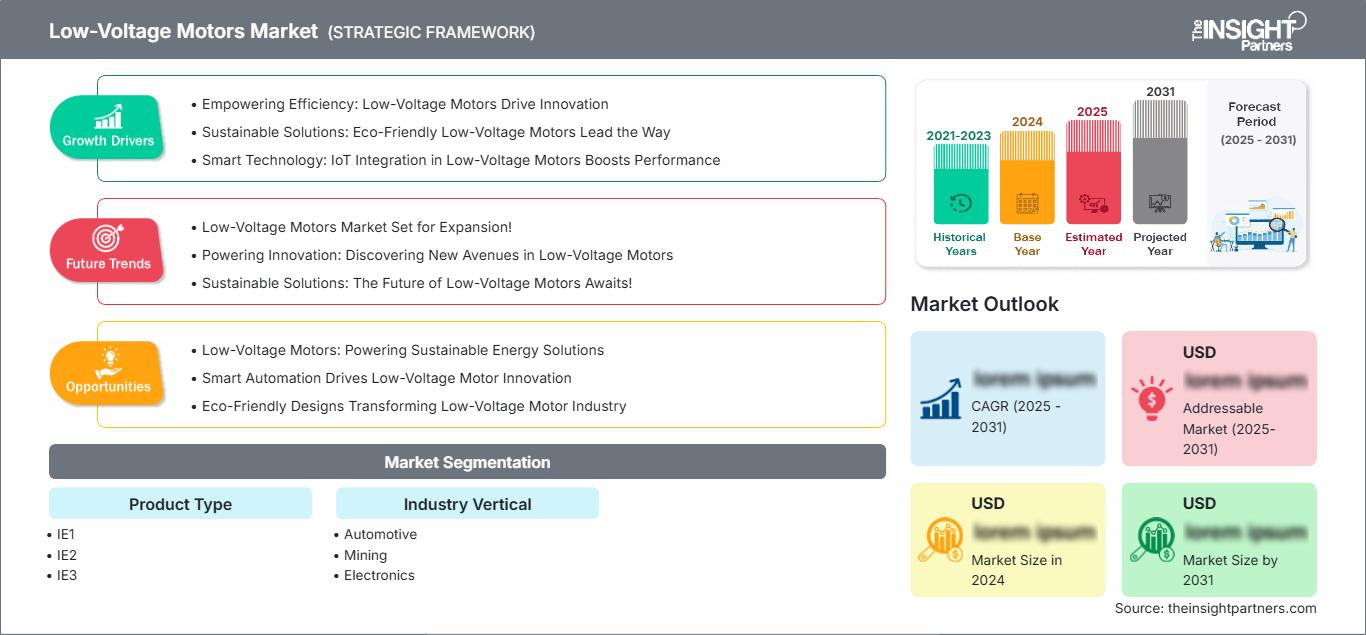
Low-Voltage Motors Market: Strategic Insights
Regional Insights
North America Low-Voltage Motors Market
North America accounted for 26–30% of the global low-voltage motors market share in 2025 and is projected to expand at a CAGR of 6.5%–7.5% during 2026–2034. Growth within the market can be attributed to modernization of industries, installation of new motor systems, and energy efficiency standards that apply in the manufacture, utility and commercial sectors. The increased use of automation systems and digital asset management is also increasing the need for premium efficiency low-voltage motors within the continuous process industries.
The region is also experiencing continued investment in water and wastewater treatment plants, food and beverage processing facilities, oil and gas infrastructure, and manufacturing facilities. Increased adoption of variable frequency drives with IE3 and IE4 motors is allowing users to save on electricity while enhancing process reliability. Government policies favoring industrial electrification and decarbonization are expected to promote replacement demand.
U.S. Low-Voltage Motors Market
The U.S. represented 78–82% of the North American market in 2025 and is anticipated to register a CAGR of 6.7%–7.7% through 2034. Strong domestic manufacturing, extensive industrial automation, and continued investments in semiconductor, automotive, and logistics facilities sustain demand for advanced low-voltage motors. Leading global manufacturers maintain engineering, manufacturing, and service operations across the country, ensuring continuous product innovation and aftermarket support.
Application demand continues to expand across HVAC systems, water infrastructure, warehouse automation, mining equipment, and food processing facilities. Industrial operators increasingly prioritize digitally connected motors capable of predictive maintenance and remote performance monitoring, helping reduce downtime and improve energy efficiency. Compliance with U.S. Department of Energy efficiency regulations continues to accelerate the replacement of legacy motor installations with premium-efficiency alternatives across industrial sectors.
Europe Low-Voltage Motors Market
Europe held 24–28% of the global market in 2025 and is expected to record a CAGR of 7.0%–8.0% during the forecast period. Germany remains the regional leader owing to its advanced manufacturing base, strong automation industry, and sustained investments in energy-efficient industrial equipment. The country's machinery, automotive, and process industries continue to adopt premium-efficiency motors to meet sustainability objectives while improving operational productivity.
The United Kingdom is witnessing the growing deployment of efficient motor systems across pharmaceuticals, food processing, and commercial infrastructure as organizations pursue carbon reduction targets. France, Italy, and Spain continue to expand investments in industrial modernization, renewable energy integration, water treatment, and advanced manufacturing. Collectively, these markets benefit from European Union energy-efficiency regulations and increasing adoption of smart factory technologies, reinforcing long-term regional demand for high-performance motor systems.
APAC Low-Voltage Motors Market
Asia Pacific accounted for 39–43% of the global market in 2025 and is forecast to expand at a CAGR of 9.5%–10.5% through 2034. China remains the largest contributor, while Japan, South Korea, India, and Australia continue strengthening regional demand through manufacturing expansion and industrial automation investments.
Government initiatives supporting industrial electrification, domestic manufacturing, and energy conservation continue to accelerate premium motor adoption across the region. Rapid infrastructure development, expanding electronics production, and increasing automation across the automotive and textile industries position the Asia Pacific as the fastest-growing regional market.
Middle East & Africa Low-Voltage Motors Market
The Middle East & Africa market is projected to grow at a CAGR of 7.8%–8.8% during 2026–2034. Saudi Arabia leads regional demand through industrial diversification and large-scale infrastructure projects, while the United Arab Emirates continues investing in advanced manufacturing and utilities. South Africa remains an important market supported by mining, metals, and industrial processing applications.
Expansion of desalination facilities, power infrastructure, oil and gas modernization, and manufacturing capacity is creating sustained opportunities for premium-efficiency low-voltage motors. Continued investments across the rest of the Middle East & Africa are expected to support demand for reliable industrial equipment capable of operating under challenging environmental and operating conditions.
Segmentation Analysis
Product Type
The Product Type segment is expected to register a CAGR of 8.5%–9.5% during 2026–2034, supported by tightening global energy-efficiency regulations and increasing industrial investment in advanced motor technologies. Growing replacement of conventional motors with premium-efficiency alternatives, coupled with digital monitoring capabilities and compatibility with variable frequency drives, continues to strengthen adoption across diverse industrial applications. The low-voltage motors market scope continues to expand as manufacturers introduce higher-efficiency motor platforms to meet sustainability goals, lower lifecycle operating costs, and improve equipment reliability in industrial environments.
- IE1: IE1 motors continue to serve cost-sensitive industrial applications where capital expenditure remains the primary purchasing consideration. Demand is gradually declining as industries migrate toward higher-efficiency alternatives to comply with evolving regulatory requirements and reduce long-term electricity consumption.
- IE2: IE2 motors maintain a significant installed base across manufacturing, commercial buildings, and utility applications. They provide an effective balance between acquisition cost and operational efficiency, particularly in regions where premium-efficiency regulations are being implemented progressively.
- IE3: IE3 motors represent the most widely adopted premium-efficiency category across modern industrial facilities. Strong acceptance is driven by regulatory compliance, improved energy savings, compatibility with automation systems, and favorable lifecycle economics across continuous-duty industrial operations.
- IE4: IE4 motors are experiencing rapid adoption as manufacturers prioritize sustainability, operational efficiency, and carbon reduction initiatives. Their superior energy performance and lower maintenance requirements make them increasingly attractive for high-utilization industrial applications and smart manufacturing environments.
Industry Vertical
The Industry Vertical segment is projected to grow at a CAGR of 8.0%–9.0% during the forecast period. Expanding industrial automation, electrification of manufacturing processes, and increasing investments in energy-efficient production facilities continue to stimulate demand across multiple end-use industries. Rising emphasis on operational productivity, predictive maintenance, and compliance with environmental standards further supports sustained adoption of premium low-voltage motor solutions across both established and emerging industrial sectors.
- Automotive: The automotive industry remains the leading consumer of low-voltage motors owing to extensive use in robotic assembly, conveyor systems, paint shops, and automated production lines. Continuous investments in electric vehicle manufacturing further reinforce long-term demand.
- Mining: Mining operations require robust and energy-efficient motor systems for crushers, conveyors, pumps, and ventilation equipment. Growing investments in mineral extraction and digital mine automation continue to strengthen demand for reliable industrial motor solutions.
- Electronics: Electronics manufacturing increasingly deploys precision motor systems within semiconductor fabrication, assembly automation, cleanroom equipment, and material handling operations. Rising investments in semiconductor capacity support sustained demand for efficient motor technologies.
- Textile: Textile manufacturers are modernizing spinning, weaving, dyeing, and finishing operations through automated equipment powered by energy-efficient motors. Improved production efficiency and lower operating costs remain primary purchasing considerations across the industry.
- Food & Beverages: Food and beverage facilities increasingly adopt premium-efficiency motors to support hygienic processing, refrigeration, packaging, pumping, and material handling systems. Growing investment in automated production and stringent food safety standards continue to drive market demand.
Opportunity Snapshot
| Industry Vertical | Revenue Contribution | Trend Tag | Adoption Stage |
|---|---|---|---|
| Automotive | High | EV Manufacturing | Mature |
| Mining | Medium | Mine Automation | Scaling |
| Electronics | High | Semiconductor Expansion | Scaling |
| Textile | Medium | Smart Mills | Scaling |
| Food & Beverages | High | Hygienic Processing | Mature |
Low-Voltage Motors Market Growth Drivers and Impact Analysis
Rising Industrial Electrification and Energy-Efficiency Regulations
Industrial electrification is accelerating across manufacturing, utilities, mining, and commercial infrastructure as organizations seek to improve operational efficiency and reduce greenhouse gas emissions. Governments and regulatory authorities continue to tighten minimum energy performance standards, encouraging replacement of aging IE1 and IE2 motors with high-efficiency IE3 and IE4 alternatives. Since electric motors account for a substantial share of industrial electricity consumption, upgrading installed motor fleets offers measurable reductions in operating costs and carbon emissions. These regulatory and economic factors are encouraging capital investments in premium-efficiency motor systems integrated with variable frequency drives and digital monitoring technologies. Consequently, equipment manufacturers are expanding advanced product portfolios while industrial operators prioritize lifecycle cost savings, reinforcing sustained demand across the global low-voltage motors market.
Rapid Expansion of Industrial Automation and Smart Manufacturing
The shift towards Industry 4.0 is leading to an unprecedented surge in the need for smart motor systems that would be able to assist in automated production settings. Automakers, electronics firms, food processors, and logistics companies are deploying robots, automated material handling, and production machinery that requires robust low-voltage motors. The use of the Industrial Internet of Things platforms is leading to predictive maintenance, real-time performance monitoring, and optimal energy consumption, lowering downtime and increasing efficiency of assets. In response, manufacturers have been producing motors that are more connected and smarter and can interact with digital control systems. Such developments are likely to fuel growth of the market in the future due to continued investments in factory upgrades backed by the manufacturing programs of the government and private capex.
Infrastructure Development and Manufacturing Capacity Expansion
Massive investments in industrial infrastructure, water and wastewater treatment systems, renewable energy plants, mining facilities, and commercial structures will keep the demand for low-voltage motors high. Developing nations will be building up their own manufacturing capacity through industrial corridors, special economic zones, and investment incentive schemes for manufacturers that encourage equipment purchases. In addition, developed countries will be bringing back strategic manufacturing industries from abroad and upgrading their existing manufacturing capacities. All of this will result in greater demand for energy-efficient and motorized pumps, compressors, conveyors, fans, and processing equipment. It is clear that rising industrial capacity all around the world will create opportunities for suppliers of motor products.
Low-Voltage Motors Market Future Trends
Acceleration of Premium-Efficiency Motor Adoption
Growing sustainability commitments and tightening efficiency regulations are expected to accelerate the transition from conventional motor technologies toward IE4 and higher-efficiency solutions across industrial sectors. The low-voltage motors market trends indicate that end users are increasingly evaluating total lifecycle costs rather than initial purchase prices, encouraging investments in premium motors that deliver lower energy consumption, reduced maintenance requirements, and longer operational life. The integration of variable frequency drives and intelligent control systems will ensure that system efficiency is improved while helping achieve carbon emission reduction goals. Advanced materials, optimal electromagnetic configurations, and digital monitoring will therefore be the key focus areas of manufacturers to improve their products’ competitive edge and meet industrial energy management needs.
Growing Integration of Intelligent Motor Monitoring Platforms
The adoption of digital transformation is set to revolutionize motor management systems in industries due to the increasing prevalence of connectivity monitoring solutions. Through sensors, cloud computing, and AI analysis, monitoring of vibration, temperature, energy consumption, and operation becomes possible, which will help in the adoption of a predictive maintenance model in place of a traditional maintenance schedule. This approach will aid in minimizing breakdowns and ensuring optimal efficiency of production while reducing costs. With the advancement of smart factories by industrial firms, it is expected that manufacturers will launch increasingly connected low-voltage motors that integrate easily within IIoT environments, enterprise asset management, and automation solutions.
Low-Voltage Motors Market Opportunities
Expansion of High-Efficiency Motor Deployment in Emerging Manufacturing Economies
Rapid industrialization across India, Southeast Asia, Latin America, the Middle East, and selected African economies is creating significant opportunities for manufacturers of premium low-voltage motors. Industrial investment programs, manufacturing incentives, and infrastructure development are increasing demand for energy-efficient equipment across automotive, electronics, mining, food processing, and textile industries. Low-voltage motors market forecasts indicate that suppliers establishing localized production, engineering support, and aftermarket service networks will be better positioned to capture long-term demand. Strategic partnerships with system integrators, original equipment manufacturers, and industrial automation providers can further strengthen market penetration while reducing supply chain risks. Companies investing in region-specific product customization and technical support capabilities are expected to achieve stronger competitive differentiation and sustainable revenue growth.
Growth Potential Through Digital Service and Lifecycle Management Solutions
Today's industrial customers are demanding integrated lifecycle solutions instead of mere individual motor solutions, opening up new avenues for revenue generation for the suppliers and technological partners. The predictive maintenance systems, remote monitoring systems, digital diagnosis, and performance optimization services are some key factors that distinguish the procurement processes today. The companies that provide efficient motors in conjunction with asset management through software, performance assessment of energy usage, and maintenance agreements will be able to ensure good customer relations as well as generate revenue from the services. The adoption of Industrial IoT technology in manufacturing, utility, mining, and infrastructure industries will help vendors to shift towards service-oriented business models.
Frequently Asked Questions

- Comprehensive Market Sizing and Forecast Analysis
- Detailed Segmentation Analysis
- In-Depth Market Dynamics Assessment
- Regional and Country-Level Insights
- Competitive Landscape and Company Benchmarking
- Strategic Business Intelligence
Recent Reports
Testimonials

The Insight Partners provided valuable market intelligence that supported our global go-to-market strategy. Their team was professional, responsive, and attentive to our feedback, providing thoughtful analysis and helpful methodological clarifications throughout the project.
Junmo Kim Chief Financial Officer (CFO), Enertech Co., Ltd.
The Insight Partners' SCADA System Market report is comprehensive, with valuable insights on current trends and future forecasts. The team was highly professional, responsive, and supportive throughout. We are very satisfied and highly recommend their services.
RAN KEDEM Partner, Reali Technologies LTDs
I requested a report on a very specific software market and the team produced the report in a few days. The information was very relevant and well presented. I then requested some changes and additions to the report. The team was again very responsive and I got the final report in less than a week.
JEAN-HERVE JENN Chairman, Future Analytica
We worked with The Insight Partners for an important market study and forecast. They gave us clear insights into opportunities and risks, which helped shape our plans. Their research was easy to use and based on solid data. It helped us make smart, confident decisions. We highly recommend them.
PIYUSH NAGPAL Sr. Vice President, High Beam Global
The Insight Partners delivered insightful, well-structured market research with strong domain expertise. Their team was professional and responsive throughout. The user-friendly website made accessing industry reports seamless. We highly recommend them for reliable, high-quality research services
YUKIHIKO ADACHI CEO, Deep Blue, LLC.
This is the first time I have purchased a market report from The Insight Partners.While I was unsure at first, I visited their web site and felt more comfortable to take the risk and purchase a market report.I am completely satisfied with the quality of the report and customer service. I had several questions and comments with the initial report, but after a couple of dialogs over email with their analyst I believe I have a report that I can use as input to our strategic planning process.Thank you so much for taking the extra time and making this a positive experience.I will definitely recommend your service to others and you will be my first call when we need further market data.
JOHN SUZUKI President and Chief Executive Officer, Board Director, BK Technologies
I wish to appreciate your support and the professionalism you displayed in the course of attending to my request for information regarding to infectious disease IVD market in Nigeria. I appreciate your patience, your guidance, and the fact that you were willing to offer a discount, which eventually made it possible for us to close a deal. I look forward to engaging The Insight Partners in the future, all thanks to the impression you have created in me as a result of this first encounter.
DR CHIJIOKE ONYIA MANAGING DIRECTOR, PineCrest Healthcare Ltd.Reason to Buy
- Informed Decision-Making
- Understanding Market Dynamics
- Competitive Analysis
- Identifying Emerging Markets
- Customer Insights
- Market Forecasts
- Risk Mitigation
- Boosting Operational Efficiency
- Strategic Planning
- Investment Justification
- Tracking Industry Innovations
- Aligning with Regulatory Trends





 Get Free Sample for