
Medium Voltage Fuse Market Size, Growth & Demand by 2034
Coverage: by Type (Current Limiting Fuses, Expulsion Fuses, EEI-NEMA Type K And T And Type H And N, Others); Application (Transformers, Motor Starters/Motor Circuits, Feeder Circuits/ Feeders, Switchgear, Capacitors, Others) , and Geography (North America, Europe, Asia Pacific, and South and Central America)
- Status : Data Released
- Report Code : TIPRE00004633
- Category : Electronics and Semiconductor
- No. of Pages : 150
- Available Report Formats :


- Last update date : September 29, 2026


2025 Market Size
US$ 435.68 Mn
Base year value
2034 Forecast
US$ 624.86 Mn
Projected by 2034
CAGR 2026-2034
4.61 %
Growth rate
Addressable Market
US$ 4,945.53 Mn
(2026-2034)
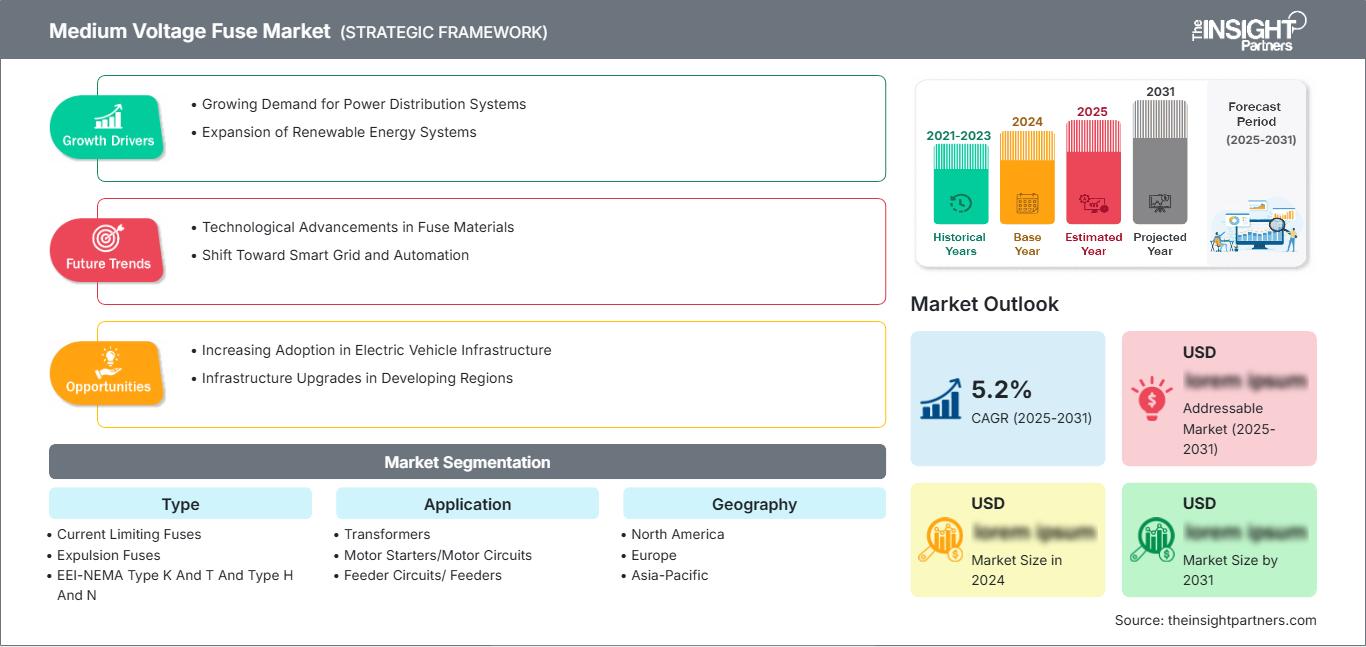
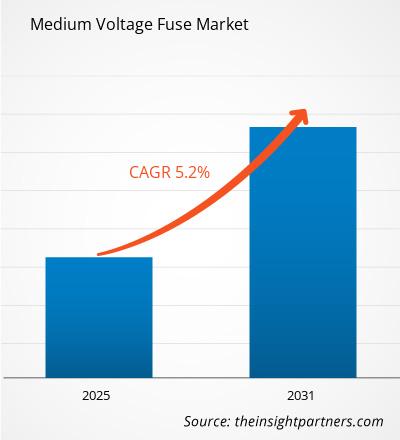
The medium voltage fuse market size is projected to expand from US$ 435.68 Million in 2025 to US$ 624.86 Million by 2034, registering a CAGR of 4.61% during 2026–2034. The outlook reflects sustained replacement demand across distribution networks, industrial electrical systems, transformers, feeders, and switchgear, where dependable short-circuit protection remains essential as power systems become more interconnected, automated, and exposed to variable loads.
North America is positioned for steady expansion as utilities modernize distribution assets and industrial operators prioritize selective protection, reliability, and faster fault isolation. The medium voltage fuse market is supported by replacement cycles, transformer additions, renewable interconnections, and continued investment in resilient distribution infrastructure, with growth also shaped by established standards and a broad installed base requiring compatible protection devices.
Medium Voltage Fuse Market Assessment and Insights
- North America: 2025 share is 28–32%, with a 2026–2034 CAGR of 4.3–4.7%. Utility replacement programs, industrial upgrades, and transformer protection requirements support consistent regional demand.
- US: The US represents 72–76% of North America's 2025 medium voltage fuse market share, with a 2026–2034 CAGR of 4.4–4.8%, supported by grid hardening and industrial electrification.
- Europe: 2025 share is 24–28%, with a 2026–2034 CAGR of 4.2–4.6%. Germany, the UK, France, Italy, and Spain remain important owing to distribution modernization and renewable integration.
- Asia Pacific: 2025 share is 31–35%, with a 2026–2034 CAGR of 5.0–5.4%. China, Japan, India, and South Korea benefit from industrial capacity expansion and network investment.
- Largest Segment: Current Limiting Fuses hold a 2025 share of 58–62%, with a 2026–2034 CAGR of 4.9–5.2%, reflecting broad fault-current protection requirements.
- High Growth Segment: Feeder Circuits/ Feeders hold a 2025 share of 21–25%, with a 2026–2034 CAGR of 5.3–5.7%, supported by distribution expansion.
- Key companies: ABB Ltd, Bel Fuse Inc, DF Electric, Eaton Corporation plc, Fuseco Inc, Fusetek, GE Vernova Inc, Littelfuse, Inc, Mersen S.A., and SIBA GmbH.
Source: The Insight Partners' analysis based on proprietary research, government publications, company annual reports, investor presentations, industry databases, and expert interviews.
Distribution system protection has moved from standard products to custom-made solutions based on fault current level, coordination, environmental requirements, and duty. Today's current-limiting technology places increasing emphasis on low let-through energy, small size, good indication, and predictable interruption. IEC and ANSI/IEEE families are separately developed by manufacturers for their clients, since different users prefer different standards and voltage ranges.
Investment in the future will increase in such countries as India, Southeast Asia, the Middle East, and some Latin American distribution systems, because of growing power consumption and production. Legal concern about the safety and reliability of electric equipment will support qualified product choice, and computer-based procurement processes with unified technical specifications will help to speed up this process without losing the value of field engineering work and utility approval procedures.
Medium Voltage Fuse Market Report Scope
| Report Attribute | Details |
|---|---|
| Market size in 2025 | US$ 435.68 Million |
| Market Size by 2034 | US$ 624.86 Million |
| Global CAGR (2026 - 2034) | 4.61% |
| Historical Data | 2021-2024 |
| Forecast period | 2026-2034 |
Medium Voltage Fuse Market Analysis
The demand is based on transformers, feeders, motor circuits, switchgear, and capacitor installations that require a predictable interruption in case of an abnormal current event. Thus, the development of the market for medium voltage fuses depends on the base of the installed electrical equipment. The value chain includes fuse components, insulation, arc-extinguishing substances, terminals, indicators, certification and tests, distributors, panel manufacturers, utilities, and industrial consumers.
The supply is conditioned by specialized production, metallurgy, insulation, precise assembly, and high-voltage testing. Current documentation of Eaton's products shows how various designs of medium voltage fuses can protect transformers and feeders, while Littelfuse specifies its R-rated products to protect motors and controllers. Such differences promote broad product ranges of suppliers instead of universal construction.
Positioning requires a broad portfolio, certification, engineering, distribution, and rating customization. Medium voltage fuse market analysis suggests that ABB Ltd, Eaton Corporation plc, Littelfuse, Inc, Mersen S.A., and SIBA GmbH compete on existing portfolio offerings, and Bel Fuse Inc, DF Electric, Fuseco Inc, Fusetek, and GE Vernova Inc offer specialization and/or regional offerings. Differentiation is built on interruption capability, portfolio presence, reliability, and application suitability.
The focus of the medium voltage fuse market is shifting towards robust manufacturing, testing, renewable energy protection, and lifecycle management. Suppliers who have ties with utilities have the ability to compete with design approval and compatibility, and suppliers who specialize can focus on hard-to-satisfy ratings and undercovered geographic regions. Partnering with channels and extending portfolio will help with availability, but qualification prevents supplier replacement.
● REPORT CUSTOMIZATION
Tailor This Report To Align With Your Specific Business Requirements
This report can be customized to align precisely with your business objectives, scope, and target markets. Customization options include tailored segmentation, geography, competitive analysis, and strategic insights to support informed decision-making.
Customize This Report →WHAT YOU CAN ADJUST
- ● Segmentations
- ● Geography
- ● Competitive Analysis
- ● Language Preferences
Medium Voltage Fuse Market: Strategic Insights
Regional Insights
North America medium voltage fuse market
North America is estimated at 28–32% of 2025 demand, with a modeled 2026–2034 CAGR of 4.3–4.7%. There is potential for the region to derive advantages through investment in utility infrastructure replacement, transformer upgrades, industrial electrification, and grid resiliency. There are well-developed standards and distribution networks that ensure the continuous need for suitable fuse links.
The US has the largest proportion of consumption within the region. Meanwhile, Canada provides contributions through utility upgrade, mining, and industrial applications. Mexico will have its own advantages due to growth in manufacturing industries.
U.S. medium voltage fuse Market
The medium voltage fuse market report shows that US represents 72–76% of North America's 2025 demand and is modeled to grow at 4.4–4.8% through 2034. There is an ongoing need for designs of current limiting and expulsion in utility grid hardening, transformer replacement, industrial automation, and renewable interconnection projects.
Companies that have relevant positions in this market include ABB Ltd, Eaton Corporation plc, Littelfuse, Inc, Mersen S.A., and GE Vernova Inc. The need is highest in transformers and feeders protection, whereas there are specific needs for motors and switchgears protection. Certified products are preferred with coordination data and replacement options.
Europe medium voltage fuse Market
Europe represents an estimated 24–28% medium voltage fuse market share in 2025 and is modeled to expand at 4.2–4.6% during 2026–2034. Germany takes the lead in regional demand due to the presence of industrial electrical infrastructure and its modernization and integration with renewables. Other regions include the UK, France, Italy, and Spain, where investments in grid systems and industrial replacement will offer further possibilities.
The UK focuses on distribution resilience and renewable connections, Germany on industrial load and medium-voltage network, France on infrastructure investment, Italy on industrial replacement, and Spain on renewable connections. IEC standards, safety specifications, and replacements continue to be the core aspects for buying decisions in all these countries.
APAC medium voltage fuse Market
The medium voltage fuse market forecast shows that APAC holds an estimated 31–35% share in 2025 and is modeled at 5.0–5.4% CAGR through 2034. Demand from China is followed by Japan, India, South Korea, and Australia. The growth of industry, distribution network development, renewable connection, and investments in transmission and distribution drive equipment demand.
China has manufacturing capabilities along with network development, whereas India focuses on developing its distribution network and industrial electricity infrastructure. Reliability is of prime importance to Japan and South Korea, while Australia needs protection for its distributed network and resource projects.
Middle East & Africa medium voltage fuse Market
MEA is expected to grow at a modeled 4.7–5.1% CAGR through 2034, with Saudi Arabia leading regional demand. The UAE and South Africa are secondary markets, while the rest of MEA offers opportunities through utility expansion, industrial projects, and infrastructure development.
Energy-intensive facilities, urban development, water infrastructure, and renewable projects support transformer and feeder protection. Saudi Arabia benefits from infrastructure programs, the UAE from utility modernization, and South Africa from grid reliability needs. Procurement is project-driven, making local support and availability important.
Segmentation Analysis
Type
Type is expected to grow at a modeled CAGR of 4.9–5.2% from 2026–2034. Current-limiting products remain central where short-circuit energy must be constrained, while expulsion designs retain relevance in utility distribution. Selection depends on fault level, coordination, installation environment, equipment value, and standards.
- Current Limiting Fuses: These products are selected for rapid interruption and reduced let-through energy around transformers, switchgear, motors, and high-capacity distribution systems where equipment damage must be minimized.
- Expulsion Fuses: Expulsion designs remain relevant for outdoor distribution and utility applications where economical protection, visible operation, and established field practices influence specifications.
- EEI-NEMA Type K And T And Type H And N: These configurations serve established North American distribution practices, with selection influenced by time-current characteristics, coordination requirements, transformer protection, and compatibility with existing utility hardware.
- Others: This category covers application-specific constructions and ratings used where standard configurations do not fully meet installation, voltage, current, environmental, or equipment coordination requirements.
Application
Application is projected to register a modeled CAGR of 4.8–5.1% during 2026–2034. Protection demand follows the installed base of electrical equipment, with transformers and feeders representing recurring utility needs and motors, switchgear, and capacitors creating specialized industrial requirements.
- Transformers: Transformer protection remains a core application because fuses provide a compact method for limiting fault energy and isolating abnormal conditions on primary circuits, supporting utility and industrial distribution reliability.
- Motor Starters/Motor Circuits: Motor applications require coordinated protection that accommodates starting current while responding to short circuits, making rating selection and controller compatibility important engineering considerations.
- Feeder Circuits/ Feeders: Feeder protection benefits from network expansion and replacement programs, particularly where utilities need dependable fault isolation across branching distribution systems and industrial plants.
- Switchgear: Switchgear applications require compact, coordinated protection that can manage high fault levels while fitting established equipment architectures, especially in substations, industrial plants, and distribution assemblies.
- Capacitors: Capacitor protection addresses abnormal current conditions in power-factor correction and network compensation equipment, requiring careful coordination to avoid nuisance operation during switching events.
- Others: Specialized installations include equipment combinations with distinct protection requirements, where selection depends on voltage class, fault characteristics, enclosure conditions, and local engineering standards.
Opportunity Snapshot
| Application | Revenue Contribution | Trend Tag | Adoption Stage |
|---|---|---|---|
| Transformers | High | Transformer Renewal | Mature |
| Motor Starters/Motor Circuits | Medium | Motor Protection | Mature |
| Feeder Circuits/ Feeders | High | Grid Expansion | Scaling |
| Switchgear | High | Compact Protection | Scaling |
| Capacitors | Medium | Power Quality | Mature |
| Others | Low | Custom Protection | Emerging |
Medium Voltage Fuse Market Growth Drivers and Impact Analysis
Grid modernization and transformer replacement programs
Aging distribution infrastructure creates a durable replacement pathway for protection equipment because new transformers, feeders, and switchgear require correctly coordinated overcurrent devices. Utilities also increasingly segment networks to improve reliability and reduce outage consequences, increasing the number of protected circuits per project. The impact is strongest where existing equipment is being replaced without redesigning the entire protection architecture, because compatible fuse dimensions and electrical characteristics reduce engineering disruption. For suppliers, this favors products with documented interchangeability, broad voltage ratings, and established utility approvals. Modernization spending also supports demand for both current-limiting and expulsion technologies, depending on network design. As utilities combine conventional reinforcement with distributed generation, fuse coordination becomes more important, creating additional engineering-led demand rather than simple commodity replacement.
Renewable integration and increasingly variable distribution loads
Renewable generation changes current-flow patterns across distribution networks, requiring protection schemes to account for bidirectional power flows, distributed generation, and changing fault behavior. Their ratings and coordination remain important within transformers, feeders, capacitor banks, and switchgear connected to renewable assets. The impact is particularly relevant for utility projects that connect solar and wind capacity through new medium-voltage collection or distribution infrastructure. Suppliers can benefit when project engineers specify proven products that integrate with existing protection philosophies. The resulting opportunity is not limited to renewable generation itself. Battery storage, industrial electrification, and charging infrastructure can also increase the number of medium-voltage assets requiring dependable fault protection. Manufacturers should therefore strengthen testing, application engineering, and coordination support as network architectures become more complex.
Industrial electrification and higher equipment reliability requirements
Industrial facilities are adding electrical loads associated with automation, process equipment, data infrastructure, electrified heating, and distributed power systems. Higher equipment utilization raises the financial consequences of electrical faults, encouraging operators to prioritize protection that limits equipment damage and shortens restoration time. Medium-voltage motors, transformers, feeders, and switchgear are particularly important because failures can interrupt production across multiple process stages. The impact extends to suppliers that provide engineered fuse selections, replacement inventory, and technical support rather than standalone components. Industrial customers also tend to maintain documented maintenance practices, which can create recurring demand for standardized replacements. As factories modernize electrical rooms, protection devices are increasingly selected as part of integrated equipment packages, strengthening relationships between fuse manufacturers, switchgear suppliers, panel builders, system integrators, and industrial engineering contractors.
Medium Voltage Fuse Market Future Trends
Application-specific fuse engineering and compact protection architectures
The medium voltage fuse market trends indicate that future product development is likely to emphasize application-specific electrical characteristics, compact dimensions, improved indication, and better thermal behavior rather than broad increases in nominal ratings. Engineers will increasingly evaluate fuse performance alongside switchgear footprint, transformer impedance, motor starting profiles, and feeder coordination. This can encourage manufacturers to offer more differentiated families for tightly defined duty conditions. Compact protection architectures should gain attention in urban substations, industrial electrical rooms, renewable collection systems, and modular distribution equipment where available space is constrained. Digital product selectors, coordination software, and configuration databases may become more important commercial tools because they reduce engineering time and improve specification accuracy. The resulting competitive advantage will depend on combining physical product performance with usable technical data and application support.
Lifecycle intelligence and specification-led procurement
Procurement is likely to become more lifecycle-oriented as utilities and industrial operators evaluate total maintenance exposure rather than purchase price alone. Product records, drawings, certification data, compatibility, and availability can increasingly influence supplier selection. Lifecycle intelligence can help asset owners identify obsolete fuse types before failures, supporting planned rather than emergency replacement. Manufacturers connecting these resources to digital catalogs may reduce specification errors and improve repeat ordering. The trend should favor suppliers with extensive installed-base knowledge, stable product documentation, and responsive technical service. It may also strengthen customer retention because protection components are frequently selected as part of standardized maintenance practices. Over time, distributors can use digital inventory data to prioritize frequently requested ratings while maintaining access to specialized configurations.
Medium Voltage Fuse Market Opportunities
Localized manufacturing and distribution in high-investment regions
Investment opportunities are emerging where distribution infrastructure is expanding faster than established supply chains can efficiently serve local projects. India, Southeast Asia, selected Middle Eastern economies, and parts of Latin America offer potential for localized assembly, inventory hubs, technical support, and channel partnerships. The opportunity is strongest for suppliers able to combine internationally recognized standards with region-specific ratings and documentation. Local availability can reduce project delays, especially when utilities or industrial contractors require replacement units during commissioning and maintenance. Investors should assess utility qualification cycles, distributor capabilities, import requirements, and service coverage before committing capacity. Strategic partnerships with switchgear manufacturers and electrical contractors can also create specification access earlier in project development. Localized support may become a stronger differentiator than marginal price reductions.
Protection solutions for renewable and storage-linked distribution assets
Renewable generation and energy storage are creating new electrical assets that require coordinated protection across transformers, feeders, switchgear, and auxiliary equipment. Suppliers can pursue opportunities by developing application packages rather than selling individual fuse links, combining selection guidance, coordination information, installation accessories, and replacement planning. This approach can improve value capture where project developers and engineering contractors prefer qualified component packages. The opportunity also extends to hybrid systems connecting solar, storage, industrial loads, and conventional distribution equipment. Manufacturers should prioritize ratings and constructions suited to evolving system architectures while maintaining compatibility with established standards. Strategic investment in testing, engineering validation, and project support can improve credibility with utilities and EPC contractors. Companies demonstrating reliable performance under changing loads may secure longer-term positions in renewable infrastructure programs.
Frequently Asked Questions

- Comprehensive Market Sizing and Forecast Analysis
- Detailed Segmentation Analysis
- In-Depth Market Dynamics Assessment
- Regional and Country-Level Insights
- Competitive Landscape and Company Benchmarking
- Strategic Business Intelligence
Recent Reports
Testimonials

The Insight Partners provided valuable market intelligence that supported our global go-to-market strategy. Their team was professional, responsive, and attentive to our feedback, providing thoughtful analysis and helpful methodological clarifications throughout the project.
Junmo Kim Chief Financial Officer (CFO), Enertech Co., Ltd.
The Insight Partners' SCADA System Market report is comprehensive, with valuable insights on current trends and future forecasts. The team was highly professional, responsive, and supportive throughout. We are very satisfied and highly recommend their services.
RAN KEDEM Partner, Reali Technologies LTDs
I requested a report on a very specific software market and the team produced the report in a few days. The information was very relevant and well presented. I then requested some changes and additions to the report. The team was again very responsive and I got the final report in less than a week.
JEAN-HERVE JENN Chairman, Future Analytica
We worked with The Insight Partners for an important market study and forecast. They gave us clear insights into opportunities and risks, which helped shape our plans. Their research was easy to use and based on solid data. It helped us make smart, confident decisions. We highly recommend them.
PIYUSH NAGPAL Sr. Vice President, High Beam Global
The Insight Partners delivered insightful, well-structured market research with strong domain expertise. Their team was professional and responsive throughout. The user-friendly website made accessing industry reports seamless. We highly recommend them for reliable, high-quality research services
YUKIHIKO ADACHI CEO, Deep Blue, LLC.
This is the first time I have purchased a market report from The Insight Partners.While I was unsure at first, I visited their web site and felt more comfortable to take the risk and purchase a market report.I am completely satisfied with the quality of the report and customer service. I had several questions and comments with the initial report, but after a couple of dialogs over email with their analyst I believe I have a report that I can use as input to our strategic planning process.Thank you so much for taking the extra time and making this a positive experience.I will definitely recommend your service to others and you will be my first call when we need further market data.
JOHN SUZUKI President and Chief Executive Officer, Board Director, BK Technologies
I wish to appreciate your support and the professionalism you displayed in the course of attending to my request for information regarding to infectious disease IVD market in Nigeria. I appreciate your patience, your guidance, and the fact that you were willing to offer a discount, which eventually made it possible for us to close a deal. I look forward to engaging The Insight Partners in the future, all thanks to the impression you have created in me as a result of this first encounter.
DR CHIJIOKE ONYIA MANAGING DIRECTOR, PineCrest Healthcare Ltd.Reason to Buy
- Informed Decision-Making
- Understanding Market Dynamics
- Competitive Analysis
- Identifying Emerging Markets
- Customer Insights
- Market Forecasts
- Risk Mitigation
- Boosting Operational Efficiency
- Strategic Planning
- Investment Justification
- Tracking Industry Innovations
- Aligning with Regulatory Trends





 Get Free Sample for