
Outsourced Semiconductor Assembly and Test (OSAT) Market Trends, Share & Demand by 2034
Coverage: By Services (Assembly, Testing); Packaging (Ball Grid Array, Chip Scale Package, Multi-Package, Stacked Die, Quad and Dual); Industry Vertical (Automotive, Telecommunications, Computing and Networking, Consumer Electronics) , and Geography (North America, Europe, Asia Pacific, and South and Central America)
- Status : Data Released
- Report Code : TIPRE00019015
- Category : Electronics and Semiconductor
- No. of Pages : 150
- Available Report Formats :


- Last update date : October 13, 2026


2025 Market Size
US$ 65.82 Bn
Base year value
2034 Forecast
US$ 93.85 Bn
Projected by 2034
CAGR 2026-2034
4.54 %
Growth rate
Addressable Market
US$ 744.50 Bn
(2026-2034)
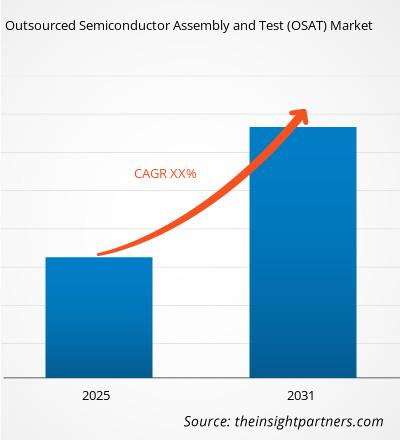
The outsourced semiconductor assembly and test market was valued at US$ 65.82 Billion in 2025 and is projected to reach US$ 93.85 Billion by 2034, expanding at a CAGR of 4.54% during 2026–2034. The market plays an essential role in the global semiconductor value chain by providing advanced packaging and testing services that enable chip manufacturers to improve production efficiency, reduce capital expenditure, and accelerate product commercialization across multiple end-use industries.
Across North America, increasing investment in advanced semiconductor manufacturing, resilient supply chain strategies, and domestic packaging capabilities is strengthening long-term industry prospects. The outsourced semiconductor assembly and test market size continues to benefit from government-backed semiconductor initiatives, rising demand for heterogeneous integration, and expanding adoption of AI accelerators, automotive electronics, and high-performance computing applications. The regional market is estimated to expand at a CAGR ranging between 4.2% and 4.8% through 2034.
Outsourced Semiconductor Assembly and Test (OSAT) Market Assessment and Insights
- North America: Accounted for an estimated 20–24% share in 2025 and is anticipated to grow at a CAGR of 4.2–4.8% during 2026–2034. Increasing semiconductor localization initiatives, advanced packaging investments, and demand from automotive and data center applications continue to support market expansion.
- U.S.: Represented approximately 78–82% of the North American market in 2025 and is projected to register a CAGR of 4.3–4.9% during 2026–2034, supported by semiconductor manufacturing incentives and strong fabless chip design activity.
- Europe: Held an estimated 17–20% share in 2025 while expanding at a CAGR of 3.8–4.4% during 2026–2034. Germany, France, the UK, Italy, and the Netherlands remain major contributors owing to automotive semiconductor demand and industrial electronics production.
- Asia Pacific: Captured approximately 50–55% share in 2025 and is expected to record a CAGR of 4.9–5.5% during 2026–2034. China, Taiwan, South Korea, Japan, and India continue to attract investments in semiconductor manufacturing, packaging innovation, and electronics production.
- Largest Segment: Assembly Services accounted for an estimated 58–62% market share in 2025 and is anticipated to grow at a CAGR of 4.2–4.7% during 2026–2034, supported by increasing outsourcing from fabless semiconductor companies.
- High Growth Segment: Automotive accounted for approximately 20–24% market share in 2025 and is projected to expand at a CAGR of 6.0–6.6% during 2026–2034, driven by vehicle electrification, advanced driver assistance systems, and power semiconductor adoption.
- Key companies analyzed in detail: ASE Technology Holding Co., Ltd.; UTAC Holdings Ltd.; Siliconware Precision Industries Co., Ltd. (SPIL); Amkor Technology, Inc.; TongFu Microelectronics Co., Ltd.; Jiangsu Changjiang Electronics Technology Co., Ltd. (JCET); ChipMOS Technologies Inc.; Tianshui Huatian Technology Co., Ltd.; Powertech Technology Inc.; Chipbond Technology Corporation.
Source: The Insight Partners' analysis based on proprietary research, government publications, company annual reports, investor presentations, industry databases, and expert interviews.
The evolution of the outsourced semiconductor assembly and test market reflects continuous transformation in semiconductor manufacturing priorities, where advanced packaging has become as strategically important as wafer fabrication. Advancements in artificial intelligence processors, high-performance computing, automotive electronics, and 5G communications have led to an increased demand for advanced assembly processes, such as chip-scale packaging, system-in-package, and stacked die assembly. There is a growing trend among semiconductor companies to collaborate with OSAT firms to keep production costs low and decrease time-to-market. Enhanced capabilities in testing automation, inspection, and heterogeneous integration have increased the significance of OSAT partners.
In terms of future developments, investments will be made in emerging semiconductor clusters driven by government policies, diversification of supply chains, and domestic manufacturing support measures. Asian, North American, and European countries are continuously launching semiconductor development initiatives, promoting the growth of advanced packaging capacities along with research collaboration initiatives. Increased demand for electric vehicles, edge artificial intelligence, industrial automation, and advanced telecommunications infrastructure will drive outsourcing requirements in the coming years.
Outsourced Semiconductor Assembly and Test (OSAT) Market Report Scope
| Report Attribute | Details |
|---|---|
| Market size in 2025 | US$ 65.82 Billion |
| Market Size by 2034 | US$ 93.85 Billion |
| Global CAGR (2026 - 2034) | 4.54% |
| Historical Data | 2021-2024 |
| Forecast period | 2026-2034 |
Outsourced Semiconductor Assembly and Test (OSAT) Market Analysis
The outsourced semiconductor assembly and test market growth is increasingly supported by expanding semiconductor demand across computing, automotive, industrial automation, telecommunications, and consumer electronics. Chip architecture innovation is fast-moving, resulting in the increased use of packaging technology, which enhances energy efficiency, thermal behavior, and miniaturization. As the complexity in semiconductor design increases, it becomes necessary to outsource the assembly and testing of integrated device manufacturers and fabless companies in order to remain flexible while keeping investment capital-intensive.
Optimization of the supply chain is yet another market driver. OSAT firms are adopting advanced packaging technology, automation technology, and quality systems to cope with the increasing complexity in the production process. Collaboration between foundries, integrated device manufacturers, EMS providers, and equipment manufacturers has been beneficial in optimizing the value chain of semiconductors.
The outsourced semiconductor assembly and test market analysis indicates that competition is increasingly centered on technological capability rather than manufacturing scale alone. Key players, including ASE Technology Holding Co., Ltd., Amkor Technology, Inc., Siliconware Precision Industries Co., Ltd., Jiangsu Changjiang Electronics Technology Co., Ltd., TongFu Microelectronics Co., Ltd., Powertech Technology Inc., UTAC Holdings Ltd., ChipMOS Technologies Inc., Chipbond Technology Corporation, and Tianshui Huatian Technology Co., Ltd., will keep making innovations in advanced packaging platforms, automation, and testing to reinforce competitive positioning.
The trend will be centered around fan-out packaging, wafer-level packaging, artificial intelligence-based inspection systems, and high-density interconnects. Collaborations between key players and foundry companies, automotive semiconductor producers, and cloud computing chipmakers will continue to influence competitive landscape dynamics. Growth in capacity in Asia, coupled with semiconductor industry initiatives supported by governments in North America and Europe, will contribute to improved supply chain reliability and sustainable industry development.
● REPORT CUSTOMIZATION
Tailor This Report To Align With Your Specific Business Requirements
This report can be customized to align precisely with your business objectives, scope, and target markets. Customization options include tailored segmentation, geography, competitive analysis, and strategic insights to support informed decision-making.
Customize This Report →WHAT YOU CAN ADJUST
- ● Segmentations
- ● Geography
- ● Competitive Analysis
- ● Language Preferences
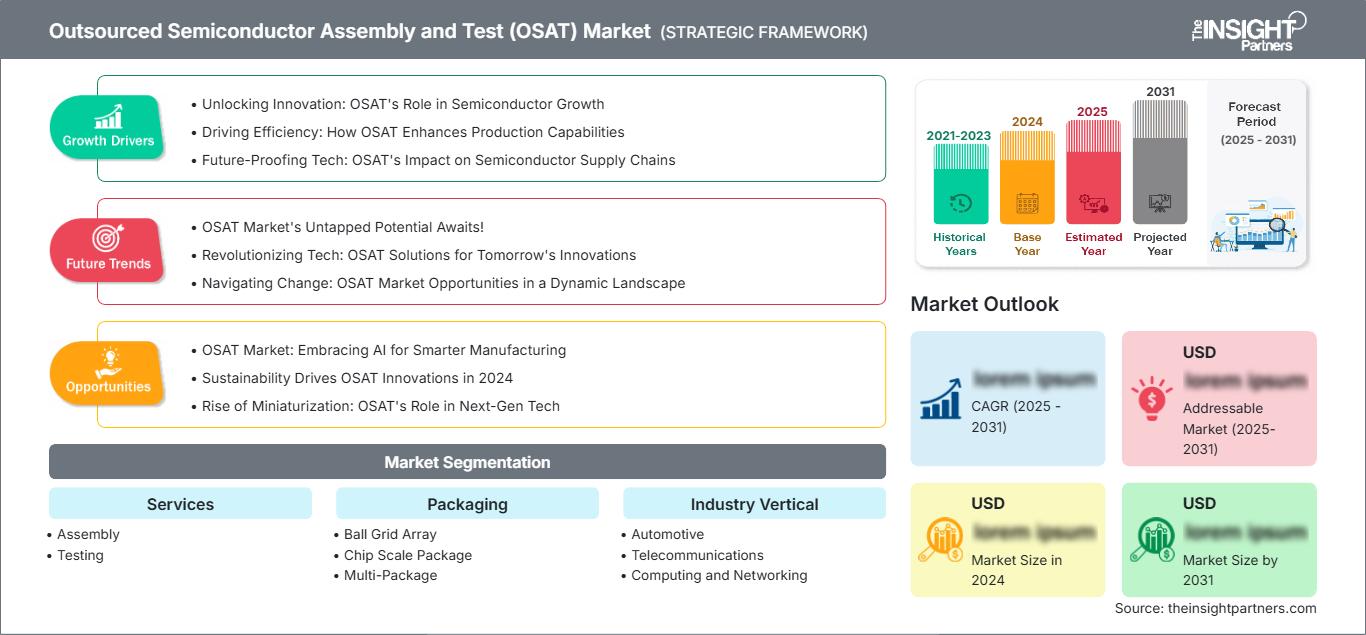
Outsourced Semiconductor Assembly and Test (OSAT) Market: Strategic Insights
Regional Insights
North America Outsourced Semiconductor Assembly and Test Market
North America accounted for approximately 20–24% of the outsourced semiconductor assembly and test market share in 2025 and is projected to expand at a CAGR ranging between 4.2% and 4.8% through 2034. Governments’ efforts to develop the semiconductor manufacturing industry, rising investment in advanced packaging capacity, and growing demand for semiconductors from applications such as AI, aerospace, and defense have been driving local industry growth. Collaborations between chip developers, equipment makers, and research centers have contributed to the competitiveness of technology.
The region also enjoys increased investment in automotive electronics, cloud systems, and high-performance computing. The advanced semiconductor packaging becomes a crucial priority for local manufacturing in order to mitigate the risks of the supply chain. Widespread use of chiplets, heterogeneous integration, and high bandwidth memory will generate further opportunities for dedicated OSATs as well as will increase the importance of North America in the worldwide semiconductor value chain.
U.S. Outsourced Semiconductor Assembly and Test Market
The United States represented nearly 78–82% of the North American market in 2025 and is expected to register a CAGR ranging from 4.3% to 4.9% through 2034. Adequate semiconductor design leadership, robust research and development investments, and enhanced domestic packaging capabilities will ensure market growth. Growing utilization of AI accelerators, data center processors, and advanced automotive semiconductors will enhance outsourcing demands.
Many major semiconductor firms have established technology partnerships within the US, ensuring that there is a need for quality assembly and testing operations. Defense electronics, cloud computing, and networking equipment continue to support sophisticated packaging technologies. Manufacturing incentives from federal organizations and private investors are anticipated to ensure supply chain resilience and increased localization of packaging operations.
Europe Outsourced Semiconductor Assembly and Test Market
Europe accounted for approximately 17–20% of the global market during 2025 and is forecast to grow at a CAGR ranging between 3.8% and 4.4% through 2034. Germany continues to be the leader due to its robust automotive semiconductor environment, industrial automation prowess, and growing investment in semiconductor fabrication technologies. The rise in use of electric vehicles and Industry 4.0 technologies also helps in meeting the demands for advanced packaging.
The United Kingdom maintains its semiconductor innovation efforts through intensive research programs in compound semiconductors, chip design, and advanced electronics. The combination of France, Italy, and Spain together makes an effort through aerospace electronics, industrial manufacturing, telecommunications infrastructure, and automotive applications. The development of regional efforts toward ensuring semiconductor supply chain strength and manufacturing capacity is expected to strengthen Europe’s position in advanced packaging and testing technologies.
APAC Outsourced Semiconductor Assembly and Test Market
Asia Pacific represented approximately 50–55% of the global market in 2025 and is projected to expand at a CAGR ranging from 4.9% to 5.5% during the forecast period. China, Taiwan, South Korea, Japan, and India continue attracting semiconductor manufacturing investments supported by extensive electronics production ecosystems and established supply chains.
Government incentives, expanding fabrication capacity, and increasing adoption of advanced semiconductor packaging technologies continue to strengthen regional competitiveness. China remains the largest regional market, while Taiwan and South Korea maintain leadership in advanced packaging innovation. India and Australia are gradually increasing semiconductor investments through manufacturing incentives, research collaboration, and electronics production initiatives.
Middle East & Africa Outsourced Semiconductor Assembly and Test Market
The Middle East and Africa market is expected to witness a CAGR ranging between 3.6% and 4.2% during 2026–2034. Saudi Arabia and the United Arab Emirates continue investing in digital infrastructure, advanced manufacturing, and technology diversification strategies that gradually increase semiconductor demand across industrial sectors.
South Africa remains an important electronics manufacturing and industrial technology market within the region, while the rest of the Middle East and Africa continues benefiting from infrastructure modernization and industrial automation investments. Expanding renewable energy projects, smart city initiatives, and telecommunications development are expected to support the gradual demand for semiconductor assembly and testing services.
Segmentation Analysis
Services
The Services segment of the outsourced semiconductor assembly and test market is projected to expand at a CAGR of 4.3–4.9% during 2026–2034. Increasing semiconductor complexity, shorter product cycles, and capital-intensive back-end manufacturing requirements are encouraging chip companies to outsource specialized assembly and testing processes. The outsourced semiconductor assembly and test market scope within services continues widening as advanced processors require increasingly sophisticated thermal management, interconnection, reliability validation, and automated testing capabilities.
- Assembly: Assembly services maintain a strategically important position as semiconductor manufacturers require sophisticated die attachment, wire bonding, flip-chip integration, encapsulation, and interconnect processes capable of supporting increasingly complex device architectures.
- Testing: Testing services are gaining strategic importance as automotive, telecommunications, and computing applications require stronger reliability assurance, automated defect identification, functional validation, and performance verification before semiconductor devices enter downstream production environments.
Packaging
The Packaging segment is expected to register a CAGR of 4.5–5.1% during 2026–2034. Demand is shifting toward smaller footprints, greater interconnect density, improved electrical performance, and enhanced thermal efficiency as semiconductor devices become increasingly sophisticated. Advanced packaging also enables manufacturers to combine multiple dies, processors, memory components, and specialized functions within compact architectures, making packaging capability increasingly important for artificial intelligence, automotive electronics, smartphones, and high-performance computing systems.
- Ball Grid Array: Ball grid array packaging maintains significant demand for processors, controllers, networking devices, and memory applications because its dense connection architecture enables efficient electrical performance, thermal management, and compact semiconductor integration.
- Chip Scale Package: Chip scale packages support smartphones, wearables, portable electronics, and compact industrial devices where manufacturers prioritize reduced package footprints, lower weight, shorter electrical paths, and efficient integration into space-constrained designs.
- Multi-Package: Multi-package configurations are strategically important for semiconductor manufacturers, combining complementary logic, memory, connectivity, and processing functions, enabling system-level functionality while reducing board space and simplifying downstream electronic product architectures.
- Stacked Die: Stacked die packaging is increasingly relevant for memory-intensive computing, artificial intelligence accelerators, mobile electronics, and high-performance applications requiring greater functional density, improved bandwidth, and vertically integrated semiconductor architectures.
- Quad and Dual: Quad and dual packaging technologies remain important across established industrial, automotive, telecommunications, and consumer applications where standardized assembly processes, manufacturing scalability, reliability, and compatibility with mature electronic system designs remain priorities.
Industry Vertical
The Industry Vertical segment is projected to expand at a CAGR of 4.6–5.2% during 2026–2034, reflecting diversified semiconductor consumption across digital and connected industries. Automotive electrification, AI infrastructure, communications modernization, and increasingly sophisticated consumer devices are strengthening outsourced packaging and testing requirements. Suppliers capable of addressing industry-specific qualification, reliability, thermal performance, and production-volume requirements are positioned to capture demand across both mature applications and emerging semiconductor-intensive platforms.
- Automotive: Automotive applications are gaining strategic importance as electric powertrains, battery management, infotainment, connectivity, ADAS, sensing, and vehicle computing increase semiconductor content while imposing demanding reliability and temperature-performance requirements.
- Telecommunications: Telecommunications demand is supported by 5G infrastructure, optical networks, edge computing, radio equipment, and network modernization, creating requirements for semiconductor packages capable of handling high frequencies, bandwidth, and continuous operating conditions.
- Computing and Networking: Computing and networking remain major demand centers as cloud platforms, artificial intelligence infrastructure, enterprise servers, accelerators, and data-intensive workloads require high-performance processors, memory integration, and sophisticated semiconductor packaging.
- Consumer Electronics: Consumer electronics generate sustained high-volume requirements through smartphones, wearables, smart-home devices, gaming systems, televisions, and connected appliances, encouraging cost-efficient packaging, miniaturization, rapid production scaling, and dependable device testing.
Opportunity Snapshot
| Industry Vertical | Revenue Contribution (High/Medium/Low) | Trend Tag | Adoption Stage |
| Automotive | High | Vehicle Compute | Scaling |
| Telecommunications | Medium | 5G Infrastructure | Scaling |
| Computing and Networking | High | AI Accelerators | Scaling |
| Consumer Electronics | High | Device Miniaturization | Mature |
Outsourced Semiconductor Assembly and Test (OSAT) Market Growth Drivers and Impact Analysis
Accelerating Adoption of Advanced Packaging Architectures
Advanced packaging is transitioning from a back-end manufacturing consideration into a critical enabler of semiconductor performance. Artificial intelligence accelerators, high-performance processors, data center hardware, and advanced mobile devices increasingly require heterogeneous integration, chiplets, stacked architectures, and high-density interconnect technologies. This transition is strengthening the role of specialized OSAT providers possessing packaging expertise and production scale. Semiconductor designers can use outsourced infrastructure to introduce sophisticated products without constructing capital-intensive internal packaging operations. Providers investing in precision assembly, wafer-level technologies, thermal management, and automated process control can consequently address higher-value semiconductor applications. The resulting outsourced semiconductor assembly and test market demand extends beyond conventional packaging volumes toward technology-intensive services where manufacturing yield, reliability, electrical performance, and integration capabilities materially influence final device competitiveness.
Increasing Semiconductor Content Across Automotive Platforms
Electric drives, battery management systems, power conversion, advanced driver assistance system functionalities, infotainment and connectivity applications, sensors, and vehicle compute platforms are fundamentally driving up the need for semiconductors per vehicle platform. Various semiconductor families with high reliability requirements are needed for electric drives, battery management, power conversion, ADAS, infotainment, connectivity, sensors, and vehicle computer platforms. This trend is beneficial for OSAT players able to handle automotive qualification requirements, a wide operating temperature range, traceability, and high reliability testing. Packaging players are also facing the need to supply various packaging solutions for power management, heat dissipation, size optimization, and the lifetime of the components. As OEMs integrate more and more functionality into centralized computing architectures, semiconductor players have to offer higher computing capabilities without any reliability compromises.
Expansion of AI, Cloud Computing, and Data Center Infrastructure
Rapid expansion of artificial intelligence workloads is reshaping semiconductor requirements across processors, accelerators, memory, networking components, and data center infrastructure. AI systems require extremely high computational throughput alongside efficient power management and rapid data movement, increasing dependence on sophisticated packaging and testing techniques. High-bandwidth memory integration, multi-die architectures, and chiplet-based designs create assembly challenges that specialized OSAT providers can address through advanced equipment and process expertise. Cloud service expansion further increases semiconductor volumes across servers, switches, storage platforms, and networking hardware. Consequently, the outsourced semiconductor assembly and test market benefits from simultaneous volume expansion and increasing technical complexity. Providers capable of achieving high manufacturing yields while addressing thermal, electrical, and reliability constraints can strengthen their participation within high-value computing supply chains.
Outsourced Semiconductor Assembly and Test (OSAT) Market Future Trends
Shift Toward Chiplets and Heterogeneous Integration
Among the defining outsourced semiconductor assembly and test market trends through 2034 will be the transition from monolithic semiconductor architectures toward chiplets and heterogeneous integration. Rather than fabricating each computational functionality within a single advanced node die, architects can build their system by integrating various types of processors, memory, connectivity, accelerators, and other specialized components that have been fabricated utilizing different process nodes. This design may not only provide enhanced manufacturing efficiencies but will also increase customization and scaling options. Hence, OSAT vendors will need increasing sophistication in areas such as die-to-die interconnects, precise positioning, thermal management, substrate technologies, and system-level testing. This suggests that competitive advantage will shift towards those players who will be able to orchestrate multi-die fabrication processes while sustaining manufacturing yields.
Growing Integration of Automation and AI in Semiconductor Testing
Testing operations are expected to become increasingly automated as semiconductor architectures generate larger quantities of performance, reliability, and manufacturing data. Machine learning-supported inspection can help identify defect patterns, optimize process parameters, predict equipment deviations, and improve manufacturing yield across high-volume production environments. Automated material handling and intelligent testing platforms can simultaneously reduce manual intervention while increasing repeatability. These capabilities will become particularly valuable as advanced packages contain multiple interconnected dies whose individual performance can influence overall device reliability. OSAT providers are therefore expected to integrate manufacturing analytics more deeply with assembly and testing workflows. Over the forecast period, intelligent production environments could enable faster fault isolation, predictive quality management, adaptive testing sequences, and improved traceability across increasingly complicated semiconductor supply chains.
Outsourced Semiconductor Assembly and Test (OSAT) Market Opportunities
Building Regional Advanced Packaging Capacity
Supply chain diversification presents a substantial investment opportunity as governments and semiconductor companies seek manufacturing networks with reduced geographic concentration. The outsourced semiconductor assembly and test market forecasts support strategic capacity development around emerging semiconductor manufacturing clusters where fabrication investment can generate corresponding demand for assembly, packaging, and testing infrastructure. Companies can pursue greenfield facilities, joint ventures, technology partnerships, and localized engineering centers to capture these requirements. North America and Europe offer opportunities associated with semiconductor localization, while India and Southeast Asian economies provide alternatives for geographically diversified manufacturing expansion. Investment decisions should prioritize access to skilled engineering talent, semiconductor equipment ecosystems, reliable utilities, logistics infrastructure, and anchor customers. Building capabilities near new fabrication facilities can also shorten supply chains and improve responsiveness for semiconductor manufacturers.
Capturing High-Value Automotive and Power Semiconductor Applications
Automotive and power electronics provide OSAT companies with an opportunity to expand beyond highly commoditized assembly operations into applications where reliability and technical specialization command greater strategic importance. Electric vehicles require power semiconductors for battery systems, charging, traction inverters, power conversion, and energy management, while advanced vehicle architectures increase demand for sensing and processing components. Providers can invest in packaging technologies capable of supporting elevated temperatures, power densities, vibration resistance, and long operational lifetimes. Strategic partnerships with automotive semiconductor suppliers can create longer-duration customer relationships because qualification requirements make supplier transitions comparatively complex. Capacity dedicated to silicon carbide, power modules, automotive-grade testing, and advanced thermal management could therefore strengthen differentiation while creating exposure to semiconductor applications connected with transportation electrification.
Frequently Asked Questions

- Comprehensive Market Sizing and Forecast Analysis
- Detailed Segmentation Analysis
- In-Depth Market Dynamics Assessment
- Regional and Country-Level Insights
- Competitive Landscape and Company Benchmarking
- Strategic Business Intelligence
Recent Reports
Testimonials

The Insight Partners provided valuable market intelligence that supported our global go-to-market strategy. Their team was professional, responsive, and attentive to our feedback, providing thoughtful analysis and helpful methodological clarifications throughout the project.
Junmo Kim Chief Financial Officer (CFO), Enertech Co., Ltd.
The Insight Partners' SCADA System Market report is comprehensive, with valuable insights on current trends and future forecasts. The team was highly professional, responsive, and supportive throughout. We are very satisfied and highly recommend their services.
RAN KEDEM Partner, Reali Technologies LTDs
I requested a report on a very specific software market and the team produced the report in a few days. The information was very relevant and well presented. I then requested some changes and additions to the report. The team was again very responsive and I got the final report in less than a week.
JEAN-HERVE JENN Chairman, Future Analytica
We worked with The Insight Partners for an important market study and forecast. They gave us clear insights into opportunities and risks, which helped shape our plans. Their research was easy to use and based on solid data. It helped us make smart, confident decisions. We highly recommend them.
PIYUSH NAGPAL Sr. Vice President, High Beam Global
The Insight Partners delivered insightful, well-structured market research with strong domain expertise. Their team was professional and responsive throughout. The user-friendly website made accessing industry reports seamless. We highly recommend them for reliable, high-quality research services
YUKIHIKO ADACHI CEO, Deep Blue, LLC.
This is the first time I have purchased a market report from The Insight Partners.While I was unsure at first, I visited their web site and felt more comfortable to take the risk and purchase a market report.I am completely satisfied with the quality of the report and customer service. I had several questions and comments with the initial report, but after a couple of dialogs over email with their analyst I believe I have a report that I can use as input to our strategic planning process.Thank you so much for taking the extra time and making this a positive experience.I will definitely recommend your service to others and you will be my first call when we need further market data.
JOHN SUZUKI President and Chief Executive Officer, Board Director, BK Technologies
I wish to appreciate your support and the professionalism you displayed in the course of attending to my request for information regarding to infectious disease IVD market in Nigeria. I appreciate your patience, your guidance, and the fact that you were willing to offer a discount, which eventually made it possible for us to close a deal. I look forward to engaging The Insight Partners in the future, all thanks to the impression you have created in me as a result of this first encounter.
DR CHIJIOKE ONYIA MANAGING DIRECTOR, PineCrest Healthcare Ltd.Reason to Buy
- Informed Decision-Making
- Understanding Market Dynamics
- Competitive Analysis
- Identifying Emerging Markets
- Customer Insights
- Market Forecasts
- Risk Mitigation
- Boosting Operational Efficiency
- Strategic Planning
- Investment Justification
- Tracking Industry Innovations
- Aligning with Regulatory Trends





 Get Free Sample for