
Refrigeration Condensing Unit Market Share, Growth & Forecast by 2034
Coverage: by Type (Air-cooled, Water-cooled, Evaporative); Cooling Capacity (Less than 20 kW, 20-50 kW, 51- 100 kW, 101-500 kW, Above 500 kW); Refrigerant Type (R404A, R134a, R744, R143a, Others); Application (Commercial, Industrial, Others) , and Geography (North America, Europe, Asia Pacific, and South and Central America)
- Status : Data Released
- Report Code : TIPRE00011141
- Category : Electronics and Semiconductor
- No. of Pages : 150
- Available Report Formats :


- Last update date : September 16, 2026


2025 Market Size
US$ 39.49 Bn
Base year value
2034 Forecast
US$ 69.91 Bn
Projected by 2034
CAGR 2026-2034
6.55 %
Growth rate
Addressable Market
US$ 494.66 Bn
(2026-2034)
The refrigeration condensing unit market was valued at US$ 39.49 Billion in 2025 and is projected to reach US$ 69.91 Billion by 2034, registering a CAGR of 6.55% during 2026–2034. Expansion of temperature-controlled logistics, food retail infrastructure, pharmaceutical distribution, and industrial process cooling is increasing demand for packaged heat-rejection equipment with stronger efficiency, refrigerant flexibility, and controllability.
North American refrigeration condensing unit market size is positioned for a CAGR of 5.6–6.2% through 2034, supported by supermarket modernization and the replacement of aging refrigeration assets. Higher adoption of natural refrigerants, tighter efficiency expectations, and investment in cold-storage facilities are encouraging operators to select condensing equipment with variable capacity, improved heat transfer, and easier service access.
Refrigeration Condensing Unit Market Assessment and Insights
- North America: North America represented a 27–31% share in 2025 and is expected to grow at a CAGR of 5.6–6.2% between 2026–2034, supported by replacement cycles, food distribution expansion, and energy-efficiency upgrades.
- US: The US accounted for 19–22% of global demand in 2025 and is projected to expand at a CAGR of 5.5–6.1% during 2026–2034 as retailers modernize refrigeration infrastructure.
- Europe: Europe held a 23–27% share in 2025 and is expected to grow at a CAGR of 5.8–6.4%, with Germany, France, Italy, Spain, and the UK supported by refrigerant transition and supermarket efficiency programs.
- Asia Pacific: Asia Pacific captured a 29–33% share in 2025 and is forecast to expand at a CAGR of 7.0–7.7%, led by China, Japan, India, and South Korea as food processing and cold-chain capacity deepen.
- Largest Segment: Air-cooled units held a 48–53% market share in 2025 and are projected to grow at a CAGR of 6.0–6.5%, benefiting from broad installation flexibility.
- High Growth Segment: R744 systems represented a 9–13% market share in 2025 and are expected to grow at a CAGR of 8.0–9.0%, driven by low-GWP refrigeration requirements.
- Key companies analyzed in detail: Baltimore Aircoil Company, BITZER Kühlmaschinenbau GmbH, Carrier Global Corporation, Decsa Srl, Danfoss A/S, Daikin Applied, Emerson Electric Co., Jinan Retek Industries Inc., Johnson Controls International plc, Hussmann Corporation.
Source: The Insight Partners' analysis based on proprietary research, government publications, company annual reports, investor presentations, industry databases, and expert interviews.
The process of product development has moved from basic compressor-condenser units to electronic control with variable speed compressor technology, along with optimization of coils, protective measures, and refrigerant controls. Manufacturers now design platforms that accommodate various types of refrigerants and ambient environments, while installers prefer small footprints and easy access for servicing. This change allows for differentiation of products by commercial/industrial load without having separate architectures.
During the outlook period, the investments will be made in natural refrigerants, heat recovery, connectivity, and efficiency of heat rejection. New cold-chain infrastructure to be developed in Asia, the Middle East, and Latin America will expand the available equipment. Pressure from regulatory policies regarding high-GWP refrigerants is also motivating manufacturers to reengineer compressors, controls, safety features, and heat exchangers for low-GWP and natural refrigerant designs.
Refrigeration Condensing Unit Market Report Scope
| Report Attribute | Details |
|---|---|
| Market size in 2025 | US$ 39.49 Billion |
| Market Size by 2034 | US$ 69.91 Billion |
| Global CAGR (2026 - 2034) | 6.55% |
| Historical Data | 2021-2024 |
| Forecast period | 2026-2034 |
Refrigeration Condensing Unit Market Analysis
Demand for refrigeration condensing unit market equipment is closely tied to food retail, cold storage, food processing, beverage distribution, and pharmaceutical logistics. The value chain includes compressors, heat exchangers, fans, controls, valves, refrigerants, systems integration, installation, and service companies. Demand growth will be augmented by temperature regulation needs, whereas rising energy costs increase the economic benefit from high-efficiency performance. Availability of components and suitability for the refrigerant are still important from the supply side.
Standardization, compactness, fast commissioning, and ease of servicing are desired in commercial applications, while industrial installations need more redundant features, higher capacity of heat rejection, and stable performance under fluctuating loads. Competitiveness therefore, is based on modularity, control system, efficiency of compression system, and lifetime service. The trade-off between air cooling simplicity, water cooling efficiency, and evaporative efficiency decides the choice depending on climatic conditions, water supply, footprint, and operation profile.
Competitive positioning in the refrigeration condensing unit market increasingly centers on refrigerant flexibility, application engineering, and integrated controls rather than compressor capacity alone. Carrier Global Corporation, Danfoss A/S, BITZER Kühlmaschinenbau GmbH, Emerson Electric Co., and Johnson Controls International plc offer solutions to broad application needs; however, Baltimore Aircoil Company distinguishes itself with heat rejection technologies. Daikin Applied, Hussmann Corporation, Decsa Srl, and Jinan Retek Industries Inc. add value to the industry with application-based equipment and local marketing channels.
The future investments are in product localization, online monitoring capabilities, and low-GWP technology. Danfoss has been expanding its Optyma series toward CO2 variants, while the rest of the big players are creating platform systems suitable for lower GWP or natural refrigerants. The competitive edge lies in the ability to combine the high-efficiency hardware with control systems, diagnostics, and installations.
● REPORT CUSTOMIZATION
Tailor This Report To Align With Your Specific Business Requirements
This report can be customized to align precisely with your business objectives, scope, and target markets. Customization options include tailored segmentation, geography, competitive analysis, and strategic insights to support informed decision-making.
Customize This Report →WHAT YOU CAN ADJUST
- ● Segmentations
- ● Geography
- ● Competitive Analysis
- ● Language Preferences
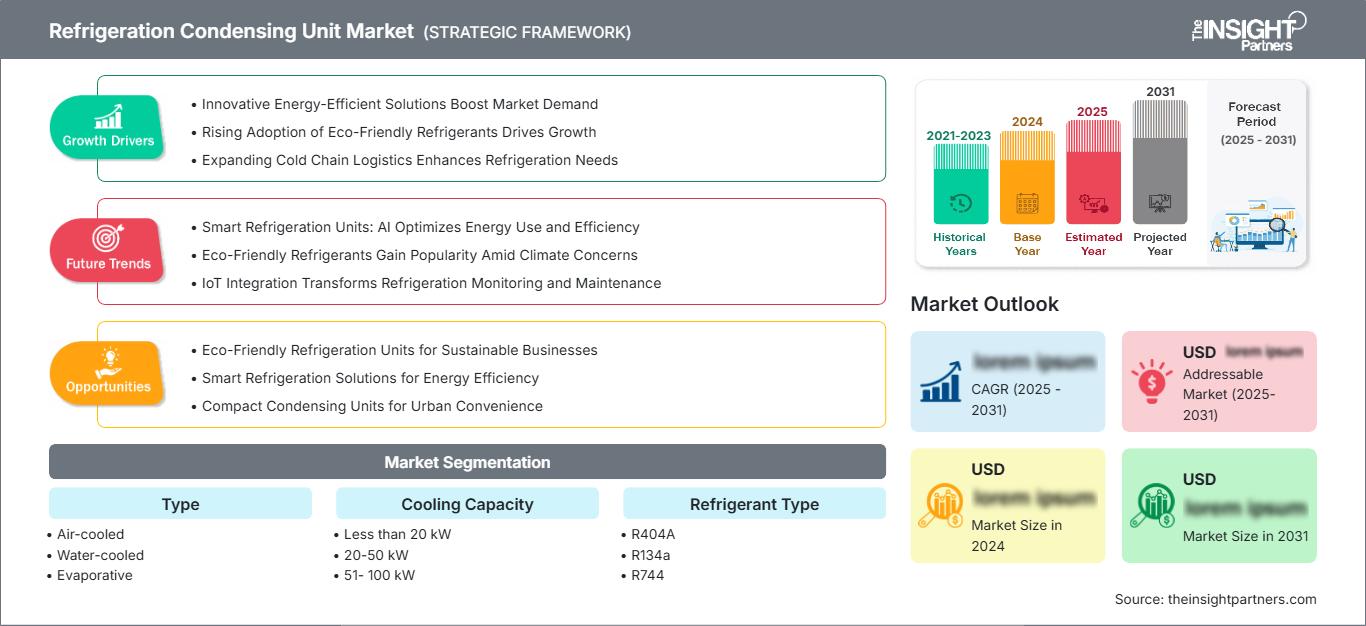
Refrigeration Condensing Unit Market: Strategic Insights
Regional Insights
North America refrigeration condensing unit market
North America held a 27–31% of the refrigeration condensing unit market share in 2025 and is projected to grow at a CAGR of 5.6–6.2% through 2034. The region benefits from mature supermarket networks, extensive food distribution, replacement of aging refrigeration assets, and investment in temperature-controlled warehouses. Energy-efficiency programs and refrigerant transition are strengthening demand for electronically controlled units with improved part-load performance.
The US dominates regional demand, while Canada contributes through food processing, grocery modernization, and cold-storage construction. Mexico is increasingly relevant as manufacturing and food logistics expand. Buyers emphasize reliability, serviceability, and operation across high ambient conditions. Natural refrigerants and low-GWP alternatives are gaining attention, although installed-base compatibility and technician capability continue to influence replacement timing.
U.S. refrigeration condensing unit Market
The US represented 19–22% of the global refrigeration condensing unit market demand and approximately 70–75% of North American demand in 2025, with a projected CAGR of 5.5–6.1%. Retail foods, convenience stores, food service facilities, pharmaceuticals, and logistics centers constitute a wide range of equipment markets. The trend for replacement projects is moving towards equipment that manages electronic capacity control and GWP-reduced refrigerants.
Major manufacturers include Carrier Global Corporation, Johnson Controls International plc, Hussmann Corporation, and Emerson Electric Co. The market demand is also driven by warehouse development and food distribution system modernization. Large customers are increasingly considering lifetime energy expenses, remote monitoring capabilities, refrigerants' availability, and serviceability in addition to the equipment cost factor.
Europe refrigeration condensing unit Market
Europe accounted for a 23–27% share of the refrigeration condensing unit market in 2025 and is forecast to grow at a CAGR of 5.8–6.4%. Germany is the leading country, supported by industrial refrigeration and food retail. The UK contributes through supermarket replacement and convenience retail, while France, Italy, and Spain benefit from food processing, hospitality, and distribution investment.
Germany combines a large industrial base with stringent efficiency expectations, making reliability and heat-rejection performance central to procurement. The UK emphasizes compact equipment and lower-GWP refrigerants. France and Italy are active in food retail and industrial applications, while Spain benefits from food exports and hospitality. Across Europe, R744 adoption and tighter refrigerant rules favor redesigned condensing platforms.
APAC refrigeration condensing unit Market
APAC represented 29–33% of refrigeration condensing unit market demand in 2025 and is projected to grow at a CAGR of 7.0–7.7%, making it the leading regional growth market. China leads, followed by Japan, South Korea, India, and Australia. Food processing, retail modernization, pharmaceuticals, and logistics infrastructure underpin demand.
Industrialization and cold-chain policies are expanding installed capacity, while manufacturers increasingly localize production and engineering. India and China provide major incremental opportunities, whereas Japan and South Korea emphasize efficiency and technology sophistication. Australia supports demand through food exports and geographically dispersed cold-chain operations.
Middle East & Africa refrigeration condensing unit Market
The Middle East and Africa refrigeration condensing unit market demand is supported by food security programs, hospitality construction, pharmaceutical logistics, and controlled-temperature warehousing. Saudi Arabia leads the regional opportunity, followed by the UAE and South Africa. The region is expected to grow at a CAGR of 6.2–7.0% through 2034, with high ambient temperatures increasing the importance of condenser performance.
Saudi Arabia and the UAE are investing in logistics and food infrastructure, while South Africa has a more established commercial refrigeration base. The rest of MEA remains fragmented, with equipment selection influenced by power reliability, water availability, imported components, and service capability. Air-cooled configurations remain practical in water-constrained environments.
Segmentation Analysis
Type
Type selection reflects climate, installation constraints, maintenance requirements, and operating economics in the Refrigeration Condensing Unit Market Forecast. Air-cooled systems remain widely deployed because they avoid condenser-water infrastructure, while water-cooled and evaporative designs become attractive where thermal performance and footprint justify added complexity. The segment is expected to grow at a CAGR of 6.1–6.6% during 2026–2034, with efficiency optimization supporting higher-value configurations
- Air-cooled: Broadly applicable across retail and light industrial installations, air-cooled units simplify commissioning and water management while remaining suitable for replacement projects where installation constraints limit condenser-side infrastructure.
- Water-cooled: Water-cooled systems serve applications prioritizing stable heat rejection and compact equipment footprints, particularly where cooling-water infrastructure already exists and operators can manage treatment, pumps, and maintenance.
- Evaporative: Evaporative systems provide strong heat rejection under demanding ambient conditions, supporting industrial and large commercial applications where energy savings can offset water-treatment requirements and additional operating complexity.
Cooling Capacity
Cooling Capacity determines equipment architecture, compressor configuration, heat-exchanger sizing, and application suitability. Small capacities dominate decentralized retail and service applications, while larger systems serve warehouses, processing plants, and centralized refrigeration. The segment is expected to expand at a CAGR of 6.2–6.7% during 2026–2034, reflecting key Refrigeration Condensing Unit Market Trends as cold-chain projects increase equipment requirements across multiple load profiles.
- Less than 20 kW: Compact capacities suit convenience stores, small cold rooms, restaurants, and localized refrigeration, emphasizing low installation complexity, compact footprints, and accessible maintenance.
- 20-50 kW: This range addresses medium commercial loads and smaller processing facilities, balancing standardized equipment with sufficient capacity for multiple cabinets, cold rooms, or food-service applications.
- 51- 100 kW: Mid-range systems support supermarkets, larger food-service operations, and regional cold rooms where operators require stronger capacity control, reliability, and efficient operation under changing loads.
- 101-500 kW: Higher-capacity systems are important for distribution centers, food processing, and industrial refrigeration, where redundancy, heat-rejection performance, and lifecycle operating costs influence procurement.
- Above 500 kW: Very large capacities support intensive industrial and centralized refrigeration requirements, emphasizing engineered configurations, compressor staging, advanced controls, and robust maintenance arrangements.
Refrigerant Type
Refrigerant Type is becoming a strategic purchasing variable because environmental regulation, refrigerant availability, safety requirements, and system efficiency affect lifecycle economics. The segment is expected to grow at a CAGR of 6.7–7.3% during 2026–2034, led by lower-GWP and natural refrigerant adoption.
- R44A: R44A configurations remain relevant where installed-system compatibility and existing service practices influence equipment selection, although regulatory and supply considerations increasingly affect long-term replacement decisions.
- R134a: R134a continues to have an installed-base role, with replacement decisions increasingly weighing retrofit feasibility, refrigerant availability, efficiency, and compliance requirements.
- R744: R744 is gaining strategic importance for commercial refrigeration because CO2 offers a very low direct global-warming impact, supporting adoption where operators prioritize regulatory resilience and natural-refrigerant systems.
- R143a: R143a applications are influenced by installed equipment requirements and refrigerant policy, making lifecycle serviceability, replacement availability, and compliance assessment important during procurement.
Application
Application requirements vary between commercial and industrial refrigeration, with differences in load continuity, redundancy, operating temperatures, equipment scale, and maintenance expectations in the Refrigeration Condensing Unit Market. The segment is expected to grow at a CAGR of 6.3–6.8% during 2026–2034, supported by food logistics and process cooling.
- Commercial: Commercial applications include retail, food service, convenience stores, and smaller cold rooms, where compact equipment, low downtime, energy efficiency, and simple servicing strongly influence purchasing decisions.
- Industrial: Industrial installations require higher capacity, operational resilience, process integration, and engineered heat rejection, making redundancy, controls, monitoring, and lifecycle service important competitive differentiators.
Geography
Geography influences equipment selection through climate, regulation, electricity costs, water availability, construction practices, and refrigerant policy in the Refrigeration Condensing Unit Market. The segment is expected to grow at a CAGR of 6.4–6.9% during 2026–2034, with APAC and emerging markets contributing incremental demand.
- North America: Mature retail and cold-storage infrastructure creates a substantial replacement market, with efficiency upgrades and refrigerant transition supporting demand for electronically controlled equipment.
- Europe: Regulatory pressure and supermarket modernization favor natural-refrigerant systems, compact designs, and higher-efficiency configurations.
- Asia-Pacific: Rapid cold-chain development, food processing, and urban retail expansion support broad deployment across commercial and industrial applications.
- South and Central America: Food exports, distribution infrastructure, and supermarket expansion create opportunities for robust equipment suited to variable ambient conditions.
- Middle East and Africa: Food security investments, hospitality, pharmaceuticals, and logistics projects support demand, while high temperatures and service availability shape technology selection.
Opportunity Snapshot
| Application | Revenue Contribution | Trend Tag | Adoption Stage |
| Commercial | High | Retail Cooling | Mature |
| Industrial | High | Process Cooling | Scaling |
Refrigeration Condensing Unit Market Growth Drivers and Impact Analysis
Cold-chain expansion across food and pharmaceutical logistics
The growth in temperature-controlled logistics has led to an increase in the number of cooling stations that are needed from the production point through storage, distribution, and up to the point of sale. Food processors and cold stores need efficient condensing units due to the risk posed by failures in the refrigeration process. The increased need for temperature control in pharmaceutical distribution has added to the trend. The increased need for remote diagnostics and modularity in capacity in order to serve geographically spread out systems will make it beneficial to be a supplier of these products. Increased organization in retail and cold storage will increase the stock of outdated systems to be replaced.
Refrigerant transition and energy-efficiency requirements
Refrigerant policies are altering equipment economics by making low-GWP and natural refrigerant compliance more significant. Equipment suppliers find operators choosing equipment based not only on today's refrigerants but on those that will be available in the future, diminishing the appeal of technologies with an uncertain future from a regulatory perspective. Efficiency becomes important for the same reason, since compressors, fans, heat exchangers, and controls determine the amount of energy used for many years to come. Equipment suppliers who are able to offer systems featuring R744, low GWP, or compatible refrigerants along with efficiency capacity control are well-positioned to meet both environmental and economic considerations. The effect goes beyond equipment sales, however, as installers need new skills and approaches to commissioning and safety.
Industrial modernization and higher process-cooling reliability
Food processing, beverages, warehouse, and other temperature-dependent processes are improving their refrigeration facilities for higher efficiency and consistency in process operations. The larger plants are now adopting multi-stage compression, VSD technology, electronically controlled expansion valve, and supervisor controls for matching the refrigeration capacity with load variations. This helps reduce inefficiencies with respect to fixed capacity operations and may provide better performance under part-load conditions. With industrial modernization, there is also an increasing need for redundancy due to the high cost of production losses when there is a breakdown of the refrigeration facility, which could be more than the cost of installing the equipment. This results in competition in systems, service, controls, and heat rejection.
Refrigeration Condensing Unit Market Future Trends
Intelligent capacity management and predictive service
In the future, systems are expected to be able to incorporate variable-speed compressors, controls, sensors, and analytics to regulate their refrigeration capacity continuously rather than through basic on/off cycling. Algorithms that can predict the potential failure of the equipment due to issues such as abnormal discharge pressure, fan, and compressor operation, and condenser fouling can help avoid disruption to the operation. This will prove to be beneficial for retailers and logistics companies as they will have to manage their distributed fleet in the future without enough technical manpower. Cloud-based dashboards will also enable them to evaluate the energy efficiency of each site based on the condition of the assets. The next step forward could be integration of refrigeration controls with energy management systems to align the cooling needs with tariffs, renewables, and heat recovery.
Natural refrigerants and hybrid heat-rejection architectures
Natural refrigerants are expected to play an important role in the design of the condensing unit, as there is a need for less direct environmental impacts and more resilience from regulations. Systems using R744 are likely to grow in commercial refrigeration, whereas the ammonia and hydrocarbons technologies will continue to be used in some particular industrial and compact applications. Rejection of heat is also expected to progress by using a mixture of dry, evaporative, and adiabatic processes, balancing electrical and water usage. Such systems can be chosen depending on climate and resource conditions rather than implementing a universal technology of condensing. In addition, manufacturers will develop controls for switching the working mode of the system according to climatic conditions and water availability.
Refrigeration Condensing Unit Market Opportunities
Localized manufacturing and application engineering in emerging markets
Manufacturers can pursue localization strategies in India, Southeast Asia, the Middle East, and Latin America, where cold-chain infrastructure is expanding and imported equipment can face long lead times. Local assembly and component sourcing can shorten delivery cycles while allowing designs to reflect ambient temperatures, voltage conditions, service capabilities, and refrigerant practices. Partnerships with installers and refrigeration contractors can improve market access because these channels influence specification and replacement decisions. Investment opportunities also exist in regional engineering centers that adapt global platforms to local standards without creating entirely new product families. Companies that combine standardized cores with configurable controls, compressors, and heat exchangers can protect manufacturing efficiency while serving diverse applications. This approach may also strengthen after-sales support and reduce lifecycle downtime for customers.
Service-led replacement and performance-contracting models
The installed base creates an opportunity to shift from one-time equipment transactions toward service-led replacement programs. Operators with large refrigeration fleets increasingly need condition assessment, energy benchmarking, leak management, controls upgrades, and scheduled replacement planning. Suppliers can package these services with equipment financing, remote monitoring, preventive maintenance, and guaranteed performance metrics. Such models reduce the upfront barrier for customers while creating recurring revenue opportunities for manufacturers and service partners. Performance-based contracts can be particularly relevant for supermarkets, warehouses, and food processors where energy consumption is measurable and refrigeration assets operate continuously. Companies with extensive technician networks can use asset data to identify replacement candidates before failures occur. The resulting model links equipment sales to lifecycle optimization and gives suppliers greater visibility into future demand.
Frequently Asked Questions

- Comprehensive Market Sizing and Forecast Analysis
- Detailed Segmentation Analysis
- In-Depth Market Dynamics Assessment
- Regional and Country-Level Insights
- Competitive Landscape and Company Benchmarking
- Strategic Business Intelligence
Recent Reports
Testimonials

The Insight Partners' SCADA System Market report is comprehensive, with valuable insights on current trends and future forecasts. The team was highly professional, responsive, and supportive throughout. We are very satisfied and highly recommend their services.
RAN KEDEM Partner, Reali Technologies LTDs
I requested a report on a very specific software market and the team produced the report in a few days. The information was very relevant and well presented. I then requested some changes and additions to the report. The team was again very responsive and I got the final report in less than a week.
JEAN-HERVE JENN Chairman, Future Analytica
We worked with The Insight Partners for an important market study and forecast. They gave us clear insights into opportunities and risks, which helped shape our plans. Their research was easy to use and based on solid data. It helped us make smart, confident decisions. We highly recommend them.
PIYUSH NAGPAL Sr. Vice President, High Beam Global
The Insight Partners delivered insightful, well-structured market research with strong domain expertise. Their team was professional and responsive throughout. The user-friendly website made accessing industry reports seamless. We highly recommend them for reliable, high-quality research services
YUKIHIKO ADACHI CEO, Deep Blue, LLC.
This is the first time I have purchased a market report from The Insight Partners.While I was unsure at first, I visited their web site and felt more comfortable to take the risk and purchase a market report.I am completely satisfied with the quality of the report and customer service. I had several questions and comments with the initial report, but after a couple of dialogs over email with their analyst I believe I have a report that I can use as input to our strategic planning process.Thank you so much for taking the extra time and making this a positive experience.I will definitely recommend your service to others and you will be my first call when we need further market data.
JOHN SUZUKI President and Chief Executive Officer, Board Director, BK Technologies
I wish to appreciate your support and the professionalism you displayed in the course of attending to my request for information regarding to infectious disease IVD market in Nigeria. I appreciate your patience, your guidance, and the fact that you were willing to offer a discount, which eventually made it possible for us to close a deal. I look forward to engaging The Insight Partners in the future, all thanks to the impression you have created in me as a result of this first encounter.
DR CHIJIOKE ONYIA MANAGING DIRECTOR, PineCrest Healthcare Ltd.Reason to Buy
- Informed Decision-Making
- Understanding Market Dynamics
- Competitive Analysis
- Identifying Emerging Markets
- Customer Insights
- Market Forecasts
- Risk Mitigation
- Boosting Operational Efficiency
- Strategic Planning
- Investment Justification
- Tracking Industry Innovations
- Aligning with Regulatory Trends





 Get Free Sample for