
Resistive RAM Market Size, Share & Demand by 2034
Coverage: By Type (Conductive Bridging, Oxide Based ReRAM); Solution (NVMe SSD, NVDIMM); Memory (Embedded, Standalone, Discrete); Application (Neuromorphic Computing, Security, Data storage and Logical); and Geography (North America, Europe, Asia Pacific, and South and Central America)
- Status : Data Released
- Report Code : TIPRE00014707
- Category : Electronics and Semiconductor
- No. of Pages : 150
- Available Report Formats :


- Last update date : September 15, 2026


2025 Market Size
US$ 1,001.31 Mn
Base year value
2034 Forecast
US$ 4,124.54 Mn
Projected by 2034
CAGR 2026-2034
17.03 %
Growth rate
Addressable Market
US$ 21,454.19 Mn
(2026-2034)
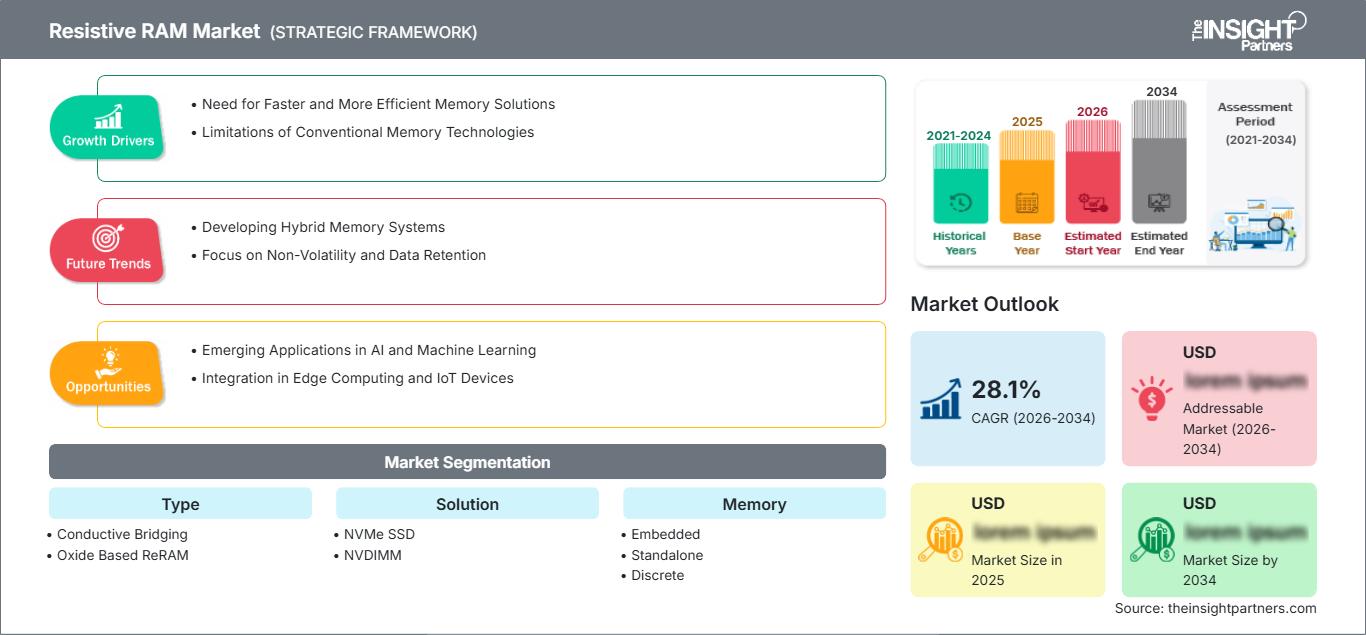
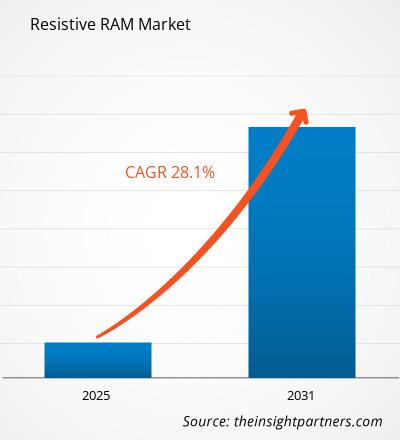
The resistive ram market is valued at US$ 1001.31 Million in 2025 and is projected to reach US$ 4124.54 Million by 2034, registering a CAGR of 17.03% during 2026–2034. Expansion is supported by the transition toward non-volatile memory architectures that combine low standby power, fast switching, high endurance, and closer integration with processing logic across increasingly data-intensive computing environments.
The resistive ram market size in North America is expected to expand at an estimated 17.5–19.5% CAGR during 2026–2034, supported by semiconductor R&D, AI accelerator development, and demand for embedded non-volatile memory. The region benefits from established fabless design ecosystems, advanced foundry relationships, and investment in edge computing architectures requiring lower data movement and improved energy efficiency.
Resistive RAM Market Assessment and Insights
- North America: North America maintains a leading position, supported by semiconductor design capabilities, AI infrastructure, and embedded-memory development, accounting for 38–42% share in 2025 and growing at a 17.5–19.5% CAGR between 2026–2034.
- US: The US represents 72–76% of North America's market in 2025, supported by AI computing, advanced semiconductor design, and demand for secure non-volatile memory, with a 17.5–19.5% CAGR through 2034.
- Europe: Europe accounts for 24–28% share in 2025, with Germany, the UK, France, and Italy supporting automotive electronics, industrial automation, and semiconductor research, while the market expands at a 16–18% CAGR through 2034.
- Asia Pacific: Asia Pacific represents 28–32% share in 2025, led by China, Japan, South Korea, and Taiwan, with foundry capacity, electronics manufacturing, and AI investment supporting a 19–21% CAGR through 2034.
- Largest Segment: Oxide Based ReRAM represents 82–86% market share in 2025, benefiting from process maturity, broad research adoption, and established integration pathways, with a 16–18% CAGR through 2034.
- High Growth Segment: Conductive Bridging represents 12–16% market share in 2025 and is projected to record a 22–25% CAGR through 2034 as endurance and multi-level operation improve.
- Key companies analyzed in detail: Panasonic Holdings Corporation, Fujitsu Limited, Crossbar Inc., Rambus Inc., Weebit Nano Ltd., Micron Technology, Inc., Taiwan Semiconductor Manufacturing Company Limited, 4DS Memory Limited, Renesas Electronics Corporation, Sony Group Corporation.
Source: The Insight Partners' analysis based on proprietary research, government publications, company annual reports, investor presentations, industry databases, and expert interviews.
Development of technology has moved from lab demonstrations to foundry-qualified embedded memories, application-specific arrays, and persistency architectures. The oxide switching continues to remain relevant due to its alignment with conventional semiconductors, whereas the conductive bridge methods focus on faster switching with high endurance. Development trends are becoming more dependent on licensing, foundry qualification, process node compatibility, and design-in cycles, rather than just the cell performance. Development of such technologies is hence based on wafer processing, retention, endurance, yield, and integration with logic.
The future growth will be dependent upon increased geographical involvement and investment in memory-based AI architectures. The North American development teams are oriented towards AI and edge computing, whereas the Asian semiconductor ecosystems can leverage their foundry density and electronics manufacturing advantages. Regulatory and industrial policies supporting domestic semiconductor capacity should improve access to qualified manufacturing, while JEDEC-aligned qualification and reliability testing can reduce adoption barriers for embedded deployments, according to the Resistive RAM Market report.
Resistive RAM Market Report Scope
| Report Attribute | Details |
|---|---|
| Market size in 2025 | US$ 1,001.31 Million |
| Market Size by 2034 | US$ 4,124.54 Million |
| Global CAGR (2026 - 2034) | 17.03% |
| Historical Data | 2021-2024 |
| Forecast period | 2026-2034 |
Resistive RAM Market Analysis
Demand is increasingly shaped by the limitations of conventional memory hierarchies in workloads requiring rapid access, persistence, and lower energy consumption. ReRAM can reduce data movement by locating non-volatile storage closer to processing elements, making it relevant to edge AI, security, embedded control, and neuromorphic architectures. The ecosystem includes memory-IP developers, semiconductor foundries, integrated device manufacturers, controller designers, system developers, and equipment suppliers. Supply remains constrained by qualification cycles, process transfer requirements, yield optimization, and the need to demonstrate stable endurance and retention at production scale.
The resistive RAM market growth is also linked to the expanding use of heterogeneous computing, where memory technologies are selected according to latency, persistence, density, and energy requirements rather than through a single universal architecture. NVMe SSD and NVDIMM technologies cater to high-level storage and persistent memory needs, whereas embedded approaches cater to microcontrollers, SoC, sensors, and edge processors. Foundry access is strategically important since commercialization depends on compatible fabrication without causing disruption to the economics of CMOS manufacturing.
The competitive positioning includes unique cell designs, licensing arrangements, foundry partnerships, and application-specific engineering. Weebit Nano Ltd. has made progress in the commercialization phase via licensing and product incorporations, whereas 4DS Memory Limited is developing interface-switching technology with partners from the semiconductor industry. Crossbar Inc. focuses on the embedding of ReRAM and security-specific solutions. Panasonic Holdings Corporation and Renesas Electronics Corporation bring experience in semiconductors and embedded systems, whereas Taiwan Semiconductor Manufacturing Company Limited offers strategic advanced manufacturing capabilities. Fujitsu Limited, Micron Technology, Inc., Rambus Inc., and Sony Group Corporation strengthen the broader competitive environment through memory, computing, semiconductor, and systems expertise.
Investment is increasingly directed toward qualification rather than basic research alone. Companies are seeking production-node validation, customer tape-outs, technology licensing, and custom memory macros to convert technical demonstrations into commercial programs. The competitive landscape, therefore, favors suppliers capable of demonstrating reproducible performance across process nodes and customer designs. Strategic differentiation is emerging around endurance, retention control, write latency, multi-level storage, security functionality, and integration with AI-oriented compute architectures, according to the Resistive RAM Market forecast.
● REPORT CUSTOMIZATION
Tailor This Report To Align With Your Specific Business Requirements
This report can be customized to align precisely with your business objectives, scope, and target markets. Customization options include tailored segmentation, geography, competitive analysis, and strategic insights to support informed decision-making.
Customize This Report →WHAT YOU CAN ADJUST
- ● Segmentations
- ● Geography
- ● Competitive Analysis
- ● Language Preferences
Resistive RAM Market: Strategic Insights
Regional Insights
North America resistive ram market
North America held a 38–42% of the Resistive RAM Market share in 2025 and is projected to expand at a 17.5–19.5% CAGR through 2034. The US dominates regional activity because of its concentration of semiconductor designers, AI developers, cloud infrastructure operators, and advanced memory research programs. Demand is highest for locations where durable memory will help move less data around, enable faster computing and perform low-power edge computing tasks. Advancements in advanced packaging and heterogeneous integration offer prospects for memory solutions that will be located near compute solutions.
There is excellent collaboration within the region in terms of fabless semiconductor players, research organizations, foundries and equipment suppliers. AI accelerators are creating value for memory that is bandwidth efficient and energy efficient, while cybersecurity needs drive demands for embedded memory for storing keys and trusted data. Canada provides research and semiconductor design expertise, while commercialization is done in the US. Qualification partnerships and customer tape-outs are expected to remain important commercialization indicators through 2034.
U.S. resistive ram Market
The U.S. accounted for 72–76% of North America's 2025 Resistive RAM Market and is expected to grow at a 17.5–19.5% CAGR through 2034. The country benefits from semiconductor design leadership, AI infrastructure investment, defense electronics, and strong demand for secure embedded memory. Applications span edge processors, automotive electronics, industrial systems, and data-intensive computing platforms.
Company presence includes Crossbar Inc., Rambus Inc., Micron Technology, Inc., and other semiconductor developers participating across memory architecture, IP, interfaces, and system integration. Application trends increasingly favor embedded implementations that combine persistence with low-power operation. Security-sensitive designs can use integrated non-volatile memory for device identity and cryptographic assets, while AI systems create demand for architectures capable of reducing memory-to-compute data transfers and improving energy efficiency.
Europe resistive ram Market
Europe represented a 24–28% share of the Resistive RAM Market in 2025 and is expected to grow at a 16–18% CAGR through 2034. Germany remains a leading country because automotive electronics, industrial automation, and semiconductor engineering create demand for reliable embedded memory. European adoption is influenced by efforts to strengthen regional semiconductor supply chains and reduce dependence on external manufacturing.
The UK, Germany, France, Italy, and Spain provide complementary demand through research, automotive, industrial, aerospace, and consumer-electronics applications. The UK contributes advanced semiconductor research and design, Germany emphasizes automotive and industrial deployment, while France supports aerospace and electronics development. Italy and Spain add industrial automation, energy, and electronics applications. Regional adoption will depend on qualification, process integration, and availability of commercially scalable manufacturing capacity.
APAC resistive ram Market
APAC accounted for 28–32% share in 2025 and is projected to expand at a 19–21% CAGR through 2034. China, Japan, South Korea, India, and Australia contribute through semiconductor manufacturing, electronics production, AI development, and industrial applications. China provides substantial electronics demand, Japan supports memory and precision manufacturing, while South Korea combines foundry and semiconductor expertise.
India is becoming increasingly relevant through semiconductor ecosystem development, while Australia contributes research capabilities. Taiwan remains strategically important because of its foundry infrastructure. Industrial digitization, national semiconductor policies, AI investment, and localization initiatives are expected to accelerate qualification and manufacturing activity, making APAC the fastest-growing regional market through the forecast period.
Middle East & Africa resistive ram Market
The Middle East and Africa Resistive RAM Market are expected to expand at a 14–16% CAGR through 2034 as digital infrastructure, industrial automation, and data-center investment increase demand for efficient memory architectures. Saudi Arabia and the UAE are leading regional contributors through technology investment and infrastructure programs, while South Africa provides an established electronics and research base.
Saudi Arabia is prioritizing digital infrastructure and advanced technology, whereas the UAE is expanding cloud, AI, and smart-city capabilities. South Africa supports industrial and telecommunications applications, with the rest of MEA developing more selectively. Energy efficiency remains strategically important because memory technologies that reduce unnecessary data movement can support computational workloads where power and cooling requirements influence infrastructure economics.
Segmentation Analysis
Type
Type is expected to expand at a 17–19% CAGR during 2026–2034. Oxide-based architectures retain broad commercial relevance because of established material research and compatibility with semiconductor processing, while conductive bridging technologies attract attention for faster switching, endurance improvements, and potential multi-level operation. The competitive balance will increasingly depend on qualification results, manufacturing repeatability, and application-specific reliability requirements, reflecting key Resistive RAM Market trends.
- Conductive Bridging: Conductive Bridging ReRAM supports applications requiring rapid switching and high endurance. Its strategic importance is increasing as developers address variability, retention, and multi-level programming challenges for compute-intensive architectures.
- Oxide Based ReRAM: Oxide Based ReRAM maintains broad adoption across embedded and standalone development because established switching mechanisms, materials research, and process compatibility support scalable semiconductor integration and application diversification.
Solution
Solution is projected to grow at an 18–20% CAGR during 2026–2034. NVMe SSD and NVDIMM solutions address persistent storage and memory-access requirements where conventional flash-based architectures can introduce latency, endurance, or write-management constraints. Adoption will depend on controller integration, interface standards, system-level economics, and the ability to demonstrate measurable improvements over established storage technologies, according to the Resistive RAM Market.
- NVMe SSD: NVMe SSD solutions target persistent storage requiring lower latency and higher responsiveness. ReRAM-based architectures can reduce erase and garbage-collection overhead, strengthening their strategic relevance for data-intensive workloads.
- NVDIMM: NVDIMM solutions combine persistence with memory-class access characteristics, supporting applications requiring rapid recovery and reliable data retention. Their adoption depends on platform compatibility, controller design, and enterprise workload requirements.
Memory
Memory is forecast to grow at an 18–20% CAGR through 2034. Embedded memory is strategically positioned because integration directly into processing devices can reduce external memory transactions and improve energy efficiency. Standalone and discrete architectures remain relevant for specialized storage and persistent-memory applications. Commercial progress will depend on density, endurance, process-node compatibility, and customer qualification, reflecting developments across the Resistive RAM Market.
- Embedded: Embedded memory supports system-on-chip and microcontroller designs where non-volatility, low power, and compact integration are important. Demand is strengthened by edge AI, connected devices, automotive electronics, and industrial control.
- Standalone: Standalone memory addresses applications requiring separate persistent storage resources. Its strategic role depends on capacity, latency, endurance, and system architecture, particularly where conventional storage cannot satisfy performance requirements.
Application
Application is expected to record a 20–22% CAGR during 2026–2034, supported by increasing use of memory-centric computing. Neuromorphic computing represents an important emerging area because resistive states can emulate synaptic behavior. Security and data-storage applications provide nearer-term opportunities, while logical applications can exploit programmable resistance states for specialized computing functions, according to the Resistive RAM Market.
- Neuromorphic Computing: Neuromorphic computing uses resistive switching characteristics to support synaptic-weight storage and in-memory operations. Its strategic importance is increasing as AI designers seek architectures that reduce energy-intensive movement between processors and memory.
- Security: Security applications can embed persistent device credentials, cryptographic material, and trusted configuration data. Integration can reduce exposure to external memory buses and strengthen hardware-based protection for connected devices.
- Data storage: Data storage applications benefit from persistent operation and potentially lower access latency. Adoption is strategically relevant for systems requiring rapid recovery, frequent updates, and improved performance compared with conventional flash architectures.
- Logical: Logical applications use programmable resistance states to perform computation or Boolean operations within memory arrays. Their importance is increasing for specialized accelerators seeking lower data-transfer overhead and improved energy efficiency.
Opportunity Snapshot
| Application | Revenue Contribution (High/Medium/Low) | Trend Tag (MAX 2 words) | Adoption Stage (Emerging/Scaling/Mature) |
| Neuromorphic Computing | Medium | In-Memory AI | Emerging |
| Security | Medium | Hardware Trust | Scaling |
| Data storage | High | Persistent Storage | Scaling |
| Logical | Medium | Memory Logic | Emerging |
Resistive RAM Market Growth Drivers and Impact Analysis
AI inference increases pressure on memory bandwidth
AI inferencing is moving performance challenges towards memory accesses due to the limited energy budget that prevents repeated transfers between compute engines and off-chip memory. ReRAM can be used not only to store weights but also execute specific computations near processing units, avoiding extra transfers and maybe increasing efficiency. The use case is applicable to cameras, robots, industry sensors, and intelligent control units where on-board inferencing is needed without persistent cloud access. The effect will be seen across the entire value chain since chip developers require memory IPs that can be implemented in accelerator designs, while foundries have to provide qualified production process flows. With the growing heterogeneity of AI models, memory solutions capable of providing configurable resistance states could be valuable for application-specific accelerators.
Embedded semiconductor integration expands addressable applications
Embedded non-volatile memory is becoming strategically important as microcontrollers, system-on-chip devices, automotive processors, and industrial controllers incorporate greater software functionality. Integrating memory with logic can reduce board-level components, simplify system architecture, and preserve data during power interruptions. ReRAM offers a pathway for developers seeking non-volatility without relying exclusively on conventional embedded flash technologies. The market impact is significant because qualification by foundries and integrated device manufacturers can create repeatable technology platforms that multiple customers can adopt. Once a memory module is qualified on a process node, the economic value can extend across product families, reducing development friction. This dynamic encourages IP licensing, technology transfer, and design-support agreements between memory specialists and semiconductor manufacturers.
Security requirements increase demand for integrated persistent memory
Connected devices increasingly require secure storage for cryptographic keys, authentication credentials, firmware parameters, and device identity information. External memory can expose sensitive data through interfaces that are accessible to attackers, whereas integrated non-volatile memory can place security assets closer to trusted processing logic. ReRAM is relevant because its resistance-based storage can be incorporated into compact semiconductor designs and can support secure configuration and identification functions. The commercial impact is strongest in automotive, industrial, medical, and IoT applications, where device lifecycles are long and security requirements continue to tighten. Suppliers that demonstrate reliable retention, tamper resistance, radiation tolerance, and process compatibility can differentiate beyond conventional memory specifications, creating opportunities for application-specific designs and recurring semiconductor platform adoption.
Resistive RAM Market Future Trends
Analog compute-in-memory architectures gain strategic relevance
Analog compute-in-memory is likely to become a major development direction as AI system designers seek alternatives to repeated digital data transfers. ReRAM crossbars can represent weights through resistance states and perform matrix operations using physical characteristics of the array. Future systems are expected to combine these arrays with digital control, analog-to-digital conversion, error correction, and calibration circuitry. The most important development will be system-level optimization rather than isolated memory-cell performance. Commercialization will require reproducible resistance states, manageable variability, adequate endurance, and algorithms capable of compensating for device imperfections. Partnerships among memory-IP developers, foundries, AI accelerator companies, and research institutions should therefore increase as developers move from experimental arrays toward application-specific silicon and production-qualified architectures.
Multi-level operation improves memory density economics
Multi-level resistive states could improve the economic attractiveness of future devices by storing more information within individual memory cells. The approach is particularly relevant where physical density and energy efficiency are constrained by chip area. Achieving practical multi-level operation requires accurate programming, stable resistance distributions, reliable sensing, and compensation for device variability over operating temperature and lifetime. Future controllers are likely to incorporate calibration and error-management functions that dynamically maintain usable resistance windows. The resulting architectures could support denser embedded memories and more capable in-memory computing arrays without proportionally increasing silicon area. Progress will depend on whether device-level improvements can be reproduced across wafers and process generations, making manufacturing consistency a critical determinant of commercial adoption.
Resistive RAM Market Opportunities
Foundry-qualified IP platforms can accelerate commercialization
A significant opportunity exists for memory-IP suppliers that can package cell technology, process recipes, design libraries, verification support, and qualification documentation into reusable foundry platforms. Customers increasingly require more than a working memory cell because integration risk can delay tape-out and production. A qualified platform can shorten development cycles by providing characterized memory macros, reliability data, process design information, and application guidance. Foundries can also benefit by offering differentiated non-volatile memory capabilities without developing every architecture internally. Investment should therefore focus on process portability, automated characterization, design-for-manufacturing methodologies, and qualification across multiple mature and advanced nodes. Companies capable of establishing repeatable technology-transfer frameworks may capture licensing opportunities across automotive, industrial, IoT, and AI-oriented semiconductor programs, according to the Resistive RAM Market report.
Persistent memory opportunities emerge in specialized computing systems
Specialized computing systems represent another opportunity because they can justify new memory architectures where performance or energy efficiency has greater economic value than commodity storage cost. Edge AI gateways, industrial controllers, robotics, autonomous systems, and high-availability computing can benefit from persistent data that remains accessible after power interruptions. ReRAM-based solutions may also support rapid recovery and application-specific memory functions without relying entirely on conventional storage hierarchies. Investment priorities should include controller architectures, system software, reliability management, and workload-specific benchmarking. Rather than competing directly with high-density NAND across every storage category, suppliers can target applications where low latency, persistence, frequent updates, or integrated security provide measurable system-level advantages and support premium technology economics.
Frequently Asked Questions

- Comprehensive Market Sizing and Forecast Analysis
- Detailed Segmentation Analysis
- In-Depth Market Dynamics Assessment
- Regional and Country-Level Insights
- Competitive Landscape and Company Benchmarking
- Strategic Business Intelligence
Recent Reports
Testimonials

The Insight Partners provided valuable market intelligence that supported our global go-to-market strategy. Their team was professional, responsive, and attentive to our feedback, providing thoughtful analysis and helpful methodological clarifications throughout the project.
Junmo Kim Chief Financial Officer (CFO), Enertech Co., Ltd.
The Insight Partners' SCADA System Market report is comprehensive, with valuable insights on current trends and future forecasts. The team was highly professional, responsive, and supportive throughout. We are very satisfied and highly recommend their services.
RAN KEDEM Partner, Reali Technologies LTDs
I requested a report on a very specific software market and the team produced the report in a few days. The information was very relevant and well presented. I then requested some changes and additions to the report. The team was again very responsive and I got the final report in less than a week.
JEAN-HERVE JENN Chairman, Future Analytica
We worked with The Insight Partners for an important market study and forecast. They gave us clear insights into opportunities and risks, which helped shape our plans. Their research was easy to use and based on solid data. It helped us make smart, confident decisions. We highly recommend them.
PIYUSH NAGPAL Sr. Vice President, High Beam Global
The Insight Partners delivered insightful, well-structured market research with strong domain expertise. Their team was professional and responsive throughout. The user-friendly website made accessing industry reports seamless. We highly recommend them for reliable, high-quality research services
YUKIHIKO ADACHI CEO, Deep Blue, LLC.
This is the first time I have purchased a market report from The Insight Partners.While I was unsure at first, I visited their web site and felt more comfortable to take the risk and purchase a market report.I am completely satisfied with the quality of the report and customer service. I had several questions and comments with the initial report, but after a couple of dialogs over email with their analyst I believe I have a report that I can use as input to our strategic planning process.Thank you so much for taking the extra time and making this a positive experience.I will definitely recommend your service to others and you will be my first call when we need further market data.
JOHN SUZUKI President and Chief Executive Officer, Board Director, BK Technologies
I wish to appreciate your support and the professionalism you displayed in the course of attending to my request for information regarding to infectious disease IVD market in Nigeria. I appreciate your patience, your guidance, and the fact that you were willing to offer a discount, which eventually made it possible for us to close a deal. I look forward to engaging The Insight Partners in the future, all thanks to the impression you have created in me as a result of this first encounter.
DR CHIJIOKE ONYIA MANAGING DIRECTOR, PineCrest Healthcare Ltd.Reason to Buy
- Informed Decision-Making
- Understanding Market Dynamics
- Competitive Analysis
- Identifying Emerging Markets
- Customer Insights
- Market Forecasts
- Risk Mitigation
- Boosting Operational Efficiency
- Strategic Planning
- Investment Justification
- Tracking Industry Innovations
- Aligning with Regulatory Trends





 Get Free Sample for