
Satellite Transponder Market Trends, Size & Forecast by 2034
Coverage: By Bandwidth (C-Band, Ku-Band, Ka-Band, K-Band, Others); Service (Leasing, Maintenance and Support, Others); Application (Commercial Communications, Military Communications, Navigation, Remote Sensing, Others) , and Geography (North America, Europe, Asia Pacific, and South and Central America)
- Status : Data Released
- Report Code : TIPRE00019096
- Category : Electronics and Semiconductor
- No. of Pages : 150
- Available Report Formats :


- Last update date : September 21, 2026


2025 Market Size
US$ 15.99 Bn
Base year value
2034 Forecast
US$ 22.4 Bn
Projected by 2034
CAGR 2026-2034
3.82 %
Growth rate
Addressable Market
US$ 174.39 Bn
(2026-2034)
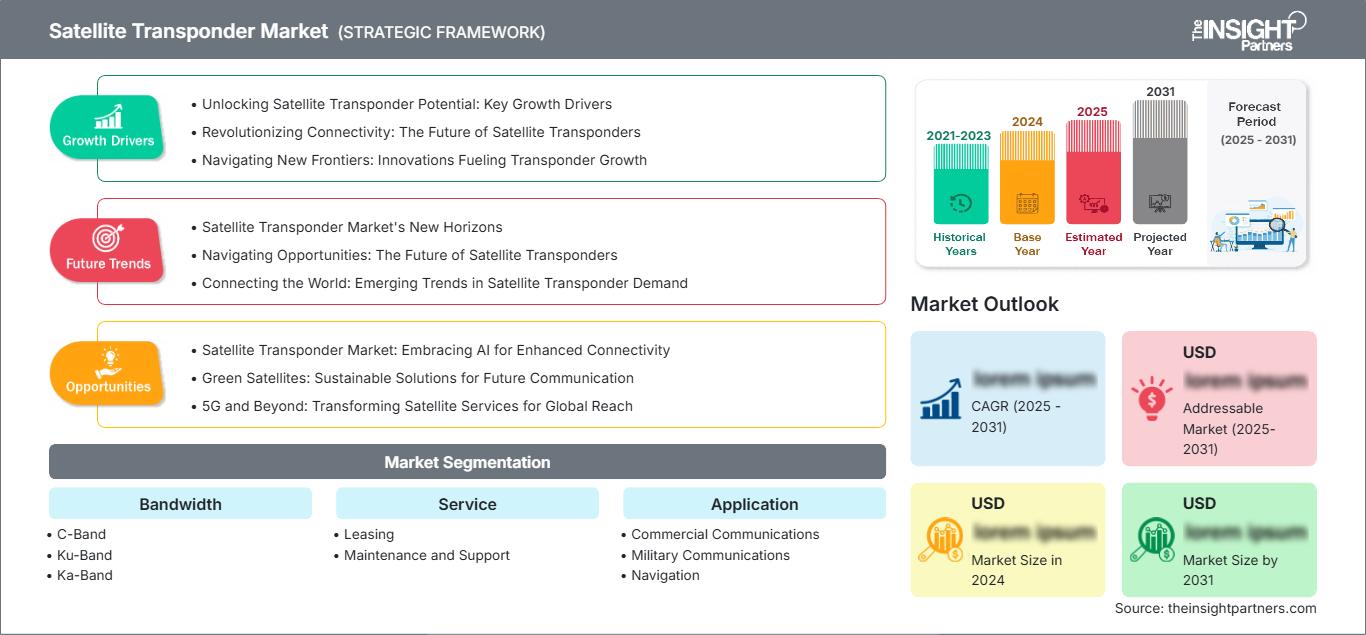
The global Satellite Transponder market was valued at US$ 15.99 billion in 2025 and is expected to reach US$ 22.4 billion by 2034; it is estimated to record a CAGR of 3.82% during 2026-2034.
Satellite Transponder Market Assessment and Insights
- North America accounted for an estimated 32.16–41.5% share in 2025 and is expected to grow at a CAGR range of 4.1–4.8% during 2026–2034, led by defense, aviation, broadband, and media distribution needs.
- US represented about 74–78% of North America in 2025 and is likely to record a 4.2–4.9% CAGR through 2034 on secure communications modernization.
- Europe held an estimated 22–26% share in 2025 and is projected to expand at a 3.8–4.5% CAGR, led by France, Luxembourg, the UK, Germany, and Spain.
- Asia Pacific captured roughly 23–27% share in 2025 and is expected to grow at a 4.7–5.5% CAGR, supported by China, India, Japan, South Korea, and Australia.
- Largest Segment: Leasing held about 76–78% market share in 2025, with an estimated 4.0–4.6% CAGR during 2026–2034 as operators favor flexible bandwidth access.
- High Growth Segment: Ka-Band represented about 18–22% market share in 2025 and is forecast to grow at a 5.2–6.0% CAGR due to high-throughput satellite demand.
- Key companies analyzed in detail: Arab Satellite Communications Organization, Embratel Star One, Eutelsat Communications SA, Hispasat, Intelsat, SES S.A., Singapore Telecommunications Limited, SKY Perfect JSAT Holdings Inc., Telesat Corporation, and Thaicom Public Company Limited.
Source: The Insight Partners' analysis based on proprietary research, government publications, company annual reports, investor presentations, industry databases, and expert interviews.
The evolution of the market has seen a change from capacity of the bandwidth being marketed largely for video broadcasting to one that offers flexible transponder capacity which enables broadband usage, mobility, defense, and connectivity through cloud connection. The market has evolved technologically by incorporating payloads which are high in throughput, spot beams, frequency reuse, digital processing, and services that offer multiple bands for spectral efficiency. Operators of the fleets are dealing with reduced video business while increasing focus on the other aspects of the business.
Future market demand would be greatest in areas where terrestrial networks are expensive, congested, and vulnerable to disruptions. Markets that are coming up are developing their own projects for connectivity at national levels, disaster response systems, and sovereignty of communication channels. Regulations with respect to spectrum coordination, transition of C-Band, and securing orbital assets will affect investments. Operator consolidation will also bring in pricing discipline, increase fleet efficiency, and bundle multi-orbit services.
Satellite Transponder Market Report Scope
| Report Attribute | Details |
|---|---|
| Market size in 2025 | US$ 15.99 Billion |
| Market Size by 2034 | US$ 22.4 Billion |
| Global CAGR (2026 - 2034) | 3.82% |
| Historical Data | 2021-2024 |
| Forecast period | 2026-2034 |
Satellite Transponder Market Analysis
The growth in the market will be enabled through an increase in the usage of satellite bandwidth for broadband backhaul, broadcasting, military communications, and mobility connectivity. The demands are not only limited to traditional television broadcasting. The requirements of airlines, maritime companies, government organizations, rural broadband providers, and enterprise networks have increased demands for reliable capacity across C-Band, Ku-Band, and Ka-Band. Such a diversifying environment pushes the satellite operators to leverage legacy geostationary fleets through high throughput and software-defined payloads.
There are various factors that influence the supply dynamics like the cycle of satellite replacement, spectrum availability, payload flexibility, and integration with the ground segment network. Satellite operators who have diverse fleets of orbiting satellites are in a better position to cope with the challenges of capacity transition among applications and regions. The leasing of capacity is still prominent since the customers prefer stable capacity usage without ownership of satellite assets.
The market analysis shows that there is moderate market consolidation due to dominant large fleet holders and regional specialists. SES S.A., Intelsat, Eutelsat Communications SA, Telesat Corporation, Arab Satellite Communications Organization, Hispasat, SKY Perfect JSAT Holdings Inc., Singapore Telecommunications Limited, Embratel Star One, and Thaicom Public Company Limited compete based on fleet, spectral depth, service stability, and regional customers.
Priorities for investments shift towards multi-orbit solutions, high throughput payloads, and hybrid services instead of straightforward capacity growth. In July 2025, SES S.A. finalized the acquisition of Intelsat and established a merged satellite network of about 120 GEO and MEO satellites. These actions help to achieve scale economies, more extensive band coverage, and positioning in government, aviation, maritime, enterprise, and media markets where customers need continuous service. The Satellite Transponder Market report highlights that consolidation, network diversification, and advanced satellite architectures are strengthening competitive positioning while addressing evolving connectivity requirements across commercial and government end-use sectors.
● REPORT CUSTOMIZATION
Tailor This Report To Align With Your Specific Business Requirements
This report can be customized to align precisely with your business objectives, scope, and target markets. Customization options include tailored segmentation, geography, competitive analysis, and strategic insights to support informed decision-making.
Customize This Report →WHAT YOU CAN ADJUST
- ● Segmentations
- ● Geography
- ● Competitive Analysis
- ● Language Preferences
Satellite Transponder Market: Strategic Insights
Regional Insights
North America satellite transponder market
North America held an estimated 32.16–41.5% satellite transponder market share in 2025, reflecting large defense communications budgets, broadcast capacity demand, aviation broadband, and enterprise continuity applications. The region is expected to expand at a 4.1–4.8% CAGR during 2026–2034. Growth is supported by replacement of aging capacity, secure network modernization, and rising use of high-throughput satellite payloads.
Commercial operators in the region benefit from strong customer demand across media, mobility, and government networks. The U.S. dominates procurement, while Canada contributes through remote connectivity, broadcasting, and northern infrastructure needs. C-Band remains important for reliability, while Ku-Band and Ka-Band capacity is gaining share in broadband, aircraft connectivity, and high-capacity data services.
U.S. satellite transponder Market
The U.S. accounted for about 74–78% of North American revenue in 2025 and is expected to grow at a 4.2–4.9% CAGR during 2026–2034. Demand is anchored in defense communications, aviation connectivity, emergency response networks, media distribution, and commercial broadband coverage. Operators with domestic ground infrastructure and secure service credentials are positioned favorably.
Company presence is strong because major global operators serve federal, enterprise, aviation, and broadcast customers from U.S. hubs. Application trends include protected communications, mobility broadband, and managed satellite services. Capacity requirements are increasingly linked to resilient hybrid networks, where satellite links complement terrestrial fiber, cellular, and cloud infrastructure.
Europe satellite transponder Market
Europe represented an estimated 22–26% share in 2025 and is projected to grow at a 3.8–4.5% CAGR through 2034. France and Luxembourg remain strategically important due to operator headquarters, satellite fleet management, and institutional connectivity programs. The region also benefits from sovereign communications initiatives, broadcast distribution, maritime routes, and government-backed secure connectivity.
The UK and Germany show steady demand for defense, enterprise, mobility, and media applications, while France, Italy, and Spain strengthen regional usage through national space capabilities, broadcast services, and maritime communications. Europe’s growth is influenced by spectrum transition, orbital asset modernization, and programs supporting secure multi-orbit connectivity infrastructure for public and enterprise users.
APAC satellite transponder Market
Asia Pacific held about 23–27% share in 2025 and is forecast to grow at a 4.7–5.5% CAGR during 2026–2034. China, Japan, South Korea, India, and Australia lead demand through broadband expansion, disaster management, maritime connectivity, broadcasting, and national security networks.
Industrial and policy drivers include rural broadband, island connectivity, defense modernization, and commercial mobility services. Japan and Australia require reliable coverage for remote territories, while India and China support satellite capacity through expanding space programs and digital inclusion objectives.
Middle East & Africa satellite transponder Market
The Middle East & Africa is projected to expand at a 4.4–5.2% CAGR during 2026–2034, supported by energy-sector communications, defense connectivity, remote broadband, and infrastructure resilience. Saudi Arabia and the UAE lead Gulf demand through government, enterprise, and mobility applications.
South Africa and the Rest of MEA rely on satellite capacity for broadcasting, remote connectivity, and critical communications in areas with uneven terrestrial coverage. Regional operators benefit from demand in oil and gas, maritime, aviation, education, and emergency response networks.
Segmentation Analysis
Bandwidth
Bandwidth is expected to register a 4.2–4.9% CAGR during 2026–2034. The satellite transponder market scope across C-Band, Ku-Band, Ka-Band, and K-Band reflects different trade-offs between coverage, rain attenuation, antenna size, and throughput. Operators are retaining C-Band for resilient wide-area services while expanding Ku-Band and Ka-Band capacity for mobility and broadband.
- C-Band remains important for broadcast, government, and tropical-region links because of signal stability, broad coverage, and resistance to weather-related attenuation across large service footprints.
- Ku-Band supports aviation, maritime, enterprise, and direct-to-home services where smaller antennas, flexible capacity, and regional beam coverage are commercially useful.
- Ka-Band is gaining strategic importance as high-throughput satellites use spot beams and frequency reuse to deliver higher capacity for broadband and mobility applications.
- K-Band remains more specialized, but interest is rising where next-generation payloads require higher frequencies, greater bandwidth efficiency, and experimental service architectures.
Service
Service is projected to advance at a 4.0–4.7% CAGR through 2034. Leasing dominates because customers require scalable satellite capacity without major asset ownership. Maintenance and support are becoming more valuable as networks grow more complex, interference-sensitive, and mission-critical across commercial, mobility, government, and remote infrastructure applications.
- Leasing remains the principal revenue contributor, offering broadcasters, governments, enterprises, and mobility providers predictable access to capacity across regions and frequency bands.
- Maintenance and support strengthen service differentiation by improving uptime, troubleshooting, network monitoring, interference mitigation, and operational continuity for customers using satellite links.
Application
Application is estimated to grow at a 4.3–5.0% CAGR during 2026–2034 as demand broadens from broadcast toward broadband, government, navigation, and sensing-linked communications. Commercial communications remain the leading area, while military applications support premium capacity needs and remote sensing requires dependable data relay.
- Commercial Communications accounts for the largest demand base, supported by broadcast distribution, broadband access, mobility connectivity, enterprise networks, and telecom backhaul in underserved locations.
- Military Communications requires protected, resilient, and often priority satellite links for command networks, mobility platforms, contingency planning, and secure communications across regions.
- Navigation uses satellite communications support for timing, positioning augmentation, maritime operations, aviation routes, and reliability improvements in remote environments.
- Remote Sensing depends on stable satellite relay capacity to transmit earth observation, environmental monitoring, disaster management, and security data from orbital assets to ground users.
Opportunity Snapshot
| Application | Revenue Contribution | Trend Tag | Adoption Stage |
| Commercial Communications | High | Broadband Backhaul | Mature |
| Military Communications | Medium | Secure Links | Scaling |
| Navigation | Low | Timing Support | Scaling |
| Remote Sensing | Medium | Data Relay | Emerging |
Satellite Transponder Market Growth Drivers and Impact Analysis
Rising Demand for Resilient Broadband and Mobility Capacity
The capacity offered by satellite communication has become a layer of resiliency for broadband, air, sea, enterprise, and remote community communications. The reason for this is especially important if there is restricted or vulnerable terrestrial network infrastructure available. High-throughput satellites make it economical to use capacity via spot beams and frequency reuse, thereby making Ka-Band and Ku-Band services more desirable. Customers are increasingly looking for consistent connectivity; hence, operators can maximize capacity usage and renegotiate their leases for satellites.
Defense and Government Modernization of Secure Communications
Users from defense and governments need assured bandwidth for command, surveillance, border security, disaster recovery, and deployment. These users prioritize service assurance, wide coverage, redundancy, and secured network management above inexpensive bandwidth. This ensures constant demand for C-Band, Ku-Band, Ka-Band, military Ka-Band, and other services. Modernization of public sector users is also favorable to long-term contracts, ensuring satellite providers with assured revenue even with new payloads and ground network modifications.
Fleet Consolidation and Multi-Orbit Service Integration
Consolidation is redefining competitive positioning through the consolidation of fleets, spectrum assets, technology, and customer contracts. The merger of SES and Intelsat in July 2025 resulted in a consolidated operator with more than 120 satellites in geostationary orbit (GEO) and medium earth orbit (MEO). Consolidated operators can make better use of satellite coverage and minimize overlaps in capacity to deliver more integrated multi-band capabilities to customers.
Satellite Transponder Market Future Trends
Software-Defined Payloads and Flexible Capacity Allocation
The satellite transponder market trends increasingly point toward software-defined payloads that can reconfigure beams, bandwidth, and coverage according to customer demand. This is beneficial for managing the changes in traffic along airways, seaways, disaster areas, and new broadband market areas. Flexible payloads will enable higher efficiency of capacity utilization compared to that of fixed capacity and improve value for money from satellite orbits. In the coming years, flexible satellites will enable differentiation, minimize idle capacity, and increase customized service-level agreements.
Hybrid GEO, MEO, and LEO Connectivity Portfolios
The trend is towards hybrid solutions for GEO, the low latency of MEO, and access to LEO capacity on an as-needed basis. This would affect transponder demand, given that customers are now assessing the end results of their services regardless of the orbit used. The benefits of using multiple orbits can be applied to serve the needs of aviation, maritime, government, and enterprise customers that require coverage, redundancy, latency management, and service continuity.
Satellite Transponder Market Opportunities
Managed Capacity for Aviation and Maritime Connectivity
The satellite transponder market forecasts indicate growing opportunities in aviation and maritime connectivity as passengers, crews, operators, and regulators expect continuous broadband access. Airlines require capacity for passenger internet, operational data, and aircraft monitoring, while vessels need coverage for crew welfare, route optimization, cargo visibility, and safety systems. Operators can capture value by bundling transponder capacity with managed services, network monitoring, and regional coverage guarantees. This opportunity is attractive because mobility customers often require premium reliability and long-duration service contracts.
Government-Backed Rural and Remote Connectivity Programs
Public investments in rural broadband, education access, telemedicine, and emergency communications create opportunities for satellite operators where fiber or cellular expansion remains uneconomic. Capacity leasing can support schools, clinics, public safety agencies, and remote enterprises without waiting for extensive terrestrial infrastructure. Operators that combine affordable bandwidth, local gateways, and service support can participate in national digital inclusion programs. This opportunity is strongest in Asia Pacific, the Middle East & Africa, Latin America, and remote areas of developed markets.
Frequently Asked Questions

- Comprehensive Market Sizing and Forecast Analysis
- Detailed Segmentation Analysis
- In-Depth Market Dynamics Assessment
- Regional and Country-Level Insights
- Competitive Landscape and Company Benchmarking
- Strategic Business Intelligence
Recent Reports
Testimonials

The Insight Partners provided valuable market intelligence that supported our global go-to-market strategy. Their team was professional, responsive, and attentive to our feedback, providing thoughtful analysis and helpful methodological clarifications throughout the project.
Junmo Kim Chief Financial Officer (CFO), Enertech Co., Ltd.
The Insight Partners' SCADA System Market report is comprehensive, with valuable insights on current trends and future forecasts. The team was highly professional, responsive, and supportive throughout. We are very satisfied and highly recommend their services.
RAN KEDEM Partner, Reali Technologies LTDs
I requested a report on a very specific software market and the team produced the report in a few days. The information was very relevant and well presented. I then requested some changes and additions to the report. The team was again very responsive and I got the final report in less than a week.
JEAN-HERVE JENN Chairman, Future Analytica
We worked with The Insight Partners for an important market study and forecast. They gave us clear insights into opportunities and risks, which helped shape our plans. Their research was easy to use and based on solid data. It helped us make smart, confident decisions. We highly recommend them.
PIYUSH NAGPAL Sr. Vice President, High Beam Global
The Insight Partners delivered insightful, well-structured market research with strong domain expertise. Their team was professional and responsive throughout. The user-friendly website made accessing industry reports seamless. We highly recommend them for reliable, high-quality research services
YUKIHIKO ADACHI CEO, Deep Blue, LLC.
This is the first time I have purchased a market report from The Insight Partners.While I was unsure at first, I visited their web site and felt more comfortable to take the risk and purchase a market report.I am completely satisfied with the quality of the report and customer service. I had several questions and comments with the initial report, but after a couple of dialogs over email with their analyst I believe I have a report that I can use as input to our strategic planning process.Thank you so much for taking the extra time and making this a positive experience.I will definitely recommend your service to others and you will be my first call when we need further market data.
JOHN SUZUKI President and Chief Executive Officer, Board Director, BK Technologies
I wish to appreciate your support and the professionalism you displayed in the course of attending to my request for information regarding to infectious disease IVD market in Nigeria. I appreciate your patience, your guidance, and the fact that you were willing to offer a discount, which eventually made it possible for us to close a deal. I look forward to engaging The Insight Partners in the future, all thanks to the impression you have created in me as a result of this first encounter.
DR CHIJIOKE ONYIA MANAGING DIRECTOR, PineCrest Healthcare Ltd.Reason to Buy
- Informed Decision-Making
- Understanding Market Dynamics
- Competitive Analysis
- Identifying Emerging Markets
- Customer Insights
- Market Forecasts
- Risk Mitigation
- Boosting Operational Efficiency
- Strategic Planning
- Investment Justification
- Tracking Industry Innovations
- Aligning with Regulatory Trends





 Get Free Sample for