
V2X Communication Market Trends, Size & Forecast by 2034
Coverage: By Communication Type (V2V, V2I, V2P, V2C, V2G, Others); Propulsion Type (Internal Combustion Engine (ICE), Electric Vehicles (EV)); Vehicle type (Passenger Car, Commercial Vehicle) , and Geography (North America, Europe, Asia Pacific, and South and Central America)
- Status : Data Released
- Report Code : TIPAT00002126
- Category : Electronics and Semiconductor
- No. of Pages : 150
- Available Report Formats :


- Last update date : September 17, 2026


2025 Market Size
US$ 5.98 Bn
Base year value
2034 Forecast
US$ 25 Bn
Projected by 2034
CAGR 2026-2034
17.23 %
Growth rate
Addressable Market
US$ 129.45 Bn
(2026-2034)
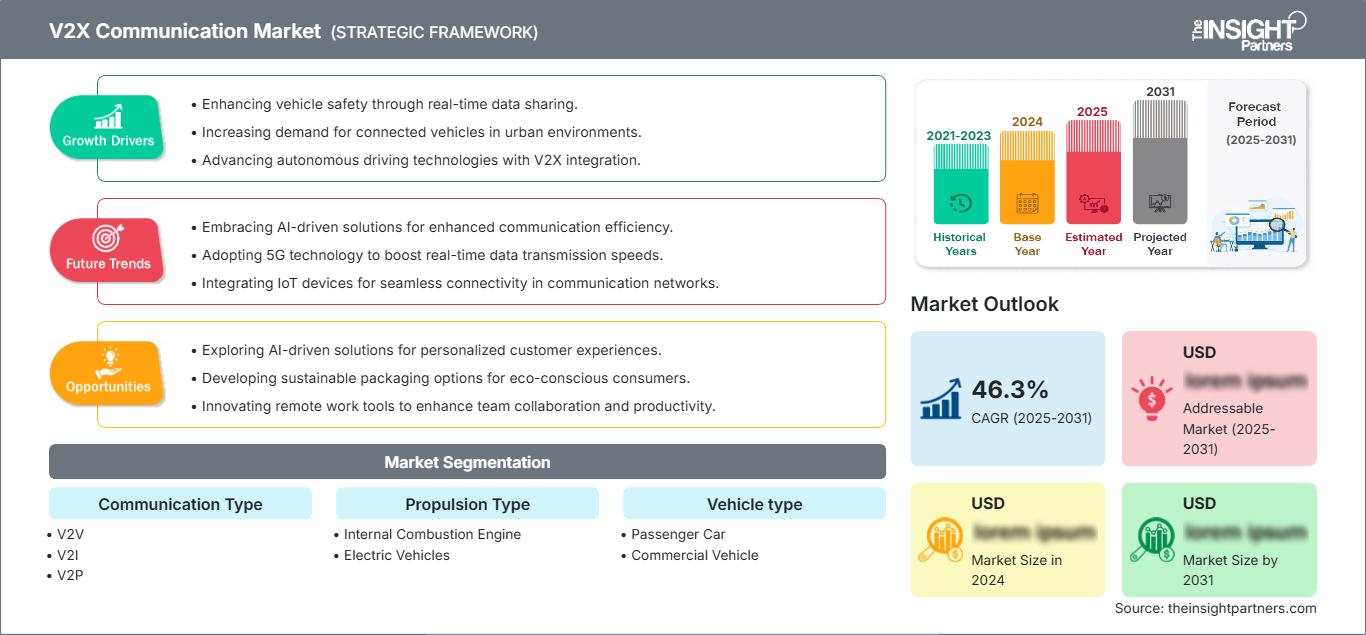
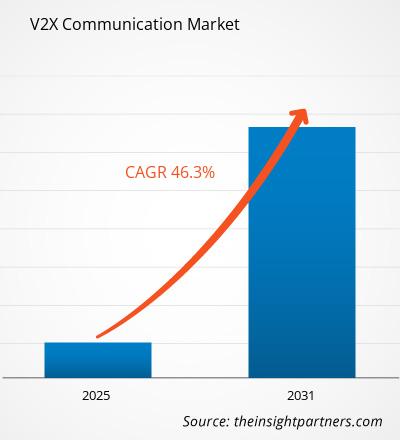
The V2X communication market was valued at US$ 5.98 Billion in 2025 and is projected to reach US$ 25 Billion by 2034, registering a CAGR of 17.23% during 2026–2034. The market encompasses communication technologies that connect vehicles with other vehicles, infrastructure, pedestrians, cloud platforms, and power networks to support safer mobility, traffic coordination, connected services, and increasingly automated driving applications.
North America is expected to maintain a strong position, with the V2X communication market size estimated to expand at a CAGR of 18–21% between 2026–2034. Federal and state-funded intelligent transportation programs, growing connected vehicle deployment, advanced automotive electronics adoption, and investments in roadside communication infrastructure are creating favorable conditions for commercial-scale implementation.
V2X Communication Market Assessment and Insights
- North America recorded an estimated 2025 share of 28–32% and is expected to grow at a CAGR of 18–21% between 2026–2034, supported by connected-road programs, automotive technology investment, and increasing integration of C-V2X systems.
- US represented approximately 68–72% of North America's 2025 market and is projected to expand at a CAGR of 18–21% between 2026–2034, driven by automotive OEM programs and intelligent transportation deployments.
- Europe accounted for an estimated 24–28% share in 2025 and is forecast to register a CAGR of 16–19% between 2026–2034, with Germany, the UK, France, Italy, and Spain advancing cooperative mobility and connected-road initiatives.
- Asia Pacific held approximately 31–35% share in 2025 and is projected to grow at a CAGR of 19–22% between 2026–2034, led by China, Japan, South Korea, and India through vehicle electronics investment and smart-mobility programs.
- Largest Segment: V2V communication is estimated to hold a 29–33% market share in 2025 and expand at a CAGR of 17–20% between 2026–2034, reflecting its direct safety and collision-warning applications.
- High Growth Segment: Electric Vehicles are estimated to represent a 38–42% market share in 2025 and grow at a CAGR of 20–23% between 2026–2034, supported by digital architectures and connected energy-management requirements.
- Key companies analyzed in detail: Cisco Systems, Inc.; Continental AG; DENSO CORPORATION; General Motors Company; HARMAN International Industries, Incorporated; Infineon Technologies AG; NXP Semiconductors N.V.; Qualcomm Technologies, Inc.; STMicroelectronics N.V.; Volkswagen AG; Robert Bosch GmbH; Aptiv PLC.
Source: The Insight Partners' analysis based on proprietary research, government publications, company annual reports, investor presentations, industry databases, and expert interviews.
The V2X communication market is evolving from isolated connected-vehicle functions toward integrated communication architectures combining direct vehicle links, cellular connectivity, roadside units, cloud platforms, and advanced driver-assistance systems. The focus in manufacturing will move towards software-defined vehicle platforms, automotive-specific semiconductor technologies, secure communications hardware, and standardization of messages.
In terms of future developments, investments will be directed towards connected intersections, intelligent highways, automated driving, and energy-efficient vehicle communication. The regulation factor is becoming more significant due to the standardization of spectrum allocation and connected vehicle regulations. Europe will continue developing cooperative ITS, whereas North America and the Asia Pacific will increase pilot-to-production development paths. These developments create opportunities for suppliers capable of integrating communications, computing, sensing, and cybersecurity into scalable vehicle architectures, according to the V2X Communication Market report.
V2X Communication Market Report Scope
| Report Attribute | Details |
|---|---|
| Market size in 2025 | US$ 5.98 Billion |
| Market Size by 2034 | US$ 25 Billion |
| Global CAGR (2026 - 2034) | 17.23% |
| Historical Data | 2021-2024 |
| Forecast period | 2026-2034 |
V2X Communication Market Analysis
Demand is being shaped by the need to extend vehicle perception beyond conventional cameras, radar, and lidar. V2X communication market solutions allow vehicles to exchange position, speed, movement, road conditions, and hazard information, supporting collision warnings and traffic coordination. The ecosystem consists of automobile manufacturers, semiconductor companies, communications companies, telecommunication operators, infrastructure players, software firms, and regulatory agencies. Interoperability between all these actors will become more important for the generation of value.
Moreover, there is a shift in the supply dynamic due to the integration of communication modules into centralized vehicle computers and telematics platforms. In this way, semiconductor companies develop processors, security elements, modems, and positioning features while infrastructure companies provide roadside units and traffic management interfaces. Due to increased volume of production, hardware platforms could be used to decrease the costs of integration, although the regulations concerning frequency band and certification still play an important role.
Competition is increasingly organized around complete technology stacks rather than standalone communication components. Qualcomm Technologies, Inc. combines automotive connectivity with V2X capabilities, while NXP Semiconductors N.V., Infineon Technologies AG, and STMicroelectronics N.V. contribute semiconductor and security technologies. Continental AG, DENSO CORPORATION, HARMAN International Industries, Incorporated, and Robert Bosch GmbH compete through integrated automotive and mobility solutions, while Cisco Systems, Inc. strengthens the networking ecosystem.
Strategic positioning is also influenced by software-defined vehicles and electrification. General Motors Company and Volkswagen AG can use connected architectures to introduce safety, traffic, and cloud-enabled services across model ranges. Aptiv PLC focuses on vehicle architecture and software integration, while semiconductor suppliers are targeting scalable designs suitable for passenger and commercial platforms. Investment is therefore moving toward interoperable platforms that can support multiple standards and evolve with future cellular networks, according to the V2X Communication Market forecast.
● REPORT CUSTOMIZATION
Tailor This Report To Align With Your Specific Business Requirements
This report can be customized to align precisely with your business objectives, scope, and target markets. Customization options include tailored segmentation, geography, competitive analysis, and strategic insights to support informed decision-making.
Customize This Report →WHAT YOU CAN ADJUST
- ● Segmentations
- ● Geography
- ● Competitive Analysis
- ● Language Preferences
V2X Communication Market: Strategic Insights
Regional Insights
North America V2X communication market
North America is estimated to account for 28–32% of the V2X communication market in 2025, with a projected CAGR of 18–21% between 2026–2034. The United States is the key national market due to the fact that connected vehicle systems increasingly integrate roadside equipment, traffic signals, fleets, and vehicle systems. The Canadian market presents itself through smart mobility programs and connected corridors. The capabilities in automotive electronics, cellular infrastructure, and public sector investments make this an enabling deployment environment.
The adoption model in the region is moving from demonstrations to large-scale corridor and intersection implementations. While passenger vehicles will continue to matter, the commercial fleets present themselves as attractive application areas for hazard warnings, signal priority, route coordination, and other operations. Car makers and technology providers are increasingly integrating the V2X systems with ADAS and software-defined vehicle systems. Regulations with respect to 5.9 GHz spectrum and state transportation programs, as well as auto-infrastructure cooperation, would enable continued adoption till 2034.
U.S. V2X communication Market
The US is estimated to represent 68–72% of North America's 2025 V2X communication market, with a projected CAGR of 18–21% between 2026–2034. Federal transport programs, state-level pilot projects, connected intersections, and investment in automotive technology will facilitate deployment. Firms like General Motors Company, Qualcomm Technologies, Inc., Cisco Systems, Inc., and HARMAN International Industries, Incorporated have been involved in connected mobility innovations.
Applications are evolving from simple vehicle notifications to more sophisticated applications, including intersection awareness, emergency vehicle prioritization, road work warning, fleet management, and cooperative automated driving. Commercial vehicles can benefit from advanced notice of hazards and traffic data, whereas passenger cars are integrating connected systems in their centralized electronic architecture. The US market will, hence, be oriented towards interoperable infrastructure and automotive technologies.
Europe V2X communication Market
Europe is estimated to hold 24–28% of the V2X communication market in 2025 and is expected to expand at a CAGR of 16–19% between 2026–2034. Germany leads the regional landscape, supported by automotive manufacturing depth, cooperative mobility projects, and established standards. The UK, France, Italy, and Spain also contribute through intelligent transport and connected-road programs.
The UK is building capabilities in connected mobility in areas such as smart highways, urban traffic management, and software-based vehicle features. Germany continues to be the frontrunner as auto manufacturers, suppliers, researchers, and road authorities take part in collaborative transport projects. France, Italy, and Spain continue to build capabilities in connected infrastructure, urban mobility, and road safety, resulting in an increased need for V2X solutions.
APAC V2X communication Market
APAC is estimated to represent 31–35% of the V2X communication market in 2025, with a projected CAGR of 19–22% between 2026–2034. China takes the lead, bolstered by programs for vehicle connectivity, investment in smart cities, and large-scale manufacturing of automotive electronics. Japan and South Korea hold their ground through advanced automotive technology, whereas India and Australia present new deployment prospects.
While China's manufacturing capacity allows for fast implementation, Japan focuses on coordination between mobility and safety technologies. South Korea combines telecommunications and automotive technologies, and India develops a good policy basis for connected safety systems, while Australia presents new prospects for intelligent transport corridors.
Middle East & Africa V2X communication Market
The Middle East & Africa V2X communication market is expected to expand at a CAGR of 15–18% between 2026–2034, with Saudi Arabia leading regional opportunity creation. The UAE is investing heavily in smart mobility and connected infrastructure, while South Africa represents an important African market for commercial mobility and intelligent transport applications.
Saudi Arabia and the UAE benefit from smart-city development, digital infrastructure investment, and new mobility projects. South Africa offers applications in fleet management and urban traffic coordination, while the rest of MEA presents selective opportunities around connected highways, logistics corridors, and public transport. Energy diversification and infrastructure modernization are increasing interest in digitally managed mobility ecosystems.
Segmentation Analysis
Communication Type
Communication Type remains central to system architecture because different connectivity modes address different latency, range, and application requirements. V2V communication is the largest segment, while V2I, V2P, V2C, and V2G broaden the addressable use cases. The segment is projected to grow at a CAGR of 17–20% between 2026–2034 as direct safety communication becomes increasingly integrated with cloud and infrastructure services, according to the V2X Communication Market forecast.
- V2V: V2V supports direct exchange of vehicle position, speed, and maneuver information, making it strategically important for collision warnings, cooperative braking, platooning, and non-line-of-sight hazard detection.
- V2I: V2I connects vehicles with traffic signals, roadside units, road signs, and construction infrastructure, supporting signal priority, road warnings, traffic optimization, and intelligent corridor management.
- V2P: V2P enables communication with pedestrians, cyclists, and other vulnerable road users, addressing visibility limitations and supporting safety applications in dense urban environments.
- V2C: V2C connects vehicles with cloud platforms for data exchange, software services, traffic information, predictive functions, and centralized management of connected mobility experiences.
- V2G: V2G links vehicles with electricity networks, enabling communication for charging coordination, energy management, demand response, and future bidirectional power applications.
- Others: Other communication configurations support specialized mobility scenarios and complementary connectivity functions, providing flexibility where standard vehicle, infrastructure, pedestrian, cloud, or grid links require additional interfaces.
Propulsion Type
Propulsion Type is increasingly influenced by vehicle electrification because electric platforms depend heavily on software, connectivity, charging systems, and centralized electronic architectures. The segment is projected to grow at a CAGR of 18–22% between 2026–2034, with electric vehicles gaining strategic importance as connectivity expands into energy management and intelligent charging, reflecting key V2X Communication Market trends.
- Internal Combustion Engine: Internal Combustion Engine vehicles remain a significant installed base, supporting retrofit and new-production connectivity programs where automakers add communication modules without redesigning complete propulsion architectures.
- Electric Vehicles: Electric Vehicles increasingly integrate connected charging, battery management, cloud services, and energy communication, making V2X capabilities strategically relevant to both mobility and electricity-system integration.
Vehicle type
Vehicle type influences adoption according to production volumes, operating patterns, and application complexity. The segment is projected to expand at a CAGR of 16–20% between 2026–2034 as connected functions become embedded across passenger and commercial platforms. Commercial fleets offer particularly attractive use cases because connectivity can deliver operational benefits alongside safety improvements, contributing significantly to the V2X Communication Market share.
- Passenger Car: Passenger Car deployment is supported by growing integration of connected infotainment, ADAS, telematics, and software-defined vehicle architectures, creating a broad pathway for factory-installed communication capabilities.
- Commercial Vehicle: Commercial Vehicle adoption benefits from fleet-scale economics, route optimization, emergency warnings, traffic coordination, and logistics applications, making connected communication valuable for both safety and operational efficiency.
Opportunity Snapshot
| Communication Type | Revenue Contribution (High/Medium/Low) | Trend Tag (MAX 2 words) | Adoption Stage (Emerging/Scaling/Mature) |
| V2V | High | Collision Avoidance | Scaling |
| V2I | High | Smart Intersections | Scaling |
| V2P | Medium | Pedestrian Safety | Emerging |
| V2C | High | Cloud Mobility | Scaling |
| V2G | Medium | Grid Integration | Emerging |
| Others | Low | Specialized Links | Emerging |
V2X Communication Market Growth Drivers and Impact Analysis
Expansion of connected and software-defined vehicle architectures
Software-defined car development has increased the importance of having flexible communication capabilities that can be updated, integrated, and coordinated within a central electronic architecture. Functions that used to be separate and divided into different control units are being centralized into a new platform that would facilitate connectivity, ADAS, telematics, and cloud service offerings. The benefits of the architecture lie in reduced redundancy and sharing of computing, positioning, security, and data management functions through communication capabilities. The effects go beyond automakers and apply to semiconductor companies, software providers, communication providers, and infrastructure as well. With the growing importance of software in the car architecture, the communication function will be considered an architecture element rather than an option. This will not only improve scalability but also motivate suppliers to develop modular hardware and software kits that could fit several vehicles and regional communication standards.
Increasing demand for non-line-of-sight road safety information
In addition, conventional car sensors may suffer from physical obstacles, unfavorable weather conditions, and line-of-sight limitations. V2X communication solves this problem by facilitating the exchange of hazardous information by the transmitting vehicle, even before such a danger has been detected by the receiver. There emerges a valuable proposition for intersections, sites of road work, approaching emergency vehicles, bicycles, and emergency braking cases. From the commercial point of view, it becomes especially critical when it comes to augmenting camera, radar, and lidar systems, not replacing them. Thus, the awareness of the communicating vehicle gives the opportunity for the formation of additional context before a hazard becomes available to sensors.
Growth of intelligent transportation infrastructure and connected corridors
Traffic management infrastructure is becoming increasingly digitized in the form of traffic signals, roadside equipment, roadwork sites, toll collection and mobility management infrastructure. All of these pieces of infrastructure create a growing communications ecosystem that allows vehicles to access information from road systems and react to changes. Infrastructure communications systems will allow connected roads to perform tasks such as priority signaling for buses and other priority vehicles, preemptive signaling for emergency response vehicles, alerts about roadworks, queuing information and traffic optimization. In terms of market impact, this ecosystem will generate greater demand than vehicle electronics alone since the implementation of these systems would require a range of products and services such as roadside devices, networking, cybersecurity, software, installation and management of infrastructure.
V2X Communication Market Future Trends
AI-enabled cooperative perception and maneuver coordination
AI technology is likely to turn communication data from warnings to more cooperative perceptions and maneuver planning. The future technologies will integrate data from multiple sources, including other cars, roadside sensors, traffic lights, maps, and cloud-based information sources, to generate an extensive picture of the situation. AI algorithms could determine the most useful communications, detect any conflict, predict trajectory and minimize unnecessary warnings. Such advancement will be capable of facilitating cooperative lane changes, collaborative merges, traffic route planning and accurate predictions of dangers. With the trend towards centralized computing in vehicles, communication data could be combined with the data from cameras, radars, lidars and position sensors. Such systems would demand better validation, cybersecurity and safety functions since the automatic decision could rely on the data outside the car.
Convergence of vehicle communication and energy ecosystems
Vehicle communication is expected to increasingly connect transportation and electricity infrastructure as electric vehicle penetration rises. Communication between vehicles, chargers, buildings, utilities, and grid-management platforms can support dynamic charging, demand response, load balancing, and eventually bidirectional energy services. This trend expands the role of connected vehicles from transportation assets into flexible energy resources. Automakers and charging providers can use communication capabilities to coordinate charging schedules according to electricity prices, grid conditions, battery requirements, and user preferences. Utilities can gain better visibility into distributed charging demand, while fleet operators can optimize charging around operational schedules. The convergence also creates new cybersecurity and interoperability requirements because mobility and energy systems operate under different regulatory and technical frameworks. Suppliers that can bridge these ecosystems may gain strategic importance as electrification accelerates.
V2X Communication Market Opportunities
Connected infrastructure platforms for emerging mobility markets
Emerging mobility markets offer opportunities to deploy communication infrastructure alongside new roads, logistics, and smart-city projects rather than replacing extensive legacy systems. India, Southeast Asia, the Middle East, and selected Latin American markets can integrate connected intersections, roadside units, fleet platforms, and digital traffic management into infrastructure modernization programs. This approach allows public authorities to target high-risk intersections, freight corridors, airports, ports, and major urban routes where connectivity can deliver measurable benefits. Technology providers can pursue modular infrastructure platforms that accommodate local spectrum rules and multiple communication standards. Partnerships among infrastructure companies, automotive suppliers, telecommunications providers, and public agencies can reduce deployment fragmentation. Investors should prioritize projects with clear operating ownership, measurable safety or congestion outcomes, and pathways for expanding from individual pilots to connected regional corridors.
Vehicle-to-grid communication for electrified commercial fleets
Electrified buses, delivery fleets, logistics vehicles, and municipal vehicles provide an attractive opportunity for communication-enabled energy management because charging schedules are predictable and centrally managed. Fleet operators can coordinate vehicle availability, charging capacity, electricity costs, and battery requirements through connected platforms. Vehicle-to-grid functionality can eventually create additional revenue opportunities where regulatory frameworks permit bidirectional power exchange. The commercial case is strongest when charging infrastructure, fleet management, energy management, and vehicle communication are designed as one integrated system. Technology suppliers can develop secure communication layers that connect fleet vehicles with chargers, buildings, utilities, and cloud platforms while maintaining operational priorities. This opportunity is particularly relevant to markets investing simultaneously in fleet electrification and grid modernization, where connected charging can improve asset utilization and reduce unmanaged peak electricity demand.
Frequently Asked Questions

- Comprehensive Market Sizing and Forecast Analysis
- Detailed Segmentation Analysis
- In-Depth Market Dynamics Assessment
- Regional and Country-Level Insights
- Competitive Landscape and Company Benchmarking
- Strategic Business Intelligence
Recent Reports
Testimonials

The Insight Partners provided valuable market intelligence that supported our global go-to-market strategy. Their team was professional, responsive, and attentive to our feedback, providing thoughtful analysis and helpful methodological clarifications throughout the project.
Junmo Kim Chief Financial Officer (CFO), Enertech Co., Ltd.
The Insight Partners' SCADA System Market report is comprehensive, with valuable insights on current trends and future forecasts. The team was highly professional, responsive, and supportive throughout. We are very satisfied and highly recommend their services.
RAN KEDEM Partner, Reali Technologies LTDs
I requested a report on a very specific software market and the team produced the report in a few days. The information was very relevant and well presented. I then requested some changes and additions to the report. The team was again very responsive and I got the final report in less than a week.
JEAN-HERVE JENN Chairman, Future Analytica
We worked with The Insight Partners for an important market study and forecast. They gave us clear insights into opportunities and risks, which helped shape our plans. Their research was easy to use and based on solid data. It helped us make smart, confident decisions. We highly recommend them.
PIYUSH NAGPAL Sr. Vice President, High Beam Global
The Insight Partners delivered insightful, well-structured market research with strong domain expertise. Their team was professional and responsive throughout. The user-friendly website made accessing industry reports seamless. We highly recommend them for reliable, high-quality research services
YUKIHIKO ADACHI CEO, Deep Blue, LLC.
This is the first time I have purchased a market report from The Insight Partners.While I was unsure at first, I visited their web site and felt more comfortable to take the risk and purchase a market report.I am completely satisfied with the quality of the report and customer service. I had several questions and comments with the initial report, but after a couple of dialogs over email with their analyst I believe I have a report that I can use as input to our strategic planning process.Thank you so much for taking the extra time and making this a positive experience.I will definitely recommend your service to others and you will be my first call when we need further market data.
JOHN SUZUKI President and Chief Executive Officer, Board Director, BK Technologies
I wish to appreciate your support and the professionalism you displayed in the course of attending to my request for information regarding to infectious disease IVD market in Nigeria. I appreciate your patience, your guidance, and the fact that you were willing to offer a discount, which eventually made it possible for us to close a deal. I look forward to engaging The Insight Partners in the future, all thanks to the impression you have created in me as a result of this first encounter.
DR CHIJIOKE ONYIA MANAGING DIRECTOR, PineCrest Healthcare Ltd.Reason to Buy
- Informed Decision-Making
- Understanding Market Dynamics
- Competitive Analysis
- Identifying Emerging Markets
- Customer Insights
- Market Forecasts
- Risk Mitigation
- Boosting Operational Efficiency
- Strategic Planning
- Investment Justification
- Tracking Industry Innovations
- Aligning with Regulatory Trends





 Get Free Sample for