
Valve Driver Market Size, Share & Demand by 2034
Coverage: By Function (Solenoid, Proportional); Valve Type (Conventional Control Valve, Expansion Valve); End-User (Commercial and Residential, Industrial, Motion Equipment), and Geography (North America, Europe, Asia Pacific, and South and Central America)
- Status : Data Released
- Report Code : TIPRE00013550
- Category : Electronics and Semiconductor
- No. of Pages : 150
- Available Report Formats :


- Last update date : September 10, 2026


2025 Market Size
US$ 4.65 Bn
Base year value
2034 Forecast
US$ 9.26 Bn
Projected by 2034
CAGR 2026-2034
7.94 %
Growth rate
Addressable Market
US$ 62.52 Bn
(2026-2034)
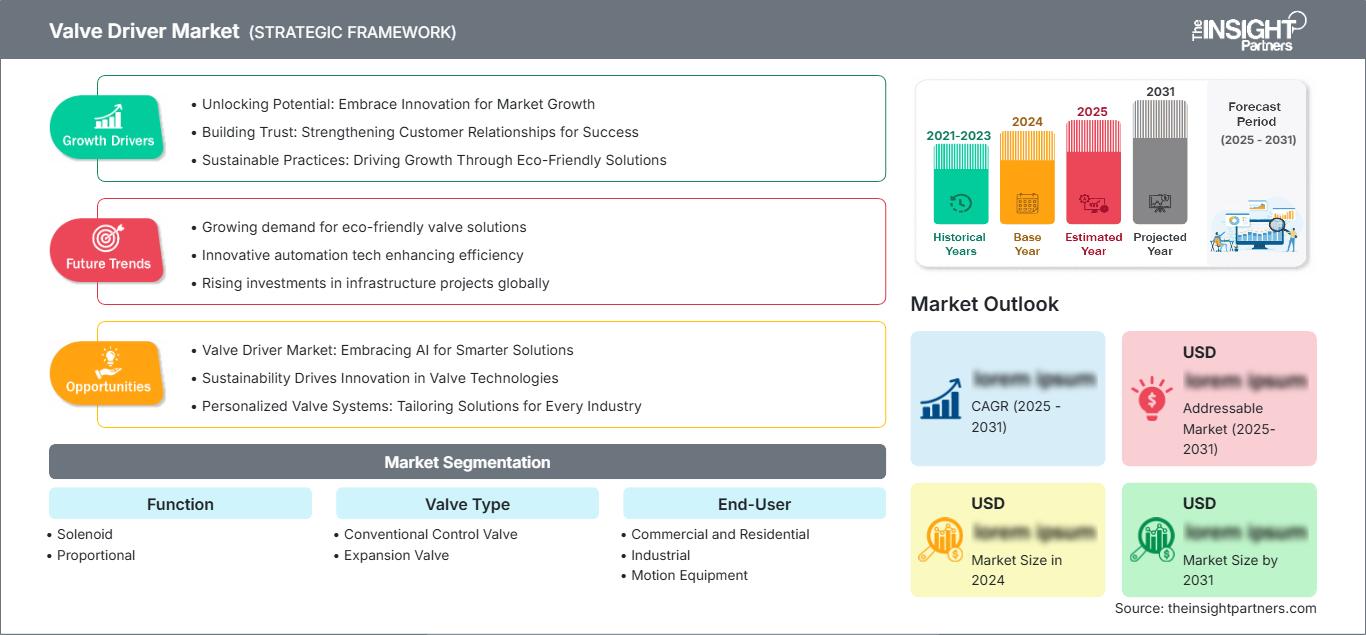
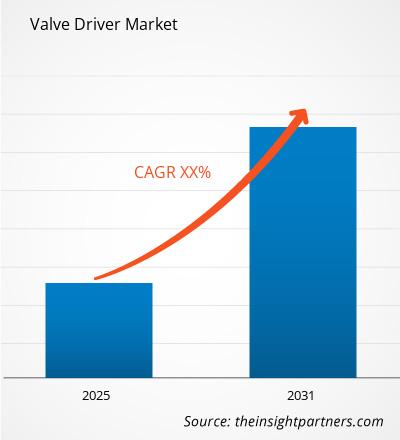
The Valve driver market is valued at US$ 4.65 Billion in 2025 and is projected to reach US$ 9.26 Billion by 2034, registering a CAGR of 7.94% during 2026–2034. Expansion is supported by rising demand for electronically controlled fluid systems, tighter energy-efficiency requirements, and broader deployment of proportional and solenoid actuation across industrial automation, refrigeration, mobility, and equipment control applications.
North America is expected to remain a technologically advanced regional market, with the Valve Driver Market size supported by industrial automation investment, modernization of HVAC and refrigeration systems, replacement of legacy electromechanical controls, and increasing integration of electronically managed valves into mobile and stationary equipment. An estimated 7.0–8.0% CAGR during 2026–2034 reflects continued demand for precise flow-control technologies and smart industrial systems.
Valve Driver Market Assessment and Insights
- North America: The region is estimated to account for 31–35% share in 2025, supported by automation and equipment modernization, with the market growing at a 7.0–8.0% CAGR between 2026–2034.
- US: The US represents approximately 22–25% share in 2025 and is expected to expand at a 7.1–8.1% CAGR between 2026–2034, supported by industrial controls and HVAC replacement.
- Europe: Europe is estimated at 25–29% share in 2025, led by Germany, France, Italy, and the UK, with a 6.5–7.5% CAGR between 2026–2034 as energy-efficiency and automation investments accelerate.
- Asia Pacific: Asia Pacific is estimated at 28–32% share in 2025, led by China, Japan, South Korea, and India, and is projected to register a 8.5–9.5% CAGR between 2026–2034.
- Largest Segment: Solenoid function is estimated to hold a 55–59% market share in 2025, with a 7.0–8.0% CAGR during 2026–2034, reflecting broad installed-base requirements.
- High Growth Segment: Proportional function is estimated at 41–45% market share in 2025, with a 8.5–9.5% CAGR during 2026–2034, driven by precision control and electrification.
- Key companies analyzed in detail: Axiomatic Technologies Corporation, CAREL Industries S.p.A., Eliwell Controls S.r.l., Emerson Electric Co., HydraForce, Kar-Tech, MKS Instruments, Parker-Hannifin Corporation, Schneider Electric SE, and STMicroelectronics N.V.
Source: The Insight Partners' analysis based on proprietary research, government publications, company annual reports, investor presentations, industry databases, and expert interviews.
The market has evolved from relatively simple coil-driving arrangements toward electronically managed architectures capable of current regulation, pulse-width modulation, diagnostics, feedback integration, and communication with machine controllers. Compact electronics increasingly sit closer to the valve, reducing wiring and improving response. Industrial and mobile equipment designers are consequently evaluating drivers as system-level control components rather than isolated switching devices.
Forward momentum is expected to strengthen as manufacturers prioritize lower power consumption, tighter pressure and flow control, and easier machine commissioning. Asia Pacific offers significant manufacturing-led opportunities, while North America and Europe provide replacement-driven demand. As highlighted in the Valve Driver Market report, regulatory emphasis on efficiency and equipment safety should further encourage electronically controlled actuation, particularly where variable operating conditions make fixed-output control less efficient.
Valve Driver Market Report Scope
| Report Attribute | Details |
|---|---|
| Market size in 2025 | US$ 4.65 Billion |
| Market Size by 2034 | US$ 9.26 Billion |
| Global CAGR (2026 - 2034) | 7.94% |
| Historical Data | 2021-2024 |
| Forecast period | 2026-2034 |
Valve Driver Market Analysis
The demand for such devices is being affected by automation, refrigeration, HVAC upgrading, hydraulic motorization, and advanced motion control systems. A driver converts electronic signals to control valve operation, connecting sensors, controllers, and components of fluid power systems. Thus, the industry includes semiconductor companies, electronics manufacturers, valve producers, system integration firms, and OEMs. The supply situation is still dependent on the availability of power semiconductors, microcontrollers, magnetics, and packaging.
Valve driver market prospects also have to do with the trend toward shifting from discrete control to programmable architecture. Companies want repeatable current profiles, fast switching capabilities, temperature management features, fault diagnostics, and interface capability with digital control platforms. These factors raise component price per unit while providing an opportunity for companies that will be able to combine electronics, firmware, sensors, and valves production expertise. Old controls replacement adds one more level of demand.
Competition is differentiated by application depth rather than a single product specification. Emerson combines valve and automation capabilities, while Parker-Hannifin Corporation emphasizes electrohydraulic and proportional control. STMicroelectronics focuses on dedicated driver ICs, including current-controlled automotive devices, while HydraForce integrates electronics into hydraulic control solutions. CAREL Industries S.p.A., Eliwell Controls S.r.l., Schneider Electric SE, MKS Instruments, Axiomatic Technologies Corporation, and Kar-Tech address specialized automation, refrigeration, motion, and equipment-control requirements. The Valve Driver Market share remains influenced by suppliers' ability to deliver application-specific expertise, system integration capabilities, and reliable performance across diverse industrial and mobile equipment environments.
Investment is increasingly directed toward integrated electronics, application software, onboard diagnostics, and modular architectures. Suppliers with broad distribution networks can support multinational OEM programs, whereas specialists can compete through rapid customization and application engineering. Strategic positioning is therefore moving toward complete control of ecosystems. The valve driver analysis indicates that differentiation will increasingly depend on response accuracy, energy consumption, safety diagnostics, communications capability, and ease of integration rather than basic switching functionality alone.
● REPORT CUSTOMIZATION
Tailor This Report To Align With Your Specific Business Requirements
This report can be customized to align precisely with your business objectives, scope, and target markets. Customization options include tailored segmentation, geography, competitive analysis, and strategic insights to support informed decision-making.
Customize This Report →WHAT YOU CAN ADJUST
- ● Segmentations
- ● Geography
- ● Competitive Analysis
- ● Language Preferences
Valve Driver Market: Strategic Insights
Regional Insights
North America Valve Driver Market
North America is estimated to represent 31–35% share in 2025 and is modeled to expand at a 7.0–8.0% CAGR through 2034. The US provides the largest regional demand base, supported by industrial automation, commercial HVAC replacement, process equipment modernization, and sophisticated mobile machinery. Canada contributes through energy, industrial processing, building systems, and equipment-control applications. As outlined in the Valve Driver Market forecast, continued investment in automation technologies and electronically controlled fluid-management systems is expected to support steady regional growth over the forecast period.
There is an advantage in the regional ecosystem in having suppliers of automation systems in place, along with an installed base that will need only incremental electrical components. There is a growing demand for the use of technology in situations where control of current, feedback, and diagnostics increases the efficiency of machines. The electrification of mobile machines helps in implementing proportional controls. North American producers are expected to prefer compact and programmable drives that interface well with the controller.
U.S. Valve Driver Market
The US is estimated to represent 22–25% of the North American share in 2025 and is projected to grow at a 7.1–8.1% CAGR through 2034. Demand is supported by industrial automation, HVAC replacement, medical equipment, process control, and electronically managed mobile machinery. Valve Driver Market trends indicate increasing adoption of smart control systems, energy-efficient equipment, and electronically actuated fluid-management technologies across industrial and commercial applications.
Corporate presence includes diversified automation companies, valves, semiconductors, and hydraulic control suppliers. More applications prefer the use of proportional controls where the pressure, temperature, flow rate, or actuator location needs to react to the feedback from sensors. Also, there is a replacement of the old relays used in industrial setups by programmable electronic controls. The integration of production efficiency, energy management, and electronics will keep demand going in OEM and retrofit applications, with safety and diagnostics becoming more purchase criteria.
Europe Valve Driver Market
Europe is estimated at 25–29% share of the Valve Driver Market in 2025 and is expected to register a 6.5–7.5% CAGR through 2034. Germany still leads the pack due to its industrial automation, machine tool manufacturing, automobile manufacturing, and processing equipment. Other nations that make up additional demand include the UK, France, Italy, and Spain due to their building systems, industrial machinery, transport, and energy applications.
In Germany, there is a well-developed industrial automation market in which electronically operated hydraulic and pneumatic systems are used together with software at the machine level. The needs of efficient operations and predictable machine performance, as well as flexibility, continue to fuel demand. Integrated diagnostic capabilities and communication are highly regarded due to decreased commissioning effort and maintenance.
The UK market gains advantage from building automation, process industries, food & beverages equipment, and industrial renovations. The French market gains advantage from aerospace, energy, industrial machinery, and automation projects, whereas the Italian market gains advantage from machinery and packaging equipment demands. The Spanish market gains an advantage through manufacturing, HVAC systems, the food processing industry, and infrastructure renovations. In all these markets, efficiency standards and digitalization of the industry help in adopting automation technology.
APAC Valve Driver Market
APAC is estimated to account for 28–32% share of the Valve Driver Market in 2025 and is projected to record an 8.5–9.5% CAGR, making it the fastest-growing major region. China is the leading country, followed by Japan, South Korea, India, and Australia. Industrial automation, semiconductor manufacturing, HVAC expansion, and equipment localization support demand.
China benefits from large manufacturing capacity and automation investment, while Japan and South Korea emphasize precision equipment and advanced electronics. India is supported by industrial modernization and expanding equipment manufacturing, and Australia contributes through mining and process applications. Policy emphasis on industrial efficiency, electrification, and domestic manufacturing strengthens the regional opportunity. Suppliers able to localize products, certification, and engineering support should gain advantages as OEM production expands.
Middle East & Africa Valve Driver Market
The Middle East & Africa Valve Driver Market is expected to expand at a 6.0–7.0% CAGR through 2034. Saudi Arabia is the leading country, with the UAE and South Africa providing important demand centers. Energy projects, water infrastructure, industrial processing, and commercial building development support electronically controlled valves.
Saudi Arabia and the UAE are investing in industrial and infrastructure diversification, creating applications for automated fluid handling and HVAC control. South Africa contributes through mining, water management, manufacturing, and energy-related systems. Across the rest of MEA, adoption is more project-driven and dependent on imported equipment. Demand should nevertheless increase as new facilities incorporate modern control architectures instead of relying exclusively on conventional electromechanical systems.
Segmentation Analysis
Function
Function segmentation comprises Solenoid and Proportional. Solenoid systems remain the broadest installed application because they provide straightforward on/off actuation across HVAC, refrigeration, industrial machinery, and general fluid-control systems. The segment is modeled to grow at a 7.0–8.0% CAGR during 2026–2034, supported by replacement demand and continued equipment deployment. The Valve Driver Market continues to benefit from increasing adoption of electronically controlled actuation systems that improve operational efficiency, precision, and reliability across diverse end-use applications.
- Solenoid: Solenoid drivers retain strong demand where reliable binary actuation, compact dimensions, straightforward installation, and established control practices are priorities. Their broad installed base supports recurring replacement and OEM demand.
- Proportional: Proportional drivers serve applications requiring variable flow or pressure control. Their strategic importance is increasing as equipment designers pursue energy optimization, precise motion, electrification, and software-managed machine functions.
Valve Type
Valve Type comprises the Conventional Control Valve and Expansion Valve. Conventional control valves represent the wider application base because they serve diverse industrial and commercial systems. The segment is modeled to grow at a 7.5–8.5% CAGR during 2026–2034, supported by automation and replacement activity. The Valve Driver Market continues to benefit from increasing demand for precise valve actuation, improved process efficiency, and advanced electronic control systems across industrial, commercial, and HVAC applications.
- Conventional Control Valve: These valves address broad industrial, hydraulic, pneumatic, and building-control requirements. Their diversity creates opportunities for drivers optimized for different voltage, current, feedback, environmental, and communication requirements.
- Expansion Valve: Expansion-valve applications are concentrated in refrigeration and thermal-management systems. Demand is supported by tighter temperature control, HVAC efficiency objectives, variable-load operation, and increasing electronic management of cooling cycles.
End-User
End-User segmentation covers Commercial and Residential, Industrial, and Motion Equipment. Industrial applications remain strategically important because complex machinery increasingly requires controlled actuation, feedback, and diagnostics. The segment is modeled to expand at a 8.0–9.0% CAGR during 2026–2034. The Valve Driver Market is supported by growing demand for automation, precision control, and intelligent fluid-management systems across industrial equipment, commercial installations, and advanced motion-control applications.
- Commercial and Residential: HVAC, refrigeration, building services, and comfort-control equipment create recurring demand. Electronic actuation enables better temperature management and system response while supporting increasingly automated building environments.
- Industrial: Industrial users require reliable actuation across process machinery, factory automation, fluid handling, and specialized equipment. Integration with PLCs and digital control platforms strengthens the strategic role of advanced drivers.
- Motion Equipment: Mobile and motion applications emphasize compact electronics, rapid response, ruggedness, and proportional control. Electrification and increasingly automated machinery create demand for integrated valve electronics and programmable control.
Opportunity Snapshot
| End-User | Revenue Contribution (High/Medium/Low) | Trend Tag (Max 2 Words) | Adoption Stage (Emerging/Scaling/Mature) |
| Commercial and Residential | Medium | Smart HVAC | Scaling |
| Industrial | High | Process Automation | Mature |
| Motion Equipment | High | Machine Electrification | Scaling |
Valve Driver Market Growth Drivers and Impact Analysis
Rising Industrial Automation and Programmable Control
Valve actuation that is capable of reacting to the process conditions and not just running based on predetermined electrical commands will see increased need due to industrial automation. Modern industrial systems integrate valves with PLCs, sensors, drives, and monitoring systems, leading to an increase in the need for regulation of the current, diagnostics, and repeatability of operation. Such a trend widens the applicability market for electronic drivers since more and more manufacturers of production equipment prefer electronic devices for control over mechanical valves. The effect is most noticeable in process machines, packaging, material handling and factory automation equipment, where response consistency influences productivity and quality of products. Manufacturers of configurable drivers can decrease the efforts of OEM engineers due to a standardized interface and parameters of software.
Electrification of Mobile and Hydraulic Equipment
The mobile equipment industry is gradually shifting towards electronically-controlled hydraulic systems as a way to improve fuel economy, automation, operator support, and suitability to electric drive technology. Proportional valve control is especially pertinent considering that electronic instructions can be transformed to control hydraulic flow and pressure. The architecture allows for a range of applications, including automatic boom motion, load sensing, steering assist, and implementation control. The effect on the market is not limited to valve manufacturers, as driver electronics affect wiring, diagnostics, control selection, and calibration. Rugged design with feedback capabilities and tailored programming will allow suppliers to benefit from high-value programs as OEMs move from traditional hydraulic control to electronically coordinated machines.
Energy-Efficiency Requirements Across Thermal and Fluid Systems
The need for energy-efficient operation is causing equipment suppliers to consider dynamic pressure and flow regulation. HVAC, refrigeration, compressed air, process, and hydraulic systems may suffer from energy losses due to inadequate valve actuation and poor current control of the associated hardware. Electronic drives will allow a more dynamic valve operation and variable load operation. The effect will be most visible in the case of systems that operate constantly or vary in terms of their load due to the fact that small improvements in control will have an impact on the operation expenses over long periods of time. Modernization of buildings, replacement of the refrigeration system, and an industrial efficiency program can serve as extra sources of demand. The suppliers who will integrate low-power electronics with precise control and thermal protection capabilities will win in the future.
Valve Driver Market Future Trends
Integrated Sensing and Edge Diagnostics
Future driver architectures are likely to combine actuation electronics with sensing, diagnostics, and local decision-making. Instead of simply generating current for a coil, next-generation devices can monitor temperature, supply conditions, load behavior, and fault states while communicating information to supervisory controllers. This architecture can support predictive maintenance by identifying abnormal current signatures, mechanical resistance, or thermal stress before failure occurs. Valve driver trends are therefore moving toward greater intelligence at the component level, particularly in industrial and mobile equipment. Integration should reduce external component counts and simplify wiring, although manufacturers will need to balance functionality against thermal constraints, cybersecurity requirements, software validation, and cost. Standardized communication interfaces will become more important as OEMs seek interchangeable control modules across equipment platforms and regional product variants.
Higher-Efficiency Proportional and Low-Power Actuation
Future advancements in proportional technologies will include reduced power usage, increased stability under low flow rates, rapid responsiveness and precision control regardless of operational conditions. In drivers, closed-loop current regulation along with high-level pulse-width modulation will be used to ensure the predictability of actuation regardless of temperature and supply voltage fluctuations. Such capabilities could increase efficiency in such applications as refrigeration technology, medical devices, hydraulic machines and industrial automation processes. Due to further semiconductor progress, the technology will become less bulky and more integrated, while due to software-based calibration, it will be possible for manufacturers to tailor performance to different valves without hardware redesign. This would create further convergence of development of valves, electronics and control software. Companies using the same driver platform on several machines will have certain benefits.
Valve Driver Market Opportunities
Localized Manufacturing and Application Engineering in Asia
Asia offers an opportunity for suppliers to establish localized design, testing, distribution, and application-engineering capabilities alongside expanding OEM production. China, India, Japan, and South Korea combine substantial industrial manufacturing with growing requirements for electronically controlled equipment. Local technical support can shorten qualification cycles and help suppliers adapt driver voltage ranges, communication interfaces, environmental protection, and mounting arrangements to regional machinery. Valve driver Forecasts indicate that the strongest opportunities should emerge where automation investment intersects with local equipment production rather than relying solely on imported finished systems. Partnerships with machine builders, hydraulic integrators, HVAC manufacturers, and electronics distributors can broaden market access. Suppliers that combine competitive manufacturing economics with reliable engineering support should be better positioned to win recurring platform-level business.
Retrofit Platforms for Legacy Industrial Equipment
A second opportunity lies in retrofit kits that replace aging electromechanical control hardware without requiring complete equipment replacement. Many installed systems continue to use basic switching arrangements even though modern production environments increasingly require monitoring, modulation, and diagnostics. Modular driver products can provide a bridge by preserving existing valves while adding programmable control, current regulation, and communication capabilities. This approach can reduce customer capital expenditure and shorten equipment downtime compared with full system replacement. Suppliers can differentiate retrofit offerings through application-specific wiring harnesses, configuration software, diagnostics, and commissioning services. Demand is particularly relevant in mature industrial markets where machinery has long operating lives. The opportunity also supports recurring revenue through replacement components, firmware updates, engineering services, and standardized control platforms across multiple equipment generations.
Frequently Asked Questions

- Comprehensive Market Sizing and Forecast Analysis
- Detailed Segmentation Analysis
- In-Depth Market Dynamics Assessment
- Regional and Country-Level Insights
- Competitive Landscape and Company Benchmarking
- Strategic Business Intelligence
Recent Reports
Testimonials

The Insight Partners' SCADA System Market report is comprehensive, with valuable insights on current trends and future forecasts. The team was highly professional, responsive, and supportive throughout. We are very satisfied and highly recommend their services.
RAN KEDEM Partner, Reali Technologies LTDs
I requested a report on a very specific software market and the team produced the report in a few days. The information was very relevant and well presented. I then requested some changes and additions to the report. The team was again very responsive and I got the final report in less than a week.
JEAN-HERVE JENN Chairman, Future Analytica
We worked with The Insight Partners for an important market study and forecast. They gave us clear insights into opportunities and risks, which helped shape our plans. Their research was easy to use and based on solid data. It helped us make smart, confident decisions. We highly recommend them.
PIYUSH NAGPAL Sr. Vice President, High Beam Global
The Insight Partners delivered insightful, well-structured market research with strong domain expertise. Their team was professional and responsive throughout. The user-friendly website made accessing industry reports seamless. We highly recommend them for reliable, high-quality research services
YUKIHIKO ADACHI CEO, Deep Blue, LLC.
This is the first time I have purchased a market report from The Insight Partners.While I was unsure at first, I visited their web site and felt more comfortable to take the risk and purchase a market report.I am completely satisfied with the quality of the report and customer service. I had several questions and comments with the initial report, but after a couple of dialogs over email with their analyst I believe I have a report that I can use as input to our strategic planning process.Thank you so much for taking the extra time and making this a positive experience.I will definitely recommend your service to others and you will be my first call when we need further market data.
JOHN SUZUKI President and Chief Executive Officer, Board Director, BK Technologies
I wish to appreciate your support and the professionalism you displayed in the course of attending to my request for information regarding to infectious disease IVD market in Nigeria. I appreciate your patience, your guidance, and the fact that you were willing to offer a discount, which eventually made it possible for us to close a deal. I look forward to engaging The Insight Partners in the future, all thanks to the impression you have created in me as a result of this first encounter.
DR CHIJIOKE ONYIA MANAGING DIRECTOR, PineCrest Healthcare Ltd.Reason to Buy
- Informed Decision-Making
- Understanding Market Dynamics
- Competitive Analysis
- Identifying Emerging Markets
- Customer Insights
- Market Forecasts
- Risk Mitigation
- Boosting Operational Efficiency
- Strategic Planning
- Investment Justification
- Tracking Industry Innovations
- Aligning with Regulatory Trends





 Get Free Sample for