
Voltage Regulators Market Trends, Size & Forecast by 2034
Coverage: By Type (Ferroresonant, Tap-switching); Phase (Single Phase, Three Phase); End-Use (Residential, Industrial, Commercial), and Geography (North America, Europe, Asia Pacific, and South and Central America)
- Status : Data Released
- Report Code : TIPRE00014285
- Category : Electronics and Semiconductor
- No. of Pages : 150
- Available Report Formats :


- Last update date : September 28, 2026


2025 Market Size
US$ 3.64 Bn
Base year value
2034 Forecast
US$ 7.73 Bn
Projected by 2034
CAGR 2026-2034
8.72 %
Growth rate
Addressable Market
US$ 50.93 Bn
(2026-2034)
The voltage regulators market is valued at US$ 3.64 Billion in 2025 and is projected to reach US$ 7.73 Billion by 2034, registering a CAGR of 8.72% during 2026–2034. Demand is supported by the need for stable electrical supply, modernization of distribution networks, and wider deployment of electronically controlled equipment across residential, commercial, and industrial environments.
North America is expected to record an estimated CAGR of 8.4%–9.2% through 2034, supported by replacement of aging distribution equipment and rising electricity requirements from data centers, advanced manufacturing, and electrification projects. The voltage regulators market size is also influenced by increasing investments in grid resilience, distributed generation, and power-quality management across the US and Canada.
Voltage Regulators Market Assessment and Insights
- North America: North America is expected to represent approximately 28%–32% share in 2025, growing at a CAGR of 8.4%–9.2% during 2026–2034. Utility modernization and industrial electrification support sustained demand for voltage-control equipment.
- US: The US is estimated to account for 58%–61% of North American demand in 2025, expanding at a CAGR of 8.6%–9.4% through 2034, supported by grid replacement and data-center investment.
- Europe: Europe is projected to hold 23%–27% share in 2025 and grow at a CAGR of 7.5%–8.3% through 2034, with Germany, the UK, France, Italy, and Spain supported by grid digitization and renewable integration.
- Asia Pacific: Asia Pacific is estimated at 31%–35% share in 2025 and is expected to grow at 9.1%–10.0% CAGR through 2034, led by China, India, Japan, and South Korea amid industrial expansion and network investment.
- Largest Segment: Three Phase is expected to hold a 55%–59% market share in 2025 and expand at a 8.8%–9.5% CAGR during 2026–2034, reflecting utility and industrial applications.
- High Growth Segment: Industrial end-use is estimated at 38%–42% share in 2025 and is projected to grow at a 9.2%–10.1% CAGR through 2034, driven by automation and power-quality requirements.
- Key companies analyzed in detail: ABB Ltd.; Belotti s.r.l.; Eaton Corporation plc; General Electric Company; Infineon Technologies AG; J. Schneider Elektrotechnik GmbH; Maschinenfabrik Reinhausen GmbH; Schweitzer Engineering Laboratories, Inc.; Siemens AG; Toshiba Corporation.
Source: The Insight Partners' analysis based on proprietary research, government publications, company annual reports, investor presentations, industry databases, and expert interviews.
Voltage stabilizers have progressed from simple electromechanical designs to electronic and digital regulation designs. Ferroresonant technology will continue to play its role in places where durable voltage stabilization is needed, and tap switching designs will find relevance in situations where adaptable voltage regulation is needed. Manufacturing efforts will include modular construction, better heat dissipation, remote sensing, and incorporation with protective devices.
In the forecast period, purchases will gravitate towards products that can handle variable loads and distributed energy generation. Developing nations will be receiving investments for distribution network improvement, whereas developed markets will see replacement and resilience as their main areas of interest. Regulatory pressure on electricity reliability, efficiency, and grid flexibility will ensure adoption in cases of fluctuating voltages because of renewable generation and electric loads.
Voltage Regulators Market Report Scope
| Report Attribute | Details |
|---|---|
| Market size in 2025 | US$ 3.64 Billion |
| Market Size by 2034 | US$ 7.73 Billion |
| Global CAGR (2026 - 2034) | 8.72% |
| Historical Data | 2021-2024 |
| Forecast period | 2026-2034 |
Voltage Regulators Market Analysis
The demand for voltage regulators will be affected by aging infrastructure, growth of industrial loads, and increased susceptibility of electronic components to fluctuations in voltages. Thus, the voltage regulator market growth will cover utilities, industry, commerce, and housing. Value chain of this market covers the following actors: electrical equipment producers, parts producers, engineering contractors, distributors, system integration firms, utilities, and end-users. Increasingly, purchasing decision is made not only on the basis of equipment price but also on the basis of reliability of equipment.
According to the voltage regulators market report, ynamics of supply of products depends on applications of such equipment. For instance, utility equipment should demonstrate good insulating characteristics, strong construction, and compliance with current distribution infrastructures. Industrial installations pay much attention to small size, fast response time, diagnostics capabilities, and easy maintenance of equipment. Consequently, there is an increase in investment into development of standard platforms and application-oriented configurations.
Another insight gained from the voltage regulator market analysis is the rising competitive pressures among diversified electrical-equipment manufacturers and voltage regulation specialists. ABB Ltd, Eaton Corporation plc, Siemens AG, General Electric Company, and Toshiba Corporation leverage their existing relationships with utility and industrial clients, whereas Maschinenfabrik Reinhausen GmbH and Schweitzer Engineering Laboratories, Inc have their strengths in the field of voltage regulation and monitoring. The Infineon Technologies AG supplies power electronics solutions that fit into digital regulation systems.
It becomes critical for companies to position themselves via the use of integration and not via the provision of standalone devices anymore. Equipment providers are now integrating voltage regulators with monitoring, protection, communications, and maintenance solutions in order to increase the value of a system solution for customers. There is also an increasing focus on regional manufacturing and engineering activities in places where utilities need faster delivery cycles. The example of Eaton’s 2025 plan to increase US manufacturing capacity shows this focus on localization of equipment production.
● REPORT CUSTOMIZATION
Tailor This Report To Align With Your Specific Business Requirements
This report can be customized to align precisely with your business objectives, scope, and target markets. Customization options include tailored segmentation, geography, competitive analysis, and strategic insights to support informed decision-making.
Customize This Report →WHAT YOU CAN ADJUST
- ● Segmentations
- ● Geography
- ● Competitive Analysis
- ● Language Preferences
Voltage Regulators Market: Strategic Insights
Regional Insights
North America Voltage Regulators Market
North America is predicted to have 28%-32% of the worldwide voltage regulators market share by 2025 and to grow at a CAGR of 8.4%-9.2% through 2034. Utilities are upgrading old distribution infrastructure alongside accommodating distributed generation, electrification, and varying load profiles. In North America, the USA is the major hub, driven by transmission and distribution investments and increasing capacities of data centers. On its part, Canada is contributing through the refurbishment of utilities, electrification of mines, and development of renewable power sources. Equipment purchases increasingly consider operational reliability, diagnostic capabilities from afar, and suitability of modern protective devices. Industrial users require consistent voltage for the operations of automated machinery, motors, drives, and electronics.
The region's prospects are driven by investments in infrastructure as well as the increasing focus on resilience. Voltage regulation will be needed at the points of connection of renewable energy generators, energy storage devices, electric cars, and other loads. Utility suppliers that have connections with utilities will benefit from replacement opportunities, while digital technology can act as an advantage in competitive bidding processes. The market is expected to exhibit relatively high growth rates with utilities investing in physical upgrades and monitoring as well as automation.
U.S. Voltage Regulators Market
The US is estimated to make up 58%–61% of North American voltage regulators market demand in 2025 and is expected to experience growth at CAGR of 8.6%–9.4% during 2026–2034. Utility modernization will continue to be key driver along with demand from data centers, semiconductor manufacturing, manufacturing facilities, and electrification projects. Relevant applications and infrastructures will be possessed by Eaton, ABB, Siemens, General Electric, and Schweitzer Engineering Laboratories throughout the country.
The growing requirement for regulation equipment capable of handling varying loads and delivering operational information to commercial and industrial customers is becoming more pronounced. Utility projects prefer robust tap switching technology, whereas special facilities can use a combination of regulation and power quality devices. The share of the US market in North America is still high due to its bigger base of installed electricity and investment opportunities. Therefore, the voltage regulators market is expected to benefit from replacement and new infrastructure needs. The local production of voltage regulators is also vital for reducing risks of project delays and meeting utility procurement timelines.
Europe Voltage Regulators Market
The Europe region accounts for the 23%–27% share of the voltage regulators market in 2025 and is set to expand at a CAGR of 7.5%–8.3% through 2034. In terms of country-level demand, Germany is the leading market followed by the UK, France, Italy, and Spain. The key drivers for the region include grid modernization, distributed renewable generation, industrial automation, and electrification. In Germany, the large number of industries and advanced electrical network infrastructure, in the UK, network flexibility and resilience are the primary influences, while in France, nuclear power generation combined with renewable energy capacity creates various regulation needs.
Germany is the dominant market country due to its industrial focus, electricity equipment ecosystem, and the requirement to ensure reliability of power quality in industries. The increasing influence on demand comes from automation, process, and renewable energy technologies. The decarbonization efforts of countries in the Europe region have an impact on the voltage regulators market as networks need to accommodate more variable power sources and bi-directional power flows.
APAC Voltage Regulators Market
APAC has a market share of 31%–35% in 2025 and is predicted to register a CAGR of 9.1%–10.0% from 2026 to 2034. Leading countries in the region include China, Japan, South Korea, India, and Australia. Growth will be driven by industry growth, renewable energy, urbanization, and infrastructure construction. India will play an important role due to distribution improvement and increased industrial consumption of electricity that increase demand for stable power supply.
China is favored by a high level of manufacturing and grid development, Japan has a focus on reliability and equipment renewal, while South Korea is driven by electronics and advanced manufacturing. Australia needs solutions for regulation in dispersed network and renewable energy integration. Electrification and infrastructure investments driven by policy will keep demand strong in the region. The largest growth will be observed where industrial growth meets distribution development, making APAC the area of choice for volume sales and local manufacturing.
Middle East & Africa Voltage Regulators Market
The MEA region is estimated to grow at a CAGR of 7.0%–8.0% during 2026–2034. Saudi Arabia dominates the region, thanks to diversification of infrastructure development as well as industrial projects, followed by UAE and South Africa. Infrastructure expansion, renewable energy installation, commercial construction, and industrial facilities result in regular demand for voltage regulation. The regional opportunity is becoming more associated with big infrastructure projects and industrial growth.
While modernization of power grids in Saudi Arabia and UAE has been going on, it is still required for South Africa to develop its network and enhance network reliability. Markets of RoMEA will provide selective opportunities since there is increasing electrification and network infrastructure development taking place. Voltage regulators will have growth due to their applicability in the renewable energy sector because there will be a requirement to control voltage due to changing power generation.
Segmentation Analysis
Type
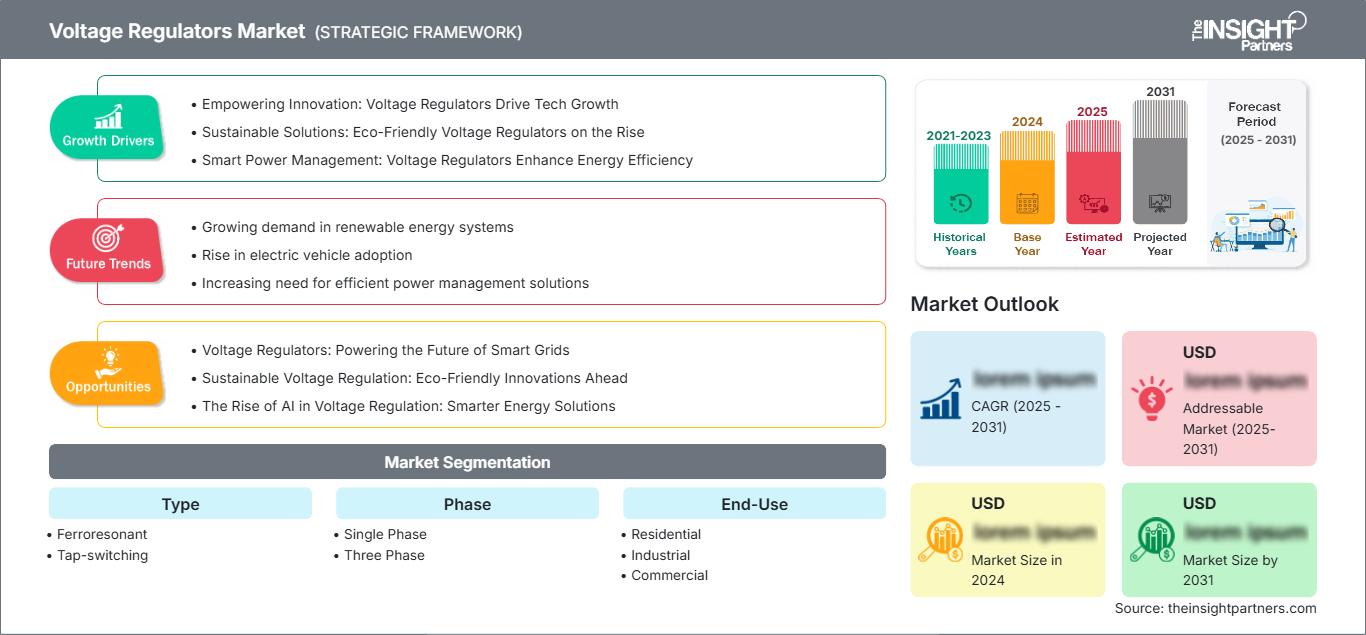
The Type segment is divided into Ferroresonant and Tap-switching. The segment is expected to grow at a CAGR of 8.1%–8.9% during 2026–2034. Ferroresonant equipment remains valued for dependable stabilization, while tap-switching systems offer flexible regulation across utility and industrial networks. Selection depends on load characteristics, voltage variability, maintenance requirements, and integration with protection and monitoring infrastructure.
- Ferroresonant: Ferroresonant regulators retain relevance where stable output, electrical isolation, and tolerance to input fluctuations are priorities. Their rugged operating characteristics support specialized industrial and commercial installations requiring dependable voltage conditioning.
- Tap-switching: Tap-switching systems address variable network conditions through controlled adjustment of transformer ratios. Their suitability for utility and high-load applications supports broad deployment where voltage levels must be continuously managed across changing demand conditions.
Phase
The Phase segment comprises Single Phase and Three Phase and is projected to expand at a CAGR of 8.8%–9.5% during 2026–2034. Three-phase systems are expected to remain dominant because utilities and industrial facilities require balanced regulation across higher loads. Single-phase systems retain importance in residential and smaller commercial applications where lower capacity and simpler installation are advantageous.
- Single Phase: Single-phase equipment serves residential buildings, small commercial premises, and selected equipment loads. Demand is associated with compact installation requirements, localized voltage stabilization, and protection of sensitive household and business electronics.
- Three Phase: Three-phase regulators address higher-capacity electrical networks and are widely applicable to industrial facilities, utility distribution systems, large commercial buildings, and infrastructure projects where balanced voltage control is operationally important.
End-Use
The End-Use segment includes Residential, Industrial, and Commercial and is expected to grow at a CAGR of 8.7%–9.4% through 2034. Industrial applications are positioned as the leading demand center because automated machinery, production lines, motors, and sensitive control systems require dependable electrical conditions. Commercial demand is supported by offices and critical facilities, while residential adoption remains tied to local power-quality conditions.
- Residential: Residential adoption is concentrated in areas exposed to voltage fluctuation and unreliable distribution. Demand is supported by appliances, home electronics, backup systems, and increasing household electrification, although equipment affordability remains a key purchasing consideration.
- Industrial: Industrial installations prioritize continuous operation and protection of high-value equipment. Regulation supports production reliability, reduces disruption caused by voltage variation, and complements automation, motor-driven systems, and digitally controlled manufacturing assets.
- Commercial: Commercial facilities use regulation equipment to support lighting, HVAC, information technology, elevators, and other electrical loads. Demand is strengthened by greater reliance on digital equipment and continuity requirements in offices, retail, hospitality, and institutional buildings.
Opportunity Snapshot
| End Use | Revenue Contribution | Trend Tag | Adoption Stage |
|---|---|---|---|
| Residential | Medium | Home Electronics | Mature |
| Industrial | High | Factory Automation | Scaling |
| Commercial | Medium | Digital Buildings | Scaling |
Voltage Regulators Market Growth Drivers and Impact Analysis
Grid modernization and replacement of aging distribution assets
Utilities, both in developed and developing countries, are replacing their old transformers, feeders, control equipment, and regulation systems to increase their reliability. In situations where an aged distribution system is subjected to increasing loads or reverse loads through distributed generation, the importance of voltage control increases. As such, the replacement process may create a demand for equipment that offers reliable regulation but is also compatible with the existing distribution system. The effects go beyond new investments since, during the replacement process, utilities usually couple their voltage regulation needs with improved monitoring and protection capabilities. Equipment providers that are able to provide suitable replacement equipment can leverage on the existing installed base and maintenance services. Therefore, modernization efforts can be used to create a sustainable demand stream which is independent of the construction cycle.
Expansion of industrial electrification and power-sensitive automation
The current trend in manufacturing is the use of automated lines, adjustable-speed drives, robotic systems, process controls, and connectivity of devices. Such resources may require stable voltages to be supplied to them because it is essential to ensure production continuity and minimize interruptions to the equipment used. The semiconductor manufacturing industry, metals processing, chemical, food, and advanced manufacturing facilities are especially dependent on stable power supplies. As manufacturing companies implement increased levels of automation, the cost of voltage disruptions may increase relative to the cost of voltage regulation devices. It means there is an opportunity to develop more advanced solutions featuring monitoring capabilities. Hence, the growth in investment in manufacturing translates into the growth of the voltage regulators market even at moderate electricity usage increases.
Increasing renewable integration and variable electrical loads
Generation from renewables impacts the operations of distribution systems through the introduction of new forms of power flows that are highly variable and are spread out geographically. Generation from solar and wind sources may have an effect on voltage profiles, especially in situations when generation sources and consumers are physically close to each other or when the capacity of the network is limited. Electric cars, batteries, heat pumps, and data centers represent new types of loads. Devices that regulate electricity may allow distribution system operators to manage voltage profiles as they arise from the combination of these sources and loads. The impact will be highest in cases where distribution systems have to integrate distributed energy sources into their existing networks instead of building new ones.
Voltage Regulators Market Future Trends
Digitally coordinated voltage regulation
The next stage of voltage control is likely to involve greater coordination between regulators, sensors, protection devices, and utility software. Rather than operating as isolated mechanical assets, regulation equipment can increasingly become part of a connected distribution architecture. Digital controllers can use operating information to adjust settings more precisely, while remote diagnostics can identify abnormal conditions before equipment failure. This trend should influence product design, procurement specifications, and service models. Utilities may increasingly evaluate equipment based on data availability and interoperability as well as electrical performance. Manufacturers that develop open communication capabilities and scalable monitoring platforms can position regulation systems as components of broader grid-management strategies. The voltage regulators market trends should consequently experience a gradual shift from standalone equipment toward connected assets capable of supporting predictive maintenance and more responsive network operation.
Regulation solutions designed for high-density electrical loads
Rapid expansion of data centers, semiconductor facilities, advanced manufacturing, and electrified industrial processes is creating concentrated electrical loads with stringent power-quality requirements. Future regulation systems are likely to be engineered around these operating environments, with greater emphasis on response characteristics, thermal performance, redundancy, and integration with power-protection equipment. Data-center development is particularly relevant because operators require resilient electrical infrastructure and increasingly higher power densities. Industrial customers similarly need systems that can tolerate dynamic loads without compromising production. This trend should encourage suppliers to develop application-specific architectures rather than relying solely on standardized products. It also creates opportunities for engineering partnerships involving electrical contractors, utilities, equipment integrators, and facility developers. Over the forecast period, high-density loads should therefore influence both technical specifications and go-to-market strategies across the sector.
Voltage Regulators Market Opportunities
Localized manufacturing and utility-focused supply partnerships
Manufacturers can capture additional value by establishing regional production, service, and engineering capabilities near major utility markets. Localized manufacturing can shorten delivery schedules, simplify replacement projects, and improve responsiveness to country-specific electrical standards. Strategic partnerships with utilities and engineering contractors can also provide earlier access to infrastructure planning and replacement programs. This approach is particularly relevant in North America, India, Southeast Asia, and the Middle East, where infrastructure investment is creating multiple project pipelines. Companies can strengthen positioning by combining equipment supply with commissioning, maintenance, monitoring, and lifecycle services. The opportunity is therefore broader than unit sales. Building regional ecosystems can reduce procurement friction and create recurring service revenue while improving customer confidence in long-duration infrastructure projects. Manufacturers with flexible production platforms are particularly well positioned to serve diverse utility specifications.
Advanced regulation for renewable-rich distribution networks
Renewable integration creates opportunities for regulation products specifically engineered for networks with fluctuating generation and bidirectional power flows. Developers and utilities increasingly require equipment that can operate alongside solar, wind, storage, and distributed generation without compromising voltage quality. Suppliers can address this opportunity through adaptive control, improved sensing, remote configuration, and integration with distribution-management systems. The voltage regulators market forecasts indicate that demand should increasingly reflect network complexity rather than simple electricity-load growth. Manufacturers that collaborate with utilities during pilot projects can develop application data and demonstrate performance under real operating conditions. This can support adoption in additional regions and strengthen competitive differentiation. The opportunity is particularly attractive in countries combining aggressive renewable targets with constrained distribution infrastructure, where regulation upgrades can improve network utilization without requiring immediate replacement of entire electrical systems.
Frequently Asked Questions

- Comprehensive Market Sizing and Forecast Analysis
- Detailed Segmentation Analysis
- In-Depth Market Dynamics Assessment
- Regional and Country-Level Insights
- Competitive Landscape and Company Benchmarking
- Strategic Business Intelligence
Recent Reports
Testimonials

The Insight Partners provided valuable market intelligence that supported our global go-to-market strategy. Their team was professional, responsive, and attentive to our feedback, providing thoughtful analysis and helpful methodological clarifications throughout the project.
Junmo Kim Chief Financial Officer (CFO), Enertech Co., Ltd.
The Insight Partners' SCADA System Market report is comprehensive, with valuable insights on current trends and future forecasts. The team was highly professional, responsive, and supportive throughout. We are very satisfied and highly recommend their services.
RAN KEDEM Partner, Reali Technologies LTDs
I requested a report on a very specific software market and the team produced the report in a few days. The information was very relevant and well presented. I then requested some changes and additions to the report. The team was again very responsive and I got the final report in less than a week.
JEAN-HERVE JENN Chairman, Future Analytica
We worked with The Insight Partners for an important market study and forecast. They gave us clear insights into opportunities and risks, which helped shape our plans. Their research was easy to use and based on solid data. It helped us make smart, confident decisions. We highly recommend them.
PIYUSH NAGPAL Sr. Vice President, High Beam Global
The Insight Partners delivered insightful, well-structured market research with strong domain expertise. Their team was professional and responsive throughout. The user-friendly website made accessing industry reports seamless. We highly recommend them for reliable, high-quality research services
YUKIHIKO ADACHI CEO, Deep Blue, LLC.
This is the first time I have purchased a market report from The Insight Partners.While I was unsure at first, I visited their web site and felt more comfortable to take the risk and purchase a market report.I am completely satisfied with the quality of the report and customer service. I had several questions and comments with the initial report, but after a couple of dialogs over email with their analyst I believe I have a report that I can use as input to our strategic planning process.Thank you so much for taking the extra time and making this a positive experience.I will definitely recommend your service to others and you will be my first call when we need further market data.
JOHN SUZUKI President and Chief Executive Officer, Board Director, BK Technologies
I wish to appreciate your support and the professionalism you displayed in the course of attending to my request for information regarding to infectious disease IVD market in Nigeria. I appreciate your patience, your guidance, and the fact that you were willing to offer a discount, which eventually made it possible for us to close a deal. I look forward to engaging The Insight Partners in the future, all thanks to the impression you have created in me as a result of this first encounter.
DR CHIJIOKE ONYIA MANAGING DIRECTOR, PineCrest Healthcare Ltd.Reason to Buy
- Informed Decision-Making
- Understanding Market Dynamics
- Competitive Analysis
- Identifying Emerging Markets
- Customer Insights
- Market Forecasts
- Risk Mitigation
- Boosting Operational Efficiency
- Strategic Planning
- Investment Justification
- Tracking Industry Innovations
- Aligning with Regulatory Trends





 Get Free Sample for